Saros Beginner Guide: How It Plays and What Carries Over
Saros is a PS5 exclusive from Housemarque, and its pitch is that dying is supposed to be useful. Here is how a run works, what carries over, how the difficulty modifiers work, and what to know before you spend $69.99.

Saros wants you to die, and it says so out loud. Housemarque's own creative director wrote on the PlayStation Blog that "every death is valuable," and the whole structure of the game is built around that sentence. This guide covers how the game works at the systems level, using only what Sony, PlayStation.Blog and the Saros wiki can show. It deliberately has no boss strategies, weapon tier lists or story detail. Those need more first-hand play than the published sources support.
What Saros is
Saros is a single-player action shooter for PlayStation 5, developed by Housemarque in Helsinki and published by Sony Interactive Entertainment. It released on April 30, 2026. It is PS5-only (PlayStation.com states it is not available on PS4), it has an ESRB Teen rating, and it is listed as PS5 Pro Enhanced.
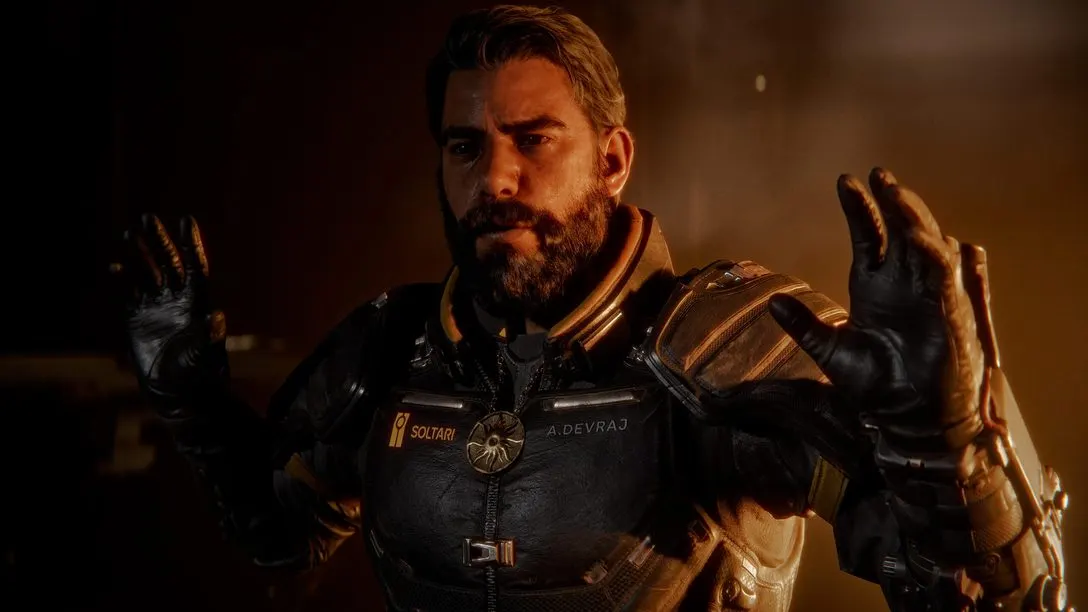
You play Arjun Devraj, a Soltari enforcer voiced by Rahul Kohli, who is sent to the planet Carcosa. Carcosa is a hostile, shape-shifting world, and the Eclipse corrupts it. The crew from Echelon IV that Arjun belongs to is succumbing to the madness the Eclipse brings, so part of the pitch is deciding who can still be trusted. That is as far as this guide goes on story.
How a run works
The unit of play is the attempt, which the PlayStation Blog calls a cycle. You push through Carcosa's biomes, fight hostiles, and eventually die or reach the end of an area. Then you return to a hub and go again.
Two details from Housemarque's own posts matter for a newcomer:
- Weapon variants are generated every cycle. You do not pick a fixed loadout and bring it in. Main weapons and Power weapons come with variations each attempt.
- The world changes between attempts. PlayStation.com says that after every run you face a changed world.
The wiki lists five main weapon families (Handcannon, Rifle, Shotgun, Crossbow and Chakram) and four Power weapons (Prominence, Dispiritor, Nova Lance and Illumine). It says each main weapon comes in three variations that can spawn with up to five modifiers. That list is a community wiki count, not a Sony statement, so treat the exact numbers as the wiki's.
What you keep when you die
This is the part that makes Saros different from a pure roguelike, and it is where the sources are strongest.
| Thing | What the source says | Source |
|---|---|---|
| Permanent progression | Weapons and upgrades can be permanently augmented between runs | PlayStation.com |
| The hub | The Passage is where you track permanent progression and meet an ensemble cast of characters | PlayStation.com |
| Upgrade currency | You spend Lucenite and Halycon, collected during eclipse cycles, to upgrade yourself in the Passage | PlayStation.Blog, Feb 12, 2026 |
| Upgrade menu | Upgrades are applied through the Armor Matrix by Primary, a Soltari AI, covering things like maximum armor integrity, faster Lucenite gain and bigger power capacity for longer shield use | PlayStation.Blog, Feb 12, 2026 |
| Weapons on death | Collected main and Power weapons are kept, so you start the next attempt with them | PlayStation.Blog, Feb 12, 2026 |
| World Dial | Teleports you to any previously unlocked biome, or to the start of your last biome | PlayStation.Blog, Feb 12, 2026 |
| Second Chance | Revives you instantly on your first death; unlocked through Armor Matrix progression | PlayStation.com and PlayStation.Blog |
Two consequences for how you should play. First, a bad run is not a wasted run, because the Passage is where the currency you collected turns into permanent upgrades. Second, the World Dial means you are not forced to replay early biomes from the start every time. Housemarque also says marathon runs, meaning pushing as far as you can without stopping, remain possible if you prefer them.
Second Chance, in plain terms
Second Chance is worth understanding early. PlayStation.com says "you'll be revived instantly on your first death." The PlayStation Blog adds that it is not available from the start: it is one of the key additions you unlock as you progress through the Armor Matrix. It can also be removed on purpose, which is covered under the modifiers below.
Combat: dodge, shield, parry
PlayStation.com describes the combat as centred on dodging, shielding and parrying enemy attacks while learning enemy attack patterns. The game also has boss fights; the PlayStation Blog names the bosses as the Overlords of Carcosa.
The wiki documents six Permanent Equipment items that you unlock by progressing: Jump Network, Grapple, Overdrive, Parry, Eclipse Thread and Blazing Strike. Two are worth knowing by name as a beginner:
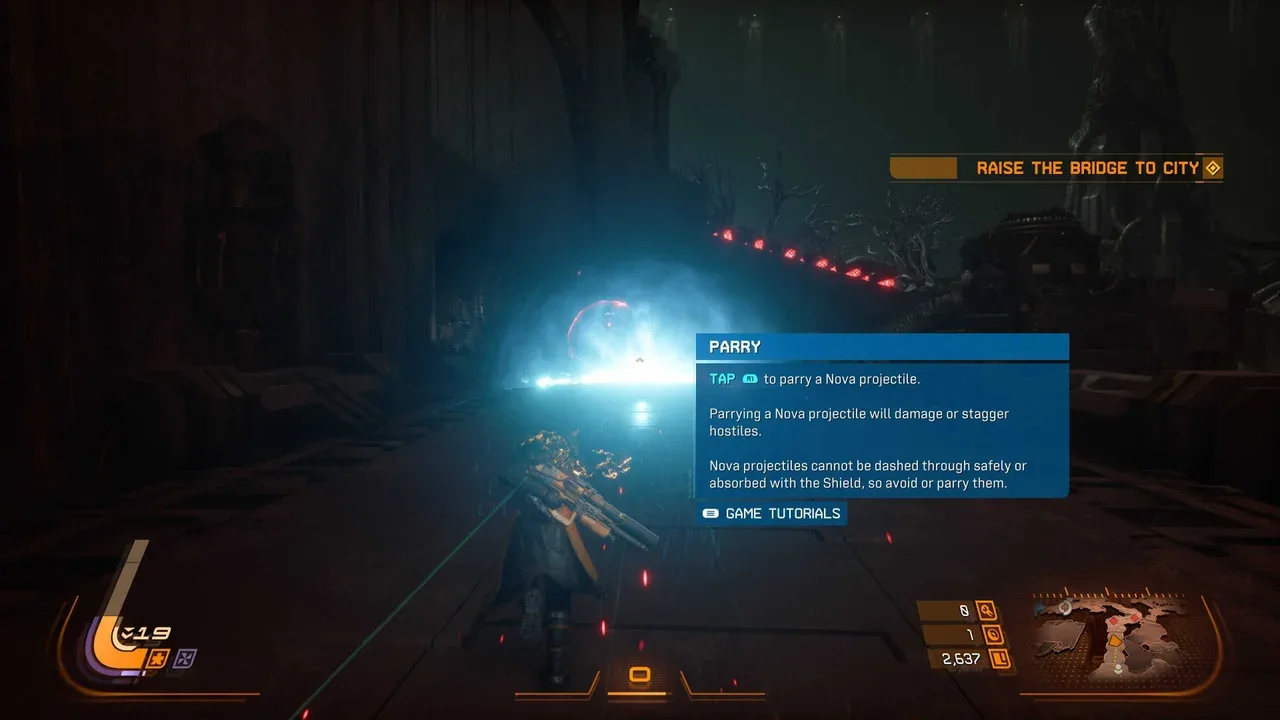
- Parry. The wiki describes it as the fourth Permanent Equipment item. The in-game tutorial text, visible in the screenshot below, says parrying a Nova projectile will damage or stagger hostiles, and that Nova projectiles cannot be dashed through safely or absorbed with the Shield, so you have to avoid or parry them.
- Overdrive. The wiki says it briefly slows time so you can change targets before firing a single high-damage projectile, and lists R3 plus L3 as the input. This comes from the community wiki, so check it against the in-game prompt.
PlayStation.com also says you feel the corrupting experience of Carcosa through the DualSense controller's adaptive triggers and haptic feedback.
Carcosan Modifiers: choosing your difficulty
Saros has no fixed difficulty ladder in the sources reviewed here. Instead it uses Carcosan Modifiers, which Housemarque describes as letting you lower or raise the challenge. They come in two families, and the PlayStation Blog says you pick your own combinations, with the note that "Protections and Trials must be kept in balance to ensure a consistent challenge level."
| Family | Effect | Examples named by Housemarque |
|---|---|---|
| Protection Modifiers | Make the game easier | Reduced incoming damage, faster reloading, longer shield duration, Damage Enhancement, Shield Power Enhancement, Overlord Restoration (full armor integrity when you face the Overlords) |
| Trial Modifiers | Make the game harder | More aggressive hostiles, weapon power that degrades over time (Weapon Decay), Hostile Death Projectiles, Growth Incapacitor I (removes Second Chance), Growth Incapacitor II (removes all Armor Matrix enhancements) |
For a first playthrough the practical read is simple: the modifiers exist so you can tune the game, and Housemarque presents the easier family as a legitimate option rather than a penalty. The source posts do not publish a recommended starting loadout of modifiers, so this guide will not invent one.
The Eclipse
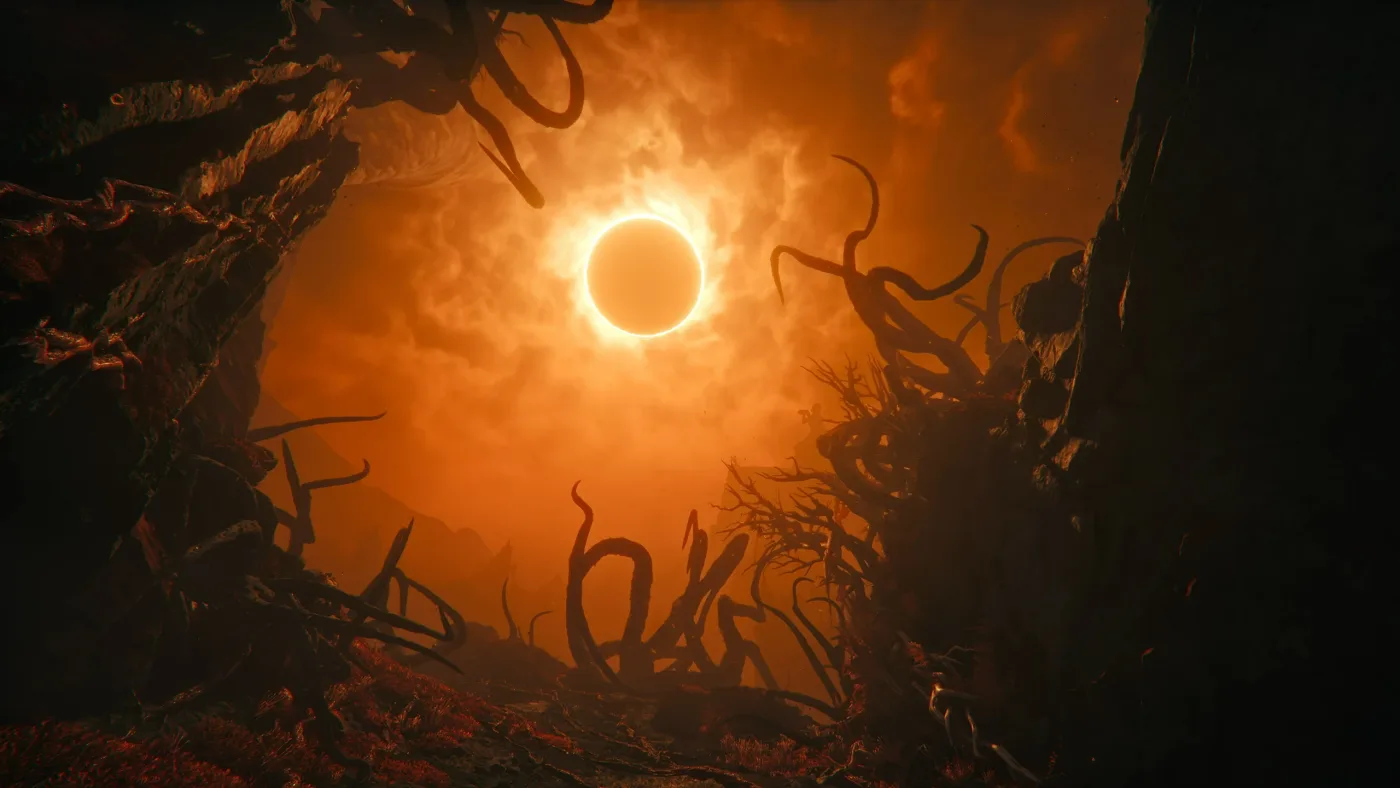
The Eclipse is the force driving Carcosa's corruption. Per the PlayStation Blog, it corrupts weapons, artifacts, the world and minds, and "with every attempt it adds corruption to Carcosa." Concrete effects Housemarque has described:
- It changes biome properties. In the Blighted Marsh, the water comes alive and burns you while the Eclipse is active.
- Hostiles fire yellow corrupted projectiles that lower your maximum armor integrity. You can cleanse that effect with your Power weapon.
- It corrupts the soundtrack, which is by composer Sam Slater.
The wiki also notes that Carcosa has eight listed biomes (Shattered Rise, Ancient Depths, Shattered Descent, Blighted Marsh, Desecrated Fortress, Acolyte's Haven, Nightmare Strand and Cathedral). The wiki marks that page as a stub, so it may be incomplete or out of order.
Zenith and accessibility
PlayStation.com lists SAROS: Zenith as a free update for all players. It names three things:
- Overlord Rush: a back-to-back, arcade-style mode against Overlord enemies, with online leaderboards.
- Eclipse Layers: a New Game+ style mode with Carcosan Modifiers, plus new secrets and trophies.
- Accessibility additions: high-contrast visuals, motion-controlled aiming with the DualSense, and a toggleable Slow Game Speed.
Before launch, Housemarque said it would support colour blindness features so players can tell Normal, Corrupted and Nova projectiles apart, and that a Dialogue focus mode and controller remapping were planned, with more details to come. That April 23 post is a pre-launch promise, so check the in-game accessibility menu for what actually shipped.
Price, editions and the trial
PlayStation.com lists these prices at the time of writing:
| Edition | Price | Notes |
|---|---|---|
| Standard Edition | $69.99 | |
| Digital Deluxe Edition | $59.99, down from $79.99 | Listed as ending 11/21/2026 07:59 AM UTC; adds three cosmetic armor sets for Arjun inspired by Returnal, God of War and Ghost of Yotei |
| Digital Deluxe Edition Upgrade add-on | $10.00 | Listed on PlayStation.com as an add-on pack |
A 2.5-hour game trial is available with PlayStation Plus Premium. If you are unsure whether the loop suits you, that is a cheap way to find out. Prices and sale dates change, so confirm on the PlayStation Store before buying.
What this guide leaves out
Saros released on April 30, 2026, and the confirmed public material is still mostly publisher posts plus a partly-filled community wiki. I have intentionally left out boss tactics, a best-weapon ranking, biome routes and any story spoilers. Where a fact comes from the wiki rather than Sony or Housemarque, the text says so. If you have played it and a detail here differs from what you see in-game, the in-game text wins.
Frequently Asked Questions
Is Saros a roguelike?
What is Second Chance in Saros?
Is Saros on PS4 or PC?
Does Saros have difficulty settings?
Is there a Saros demo?
What does the Zenith update add to Saros?
Keep Reading
- PlayStation.com - SAROS (platform, editions, Zenith, gameplay overview)
- PlayStation.Blog - Saros: eclipse escalation gameplay revealed, customization options detailed (Feb 12, 2026)
- PlayStation.Blog - Saros: gameplay modifiers, accessibility options, and more detailed (Apr 23, 2026)
- Saros Wiki - Weapon, Permanent Equipment and Biomes pages (community-edited)