The MagicCon Prize Wall, Explained: How I Ended Up With an Oversized Prismari, the Inspiration
The prize wall is an arcade ticket counter with a Magic skin on it, and Wizards publishes more of the numbers than most people realise: the tier prices, the event payouts, and the exact rate an unused voucher converts at. Here is the whole economy laid out, plus why a 7/7 Elder Dragon is the right thing to hang on a wall.
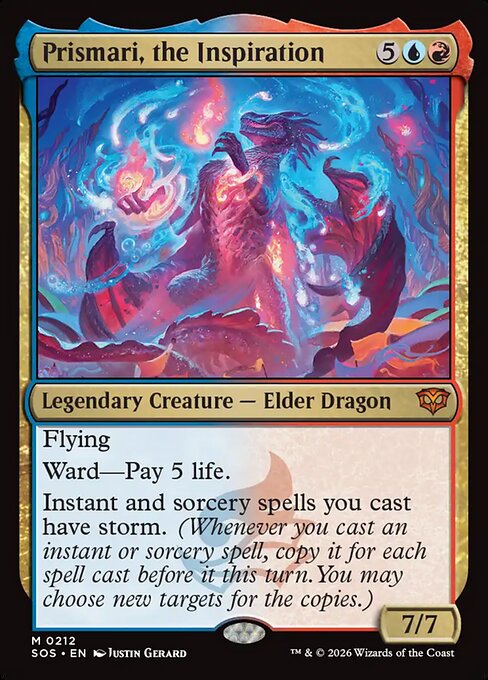
Somewhere in my house there is now a Magic card too large to fit in any sleeve ever manufactured, depicting a dragon I cannot cast because it is roughly the size of a coffee table.
At MagicCon I drafted Prismari in every match but one and won about 75% of my matches. The oversized card on the prize wall was Prismari, the Inspiration. So I redeemed for it, because when the universe hands you a joke that clean you do not argue with it.
What I want to write about is the machine behind that wall, because it is one of the few parts of a convention where Wizards publishes real numbers and almost nobody reads them. For the show itself, see our MagicCon Las Vegas 2026 recap; for what I was doing at the draft tables, the full Prismari breakdown is here.
The prize wall is an arcade counter
The official MagicCon Las Vegas page does not dress this up, which I respect. It opens by asking whether you have ever traded arcade tickets for something on your way out and then says "That is exactly what the Prize Wall is".
The mechanics, straight off that page:
- Prize Tix are awarded for participating in scheduled and on-demand Magic Ticketed Play events. Not for buying things, not for badge tier. Every event's Tix payout is printed in its own description.
- The wall lives inside the Magic Ticketed Play Area. Vegas hours were Friday and Saturday 10:00 a.m. to 11:59 p.m., Sunday 10:00 a.m. to 6:00 p.m., with a hard requirement to be in line by 5:30 p.m. on Sunday.
- Tix have no cash value and expire with the show. Only valid for the MagicCon that issued them. There is no Amsterdam savings account.
- Everything is "subject to change" and allocated by availability. That disclaimer is doing real work, and I will come back to it.
A closed-loop currency with a hard expiry is not a criticism here. It is the cleanest incentive design at the show: it converts "I have four hours and no plan" into "I am going to go play Magic with strangers."
What a Prize Tix is actually worth
Here is the number that unlocks the whole economy, and it is buried in the small print at the bottom of the On-Demand Events page rather than on the prize wall page: unredeemed On-Demand vouchers can be redeemed at the prize wall at 500 Prize Tix per $5.
On-Demand vouchers cost $5 each. So Wizards has published an exchange rate: 100 Prize Tix to the dollar, guaranteed, no games played. That is the floor. Every Tix you win by playing is worth measuring against it.
Now run the published Vegas redemption tiers through that rate:
| Prize wall item | Starting cost | Voucher-equivalent |
|---|---|---|
| Play Booster | 500 Tix | $5 |
| Collector Booster | 2,500 Tix | $25 |
| Commander precon | 5,000 Tix | $50 |
| Bundle | 6,000 Tix | $60 |
| 12" x 17" "Jumbo" card | 20,000 Tix | $200 |
| 23" x 32" "Oversized" card | 40,000 Tix | $400 |
| Uncut sheet | 50,000 Tix | $500 |
A Play Booster at 500 Tix is exactly one $5 voucher. That is not an accident — it is the anchor the entire wall is priced against, and it tells you Wizards set the rate deliberately rather than pulling arcade numbers out of the air.
It also tells you what the big cards are for. At 400 Tix for a Swiss-draft match loss, the 40,000-Tix tier is a hundred losses' worth of showing up. The large-format tiers are not participation trophies — they are chase items with a grind attached, priced two orders of magnitude above a booster.
The math on earning forty thousand of them
The On-Demand Events page lists every payout, so you can actually do this arithmetic before you buy a single voucher. A few of the Vegas lines:
- 8-player Secrets of Strixhaven Swiss draft. Entry six vouchers ($30). Three Swiss rounds. 1,200 Tix for a win, 400 for a loss.
- 8-player Secrets of Strixhaven single-elimination draft. Same $30 entry. 8,000 Tix for first, 4,000 for second, 2,000 for third and fourth, 1,000 for fifth through eighth.
- 4-player competitive Commander pod. Entry four vouchers ($20). 5,000 Tix for the win, 600 for a loss.
Sit with the Swiss draft for a second. Six vouchers you never spend convert to 3,000 Tix. Six vouchers spent on a Swiss draft return 3,600 Tix if you win out, 1,200 if you lose out. Push a 75% match win rate through three rounds and you expect 2.25 wins and 0.75 losses — 2,700 plus 300, or 3,000 Tix. Identical to not playing at all.
That is arithmetic on published numbers and a stated win rate, not a claim about what anybody's weekend actually paid. But the shape is real: the Swiss draft is roughly Tix-neutral even when you are running hot, and what you are really getting paid in is cards. Three Play Boosters' worth of picks for $30 is the product. The Tix are a rebate.
The Tix engines are elsewhere. Single-elimination drafts pay 8,000 for a first place off a $30 entry — nearly triple the voucher value, with the variance you would expect. Competitive Commander pods pay 5,000 off $20, the best posted rate on the board if you can win a four-player pod in one 90-minute round.
None of which makes grinding the wall good value. You are paying convention prices for a novelty, and I am not going to pretend the object at the end is the efficient part.
What I am not going to tell you
I am not going to tell you what mine cost.
The wall lists two large-format tiers — a 12" x 17" Jumbo starting at 20,000 Tix and a 23" x 32" Oversized starting at 40,000 — and the operative words are starting at. Per-item pricing lives on the physical wall at the show, moves with stock, and is explicitly subject to change. I did not write my number down, so stating one now would be making it up, and there is enough of that in convention coverage already.
If you find a post that confidently quotes you an exact Tix price for a specific prize wall card at a specific MagicCon, check whether they are citing the wall or citing a vibe.
Magic has printed oversized cards since 1995
The prize wall did not invent the giant card. Magic has been making them for three decades, and they split cleanly into two families.
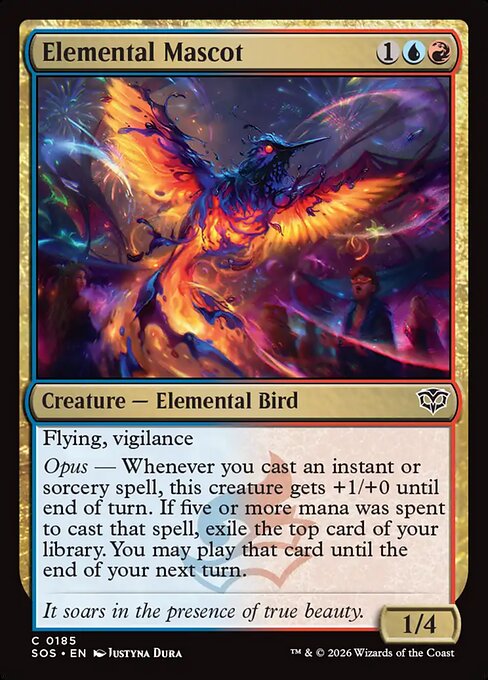
Elemental Mascot, the Prismari common that quietly does the archetype's job. Card image via Scryfall; card art and design (c) Wizards of the Coast.
The ones that actually do something
Vanguard, 1997. Thirty-two oversized character cards at roughly 3.5" x 5", set aside before the game starts, altering your maximum hand size and starting life total and handing you an ability for the whole match. Planechase, 2009: forty plane cards on the same footprint, sitting outside the game and rewriting the rules for everyone at the table. Archenemy, 2010: forty-five scheme cards on the same principle.
Commander, 2011 onward. The 2011 and 2013 decks each shipped three oversized cards; Commander 2014 cut it back to just the planeswalker; the line ran until display commanders replaced them with Commander 2021. Those were status markers — the thing you put in front of you so the table knows which card is the commander.
The common thread: every one exists outside the deck. The Magic Tournament Rules define an Authorized Game Card as a genuine Wizards printing with a standard Magic back, which is why nontraditional cards get carved out per-format instead. If it does not shuffle, it can be any size you like.
The ones that are furniture
Then there is everything else, and this is the family the prize wall card belongs to.
Scryfall catalogues a set literally named Oversized 90's Promos: ten cards printed between 1995 and 1999, including a Douglas Shuler Serra Angel and a Hurloon Minotaur from August 1995, Mark Tedin's Chaos Orb from April 1996, Christopher Rush's Black Lotus from July 1996 and Juzám Djinn that September. There is also an Oversized League Prizes set of eighty-three cards dated 1997.
Most of the 6" x 9" cards went out through the Arena League between 1997 and 1999, awarded for top placements each season plus a participation card at the start of one, and were discontinued after the Radiant 1999 season because interest fell off. A separate 9" x 12" format existed purely as store advertising — Sixth Edition's Raging Goblin, Nemesis' Ascendant Evincar and Rhox — punched with holes so shops could hang them up.
There is a units joke in here I enjoy more than I should. That 9" x 12" store display measures about 23 x 32 centimetres. The prize wall's top tier is 23 x 32 inches. Same digits, thirty years apart.
The point of the furniture family has never changed: it is a trophy in the shape of a card. You cannot play it, nobody pretends you can, and its job is to make a wall look like somebody won something.
Why Prismari, the Inspiration belongs on a wall
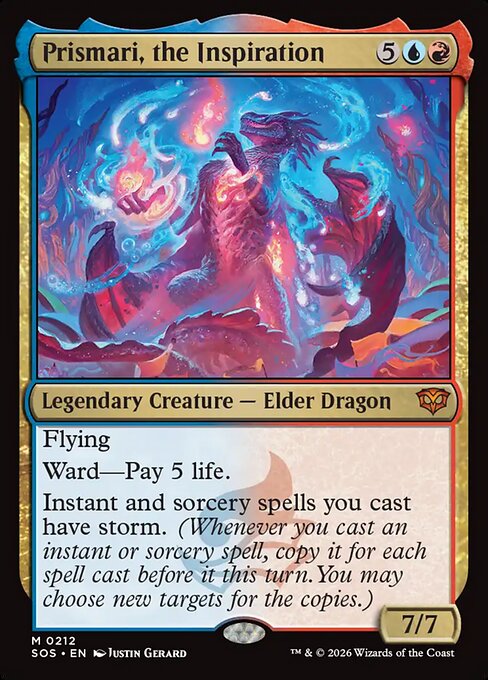
Straight off Scryfall, so nobody has to take my memory for it. Prismari, the Inspiration is {5}{U}{R} — seven mana — a mythic Legendary Creature — Elder Dragon, 7/7, Secrets of Strixhaven collector number 212, art by Justin Gerard, released 24 April 2026. It has flying, Ward—Pay 5 life, and this: instant and sorcery spells you cast have storm.
Storm. Not one copy. Not a rebate. Every instant and sorcery you cast copies itself for each spell cast before it that turn, for the rest of the game.
That is the correct thesis statement for Prismari specifically, and it is why the card works as a centrepiece rather than just as a big rare. Prismari's mechanic in this set is Opus, which triggers whenever you cast an instant or sorcery and pays out something bigger if five or more mana went into that spell. Elemental Mascot, a common, gets +1/+0 and — on a five-plus-mana spell — exiles the top card of your library for you to play through your next turn. Spectacular Skywhale gets +3/+0, or three permanent +1/+1 counters on the big spells instead.
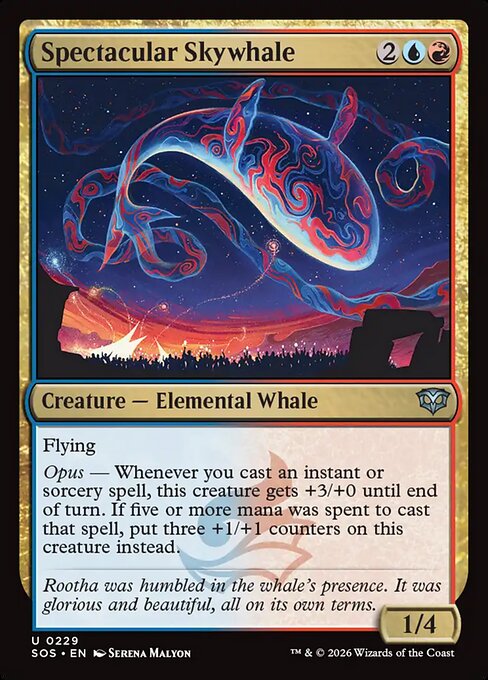
Spectacular Skywhale splits its Opus payoff between a temporary swing and a permanent one. Card image via Scryfall; card art and design (c) Wizards of the Coast.
Every Opus card teaches one lesson at increasing volume: stop trimming your expensive spells, the deck is built to reward them. The Elder Dragon is that lesson with the volume knob snapped off — seven mana, and the payoff is that the curve stops being a constraint at all.
The art earns the wall too. Gerard's dragon rears inside a storm of blue water ribbons and magenta flame shot through with glowing pink orbs: Prismari's two colours doing the thing Prismari is about, which is making a scene. Blown up to poster size, that reads across a room in a way a tidy blue counterspell never would.
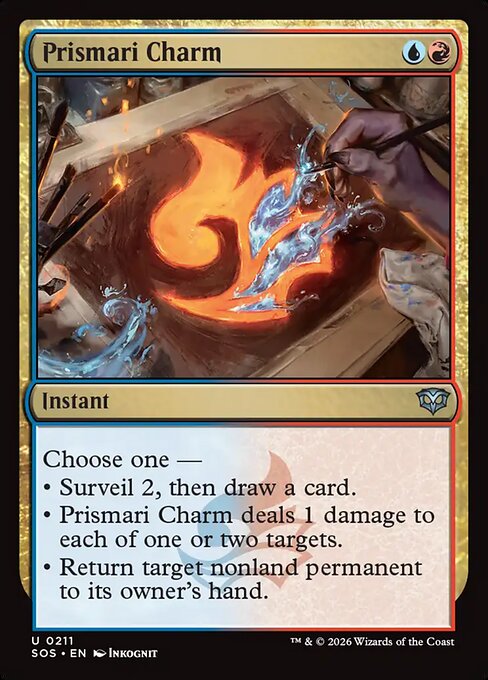
Prismari Charm — surveil 2 and draw, one damage split across one or two targets, or a bounce. The college in miniature. Card image via Scryfall; card art and design (c) Wizards of the Coast.
Scryfall has no separate oversized printing on record for the dragon, incidentally, which is normal — prize wall large-format cards generally do not get their own set entry the way Commander display commanders do. The catalogued printings are the mythic at 212, the inverted-frame version at 285, a stamped promo pack version and an Art Series card.
If you are chasing one
Practical, all of it sourced from the official pages rather than from me:
- Look at the wall on Friday, before you plan anything. Posted tier prices are starting points and stock is allocated by availability. Deciding on Sunday morning what you are grinding toward is how you end up with 38,000 Tix and nothing you want.
- Vouchers are the safety net. Sold in $5 increments, up to $100 per visit, and anything unspent converts at 500 Tix per $5. You cannot really over-buy, only over-commit.
- Single-elimination events are the Tix engine. Swiss is where you go for cards; single-elim is where you go for the wall.
- Watch the Sunday cutoff. In line by 5:30 p.m. Tix die with the show and there is no appeal.
- Decide whether you want the card or the story. Forty thousand Tix is $400 of vouchers at the published rate. "The story" is a fine answer — it just should not be an accident.
Mine was an accident of the good kind. I went in to draft blue-red and came out with the largest possible blue-red card. There are worse ways to spend a convention.
Frequently Asked Questions
How does the MagicCon prize wall work?
How much do prize wall items cost in Prize Tix?
What is a Prize Tix worth in real money?
Do Prize Tix carry over to the next MagicCon?
Which events pay the most Prize Tix?
Are oversized Magic cards legal to play with?
How long has Magic printed oversized cards?
What does Prismari, the Inspiration do?
What is Opus in Secrets of Strixhaven?
Keep Reading
- MagicCon: Las Vegas — Prizes, Prize Tix & Prize Wall (how Tix are earned, wall hours and location, published redemption tiers, no-cash-value and expiry rules)
- MagicCon: Las Vegas — On-Demand Events (voucher pricing, per-event Prize Tix payouts, the 500 Tix per $5 unredeemed-voucher rate)
- MTG Festivals — Prizes, Prize Tixs, & the Prize Wall! (the general MagicCon prize wall explainer)
- Scryfall — Prismari, the Inspiration (Secrets of Strixhaven #212, mana cost, Oracle text, artist, release date)
- Scryfall — Elemental Mascot (Secrets of Strixhaven #185, Opus Oracle text)
- Scryfall — Spectacular Skywhale (Secrets of Strixhaven #229, Opus Oracle text)
- Scryfall — Prismari Charm (Secrets of Strixhaven #211, Oracle text)
- Scryfall — Oversized 90's Promos set data (10 cards, 1995 to 1999)
- Scryfall — Oversized League Prizes set data (83 cards, 1997)
- Scryfall — Vanguard Series set data (32 cards, 1997)
- MTG Wiki — Promotional card, Oversized cards section (6x9 Arena League prizes 1997-1999, 9x12 store advertising cards, Vanguard, Planechase, Commander oversized cards)
- Magic Tournament Rules 3.3 — Authorized Cards (standard Magic back requirement, nontraditional cards in formats that use them)
Related Guides
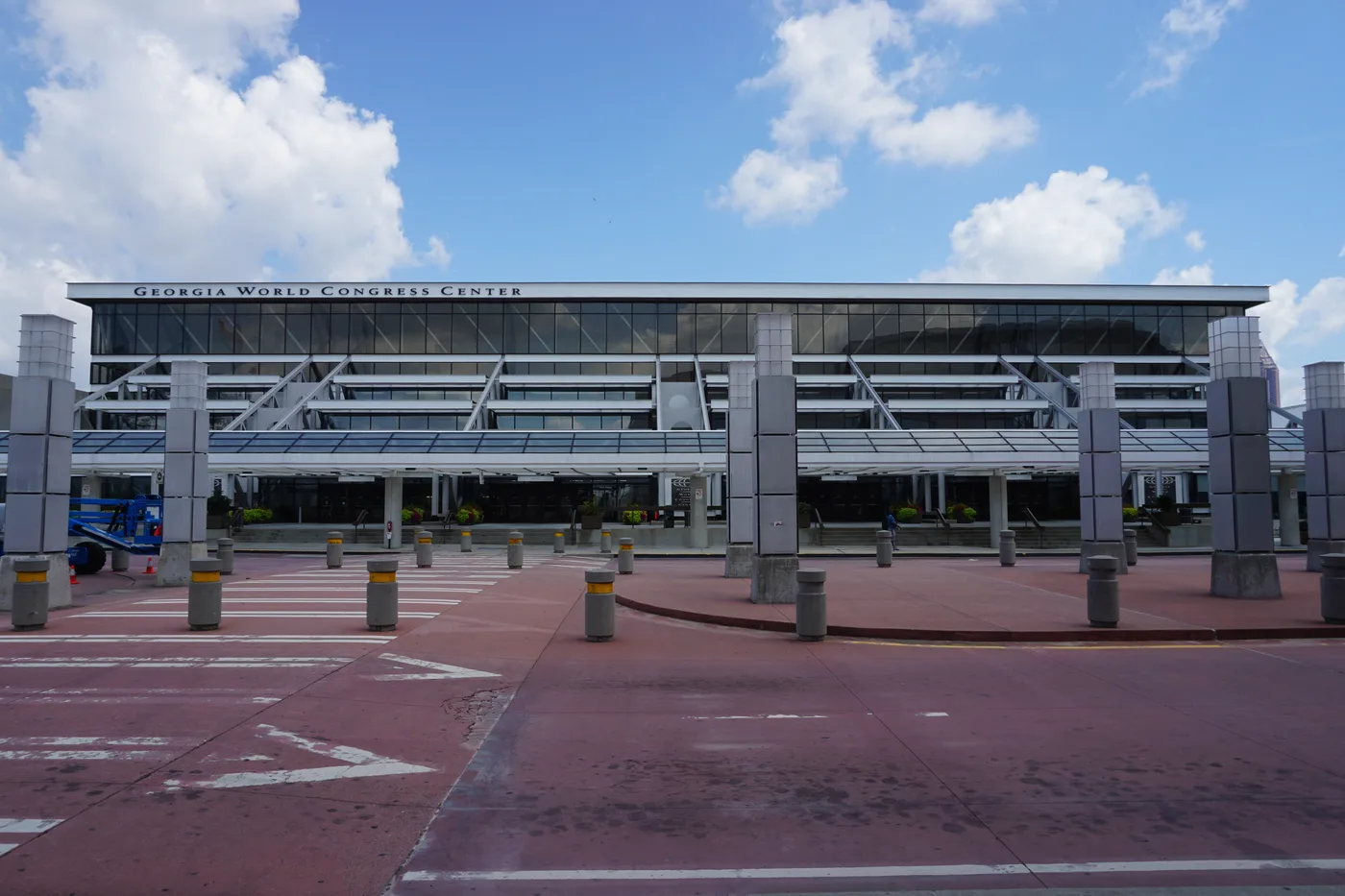
MagicCon Atlanta 2026: Worlds 32, Badges, Deadlines
The last MagicCon of 2026 is the one the whole competitive year lands on: World Championship 32, a $1,000,000 prize pool, and three rounds of Booster Draft in a set that reaches retail the same morning the doors open. Badge tiers, show hours, application deadlines you can still hit, and an honest list of what Wizards has not published yet.
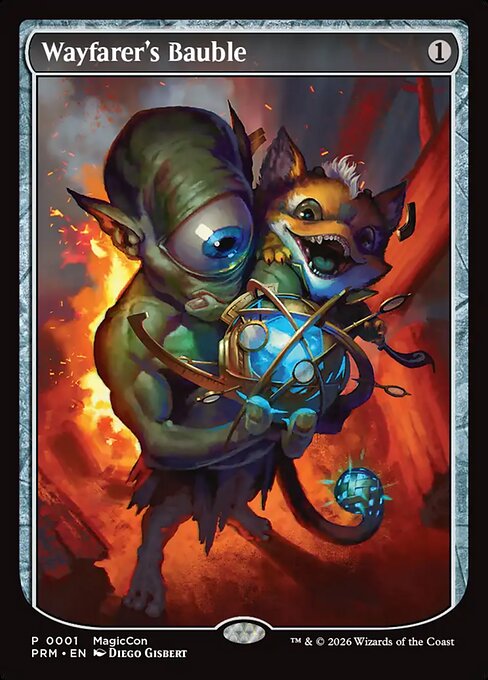
Drafting Prismari at MagicCon: I Forced One Archetype in Every Match but One
At MagicCon I drafted Prismari in every match but one and won about 75% of my matches. That is a small sample and I will say so up front — but the reason it held up is structural, not lucky. Secrets of Strixhaven put the U/R payoffs at common, and the Opus mechanic pays you for the expensive spells every other Limited deck is trying to cut. Here is the archetype, card by card, straight off Scryfall.
MagicCon Las Vegas 2026 Recap: Three Set Reveals, a $500,000 Pro Tour, and a Whole New Game
MagicCon Las Vegas ran May 1 to 3, 2026 at the Las Vegas Convention Center. Wizards used the Friday Preview Panel to put three unreleased sets on stage, ran a 200-plus-player Pro Tour on a format that was seven days old, and handed a full-art promo to every badge that walked in. Here is the sourced version.
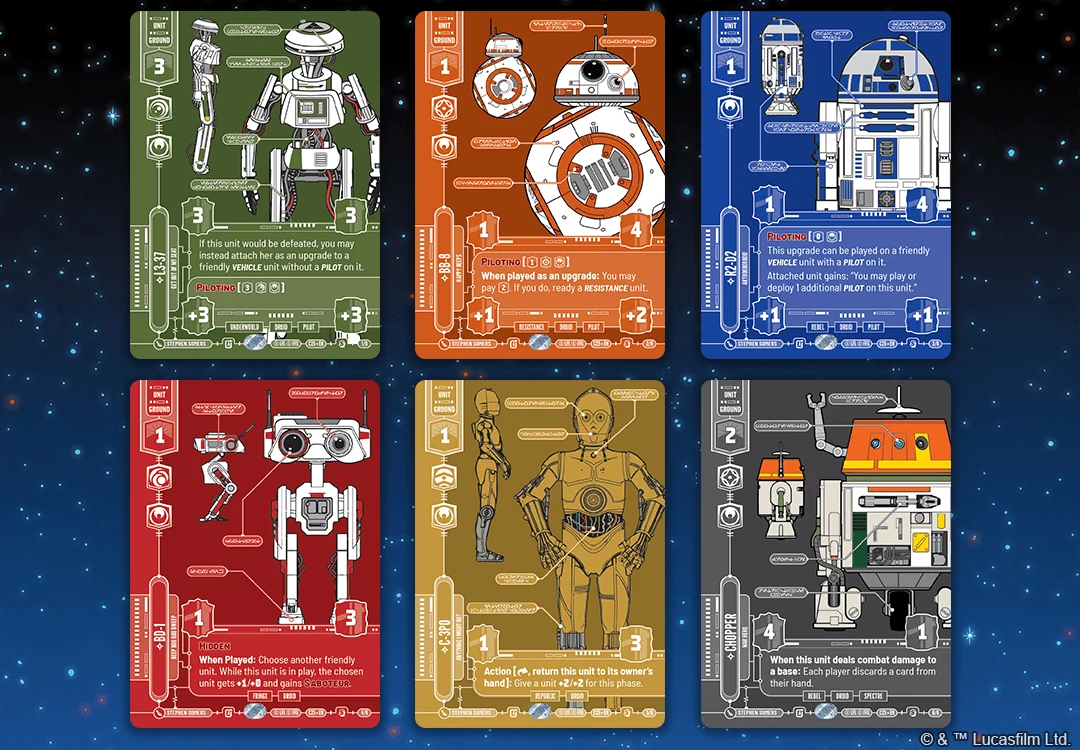
The Gen Con 2025 Exclusives, One Year On: One Lasted 12 Days, One Is Still Touring
Four publishers ran four completely different exclusive strategies at Gen Con 2025, and a year later you can grade every one of them. One product hit general retail twelve days after the show closed. One pack was already sitting in the publisher's own web store. One is on a twenty-five-stop world tour. And one still only exists if you were standing at a specific booth in Indianapolis last August.
Gen Con: What to Know Before You Go (2026 Numbers, Evergreen Advice)
Badges, the event catalog, the wish list, the two-hour cart, and generic tickets — plus a category-by-category count of what actually sold out at Gen Con 2026, pulled from the public event database. Written to still be useful next year.

Lucca Comics & Games 2026: Tickets, Wristbands and Games
Lucca Comics & Games 2026, the festival's 60th-anniversary edition, runs October 28 to November 1 across the walled city of Lucca. A ticket on its own gets you into nothing paid: you also need that day's coloured wristband, and the option that posts it to you ends at 10:00 Italian time on Friday, October 16. Here is what every ticket and pass costs, where the welcome desks are, how the free Pikachu card works, and the video game and card game programme, with times.