Best Graveyard Hate Cards in MTG Commander, Ranked
Every Commander pod has a reanimator deck, an aristocrats deck, and a guy whose commander says "return target creature card from your graveyard." Here is the best graveyard hate in the format, ranked — and the timing rules that separate a blowout from a wasted card.
Count the decks at your next pod. Odds are one of them reanimates something enormous, one of them loops a creature through a sacrifice outlet, one of them casts the same instant four times with flashback and escape, and at least one commander in the command zone has the words "from your graveyard" printed on it. Now count how many cards in your deck do anything about that. If the answer is zero, you are not playing a fair game against those decks — you are watching them play theirs.
Graveyard hate is the cheapest interaction in Magic and the most consistently under-slotted. A land that costs you nothing, a one-mana artifact, a two-mana enchantment: these are the cards that turn a turn-six reanimated Griselbrand into a dead draw step. Every card below is checked against Scryfall for cost, oracle text, and current Commander legality.
The graveyard is the second battlefield
Here is the structural thing that Commander does to graveyards that 60-card formats do not. In a singleton 100-card deck, every card in your yard is a unique resource. There is exactly one Cyclonic Rift, one Craterhoof, one Rhystic Study. When a reanimator deck puts a fatty in the bin, that graveyard is not "a pile of cards" — it is a curated stack of the best card in the deck, and putting it back on the battlefield costs far less than casting it.
That asymmetry is why the format's most efficient decks all route through the yard:
- Reanimator discards a 12-drop on turn two and pays {B} to put it into play. See our reanimation spells breakdown for how cheap that actually gets.
- Aristocrats loops the same creature between the battlefield and the graveyard for value, over and over.
- Recursion value decks — Meren, Muldrotha, Karador — treat the graveyard as a second hand they refill for free every turn.
- Delirium, threshold, escape, flashback, and delve all quietly price their cards assuming the yard fills up.
Blowing that up costs one card. Killing the same creature four separate times costs four cards. That trade is the entire argument.
One-shot hate vs continuous hate
There are two kinds and they do completely different jobs. Confusing them is how people end up with a hand full of Tormod's Crypts against a deck that never actually cared.
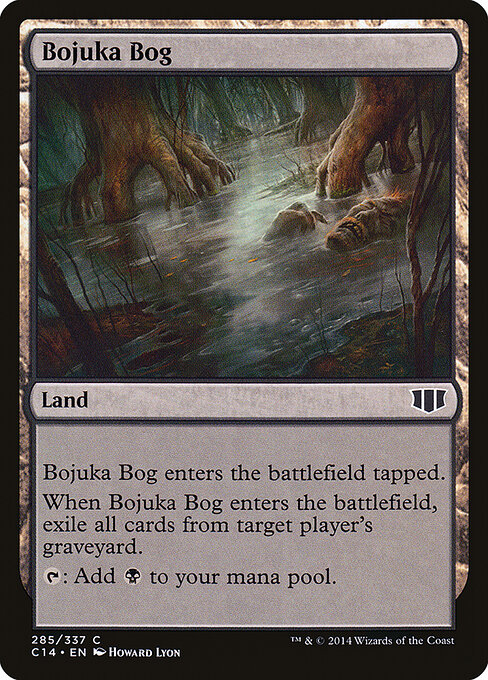
One-shot hate exiles a graveyard once and stops. Bojuka Bog, Tormod's Crypt, Nihil Spellbomb, Relic of Progenitus. These are surgical. They answer a specific graveyard at a specific moment — in response to the reanimation spell, with the trigger on the stack. Used correctly they are a hard counterspell that also happens to be a land or a zero-mana artifact. Used incorrectly, on turn three because the yard "looked scary," they do nothing and the deck rebuilds by turn five.
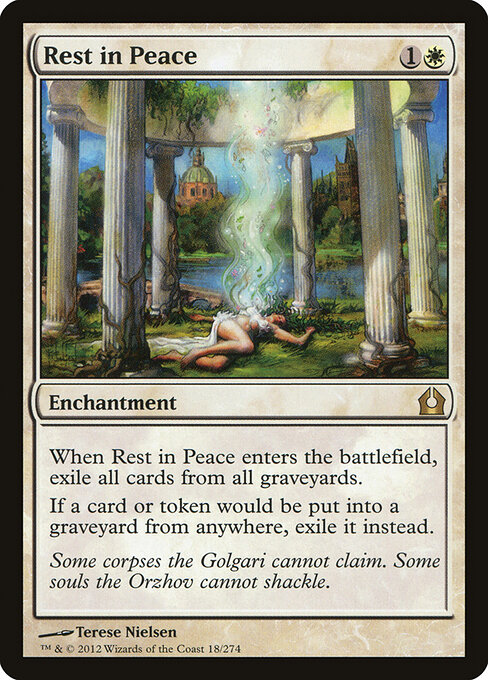
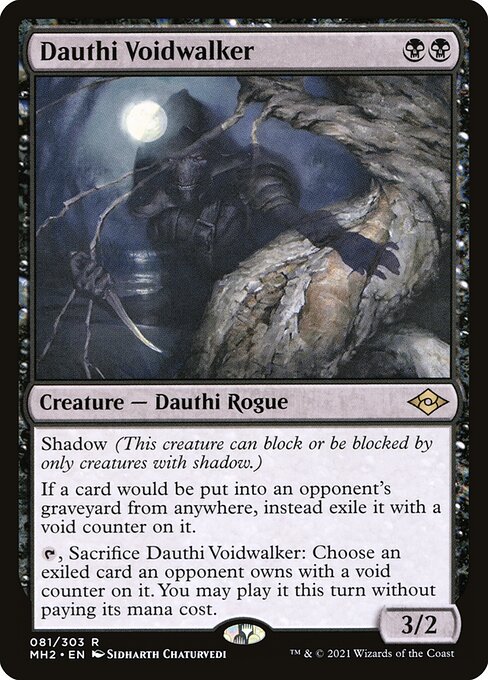
Continuous hate shuts the zone off permanently. Rest in Peace, Leyline of the Void, Dauthi Voidwalker, Grafdigger's Cage. These do not need timing. They need to resolve and stick, and they announce to the table that you are the problem. Continuous hate beats decks whose whole plan is the graveyard; one-shot hate beats a single haymaker.
The rule of thumb: play one-shot hate when your meta has one or two graveyard payoffs, and continuous hate when your meta has four. Most pods are the former, which is why the cheap incidental stuff outranks the nuclear options below.
The best graveyard hate cards, ranked
Ranked on cost to include, how little the card asks of your deck, and how completely it answers the problem.
- Bojuka Bog — a land. It enters tapped, exiles target player's graveyard when it enters, and taps for {B}. That is the whole card and it is absurd: you pay zero cards and zero mana for a Nihil Spellbomb stapled to a Swamp. Every black deck in Commander should run it and most already do without thinking of it as interaction. The only cost is entering tapped.
- Rest in Peace — {1}{W}. Exiles all graveyards on entry, then exiles every card that would ever hit a graveyard afterward. This is the hardest continuous answer in the format: no yard, no flashback, no escape, no delve, no delirium, no dredge, nothing. It is fully symmetrical, so it belongs in decks that do not care — enchantress, blink, artifacts, stax — and nowhere near a deck that likes its own graveyard.
- Dauthi Voidwalker — {B}{B}. A 3/2 with shadow, which means it can only be blocked by other shadow creatures and nobody at your table is running any. It replaces every card going to an opponent's graveyard with an exile plus a void counter. Then it can sacrifice itself to cast one of those exiled cards for free. One-sided hate, a real clock, and a Bribery-on-a-stick finish. The catch is obvious: it is a 2-power creature and everyone at the table owns removal.
- Leyline of the Void — {2}{B}{B}. Same replacement effect as Voidwalker but on an enchantment, hitting all opponents at once. The headline is the leyline clause: if it is in your opening hand you may start the game with it on the battlefield, which means it can be online before anyone's first land drop. Four mana off the top is clunky; free on turn zero is a format-warping opener.
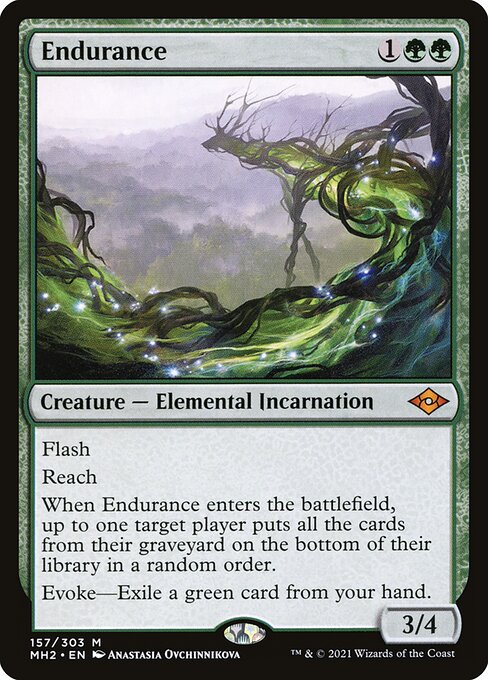
- Endurance — {1}{G}{G}. Flash, reach, 3/4, and on entry up to one target player shuffles their graveyard into the bottom of their library in a random order. The evoke cost is what puts it here: exile a green card from your hand and you cast it for free, at instant speed, in response to the reanimation spell. It bottoms rather than exiles, so it is a reset, not a lock — but a free answer that also leaves a 3/4 blocker when hard-cast is one of the best interaction cards green has ever printed.
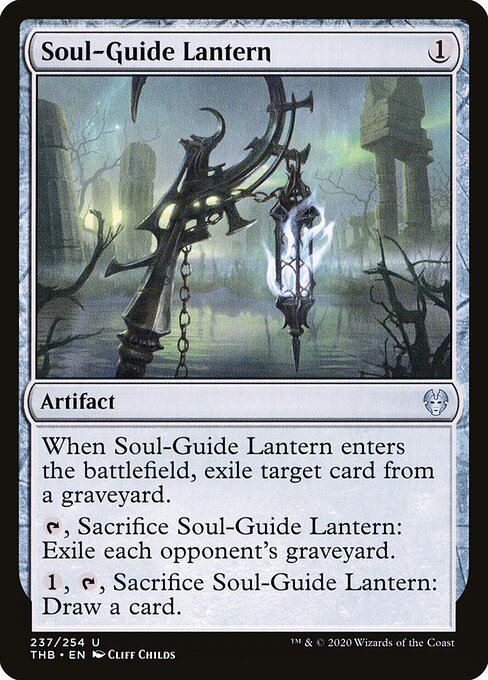
- Soul-Guide Lantern — {1}. The best one-shot artifact because it never rots in your hand. It exiles a single card from a graveyard on entry (kill the one reanimation target), then taps and sacrifices to exile each opponent's entire graveyard, and if nobody ever plays a graveyard deck you pay {1} and draw a card instead. Colorless, so it slots into literally any deck.
- Grafdigger's Cage — {1}. A different angle entirely: creature cards in graveyards and libraries cannot enter the battlefield, and players cannot cast spells from graveyards or libraries. It does not exile anything — the yard stays full — but it blanks Reanimate, Living Death, escape, flashback, and half the tutor-into-play lines in the format for one generic mana. It also turns off your own Birthing Pod and Green Sun's Zenith, so read your own decklist first.
- Tormod's Crypt and Nihil Spellbomb — {0} and {1}. The classic instant-speed exile buttons. Crypt costs literally nothing to deploy and sacrifices to exile a graveyard, so you can jam it on turn one and hold the trigger for eight turns. Spellbomb does the same for one mana and replaces itself with a card when it dies if you pay {B}. Both are pure answers with no other function — run one, not four.
- Unlicensed Hearse — {2}. A Vehicle that taps to exile up to two cards from a single graveyard, permanently, on repeat, and grows to a power and toughness equal to the number of cards it has exiled. It is slower than a Crypt but it keeps working — against a Muldrotha or a flashback deck that rebuilds every turn, incremental exile is the correct answer, and eventually you crew a 12/12.
- Scavenging Ooze — {1}{G}. Pay {G}, exile a card from a graveyard; if it was a creature, the Ooze grows and you gain a life. This is the mana-sink version: a two-drop that scales, gives green a repeatable answer, and turns a reanimator's discard outlet into your win condition. Slow against a single-turn combo, excellent against a grindy yard deck.
Worth naming beyond the top ten. Relic of Progenitus ({1}) drips one card at a time then exiles all graveyards and draws you a card. Ashiok, Dream Render ({1}{U/B}{U/B}) exiles each opponent's graveyard with a minus and stops opponents from searching their libraries — tutor hate and yard hate on the same planeswalker. Ground Seal ({1}{G}) draws a card and makes graveyard cards untargetable, which shuts off Reanimate and Animate Dead while leaving your graveyard fully usable. Planar Void ({B}) exiles every card put into any graveyard for one mana. Anafenza, the Foremost ({W}{B}{G}) and Kalitas, Traitor of Ghet ({2}{B}{B}) exile opponents' creatures as they die, which is the cleanest answer to aristocrats decks. Faerie Macabre ({1}{B}{B}) is free interaction you discard to exile two cards, dodging counterspells entirely. And Scavenger Grounds is another free land slot that sacrifices a Desert to exile all graveyards.
Symmetrical hate and who it actually hurts
The word "symmetrical" gets thrown around like it settles the question. It does not. Rest in Peace hitting your own graveyard is only a cost if your graveyard was doing something, and in a lot of decks it genuinely is not.
Ask three questions before you sleeve a symmetrical hate piece:
Do you cast anything from your yard? Flashback, escape, disturb, jump-start, aftermath, adventure returns — any of these and Rest in Peace or Planar Void is a real cost.
Do you care about card types in your yard? Delirium, threshold, delve, and "creatures you own that died this turn" all quietly go to zero.
Do you have recursion you would miss? If your answer to a board wipe is rebuying your creatures, a permanent yard-off is a real downgrade to your own resilience.
Answer no to all three and symmetrical hate is strictly better than one-sided hate, because it is cheaper. Answer yes to any and you want the one-sided stuff: Dauthi Voidwalker, Leyline of the Void, Ground Seal, Anafenza — all of which hit opponents while leaving you intact.
The other axis nobody mentions: symmetrical hate makes you the archenemy faster than almost anything else. Rest in Peace turns off three players' plans simultaneously. Expect it to eat the next removal spell somebody draws, and build accordingly with the rest of your interaction suite.
When to fire the button
This is where most of the value lives, and it is all timing.
Hold one-shot hate until the trigger is on the stack. Someone casts Reanimate targeting the 15-power monster they discarded on turn two, you respond by sacrificing Tormod's Crypt, the target vanishes, and the spell fizzles. That is a hard counter for zero mana. Firing the same Crypt on your own turn "to be safe" trades one card for four cards of milled junk and does nothing about the reanimation spell.
Deploy continuous hate early and be ready to lose it. Leyline of the Void and Rest in Peace want to be down before the graveyard deck commits, and they will get answered. Do not treat one Rest in Peace as your whole plan against a dedicated reanimator player.
Watch for the self-mill tell. A player who cracks a fetchland, casts a cantrip, and then mills eight of their own cards on turn two is telling you exactly what their deck does. That is when you decide whether the piece in hand is a hold-and-respond card or a jam-now card.
Do not blow it on a fair deck. Exiling a graveyard containing two lands and a dead Llanowar Elves is a wasted card. In a four-player pod, aim your one-shot hate at the player whose deck functionally cannot win without the yard.
Instant speed beats sorcery speed by a mile. This is the whole reason Tormod's Crypt, Nihil Spellbomb, Faerie Macabre, and Endurance outclass a sorcery-speed graveyard sweeper. Being able to respond is what converts a "removal spell" into a "counterspell."
How many slots you owe this
For a normal Commander deck in a normal pod, two to three slots is the correct number, and one of them should cost you nothing.
The free slot is a land. If you play black, Bojuka Bog is not a card slot at all — it is a Swamp with upside. Scavenger Grounds does the same job colorless. Start there; it is the single highest-value inclusion in this entire guide precisely because it does not compete with anything.
The second slot is a cheap colorless artifact — Soul-Guide Lantern or Relic of Progenitus — because they replace themselves and fit any color identity. The third slot, if your pod earns it, is the continuous piece that matches your deck: Rest in Peace if you do not use your yard, Dauthi Voidwalker or Leyline of the Void if you do.
What you should not do is load up on five pieces of pure hate. Cards that only answer one archetype are dead against the other three decks at the table, and Commander punishes dead cards harder than any format — this is the same discipline that governs hatebears and stax pieces generally. Prefer the cards that do a second thing: draw a card, tap for mana, block, grow.
Legality note. Everything on this page is Commander-legal as of this writing, but the banned list moves and old primers lie. Confirm on Scryfall before you buy.
Quick Action Checklist
- Put Bojuka Bog in every black deck you own. It is a land, not a card slot, and it exiles a graveyard for free.
- Add one cheap colorless artifact — Soul-Guide Lantern or Relic of Progenitus — that replaces itself when nobody at the table is playing graveyards.
- Hold one-shot hate until the reanimation spell or trigger is on the stack. Firing early trades a card for nothing.
- Pick symmetrical (Rest in Peace, Planar Void) only if your deck does not use flashback, escape, delirium, delve, or recursion.
- If your deck DOES use its graveyard, run one-sided hate instead: Dauthi Voidwalker, Leyline of the Void, Ground Seal, Anafenza.
- Use Grafdigger's Cage when the problem is things entering the battlefield from yards and libraries — then check it does not blank your own tutors.
- Against grindy recursion decks (Muldrotha, Meren), pick repeatable exile — Unlicensed Hearse, Scavenging Ooze — over a single Crypt.
- Cap it at two to three dedicated slots. Dead cards lose games faster than an unanswered reanimator.
- Verify current Commander legality on Scryfall before buying anything.
Frequently Asked Questions
What is the best graveyard hate card in MTG Commander?
How many graveyard hate cards should a Commander deck run?
When should I use one-shot graveyard hate like Tormod's Crypt?
Is Rest in Peace better than Leyline of the Void?
Does Grafdigger's Cage stop reanimation?
Keep Reading
Related Guides
Best +1/+1 Counter Cards in MTG Commander, Ranked
Kill the anthem and the board shrinks. Kill the creature that placed a +1/+1 counter and nothing changes — the counter is already part of the creature. Here are the best +1/+1 counter payoffs and multipliers in Commander, ranked, plus the stacking order that turns one counter into eight.
Best Mill Cards in MTG Commander, Ranked
Milling one player out is a chore. Milling three at once, before they punch your face in, is a real deck. Here are the best mill cards in Commander, ranked — plus the doublers and win conditions that make 300 total cards of library actually beatable.
Best Double Strike Cards in MTG Commander, Ranked
Double strike is the only keyword that literally doubles your damage, and it multiplies with every buff you have already committed. Here are the best double strike cards in Commander, ranked — the equipment, enchantments, instants and creatures that turn a fair attack into a dead opponent.
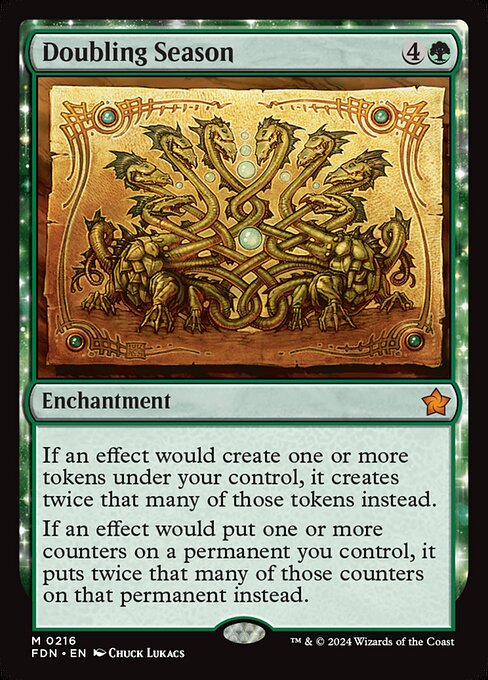
Best Token Doublers in MTG Commander, Ranked
One Doubling Season turns a five-token Secure the Wastes into ten, a single Elspesth ult into a real board, and a fragile go-wide deck into a lethal one. Here are the best token doublers in Commander, ranked — the enchantments, the creatures, and the one that triples.
MTG Commander Format Guide — How to Start Playing EDH (2026)
Commander is the most-played MTG format on the planet and the easiest one for new players to start in. The rules look intimidating on paper. They are not. Here is the full beginner guide.

Best Commander Staples Every Deck Wants, Ranked
There's a short list of cards that show up in basically every Commander deck regardless of theme — the silent 25 that make the splashy 75 work. Here are the staples worth a slot in almost any list, sorted by the job they do, with the legality double-checked.