Best MTG Stax Pieces for Commander, Ranked
Stax is the most hated archetype in Commander and the most misunderstood. Done right, it slows everyone but you. Here are the best resource-denial pieces, ranked, and the asymmetry rule that separates a winning lock from a salt mine.

Stax is the archetype people threaten to leave the table over. It's also the most misunderstood deck in Commander — most of the hate comes from people who've only ever seen it played badly: a player drops Winter Orb, Static Orb, and Stasis, locks the entire game including themselves, and everyone sits in a frozen board state for forty minutes while nothing happens and nobody wins. That's not stax. That's a hostage situation with extra steps.
Played correctly, stax is resource denial that hits your opponents harder than it hits you — you build your board, your engine, or your win condition under a tax everyone else is paying and you've prepaid or sidestepped. Smothering Tithe gives you Treasure off everyone else's draws. Drannith Magistrate shuts off opponents' commanders and graveyard plays while yours work fine. The good stax piece is asymmetric: it taxes the table and exempts you. Below are the best stax pieces in Commander, ranked, with the one rule that separates a winning lock from a salt mine — if it slows you down as much as it slows them, it's a bad stax piece.
Everything is legality-checked against Scryfall, and every cost and effect is accurate as printed. (Stax is not for casual tables — read the etiquette section before you build it.)
What stax actually does
Stax denies opponents resources faster than they can rebuild, then closes the game while they're locked out. The "resources" come in four flavors — mana, spells per turn, library access, and untapping — and a stax deck stacks pieces across those categories until opponents simply can't function.
The misconception is that stax wins by making the game un-fun until everyone scoops. It doesn't. A good stax deck wins by getting ahead under the lock — you resolve your threats and engines while the tax pieces stop everyone else from answering them, then you ride that asymmetry to an actual victory. The lock is the setup; you still need a kill. A stax deck with no win condition is just a player griefing the table, and that's the version everyone rightfully hates.
The format where this shines is cEDH, where fast combo decks try to win on turn three or four and stax exists to push that back to turn eight — long enough for a grindier deck to assemble its own win. But scaled-down stax (the "soft" tax pieces) shows up in plenty of mid-power decks too, as a speed bump that buys you time. If you're new to the format's power tiers, our Commander brackets guide explains where stax belongs and where it absolutely does not.
The asymmetry rule that makes or breaks stax
This is the single most important concept in the archetype, and it's why a list of "best stax pieces" can't just be "most restrictive effects." A stax piece is good in proportion to how asymmetric it is — how much it hurts your opponents while sparing or benefiting you.
Fully asymmetric (the best): the piece only affects opponents. Drannith Magistrate stops your opponents from casting from anywhere but hand — your commander, your flashback, your adventure cards all work. Smothering Tithe taxes opponents' draws and pays you. These are pure upside; you run them freely.
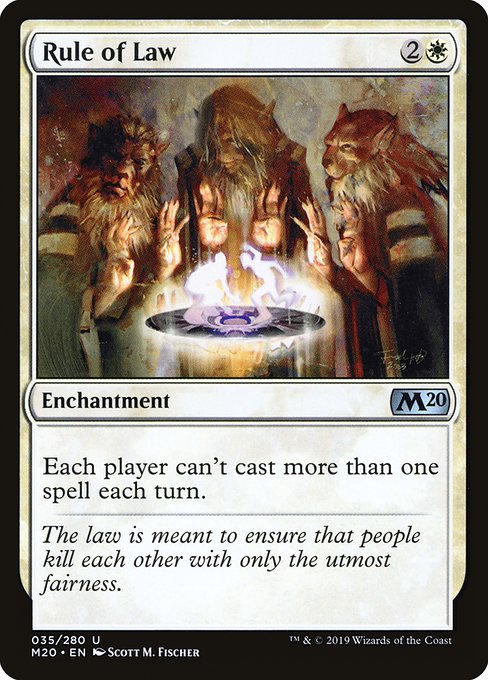
Asymmetric in practice (very good): the piece is symmetric on paper but your deck is built to ignore it. Winter Orb stops everyone from untapping lands — but if you run mana rocks and dorks that untap normally, plus low curve, the orb cripples opponents while you keep casting. Rule of Law limits everyone to one spell a turn, which barely affects a deck built around expensive haymakers but wrecks a combo or storm deck.
Symmetric (dangerous): Stasis, Static Orb, Winter Orb with no way to exempt yourself — these lock you too. They're only good if you have a deliberate break: a way to win through the lock, untap selectively, or remove the piece once it's done its job. Run these without a plan and you've locked yourself out of your own game.
The rule in one line: never run a symmetric stax piece you don't have a plan to break. Build your mana base and your win condition to operate under your own lock, or pick pieces that only hit opponents in the first place. The proactive version of this same idea — denying spells before they resolve — lives in the best counterspells guide.
The best stax pieces, ranked
Ranked on power, asymmetry, and how reliably they buy you the game. Weighted toward Commander and cEDH, where stax matters most.
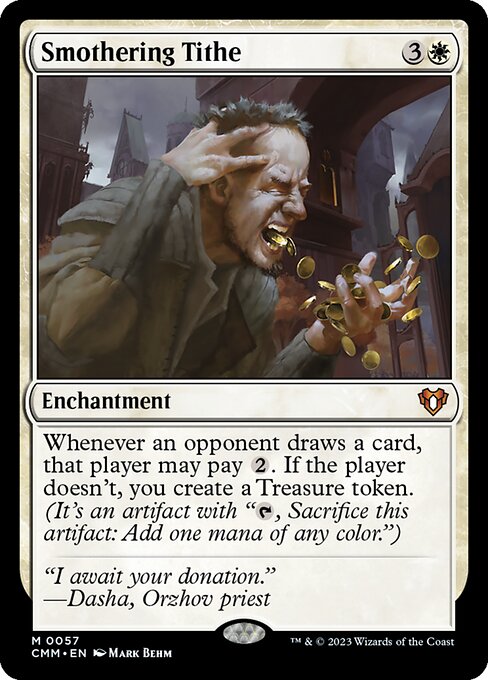
- Smothering Tithe — {3}{W}. Whenever an opponent draws a card, that player may pay {2} or you create a Treasure. The single most asymmetric "stax" piece in the game — it taxes every opponent's draw step and card draw spell while ramping you with Treasure tokens. In a four-player game it generates absurd amounts of mana off the table's own engines, and there's no downside to you. Auto-include in any white deck that can support it. Commander-legal.
- Drannith Magistrate — {1}{W}. Your opponents can't cast spells from anywhere other than their hands. Two mana to shut off every commander, every flashback, every adventure, every cascade and foretell your opponents have — while yours all work. It single-handedly turns off the Command Zone for the rest of the table. One of the best two-drops in Commander, stax or not.
- Rule of Law — {2}{W}. Each player can't cast more than one spell each turn. The premier anti-combo and anti-storm lock. It barely touches a deck built around one big spell a turn, but it stops a storm or combo deck cold — they need to chain spells, and now they can't. Cheap, hard to interact with at instant speed, and devastating against the decks stax is built to beat.
- Winter Orb — {2}. As long as it's untapped, players can't untap more than one land each turn. The iconic mana-denial piece. Symmetric on paper, but a deck built with mana rocks (which untap normally), dorks, and a low curve laughs at it while opponents starved of lands grind to a halt. The textbook "asymmetric in practice" card — run it with a plan to operate around it.
- Trinisphere — {3}. As long as it's untapped, each spell that would cost less than three mana costs three. A cEDH staple that taxes the cheap interaction and fast mana that combo decks live on — suddenly every {1} counterspell and {0} mana rock costs three, and the turn-two kill becomes a turn-five kill. Colorless, so it slots anywhere.
- Opposition Agent — {2}{B}. Flash; you control opponents while they search their libraries, and you exile and may play the cards they find. A flash creature that turns every fetch land, every tutor into a trap — punishes the entire category of library search the format leans on, and you steal the card. Brutal, asymmetric, and a blowout when flashed in response to a tutor.
- Grand Arbiter Augustin IV — {2}{W}{U}. Your white and blue spells cost {1} less; opponents' spells cost {1} more. A commander-as-stax-piece: it taxes the whole table while discounting you, the purest asymmetry possible. A backbone Azorius stax commander that pays for your control shell while slowing everyone else.
- Archon of Emeria — {2}{W}. Flying; each player can't cast more than one spell each turn, and opponents' nonbasic lands enter tapped. A Rule of Law on a 3/2 flying body that also taxes opponents' lands. Two lockdown effects plus a clock on one card — among the best stax creatures printed.
- Aven Mindcensor — {2}{W}. Flash, flying; if an opponent would search a library, they search only the top four cards. A flash flyer that turns fetches and tutors into a near-miss — they're far less likely to find what they wanted. Pairs with Opposition Agent as the white-side search-hate package.
- Esper Sentinel — {W}. Whenever an opponent casts their first noncreature spell each turn, draw a card unless they pay X (its power). A one-drop that taxes every opponent's first spell and refills your hand when they don't pay — soft, asymmetric, and a value engine that's good even outside dedicated stax. The most widely-played card on this list.
The best budget stax pieces
You don't need a cEDH budget to slow a table down. Most of the hardest-hitting tax pieces are cheap because they're old or heavily reprinted.
- Rule of Law — {2}{W}. A few dollars, and one of the best anti-combo cards in the format. Pure value for a budget control or midrange shell.
- Winter Orb — {2}. The classic mana-denial piece, inexpensive, and devastating against greedy mana bases when you build to ignore it.
- Sphere of Resistance — {2}. Spells cost {1} more to cast. A colorless, budget Trinisphere-lite that taxes the whole table; brutal against low-curve combo.
- Deafening Silence — {W}. Each player can't cast more than one noncreature spell each turn. A one-mana Rule of Law that exempts your creatures — fantastic in a creature-based deck. Near-bulk.
- Cursed Totem — {2} / Collector Ouphe — {1}{G} / Null Rod — {2}. Ability-denial pieces that shut off creature or artifact activated abilities — cheap, narrow, and backbreaking against the right decks.
The honest budget read: a soft-stax package of Rule of Law, Sphere of Resistance, and Esper Sentinel costs a few dollars and meaningfully slows a combo-heavy pod. You buy the expensive pieces (Trinisphere, Opposition Agent) when you move toward cEDH.
The categories of resource denial
Build your stax package by covering categories, not by stacking the same effect. The four levers:
Mana denial — Winter Orb, Static Orb, Stasis, Sphere of Resistance, Trinisphere. Slows everyone's ability to cast. The riskiest category because it's the most symmetric; only run pieces you can operate around.
Spell-count denial — Rule of Law, Archon of Emeria, Deafening Silence, Eidolon-style taxers. The cleanest anti-combo lever, and several pieces here are asymmetric or near-it. The best category for a focused, fair-ish stax deck.
Library/search denial — Opposition Agent, Aven Mindcensor, Drannith Magistrate (for graveyard/command-zone casts). Punishes tutors, fetches, and recursion — the engines that make decks consistent. Highly asymmetric.
Ability denial — Cursed Totem, Collector Ouphe, Null Rod, Grand Abolisher-style effects. Turns off the activated abilities that power combos and mana production. Narrow but devastating against the right target.
A coherent stax deck picks pieces across these levers so opponents can't just route around a single category. For where these slot into the rest of the 99, our Commander deckbuilding ratios guide covers how many slots to give the package, and the advanced Commander combos guide shows the combo decks your stax is built to beat.
How to actually win with stax
The most common stax mistake isn't being too oppressive — it's having no plan to close. A lock that never converts to a win is just everyone wasting an evening. Your stax deck needs one of these:
A combo or engine that ignores your own lock. The cleanest line: assemble a win that operates under your tax pieces while opponents can't. A two-card combo that doesn't care about Rule of Law, or a value engine that grinds while Winter Orb starves the table, lets you win through the lock you built.
An asymmetric clock. Drop a threat that closes the game over a few turns — Archon of Emeria swinging for three, a planeswalker ticking up, a commander beating down — while the tax pieces stop opponents from answering it. Slow but inevitable, and the cleanest "fair stax" plan.
A break-the-lock finisher. Run pieces that let you punch through your own symmetric lock at the right moment: untap your own lands, remove your own Winter Orb once you're ahead, or generate mana outside the taxed resource. The lock buys time; the break-out wins.
The throughline: stax is the setup, not the win. You're using resource denial to buy the turns you need to deploy a real win condition. If you can't articulate how your stax deck actually wins the game, you've built a salt mine, not a deck. For grindy recursion-based win plans that thrive under a lock, see the graveyard recursion guide.
The etiquette (and when not to play stax)
Let's be honest about the social contract, because stax breaks it more than any other archetype.
- Don't bring stax to a casual pod. A precon table or a "we're here to have fun" group will hate a hard-lock deck, and they're not wrong to. Stax belongs at high-power and cEDH tables that opted into it. Read the room and our Commander format guide on rule-zero conversations.
- Have a win condition and use it. The cardinal sin is locking the table and then not closing. If you've established a lock, you owe the table a kill in a reasonable number of turns. Don't durdle behind your stax pieces forever.
- Never lock a game you can't win. A symmetric lock that benefits nobody and just freezes the board is the worst-case outcome — everyone loses time and nobody wins. If your lock isn't advancing your win, it's pure griefing.
- Don't be precious about the pieces. If a stax piece is hurting you more than the table, it's a bad piece for that game — be willing to let it go. The asymmetry has to favor you, every game, or you're playing the archetype wrong.
Stax is a legitimate, skill-intensive archetype at the right table. It's also the fastest way to never get invited back at the wrong one. Match the deck to the pod, win the games you lock, and the hate mostly evaporates.
Quick Action Checklist
Apply this when building or playing stax:
- Only run symmetric pieces (Winter Orb, Static Orb, Stasis) if you have a deliberate plan to operate or win under them
- Prioritize asymmetric pieces: Smothering Tithe, Drannith Magistrate, Esper Sentinel, Grand Arbiter
- Cover multiple denial categories — mana, spell-count, library/search, ability — not four of the same lever
- Build your mana base (rocks, dorks, low curve) to function under your own lock
- Include a real win condition that ignores or breaks your lock — stax is the setup, not the kill
- Use search-hate (Opposition Agent, Aven Mindcensor) against tutor- and fetch-heavy pods
- On a budget, run Rule of Law, Sphere of Resistance, Deafening Silence, and Esper Sentinel
- Keep stax to high-power and cEDH tables, and close the game once you've established the lock
Frequently Asked Questions
What is the best stax piece in Commander?
What makes a stax piece good?
How do you win with a stax deck?
Is stax legal and allowed in Commander?
What are the best budget stax pieces?
Keep Reading
Related Guides
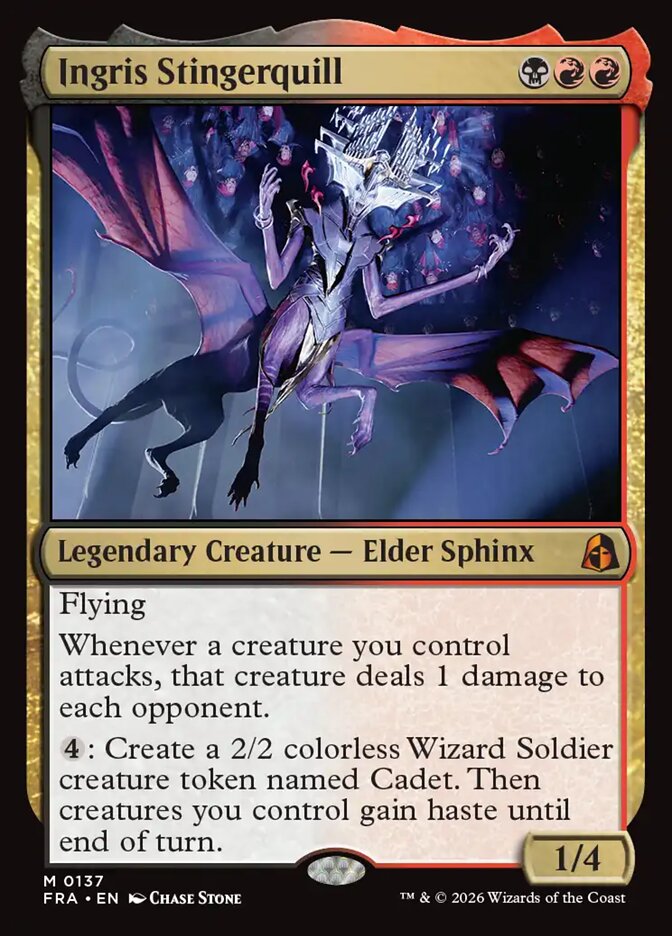
MTG Reality Fracture: The Best New Commanders
Reality Fracture ships 75 Commander-legal legendary creatures, more than Secrets of Strixhaven, Lorwyn Eclipsed, and Edge of Eternities combined. Here's which ones are actually worth the command zone, checked card by card against Scryfall's own spoiled set data.
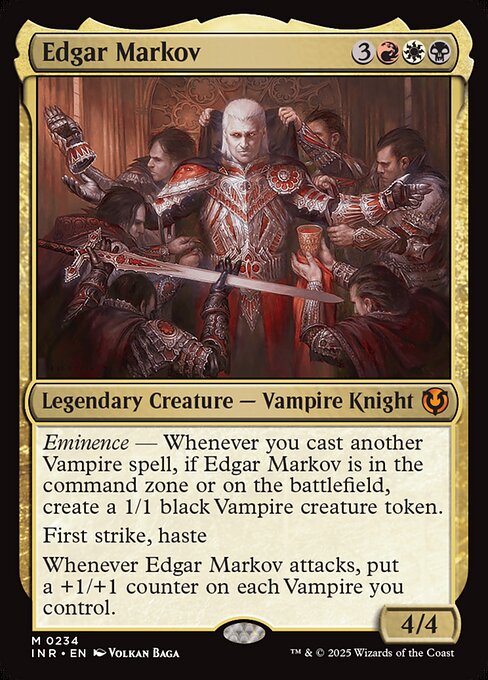
Best Tribal Commanders in MTG by Creature Type
Picking a creature type is the biggest deckbuilding decision you'll make, and most players make it with their heart instead of the card pool. Here are the best tribal commanders by creature type, the real support depth behind each one, and the typal package that works in all of them.
Best +1/+1 Counter Cards in MTG Commander, Ranked
Kill the anthem and the board shrinks. Kill the creature that placed a +1/+1 counter and nothing changes — the counter is already part of the creature. Here are the best +1/+1 counter payoffs and multipliers in Commander, ranked, plus the stacking order that turns one counter into eight.
Best Graveyard Hate Cards in MTG Commander, Ranked
Every Commander pod has a reanimator deck, an aristocrats deck, and a guy whose commander says "return target creature card from your graveyard." Here is the best graveyard hate in the format, ranked — and the timing rules that separate a blowout from a wasted card.

MTG Commander Format Guide — How to Start Playing EDH (2026)
Commander is the most-played MTG format on the planet and the easiest one for new players to start in. The rules look intimidating on paper. They are not. Here is the full beginner guide.

Best Commander Staples Every Deck Wants, Ranked
There's a short list of cards that show up in basically every Commander deck regardless of theme — the silent 25 that make the splashy 75 work. Here are the staples worth a slot in almost any list, sorted by the job they do, with the legality double-checked.