How to Build Your First MTG Cube: A 360-Card Blueprint
Most first cubes fail on ratios, not card quality. Here is the exact 360-slot skeleton — 48 cards per color, four gold cards per guild, 50 land slots — plus the curve numbers and the iteration rule that keeps it from turning into a pile.
A cube is the only Magic format where you are simultaneously the designer and one of the players, and that is exactly why first cubes go wrong. Almost nobody fails because their cards are weak. They fail because they built a 400-card pile of personal favorites, sat eight people down, and discovered that three of those people ended up with four-color decks that could not cast their own spells while one person opened a haymaker on turn four and the game was over.
Cube is a curated singleton draft pool. You own the cards, you assemble the packs, and one copy of everything means no two drafts play out the same. But the format lives and dies on ratios — how many cards per color, how much fixing, how steep the curve, how wide the power gap between your best card and your median card. Get the ratios right and even a cube full of commons is a genuinely great night of Magic. Get them wrong and no amount of expensive cardboard saves it.
Here is the skeleton I would hand anyone building their first one, with the actual numbers, and the reasoning behind every slot.
Why 360 is the number
The arithmetic is not a matter of taste. A standard draft is three packs of 15 cards per player. Eight drafters times three packs times 15 cards is exactly 360. That means a 360-card cube feeds a full eight-person pod with zero cards left over — every card you own gets seen and gets a chance to be picked.
That "every card gets seen" property is the whole reason to target 360 rather than a rounder number like 400. If your cube is bigger than the pod consumes, the cards you actually want people to fight over might sit in the box all night, and you learn nothing about whether they are any good.
| Pod size | Cards used (3 packs of 15) | Cube size that fits exactly |
|---|---|---|
| 4 players | 180 | 180 |
| 6 players | 270 | 270 |
| 8 players | 360 | 360 |
| 10 players | 450 | 450 |
| 12 players | 540 | 540 |
Build 360 first. A 360 cube also drafts fine at four or six players — you just use fewer cards, and the pool rotates differently every time. Going straight to 540 because "more cards means more variety" is the single most common first-cube mistake, because 540 is 50% more cards to buy, sort, and evaluate, and you get fewer reps per card to figure out what is working.
The one rule the format actually enforces: singleton, one copy of every card, basic lands excepted. Cube is not a sanctioned Constructed format, so there is no official ban list and nobody is coming to check. The design constraints are the ones you choose, which is why choosing them deliberately matters so much.
Decide the power band before you sleeve anything
Before you buy a single card, answer one question: how wide is the gap between the strongest card in your cube and the median card?
That gap is your power band, and it determines whether games feel like Magic or feel like a coin flip. The community has settled on a few rough tiers:
- Powered / Vintage-level. Everything goes, including the most broken cards ever printed. Games are explosive, non-interactive, and end on turn three about as often as they go long. Great for a specific kind of player, terrible as a first cube.
- Unpowered / Legacy-level. Format staples and efficient bombs, but nothing that outright ends the game on turn one. This is the default "regular cube" and where I would point most people who already own a decent collection.
- Peasant. Commons and uncommons only. Dramatically cheaper, and the games are noticeably grindier and more skill-testing because nobody just draws a game-winner.
- Pauper. Commons only. The tightest power band of the four, and the best value per dollar in the entire hobby.
The trap is mixing bands. If 90% of your cube is fair midrange cards and 10% is turn-three-you-lose, the drafter who opens one of those ten cards wins the pod and everybody else spent 45 minutes on a raffle. Consistency of power level beats peak power level, every time, for the same reason a clean two-color Limited deck beats a four-color pile.
Practical test for whether a card belongs: if it would be a fine, reasonable pick in the third pack of a normal draft — good but not oppressive — it fits an unpowered cube. If it makes the other seven players groan when they see it flipped, it either belongs in a powered cube or nowhere.
The 360-slot blueprint
Here is the split. It adds to exactly 360, and every number below is chosen to serve a specific job.
| Section | Slots | Why this many |
|---|---|---|
| Mono-colored cards (5 colors × 48) | 240 | The backbone. 48 per color is enough for two drafters to be deep in a color without either deck being hollow. |
| Two-color gold cards (10 guild pairs × 4) | 40 | Four per pair seeds every archetype without forcing anyone into a lane. |
| Colorless (artifacts, equipment, colorless creatures) | 30 | Playable by everyone, so this section is the most-contested part of the cube. Keep it small. |
| Lands (duals, fixing, utility) | 50 | The single biggest lever on how the format plays. More on this below. |
| Total | 360 |
Two numbers here are load-bearing. The 240 mono-colored cards mean 48 per color, and at eight drafters, roughly three players end up in any given color across a pod — so each color's 48 cards get split among three decks that each want about 12 to 16 playables from it. That works. Drop to 40 per color and the third drafter in a color is scraping.
The 50 land slots are 14% of the cube. That sounds high if you are used to Constructed, and it is deliberate. A cube with thin fixing forces everyone into strict two-color decks, which makes your 40 carefully chosen gold cards nearly undraftable. A cube with generous fixing lets people splash, which makes the gold section sing and makes bombs in a third color a real decision instead of a dead pick.
Inside a 48-card color section
Do not just fill each color with "the 48 best cards." Fill roles. Here is the breakdown I use per color, which totals 48:
| Role | Slots | Notes |
|---|---|---|
| Creatures | 26 | The bulk. Cube games are won in combat far more often than people expect. |
| Removal and interaction | 9 | Includes counterspells in blue, fight effects in green, damage in red, and so on. |
| Card advantage | 5 | Draw, recursion, repeatable value engines. |
| Acceleration | 3 | Mana dorks and rituals in green and red; rummaging and cost reduction elsewhere. |
| Archetype payoffs and flex | 5 | The cards that reward a specific plan — sacrifice outlets, tokens matter, graveyard payoffs. |
Nine removal spells per color is the number people push back on hardest, and it is the number I would defend the loudest. That is 45 removal spells across the cube before you count colorless and gold ones. Without that density, the first bomb to hit the table just wins, and the cube collapses into "who opened the biggest creature."
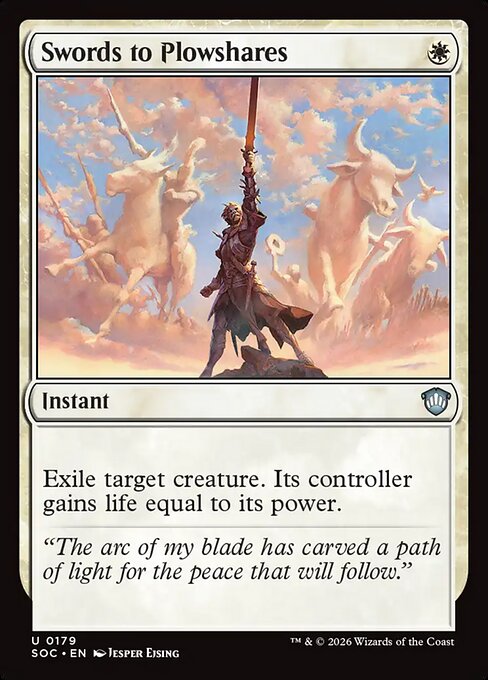
Swords to Plowshares is the model. One white mana, exile target creature, and the drawback is life the opponent probably cannot convert into anything. It answers a 12/12 as cleanly as it answers a 2/2, it never rots in your hand, and it costs one card for one card at a mana rate nobody can complain about. Every color needs its version of that at the cheap end, plus something unconditional at four or five mana for the creatures that removal at one mana cannot handle.
The 26-creature count matters too. New cube builders massively over-index on splashy noncreature spells because those cards read as more exciting. Then eight people sit down, four of them have decks with 11 creatures, and every game turns into two people staring at each other holding removal. Creatures are the engine; spells are the steering.
The curve every color section should hit
This is where the numbers get concrete and where most homebrew cubes leak games. Target this distribution across the 48 nonland cards in each color:
| Mana value | Cards | Job |
|---|---|---|
| 1 | 6 | Turn-one plays, one-mana removal, mana dorks |
| 2 | 13 | The densest slot — this is where cube games are decided |
| 3 | 12 | Backbone creatures and mid-cost interaction |
| 4 | 9 | Real threats, value engines |
| 5 | 5 | Top-end you can reliably reach |
| 6+ | 3 | Finishers, and only three of them |
That averages a hair over 3.0 mana value per card, which is the right target for a format where nobody has a tuned Constructed mana base. Note the shape: 19 of the 48 cards cost one or two mana. Nearly 40% of every color section is cheap. That is what stops the format from turning into a durdle-fest where the first person to untap with six mana wins.
The 6-plus row is the discipline test. Three cards. Not eight. Every builder wants to jam their favorite eight-drops, and then the pod's decks all top out at seven mana and games take forty minutes.
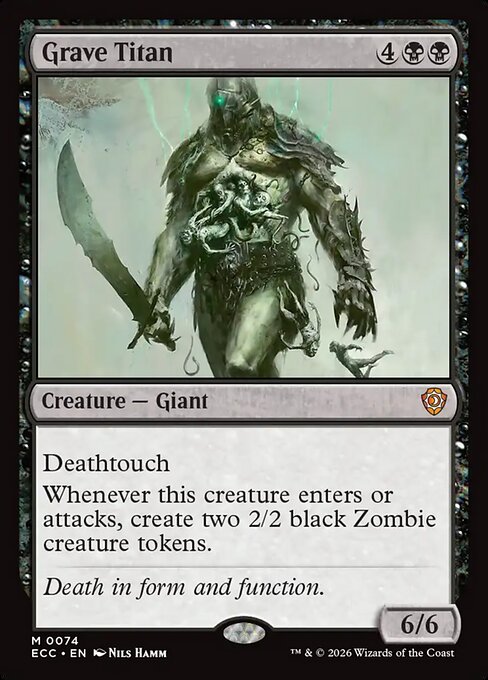
Grave Titan sets the bar for what earns one of those three slots. Six mana, and the moment it resolves you have ten power across three bodies with deathtouch on the biggest one. If your opponent has removal, you still keep four power. If they do not, it attacks and makes two more. A six-drop that dies to a single removal spell and leaves nothing behind does not deserve a slot — that is the actual test, not raw stats.
The 40 gold cards are your archetype map
There are ten two-color pairs, and four gold cards each is 40 slots. Those 40 cards are the closest thing your cube has to a design document, because they tell drafters what each color pair is supposed to be doing.
Pick a one-line identity per pair before you pick the cards — aggro, control, tokens, sacrifice, reanimator, artifacts, whatever — then choose four cards that are excellent specifically in that pair and unremarkable outside it. That is the job. A gold card that is just "a good card that happens to cost two colors" wastes the slot; you already have 240 mono slots for good cards.
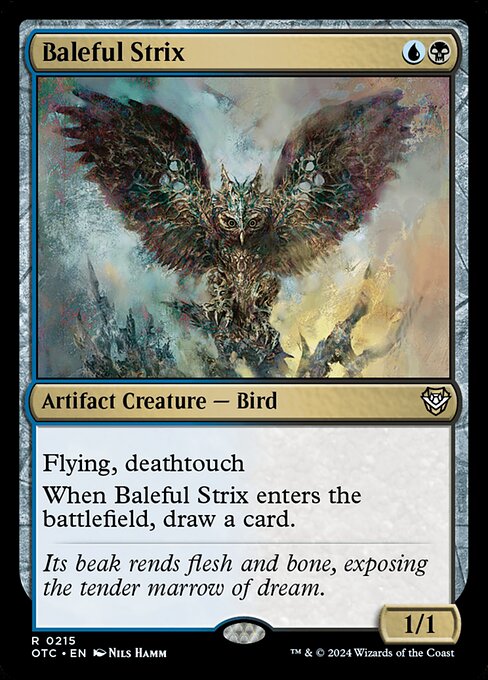
Baleful Strix, the hero card at the top of this post, is the platonic ideal. Two mana, a 1/1 with flying and deathtouch that draws a card when it enters. It blocks anything, replaces itself, and costs one blue and one black — so it tells every drafter at the table that blue-black in this cube is the attrition deck. Three jobs, two mana, one clear signal.
One subtlety worth knowing: a card's color is set by its mana cost, not by everything printed on it. Lingering Souls costs three mana with one white pip, so Scryfall lists it as a white card, but its flashback cost is one generic and one black — meaning it is functionally a white-black card that only reaches its full value in that pair. Cards like that are excellent gold-section material even though they technically live in a mono-color slot. Sort by what a card wants, not by what a database says.
Resist the urge to give one pair six cards because you like it. Four each, ten pairs, no favorites. If one archetype is genuinely underpowered after a few drafts, fix it by swapping cards, not by adding slots.
30 colorless slots and the Sol Ring problem
Colorless cards go in every deck. That makes them the highest-pick-rate cards in the cube by a mile, and it means a colorless card that is too strong warps the entire format rather than just one color.
Sol Ring is the canonical example. One mana for an artifact that taps for two colorless is a straight net-positive mana engine on turn one, and unlike in Commander — where every deck has 99 cards to dilute it and everyone accepts the chaos — in a 40-card cube deck it is close to an auto-win whenever it lands early. Same story with Skullclamp, one mana to equip and draw two cards every time a small creature dies, and Umezawa's Jitte, which effectively ends the game if it connects once and you have any board at all.
None of those three are unplayable in a cube. They are just power-band decisions. If your cube is unpowered and fair, they do not belong. If you are building explosively on purpose, jam all three.
What should fill most of those 30 slots is the boring stuff that smooths games out: two-mana rocks like Mind Stone that ramp early and cash in for a card late, four-mana value bodies like Solemn Simulacrum that fix your mana and replace themselves, cheap equipment that helps small creatures matter, and a handful of colorless creatures that give an aggressive deck something to do. Thirty is already generous. Do not let this section creep to 40 — every colorless card you add makes every deck in the pod slightly more similar to every other deck.
50 land slots because fixing is the whole game
Fifty land slots is the number that separates a cube that plays well from one where everybody grinds out a two-color deck and the gold section may as well not exist.
Here is a clean way to fill it, using cycles that each happen to contain exactly ten cards — one per color pair — which makes the fixing perfectly symmetric:
- 10 fetchlands. The classic dual-type fetches: Arid Mesa, Bloodstained Mire, Flooded Strand, Marsh Flats, Misty Rainforest, Polluted Delta, Scalding Tarn, Verdant Catacombs, Windswept Heath, Wooded Foothills. Exactly ten exist, five allied and five enemy.
- 10 shocklands. Blood Crypt, Breeding Pool, Godless Shrine, Hallowed Fountain, Overgrown Tomb, Sacred Foundry, Steam Vents, Stomping Ground, Temple Garden, Watery Grave. Also exactly ten, and they pair with the fetches.
- 10 painlands. Untapped, two colors, one life per colored mana. Ten of them, one per pair.
- 10 three-color lands. The Triome cycle is ten cards and each one enters tapped while producing three colors and having basic land types — which means fetchlands can grab them.
- 10 utility and colorless lands. Creature-lands like Mishra's Factory, which taps for colorless and can become a 2/2 for one mana, plus whatever else you want. Be careful here: land destruction like Wasteland punishes exactly the greedy manabases your other 40 land slots are trying to encourage. One or two is spice; five is a design contradiction.
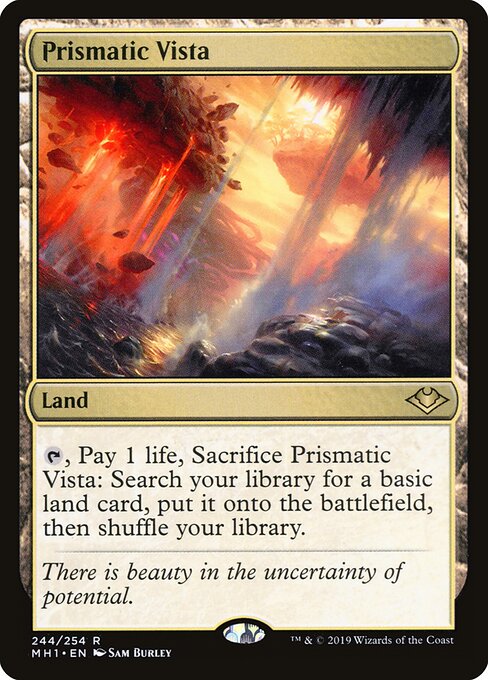
If the fetch-and-shock package is out of your budget, the fixing still works — it just costs a bit of speed. Prismatic Vista finds any basic untapped for one life. Evolving Wilds and Terramorphic Expanse do the same thing tapped and cost pennies. Two-color tap-lands and the common gain-lands fill the rest. A cube with 50 slow fixing lands plays better than a cube with 20 fast ones, because the thing you are buying with those slots is the ability for a drafter to say yes to a third color, not raw tempo. Your regular mana base instincts do not fully apply here.
One logistics note nobody mentions until draft night: basic lands do not live in the cube. Keep a separate box with roughly 15 of each basic per seat — eight players building 40-card decks will collectively want 120-plus basics.
Building it without spending a house payment
The math is brutally simple and worth internalizing: your cube costs 360 times your average card price. Every dollar you add to the average is 360 dollars. That is the entire budgeting conversation.
Which means the real lever is not "buy fewer cards," it is "set a per-card ceiling and hold it." Scryfall makes this trivial — searching with a price ceiling like usd<=3 alongside your other filters means you never fall in love with a card you cannot afford. Cap at three or five dollars and you will be shocked how complete a cube you can assemble, because the vast majority of format-defining cube cards have been reprinted into the ground.
Three ways to cut cost without cutting quality:
- Go Peasant. Commons and uncommons only. This is not a compromise cube; the games are frequently better than in an unpowered cube because the power band is narrower and nothing single-handedly ends games.
- Downgrade the manabase, not the spells. The 50-land section is where the money is. Swapping fetches and shocks for Evolving Wilds, Terramorphic Expanse, tap-lands and gain-lands preserves the fixing count — which is what actually matters — and drops the price of that section by an enormous multiple.
- Proxy the top ten and buy the rest. Nobody at a kitchen table cares. Print the ten cards that would otherwise eat half the budget, buy real copies of the 350 that are cheap, and upgrade over time if you want.
How to iterate after your first five drafts
Your first list will be wrong. That is not a failure state; it is the format. The discipline is in how you correct it.
After every eight-person draft, all 360 cards were seen and passed at least once, which is a complete data set on your own cube. Do this every time:
- Write down every card that got passed twice. A card wheeling in a 360 cube means all seven other drafters looked at it and said no. Two or three wheels and it is a cut candidate, regardless of how much you like it.
- Note anything that ended a game on the spot. If the same card produced a non-game more than once, it is outside your power band. Cut it, do not "give it another chance."
- Ask which archetype nobody drafted. If red-white aggro went undrafted three drafts running, its four gold cards are not doing their job. Swap them before you touch anything else.
- Change no more than 5-10% between drafts. That is 18 to 36 cards. Change more than that and you cannot tell which swap fixed anything — you have a new cube, not a better one.
The temptation after a bad draft night is to rip out fifty cards. Don't. Two or three small, targeted revisions teach you more about your own cube than a full rebuild, and the whole point of owning one is that it gets sharper every time it hits the table.
Quick Action Checklist
- Build 360 cards, not 540 — it feeds a full eight-person pod exactly
- Pick one power band (powered, unpowered, Peasant, Pauper) and hold the line
- Split it 240 mono / 40 gold / 30 colorless / 50 lands
- Give each color 48 cards: 26 creatures, 9 removal, 5 card advantage, 3 acceleration, 5 payoffs
- Hit the curve — 6 one-drops, 13 twos, 12 threes, 9 fours, 5 fives, only 3 at six-plus
- Write a one-line identity for each of the 10 guild pairs, then pick 4 gold cards that serve it
- Keep colorless to 30 and treat Sol Ring, Skullclamp and Jitte as power-band decisions
- Fill all 50 land slots even on a budget — swap fetches for Evolving Wilds, keep the count
- Keep 15 of each basic land per seat in a separate box
- After each draft, cut cards that wheeled twice and change no more than 18-36 cards
Frequently Asked Questions
How many cards should an MTG cube have?
How many lands should be in a 360-card cube?
Can you build a good MTG cube on a budget?
Should Sol Ring be in a cube?
What mana curve should a cube have?
Is cube an official Magic format?
Keep Reading
Related Guides

How to Draft: An MTG Limited Guide for Beginners
Your first draft goes badly because you pick the coolest card instead of the best card, and you stay open into three colors when you should have committed by pick five. Here is the fundamentals course that fixes both.
MTG Commander Banned List: Every Card and Why
Wizards' banned list page gives Commander 42 card names and four lines of small print. Scryfall says the real number is 83. The gap is 41 cards banned by category rather than by name — Conspiracies, ante cards, and the seven banned everywhere for offensive content. Here is the entire list, grouped by what each card actually does, plus the one change the Commander Format Panel made this year.
MTG Oathbreaker Format Guide: Where to Start
Oathbreaker is what you get when you take Commander, swap the legendary creature for a planeswalker, and bolt on a signature spell you can only cast while that planeswalker is alive. Here is how the format works, how to build your first deck, and which oathbreakers actually win.
MTG Brawl Format Guide: Standard Brawl vs Historic Brawl
Brawl is singleton Commander squeezed into a one-on-one Arena format that doesn't take forty minutes a game. Here's what Brawl is, how Standard Brawl and Historic Brawl differ, how to pick a commander, and how to build your first deck.
MTG Commander Format Guide — How to Start Playing EDH (2026)
Commander is the most-played MTG format on the planet and the easiest one for new players to start in. The rules look intimidating on paper. They are not. Here is the full beginner guide.

Best Commander Staples Every Deck Wants, Ranked
There's a short list of cards that show up in basically every Commander deck regardless of theme — the silent 25 that make the splashy 75 work. Here are the staples worth a slot in almost any list, sorted by the job they do, with the legality double-checked.