MTG Zeta Set: Card List, Pack Odds, and Pauper Rules
Secret Lair x MSCHF: The Zeta Set went on sale September 2 as a single seven-card booster for $19.92, and it is an odd product to price out: 121 cards, three photocopier treatments each, archaic type lines like Interrupt and Mana Source, and rarity symbols that on 50 of the 121 cards do not match the rarity the card usually carries. Here is what is in it, what the published odds actually mean per card, and which of those rules-text oddities matter at the table.
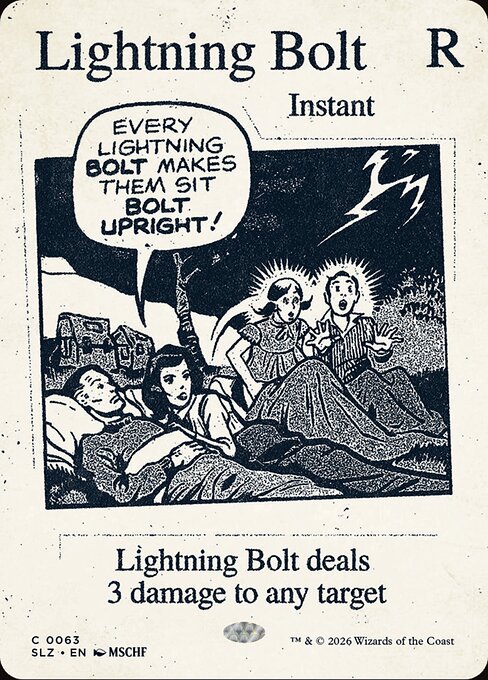
Wizards announced Secret Lair x MSCHF: The Zeta Set on September 1 and put it on sale the next day. The pitch, in Wizards' own words, is that MSCHF has taken Magic "back to the game's earliest playtest days, when prototype cards were printed out, cut up, and passed around long before Magic reached the public."
That is not marketing fluff dressed over a normal reprint drop. The cards genuinely look photocopied, the mana costs are typed out as letters instead of symbols, and a chunk of the set carries rules text and card types that were errata'd out of Magic decades ago. It is also sold differently: a randomized booster rather than a fixed list of cards, which Star City Games described as "the first Secret Lair offering to be sold as individual, randomized packs."
One thing to be clear about before any of the numbers below: the sale opened on September 2, and the Secret Lair store listing gives a November 5 ship date. Nobody has these in hand. Everything here comes from Wizards' announcement, the Secret Lair listing, and the 363 card records Scryfall published for set code SLZ — not from opened packs.
What you are actually buying
One copy is one pack. Wizards' announcement is blunt about it: "Secret Lair x MSCHF: The Zeta Set includes 1 Zeta Booster," and that booster holds seven cards for $19.92 — a number chosen as a nod to 1992, when Magic was in playtesting. That works out to $2.85 a card before shipping and tax.
The card pool is 121 different cards. Every one of them is a reprint; Scryfall flags all 363 printings as reprints, none of them are foil, and all 363 are paper cards carrying the standard Magic card back. Whatever else this product is, the cards are real cards you can sleeve up.
Here is the pool at a glance, counted off Scryfall's SLZ records:
| Slice of the set | Count |
|---|---|
| Different cards | 121 |
| Printings (121 cards x 3 treatments) | 363 |
| Commons | 52 |
| Uncommons | 39 |
| Rares | 20 |
| Mythic rares | 10 |
| Mono-colored cards (by color identity) | 88 |
| Colorless cards (by color identity) | 27 |
| Multicolored cards | 6 |
| Lands | 4 |
The four lands are Command Tower, Reliquary Tower, Oboro, Palace in the Clouds and Urborg, Tomb of Yawgmoth. Blue is the deepest color at 22 cards of mono-blue identity; white is the thinnest at 12.
The pack, slot by slot
Wizards published the full slot structure and the wildcard odds in the announcement:
| Slot | Cards | Drawn from | Published odds |
|---|---|---|---|
| Common | 3 | the 52 commons | — |
| Uncommon | 2 | the 39 uncommons | — |
| Rare or mythic rare | 1 | 20 rares, 10 mythics | 75% rare, 25% mythic |
| Wildcard | 1 | all 121 cards | 60% common, 30% uncommon, 7.5% rare, 2.5% mythic |
| Total | 7 |
Multiply that out and an average pack contains 3.6 commons, 2.3 uncommons, 0.825 rares and 0.275 mythics. Those four figures sum to exactly 7.0, which is the check that the published odds are internally consistent.
The more useful question is what the odds mean for a specific card you want. Divide each rarity's expected count by the number of cards at that rarity — this assumes every card at a rarity is equally likely, which Wizards has not stated either way:
| Rarity | Cards | Chance a named card is in one pack | Packs for a coin-flip shot | Chance across 12 packs |
|---|---|---|---|---|
| Common | 52 | 6.9% | 10 | 58% |
| Uncommon | 39 | 5.9% | 12 | 52% |
| Rare | 20 | 4.1% | 17 | 40% |
| Mythic rare | 10 | 2.8% | 25 | 28% |
Read the mythic row and then look at the price tag again. Twenty-five packs is $498 for even money on one named mythic — and there are only ten mythics in the set.
The three treatments, and how to spot them
Every one of the 121 cards exists in all three treatments, which is where the 363 number comes from. Wizards gives the rates directly: most cards are the plain photocopy, "10% of the time" you get a photocopy negative, and "5% of the time" the printer produces the "jittery CMYK look that we're calling the color banding treatment."
Scryfall's collector numbers run 1 to 363 in three clean blocks, and comparing the three scans of the same card confirms which block is which — every card sits at n, n+121 and n+242.
| Treatment | Share of cards | Collector numbers | What it looks like |
|---|---|---|---|
| Photocopy | 85% | 1–121 | Black toner on cream stock |
| Photocopy negative | 10% | 122–242 | Inverted: white line art on near-black |
| Color banding | 5% | 243–363 | Cyan, magenta and yellow bands smeared across the card |
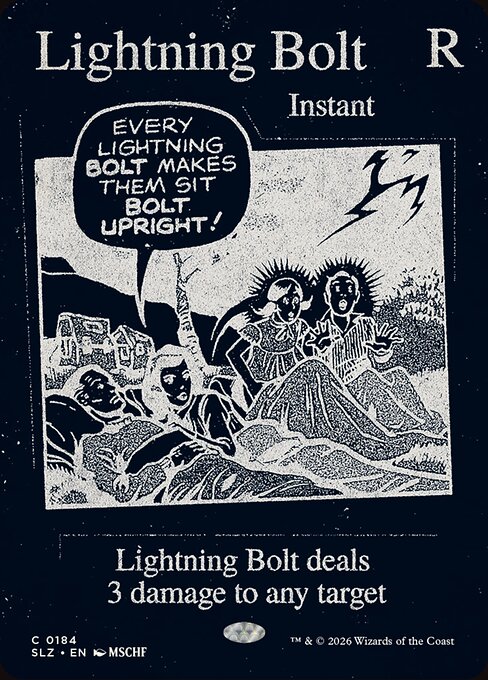
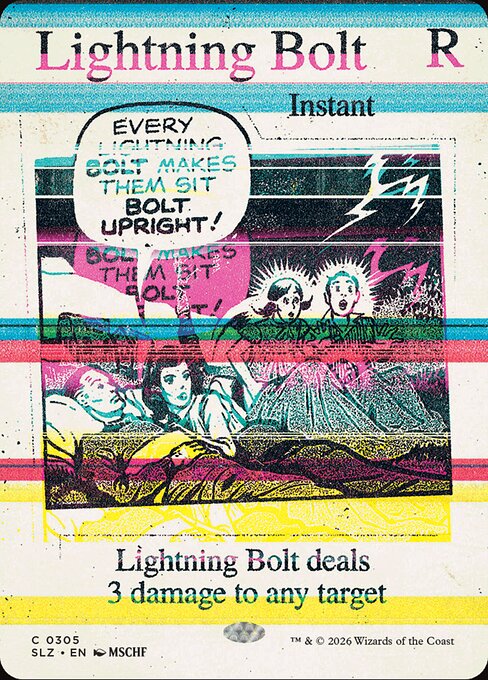
So a specific card in a specific treatment is the rate above multiplied by the treatment rate. A named mythic in color banding is roughly a 1-in-727 pack proposition. At $19.92 a pack, that is about $14,500 of expected spend for one particular card in one particular finish. This is a lottery product, and it is worth saying so plainly before anyone budgets for a chase.
What is printed is not what the card does
This is the part that will actually come up at a table, and it is the reason the set is more interesting than a novelty skin.
MSCHF did not typeset the current Oracle text. They typeset something that reads like a 1992 playtester scribbled it. Of the 116 Zeta cards that carry rules text at all, 108 print wording that differs from the card's Oracle text — sometimes just a dropped full stop, often much more:
| Card | Printed on the Zeta card | Oracle text |
|---|---|---|
| Sol Ring | TAP: ADD (two diamonds) | {T}: Add {C}{C}. |
| Path to Exile | "Remove target creature from the game, its controller may search their deck for a basic land card, which then enters tapped. Then they shuffle their deck." | "Exile target creature. Its controller may search their library for a basic land card, put that card onto the battlefield tapped, then shuffle." |
| Dark Ritual | "Add 3 black mana to your mana pool" | "Add {B}{B}{B}." |
| Mother of Runes | "TAP: target creature you control gains protection from the color of your choice until end of turn!" | "{T}: Target creature you control gains protection from the color of your choice until end of turn." |
| Baleful Strix | type line reads "Summon Artifact Bird" | "Artifact Creature — Bird" |
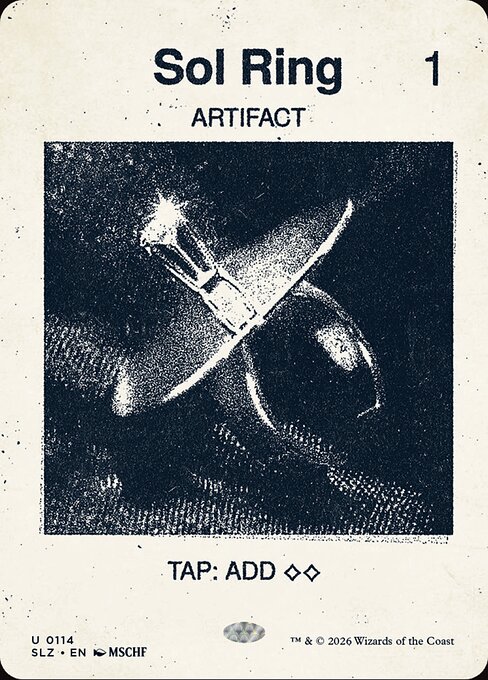
The retro styling goes further than wording. Thirty-three of the 42 creatures print their type line in the archaic "Summon Angel" or "Summon Cat" style rather than "Creature —", and the other nine, all legendary, print as "Legendary Ogre Wizard" and the like. Six cards — Mental Misstep, An Offer You Can't Refuse, Power Sink, Spell Pierce, Imp's Mischief and Pyroblast — print the card type Interrupt. Dark Ritual prints the card type Mana Source. Fifteen cards say "deck" where the Oracle text says "library", three say "mana pool", and four say "remove from the game" instead of "exile".
None of that changes anything. Rule 108.1 of the Comprehensive Rules opens with the whole answer: "Use the Oracle card reference when determining a card's wording." The rules even keep glossary entries for both dead card types — "Interrupt (Obsolete)" and "Mana Source (Obsolete)" — each ending with the same line, that all relevant cards "have been given errata in the Oracle card reference."
So a Zeta Path to Exile exiles. A Zeta Interrupt is an instant. A Zeta Dark Ritual is an instant that adds {B}{B}{B}, not a Mana Source with a timing category of its own. If anyone at the table tries to litigate the printed text, the printed text loses.
The rarity symbols are scrambled
Zeta rarity is a slot-allocation decision, not a statement about the card. I pulled every previous paper printing of all 121 cards off Scryfall and compared each card's Zeta rarity against the rarity it has been printed at most often. Of the 121:
- 34 appear at a rarity they have never held on any previous paper printing.
- 39 are printed lower than the rarity they usually carry.
- 9 are printed higher.
- 71 match it, and 2 have a prior record split evenly between two rarities.
Some of the swings are large in both directions:
| Card | Usual paper rarity | Zeta rarity |
|---|---|---|
| Baleful Strix | Rare | Common |
| Serra Angel | Uncommon | Common |
| Gigantosaurus | Rare | Common |
| Raffine, Scheming Seer | Mythic | Uncommon |
| Garth One-Eye | Mythic | Uncommon |
| Dig Through Time | Rare | Uncommon |
| Hornet Queen | Rare | Uncommon |
| Skullclamp | Uncommon | Rare |
| Dark Ritual | Common | Uncommon |
| Copper Tablet | Uncommon | Mythic |
| Scythecat Cub | Rare | Mythic |
| Panoptic Mirror | Rare | Mythic |
The practical read: do not treat the rarity symbol on a Zeta card as a value signal. Two of the ten mythics are Copper Tablet and Panoptic Mirror. Sol Ring, a fixture of the Commander mana rock slot, sits at uncommon.
No, Baleful Strix is still not Pauper-legal
This was the obvious exploit and Wizards closed it in the announcement itself: "common cards from Secret Lair x MSCHF: The Zeta Set do not affect Pauper legality. If a common card from this release wasn't legal in Pauper, it still won't be legal in Pauper."
That matters because the set is genuinely stuffed with cards printed at common that have never been common before. Sixteen of the 52 Zeta commons are not legal in Pauper — twelve because they have never been legally common, and four because they are banned in the format outright:
| Status | Count | Cards |
|---|---|---|
| Common in Zeta, never Pauper-legal | 12 | An Offer You Can't Refuse, Baleful Strix, Cut Down, Dispatch, Gigantosaurus, Narcomoeba, Price of Progress, Return to Dust, Sengir Vampire, Serra Angel, Soul-Guide Lantern, Vandalblast |
| Common in Zeta, banned in Pauper | 4 | All That Glitters, Chatterstorm, High Tide, Invigorate |
| Common in Zeta and Pauper-legal already | 36 | Lightning Bolt, Brainstorm, Mulldrifter, Gray Merchant of Asphodel and 32 others |
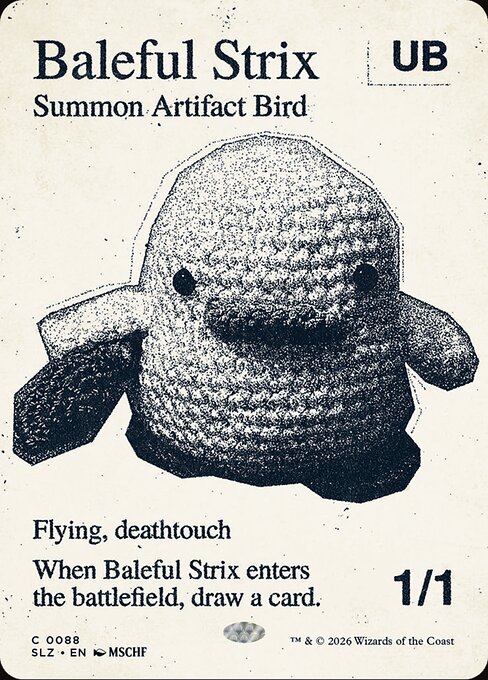
Scryfall's legality data already reflects the ruling: pull up the SLZ printing of Baleful Strix and its Pauper line reads not legal, same as every other printing.
Where the 121 cards are legal
Legality attaches to the card, not the printing, so this is just the legality profile of the pool Wizards chose. Counted across all 121:
| Format | Legal | Not legal | Banned or restricted |
|---|---|---|---|
| Commander | 121 | 0 | 0 |
| Legacy | 115 | 0 | 6 banned |
| Vintage | 115 | 0 | 6 restricted |
| Modern | 85 | 30 | 6 banned |
| Pioneer | 47 | 74 | 0 |
| Pauper | 44 | 73 | 4 banned |
| Standard | 14 | 107 | 0 |
Every card in the set is legal in Commander, which is clearly the audience. The six Legacy bans are Dig Through Time, Mental Misstep, Sensei's Divining Top, Skullclamp, Sol Ring and Windfall; the six Vintage restrictions are Brainstorm, Dig Through Time, Mental Misstep, Merchant Scroll, Sol Ring and Windfall. Note that Sol Ring being banned in Legacy has nothing to do with this product and does not touch the Commander banned list, where it remains legal.
What the 12-pack limit actually buys
Star City Games reports a purchase limit of 12 boosters per customer; Wizards' own announcement does not state a limit, so treat that number as reported rather than official. Take it at face value and the ceiling looks like this:
| At the 12-pack limit | Value |
|---|---|
| Cards | 84 |
| Cost | $239.04 |
| Expected commons | 43.2 |
| Expected uncommons | 27.6 |
| Expected rares | 9.9 |
| Expected mythics | 3.3 |
| Expected photocopy / negative / color banding | 71.4 / 8.4 / 4.2 |
Eighty-four cards against a 121-card set. Even ignoring duplicates, one customer buying the maximum cannot complete the set — there are not enough cards in the allowance. Simulating the published odds 4,000 times, collecting one of each of the 121 cards takes a median of 114 packs (mean 122, and 10% of runs needed more than 171). Collecting all 363 printings takes a median of roughly 2,330 packs, which is around $46,000.
That is the honest shape of this product: a $19.92 novelty pack that is fun to open once, and a completionist trap if you treat it as a set to finish. Compare it against the normal sealed product lineup, where a Play Booster is a draftable game piece, and the difference in intent is obvious.
Quick Action Checklist
- One copy is one seven-card pack for $19.92 — $2.85 a card. It went on sale September 2, 2026 at MagicSecretLair.com, while supplies last, and the store listing gives a November 5 ship date.
- 121 cards, three treatments each, 363 printings. Photocopy 85%, photocopy negative 10%, color banding 5%. Collector numbers 1–121, 122–242 and 243–363 map to those three in order.
- The printed text is decoration. Rule 108.1 makes the Oracle text the real rules text, and 108 of the 116 Zeta cards with rules text print something different from it.
- Interrupt and Mana Source are dead card types. The Comprehensive Rules glossary lists both as obsolete; every such card is an instant.
- Rarity here is a slot, not a signal. 39 of the 121 are printed below their usual rarity and 34 sit at a rarity they have never had in paper.
- Commons do not become Pauper-legal. Sixteen of the 52 Zeta commons are unplayable in Pauper, Baleful Strix among them.
- All 121 are Commander-legal, and six are banned in Legacy while six are restricted in Vintage.
- Do not chase a specific card. A named mythic is a 2.8% pack, and a named mythic in color banding is roughly 1 in 727.
Frequently Asked Questions
What is Secret Lair x MSCHF: The Zeta Set?
What are the pack odds for The Zeta Set?
Is Baleful Strix Pauper-legal because of The Zeta Set?
Does the old-fashioned text on Zeta Set cards change how they work?
How many Zeta Set treatments are there and how do I tell them apart?
Can you complete The Zeta Set?
Keep Reading
- Wizards of the Coast — Chaos Vault: The Zeta Set Puts the Playtest in Your Hands, 1 September 2026 (pack contents, wildcard and rare-slot odds, treatment rates, $19.92 price, 121-card pool, and the Pauper legality statement)
- Scryfall — The Zeta Set (SLZ), released 2 September 2026 (363 printings, 52/39/20/10 rarity split, all reprints, all nonfoil, collector numbers 1–363, and per-card format legalities)
- Secret Lair — Secret Lair x MSCHF: The Zeta Set product listing (pack contents and the 5 November ship date)
- Wizards of the Coast — Magic: The Gathering Comprehensive Rules, effective 7 August 2026 (rule 108.1 on Oracle text, and the glossary entries for Interrupt (Obsolete) and Mana Source (Obsolete))
- Wizards of the Coast — Comprehensive Rules download page (source for the current rules revision)
- Star City Games — Magic Unveils Surprise Secret Lair Collaboration With MSCHF (reported 12-booster purchase limit, and the description of the set as the first Secret Lair sold as individual randomized packs)
Related Guides
MTG Zeta Set Sale Disaster: What Went Wrong, What to Do
The September 2 sale of Secret Lair x MSCHF: The Zeta Set broke down inside its first hour: a paused queue, timed-out checkouts, missing and duplicate confirmation emails. The next day Wizards of the Coast posted a statement calling it, in its own words, "a disaster." Here is the timeline, what Wizards has and has not said, what to do if you were affected, and what the packs are now going for on the resale market.
Secret Lair x Masters of the Universe: Confirmed vs Hype
He-Man Magic cards are coming, and the loudest product conversation of Gen Con weekend is about a drop that was announced two weeks before the show. Here is what Wizards has actually confirmed, what is pure speculation, and what fifteen Universes Beyond Secret Lairs tell us about how this one will go.
Mystery Booster Commander Edition: Packs, Draft, Legality
Festival in a Box: Atlanta 2026 goes on sale October 19 for $249.99 with a full box of Mystery Booster Commander Edition inside, and one box is exactly one eight-player Commander Draft. Here is the booster slot by slot, the draft rules, all 60 new commanders by color, the eight rulebreakers, and when the cards become legal.
MTG Planechase Rules: Planar Die, Planes and Phenomena
Your first roll of the planar die each turn is free. The sixth costs five mana on its own, and the six together cost fifteen. Here is how Planechase actually works, from the planar deck and the starting plane to the die, chaos, phenomena and Commander pods, checked against the Comprehensive Rules effective September 25, 2026.
MTG Commander Format Guide — How to Start Playing EDH (2026)
Commander is the most-played MTG format on the planet and the easiest one for new players to start in. The rules look intimidating on paper. They are not. Here is the full beginner guide.

Best Commander Staples Every Deck Wants, Ranked
There's a short list of cards that show up in basically every Commander deck regardless of theme — the silent 25 that make the splashy 75 work. Here are the staples worth a slot in almost any list, sorted by the job they do, with the legality double-checked.