PUBG Scope Zeroing Guide: Beat Bullet Drop at Range
Your long-range shots keep landing low because PUBG bullets fall the whole way there. Here's how zeroing, holdover, and the right scope turn a 300-meter guess into a repeatable kill.
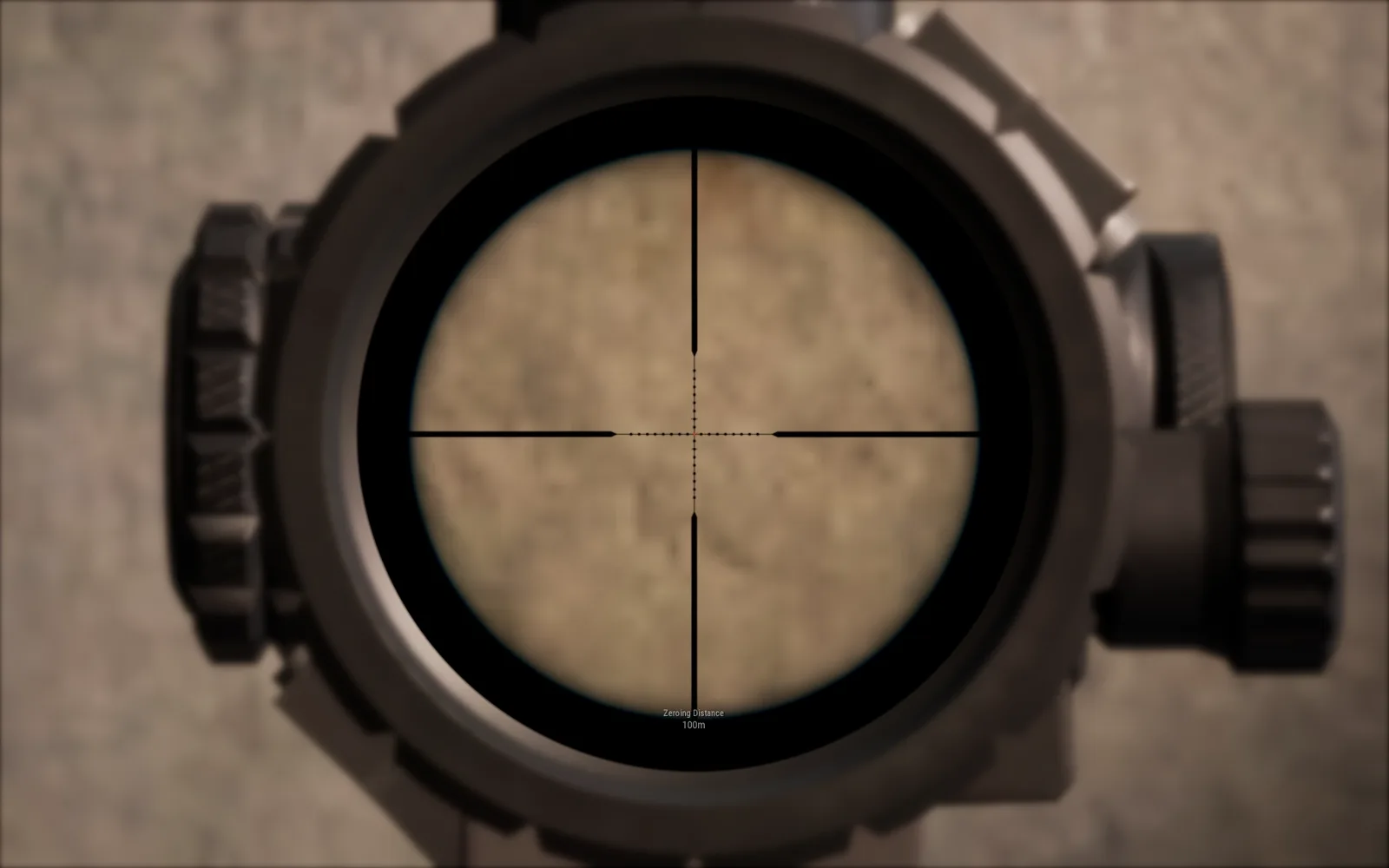
You spot a guy jogging along a ridge 300 meters out, put your dot dead center on his chest, fire, and watch the tracer sail under his feet into the dirt. He keeps running. You weren't wrong about your aim — you were wrong about gravity. That bullet started dropping the instant it left the barrel, and by 300 meters it had fallen well below where you were pointing.
That gap between where you aim and where the round lands is the entire reason zeroing exists, and it's the most common reason mid- and long-range shots miss in PUBG: Battlegrounds. Up close it doesn't matter — the bullet arrives before it can fall. Past roughly 150 meters it matters a lot, and past 300 it is the fight. This guide covers how bullet drop works, which scopes let you dial it out, how to actually change your zeroing, and how to read the rangefinder reticles baked into every optic so your long shots stop landing in the mud.
None of this is patch-dependent trivia — ballistics are core to how the game has fired a bullet since launch. Pair it with your recoil control and the right glass from the attachments guide, and your effective range jumps without your raw aim changing at all.
Zeroing, in one sentence
Zeroing is the distance at which your scope's center point of aim equals your point of impact. Set your zero to 300 and, at 300 meters, putting the center of the reticle on a target's chest lands the round on their chest — the game has pre-compensated for how far the bullet falls over that distance. Aim center, hit center. That's the whole idea.
The catch: zeroing is only correct at the one distance you set. Zero to 300 and shoot someone at 100, and the round lands high. Zero to 100 and shoot someone at 400, and it lands low. Zeroing isn't a magic "always hit" toggle — it's you telling the scope how far away you expect to be shooting, so the reticle does the drop math for that range and nothing else.
How bullet drop actually works in PUBG
Every bullet in PUBG is a physical projectile, not a hitscan line. When you fire, the round leaves the muzzle at a fixed speed (its muzzle velocity), travels across real time and distance, and falls the whole way under gravity. Two things follow from that:
- The farther the target, the more the bullet falls. Drop isn't linear — it accelerates. The difference between 100 and 200 meters is small; the difference between 300 and 400 is brutal.
- Travel time is real. At long range the bullet takes a noticeable fraction of a second to arrive, which is why you have to lead a moving target — aim where they'll be, not where they are.
Without any compensation, hitting a distant target means holdover: manually aiming above the target so the round arcs down onto them. Zeroing is the alternative — instead of eyeballing how high to hold, you tell the scope the range and aim dead center. Good players use both: zeroing for the range they're set up on, holdover for the in-between shots.
Which scopes let you adjust zeroing
Here's the part that trips people up, because not every optic can be zeroed — and the rules changed a few updates back.
Fixed 100-meter scopes
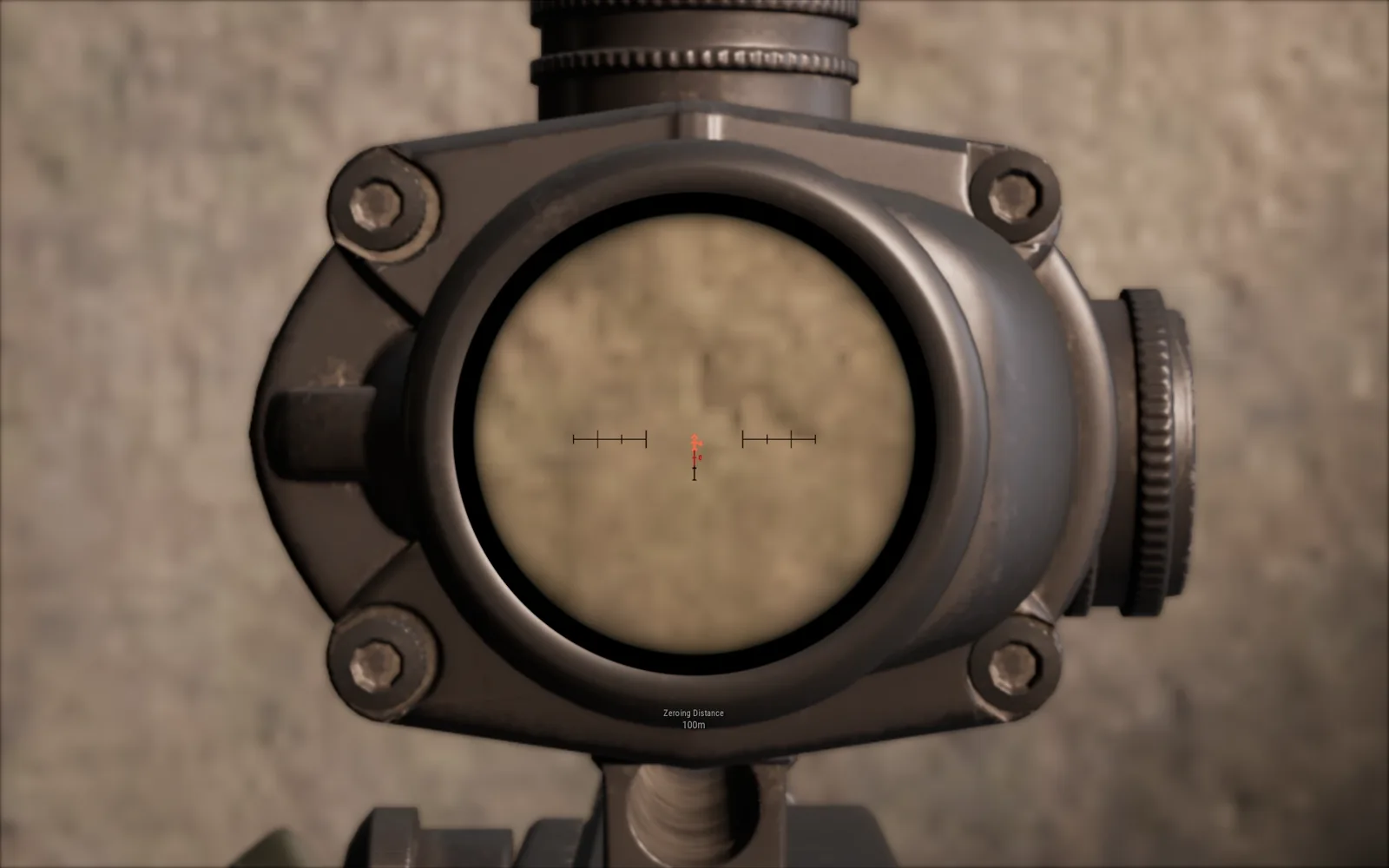
The Red Dot, Holographic, 2x, 3x, and 4x ACOG are all locked at a fixed 100-meter zero. As of the Miramar update, the 4x — along with the red dot and holo — lost its adjustable zeroing entirely and now sits permanently at 100. On these optics you cannot dial the drop out; you compensate the old-fashioned way, with holdover, using the hash marks and rangefinder lines on the reticle (covered below).
That's not a downgrade in disguise — the 4x is still one of the best all-round optics in the game and you grab it on sight. It just means that past ~150 meters with a 4x, you're holding over, not zeroing. For where each optic sits in a kit, the attachments guide and best loadouts lay it out.
Adjustable scopes: 6x, 8x, 15x
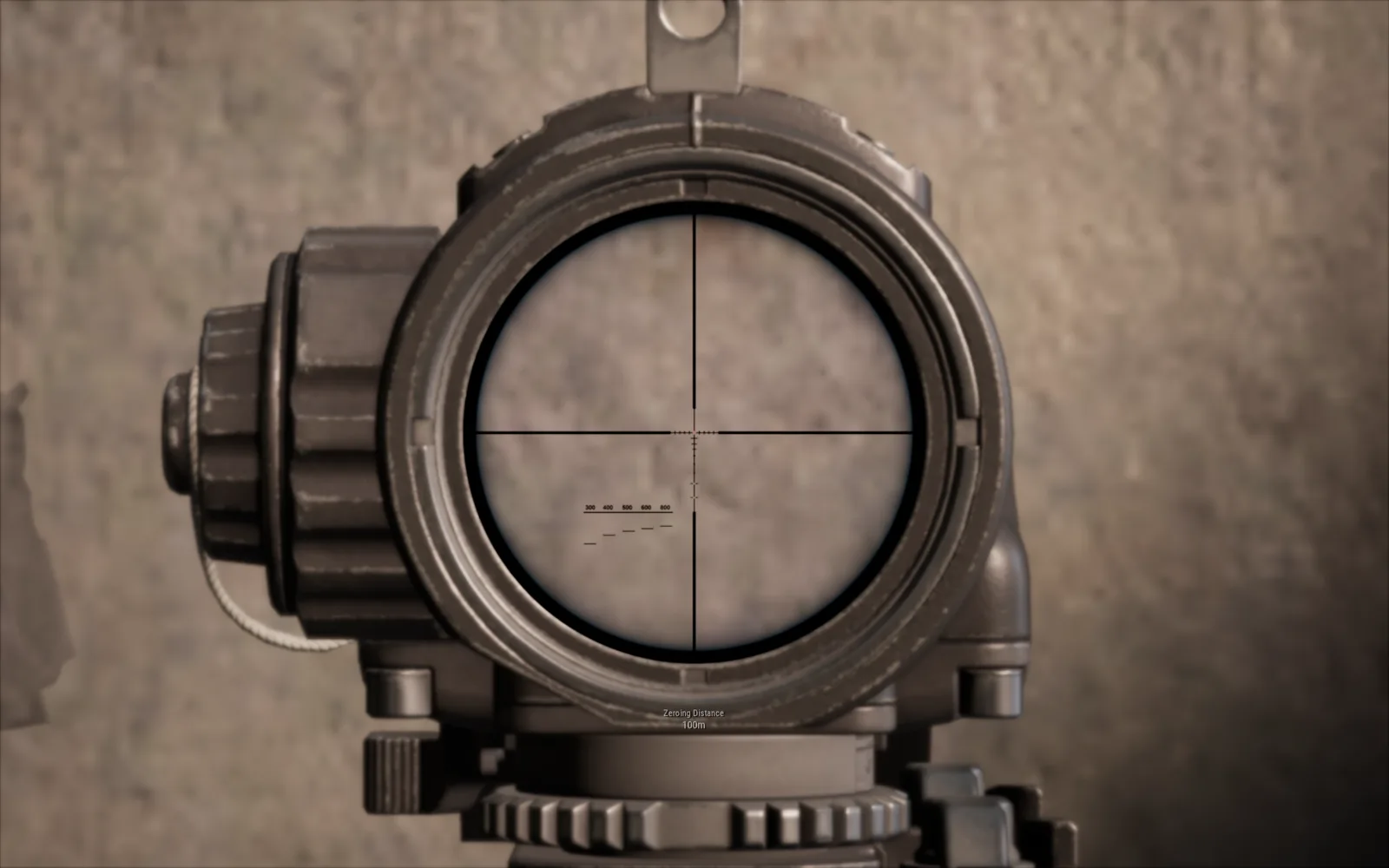
The high-power glass — the 6x, the 8x CQBSS, and the 15x PM II — is where zeroing lives. These are the scopes you adjust with Page Up and Page Down, stepping the zero out in 100-meter increments to match the range you're shooting. The 6x is a rare world spawn and the best zoomable optic for ARs and SMGs (it dials down to 3x for closer work); the 8x is a must-grab for long-range weapons; and the 15x is air-drop-only extreme-range glass. If you're running a DMR or a bolt-action — see the best DMRs and best sniper rifles — this is the tier you want bolted on top.
How to change your zeroing (Page Up and Page Down)
On PC, the default binds are Page Up to increase your zeroing distance and Page Down to decrease it, moving in 100-meter steps. Every scope starts at 100. On console it lives on the D-pad while aiming — check your control scheme, since the exact binding varies.
The routine in a real fight:
- Range the target. Use the rangefinder reticle (next section) or estimate off the terrain. Call it 300 meters.
- Dial to match. Tap Page Up twice to step 100 → 200 → 300.
- Aim center-mass and fire. The scope has now compensated for 300 meters of drop, so a center hold lands center.
- Re-dial as the fight moves. If they close to 150, your 300 zero now shoots high — drop it back down, or hold slightly low.
The honest reality: dialing mid-fight is slow, and against a moving target the range is changing constantly. Most players set a sensible standing zero for the band they're holding — say 200 for a mid-range ridge — and use holdover for shots off that number. Dialing shines when you are initiating on a static target and have a second to set up.
Reading range: the rangefinder reticles
Zeroing is useless if you don't know the range, and PUBG builds a rangefinder into most scopes so you don't have to guess. Each reticle uses the size of a standing player to tell you how far away they are:
- 2x Aimpoint: a standing person fills the outer circle at 100 meters, fits between the center dot and the outer ring at 200, and is obscured by the center dot at 300.
- 3x: the horizontal hash marks range shoulder-width targets from roughly 100 out to 400 meters.
- 4x ACOG: a built-in stadiametric rangefinder plus holdover chevrons down the reticle — the reason it punches above its zoom.
- 6x: a stadiametric rangefinder tuned for standing targets between about 300 and 800 meters, which is exactly the band where you'll be dialing zero.
The takeaway isn't to memorize every hash — it's to understand that the lines below your center dot are holdover marks. On a fixed-100 scope, you range the target, then place the correct lower chevron on them instead of the center dot. On an adjustable scope, you range them, dial the zero, and use center. Same information, two ways to apply it — and knowing your target's range first is what makes either one work.
Muzzle velocity and why it changes everything
Here's the piece most guides skip: two guns zeroed to the same distance do not shoot the same, because bullet drop depends on how fast the round is moving. A faster bullet spends less time falling, so it drops less over the same distance.
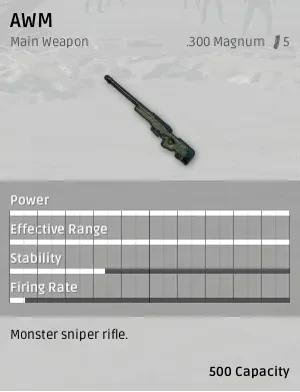
The extremes are worth knowing. The Mini-14 has the fastest initial bullet velocity of any gun in PUBG — quicker off the barrel than even the AWM — which is a big part of why it's such a forgiving long-range DMR: less drop, less lead, more margin for a sloppy range estimate. The AWM, meanwhile, fires .300 Magnum rounds with superior ballistics and the least drag of any sniper, so it holds its velocity downrange better than anything else in the crate.
What this means practically: the slower your gun's bullet, the more drop and lead you eat at range, and the more your zeroing and holdover have to do. A 7.62mm DMR arcs harder than a 5.56mm one. High-velocity guns paired with an 8x are the easiest long-range platform because they need the least compensation. If your shots keep landing low even after you zero correctly, your gun's bullet is slower than you assumed — respect the arc.
Common zeroing mistakes
- Forgetting you dialed. You zeroed to 400 for one shot, the fight collapsed to 80 meters, and now every round sails over their head. Reset to 100 after a long-range engagement so your next close fight isn't a surprise.
- Trying to zero a fixed scope. Mashing Page Up with a 4x does nothing — it's locked at 100. Know which glass you're running before you rely on dialing.
- Ignoring lead. Zeroing fixes vertical drop, not horizontal travel time. A target sprinting perpendicular at 300 meters still needs you to aim ahead of them; the bullet takes time to get there.
- Over-dialing on a moving fight. Micro-adjusting zero every 50 meters during a live duel just gets you killed mid-keystroke. Pick a band, hold it, and use holdover for the rest — the same read-the-fight discipline as peeking and crosshair placement.
- Never practicing in the range. The Camp Jackal training range exists specifically to let you feel drop, zeroing, and holdover with every scope. Ten minutes there beats learning it at 400 meters with someone shooting back — and dial in your sensitivity while you're at it.
Quick Action Checklist
- Remember bullets fall the whole way — hold or zero for drop past ~150 meters
- Grab a 6x or 8x for any long-range weapon; those are the scopes you can actually zero
- Know your fixed glass: red dot, holo, 2x, 3x, and 4x are locked at 100 meters
- Range the target off the reticle, then Page Up / Page Down in 100-meter steps to match
- Aim center-mass once zeroed; use the lower chevrons as holdover on fixed scopes
- Reset your zero to 100 after a long shot so your next close fight isn't a whiff
- Lead moving targets — zeroing kills drop, not travel time
- Prefer high-velocity guns like the Mini-14 and AWM at range; they need the least compensation
Frequently Asked Questions
What does zeroing do in PUBG?
How do you change zeroing in PUBG?
Which PUBG scopes have adjustable zeroing?
What is the difference between zeroing and holdover in PUBG?
Why do my long-range shots land low in PUBG even when I aim right?
Keep Reading
Related Guides
Best PUBG DMRs (Marksman Rifles), Ranked
A DMR is the gun that punishes a missed shot the least at long range — semi-auto follow-up beats a bolt cycle every time. Here's every PUBG marksman rifle ranked by role, control, and how often you'll actually hold one.
Best PUBG Sniper Rifles, Ranked
A Kar98k headshot ends a fight before the other guy finishes peeking. Here's every PUBG bolt-action and marksman rifle ranked by role, punch, and how often you'll actually hold one — plus when a DMR beats a sniper.
PUBG Ammo Types Explained: What Every Caliber Costs You
Every round you pick up in PUBG has a price tag in inventory space, and nobody reads it. A 7.62 bullet costs 40% more room than a 5.56 one, and a single frag grenade weighs the same as 54 rounds of 5.56. Here's the whole caliber system, priced out.
PUBG Melee Weapons Guide: Does the Pan Really Block Bullets?
The pan hits harder than every other melee weapon in PUBG and doubles as a plate of armor bolted to your back. Here's what each melee weapon actually does through armor, and the handful of moments where swinging is the correct play.
Best Weapons in PUBG: Tier List
Every PUBG tier list is out of date the moment a balance patch drops. So here's the list, ranked by role, plus the durable logic to re-tier any gun yourself when the next patch shakes things up.
Best PUBG Loadouts & Attachments
A naked M416 and a fully kitted M416 are basically two different guns. Here's how to build the strongest two-gun loadouts in PUBG and the attachment priority that turns loot into recoil control.