Riftbound Ban List Update: Ekko and Stacked Deck Banned
Riot published two new Standard and 2v2 bans on 15 September, effective 18 September: Ekko, Recurrent, for enabling an infinite combo in the Lux deck, and Stacked Deck, for overtuning the Kennen-led Chaos decks that topped the last two Regional Qualifiers. It is the third ban wave of the year, and the timing - a week before RQ Los Angeles, the same day Riftbound launches in Korea - is not an accident.
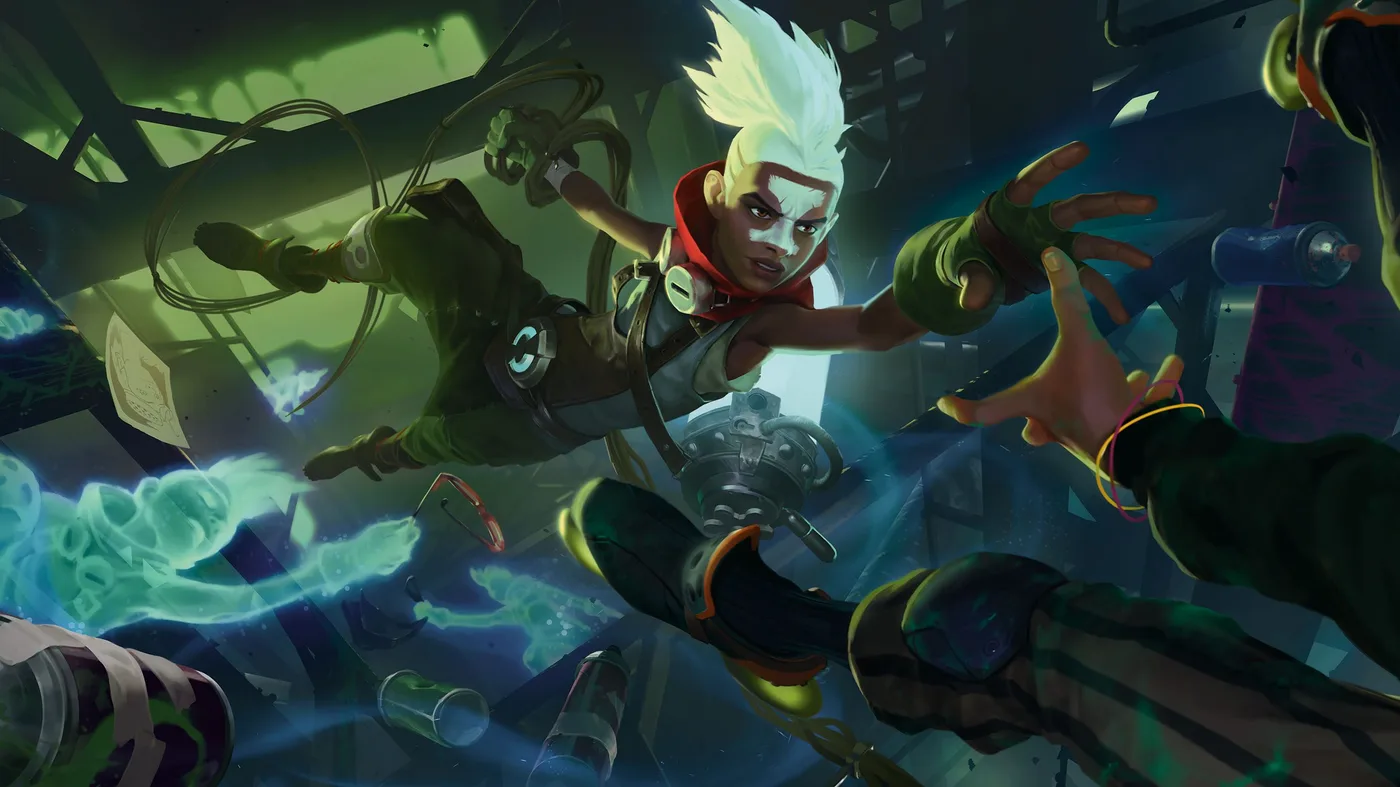
Riot banned two cards from Riftbound Standard and 2v2 Constructed on 15 September, effective 18 September. Ekko, Recurrent and Stacked Deck are both Origins cards - printed in the game's first set, legal since Riftbound's first tournament season - and both gone the moment that effective date lands. The date is not a coincidence with the rest of the calendar: 18 September is also the day Riftbound launches in South Korea, and it sits one week before RQ Los Angeles, the final Regional Qualifier of the year.
Riot's own framing makes the urgency explicit: "With the Shenyang Regional Open completed and the Los Angeles Regional Qualifier on the horizon, we wanted to release these bans quickly to let people adjust as we head into the Regional Championships." That is the entire announcement's thesis in one sentence - this is a pre-tournament correction, not a routine update.
What changed, and when
Effective 18 September 2026, two cards are banned in Riftbound Standard and 2v2 Constructed:
- Ekko, Recurrent - a Mind Champion Unit, cost 5, 5 Might (OGN 110/298)
- Stacked Deck - a Chaos spell, cost 1 (OGN 183/298)
Both bans apply to Standard and 2v2 identically; neither card was previously restricted in either format. Riot frames every ban decision, this one included, against the same three-question test it has used since Riftbound's first ban wave in March: "Is this card overrepresented in an unhealthy way? Are the problems with this card likely to get better or worse over time? Does this card promote unhealthy play patterns?" Both cards failed on the third question specifically, for different reasons.
Why Ekko, Recurrent is banned: the Lux infinite
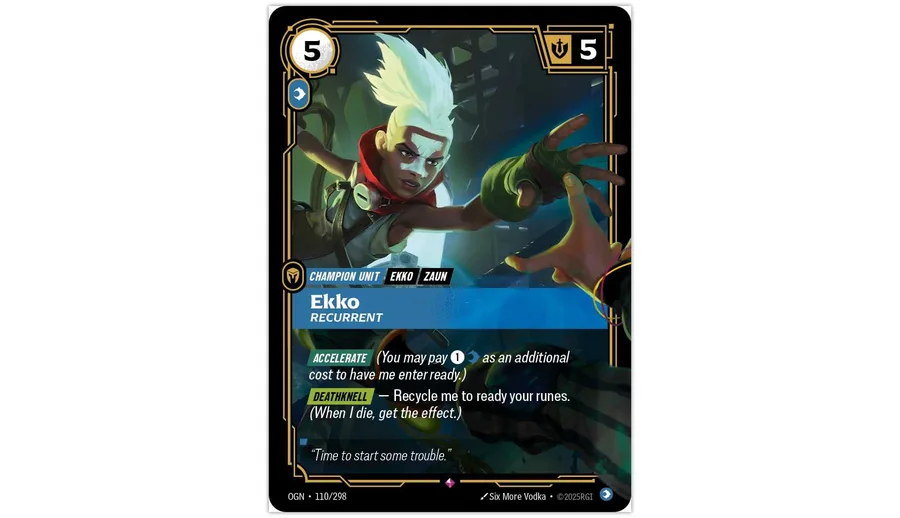
Ekko, Recurrent's printed text is short: Accelerate lets you pay 1 extra Mind to put him into play ready instead of exhausted, and his Deathknell reads "Recycle me to ready your runes." Riot's own explanation names the deck this actually mattered in: "Since the emergence of the Lux combo deck in Unleashed, we've been monitoring its tournament representation and performance." Lux, Lady of Luminosity runs the Mind domain (paired with Order), which makes Ekko a legal include, and the combination of readying a 5-cost body for free and refilling your rune resources on death is what Riot calls an infinite - "he both effectively grants an extra turn and also recycles itself."
The ban note is unusually candid about why this took until September rather than being caught at Unleashed's launch: "Although the play rate has remained low, we believe this style of infinite promotes an unhealthy play pattern due to its limited windows of interaction and solitaire-esque gameplay required to execute the combo." Low representation, in other words, was never the objection - the objection is that when the combo goes off, the opponent's turn stops mattering. Riot also states the collateral is intentionally narrow: "banning it shouldn't affect most other Mind decks."
Our Barcelona Regional Qualifier breakdown is the data point that matches this framing. Lux registered 17 times in a 2,130-player Day 1 field - 0.8% - but converted to Day 2 at 29.4%, well above the event's 17.8% baseline. A deck nobody plays that outperforms the field when it is played is exactly the "low play rate, real problem" shape Riot describes.
Why Stacked Deck is banned: the Kennen consistency engine
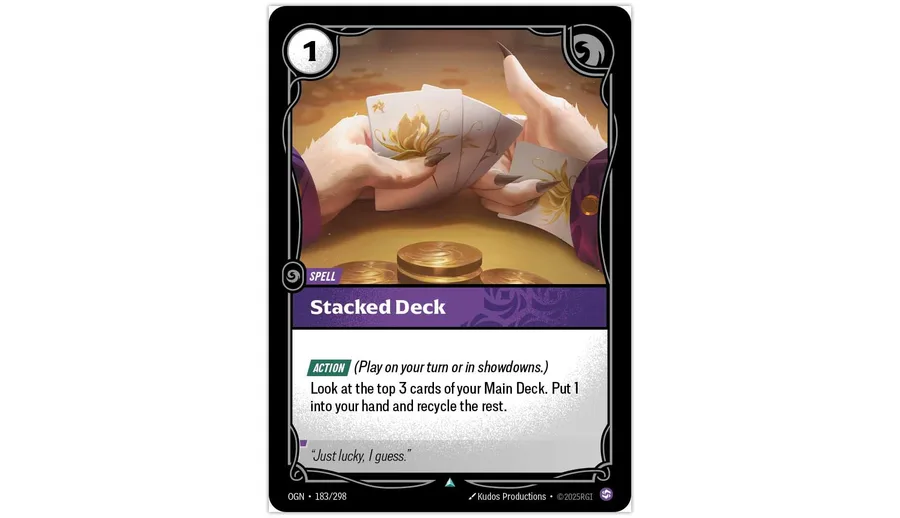
Stacked Deck is a one-cost Action: look at the top 3 cards of your Main Deck, keep one, recycle the rest. It is not a new card and it was never a problem on its own - Riot says so directly: "Stacked Deck is a low opportunity cost inclusion in a decklist that provides general consistency as well as cheap synergy when combined with cards like Ravenbloom Student or Battlefields like Abandoned Hall. While we acknowledge that the card is fun to play and can slot into any Chaos strategy seamlessly, the consistency it provides is higher than we would like and has shown a compounding issue with the release of the Kennen legend."
The mechanism Riot names is specific: "When combined with Lightning Rush, this card lets Kennen churn through the deck a little too efficiently, finding key cards like Nocturne while simultaneously filling the trash for Rhasa the Sunderer and Last Rites." That is a card-selection engine feeding Vendetta's trash-matters cards, and it explains why the fix targets the enabler rather than Kennen, Heart of the Tempest himself: "We think Kennen will feel the loss of Stacked Deck acutely, as his current strategy is built around maximizing card selection and having less access to it will slow down the entire engine."
This is the part with a paper trail in our own coverage. Kennen was the most-played Legend and the best Day 1-to-Day 2 converter at RQ Barcelona on 21-23 August - 12.7% of the Day 1 field, 30.0% conversion. At RQ Singapore on 4-6 September, per our RQ Los Angeles preview, Kennen went from 11.5% of Day 1 to 19.3% of Day 2, a +7.8-point swing that was the largest of the 43 Legends Riot tracked - both Regional Qualifiers played entirely under the ban list this update just replaced. Riot's own stated goal is not to remove Kennen from the format: "We want to avoid having a definitive best deck in the format. Kennen's play rate and win rate warrant a targeted ban that doesn't obliterate the deck and strategy, but brings it more in line with other top decks."
The full Standard and 2v2 ban list now
Reading Riot's Constructed Format Legality page alongside this announcement, here is what is actually banned as of 18 September 2026:
| Banned in Standard (cards) | Banned in Standard (battlefields) | 2v2 adds |
|---|---|---|
| Called Shot | Reaver's Row | Master Yi, Wuju Bladesman (Legend) |
| Scrapheap | Dreaming Tree | |
| Draven, Vanquisher | Obelisk of Power | |
| Fight or Flight | The Arena's Greatest | |
| Stealthy Pursuer | Aspirant's Climb | |
| Ekko, Recurrent | ||
| Stacked Deck |
That is seven banned cards and five banned battlefields in Standard, twelve entries becoming thirteen in 2v2 once Master Yi is added. Before 18 September the count was five cards and five battlefields in Standard, eleven in 2v2 - this update is a 40% jump in the Standard card-ban count in one release.
Every Riftbound ban so far, and why
Three ban waves, each citing the same three-question framework, each aimed at a different problem:
| Effective date | What was banned | Format | Why, in short |
|---|---|---|---|
| 31 March 2026 | Called Shot, Scrapheap, Draven, Vanquisher, Fight or Flight (cards); Reaver's Row, Dreaming Tree, Obelisk of Power (battlefields) | Standard | Riftbound's first bans: "Miracle" decks filtering and refilling their hand too efficiently for free, a guaranteed turn-2 Draven play, a spell "best in class in too many scenarios," a noninteractive retreat pattern, excess card flow distorting deckbuilding, and a battlefield that let decks bypass Energy breakpoints entirely |
| 24 July 2026 | Stealthy Pursuer (card); The Arena's Greatest, Aspirant's Climb (battlefields); Master Yi, Wuju Bladesman (2v2 only) | Standard, 2v2 | An infinite Recruit combo with Eye of the Herald and Renata Glasc, Industrialist reachable by turn three; a battlefield that handed the first player a deterministic Game 2/3 pick; a battlefield stretching round length badly enough to hurt tournament logistics; Master Yi's defensive bonus extending to a 2v2 teammate |
| 18 September 2026 | Ekko, Recurrent, Stacked Deck | Standard, 2v2 | An infinite combo in the Lux deck; Stacked Deck's outsized consistency compounding with the Kennen, Heart of the Tempest engine |
The July wave is the one covered in our 2026 set schedule post, written before this update - that post's ban count is accurate for its publish date but is now two cards behind. The March wave has not previously appeared in this vertical's coverage.
The timing: Shenyang, Los Angeles and the Chengdu Major
Riot names two specific competitive touchpoints for why this landed when it did: "as we head into the Los Angeles Regional Qualifier and the Chengdu Major." The Shenyang Regional Open - China's own Vendetta-season regional circuit - ran 12-13 September, concluding two days before this announcement. RQ Los Angeles runs 25-27 September, the event our RQ Los Angeles preview covers in full. Riot names the Chengdu Major without giving it a date in this article; the closest confirmed detail elsewhere is that a third 2026 Regional Championship in China, replacing what Riot had called the Radiance Major, exists and has an unpublished qualification structure - whether "Chengdu Major" is that event under a working name is not something this article, or any other Riot page we have checked, states outright.
Riot also addresses the elephant in the room directly rather than letting community pressure go unacknowledged: "We've been carefully monitoring the win rates of decks in our major tournaments as well as general community sentiment around the current metagame. For everyone that's talked to us and shared opinions, we hear you, and genuinely appreciate your passion." That is Riot confirming the Barcelona-into-Singapore Kennen trend was read as a problem internally, not just online.
What this does not touch
Two scoping notes worth being precise about, because they are easy to assume incorrectly:
- Limited is unaffected. Riftbound's Sealed and Draft rules explicitly let you "play cards banned in Standard Constructed" - a Limited pool that opens Ekko, Recurrent or Stacked Deck can still use them. This update only touches Standard and 2v2 Constructed.
- Korean Standard inherits it from day one. Korea's card pool starts at Origins alone on 18 September, with the global ban list applied. Because both newly banned cards are Origins cards and the ban's effective date is the same day Korean Riftbound goes live, Korean players never get a window where Ekko, Recurrent or Stacked Deck are legal - they are banned before the format exists there.
Quick reference
- Banned effective 18 September 2026: Ekko, Recurrent (Mind Champion Unit) and Stacked Deck (Chaos spell), in both Standard and 2v2 Constructed.
- Why: Ekko enabled an infinite combo in the Lux deck ("solitaire-esque gameplay"); Stacked Deck compounded with Lightning Rush to over-fuel the Kennen, Heart of the Tempest engine.
- Full Standard ban list now: 7 cards (Called Shot, Scrapheap, Draven Vanquisher, Fight or Flight, Stealthy Pursuer, Ekko Recurrent, Stacked Deck), 5 battlefields (Reaver's Row, Dreaming Tree, Obelisk of Power, The Arena's Greatest, Aspirant's Climb). 2v2 adds Master Yi, Wuju Bladesman.
- Third ban wave of 2026, after 31 March and 24 July.
- Timing: announced after the Shenyang Regional Open, one week before RQ Los Angeles, and the same day Riftbound launches in South Korea.
- Not affected: Sealed, Draft and any other Limited format, where Standard-banned cards remain legal.
Frequently Asked Questions
What did Riftbound ban in September 2026, and when does it take effect?
Why was Ekko, Recurrent banned in Riftbound?
Why was Stacked Deck banned in Riftbound?
What is the full Riftbound Standard ban list as of September 18, 2026?
Does the Ekko and Stacked Deck ban affect Sealed, Draft or Korean Standard in Riftbound?
Has Riftbound banned other cards before September 2026?
Keep Reading
- September Ban List Updates (Effective September 18, 2026) (Riot Games, official, 15 September 2026) - the Ekko, Recurrent and Stacked Deck bans, full design reasoning, and the Shenyang/LA/Chengdu Major timing context
- July Ban List Updates (Riot Games, official, 17 July 2026) - the Stealthy Pursuer, The Arena's Greatest and Aspirant's Climb bans, and the creation of the 2v2 ban list
- Announcing Riftbound's First Bans (Riot Games, official, 30 March 2026) - the original four-card, three-battlefield Standard ban wave
- Riftbound Rules Hub (Riot Games, official) - current Constructed Format Legality and ban lists
- Singapore's Top Decks (Riot Games, official, 9 September 2026) - the Day 1-to-Day 2 Kennen swing this ban responds to
Related Guides
Riftbound Battlefields: What 111 Tournament Decks Ran
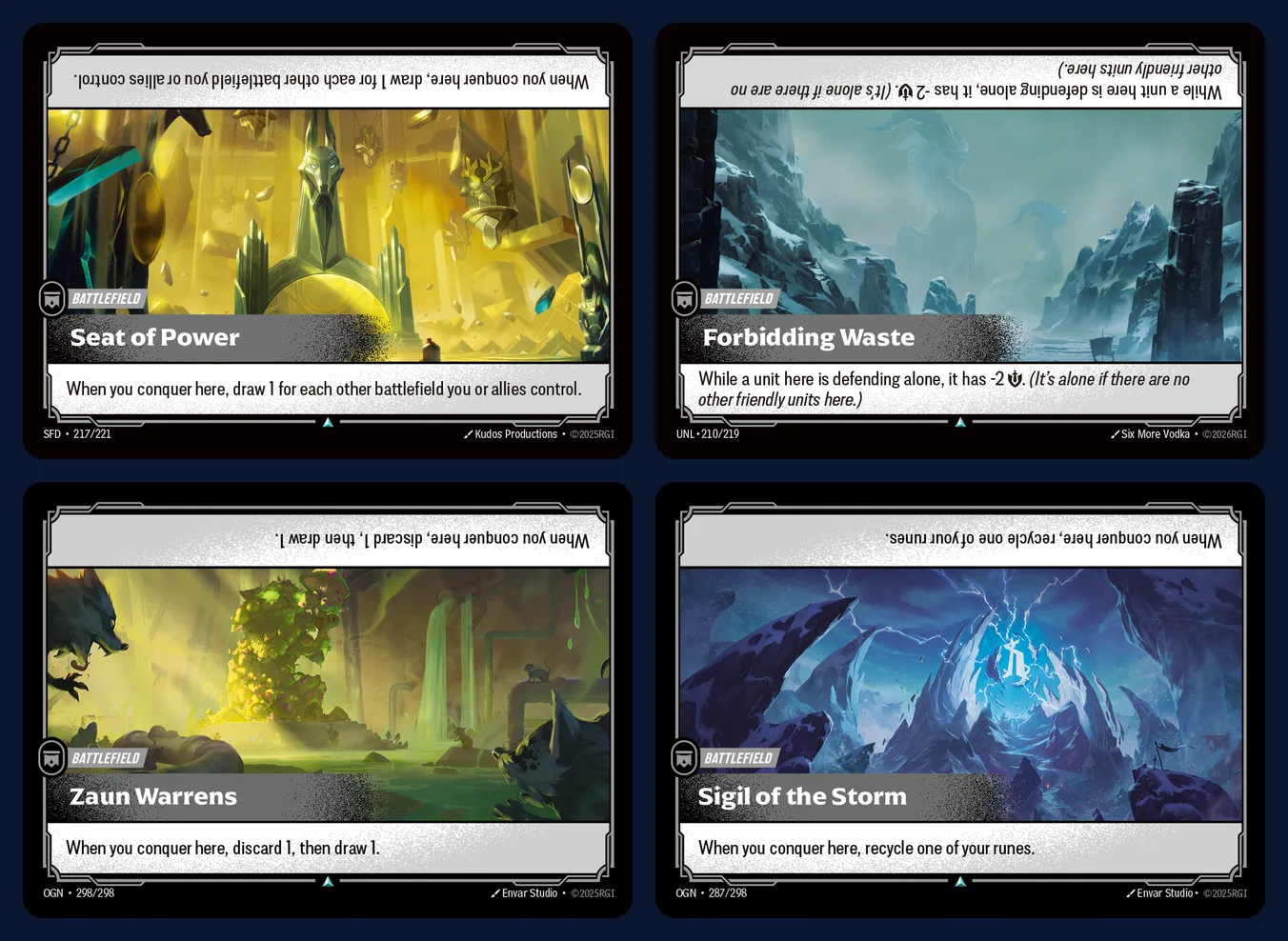
Every decklist Riot published from Barcelona, Singapore and Los Angeles, counted by battlefield. Seat of Power was the most registered and the most common in Top 8s, six popular battlefields carry no payoff for whoever holds them, and Radiance adds ten more on 23 October.

Riftbound RQ Los Angeles Results and the Post-Ban Meta
RQ Los Angeles was the first Regional Qualifier played after Riot banned Stacked Deck to slow Kennen down. Riot's own table shows fewer players registering Kennen afterwards, not Kennen surviving Day 1 any worse - it converted to Day 2 at 38.2%, the best of any Legend with ten or more pilots, and still put nobody in the Top 8. Rengar won, undefeated.

Riftbound Barcelona Meta: Who Actually Made Day 2
Riot published the full Legend breakdown from Regional Qualifier Barcelona - 2,130 players on Saturday, 379 on Sunday, 41 Legends, two columns of counts. Divide one column by the other and you get the number that actually says who showed up versus who survived, and the Legend that won the event is not near the top of it.
Riftbound Stuttgart Regional Championship: Prizes and Rules
Three weeks before Stuttgart, Riot rewrote what a Riftbound Regional Championship pays out. Overnumbered Foil Plated Legends are now drafted by the top 58 finishers, Best-Of prizes shrink to Unleashed, Vendetta and Radiance Legends, decklists are open, and asking for a concession gets you disqualified. Here is what changed, what each finish now earns, and what is still unannounced.

How to Play Riftbound — The League of Legends TCG Rules, Explained (2026)
Riftbound has no life total. You take objectives. Eight points ends it. Here is the whole rules set as Riot actually wrote it - runes, domains, battlefields, showdowns, deck construction, and the final-point rule that decides more games than any card does.
Riftbound 2027 Organized Play: Regionals and Continentals
RQ Los Angeles was the final Regional Qualifier of 2026, and under Riot's 2027 plan the last event to carry that name. In 2027 the RQ becomes the Riftbound Regional, the Regional Championship becomes a once-per-set Continental with an open Day 1, and Summoner Skirmish is retired in favour of two new store programs. Here is the whole structure, the first three dated events, and what Riot has still not published.