Riftbound Domains Explained: All 6 Colors and Their Legends
Riftbound has six domains, and your Legend picks two of them for you. Here is what each color actually plays like - its strengths, its blind spots, its signature mechanics - plus the full grid of all 49 Legend cards by domain pairing, and the three rival pairings that did not exist until Vendetta.
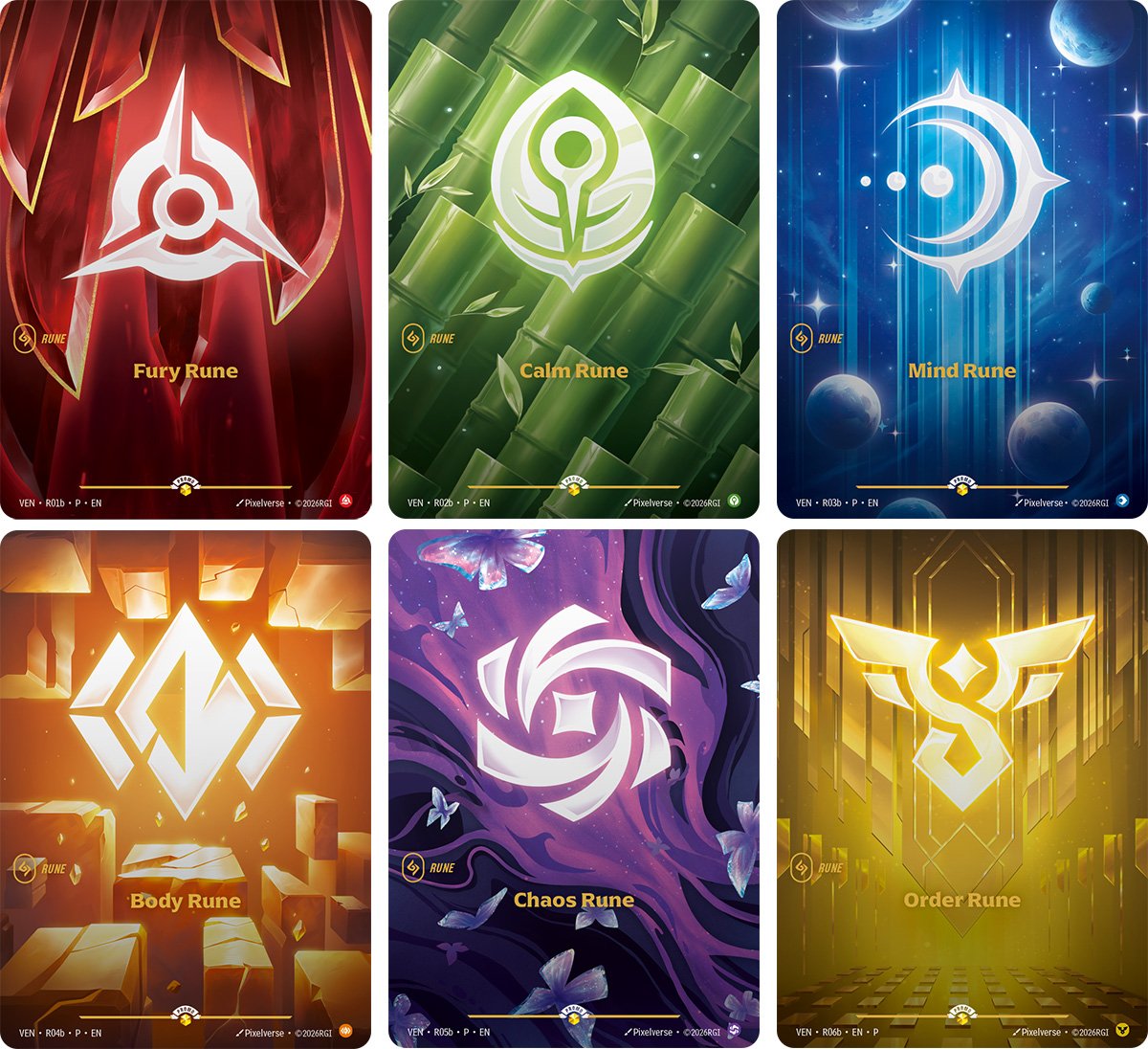
Ask what a Riftbound domain is and you get a rules answer: a symbol in the corner that decides deck legality. Ask what a domain does and you get the answer that actually matters at the table, because the six domains are Riftbound's whole strategic vocabulary - its version of Magic's color pie - and your Legend commits you to exactly two of them before you sleeve a single card.
The legality half of the story is short and covered elsewhere: how to play Riftbound explains the Domain Identity rule, and deckbuilding basics covers what it does to a decklist. This is the other half - what each color is for, and which Legend pairings actually exist. That second question turns out to have a genuinely interesting answer: three of the fifteen possible pairings did not exist at all until 31 July 2026.
The six domains at a glance
Riot Game Director Dave Guskin lays out the six philosophies in his official Deckbuilding Primer, and the numbers below come from reading every Legend printed so far. Opposites sit on the same row:
| Domain | Color | Opposite | Wants to | Struggles with |
|---|---|---|---|---|
| Fury | Red | Calm | Attack, conquer, deal damage | Card draw, removing units sitting at base |
| Calm | Green | Fury | Hold ground, stun, counter | Playing aggressively, non-unit board interaction |
| Mind | Blue | Body | Draw, plan, shrink enemy stats | Moving units, unit efficiency |
| Body | Orange | Mind | Ramp, deploy big efficient units | Card draw, non-combat spells |
| Chaos | Purple | Order | Trick, reposition, recur from trash | Permanent removal, lasting buffs |
| Order | Yellow | Chaos | Swarm, sacrifice, kill cleanly | Efficient answers to small units, repositioning |
Each domain also has one Basic Rune. Runes carry their domain, and your 12-rune deck must fit your Domain Identity - but battlefields and tokens have no domain at all, which is why any deck can run any battlefield.
Fury, the red domain
Guskin's primer calls Fury "about aggression, passion, and the thrill of conquering," and the card file backs the sales pitch. Fury's recurring tools are damage-based removal, Accelerate and other effects that let units act the moment they arrive, Assault, and abilities that pay you for conquering battlefields - the domain is pointed directly at the scoreboard.
The cost is everything that is not the scoreboard. Fury generally struggles with card draw, and it has limited ways to remove a unit that stays safely at its controller's base and refuses to fight.
Calm, the green domain
Calm is Fury's opposite: "about balance, meditation, and the peace of holding." Where Fury forces the issue, Calm defends what it has taken - Shield, Stun, Tank, hold effects, counterspells, and might increases at reaction speed, the kind you flash in mid-combat after your opponent has committed.
The trade is that Calm struggles to play aggressively, and outside its units it has limited ways to touch the board. A Calm deck that falls behind on battlefields has to grind its way back rather than burst its way back.
Mind, the blue domain
Mind is "about innovation, outsmarting opponents, and the benefits of intelligence and curiosity" - the long-game color. Its recurring tools are heavy card draw, added resources (including Gold tokens), might reductions that shrink enemy units, Sprite tokens, and - less intuitively - damage-based removal of its own.
Its weaknesses are physical. Mind has trouble moving units around the board, and its units tend to be less efficient than other domains' - you are paying for the cards in your hand, not the stats on the table.
Body, the orange domain
Body is "about physical superiority, agility, and connection to the wilds," and it is the domain of stat superiority: resource ramp, efficient high-impact units, Buff, might increases at action speed, Dragon synergy, and unit-based removal - spells that let a friendly unit deal its might to an enemy, so your big creature is also your removal spell.
Like its rival Fury, Body struggles with card draw, and it has fewer efficient non-combat spells than the other domains. If the answer is not a large unit, Body mostly does not have the answer.
Chaos, the purple domain
Chaos is "about unpredictability, rebellion, and trickiness." Its toolkit is broad: Hidden cards, discard (yours and your opponent's), selective draw, trash interaction, nonstandard movement, and bounce - returning permanents to hand as soft removal.
The catch is in that word soft. Chaos generally cannot permanently eliminate a threat or give its own units lasting enhancements. It wins by being somewhere unexpected, not by winning fair fights.
Order, the yellow domain
Order is "about unity, community, and sacrifice for the greater good" - the go-wide color. It generates weak unit tokens, gains value from its own units dying through Deathknell and sacrifice effects, and carries the game's cleanest hard removal: spells and abilities that simply kill.
Its blind spots are the mirror of its strengths: Order struggles to answer small enemy units efficiently - a kill spell aimed at a one-might token is a bad trade - and it has limited ways to reposition units once they are placed.
Every Legend is a two-domain pairing
You never play one domain. All 49 Champion Legend cards printed through Vendetta carry exactly two domains, and that pair - your Domain Identity - is the wall every card in your Main Deck and Rune Deck must fit inside. Single-domain cards need one match; multi-domain cards need both of theirs inside your identity.
Six domains make fifteen possible pairs. Twelve of them mix domains that are not opposites. The other three - Fury with Calm, Mind with Body, Chaos with Order - pair a philosophy with its own contradiction, and for Riftbound's first three sets Riot simply did not print them.
That is not a guess; it is what the set lists show. Origins, Spiritforged and Unleashed each shipped twelve Legends, and each set covered exactly the same twelve non-opposing pairings, once apiece. Three sets, three complete laps of the same grid, opposites conspicuously absent every time.
The full Legend grid, Origins through Vendetta
Here is every main-set Legend by pairing. Read a row across and you can see each set re-answering the same combination with a different champion:
| Domains | Origins (OGN) | Spiritforged (SFD) | Unleashed (UNL) | Vendetta (VEN) |
|---|---|---|---|---|
| Fury + Mind | Kai'Sa (Daughter of the Void) | Rumble (Mechanized Menace) | Jhin (Virtuoso) | - |
| Fury + Body | Volibear (Relentless Storm) | Lucian (Purifier) | Rengar (Pridestalker) | Renekton (Butcher of the Sands) |
| Fury + Chaos | Jinx (Loose Cannon) | Draven (Glorious Executioner) | Pyke (Bloodharbor Ripper) | Zed (Master of Shadows) |
| Fury + Order | Darius (Hand of Noxus) | Rek'Sai (Void Burrower) | Vi (Piltover Enforcer) | - |
| Calm + Mind | Ahri (Nine-Tailed Fox) | Ornn (Fire Below the Mountain) | Lillia (Bashful Bloom) | Nasus (Curator of the Sands) |
| Calm + Body | Lee Sin (Blind Monk) | Jax (Grandmaster at Arms) | Master Yi (Wuju Master) | - |
| Calm + Chaos | Yasuo (Unforgiven) | Irelia (Blade Dancer) | Vex (Gloomist) | - |
| Calm + Order | Leona (Radiant Dawn) | Azir (Emperor of the Sands) | Ivern (Green Father) | Shen (Eye of Twilight) |
| Mind + Chaos | Teemo (Swift Scout) | Ezreal (Prodigal Explorer) | Diana (Scorn of the Moon) | Mel (Soul's Reflection) |
| Mind + Order | Viktor (Herald of the Arcane) | Renata Glasc (Chem-Baroness) | LeBlanc (Deceiver) | - |
| Body + Chaos | Miss Fortune (Bounty Hunter) | Sivir (Battle Mistress) | Kha'Zix (Voidreaver) | - |
| Body + Order | Sett (The Boss) | Fiora (Grand Duelist) | Poppy (Keeper of the Hammer) | Ambessa (Matriarch of War) |
| Fury + Calm | - | - | - | Akali (Rogue Assassin) |
| Mind + Body | - | - | - | Jayce (Defender of Tomorrow) |
| Chaos + Order | - | - | - | Kennen (Heart of the Tempest) |
Four starter Legends from Proving Grounds (OGS) sit outside the grid's main sets but inside its pairings: Annie (Dark Child, Fury + Chaos), Master Yi (Wuju Bladesman, Calm + Body), Lux (Lady of Luminosity, Mind + Order) and Garen (Might of Demacia, Body + Order). Master Yi is the only champion with two different Legends, both on the same Calm + Body pairing.
Two things fall out of the table. First, six pairings now have four main-set Legends to choose from while six others have three - if you love a specific pairing, your options are not equal. Second, the bottom three rows are one card deep. Which brings us to the interesting part.
Vendetta broke the rival-pair rule
Vendetta's nine Legends are usually described as the rivalry set, and three of them are rivalries between the domains themselves - the first Legends ever printed on opposing pairs.
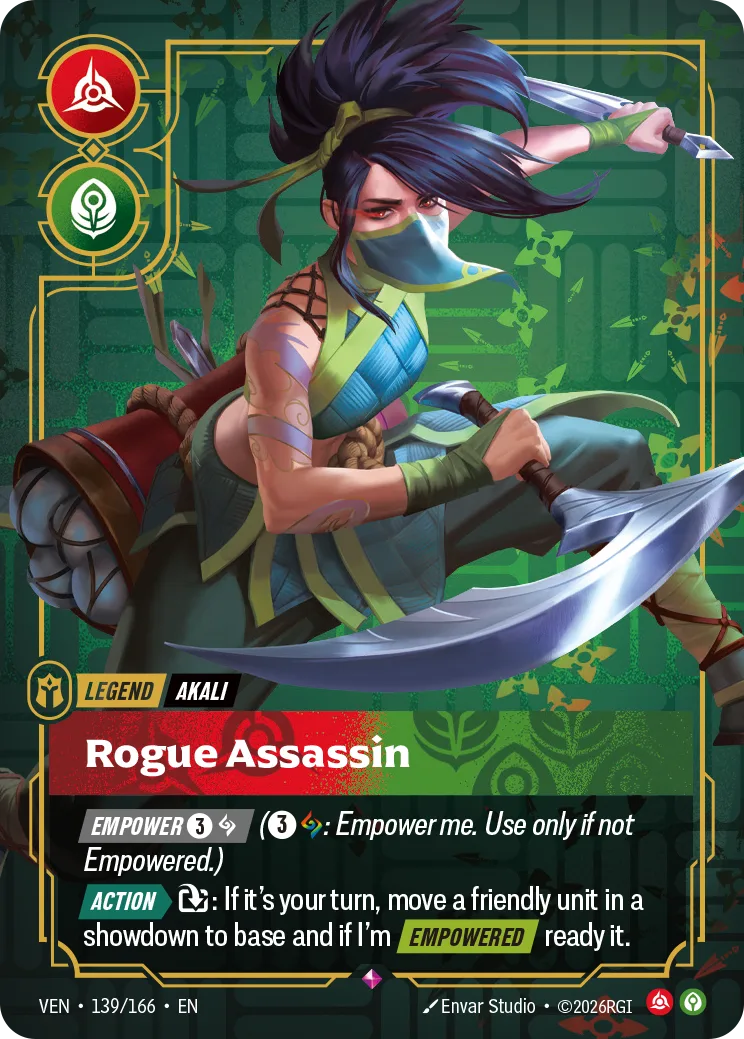
Akali, Rogue Assassin is the first Fury + Calm Legend. The card is a clean expression of holding both philosophies at once: an Action that moves a friendly unit in a showdown back to base - a Calm retreat - and, while she is Empowered, readies that unit as it returns, which is Fury's tempo dressed in Calm's clothing. Strike, vanish, strike again.
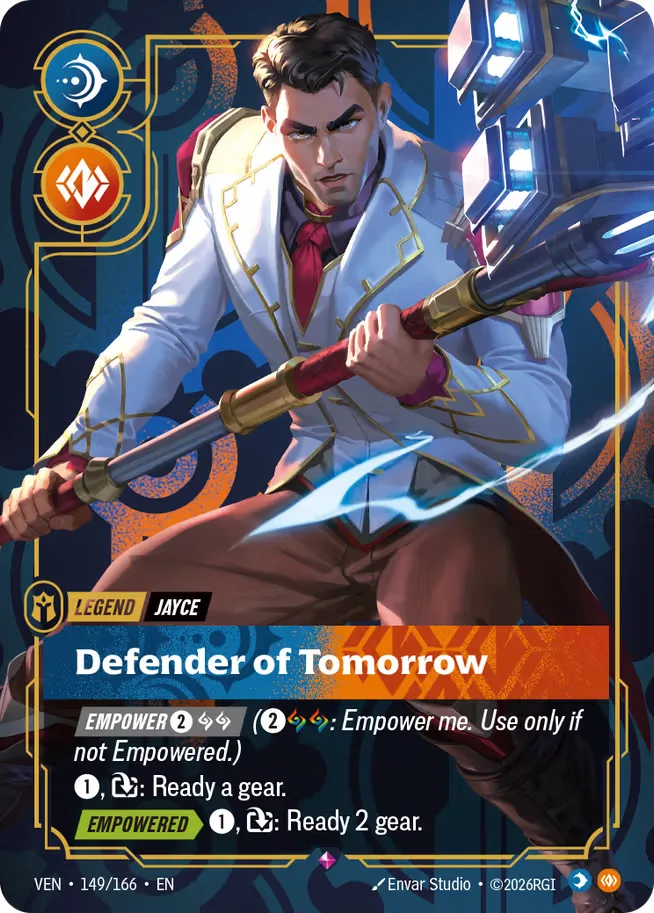
Jayce, Defender of Tomorrow is the first Mind + Body Legend - the inventor and the hammer in one card. His printed abilities are all about gear: pay 1 and exhaust to ready a gear, or ready two while he is Empowered, turning equipment into a repeatable engine rather than a one-shot bonus.
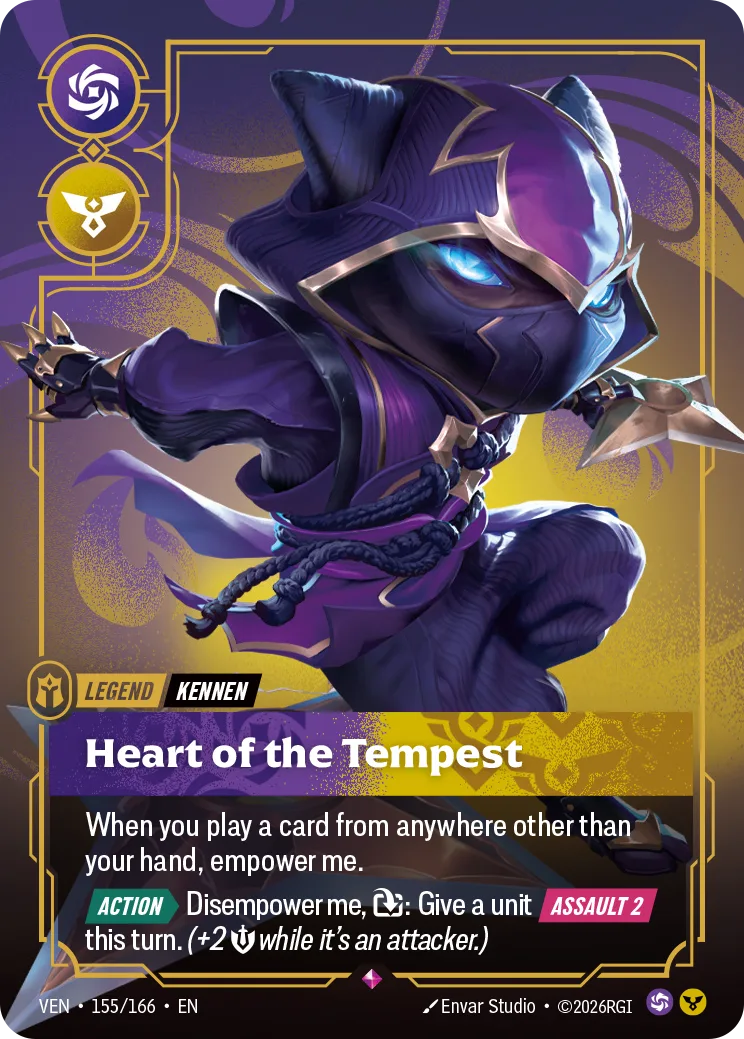
Kennen, Heart of the Tempest is the first Chaos + Order Legend. He empowers himself whenever you play a card from anywhere other than your hand - Chaos's trash-and-Hidden games feeding him directly - and cashes it in by disempowering to give a unit Assault 2 for the turn, pointing all that trickery back at the battlefield in true Order fashion.
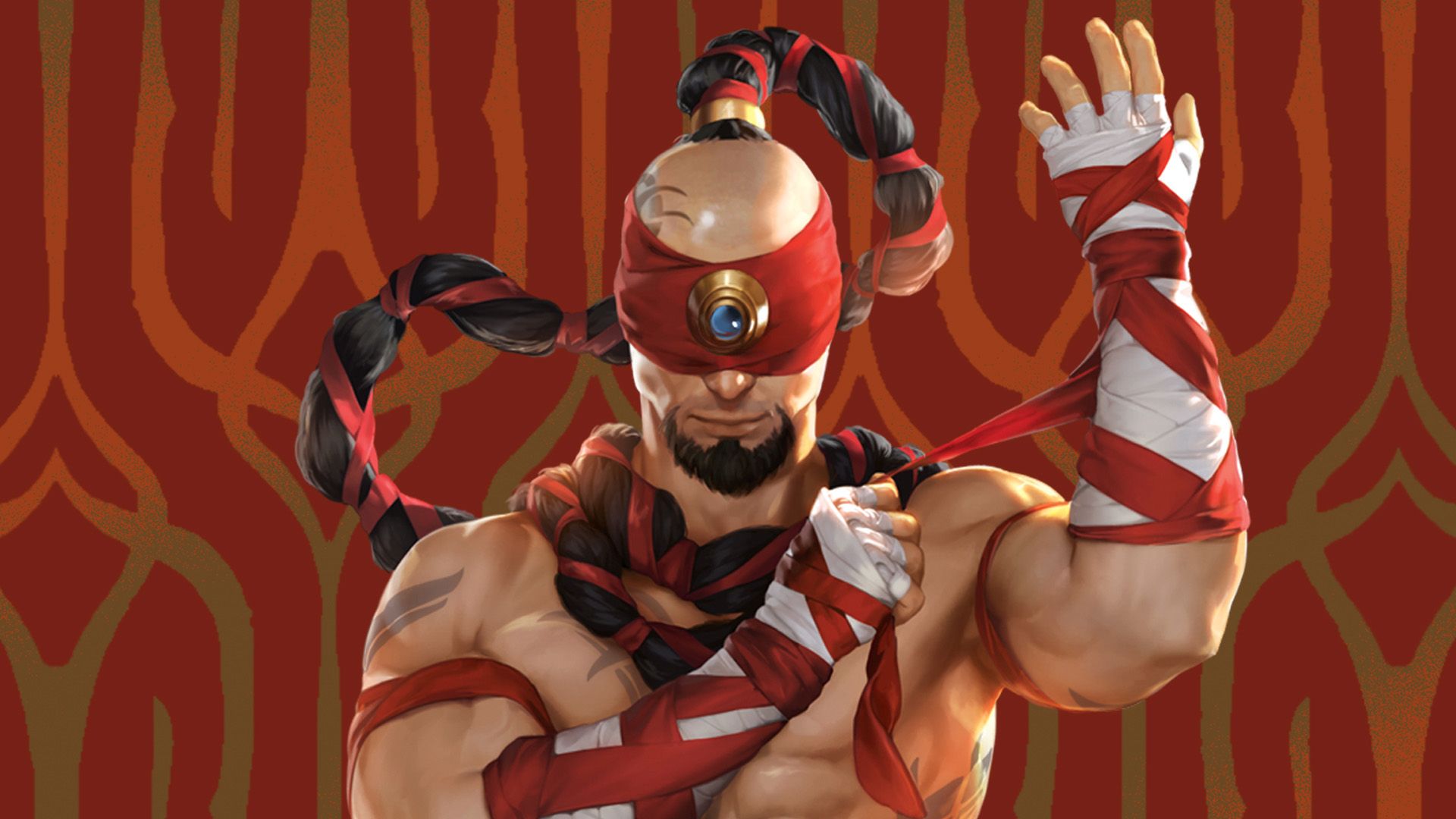
Note what Vendetta did not do: it did not print all nine Legends on rival pairs. The other six - Renekton, Zed, Nasus, Shen, Mel and Ambessa - sit on pairings the grid already had, some going back to Origins. The rival-pair experiment is exactly three cards deep, one per opposing pair, and as of August 2026 each of those three pairings has exactly one Legend in the entire game. If you want to know what an internally contradictory Domain Identity plays like, there is precisely one card per contradiction that will show you.
Which pairing should you pick first
No tier list here - Vendetta is weeks old and this is a what-does-it-do guide, not a what-wins guide. But the domain profiles above give you an honest way to choose:
- You want to attack every turn: start from Fury and pick the second color by what your losses feel like. Fury + Body doubles down on combat stats; Fury + Chaos adds tricks and reach; Fury + Order adds tokens so you have an attacker.
- You want to react, not act: Calm is your anchor. Calm + Mind is the draw-and-answer control pairing; Calm + Order trades reaction spells for board resilience.
- You want to out-resource people: Mind + Order carries draw plus clean removal; Mind + Chaos swaps some of that cleanliness for recursion and surprise.
- You want big units and simple questions: Body + Order and Fury + Body ask them loudest.
- You already know you like contradictions: the three Vendetta rival Legends are each the only card in their pairing, so the Legend is the archetype. Pick the champion you like; there is no second option to compare against.
Remember the constraint that shapes all of this: your two domains also set your 12-rune deck, and a multi-domain card needs both of its colors inside your identity. The pairing is not a suggestion. It is the border of your entire card pool.
Quick reference
- Six domains: Fury (red), Calm (green), Mind (blue), Body (orange), Chaos (purple), Order (yellow).
- Three opposing pairs: Fury-Calm, Mind-Body, Chaos-Order.
- Every Legend has exactly two domains. 49 Legend cards exist through Vendetta: 45 across the four main sets plus 4 Proving Grounds starters.
- Fifteen pairings are possible. Origins, Spiritforged and Unleashed each covered the same 12 non-opposing pairings; Vendetta added the three opposing ones.
- The first rival-pair Legends: Akali, Rogue Assassin (Fury + Calm), Jayce, Defender of Tomorrow (Mind + Body), Kennen, Heart of the Tempest (Chaos + Order) - one Legend each, and so far the only ones.
- Battlefields and tokens have no domain. Runes do, and your Rune Deck must match your identity.
If the keywords in the mechanics lists above are unfamiliar - Assault, Tank, Hidden, Deathknell, Accelerate - the keyword breakdown defines all of them, and the 2026 set schedule covers which sets added what. Radiance lands 23 October; whether it deepens the rival pairs past one Legend apiece is the next thing this grid will tell us.
Frequently Asked Questions
What are the six domains in Riftbound?
What are the opposite domains in Riftbound?
What is Domain Identity in Riftbound?
How many Legends are in Riftbound?
Which Riftbound Legends have opposite domain pairings?
Did every set add Legends for the same domain pairings?
Do battlefields have a domain in Riftbound?
Keep Reading
- Riftbound Deckbuilding Primer - Game Director Dave Guskin (Riot Games, official) - the six domain philosophies
- Domain - Riftbound (League of Legends Wiki) - domain colors, opposites and Domain Identity rules
- Legend - Riftbound (League of Legends Wiki) - the full Champion Legend card list by set
- Akali, Rogue Assassin guide (riftbound.gg) - the first Calm and Fury domain mix
- Riftbound Vendetta Legends Guide (Skillshotz Gaming) - the three enemy domain pairs debuting in Vendetta
Related Guides
Riftbound Keywords Explained: All 28 in the Core Rules
The Riftbound Core Rules in force until 15 October 2026 define 25 keywords, and Riot's 9 October update adds Deploy, Disarm and Show Off from 16 October, for 28. The reminder text printed on the card is a summary, not the rule. Here is the whole glossary sorted by what each keyword actually is - passive, triggered, activated, permissive, dependent, cost, or a deck-construction rule that never does anything at the table.
Riftbound Sealed and Draft: The Limited Format Rules
Riftbound Limited is not constructed on a budget - it switches off most of the deckbuilding rules you learned. Sealed hands you six packs and a 25-card minimum, Draft hands you three packs and a 20-card minimum, and both let you run ten copies of the same card, ignore Unique, and play cards that are banned in Standard.
Riftbound Vendetta Rules FAQ: Key Rulings Explained
Riot published the Vendetta Rules FAQ on 14 August 2026 and gave it precedence over the Core Rules Document until a new one was released. That new rulebook arrived on 9 October, effective 16 October. The FAQ also reverses a ruling Riot published in January, explains why Kayle can hold three copies of a status the rules call binary, and admits to a bug the Vendetta rules update introduced.
How to Play Riftbound — The League of Legends TCG Rules, Explained (2026)
Riftbound has no life total. You take objectives. Eight points ends it. Here is the whole rules set as Riot actually wrote it - runes, domains, battlefields, showdowns, deck construction, and the final-point rule that decides more games than any card does.
Riftbound Deckbuilding Basics - The Legal Rules, the Curve Math, and Fixing a Precon
A legal Riftbound deck is four separate stacks, and three of them are not the 40 cards you spent all your time on. Here is deck construction straight out of Riot's Core Rules and Tournament Rules, the rune math that decides your curve, the six mistakes new builders make, and how to upgrade a Showdown Deck without making it illegal.
Riftbound Chains and Focus: The HOT FEPR Timing Rules
Riftbound's turn is always in one of four states, and the state - not the card - decides whether you are allowed to play anything. The Core Rules run the whole timing system on two separate permissions called priority and focus, a stack called the chain, and a five-step resolution loop the rulebook actually names in the text: HOT FEPR.