How to Play Riftbound — The League of Legends TCG Rules, Explained (2026)
Riftbound has no life total. You take objectives. Eight points ends it. Here is the whole rules set as Riot actually wrote it - runes, domains, battlefields, showdowns, deck construction, and the final-point rule that decides more games than any card does.

The first time you sit down with a Riftbound deck, your TCG instincts will actively work against you. There is no life total to chip away at. Killing your opponent's whole board wins you exactly zero points. You can hold a dominant position for six turns and still lose to somebody who kept walking one cheap unit onto an empty objective.
That is because Riftbound is not a damage race. It is a control-point game wearing a trading card game's clothes, which makes sense once you remember Riot built it — the win condition is closer to Summoner's Rift objectives than to anything in Magic. Riot's own How to Play page compresses the whole game into four steps: choose your champion, fuel your power with runes, contest and claim battlefields, reach 8 points to win.
Everything below is pulled from the official Riftbound Core Rules and Tournament Rules, not from a stream or a hearsay chain. The versions in force until 15 October 2026 are both dated 16 July 2026. Riot published new versions of both on 9 October, effective 16 October with the Radiance Pre-Rift. This guide has been checked against both, and where they differ on something covered here, the text gives both versions with their dates. Where the rules are strange, I have quoted them.
Riftbound in one paragraph
Riftbound is a trading card game from Riot Games set in the League of Legends universe. Each player builds around a Champion Legend, spends runes to deploy units and cast spells, and pushes those units onto shared battlefields. Controlling a battlefield scores points. A player wins the game if, in a cleanup, they have points greater than or equal to the Victory Score and more points than any other player. The default Victory Score is 8. Origins, the first set, launched in English on 31 October 2025; as of August 2026 the game is four sets deep, with Vendetta — Riot's fourth set — having gone live on 31 July 2026, two days before this was written. Radiance is Set 5 and does not arrive until 23 October.
What you actually need to play
Riftbound calls the whole pile of stuff you bring "your deck," but it is four separate physical stacks, and mixing them up is the single most common setup mistake:
- 1 Champion Legend. Goes in the Legend Zone at the start of the game and never leaves. This card dictates your deck's Domain Identity.
- A Main Deck of at least 40 cards. Contains your Chosen Champion plus units, gear, and spells.
- A Rune Deck of exactly 12 rune cards. Shuffled and kept physically separate from the Main Deck.
- Battlefields. How many depends on the mode. In 1v1 you bring three.
Your Chosen Champion is pulled out of the Main Deck before the game starts and placed face up in its own Champion Zone, where you can play it from at any point. It must be a champion unit whose champion tag matches the tag on your Champion Legend. The rules give a clean example: Loose Cannon has the tag Jinx, so a player running it could choose Jinx, Rebel or Jinx, Demolitionist as their Chosen Champion.

Note what that layout is telling you: each player has their own Base, and the battlefields sit between the two of them. Units live in one place or the other, and moving between them is the whole game.
The six domains, and why your Legend picks them
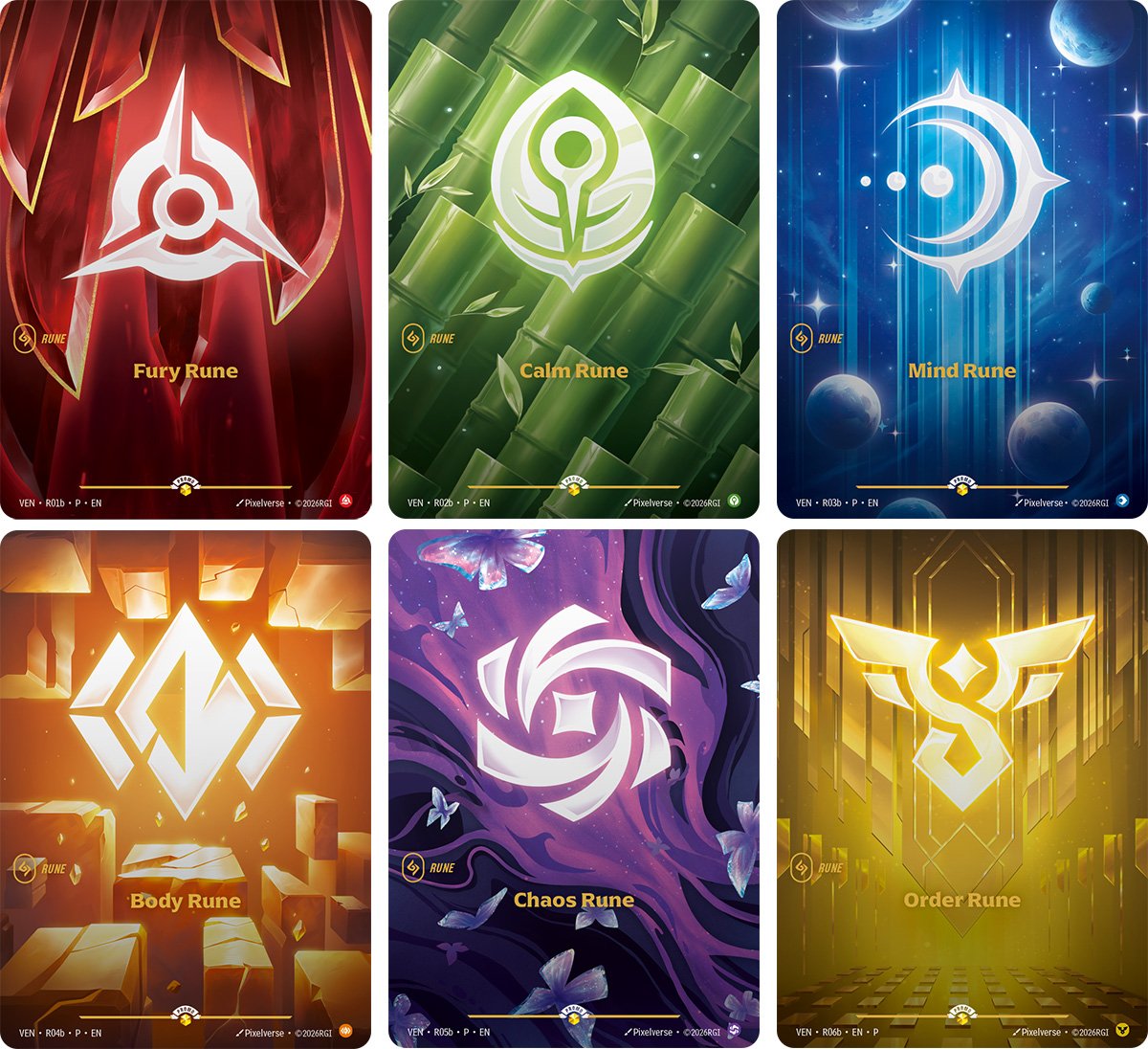
Riftbound has six domains. Every one has a color, a symbol, and a shorthand:
| Domain | Color | Shorthand |
|---|---|---|
| Fury | Red | [R] |
| Calm | Green | [G] |
| Mind | Blue | [B] |
| Body | Orange | [O] |
| Chaos | Purple | [P] |
| Order | Yellow | [Y] |
Here is the part that separates Riftbound from Magic's color identity rules: you do not pick your domains, your Legend does. Riot's own wording is that "every Riftbound deck is built around a Champion Legend, which determines your deck's domains, available cards, and overall strategy." The domains printed in your Legend's upper-left corner define your Domain Identity, and every card in the Main Deck and every rune in the Rune Deck has to fit inside it. A single-domain card is legal in any identity containing that domain; a multi-domain card is legal only in an identity containing all of its domains.
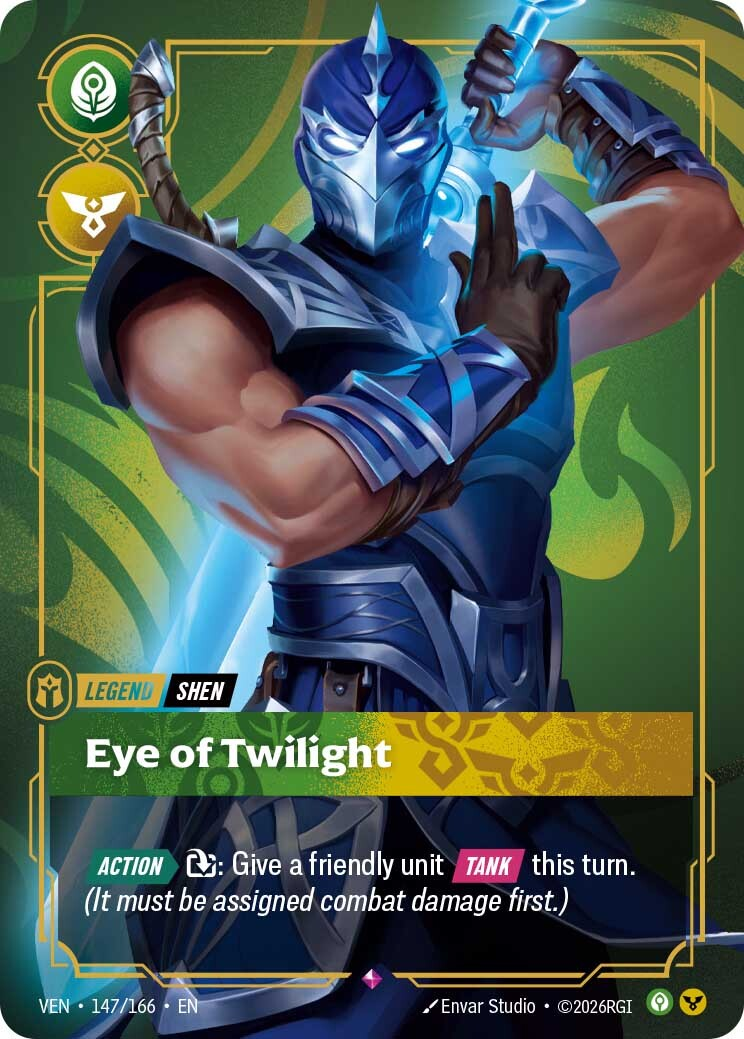
That is Eye of Twilight, the Shen Legend from Vendetta. The two stacked circles top-left are its domains — Calm and Order — and that pair is the entire boundary of what the deck may contain. The ability at the bottom is a Legend ability you can use during your own turn.
How to read a Riftbound card
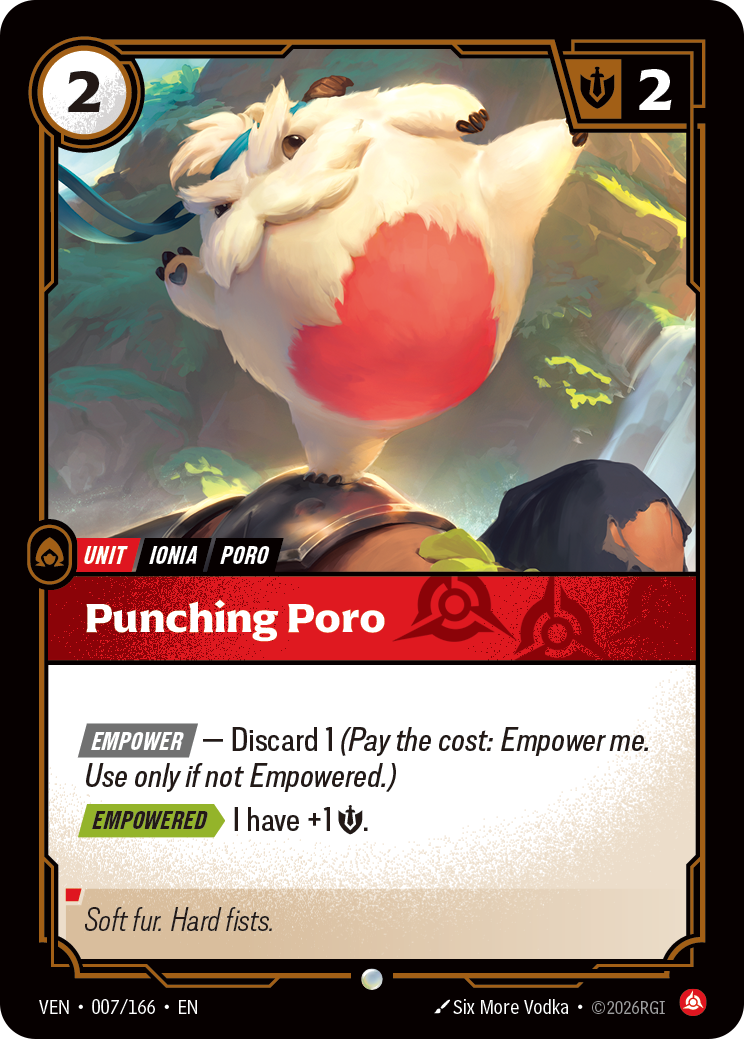
Working around that card:
- Upper left: the cost. The number is Energy. Domain symbols alongside it are Power costs, which must be paid with that specific domain.
- Upper right: Might, marked with a sword-and-shield symbol and written as [M] in rules text. Might is both how hard the unit hits and how much damage kills it — there is no separate toughness stat.
- The type line, under the art: card type first, then tags. Punching Poro reads Unit, then Ionia, then Poro. Tags have no innate rules meaning on their own, but cards reference them constantly.
- Rules text. Keywords are boxed; the italics in parentheses are reminder text and have no effect on how the card works.
- Bottom right: domain symbols, plus the collector number. Punching Poro is VEN 007/166 — VEN being Vendetta's set code.
Lethal damage is defined as "a non-zero amount greater than or equal to that Unit's Might," which means a 2-Might unit dies to 2 damage. Damage that does not kill a unit sticks around, but every unit is healed during the Ending Phase, so chip damage does not carry across turns.
Runes: the resource system, explained properly
Runes are not lands and they are not in your Main Deck. They live in their own 12-card deck, and you never draw them — you channel them, which puts them onto the board on your side.
Runes then produce two different resources, and conflating them is where new players lose turns:
- Energy pays generic numeric costs. It has no domain and no type.
- Power pays domain-specific costs. Power has a domain, normally matching the rune that produced it.
Every Basic Rune has exactly two abilities. Exhaust it to add 1 Energy, or recycle it — send it to the bottom of your Rune Deck — to add 1 Power of its own domain. That is the tension the whole resource system runs on: a rune on the board is a renewable Energy engine, but the only way to squeeze coloured Power out of it is to give it up.
Every player's Rune Pool empties at the start of each player's Main Phase and again at the end of each player's turn. Energy or Power you add and do not spend floats in your pool until one of those moments, and then it is lost, so nothing carries over into the next turn.
Setting up a 1v1 game
The Core Rules define 1v1 (Duel) precisely, and it is worth following the steps literally the first few times:
- Each player puts their Champion Legend in the Legend Zone and their Chosen Champion in the Champion Zone, both face up.
- Each player shuffles their Main Deck and Rune Deck separately.
- Each player randomly selects one of their three battlefields. The other two are removed for the game. The two selected battlefields are placed simultaneously in the Battlefield Zone. So a duel has two battlefields, one contributed by each player.
- Determine turn order by any fair random method.
- Each player draws 4.
- In turn order, each player mulligans: choose up to two cards in hand, set them aside, draw that many, then recycle the set-aside cards to the bottom of the Main Deck.
One asymmetry to remember: the player going second channels an extra rune during their first Channel Phase. Both players draw on turn one — Riftbound does not skip the first draw in a duel, though every multiplayer mode (the free-for-alls and 2v2) does skip the first player's first draw.
The turn, phase by phase
Every turn runs the same six-beat sequence:
Awaken Phase. You ready everything you control that can be readied. Exhausted runes stand back up; exhausted units are available again.
Beginning Phase. Start-of-turn triggers resolve, then the Scoring Step: "The Turn Player Holds all Battlefields they Control." This is where held battlefields turn into points, and it happens before you have drawn a card or channeled a rune. If you controlled two battlefields at the end of your opponent's turn, you are up two points before you take a single action.
Channel Phase. You channel 2 runes from your Rune Deck. Fewer than two left? You channel as many as you can.
Draw Phase. Draw 1.
Main Phase. Rune pools empty, then the phase has, in the rules' own words, "no defined structure." You play units, gear and spells, activate abilities, and move units. Combat and showdowns happen inside this phase as a consequence of your actions, not as a separate scheduled step.
Ending Phase. End-of-turn triggers, then all units heal, all "this turn" effects expire, and rune pools empty again.
Two details matter enormously here. First, units enter the board exhausted. Second, the Standard Move — the intrinsic ability every unit has to walk from its Base to a battlefield or back — costs you exhausting that unit. Put those together: a unit you deploy this turn generally cannot also move to a battlefield this turn. It arrives spent, readies on your next Awaken Phase, and only then can it be spent again to move. Riftbound has a keyword (Accelerate) that changes this, but the default is a full turn of lag between deploying a unit and contesting anything with it.
Battlefields: how you actually score
The July Core Rules define scoring as "the act of a Player gaining a point through the process of seizing or maintaining control over Battlefields." Riot's 9 October update, effective 16 October, separates the two ideas: scoring becomes "the act of a Player seizing or maintaining control over Battlefields they have not yet Scored this turn," and the new text adds that scoring "may result in a player Gaining Points, but the two are not intrinsically linked." Under both versions there are exactly two ways to score:
- Conquer. You gain control of a battlefield you have not already scored this turn. That is 1 point, immediately, on your own turn.
- Hold. You maintain control of a battlefield during your Beginning Phase. Also 1 point.
You may only score once per battlefield per turn, by either method. So the actual clock in a duel is simple: take a battlefield to conquer it for a point, then keep it to hold it for another point every turn afterwards. Hold both battlefields and you are banking 2 points per turn, which closes out a game from zero in four turns if your opponent never pushes back.
Control is established by having units at a battlefield at the end of a showdown or combat. That is the mechanism — not "having the biggest unit," not "attacking." You put units somewhere, you survive whatever happens there, you control it.
There is also a fourth, weirder route to points. If a player has to draw from an empty Main Deck, they Burn Out: they recycle their trash back into their Main Deck, choose an opponent to gain 1 point, and then complete the draw. Decking out is not an instant loss in Riftbound — it is a slow bleed that hands your opponent a point at a time until they cross 8.
Combat and showdowns
Combat happens automatically when units controlled by opposing players end up at the same battlefield. There is no attack declaration step in the Magic sense; moving a unit somewhere contested is the attack. Combat can only ever occur between two players, even in multiplayer modes.
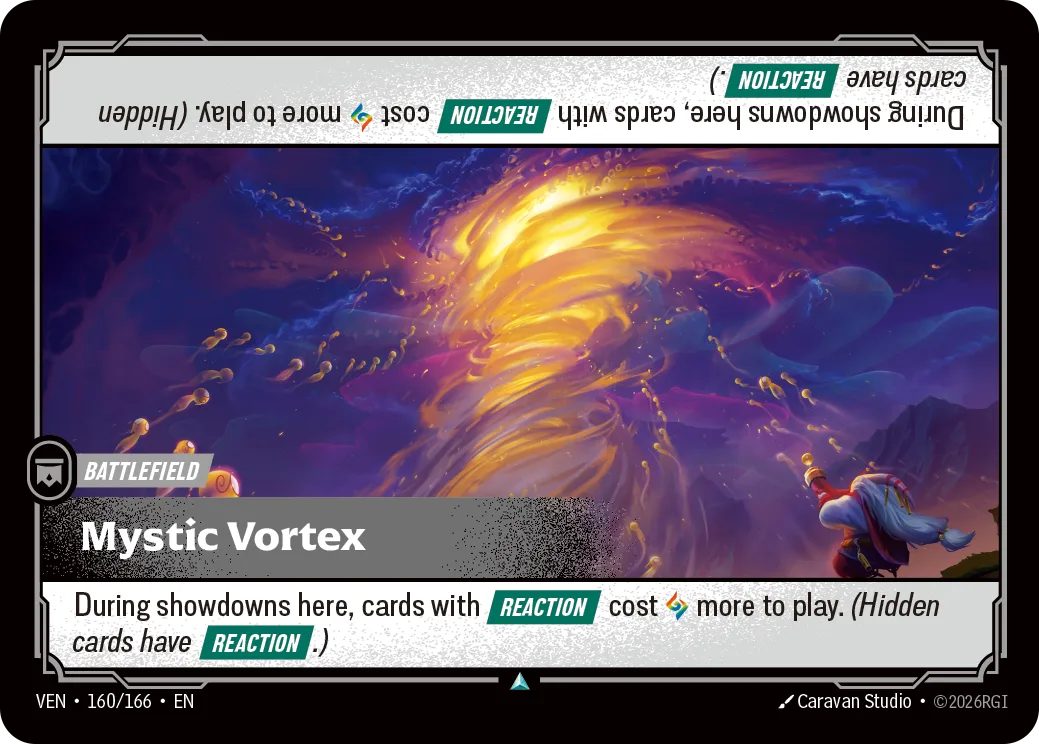
A showdown is the window of opportunity wrapped around that. By default, cards and abilities cannot be played during a showdown — only ones with the Action or Reaction keyword can. That is Riftbound's answer to instant-speed interaction, and it is deliberately narrow. If you want to do something during a fight, you had to build for it.
Damage resolution is unusual and worth reading twice. When the showdown closes:
- Sum the Might of all attacking units.
- Sum the Might of all defending units.
- Starting with the attacker, each player assigns damage equal to their summed Might among the other side's units.
Damage is assigned as one pool, not unit-versus-unit. And the assignment is constrained: a unit must have lethal damage assigned in full before you may assign damage to a different unit, and you cannot pile more than the minimum lethal amount onto a unit while others remain unassigned. The rules spell it out — 5 damage split among four 3-Might units must be 3 to one and 2 to another, not spread evenly.
Practically, pooled Might lets a wide board kill a big unit none of its members could beat alone, and lets a big unit sweep several small ones in one combat. Put three 2-Might units against one 6-Might unit and everything dies: the three small units' combined 6 damage is lethal to the big one, its 6 damage is exactly lethal to all three, and the rules deal all assigned damage simultaneously.
The final-point rule nobody warns you about
This is the rule that will cost you your first close game, and almost nobody explains it up front.
When you try to gain a point through a Conquer while your point total is already within one of the Victory Score, the Core Rules add a condition: if you have scored every battlefield this turn, you gain the final point. If you have not, you draw a card instead.
Read that again in duel terms. There are two battlefields in a 1v1 game. Sitting at 7 points, taking one battlefield does not win — it draws you a card. To close from 7 with a Conquer you have to score both battlefields on the same turn.
The restriction is specific to Conquer. The rules state that "points Gained from sources that are not Conquer are not beholden to these restrictions," which means Holding into your eighth point, or a card effect that hands you a point, is not gated the same way. But if your plan is to storm the last objective for the win, you need the whole board, not half of it.
Deck construction rules
The Core Rules set the floor for casual play:
- Main Deck of at least 40 cards, including the Chosen Champion.
- Up to 3 copies of the same named card, which includes the Chosen Champion — you may run Volibear, Furious as your Chosen Champion and still put 2 more copies in the Main Deck. Different versions of a character count as different names, so 3 copies each of Yasuo, Remorseful and Yasuo, Windrider is legal.
- A maximum of 3 Signature cards total, regardless of name, and all of them must carry the champion tag matching your Champion Legend. Signature cards are not champion units and can never be your Chosen Champion.
- Rune Deck of 12 runes, all within your Domain Identity.
- Battlefields per the mode, and no duplicates of the same battlefield name when the mode asks for more than one.
Tournament play tightens one of those. Under the Tournament Rules, in competition "a player's Main Deck must be exactly 40 cards," and a sideboard, where allowed, is 10 or fewer cards. In constructed, sideboarding happens between games of a match and swaps cards strictly 1-for-1 with Main Deck cards. You may not change your runes, Legend, or battlefields after registering your deck, though while sideboarding you may swap your Chosen Champion, provided it still matches your Legend.
Sealed is a different animal: 6 booster packs, a Main Deck of at least 25 cards, and a domain identity of any three domains, or any one domain plus your Legend's domains.
What to buy first
Riot sells four things, and their own How to Play page describes them plainly:
- Proving Grounds starter set — "Everything 2-4 players need to start. Includes 4 preconstructed decks, a rulebook, playmats and tokens." This is the honest answer for a first purchase, especially if you have someone to teach.
- Starter Decks — preconstructed and playable out of the box, each including one booster pack.
- Booster packs — 14 cards. Riot's official breakdown for Vendetta is 7 commons, 3 uncommons, 1 foil slot (Common, Uncommon, Rare or Epic), 2 cards that are Rare, Epic, Alt, Special Alt or Overnumber, and 1 token, rune or alt-rune slot, plus an informational insert.
- Bundles and special release sets, which carry limited-window promos.
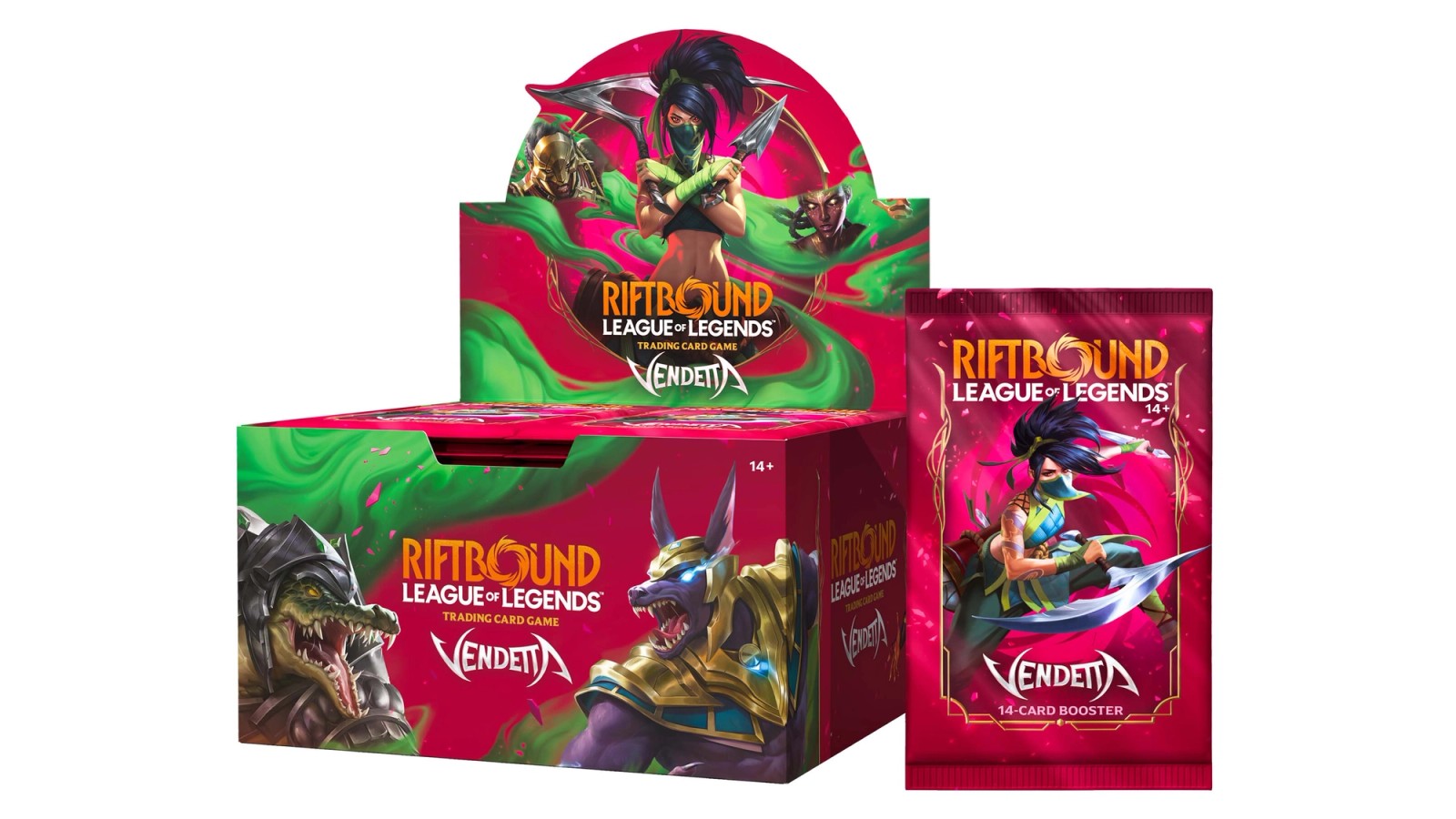
I am not going to quote you prices or pull odds — they move, they vary by region, and half the numbers floating around are secondhand. Check a local store. What I will say is that a starter set plus a handful of boosters gets two people playing real games the same night, and Riftbound's Nexus Nights program exists specifically to run weekly beginner-friendly store play, which is a cheaper way to find out whether you like the game than buying a box.
The 2026 set schedule and what's legal
2026 has been Riftbound's first full release year, and it ran four sets deep:
| Set | Code | Release |
|---|---|---|
| Spiritforged | SFD | 13 February 2026 (English) |
| Unleashed | UNL | 10 April 2026 (China), 8 May 2026 (global) |
| Vendetta | VEN | 31 July 2026 (English and Chinese, simultaneous) |
| Radiance | RAD | 23 October 2026 |
Unleashed was, per Riot's 2026 roadmap, the set where "for the final time, China will play Unleashed before the rest of the world" — and Vendetta delivered on that, launching in English and Chinese on the same day. French follows a different calendar; Vendetta is dated 23 October 2026 there.
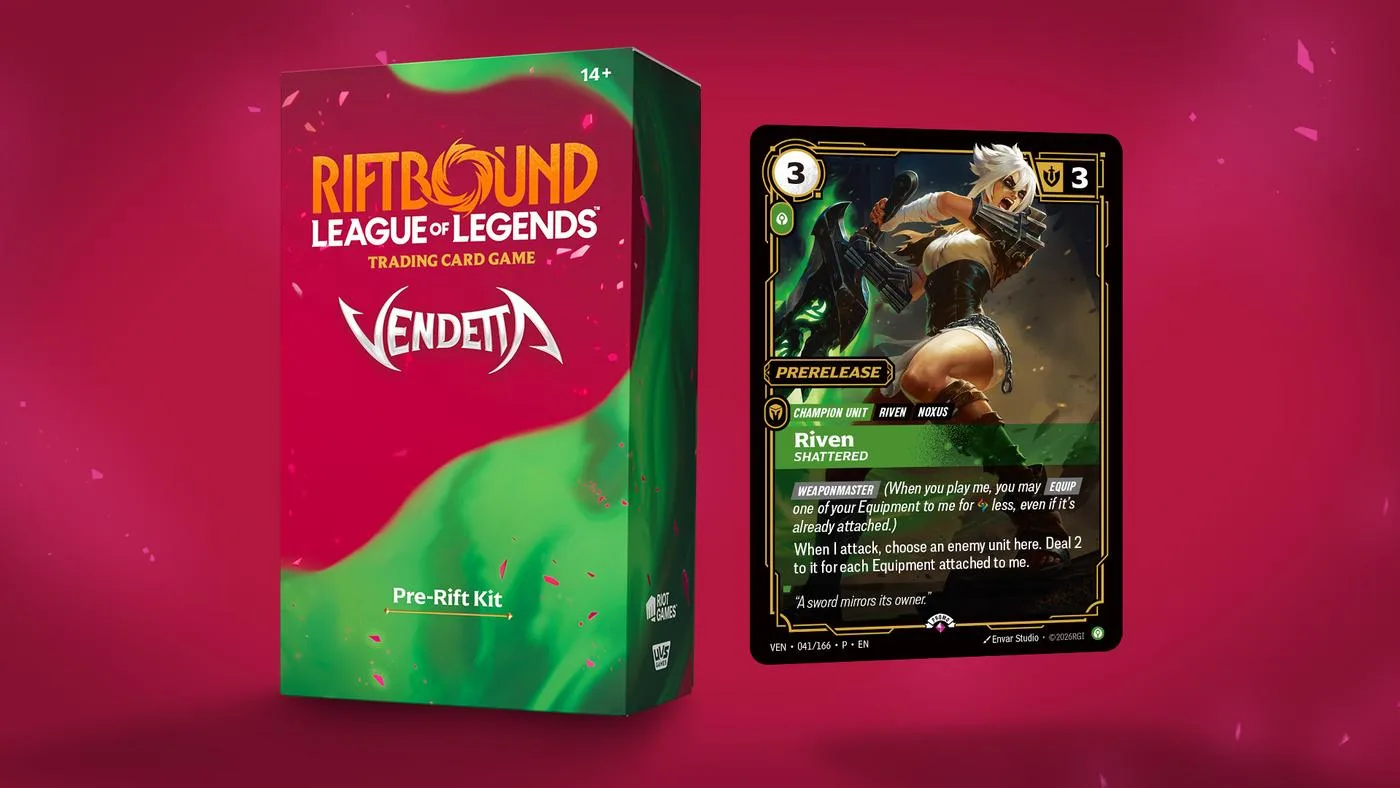
Vendetta itself is a 166-card set (the collector numbers printed on the cards confirm it) built around champion rivalries, and Riot's own overview says it introduces nine new Legends. It brings three new mechanics — Flow, which lets you play cards from your trash instead of your hand; Burn, which sends cards from your deck to your trash; and Empower, where cards gain new abilities after entering play if you pay a cost — plus a Unit-Gear hybrid card type and domain-specific spells called Decrees. Its headline product is the Showdown Deck, a pair of preconstructed rival decks meant to be played against each other straight out of the box, with Shen versus Zed confirmed.
For Standard, the Tournament Rules dated 16 July 2026, which stay in force until 15 October, list the legal pool as the Origins supplemental set from Proving Grounds (OGS), Origins (OGN), Spiritforged (SFD), Unleashed (UNL) and Vendetta (VEN). Riot's 9 October update to the Tournament Rules, effective 16 October, adds Radiance (RAD) as the sixth Standard set and lists its release date as 23 October 2026; it gives no separate tournament-legal date. Standard is defined as the most recent 5-8 sets — the current year's plus the previous year's. There is a banned list, and one merciful carve-out: at low-level events like Nexus Nights, a player running the exact unmodified contents of a preconstructed product may use banned cards that came in the box. Change one card or add a sideboard and that exemption is gone.
Five things that will trip you up in game one
- Your new unit cannot move. Units enter exhausted, and the Standard Move costs an exhaust. Deploy on turn three, contest on turn four.
- You score at the start of your turn, not the end. The Scoring Step for Holds happens in your Beginning Phase, before you draw. Whether you hold a battlefield is decided by what survives your opponent's turn.
- You cannot play most cards during a showdown. Only Action and Reaction cards work mid-fight. If you keep getting blown out in combat, you are not holding the wrong cards, you are holding the wrong kind of cards.
- Recycling a rune is a real cost. Adding 1 Power sends that rune to the bottom of your Rune Deck. You get it back eventually, but you have shrunk your board for a turn.
- Seven points is not seven-and-a-bit. The final-point restriction on Conquer means you need every battlefield scored that turn. Plan the last two points as one play, not two.
Quick reference
- Victory Score: 8 points (default).
- Duel setup: 2 battlefields, one chosen at random from each player's three.
- Opening hand: draw 4, mulligan up to 2 by setting aside, drawing, then recycling.
- Second player compensation: one extra rune channeled on their first Channel Phase.
- Per turn: ready everything, score holds, channel 2 runes, draw 1, main phase, end.
- Score: Conquer 1 point, Hold 1 point, once per battlefield per turn.
- Main Deck: 40+ casual, exactly 40 in competition. Max 3 per name, max 3 Signature cards.
- Rune Deck: exactly 12, all in your Domain Identity.
- Deck out: Burn Out — recycle trash, opponent gains 1 point, then draw.
If you have played other objective-scoring card games, the closest structural cousin is not Magic but a game like Cookie Run: Braverse, where board position matters more than raw stats. If Riftbound is your first TCG entirely, the Proving Grounds box and one opponent will teach you more in two hours than any guide will — including this one.
Frequently Asked Questions
How do you win a game of Riftbound?
How many cards are in a Riftbound deck?
What are the six domains in Riftbound?
How do runes work in Riftbound?
How does combat work in Riftbound?
Why can I not move my new unit to a battlefield in Riftbound?
Can I win Riftbound by conquering one battlefield at 7 points?
What happens if you run out of cards in Riftbound?
Which Riftbound sets are legal in Standard right now?
What should a new Riftbound player buy first?
Keep Reading
- Riftbound Rules Hub (Riot Games)
- Riftbound Core Rules, July version, last updated 2026-07-16 - in force until 15 October 2026 (Riot Games, PDF)
- Riftbound Core Rules, October version, last updated 2026-10-09 - effective 16 October 2026 (Riot Games, PDF)
- Riftbound Tournament Rules, July version, last updated 2026-07-16 - in force until 15 October 2026 (Riot Games, PDF)
- Riftbound Tournament Rules, October version, last updated 9 October 2026 - effective 16 October 2026 (Riot Games, PDF)
- Radiance Patch Notes: Radiance Rules Update Effective October 16, 2026 (Riot Games)
- October 2026 Tournament Rules Changelog (Riot Games)
- Learn to Play Riftbound (official)
- The Vendetta Overview (Riot Games)
- Riftbound's Latest 2026 Roadmap (Riot Games)
Related Guides
Riftbound Radiance Rules Update: Neeko Rulings and Errata
Riot published three Radiance rules documents on 9 October: Core Rules patch notes with ten official rulings, an errata article for four cards, and a Tournament Rules update. Together they settle how Neeko works, what happens to Equipment that Orianna turns into a unit, and what changes at your table from the 16 October Pre-Rift.
Riftbound Chains and Focus: The HOT FEPR Timing Rules
Riftbound's turn is always in one of four states, and the state - not the card - decides whether you are allowed to play anything. The Core Rules run the whole timing system on two separate permissions called priority and focus, a stack called the chain, and a five-step resolution loop the rulebook actually names in the text: HOT FEPR.
Riftbound Sealed and Draft: The Limited Format Rules
Riftbound Limited is not constructed on a budget - it switches off most of the deckbuilding rules you learned. Sealed hands you six packs and a 25-card minimum, Draft hands you three packs and a 20-card minimum, and both let you run ten copies of the same card, ignore Unique, and play cards that are banned in Standard.
Riftbound Domains Explained: All 6 Colors and Their Legends
Riftbound has six domains, and your Legend picks two of them for you. Here is what each color actually plays like - its strengths, its blind spots, its signature mechanics - plus the full grid of all 49 Legend cards by domain pairing, and the three rival pairings that did not exist until Vendetta.

Riftbound Vendetta Rules FAQ: Key Rulings Explained
Riot published the Vendetta Rules FAQ on 14 August 2026 and gave it precedence over the Core Rules Document until a new one was released. That new rulebook arrived on 9 October, effective 16 October. The FAQ also reverses a ruling Riot published in January, explains why Kayle can hold three copies of a status the rules call binary, and admits to a bug the Vendetta rules update introduced.
Riftbound Keywords Explained: All 28 in the Core Rules
The Riftbound Core Rules in force until 15 October 2026 define 25 keywords, and Riot's 9 October update adds Deploy, Disarm and Show Off from 16 October, for 28. The reminder text printed on the card is a summary, not the rule. Here is the whole glossary sorted by what each keyword actually is - passive, triggered, activated, permissive, dependent, cost, or a deck-construction rule that never does anything at the table.