CS2 Trade-Up Contracts: The 5-Skin Knife Route
Ten skins in, one skin out — that ratio has governed the Trade-Up Contract since 2013, and for twelve years it could never produce a knife no matter how many you burned. Valve changed that on October 22, 2025, and changed the contract again seven months later. Here is the actual ladder, the float math that decides your outcome's wear, and both updates most guides still have not caught up to.
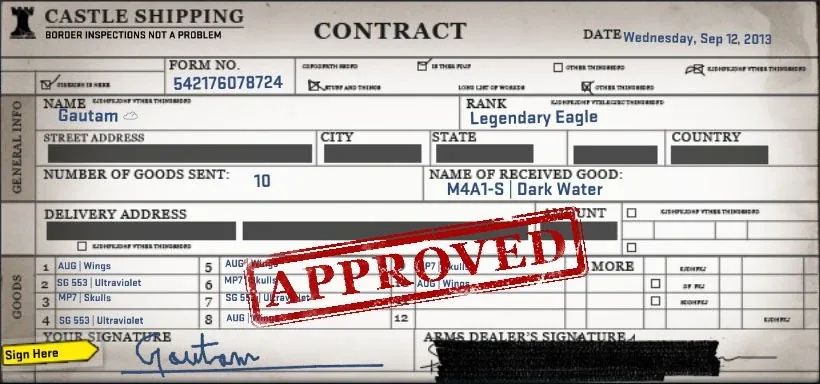
Ten skins in, one skin out. That ratio has run the Trade-Up Contract since Valve introduced it as the Arms Deal Contract in September 2013, and for twelve years the ladder it climbed stopped at Covert — the same red-tier rank as an AWP | Lightning Strike or an AK-47 | Fire Serpent. No amount of trading ever produced a knife. Knives lived behind a separate, much smaller door: roughly a 1-in-390 pull from a case.
Valve broke that wall on October 22, 2025. Then it changed the contract again on May 21, 2026. Most third-party trade-up calculators and guides still describe the 2013 rules only. Here is the mechanic as it actually runs today, with the math and both updates.
Ten skins in, one skin out
A Trade-Up Contract sits in your CS2 inventory from the moment you own the game — no purchase required, nothing to unlock. Select ten weapon skins of identical grade, all normal or all StatTrak (the two cannot be mixed in one contract), sign the contract with your mouse, and submit it. You get back one skin of the next grade up, drawn from a collection that at least one of your ten inputs belonged to.
That is the whole shape of it. Everything else is detail about which ten skins you should feed it.
The grade ladder
Five grades sit below Covert, and the contract only ever moves a skin one rung at a time:
| Input grade (10 needed) | Output grade | Color |
|---|---|---|
| Consumer Grade | Industrial Grade | White to light blue |
| Industrial Grade | Mil-Spec | Light blue to blue |
| Mil-Spec | Restricted | Blue to purple |
| Restricted | Classified | Purple to pink |
| Classified | Covert | Pink to red |
Run the arithmetic on that ladder and the reason nobody actually starts from the bottom becomes obvious: climbing from Consumer Grade all the way to a single Covert skin by pure trading, with no market purchases at any step, requires 100,000 Consumer Grade skins — five rungs of ten-for-one, compounding at each step. In practice, players looking to trade up buy skins at whatever grade they want to enter the ladder — usually straight into Classified or Covert — rather than farming from the bottom.
Contraband-grade skins (there is exactly one: the M4A4 | Howl, reclassified after its unauthorized-art controversy) and Rare Special items — knives, gloves — cannot be produced by the base ladder at all. Until October 2025, that meant no version of the standard contract ever put a knife in your inventory. That is the rule the next section breaks.
You do not pick what you get
The single most misunderstood part of the contract: you choose the ten inputs, not the output. The result is drawn randomly from the pool of skins in the next grade up that belong to a collection represented among your inputs. Valve has published an equal-odds-per-item rule for case openings specifically; whether that same equal weighting governs a trade-up's output pool has never been confirmed in a patch note, so treat any skin in the target collection as a possible outcome rather than assuming they are all equally likely.
Mixing collections in one contract has been legal since Valve's May 14, 2014 update, and Valve has never published the exact weighting when inputs are split across more than one collection — the working assumption, never confirmed in a patch note, is that it scales with how many of your ten inputs come from each collection. If you want a specific skin, you are not really trading up for it; you are trading up for a chance at one collection's worth of options at the next grade, and the wiki's own advice for years has been to check which skins are even available in that collection at the target grade before committing ten items you cannot get back.
The formula that decides your outcome's wear
The float — CS2's 0.00-to-1.00 wear value, where lower means cleaner — does carry over into the outcome skin, but through a formula rather than a direct copy. The community-reverse-engineered version of that formula, documented on the Counter-Strike Wiki, is:
f = x × (y − z) + z
- f = the exact float of your outcome skin
- x = the average float of your ten (or five) input skins
- y = the maximum float cap of the specific outcome skin
- z = the minimum float cap of the specific outcome skin
Most skins run the full 0.00–1.00 range, so y − z simplifies to 1 and your input average passes straight through. But plenty of skins are float-capped narrower — the wiki's own example is the P250 | Whiteout, capped between 0.06 and 0.80 — and the cap changes your result even with identical inputs.
Take an average input float of 0.50. Trade into an uncapped skin and f = 0.50, landing in Battle-Scarred (0.45–1.00). Trade into a P250 | Whiteout instead and f = 0.50 × (0.80 − 0.06) + 0.06 = 0.43 — Well-Worn (0.38–0.45), a full exterior tier cleaner, from the exact same inputs. The cap did that, not the trade.
For reference, the five exterior tiers and their float ranges:
| Exterior | Float range |
|---|---|
| Factory New | 0.00–0.07 |
| Minimal Wear | 0.07–0.15 |
| Field-Tested | 0.15–0.38 |
| Well-Worn | 0.38–0.45 |
| Battle-Scarred | 0.45–1.00 |
A weapon's float is fixed the instant it is generated — dropped, unboxed, or produced by a contract — and never changes afterward. There is no way to clean up a skin later; the only lever you control going in is which ten floats you average.
The new route: five Coverts for a knife
On October 22, 2025, Valve's official Counter-Strike 2 release notes announced an extension to the Trade-Up Contract: exchanging five items of Covert quality, instead of the usual ten, for a knife or a pair of gloves.
- 5 regular Covert skins → 1 regular Knife or 1 regular Gloves item, from a collection one of the five belonged to
- 5 StatTrak Covert skins → 1 StatTrak Knife, from the same rule
That is a genuinely different contract from the base ladder, not an extension of it: half the input count, and it is the only path in the entire system that turns weapon skins into a knife or gloves without opening a case. Twelve years of "you cannot trade up for a knife" ended with that patch, and a lot of the trade-up advice still circulating online was written before it and has not been corrected.
Why StatTrak only pays out a knife
Notice the asymmetry: StatTrak Coverts in only ever produce a StatTrak knife, never StatTrak gloves. That is not an arbitrary restriction — gloves have never had a StatTrak variant in Counter-Strike at all, on any acquisition path, so there is no StatTrak gloves item for the contract to produce. The rule matches the rest of the item system; it just is not obvious unless you already knew gloves skip StatTrak entirely.
Souvenir skins can feed the machine now, too
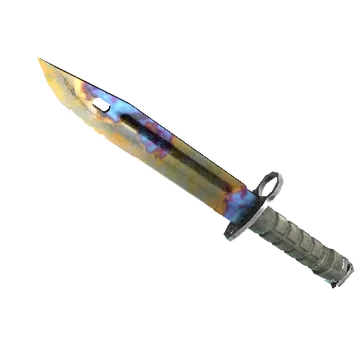
Seven months later, Valve extended the contract again. The May 21, 2026 release notes state that Souvenir-quality items can now be selected in a Trade-Up Contract alongside normal-quality items. Every Souvenir attribute — the tournament stamp, the gold team sticker, the player autograph — is stripped from any Souvenir item you feed in, and the result is one normal-quality item one grade higher, drawn from a collection represented across everything you selected.
Souvenir skins from a Major you do not care about, sitting at a grade you would otherwise never touch, are now legitimate raw material instead of a shelf item. They still count as ordinary inputs toward the standard 10-for-1 ladder rungs; Valve's notes did not extend the 5-Covert knife path to Souvenir-quality Coverts, so treat that combination as unconfirmed until you have tested it yourself.
What you cannot trade up
A handful of hard exclusions sit underneath everything above:
- Knives and gloves themselves. They are the ceiling of the system, not a rung on it — you cannot trade five knives for anything.
- Contraband skins, the sole example being the M4A4 | Howl.
- A grade with no next-grade skin in that collection. Some collections simply stop — the wiki's cited example is the Tec-9 | Ossified, a Mil-Spec skin that is the highest tier the Aztec Collection offers, so it cannot be used as a trade-up input no matter how many copies you own.
- Mixed quality within one contract. Ten normal skins or ten StatTrak skins; never a blend of both in the same submission.
Is it actually worth it?
Answering that honestly means separating two different trades hiding under one name.
The base 10-for-1 ladder is a volume play: you are betting that ten copies of a cheap skin, bought or farmed, are worth less than one copy of the next grade up from the same collection. Whether that holds depends entirely on that collection's specific market prices at the moment you trade, which move daily — check the Steam Community Market for the actual numbers before committing, rather than trusting any fixed figure written here.
The 5-Covert knife route is a different kind of bet: a fixed entry cost (five Covert-grade skins, whatever those cost you today) against an unknown output that could be any knife or gloves item available in that collection, at a float and pattern you do not choose. For comparison, Valve's own 2017 loot-box disclosure — filed under Chinese lootbox-transparency law and never superseded by a newer published figure — puts a Rare Special pull (StatTrak or not) at 0.26% odds directly from a case, versus 0.64% for landing a Covert in the first place. The contract does not change those underlying odds; it lets you buy your way to the position five Coverts deep and then take one combined shot at the knife pool, instead of separately gambling on both an already-rare Covert unbox and then the rarer knife slot on top of it.
Neither version of the contract lets you target a specific outcome. If you have a particular knife in mind, buying it directly on the market is the only route that guarantees you get it.
What I could not verify
- The exact weighting Valve applies when a contract's ten (or five) inputs are split across more than one collection, and whether every eligible skin within the winning collection carries genuinely equal odds. The mixing rule is confirmed; neither odds question has been answered in a patch note.
- Which currently active collections have a knife or gloves pool available at all. Not every Covert-tier collection includes Rare Special items, and I could not find a maintained, dated list of which ones currently do.
- Whether a Souvenir-quality Covert skin can be used in the 5-Covert knife/gloves route specifically. The October 2025 patch note predates Souvenir eligibility; the May 2026 note that added Souvenir inputs does not mention the knife path at all.
Quick Action Checklist
- Confirm you are trading normal-for-normal or StatTrak-for-StatTrak — the two never mix in one contract.
- Before committing ten skins, check that the target collection actually has a skin available at the next grade up. If it does not, as with the Aztec Collection at Mil-Spec, the trade is not possible.
- Remember the float formula: your average input float only translates 1:1 if the outcome skin is uncapped. Look up the specific outcome skin's float cap first.
- For the knife route, budget exactly five Covert-grade skins, all normal or all StatTrak, and accept you are buying a chance at that collection's whole knife/gloves pool, not a specific item.
- Price everything on the Steam Community Market at the time you trade — skin prices move daily and any number quoted elsewhere may already be stale.
- If you want one specific skin or knife, buy it directly. Nothing about the contract lets you target an outcome.
Frequently Asked Questions
How many skins do you need for a Trade-Up Contract in CS2?
Can you trade up for a knife in CS2?
Does a CS2 Trade-Up Contract let you choose which skin you get?
Can Souvenir skins be used in a CS2 Trade-Up Contract?
Does the float of a Trade-Up Contract outcome match your input skins?
Keep Reading
- Counter-Strike 2 Update, October 22, 2025 — Valve (Trade-Up Contract extended to 5 Covert items for a knife/gloves)
- Counter-Strike 2 Update, May 21, 2026 — Valve (Souvenir items now usable in Trade-Up Contracts)
- Trade Up Contract — Counter-Strike Wiki (ladder rules, float formula, exclusions, update history)
- Skins — Counter-Strike Wiki (grade colors, wear/float ranges, float caps)
- Container — Counter-Strike Wiki (2017 Perfect World case-odds disclosure by grade)
Related Guides
CS2 Wingman Explained: Maps, Money and Rank
Lose the first four rounds of a Wingman half and the fourth loss pays you $2,900, while an elimination win pays $2,750. Counter-Strike 2's 2v2 mode runs on its own config: smaller round awards, a higher and flatter loss bonus, an $8,000 cap, a 90-second clock and a seven-map pool that ignores Active Duty. Here is the whole mode from the game files and Valve's release notes, including every community map Valve has rotated through it.
CS2 SCAR-20 vs G3SG1: The $5,000 Two-Shot Autosnipers
The SCAR-20 and G3SG1 are the same rifle in Counter-Strike 2's weapon file except for three values: reload time, recoil, and the flinch numbers behind tagging. Both cost $5,000, pay $300 a kill, kill with any two hits and one-tap a helmet at any range. Here is the pair from the game files, what March 2026 did to their ammo, and how the money compares with the AWP.
CS2 Zeus x27: Range, Recharge and the $100 Kill
The Zeus x27 does 500 damage, ignores armor completely and reaches about 120 units, roughly 2.3 metres. Since February 2024 it recharges instead of disappearing, and since April 2024 a kill pays $100. Here is the whole weapon, from Valve's release notes and the game's own files: reach, recharge, money, purchase limits by mode, and every Zeus line in CS2's release notes.
CS2 Rush Mode Explained: Towers, Arenas and Money
Wiping the enemy team does not, by itself, win a round of Rush. Controlling the tower does. Counter-Strike 2's new 3v3 mode, read straight from its config, its map script and its arena list: how rounds end, how the front line moves, all 19 arenas, and an economy where a first loss pays only $400 less than a win.
CS2 Economy Guide: Buy Rounds, Loss Bonus, and MR12
Half the rounds you lose in CS2 are lost in the buy menu, before anyone fires a shot. Here are the exact payout numbers, the loss bonus ladder, and the force-buy math that decides whether your next three rounds are winnable.
CS2 AK-47 vs Galil AR: The $900 One-Tap Tax
The Galil AR now carries 175 rounds to the AK-47's 120 — a gap a March 2026 patch opened and nobody in this vertical has written down. It still cannot kill a helmeted head in one shot at any range, while the AK-47 can from point-blank out to roughly 49 meters. Here is the full stat sheet, the range math, and the ammo change that quietly rewrote the cheap rifle's job.