CS2 Rush Mode Explained: Towers, Arenas and Money
Wiping the enemy team does not, by itself, win a round of Rush. Controlling the tower does. Counter-Strike 2's new 3v3 mode, read straight from its config, its map script and its arena list: how rounds end, how the front line moves, all 19 arenas, and an economy where a first loss pays only $400 less than a win.
Wiping the enemy team does not, by itself, win a round of Rush. Controlling the tower does.
Valve's announcement puts that in one line (control the tower when you eliminate the enemy team, or when time expires); the map's script spells out what it means, and it changes how the last fight of a round should be played. Rush arrived in Counter-Strike 2's September 22, 2026 update as a "fast-paced queued 3v3 game mode," and Valve has shipped a Rush section in three more updates since. The rules below come from those release notes and from the mode's own files — the config that sets its rules, the script that runs its rounds and the English strings that name its arenas — as they stood after the September 25 update. Where a number has already changed once, this post says so.
Rush in 30 seconds
| Rule | Rush |
|---|---|
| Players | 3v3, queued |
| Map | Complex, seven arenas per match |
| How a round is won | Control the tower when the clock runs out, or wipe the enemy while you control it |
| Round clock | 40 seconds; 60 in the two castles and the Convoy decider |
| How a match is won | Win a round in the enemy castle, or reach 8 round wins; 15 rounds at most |
| Sides | No halftime swap, so your side is fixed for the match |
| Money | $800 to start, $10,000 cap, $2,500 per round win |
| Grenades | One per player per round |
| Ranking | Valve mentions a Rush friends leaderboard; no CS Rating or Skill Group |
The map is named Complex in the game's English strings and rush_001 in its files. It is its own map, built as a set of small arenas rather than bombsites.
The tower decides the round
Every arena has one tower, and at the start of each round one team owns it. During freeze time the tower glows in the owner's colour — orange for Terrorists, blue for Counter-Terrorists, per the colour table in the map script — and the radar marks it in the same team colour. The HUD tells you which side of that you are on: "You own the tower" or "Enemy owns the tower."
Walk up to it and the prompt reads "Press [use] to activate the tower." When the tower's button fires, the script hands the arena to the presser's team on the spot, recolours the tower lights and the arena's flags, and plays a control-gained sound to one team and a control-lost sound to the other. The script puts no limit on how many times it can change hands in a round.
The script then settles every round one of four ways:
| What happens | Who wins |
|---|---|
| The clock runs out | The team controlling the tower |
| The team without the tower is wiped | The tower's owner, immediately |
| The tower's owner is wiped | Nobody yet: the clock drops to at most 7 seconds (14 in a castle or Convoy), and the survivors must press the tower before it expires |
| Both teams die | The tower's owner |
The third row is the one to build habits around. Kill the last defender and you have not won; you have started a sprint. The clock drops to seven seconds, or stays where it is if less is left, and the round goes to the dead team if nobody on yours reaches the tower. At the knife's 250 units per second, the top run speed in the game's weapon files, seven seconds covers 1,750 units — about 33 meters on the standard Source-engine conversion of 0.75 inches per unit. Take the final fight further from the tower than that and you can wipe the other team and still lose the round.
Two consequences follow. The owning team plays for time. It wins by keeping the tower out of enemy hands until the clock ends, so it needs denial, not kills. The attackers can flip that script mid-round. Press the tower with enemies still alive and your team becomes the owner; now they are the ones who have to come and get it.
Since the September 23 update the short countdown only starts if the surviving team actually killed someone that round. Valve's note says it no longer activates when an entire team dies to suicides, team kills or disconnects, and the script now counts enemy kills per round before it cuts the clock.
The last ten seconds come with a built-in clock. The script plays the round-timer beeps from the tower itself, once a second from ten seconds out, twice a second from six, four times a second from four, and eight times a second for the final two. The capture countdown never exceeds 14 seconds, so its closing stretch beeps too, but the script steps the rate up by beep count, not by time left. A seven-second window cut from a clock that had not started beeping yet opens at one beep a second and only doubles at about three seconds left, so read that window off the timer rather than by ear.
Seven arenas, one front line
A Rush match lays seven arenas end to end with a castle at each end. This is the board at kickoff:
| Slot | Arena | Owner at kickoff |
|---|---|---|
| 1 | T Castle | Terrorists |
| 2 | Random standard arena | Terrorists |
| 3 | Random standard arena | Terrorists |
| 4 | Random centre arena | Counter-Terrorists |
| 5 | Random standard arena | Counter-Terrorists |
| 6 | Random standard arena | Counter-Terrorists |
| 7 | CT Castle | Counter-Terrorists |
Round one is always played in slot 4, and because the Counter-Terrorists own it, the Terrorists attack first. Whoever wins a round takes that arena, and the next round is played one slot further toward the loser's castle. Each team's territory stays in one unbroken block, so the arena the fight moves into always belongs to the team that just lost — which means the team that wins a round attacks in the next one. Winning buys you the harder job, not a breather.
Win a round inside the enemy castle and the match ends on the spot. The front starts three slots from each castle and moves one slot per round, so a castle capture always comes with a four-round lead, and a 4-0 sweep is the shortest match the script allows. The other finish line is eight round wins: the config caps a match at 15 rounds and lets a team clinch once it has won more than half of them.
Convoy, the 7-7 decider
If both teams reach seven wins, the script swaps the next arena out for Convoy before round 15 starts. The script's random draw never picks Convoy, and apart from a developer cheat command, this swap is the one code path that puts it into a match. It plays under the end-room rules: a 60-second clock and a 14-second capture window after a wipe.
Because the next arena always belongs to the team that just lost, the team that won round 14 attacks Convoy and the team that lost round 14 defends it, with the clock on its side.
All 19 arena names in the files
The game's English strings list the arenas under a "Rush Map Names" heading, and the map script sorts them into pools. It also assigns each one a fog preset, which is the closest thing the files offer to a description of the space.
| Arena | Pool | Fog preset |
|---|---|---|
| Spire | Centre | Interior |
| Wallbang | Centre | Interior |
| Big Box | Centre | Interior |
| Madhouse | Centre | Interior |
| Sewer | Standard | Tunnel |
| Dogleg | Standard | Exterior |
| Trainyard | Standard | Interior |
| Crane | Standard | Exterior |
| Bloc | Standard | Exterior |
| Hydro | Standard | Tunnel |
| Atomic | Standard | Exterior |
| Medusa | Standard | Interior |
| Bear | Standard | Interior |
| Steel | Standard | Exterior |
| Container | Standard | Exterior |
| Drop | Standard | Interior |
| T Castle | Castle (slot 1) | Base |
| CT Castle | Castle (slot 7) | Base |
| Convoy | Decider (7-7 only) | Exterior |
Each match draws one centre arena and four different standard arenas, and the slot each one lands in matters, so there are 4 × 12 × 11 × 10 × 9 = 47,520 possible layouts. That is the arithmetic behind Valve's line that "no two matches are the same" — strictly, a layout can repeat; there are just a lot of them.
The pool sizes tell you what to learn first. A given standard arena turns up in one match in three, and even then it only gets played if the front line reaches its slot. A given centre arena turns up in one match in four, and whichever one is drawn hosts round one. Spire, Wallbang, Big Box and Madhouse are the four arenas guaranteed a round whenever they appear, which makes them the place to start.
The fog presets differ a lot on paper. The "tunnel" preset used in Sewer and Hydro ramps to 80% opacity by 900 units; the interior preset tops out at 50% by 3,000 units, and the exterior preset at 70% by 6,000.
Where the announcement art and the files disagree
Valve's announcement includes a graphic of labelled arena layouts. Do not use it as a map list.
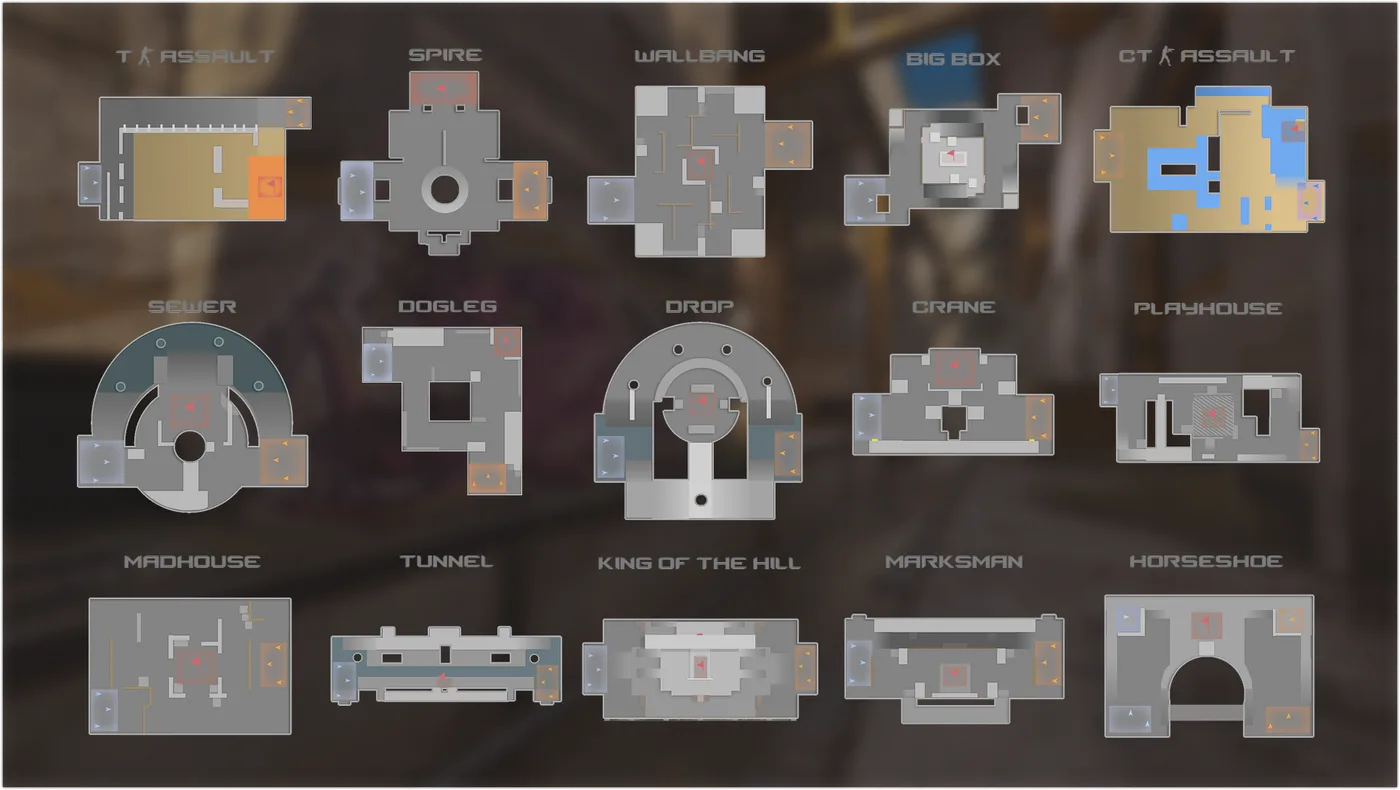
It labels 15 layouts. Eight of those names match the files: Spire, Wallbang, Big Box, Madhouse, Sewer, Dogleg, Drop and Crane. The other seven — T Assault, CT Assault, Playhouse, Tunnel, King of the Hill, Marksman and Horseshoe — are in neither the map script's arena list nor the Rush Map Names block of the English strings. Going the other way, eight standard arenas the script actually draws from are missing from the graphic: Trainyard, Bloc, Hydro, Atomic, Medusa, Bear, Steel and Container.
It is not a rename that happened after launch. The map script in the September 22 build already carried the same arena list the game uses now. The Counter-Strike Wiki's Rush page, still marked as a stub, describes the same seven-arena structure the script runs but does not name the arenas at all.
Rush money versus Competitive money
Both modes' config files sit side by side in the game, and the gaps are large. The Rush column below combines the Rush config with the $2,500 round-win award, which the map script pays directly:
| Setting | Rush | Competitive |
|---|---|---|
| Starting money | $800 | $800 |
| Money cap | $10,000 | $16,000 |
| Round-win award | $2,500 | $3,250 by elimination or time, $3,500 by bomb |
| Loss bonus base | $2,100 | $1,400 |
| Loss bonus step | +$750 per consecutive loss | +$500 per consecutive loss |
| Loss counter at kickoff | 0 | 1 |
| Kill rewards | Standard weapon table | Standard weapon table |
| Buy time | 15 seconds | 20 seconds |
| Freeze time | 11 seconds | 15 seconds (20 in Premier) |
| Grenades per player | 1, including at most 1 flashbang | 4, including at most 2 flashbangs |
The loss bonus is where Rush's economy changes shape. A first loss pays $2,100, just $400 less than winning. The step is $750, so if Rush's loss counter climbs the way Competitive's does — the ladder our economy guide walks through — a second straight loss pays $2,850, more than the $2,500 the winners collect. In Competitive the loss bonus only overtakes the $3,250 elimination award at its $3,400 ceiling.
In practice a lost pistol round still funds a real buy. Round one is Terrorists attacking the Counter-Terrorists' centre arena. If the Counter-Terrorists lose it having spent everything, they start round two on $2,100 before kill money: an MP9 ($1,250) and Kevlar ($650) with change, on a weapon class that pays $600 a kill. The Terrorists who won it having spent everything have $2,500 before kill money — a Galil AR and Kevlar for $2,450.
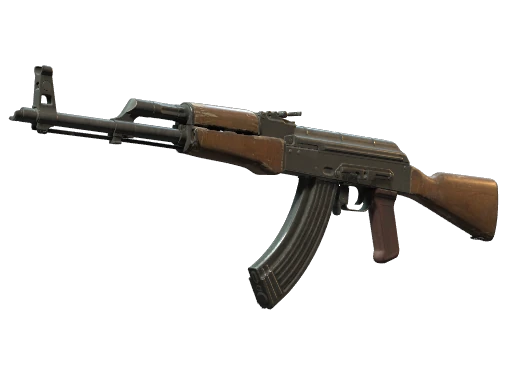
The ceiling is the other constraint. An AK-47 ($2,700), Kevlar and helmet ($1,000) and one $300 grenade come to $4,000, so the $10,000 cap holds two and a half full buys. Banking money across a run of saves tops out quickly.
One grenade and no halftime
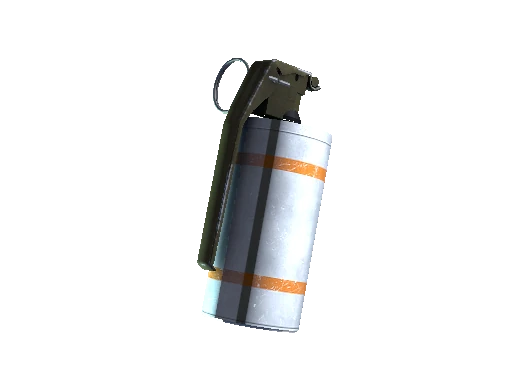
The rule that shows up in the buy menu: Rush's config limits each player to one grenade, and the September 22 update made that limit also cap how many grenades you can buy in a round. You cannot throw a flash and buy another one. One grenade per round, total, so pick it deliberately — the utility guide has the prices.
The other rules worth knowing, all from the two config files:
- No halftime. Rush's config turns the halftime side switch off, so the team that starts as Terrorists attacks round one and stays Terrorist all match.
- Map guides are off. Competitive's base config allows the limited in-match map guides Valve added on March 18, 2026; Rush's config disables them.
- One technical timeout per team, 30 seconds long, cut from 120 seconds in the launch build. Competitive's also lasts 120.
- Friendly fire is on, at the same one-third bullet damage to teammates that Competitive uses.
Rush does not rank you. Valve's announcement points to a Rush friends leaderboard for wins, neither it nor any of the four sets of release notes mentions a CS Rating or Skill Group for the mode, and the Counter-Strike Wiki lists it as unranked. It sits with the other modes that do not rank you.
Three patches in the first week
| Update | What changed in Rush |
|---|---|
| September 23, 2026 | Capture window after a wipe raised from 7 to 14 seconds in the castles and Convoy; the countdown no longer starts when a team dies to suicides, team kills or disconnects; freeze time cut from 13 to 11 seconds, the all-players-connected warmup from 15 to 5 seconds, and the technical timeout from 120 to 30 seconds |
| September 24, 2026 | Clearer rules description on the loading screen; adjusted team-damage kick rules; clipping fixes |
| September 25, 2026 | Gap fixes and clipping adjustments |
Valve's September 23 note says those three timers were "all reduced" without giving numbers; the numbers come from comparing the Rush config between the September 22 and September 23 builds. The one config change in the September 24 build fits that day's kick-rule note: it sets the window in which a team kill right after a round restart gets a player kicked to zero seconds, down from the game's five-second default. Treat every timer in this post as current to the September 25 build — a week in, several have already moved.
What I could not verify
- The loss-bonus ladder past the first loss. Rush's config sets the $2,100 base and the $750 step, but neither Rush's nor Competitive's config sets the counter's cap; the game's convar list gives a default of 4, which would top Rush's bonus out at $5,100. I have not confirmed the ladder in a live match.
- Whether pressing the tower needs a hold. The script reacts to the tower button's "pressed" output and the prompt says "Press"; any hold time would be set in the map itself, which the script does not show.
- Party size and queue rules. Valve calls Rush a queued 3v3 mode and has not said more.
- What the fog does to real sightlines. The presets are numbers in the script; I have not measured how far you can actually see in Sewer or Hydro.
More weapon math and map breakdowns live on the Counter-Strike 2 coverage hub.
Quick Action Checklist
- A Rush round is won at the tower: control it when the 40-second clock (60 in the castles and Convoy) runs out.
- Wiping the tower's owners starts a window of at most 7 seconds (14 in the castles and Convoy) to press it. Finish the last fight within sprinting distance of the tower.
- Wiping the attackers wins the round instantly for whoever owns the tower.
- The round winner always attacks next, one arena closer to the loser's castle.
- A match ends at eight round wins, or when a team wins a round in the enemy castle, which takes a four-round lead.
- At 7-7 the next arena becomes Convoy, and the round-14 winner attacks it.
- Learn Spire, Wallbang, Big Box and Madhouse first. One of them hosts round one of every match.
- One grenade per player per round, purchases included.
- A first loss pays $2,100 against $2,500 for a win, and money caps at $10,000.
- Sides never switch, map guides are off, and Rush does not touch your rating.
Frequently Asked Questions
What is Rush mode in CS2?
How do you win a round in CS2 Rush?
How many rounds is a CS2 Rush match?
What are the arenas in CS2 Rush?
How does money work in CS2 Rush?
Is CS2 Rush ranked?
Keep Reading
- Rush Hour — Valve announcement, September 22, 2026 (Rush mode, friends leaderboard, arena graphic)
- Counter-Strike 2 Update, September 22, 2026 — Valve release notes (Rush added; grenade limit now enforced on purchases)
- Counter-Strike 2 Update, September 23, 2026 — Valve release notes (14-second countdown in end rooms and Convoy; timers reduced)
- Counter-Strike 2 Update, September 24, 2026 — Valve release notes (loading-screen rules, team-damage kick rules)
- Counter-Strike 2 Update, September 25, 2026 — Valve release notes (Rush gap fixes)
- gamemode_rush.cfg — Counter-Strike 2 game files via SteamDB GameTracking (Rush money, timers, grenade limit, halftime)
- rush_001.js — Counter-Strike 2 Rush map script via SteamDB GameTracking (tower rules, arena pools, round clocks, Convoy decider, $2,500 win award)
- gamemode_competitive.cfg — Counter-Strike 2 game files via SteamDB GameTracking (Competitive money and rules for comparison)
- gamemode_competitive_tmm.cfg — Counter-Strike 2 game files via SteamDB GameTracking (team-matchmaking overrides, 20-second freeze time)
- csgo_english.txt — Counter-Strike 2 English strings via SteamDB GameTracking ("Rush Map Names" block, tower prompts, map name Complex)
- convars.txt — Counter-Strike 2 console variable dump via SteamDB GameTracking (convar defaults and descriptions)
- Rush — Counter-Strike Wiki (stub describing the seven-arena structure)
- Hammer unit — Official TF2 Wiki (Source engine unit-to-metric conversion)
Related Guides
CS2 Casual Explained: Money, Free Armor, Maps and Rules
A lost round of Casual pays $2,400 and a won one $2,700, and on Office and Italy a loss pays more than three of the four ways to win. Counter-Strike 2's Casual mode, read from its config, its map groups and Valve's release notes: the money, the free armor and kits, the four map groups, the rules that differ from Competitive and what it does to your rank.
CS2 Retakes Explained: Loadout Cards, Maps and Rules
On 19 of the 20 bombsites Retakes plays, the game file that places the bomb puts 75% of its weight on the default plant. Nuke A is the exception. Counter-Strike 2's 4v3 after-plant mode, read from its config, its card definitions and its per-map files: how a round runs, every loadout card on both sides, the two map groups and what it does to your rank.
CS2 Wingman Explained: Maps, Money and Rank
Lose the first four rounds of a Wingman half and the fourth loss pays you $2,900, while an elimination win pays $2,750. Counter-Strike 2's 2v2 mode runs on its own config: smaller round awards, a higher and flatter loss bonus, an $8,000 cap, a 90-second clock and a seven-map pool that ignores Active Duty. Here is the whole mode from the game files and Valve's release notes, including every community map Valve has rotated through it.
CS2 SCAR-20 vs G3SG1: The $5,000 Two-Shot Autosnipers
The SCAR-20 and G3SG1 are the same rifle in Counter-Strike 2's weapon file except for three values: reload time, recoil, and the flinch numbers behind tagging. Both cost $5,000, pay $300 a kill, kill with any two hits and one-tap a helmet at any range. Here is the pair from the game files, what March 2026 did to their ammo, and how the money compares with the AWP.
CS2 Economy Guide: Buy Rounds, Loss Bonus, and MR12
Half the rounds you lose in CS2 are lost in the buy menu, before anyone fires a shot. Here are the exact payout numbers, the loss bonus ladder, and the force-buy math that decides whether your next three rounds are winnable.
CS2 Zeus x27: Range, Recharge and the $100 Kill
The Zeus x27 does 500 damage, ignores armor completely and reaches about 120 units, roughly 2.3 metres. Since February 2024 it recharges instead of disappearing, and since April 2024 a kill pays $100. Here is the whole weapon, from Valve's release notes and the game's own files: reach, recharge, money, purchase limits by mode, and every Zeus line in CS2's release notes.