Cyberpunk TCG Organized Play: Every Tier, Explained
WeirdCo announced a World Championship before it sold a single retail booster. Its Organized Play page lays out eight named event types across two ladders, and buried inside it is the mechanical detail nobody is repeating: in-store sealed decks are a minimum of 30 cards and 3 Legends, not the 40 to 50 you build in constructed.
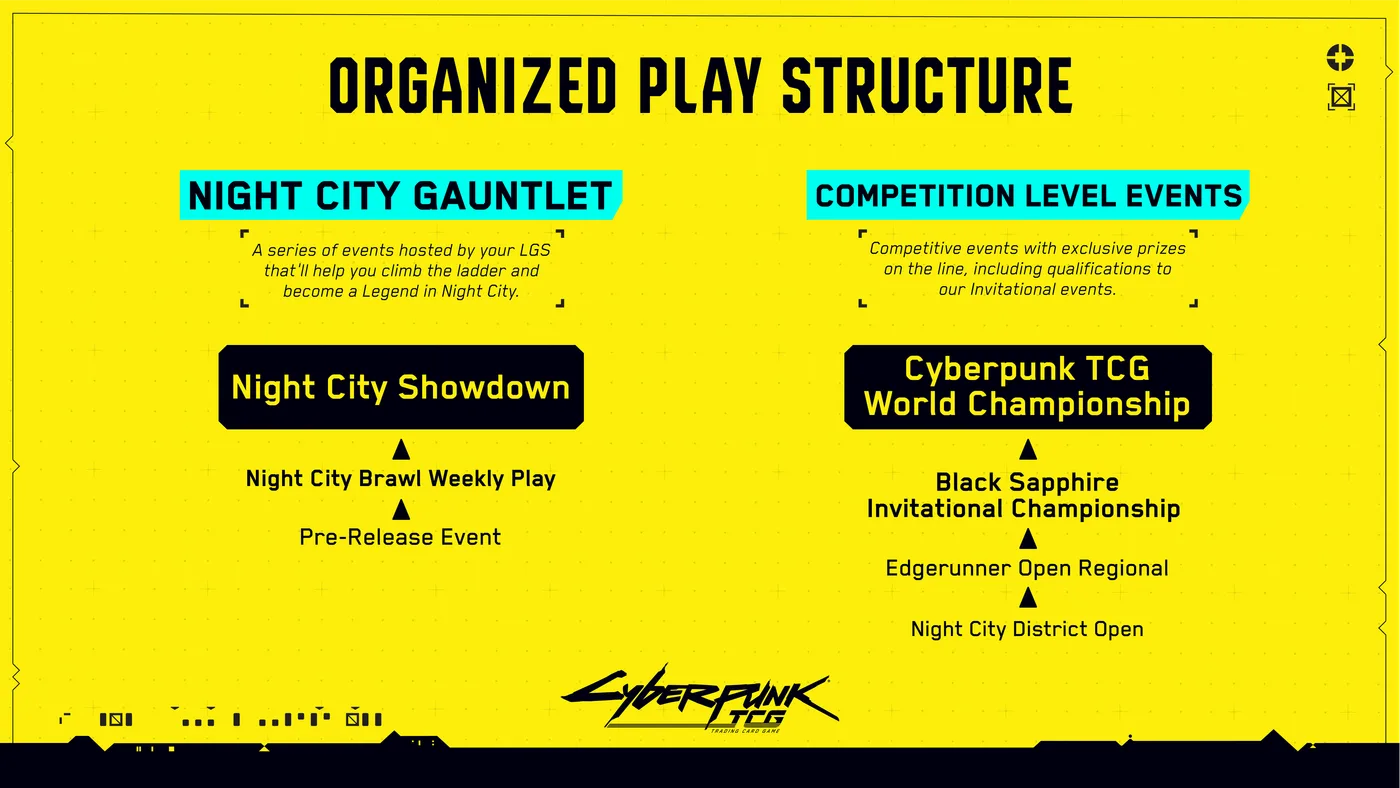
WeirdCo has announced a World Championship for a game you cannot buy until November.
That is not a criticism. It is the single most revealing thing about how this launch is being run, and it is sitting on a page most Cyberpunk TCG coverage has not opened yet. WeirdCo's Organized Play page lays out eight named event types across two ladders — four store-level rungs it calls the Night City Gauntlet, and four competition-level tiers that terminate in a World Championship it is refusing to describe.
And buried in the second paragraph of that page is a mechanical detail nobody is repeating, which will decide how your first real tournament goes: an in-store sealed deck is a minimum of 30 cards and 3 Legends. Not the 40 to 50 you build in constructed. If you have only read the gameplay guide, you have been preparing for the wrong deck size.
Here is the whole structure, what is confirmed, and where it stops being confirmed.
The ladder, top to bottom
WeirdCo splits its program in two. The Night City Gauntlet is the store-level path everyone starts on. Competition Level Events sit above it with, in WeirdCo's own words, "a qualification path to our invite-only top-level events."
| Tier | Event | Format | When | Who can run it |
|---|---|---|---|---|
| Gauntlet | Welcome to Night City Beta Event | Sealed | 10-20 September 2026 | Stores approved and holding a kit order by 1 May 2026 |
| Gauntlet | Welcome to Night City Pre-Release | Sealed | Weekend of 30 October 2026 | Any Organized Play store |
| Gauntlet | Night City Brawl | Constructed | Weekly, after Pre-Releases | Any Organized Play store |
| Gauntlet | Night City Showdown | Constructed | Once per store, per set | Any Organized Play store |
| Competition | Night City District Open | Not stated | From Set 2 | Stores that "supported Cyberpunk TCG the most" |
| Competition | Edgerunner Open Regional | Constructed, Best-of-3 | Chicago 11-13 December 2026; Warsaw 30-31 January 2027 | WeirdCo |
| Competition | Black Sapphire Invitational Championship | Not stated | Not stated | WeirdCo, invite-only |
| Competition | Cyberpunk TCG World Championship | Not stated | Not stated | WeirdCo |
Read the right-hand columns rather than the names. The Edgerunner Open Regional row filled in on 4 September 2026, when WeirdCo announced the first two events on its Digital Beta Celebration stream and then put venues, ticket prices, the round structure and a full prize ladder on a dedicated EOR page. Everything else above Night City Showdown still has at least one "not stated" cell, and the top two tiers have nothing on the table but a name and who runs them. WeirdCo frames the Organized Play page itself as "our revealed Organized Play structure so far," which is a publisher being honest about publishing a skeleton, and you should read it as one — that page has not been updated with the Regional dates and still says the tier is "set to begin during the Welcome to Night City set cycle."
The useful split: the Gauntlet is a schedule. The competition tier was a promise until 4 September 2026, when the first two Regionals got dates. Above the Regional, it is still a promise.
Sealed decks are 30 cards minimum, not 40
This is the fact worth the click.
The gameplay guide's deckbuilding rules — exactly 3 uniquely named Legends, 40 to 50 cards, maximum 3 copies of any card, everything inside your Legends' per-colour RAM ceiling — are the constructed rules. Those govern Night City Brawl and everything above it.
Beta Events and Pre-Releases do not use them. WeirdCo's own wording for both: "You'll turn up, open your sealed event kit, build a deck of 30 cards and 3 Legends." The 19 August sealed primer sharpens that into a floor rather than a fixed size: "a main deck with a minimum of 30 cards, not including your three Legends," and the Organized Play FAQ agrees with "at least 30 cards."
Ten fewer cards is a bigger change than it sounds, because a Cyberpunk deck has no lands, no Energy and no ink. There is no resource card type padding your list. Eddies come from selling one card per turn out of your hand, so every point of economy you generate is a card you decided not to play. A 30-card sealed deck is 30 real cards, and roughly a third of them will end up face-down in your Eddies area over a long game.
Do the pool arithmetic. Six boosters at 12 cards each is 72 cards, plus the three Legends the kit hands you. You are cutting a 72-card pool to 30. In Magic's sealed and draft formats you cut a comparable pool to 23 spells and pad the rest with lands you did not open. Here there is nothing to pad with, so your hit rate has to be far higher — and your sell tags matter as much as your bombs, because a hand full of unsellable cards is a hand you cannot spend.
The other consequence: at the 30-card floor, decking out stops being theoretical. You lose on the spot if you are required to draw from an empty deck, and with one draw per turn plus any card that trashes or draws extra, a 30-card deck is a real clock in a way a 50-card one is not. Overtime arrives after the last player's 7th turn, so most games will not get there — but the games that do are the ones you will remember losing.
The 19 August sealed primer settled most of what this section originally left open: in sealed you do not need to consider the RAM numbers on your cards at all, and you may play cards of up to three colours regardless of which Legends you pick. Whether the 3-copy cap applies in sealed is still unstated - treat that one as the remaining open question.
What is actually in a Beta Event Kit
You do not bring cards to a Beta Event. You buy the kit at the counter and everything comes out of the box.
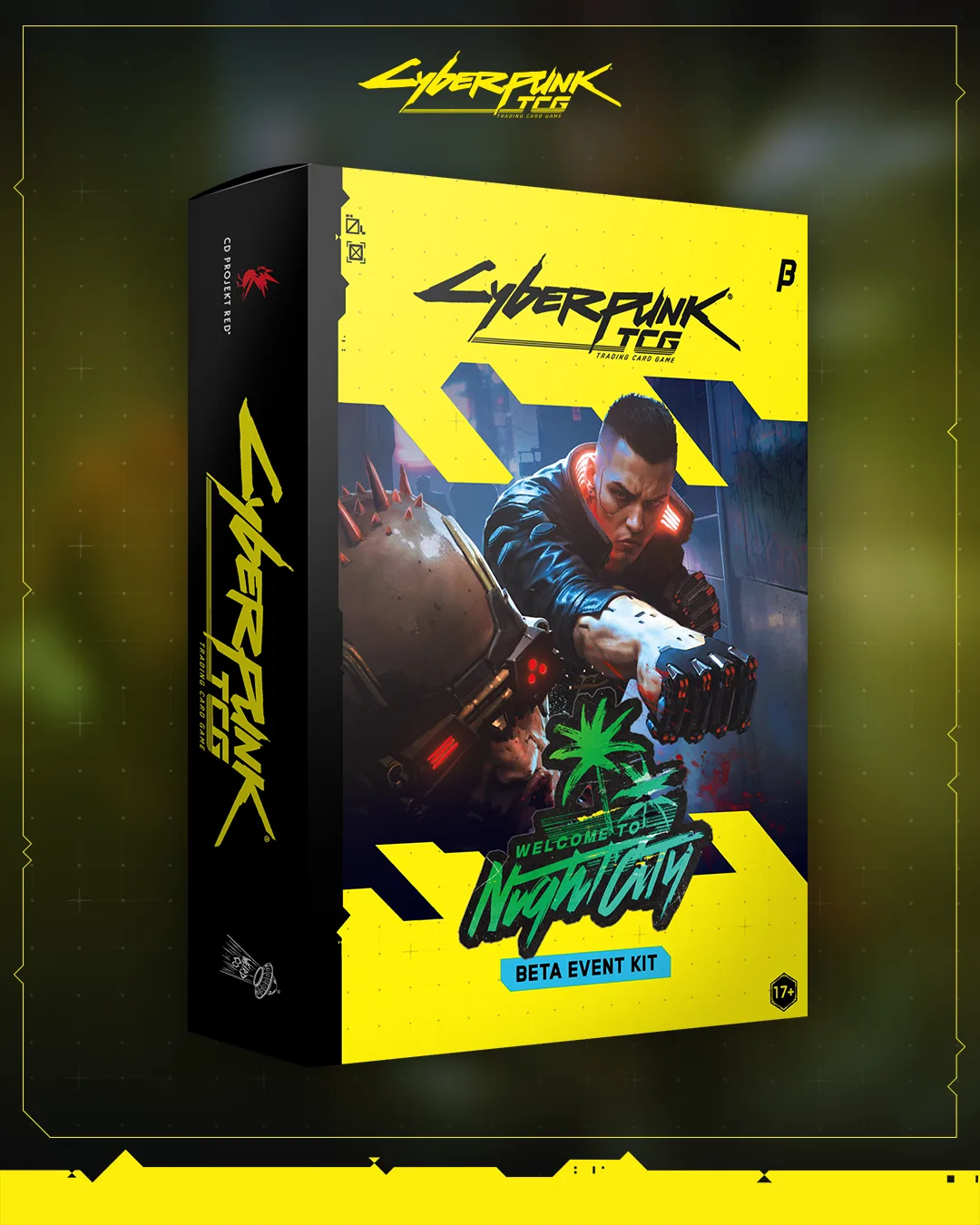
Per WeirdCo's 24 July guide, each kit contains:
- Six Welcome to Night City Beta Booster Packs.
- Three additional random Legend cards to help with deck construction.
- A Beta Kit Mantis Blades promo card.
- A full set of polyhedral dice — d4, d6, d8, d10, d12, d20.
That last line is the one that makes the kit a genuine on-ramp rather than an entry fee. You leave with the dice, and the dice are the game. WeirdCo's framing: "after they're done, everyone will have a Cyberpunk TCG deck to go home with."
The supplemental Legend pack draws three from a published pool of ten:
| Legend | Legend | Legend |
|---|---|---|
| Adam Smasher: Ender of Legends | Royce: Psycho on the Edge | Dum Dum: Maelstrom Triggerman |
| River Ward: Detective on the Hunt | Rogue Amendiares: Preem Solo | Goro Takemura: Vengeful Bodyguard |
| Jackie Welles: Mama's Favorite | Panam Palmer: Nomad Cavalry | Alt Cunningham: Soulkiller Architect |
| Judy Álvarez: Braindance Maestro |
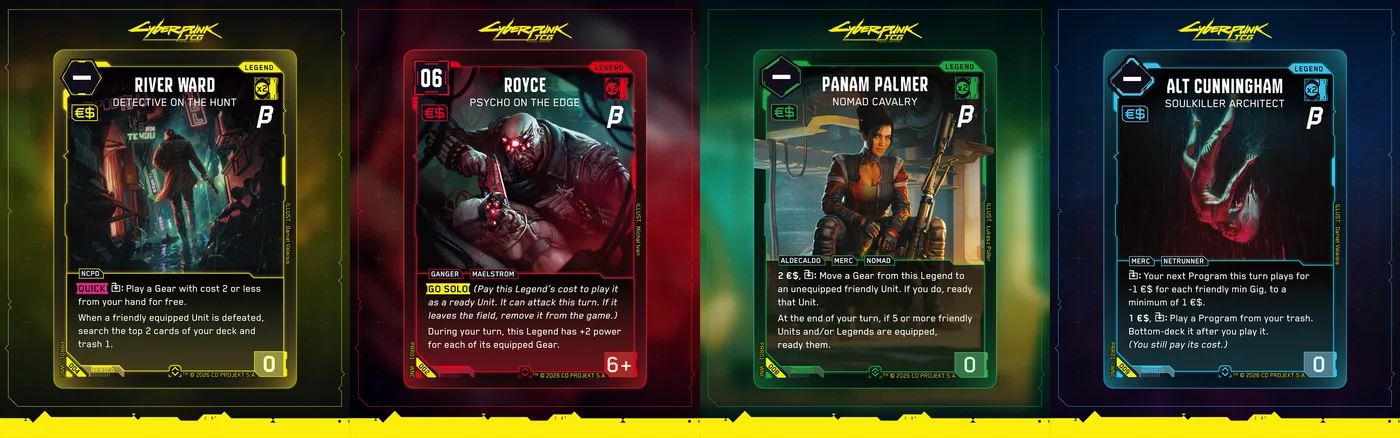
WeirdCo revealed four of the ten as card images, and the four it picked are one per colour: River Ward is Yellow, Royce is Red, Panam Palmer is Green, Alt Cunningham is Blue. Every one of the four carries x2 RAM in its own colour. If that holds across the pool, three same-colour Legends give you a 6 RAM ceiling and a three-colour spread gives you 2 in each — which is exactly the tension the constructed format is built around, handed to you at random.
Note also that Goro Takemura appears here as Vengeful Bodyguard, while the gameplay guide's worked RAM example uses Goro Takemura: Hands Unclean. Two different Legend cards, same character, different names. Since decks require three uniquely named Legends, that distinction is not cosmetic.
The kit promo is a Gear card, and it is not a throwaway:
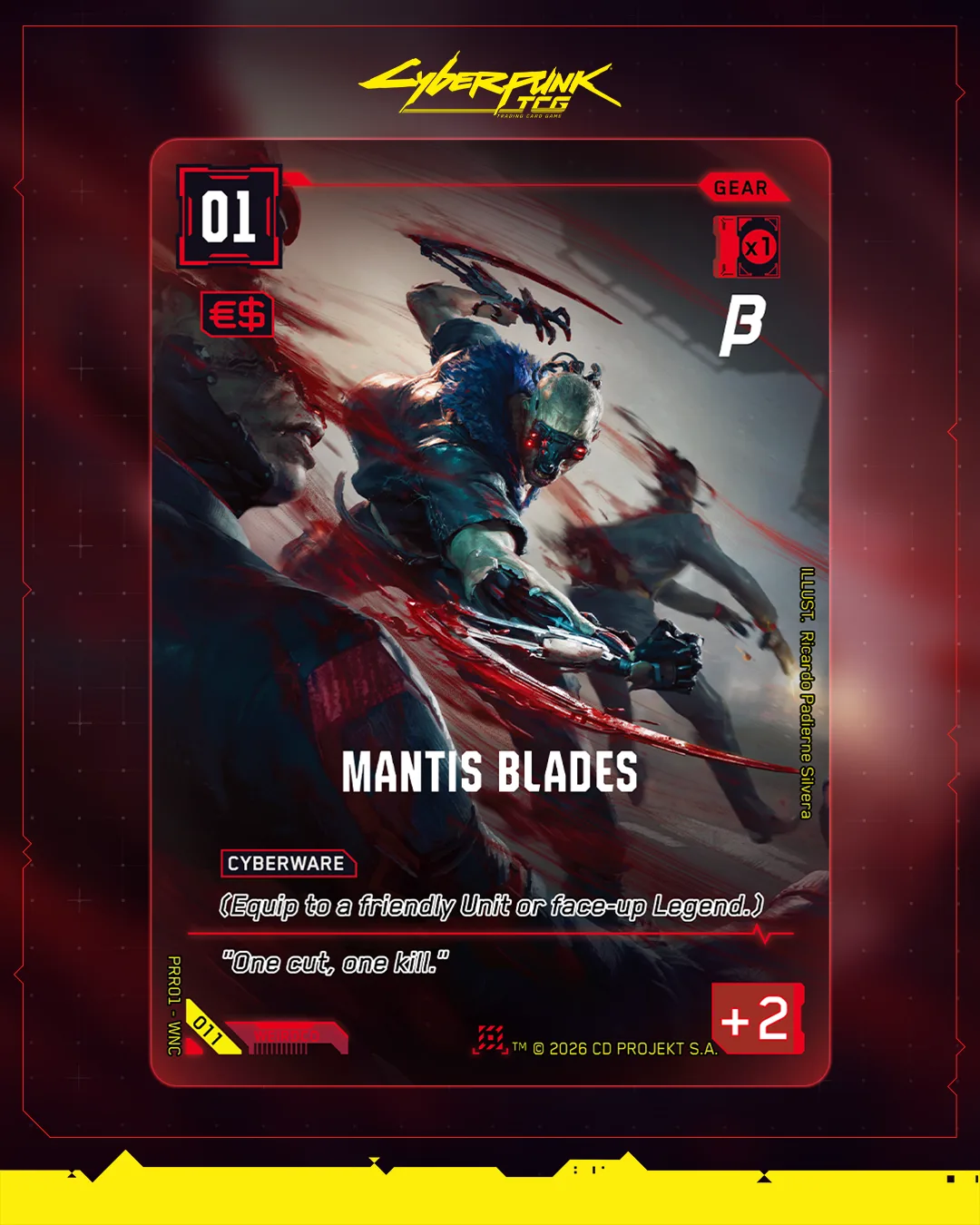
Mantis Blades is a 1-cost, x1 Red RAM Gear with the CYBERWARE tag, reading "(Equip to a friendly Unit or face-up Legend.)" for +2 power. One Eddie for two power, attachable to a face-up Legend as well as a Unit. In a format where power tiers decide how many Gigs an attack steals — 1 Gig from 1 to 9 power, 2 Gigs from 10 to 19, 3 at 20-plus — a cheap +2 is not filler. It is a card that can move you across a threshold. It also carries a sell tag, so if you draw it in a hand with nothing to equip, it is still an Eddie.
Three of the four revealed kit Legends have Gear-facing text on them. In a sealed pool where everyone is holding the same promo, that is not a coincidence worth ignoring.
Beta Events and Pre-Releases are the same event with different packs
WeirdCo says it directly: the two event types "are very similar." The differences are supply-side, not rules-side.
| Beta Event | Retail Pre-Release | |
|---|---|---|
| Dates | 10-20 September 2026, two weekends | Weekend of 30 October 2026 |
| Packs used | Welcome to Night City Beta boosters | Welcome to Night City Retail boosters |
| Store eligibility | Stores approved for Organized Play and holding a Beta Event Kit order, both by end of day 1 May 2026 | Any Cyberpunk TCG Organized Play store |
| Promos | Beta Kit promos, including Mantis Blades | Different promo cards |
| Backer status needed | No — "Being a Kickstarter backer isn't required" | No |
Two practical takeaways. First, Beta packs carry the extra hit slot and the Beta symbol, so a September event is a materially better box of cards than an October one — the Kickstarter and release breakdown covers what that stretch goal actually added. Second, September access is entirely a function of whether your shop filed paperwork by 1 May — and the Organized Play FAQ is stricter than the structure page about what that means. A store had to be approved for Organized Play by end of day 1 May 2026 and have placed an order that included Beta Event Kits by the same deadline. Signing up alone was not enough. More than 3,000 stores worldwide are signed up as retailers and Organized Play locations, but the subset that cleared both conditions is smaller, and no public list of it exists. Ask your store directly, or search Cyberpunk TCG on Melee.gg, where the eligible stores schedule their events.
Night City Brawl is the weekly rung
Brawls start immediately after Pre-Releases and run weekly once Welcome to Night City is on shelves on 6 November. They are constructed: bring your own 3 Legends and 40 to 50 cards.
WeirdCo calls them "the cornerstone of the Night City Gauntlet" and "the first rung on the competitive Cyberpunk TCG ladder." Winners take home Night City Brawl packs "that feature promo cards in exclusive treatments." Brawl kits go out to stores in time to run them straight after Pre-Release weekend.
What is not published: kit contents, round structure, how many Brawl packs a store gets, or whether prizing scales with attendance. WeirdCo says "we'll give you more details about kit contents in the months ahead," which is a polite way of saying nobody can tell you what winning is worth yet.
If you are trying to plan a first constructed deck, the constraint is not the meta — there isn't one. It is that Brawls begin roughly a week after retail, so your first list will be built from whatever you opened, not from anything netdecked.
Night City Showdown, once per store per set
Showdowns are the top of the store ladder: competitive in-store tournaments, run once per store, per set, toward the end of each set cycle. WeirdCo's framing is that the weekly Brawls "build toward" them and that they are where players "put everything they've learned over the preceding months into action."
Prizing is the most concrete thing published about them. Confirmed as on offer:
- Alternative-art promos for participating players, top 8, top 4, and Showdown Champions — four separate prize bands.
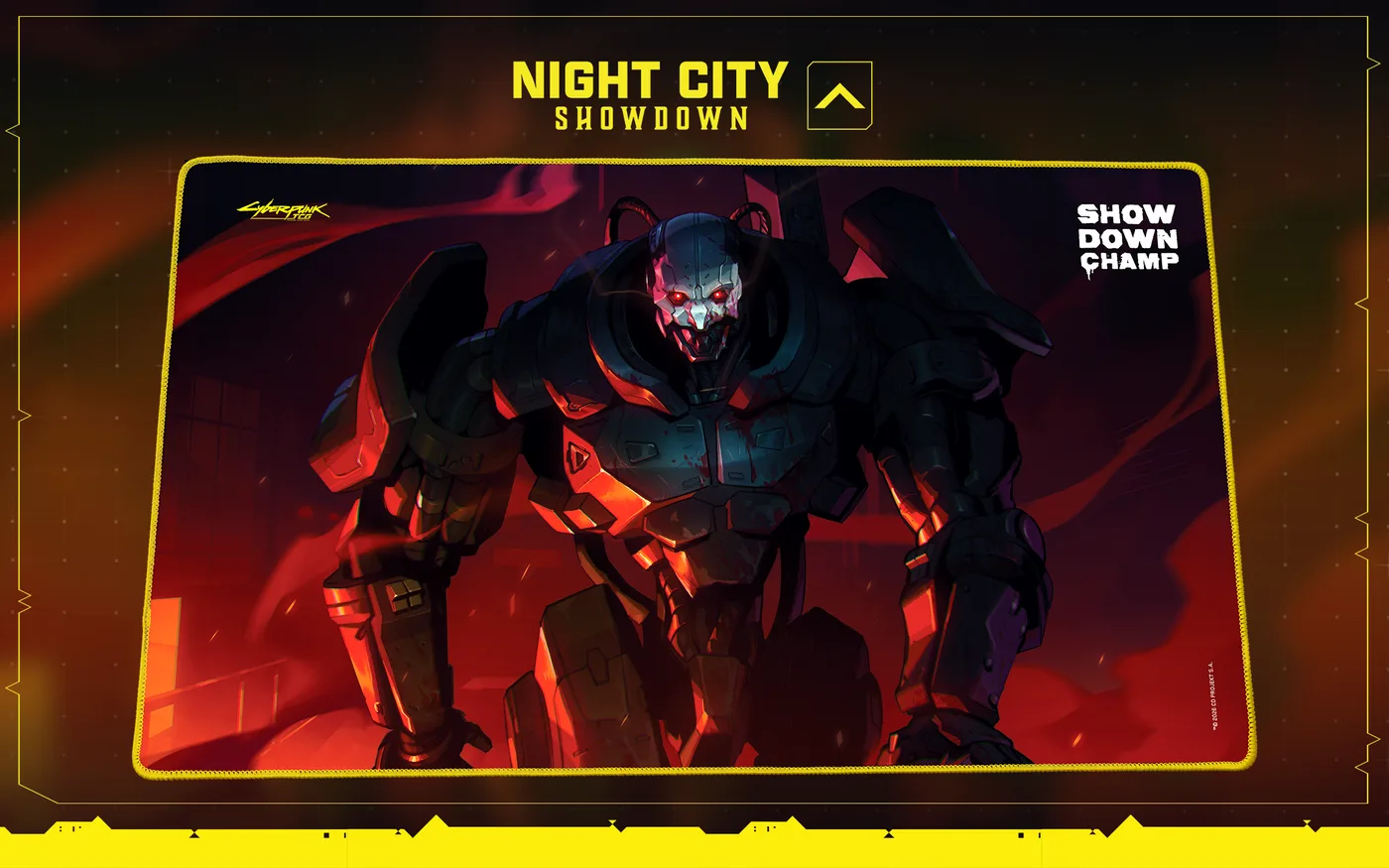
- Full-art champion variant promos and playmats for the players who finish on top.
Once per store per set is the number that matters. It means Showdown slots are scarce by design, it ties the event cadence to the set cadence, and it means a store's Showdown is a single dated event you either make or miss. Compare that to how Lorcana handles promo distribution, where the promo firehose runs more or less continuously — WeirdCo is deliberately building scarcity into the store tier. The full prizing lineup has been promised but not published.
The competitive half, and where it is still thin
Above the store, four tiers. One of them now has a full spec sheet. The other three are still mostly names.
Night City District Open. 64 to 128 players, hosted by stores "that have supported Cyberpunk TCG the most throughout Welcome to Night City," and — this is the important bit — starting with Set 2, not Set 1. So the first set cycle has no District Opens at all. WeirdCo says to expect "prizing in line with official competitive tournaments, including a path to higher tiers."
Edgerunner Open Regionals. The core large-scale events, and since 4 September 2026 the one competition tier with real dates. WeirdCo announced the first two on its Digital Beta Celebration stream: Chicago, 11-13 December 2026 at McCormick Place, with a 2,048-player main event (64 of those seats held back for a Friday play-in), and Warsaw, 30-31 January 2027 at EXPO XXI, capped at 1,536. The Organized Play page's "hundreds of players" is already out of date; the EOR page now says "thousands." Main event entry is the Major Leagues ticket at $75 or €75 plus fees, sold in waves through Melee: a backer-lottery Wave 0 on 23 September, then general sales from 30 September 2026 for Chicago (with a further wave on 4 November) and from 11 November 2026 for Warsaw. The main event is Constructed Best-of-3 — eight Swiss rounds on day one, 18 match points or better to reach day two, three more Swiss rounds, then a top-16 single-elimination cut. Finish in the top 64 and you get a Black Sapphire Invitational invite (that one is strictly top 64 — unlike the other top-64 prizes, it does not extend to matching records below 64th); the champion gets a World Championship invite. The dates confirm the inversion this post flagged in August: with District Opens not starting until Set 2, Regionals arrive before the small events that would normally feed them, so for the first set the Regional is the entry point to competitive play, not the reward for clearing one. WeirdCo says the list "will be expanded as further EOR events are announced into 2027 and beyond." The dates, tickets and promo rundown and the ticket tiers and prize ladder breakdown cover both events in full.
Black Sapphire Invitational Championship. Invite-only, invitations earned "based on their performance at previous competitive events." One route is now on paper — a top-64 finish in a Regional main event, and WeirdCo says each Regional will also run "premier side events that offer further Black Sapphire Invitation invites" — but there are still no dates, no season length and no count of events per year, and no other invite route has been specified. The Organized Play page promises District Opens will carry "a path to higher tiers," without saying which.
Cyberpunk TCG World Championship. WeirdCo's words: "We're keeping details about our World Championship under wraps for now." The only line added since is on the Regional prize ladder: each EOR champion receives a World Championship invite. No date, no venue, no format.
That is a real ladder with a real qualification chain, announced in the right order and with the right shape. It is also, as of today, one fully specified tier, two tiers with a single invite line each, and one player-count range. The first sanctioned constructed events, the weekly Brawls, do not start until after the 30 October Pre-Release weekend.
What WeirdCo has not answered
Being specific about the gaps, because the shape of the pyramid makes it easy to assume more is known than is:
- Whether the 3-copy cap applies to sealed. The 19 August primer published the RAM and colour rules — neither applies — but neither it nor the Organized Play FAQ mentions a copy cap in either direction.
- Round counts, match structure and time limits for the rest of the store ladder. The Organized Play FAQ recommends three rounds of Best-of-3 at 60 minutes for Beta Events, and nothing at all for Pre-Releases, Brawls or Showdowns. The Regional main event is the only tier with a published round structure.
- Night City Brawl kit contents and the full Night City Showdown prize lineup. Both promised, neither published.
- Regionals beyond Chicago and Warsaw. WeirdCo says the list "will be expanded," but only two events are dated. Also still open: District Open host criteria beyond "supported us the most," Black Sapphire dates and any invite route other than a Regional top-64 finish or a Regional side event, and everything about Worlds except that each Regional champion gets an invite.
- Banlists, rotation and format definitions. No competitive format has been named beyond "constructed" and "sealed."
- A Beta Event Kit or Pre-Release Kit MSRP. Trade coverage confirms the SKUs exist. Prices are not public.
Three blanks this post carried in August have since been filled, and all three are worth knowing: WeirdCo named Melee.gg as its tournament software partner on 18 August 2026 and turned on event scheduling, so Beta Events are now listed and signed up for there rather than through the store locator; the 19 August sealed primer settled the sealed colour and RAM rules; and on 4 September 2026 WeirdCo announced the first two Edgerunner Open Regionals — Chicago, 11-13 December 2026, and Warsaw, 30-31 January 2027 — with the EOR page following up on venues, ticket prices, the round structure and the prize ladder. Anything still on the list above is unpublished, and anything you read that fills it is somebody guessing. The rules themselves are still beta — the ruleset that took effect on 29 May 2026 is what every one of these events will run on, and WeirdCo flagged at the time that card stats, keywords and templating were still moving. The full rules breakdown covers what is settled and what is not.
Quick Action Checklist
- Call your local game store and ask two questions: were you approved for Cyberpunk TCG Organized Play by 1 May 2026, and did you order Beta Event Kits by the same date? The Organized Play FAQ requires both. Those answers decide whether you can play in September or have to wait until 30 October. Failing that, search Cyberpunk TCG on Melee.gg, where scheduling opened on 18 August 2026.
- Build to the 30-card minimum, not 40. Practise sealed deckbuilding at 30 cards and 3 Legends using the free print-and-play demo decks as a card pool proxy. Constructed's 40-to-50 range does not apply until Night City Brawl.
- Count your sell tags before you count your bombs. With no resource card type in the deck, the cards you sell are the cards you do not play — in a 30-card list that trade-off bites twice as hard.
- Do not build a constructed list around a specific Legend. You cannot choose which of your three you flip, and in sealed you do not choose which three you get.
- Diarise the four store-ladder dates: Beta Events 10-20 September, Pre-Release weekend 30 October, retail release 6 November, weekly Brawls immediately after.
- Diarise the two Regional dates too, and their ticket waves: Chicago, 11-13 December 2026 at McCormick Place — general sales open 30 September, with a further wave on 4 November; Warsaw, 30-31 January 2027 at EXPO XXI — general sales open 11 November. Main event entry is the $75/€75 Major Leagues ticket, sold only through Melee, so link your Melee and cyberpunktcg.com accounts before the wave you want goes live.
- Treat any Black Sapphire or Worlds date you see quoted as a guess. WeirdCo has published dates for neither. The only competition-tier dates on record are the two Regionals above.
Frequently Asked Questions
How big is a Cyberpunk TCG sealed deck?
What is in a Cyberpunk TCG Beta Event Kit?
Which Legend cards can appear in a Cyberpunk TCG Beta Event Kit?
What is the difference between a Cyberpunk TCG Beta Event and a Pre-Release?
What are Night City Brawls and Night City Showdowns?
What is the Cyberpunk TCG competitive tournament structure?
Do you need to be a Kickstarter backer to play in Cyberpunk TCG Beta Events?
Keep Reading
- Cyberpunk TCG hub
- the full rules breakdown
- the Kickstarter and release breakdown
- playing Cyberpunk TCG at Gen Con 2026
- the dates, tickets and promo rundown
- the ticket tiers and prize ladder breakdown
- Magic's sealed and draft formats
- how Lorcana handles promo distribution
- the Cookie Run: Braverse tournament guide
- the Riftbound 2026 set schedule
- Organized Play Structure (WeirdCo, official) - the eight-tier event ladder and the 30-card sealed rule
- Cyberpunk TCG Beta Event Guide: What's in the kit?, 24 July 2026 (WeirdCo) - kit contents and the ten-Legend pool
- The Cyberpunk TCG store locator is now live, 17 July 2026 (WeirdCo) - 3,000+ stores, Brawl and Showdown detail
- Cyberpunk TCG Gameplay Guide (WeirdCo, official) - constructed deckbuilding, RAM and the 7-Gig win condition
- Rule and Game System Updates from Alpha to Beta, 29 May 2026 (WeirdCo)
- Melee Integration and Organized Play FAQ (WeirdCo, official) - the two-condition store eligibility rule, the at-least-30-card sealed deck, Beta Event Kit contents and the three-round Best-of-3 recommendation
- Announcing our Tournament Software Partner for Cyberpunk TCG, 18 August 2026 (WeirdCo) - Melee.gg named, event scheduling and player account linking live
- Edgerunner Open Regionals: All the news from our Digital Beta Celebration Stream, 4 September 2026 (WeirdCo) - Chicago 11-13 December 2026 and Warsaw 30-31 January 2027 announced, backer lottery and ticket wave dates
- Edgerunner Open Regionals (EORs) (WeirdCo, official) - venues, player caps, ticket tiers and prices, Constructed Best-of-3 round structure, full prize ladder, Black Sapphire and World Championship invites
Related Guides

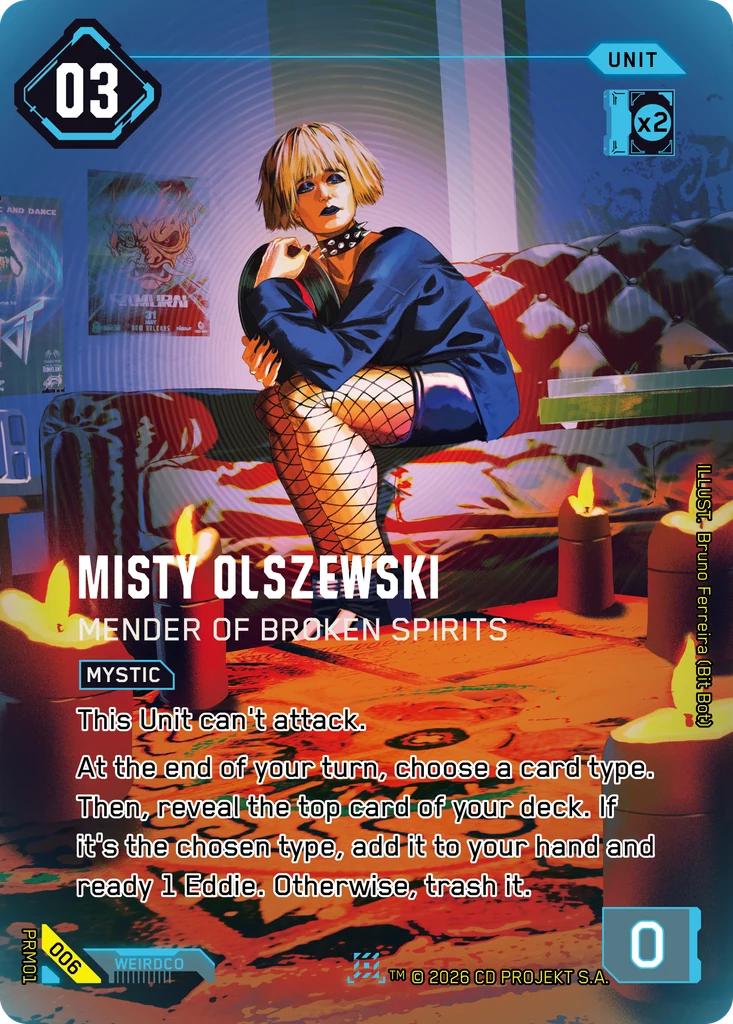
Cyberpunk TCG Conventions: Rebecca, Misty and Where to Play
WeirdCo's events calendar now lists eight convention stops from SPIEL Essen to February 2027. Only two still list the Rebecca promo. From Lucca on it is Misty Olszewski, a full-text card from the first set. Here is each stop, the three dates that disagree with the organisers, and where you can play or buy rather than just demo.

Cyberpunk TCG Holophone: Factions, Jobs and Launch Date
WeirdCo announced Holophone on 7 October: a text-message story app that connects your Night City Brawl results to jobs for one of three factions. Here is what it is, how you get in, how it lines up with the Organized Play calendar, and the naming clash worth knowing about before it goes live on 30 October.
Cyberpunk TCG Night City Brawl and Showdown Prizes
Before Chicago crowns a Regional champion, local stores crown their own: the Night City Showdown window opens one week after retail. WeirdCo has now published every prize for it and for the weekly Brawls, and the card database already carries all of the promo cards - including a headline Showdown prize that only a mono-Yellow deck can legally play.
Cyberpunk TCG Edgerunner Open: $75 Tickets, 10 Prize Tiers
As of 12 September, WeirdCo's own Edgerunner Open post said venues, ticket prices, prizing and format were all still unpublished. Nine days later they are all live on cyberpunktcg.com/eor - McCormick Place, Warsaw EXPO XXI, a $75 Major Leagues badge, an 8-round-then-playoffs format, a ten-step prize ladder, and a serialized Encrypted Legends mechanic explained in full for the first time. The four alt-art promos WeirdCo teased on stream in September have also turned up in the card database - not as one printing each, but four art variants apiece.
How to Play the Cyberpunk TCG — Gig Dice, Eddies and Street Cred, Explained
WeirdCo raised $28.3 million to build a trading card game where the win condition is a pile of dice. Here is how the Cyberpunk TCG actually works under the beta rules, what the four colors do, and why the release date most sites are printing is out of date.
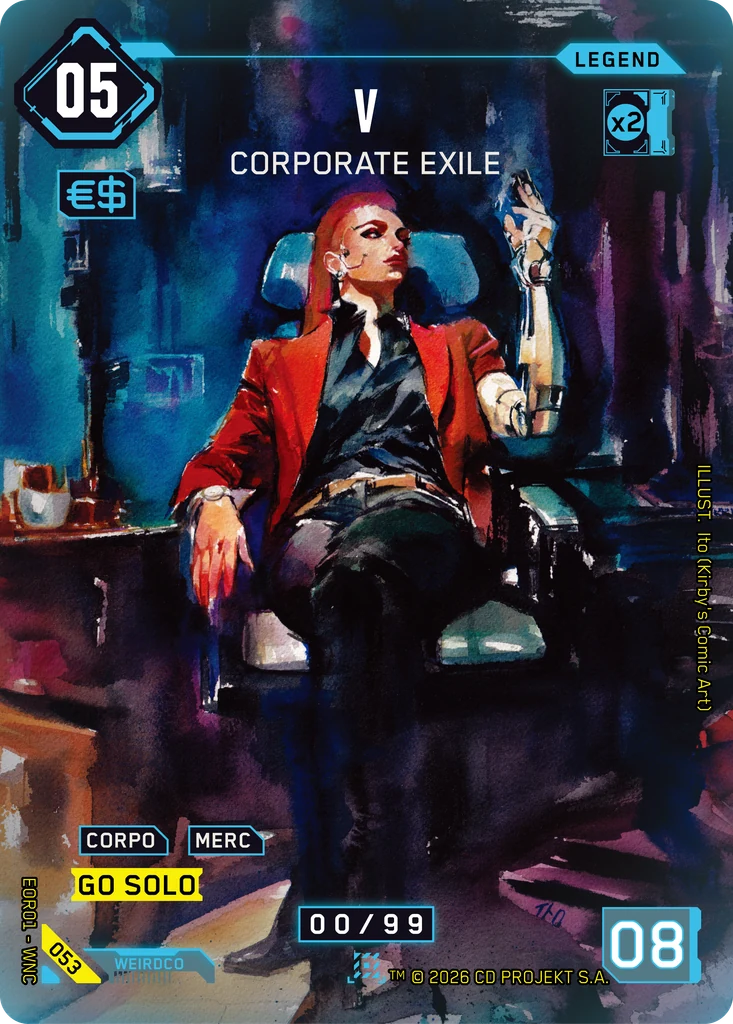
Cyberpunk TCG Edgerunner Open: Dates, Tickets, 12 Promos
WeirdCo's Organized Play page still says the Edgerunner Open Regional schedule is coming 'in due course'. On 4 September it named two cities and five ticket-sale dates, and the official card database has quietly gone further than the announcement did: twelve cards now carry an Edgerunner Open Season 1 printing, eight of them Legends stamped with a serial box.