How to Play the Cyberpunk TCG — Gig Dice, Eddies and Street Cred, Explained
WeirdCo raised $28.3 million to build a trading card game where the win condition is a pile of dice. Here is how the Cyberpunk TCG actually works under the beta rules, what the four colors do, and why the release date most sites are printing is out of date.
Six polyhedral dice. That is the part that stops people mid-sentence when you describe this game, and it is not a gimmick bolted onto a card game — the dice are the win condition. You do not reduce anyone to zero life. You do not deck them out on purpose. You collect seven dice and hold them through your opponent's turn, and then you have won.
That is The Official Cyberpunk Trading Card Game, built by WeirdCo under license from CD PROJEKT RED, and it is currently the most-funded tabletop project in Kickstarter history. The campaign ran 17 March to 17 April 2026 against a $100,000 goal and closed at $28,353,088 from 50,773 backers — figures you can still read off the campaign page itself. Press at the time reported the goal falling in about five minutes; that specific number is secondhand, so treat it as reporting rather than something you can verify now that the campaign has closed. The final total and the backer count you can verify.
Nobody can buy this at retail yet. What follows is the beta ruleset, which went live on 29 May 2026 and is what WeirdCo has been demoing at UK Games Expo, Anime Expo and Gen Con ever since. It is not final. WeirdCo said so themselves when they published it, and I will flag the parts most likely to move.
What Cyberpunk TCG actually is
A two-player game where you build a crew of edgerunners and fight over jobs. The official framing from WeirdCo's own guide: "you're the leader of your very own crew, competing against your Rival to become a Night City Legend. Take on Gigs, crush your enemies, boost your Street Cred, and go down in history."
The first set is Welcome to Night City, drawn from Cyberpunk 2077 — CD PROJEKT RED's launch release named V, Jackie Welles, Johnny Silverhand and Judy Álvarez specifically. Set 2 is where Cyberpunk: Edgerunners properly arrives. Free Lucy promo cards are owed to early newsletter signups and Kickstarter followers, shipping in the second fulfilment wave, so Edgerunners characters do exist around the first set — but the Edgerunners set proper is the follow-up.
The release date most sites are printing is out of date
This is the single most useful thing in this post, so I am putting it near the top.
Search for a Cyberpunk TCG release date and you will get 1 October 2026 from a pile of retailer listings and aggregator articles. That date is stale. WeirdCo's own production diary, published 19 June 2026, lays out a completely different schedule:
| Milestone | Date |
|---|---|
| Kickstarter backer fulfilment begins | Around 1 September 2026, two-week window |
| In-store Beta Events | 10-20 September 2026 |
| Retail pre-release events | Weekend of 30 October 2026 |
| Full retail release | 6 November 2026 |
The Beta Event Guide published on 24 July 2026 restates it: pre-releases the weekend of 30 October, "after that, we're just a week away from the full retail release, and the start of weekly Night City Brawl events."
So if a shop has you pencilled in for 1 October, that is a date from an older plan. Backers get product in September. Everyone else waits for November, unless you buy into a Beta Event Kit in September — those are open to anybody, no backer status required, and they are sealed-deck format so you turn up empty-handed.
Retail pricing is settled, even though the date was not. WeirdCo's GAMA Expo 2026 trade announcement put a 24-pack Retail Booster Display at $119.90, the 36-pack Beta Booster Display at $180.00 and each Starter Deck at $29.99, with GTS Distribution as exclusive US distributor. No MSRP has been published for the Beta Event Kit, the Pre-Release Kit or the demo kits.
What you need on the table
- A set of six dice: d4, d6, d8, d10, d12 and d20. All six, every game. These are your Gigs.
- Exactly 3 Legend cards, all with different names.
- A deck of 40 to 50 cards, not counting the Legends.
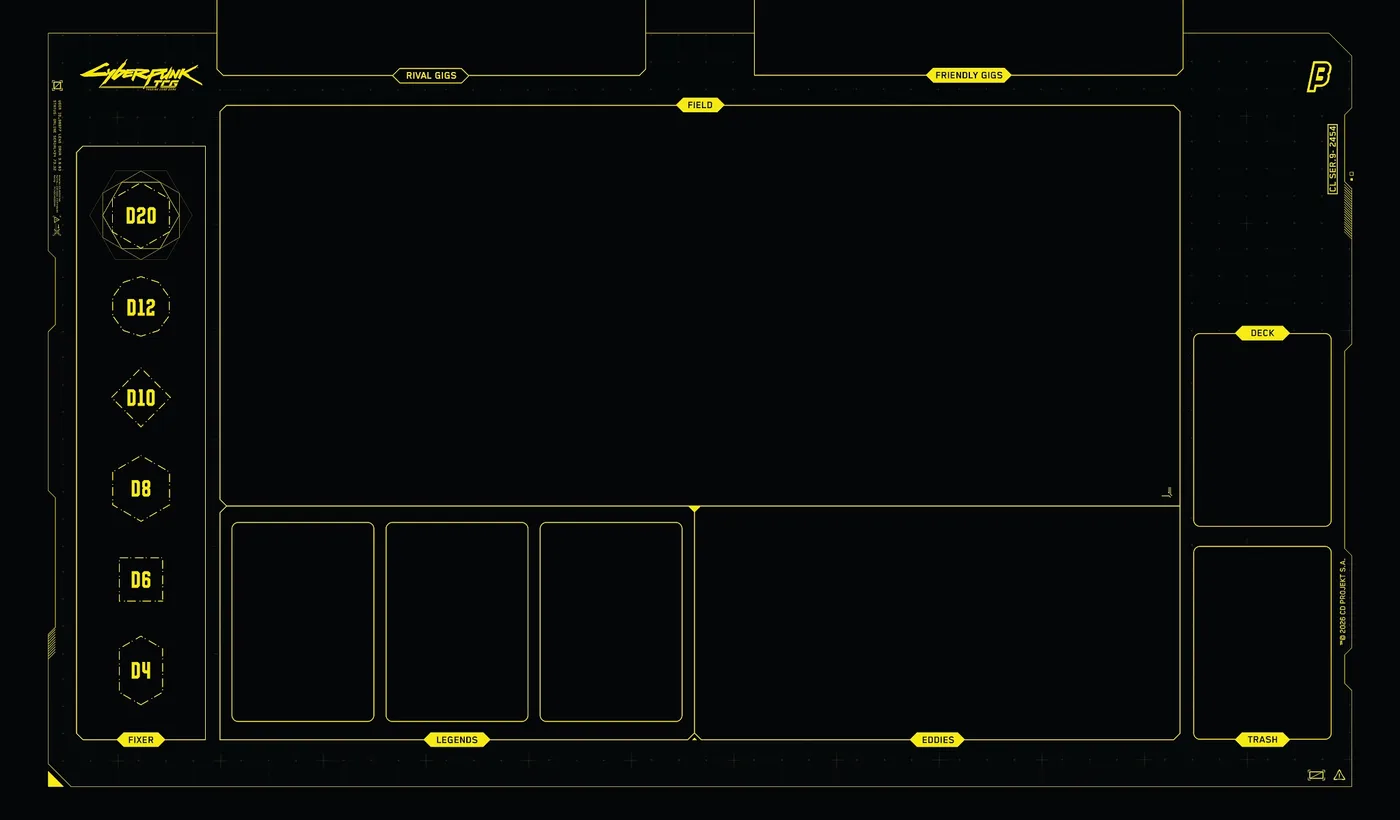
Your playmat has seven zones and they all matter: the Fixer area (where all six dice start), your Gig area (dice you control), the Field (where Units fight), the Eddies area (starts empty), the Legends area (three cards, face-down, randomised), your deck, and the trash.
Setup is short. Shuffle, randomise your three Legends face-down, both players roll a d20 for play order, then draw 6 with one full mulligan available — shuffle the whole hand back and draw six new cards. The player going first spends their two leftmost Legends and does not ready them on their first turn, which is the game's answer to first-player advantage.
Gig dice are the win condition
Every die is one Gig. At the start of your turn you take one die from your Fixer area, roll it, and move it into your Gig area. You pick which die, with one restriction: the d20 is always last. So over the course of a game you will place all six of your own dice in whatever order you like, saving the twenty-sider for the end.
The rule that ends games: if a player has at least 7 Gig dice in their Gig area at the start of their turn, they win.
Count that against your six starting dice and the arithmetic does something clever — you cannot win on your own dice alone. Seven requires at least one stolen from your opponent. WeirdCo called this out when they raised the threshold from six: it "means players must steal at least one Gig to win — a player going first can't just stall out to win automatically." There is no turtling to victory. You have to go take something.
If neither player has closed it by the end of the last player's 7th turn, the game enters Overtime, which is sudden death — the moment you hold a majority of the Gig dice in play, you win instantly.
One more losing condition, and it is brutal: if you must draw and your deck is empty, your Rival wins immediately. No burn-out grace, no shuffling the trash back. You are just done.
Street Cred is a lock, not a score
Here is where the dice stop being counters and start being a resource.
Street Cred is the sum of the top faces of every die in your Gig area. That is the whole formula. Three dice showing 4, 9 and 2 is 15 Street Cred.
Street Cred does not win you anything directly. It is a gate — a chunk of cards carry effects that only switch on at a certain Street Cred, or when your Street Cred is odd, or even, or higher than your Rival's. It is why controlling two dice always beats controlling one big one for the win condition, while the values on those dice decide which half of your deck actually functions.
That tension is the design. You are choosing dice for two incompatible reasons at once: which die gets you closer to seven, and which roll turns your cards on. A d4 fills a slot and barely moves your Cred. A d12 might spike your Cred to exactly where a card needs it, or land on 1 and do nothing.
Eddies: the worst economy in Night City
Eddies (€$) pay for everything, and you generate them the ugliest possible way — by throwing cards away.
Once per turn, you may sell one card from your hand that has a sell tag in its top-left corner. You reveal it to your Rival, then put it face-down in your Eddies area. Each face-down card there is worth exactly 1 Eddie. Spend an Eddie by turning it sideways; it readies at the start of your next turn.
Read that again: a nine-cost bomb sells for the same 1 Eddie as a two-drop. The guide is blunt about it — "no matter how much a card costs in your hand, it's only worth 1 €$ per turn as an Eddie." One card per turn, one Eddie each, forever. That is a hard ramp ceiling and it means your curve is basically dictated by turn count.
The escape hatch is Legends. You can spend any number of Legends as 1 €$ each, face-up or face-down, which turns your three centerpiece characters into an emergency wallet. Spending them has a real cost — a spent Legend cannot be used for anything else that turn — but it is the only way to burst past one new Eddie per turn.
Legends, and why you flip them blind
Your three Legends start face-down in random order and you are not allowed to look. Once per turn you may Call a Legend — spend 1 €$ to flip one face-up, chosen at random from what is still face-down.
You built the deck. You know which three names are in there. You do not know which one is coming next, and you cannot pick. WeirdCo's line is that "the randomness of your choice is a part of the game," which is either delightful or infuriating depending on your relationship with variance.
Crucially, you can Call a Legend as a reaction when a rival Unit attacks, not just on your own turn. That makes it the game's main source of surprise interaction, and it means a face-down Legend is a genuine threat your opponent has to play around without knowing what it is.
The named Legends confirmed so far give a sense of the range: V: Streetkid, Adam Smasher: Ender of Legends, Johnny Silverhand: Rocking Renegade, Royce: Psycho on the Edge, Panam Palmer: Nomad Cavalry, Judy Álvarez: Braindance Maestro and Yorinobu Arasaka: Embracing Destruction, among others. The official card database listed 127 cards on 15 August 2026, 149 on 31 August and 151 on 4 September 2026. Treat that as a database count rather than a set size — the Welcome to Night City retail numbering, 001 to 140, is now complete with no gaps, the other 11 cards are starter-deck exclusives and a promo, and the Beta numbering, which adds the alternate arts, runs to 171.
How to read a card
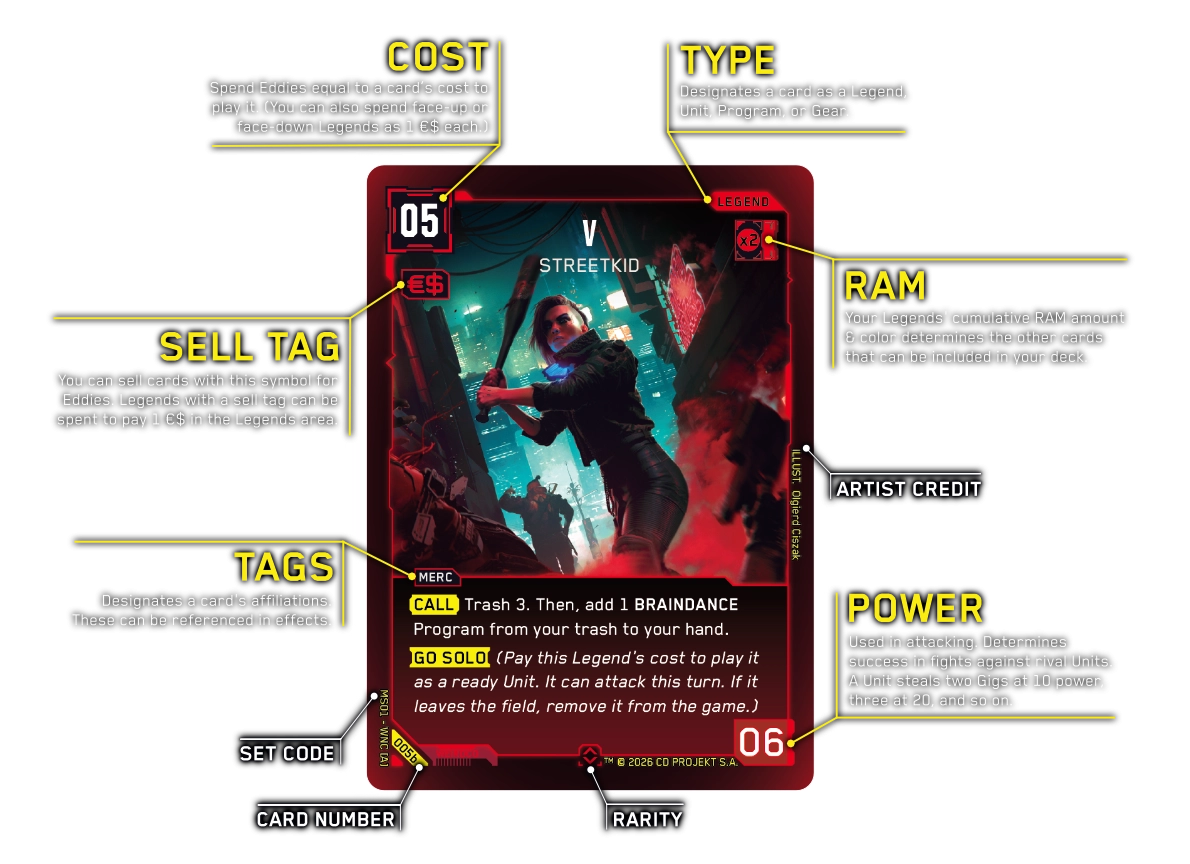
That is WeirdCo's own anatomy diagram, using V: Streetkid — a Legend with cost 5, RAM 2 in red, the Merc tag, and power 6. Working around it:
- Top left: cost. Spend that many Eddies to play it. Below it, the sell tag — the €$ symbol marking a card as sellable.
- Top right: type (Legend, Unit, Program or Gear) and, under it, RAM, which only matters for deckbuilding.
- Below the art: tags — affiliations like Merc that other cards reference. No inherent rules meaning on their own.
- Bottom right: power. Used in fights, and used to determine how many Gigs a Unit steals.
- Bottom edge carries set code, card number, rarity and the artist credit.
Card text uses two kinds of highlighted words. Timing triggers have a convex highlight and tell you when something happens — PLAY, CALL, ATTACK, DEFEATED. Keywords have a concave highlight and mean the same thing on every card that has them. The Comprehensive Rules published on 28 August 2026 define exactly four of each, so this is the complete list rather than a preview slice:
- ADRENALINE — this Unit can attack the turn it is played.
- GO SOLO — pay this Legend's cost to play it as a ready Unit. It can attack this turn. If it leaves the field, remove it from the game.
- QUICK — you may also activate this effect, or play this Program, as a reaction when a rival Unit attacks.
- BLOCKER — when a rival Unit attacks, you may spend this Unit to redirect the attack to it instead.
And the standard override applies: if a card's text conflicts with the rulebook, the card wins.
The turn, start to finish
Two phases. That is the entire structure.
Start Phase, three steps in order:
- Ready spent cards. Everything sideways stands back up — Units, Legends, Eddies.
- Draw 1.
- Gain a Gig. Take a die from your Fixer area, roll it, move it to your Gig area. Any die except the d20, which is always last.
Main Phase, anything in any order, any number of times except where noted:
- Sell for an Eddie (once per turn).
- Call a Legend (once per turn) for 1 €$.
- Play cards — Units, Gear and Programs — by spending Eddies equal to their cost.
- Activate effects on friendly Units and face-up Legends.
- Attack, as many times as you have ready Units to spend.
There is no end phase to speak of. The one thing that expires is Lag: every Unit enters the field with Lag, Lag lasts until the end of the turn, and a Unit with Lag cannot attack or activate self-spend effects. Play a Unit, it sits there looking cool, it goes to work next turn. Unless it has ADRENALINE, which is the whole point of ADRENALINE.
Combat is theft
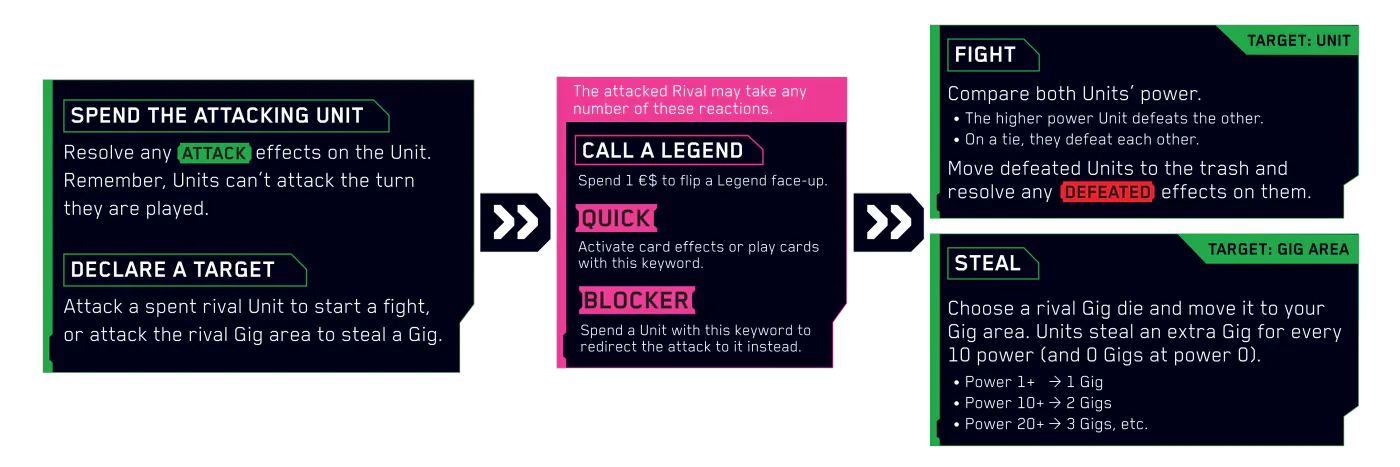
An attack has three beats.
One: spend the attacking Unit and declare a target. You may attack a spent rival Unit, or the rival Gig area. Ready Units cannot be attacked at all — which is the inverse of every game that taught you tapping out is dangerous. Here, a ready Unit is untouchable and a spent one is a target.
Two: the Rival reacts. They may Call a Legend, activate QUICK effects, or spend a BLOCKER Unit to redirect the attack onto itself. Any number of these.
Three: resolve. If you attacked a Unit, both compare power. Higher power defeats the other; on a tie they defeat each other. If you attacked the Gig area, you steal — and the count scales with power:
| Attacking Unit power | Gigs stolen |
|---|---|
| 0 | 0 |
| 1 to 9 | 1 |
| 10 to 19 | 2 |
| 20+ | 3 |
You choose which of your Rival's dice you take, and it keeps its face value, so you are not just stealing a Gig — you are stealing whatever Street Cred it was providing and adding it to your own.
Two consequences worth internalising. First, most Units cannot defend anything. The guide says it plainly: only Units with reaction effects like QUICK or BLOCKER can interrupt an attack, so those are typically the only Units worth leaving ready. Everything else should be attacking. Second, if a BLOCKER redirects an attack that was aimed at the Gig area, the fight resolves against the blocker and you steal nothing, even if you win it.
Deck construction and the RAM system
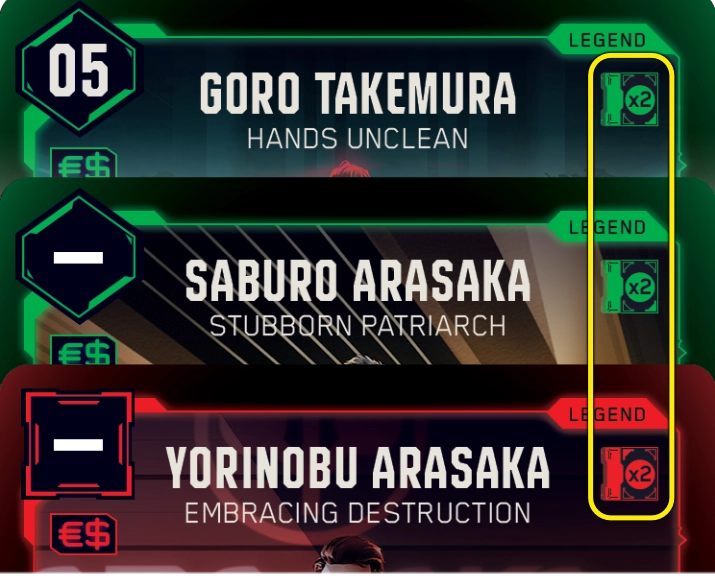
The rules are short:
- Exactly 3 Legends, all different names.
- 40 to 50 cards in the deck, not counting Legends.
- Maximum 3 copies of any one card.
- Every card must fit within the RAM limit your Legends set.
RAM is the constraint that makes this interesting. Every Legend has a colour and a RAM value in its top-right corner. Add up your Legends' RAM per colour, and that total is the highest RAM value a card of that colour may have to be legal in your deck.
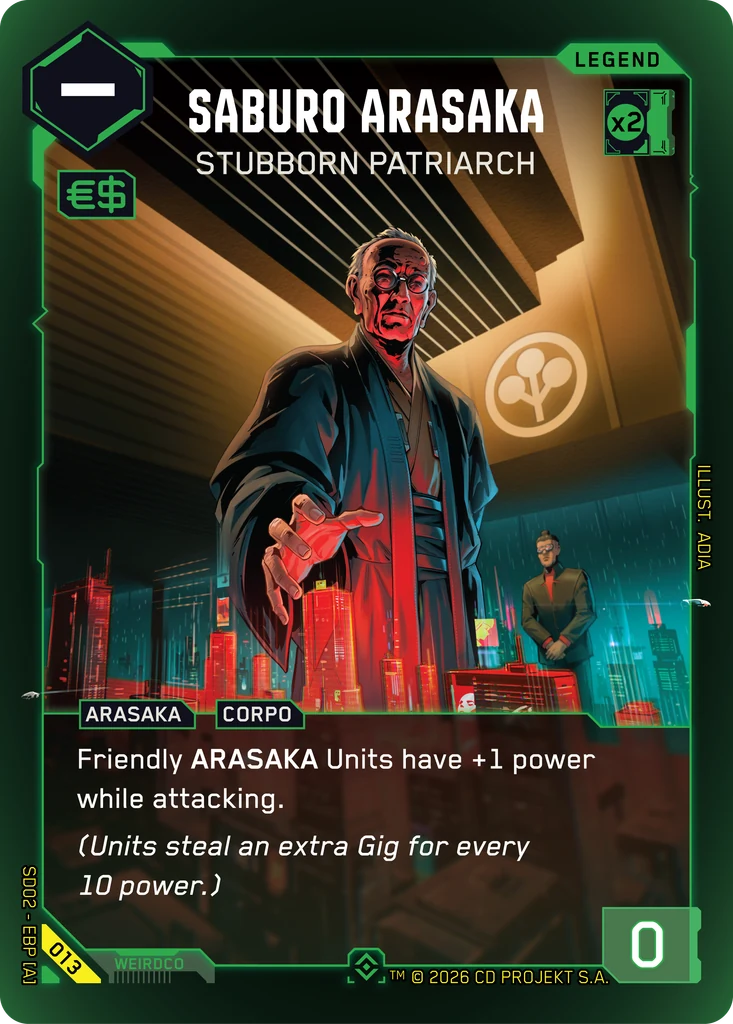
WeirdCo's own worked example, which the image above illustrates: run Goro Takemura: Hands Unclean (2 Green RAM), Saburo Arasaka: Stubborn Patriarch (2 Green RAM) and Yorinobu Arasaka: Embracing Destruction (2 Red RAM), and your deck may contain Green cards up to 4 RAM and Red cards up to 2 RAM.
Read what that does. RAM is not a cost you pay in-game — it is a ceiling, and the ceiling is per colour. Two-colour decks are legal but you are splitting six RAM across two colours instead of stacking it into one, which caps how powerful the cards in either colour can be. Going three colours with three Legends would leave you at 2 RAM in every colour. Committing hard to one colour is what unlocks the expensive toys.
The four colors
Cyberpunk TCG has four: Red, Green, Blue and Yellow. WeirdCo published a two-part breakdown of what they call the Color Tree in May 2026, and each colour has a distinct relationship with the dice — which is the smartest thing about the design, because it means colour identity and the Gig system are the same system.
| Color | Identity | What it wants from the dice | 2077 attribute it echoes |
|---|---|---|---|
| Red | Maximize, amass, overpower | Gig values as high as possible; rolls d10 and d12 early | Body |
| Green | Align, gather, execute | Pairs of matching Gig values, Gigs matched to Unit power, consistently odd or even Street Cred | Reflexes |
| Blue | Minimize, hack, disable | Low Street Cred, small dice first, actively reducing Gig values | Intelligence |
| Yellow | Diverge, equip, repurpose | Every Gig a different value, Street Cred as far as possible from the Rival's | Technical Ability |
WeirdCo are explicit that the colours are not a direct port of 2077's attributes, just heavily inspired by them, and that a character's colour is not fixed by their in-fiction role — Lucy the netrunner is not automatically Blue.
The mechanical hooks follow from the philosophies. Blue leans on Programs and Braindances and on bottom-decking threats. Yellow specialises in Gear, plus sacrifice and scavenging subthemes. Red is direct destruction and stat-checking. Green is alignment puzzles.
What changed from Alpha to Beta
If you played an Alpha kit or watched Alpha content, four things moved on 29 May 2026:
- The Ready Phase became the Start Phase, and its order was fixed at ready, draw, gain a Gig — because that is what players did anyway.
- The Play and Attack phases merged into one Main Phase, and attacking became a step you can take repeatedly. In Alpha, once you started attacking your turn was effectively over. Now you can attack, steal a high die, and then play a card that cares about your new Street Cred.
- Calling a Legend dropped from 2 €$ to 1 €$, because Alpha testing found players routinely winning without flipping more than one.
- The win condition rose from 6 Gig dice to 7, which lengthened games and, as covered above, made stealing mandatory.
WeirdCo also flagged that "there will also be changes coming to individual card stats and effects, card keywords and templating." So the frame here is: the structure looks settled and has now survived several thousand convention demos. Individual card text is the part still in motion. Anything you read about a specific card between now and November is a moving target.
Six things that will catch you out in game one
- Ready Units cannot be attacked; spent ones can. Every instinct from other card games is backwards here. If a Unit is not a BLOCKER or carrying QUICK, leaving it ready accomplishes nothing.
- New Units have Lag. They cannot attack or use self-spend effects the turn they land. Plan a turn ahead.
- You only sell one card per turn, for exactly 1 Eddie. Your economy is a trickle. Legends-as-currency is the only burst available.
- You cannot win on your own six dice. Seven means stealing at least one. Build to attack.
- You do not choose which Legend you flip. Do not build a deck that needs a specific Legend on a specific turn.
- Running out of deck loses you the game on the spot. With a 40-to-50-card deck and one draw per turn, that is not usually a clock — but effects that trash or draw extra can make it one.
What is still unknown
Being honest about the gaps, because there are several and other sites will paper over them:
- The headline set size. WeirdCo has never printed one. The official card database held 127 cards on 15 August 2026, 149 on 31 August and 151 on 4 September, and its Welcome to Night City retail numbering now runs 001 to 140 with no gaps — 140 retail cards plus 11 starter-deck and promo cards, which is the closest thing to a set-size statement that exists, and it is the database's, not WeirdCo's. Pack contents are published: 12 cards, seven commons, three uncommons, two rare-or-better, with Beta packs carrying an extra hit slot.
- Formats, banlists and rotation. The Organized Play skeleton exists — Beta Events 10-20 September, retail pre-releases 30 October, weekly Night City Brawl after launch — but the competitive format structure has not been fully spelled out.
- The final rules text. Everything above is the beta ruleset. WeirdCo published a Comprehensive Rules document on 28 August 2026 — 660 numbered rules, the reference document to a judge's standard — but it is stamped only "UPDATED AUG. 2026" and the gameplay guide still carries no version number or revision date, so there is no way to cite a specific revision of either.
- Set 2 timing. Cyberpunk: Edgerunners is confirmed as the focus. When it ships is not.
Anything else — pull rates, card values, tier lists, "best decks" — cannot exist yet. The game is not out. Treat anyone publishing that stuff accordingly.
Quick reference
- Win: start your turn with 7+ Gig dice in your Gig area. Overtime after the last player's 7th turn is sudden death on majority.
- Lose: required to draw with an empty deck.
- Setup: six dice in the Fixer area, 3 face-down randomised Legends, roll d20 for order, draw 6 with one mulligan. First player spends their two leftmost Legends and does not ready them turn one.
- Start Phase: ready, draw 1, roll one die into your Gig area (d20 last).
- Main Phase: sell 1 card for 1 Eddie (once), Call a Legend for 1 €$ (once), play cards, activate effects, attack repeatedly.
- Street Cred: sum of the top faces of your Gig dice.
- Attack: spend the Unit, declare a spent rival Unit or the Gig area, Rival reacts, then fight on power or steal 1 Gig per 10 power tier.
- Deck: exactly 3 uniquely named Legends, 40-50 cards, max 3 copies, within your Legends' per-colour RAM totals.
- Retail release: 6 November 2026, with pre-releases the weekend of 30 October.
If you have played Riftbound, the objective-control skeleton will feel familiar — take a thing, hold a thing, win on points rather than damage. What Cyberpunk does differently is make the objectives physical dice with numbers on them, so the same object is both your progress bar and your spell-enabling resource. That is a genuinely new idea in this space, and it is the reason this game is worth learning even if you already have a card game.
Frequently Asked Questions
How do you win a game of the Cyberpunk TCG?
When does the Cyberpunk TCG actually release?
What dice do you need to play the Cyberpunk TCG?
What is Street Cred in the Cyberpunk TCG?
How do Eddies work in the Cyberpunk TCG?
How does combat work in the Cyberpunk TCG?
What are the deck building rules for the Cyberpunk TCG?
What are the four colors in the Cyberpunk TCG?
How much did the Cyberpunk TCG Kickstarter raise?
Are the Cyberpunk TCG rules final?
Keep Reading
- Cyberpunk TCG Gameplay Guide (WeirdCo, official)
- Rule and Game System Updates from Alpha to Beta, 29 May 2026 (WeirdCo)
- Production Diary: Cyberpunk TCG ships to backers starting September 2026, 19 June 2026 (WeirdCo)
- Cyberpunk TCG Beta Event Guide: What's in the kit?, 24 July 2026 (WeirdCo)
- Developer Insights: The Color Tree Part 1 (Red and Green), 15 May 2026 (WeirdCo)
- Developer Insights: The Color Tree Part 2 (Blue and Yellow), 22 May 2026 (WeirdCo)
- Cyberpunk TCG at Gen Con 2026: All of our Exclusive Card Reveals, 31 July 2026 (WeirdCo)
- Cyberpunk TCG card database, powered by Netdeck.gg (WeirdCo, official)
- The Official Cyberpunk Trading Card Game by WeirdCo (Kickstarter campaign page)
- Cyberpunk Trading Card Game Launches Kickstarter Campaign, 17 March 2026 (CD PROJEKT RED Press Center)
Related Guides
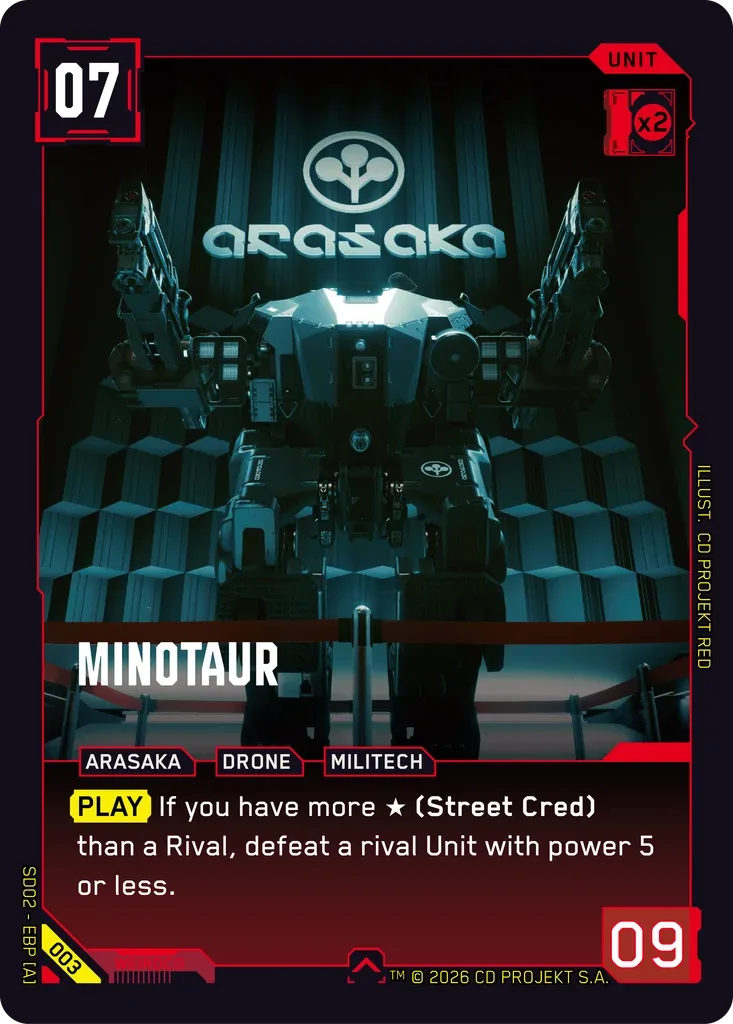
Cyberpunk TCG Starter Decks: Embracing Power vs The Heist
WeirdCo's two Welcome to Night City starter decks share no cards and are built on mirror-image Legend lines. Here are both full lists with every card's cost, RAM and power, the five cards each second Legend exists to pay for, the rulings that change how they play, and which box is the better first buy.
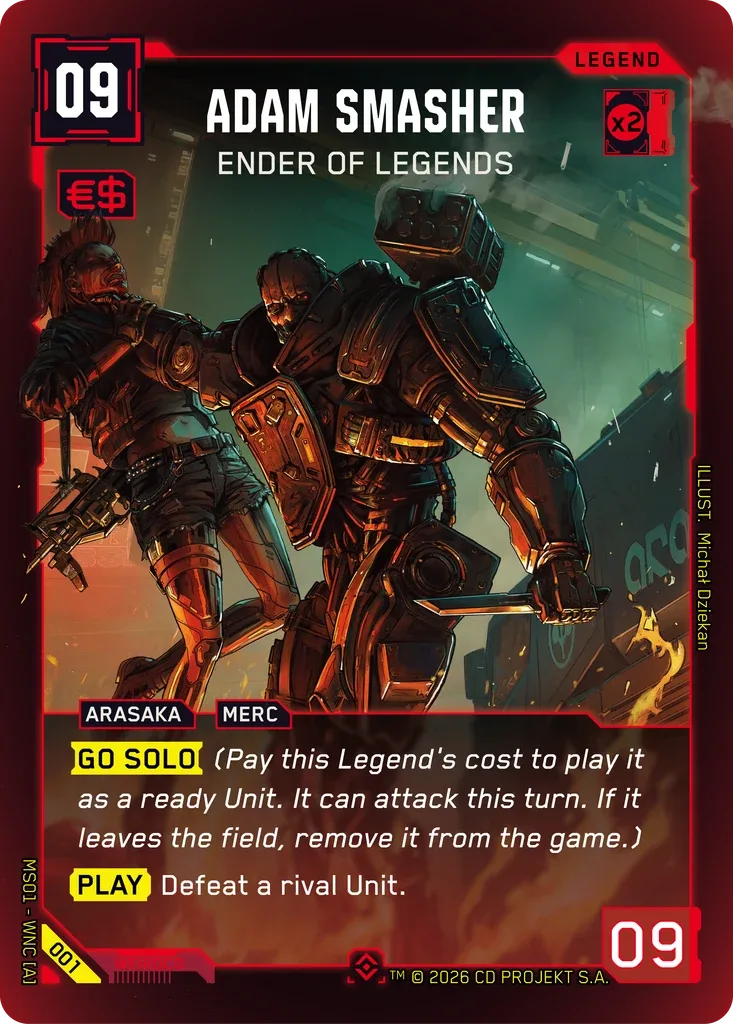
Cyberpunk TCG Rules FAQ: What 269 Official Rulings Settle
Besides the Comprehensive Rules and the Tournament Rules, WeirdCo publishes a third rules document written as the questions a player asks mid-game: a Rules FAQ with 269 official rulings, 244 of them on specific cards. It settles the GO SOLO question the rulebook left open, half-settles the Sell contradiction, and makes clear which card effects you cannot decline.
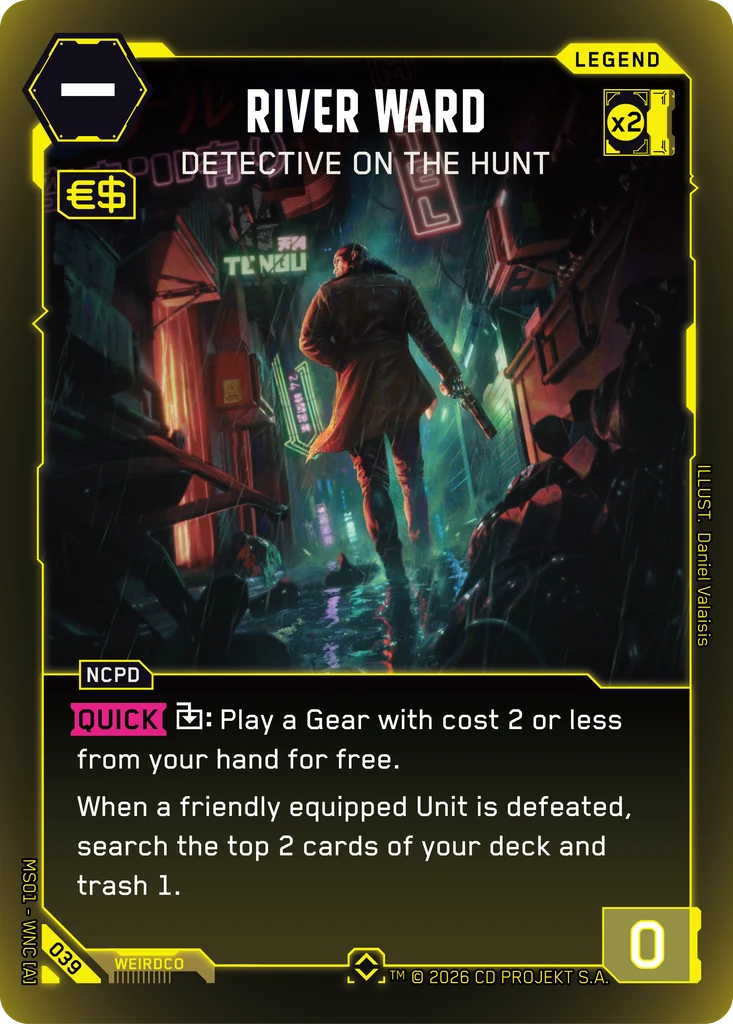
Cyberpunk TCG's Deck Builder Is Live: 716 Decks So Far
WeirdCo's official Deck Builder went live on 2 September 2026, and by 16 September the community had published 716 public decks through it. Pull every one through the tool's own API and a pattern falls out that the RAM-ceiling math alone could not show: which colours people actually pair, which Legend is in more than a quarter of all decks, and which one of the 27 Legends in the database has never been picked once.
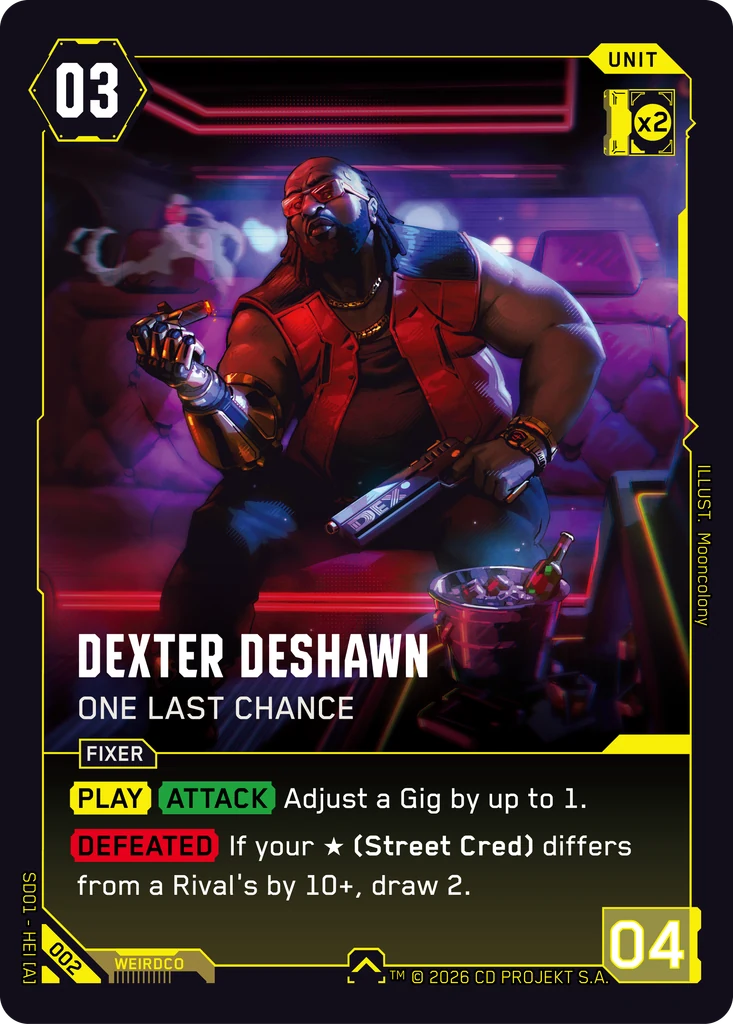
Cyberpunk TCG Keywords Explained: All 9, 86 Cards Use One
Cyberpunk TCG's official card database has a Keyword filter with zero options in it, so nothing tells you the game has keywords at all unless you read every card. It does: nine bracketed tokens, split by the Comprehensive Rules into four trigger keywords, four effect keywords and one activation shorthand it does not call a keyword. Eighty-six of the 151 cards print at least one, four cards print three, and three keywords turn out to be things one card gives another rather than something every printed instance owns.
Cyberpunk TCG Tags: 39 Printed, 10 With Payoff Cards
Cyberpunk TCG prints 39 tags across the 151 cards in its official database, and the Comprehensive Rules give them a real definition — an effect naming a tag references every card carrying it. Then only 13 cards in the whole pool name a tag at all, covering 10 of the 39. Arasaka is the deepest supported one with four; Netrunner has 13 cards and nothing that cares.
Cyberpunk TCG Comprehensive Rules: 10 Rulings That Bite
WeirdCo published the Cyberpunk TCG Comprehensive Rules on 28 August 2026 — 11 numbered sections and 660 numbered rules, thirteen days before the first Beta Events. It is the first public document that answers rules arguments rather than teaching the game, and ten of its rulings change decisions you would otherwise make from the Gameplay Guide alone. It also contradicts itself in three places.