Pokémon TCG Deck Building Basics: Ratios, Consistency, and the Draw Engine
Sixty cards, four copies max, one Supporter per turn. Here is the structure that stops a Pokemon TCG deck from bricking: the real card-type ratios, how thick the draw engine has to be, how to build an evolution line that arrives on time, and the prize math behind your attackers.
Sixty cards. That is the entire sandbox, and it is why Pokémon TCG deck building punishes guesswork harder than it looks like it should. There is no land, no mana base, no dedicated resource that soaks up a quarter of your list. Every single card is a card that could be doing something — which means every wasted slot is a slot that does nothing on the turn you needed it.
Most decks that "lose to bad draws" are not unlucky. They are running six draw Supporters instead of eleven, three Basics instead of thirteen, and eighteen Energy for an attacker that costs two. Those are structural defects, and no amount of shuffling fixes them. Here is the skeleton that makes sixty cards behave.
Start with the rules that cap everything
Before ratios, the hard constraints. These are the walls of the box, and half of new-player deck building failure is not knowing where they are.
Construction limits:
- Exactly 60 cards. Not 58, not 61. A legal constructed deck is 60 on the nose.
- Four copies max, by card name. You can run four of a card, and that is the ceiling. Name is what matters, not the artwork or the set — but variants with genuinely different names count separately, so four Meowth, four Alolan Meowth, and four Galarian Meowth can all live in the same list.
- Basic Energy is the one exception. Basic Energy cards are the only cards you are allowed to run more than four of. Special Energy is capped at four per name like everything else.
- At least one Basic Pokémon. Mandatory, and in practice you need way more than one (see below).
- One ACE SPEC per deck. Total. Across all 60 cards, you get exactly one.
Tempo limits — these are the ones that actually shape your list:
- One Energy attachment from your hand per turn. This is the single biggest constraint in the game.
- One Supporter per turn. Items are unlimited; Supporters are one and done.
- One Stadium per turn.
- The player going first cannot attack or play a Supporter on their first turn.
- You cannot evolve a Pokémon on the first turn of the game, or on the turn it came into play.
If you have played Magic, the model is inverted. There, the land count is the resource decision that dominates everything else, and a mana base gets tuned for color and tempo. Pokémon has no equivalent — your ceiling is time, one Energy per turn, and the rest of the deck is spent buying speed.
If the turn structure above is not familiar yet, start with how a game of Pokémon TCG actually plays out and come back. The rest of this assumes you know what a Bench and a Prize card are.
The three-pile split that actually works
Every one of your 60 cards is a Pokémon, a Trainer, or an Energy. The beginner theory you will see quoted everywhere is a 2/5–2/5–1/5 split: 24 Pokémon, 24 Trainers, 12 Energy. That is a fine training-wheels number for a kitchen-table deck and it is wrong for basically every deck built with intent.
The real splits look like this:
| Deck type | Pokémon | Trainers | Energy |
|---|---|---|---|
| Beginner / theme-deck baseline | ~24 | ~24 | ~12 |
| Evolution deck (Stage 1 or Stage 2 attacker) | 14–18 | 32–36 | 8–12 |
| Basic-attacker deck | 10–14 | 36–40 | 8–12 |
| Toolbox / multiple attackers | 16–20 | 30–34 | 10–14 |
The direction of travel is the point: Trainers up, Pokémon down, Energy down. A tuned deck runs roughly half its list as Trainer cards, because Trainers are what let you find the two or three Pokémon you actually wanted and the one Energy you actually needed. Twenty-four Pokémon sounds like a lot of options. In practice it is a hand full of cards you cannot put into play.
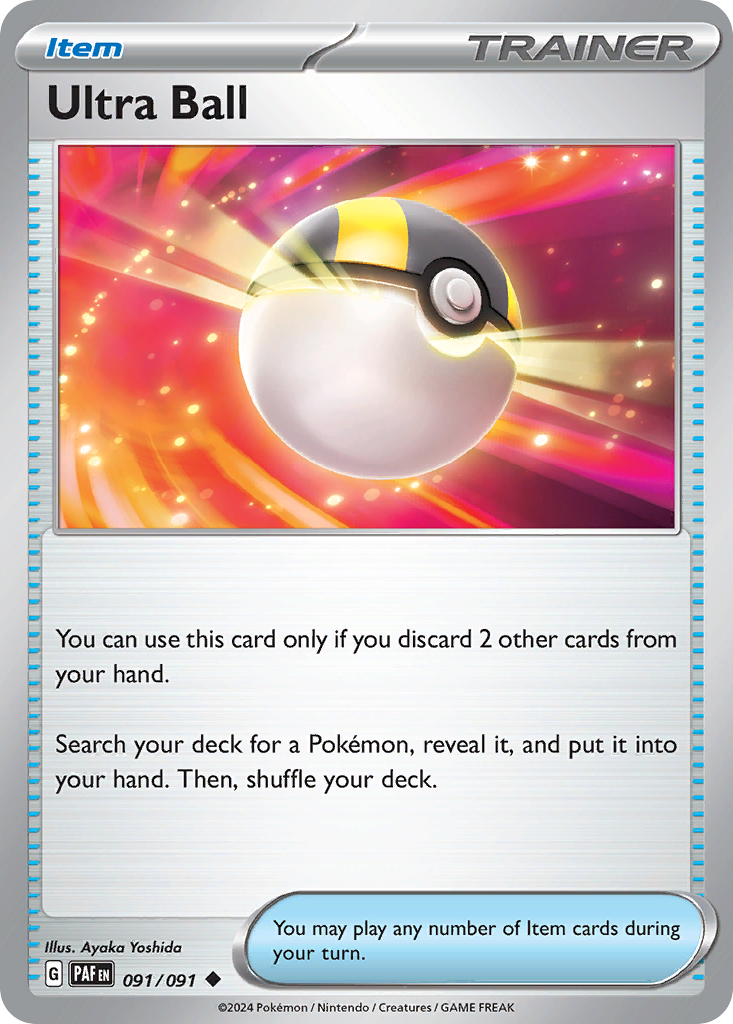
The reason a 14-Pokémon deck functions better than a 24-Pokémon deck is search density. A card like Ultra Ball — discard two cards, then dig your deck for any Pokémon — converts a generic Trainer slot into "the exact Pokémon I need right now." Four Ultra Ball plus three of your key attacker beats seven copies of the attacker, and it costs nothing when you already have the attacker, because it can go find something else instead.
Supporters are the engine, not the spice
Here is the single most common failure in a homebrew list: not enough draw.
You draw one card per turn. One. If your hand runs dry, you are drawing off the top and hoping, and the deck-out clock is real — if you cannot draw at the start of your turn, you lose on the spot. The thing that keeps your hand full is your Supporter line, and you get exactly one Supporter per turn, forever.
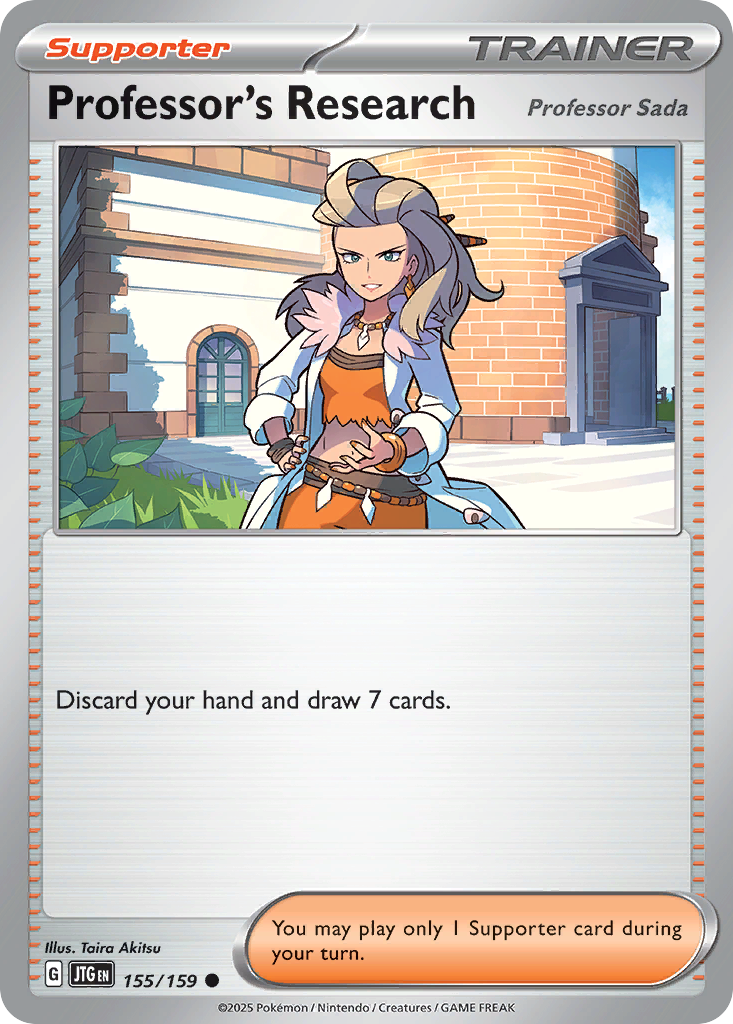
Professor's Research is the benchmark: discard your hand, draw seven. That is enormous throughput off one card. Hand-refresh Supporters that shuffle your hand back and draw a fresh one do the same job with a different risk profile — they cost you less when your hand is already good.
Run 8–12 draw and search Supporters. Here is what those counts buy you, as the chance you have seen at least one copy by the time you have your opening seven plus your first draw:
| Copies of "a draw Supporter" in 60 | Chance you have one by your first draw |
|---|---|
| 4 | 44.5% |
| 6 | 59.3% |
| 8 | 70.6% |
| 10 | ~78% |
| 12 | ~84% |
Four copies is a coin flip. Ten is a deck. That gap is the whole difference between "sometimes my deck works" and "my deck works."
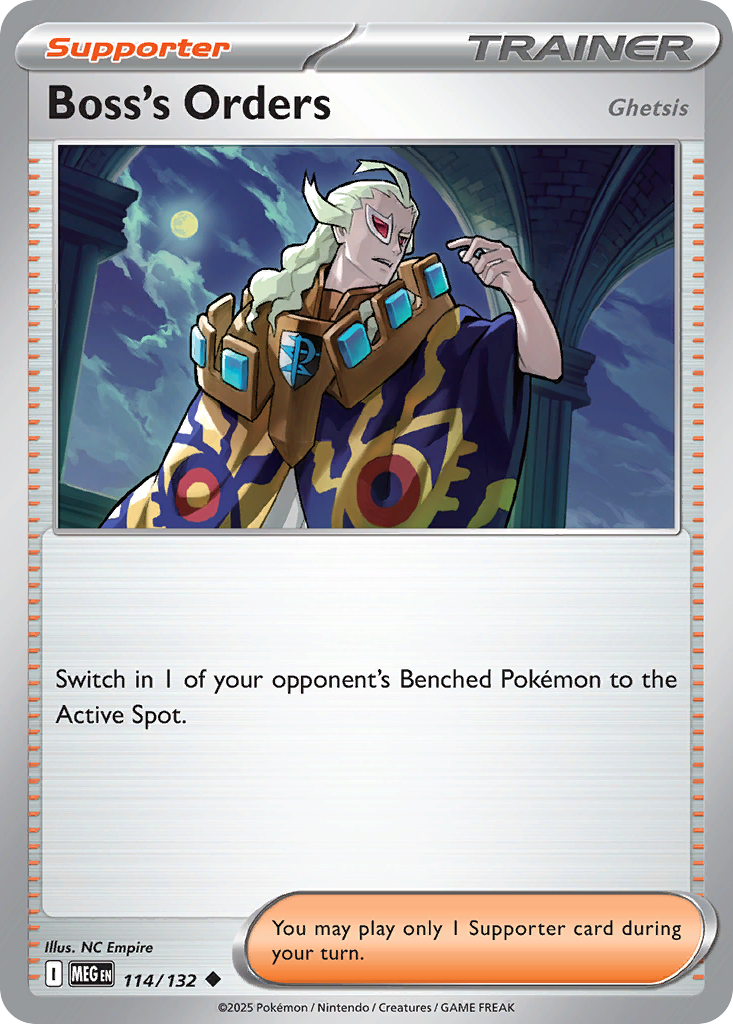
The tension is that draw is not the only thing Supporters do. A gust effect — Boss's Orders drags one of your opponent's Benched Pokémon into the Active Spot so you can knock it out — is often the card that wins the game outright, and it competes for the same one-per-turn slot. Two or three copies of a gust Supporter is standard. Every one you add is a turn you are not drawing cards, so keep the ratio honest: draw is the default, gust is the finisher.
Building an evolution line that arrives on time
Evolution decks brick more than Basic-attacker decks, and it is almost always the same mistake — the line is top-heavy.
Remember the timing rules. An Evolution card cannot enter play on its own; it has to go on top of something already there. You cannot evolve on the first turn of the game, and you cannot evolve a Pokémon on the turn it came into play. So a Stage 2 attacker is a three-turn project by default: Basic down, Stage 1, Stage 2. That is a lot of turns to survive.
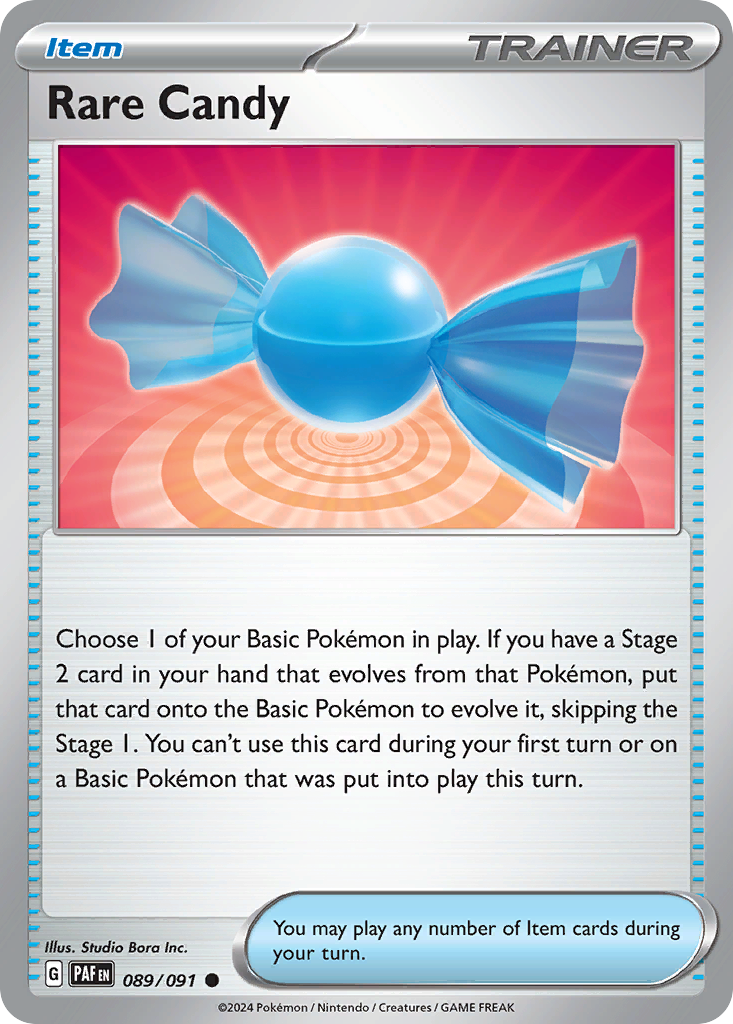
Rare Candy is the release valve: choose one of your Basic Pokémon in play, and if you have the matching Stage 2 in hand, put it straight onto the Basic and skip the Stage 1 entirely. It cannot be used on your first turn or on a Basic you just put into play, but it turns a three-turn setup into a two-turn one. Any Stage 2 deck runs the full four.
A workable Stage 2 line looks like:
- 4 Basic — the bottom of the line, and the card you must have in your opening hand
- 1–2 Stage 1 — a bridge for the games where Rare Candy is prized or discarded
- 3 Stage 2 — the actual attacker
- 4 Rare Candy — the skip
Note the shape: more Basics than Stage 2s, always. The Basic is the prerequisite for everything above it, and it is also the card that keeps you from mulliganing.
That last part deserves numbers. If your opening seven contains no Basic Pokémon, you mulligan — reveal your hand, shuffle it back, draw a new seven — and you keep going until a Basic turns up. What your opponent collects for it is netted, not raw: they may draw up to one card for each extra mulligan you took beyond their own. Both of you mulligan twice and nobody draws anything; take three more after that and they may draw up to three. Here is your mulligan rate against your Basic count:
| Basic Pokémon in deck | Chance of at least one mulligan |
|---|---|
| 8 | 34.6% |
| 10 | 25.9% |
| 12 | 19.1% |
| 14 | 13.9% |
| 16 | 9.9% |
Ten Basics is the floor; 12–14 is the comfortable range. Below ten you fail to open a Basic in a third of your games, and every mulligan your opponent does not have to match hands them a card. That is not a variance problem, it is a build problem.
How much Energy is actually enough
One attachment per turn means your Energy count is really a question about turns, not about card counts. If your primary attacker costs three Energy and you have no acceleration, you are attacking on turn three at the absolute earliest, and only if you hit an attachment every single turn.
Set the count off the attack cost:
- One- and two-Energy attackers: 6–9 Energy. You need one attachment to go live and a second to rebuild after a knockout.
- Three-Energy attackers, no acceleration: 11–14 Energy. You have to hit an attachment on consecutive turns, so you need the density.
- You have acceleration (an Ability or Item that attaches Energy from the deck or discard): shave 2–4. Every acceleration card is a virtual Energy that also does not clog your opening hand.
Basic Energy being unlimited is a trap, not a permission slip. Twenty Energy does not make you more likely to attack on time; it makes every opening hand worse, because the extras are dead cards Ultra Ball has to discard.
If your attack costs span two types, either commit to a Special Energy that provides both or cut a type. Two colors of Basic Energy with no fixing is the Pokémon equivalent of a greedy multicolor mana base, and it fails the same way.
Prize-trade math decides your attackers
Six Prize cards. Take all six and you win. That means the game is a race with a known finish line, and your attacker choice sets how many knockouts you can afford to give up.
A Pokémon ex gives up two Prize cards when it is knocked out. So a deck where every attacker is an ex is a best-of-three-knockouts game: your opponent needs three KOs to close, and you have almost no margin. A single-Prize attacker forces them to find six.
That asymmetry is a build decision, not an in-game one:
- All two-Prize attackers: highest ceiling, worst margin for error. One well-timed gust on a setup Pokémon hands over two prizes you never planned to give.
- All single-Prize attackers: your opponent has to grind out six KOs, but your damage output is lower and every attack has to count.
- Mixed: the pragmatic answer. A big two-Prize primary plus one or two single-Prize options that take a cheap knockout without exposing a two-Prize body.
Before you finalize a list, map the game: how does this deck take six prizes? "Three ex knockouts" is a plan. "I never thought about it" is why the deck loses close games. And count your liabilities — every rule-box Pokémon on your Bench is two prizes waiting for a gust effect.
Copy counts and the consistency math
The last piece is deciding whether a card is a 4-of, a 3-of, a 2-of, or a 1-of. Two numbers should drive that.
First, the prize risk. Six of your 60 cards go face down as Prizes before the game starts, and you cannot touch them until you earn them:
| Copies in deck | Chance all copies are prized |
|---|---|
| 1 | 10.0% |
| 2 | 0.85% |
| 3 | 0.06% |
| 4 | 0.003% |
A one-of is unavailable for the entire game one time in ten. If the deck cannot function without a card, it is a 3-of or a 4-of, full stop. Single copies are for effects you would like to have, not effects you need.
Second, the opening-hand math. Even a maxed-out 4-of only shows up in your opening seven about 40% of the time:
| Copies in deck | Chance of at least one in your opening 7 |
|---|---|
| 1 | 11.7% |
| 2 | 22.1% |
| 3 | 31.5% |
| 4 | 39.9% |
That number is the whole argument for the Trainer-heavy build. You cannot push "chance I open my attacker" past 40% by adding copies, because four is the cap. You can push "chance I open something that finds my attacker" past 80% with four Ultra Ball, four Nest Ball, and eleven draw Supporters. Redundancy in Pokémon comes from search and draw, not from stacking the same card — the same logic behind running a thick package of cheap cantrips in a Magic deck.
Worth noting for collectors: the limit is by card name, not by print, so a card's rarity and finish have no bearing on legality. A common and an alternate-art of the same card are the same card here, and you can mix prints freely up to four total.
The mistakes that cost the most games
- Too many Energy. The most common bloat in a homebrew list. Every Energy past what your attack cost demands is a dead card in your opening hand.
- Not enough draw Supporters. Under eight and the deck has no engine. Highest-impact fix on most lists.
- Top-heavy evolution lines. Three Basics and three Stage 2s is not a line, it is a wish.
- One-ofs the deck depends on. One game in ten, it does not exist. Build for the 90%.
- Twenty-four Pokémon. The beginner ratio. Cut to 14–18 and put the slots into Trainers.
- No switching cards. An attacker stranded Active under a heavy retreat cost loses games that had nothing to do with damage. Two to four switching outs is standard.
- Ignoring the prize trade. If you cannot say how the deck takes six prizes, it does not take six prizes.
Quick Action Checklist
Run a new list through this before you sleeve it:
- Exactly 60 cards, at least 10 Basic Pokémon, one ACE SPEC max
- Roughly 14–18 Pokémon, 32–36 Trainers, 8–12 Energy — not the 24/24/12 beginner split
- 8–12 draw and search Supporters, plus 2–3 gust effects
- Energy count matched to your attack cost, minus 2–4 if you run acceleration
- Evolution lines have more Basics than Stage 2s, plus four Rare Candy if you are on a Stage 2
- Nothing essential is a one-of — 10% of games it is prized
- Four Ultra Ball and four of a Basic-search Item for redundancy
- Two to four switching cards so your attacker never gets stranded Active
- You can state in one sentence how the deck takes six Prize cards
Frequently Asked Questions
How many cards are in a Pokémon TCG deck?
How many copies of a card can you have in a Pokémon TCG deck?
What is a good Pokémon, Trainer, and Energy ratio?
How many draw Supporters should a Pokémon TCG deck run?
How much Energy should be in a Pokémon deck?
How many Basic Pokémon do I need to avoid mulligans?
How does prize-trade math affect deck building?
Should I run one-of cards in a Pokémon TCG deck?
Keep Reading
Related Guides
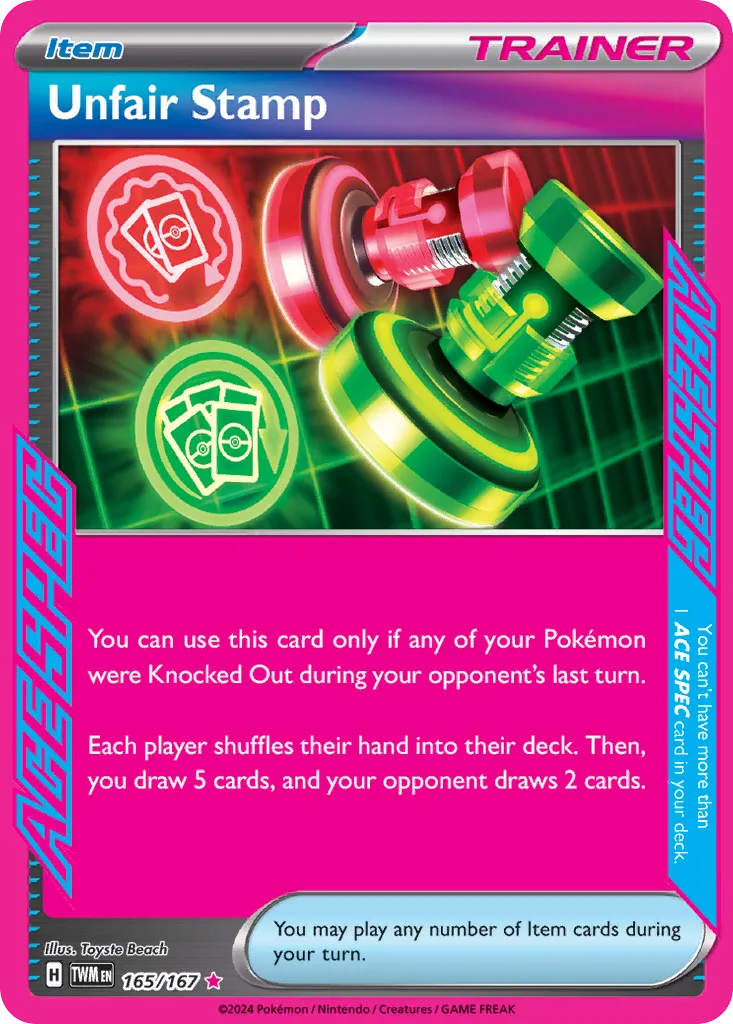
Pokémon TCG ACE SPEC Cards: All 29 Legal, Ranked by Play
You get one ACE SPEC per deck, and Standard currently offers 29 of them. We pulled all 6,728 Masters decklists from the first three Regionals of the 2027 season to see which one players actually spend that slot on, archetype by archetype, and which ACE SPECs nobody registered at all.
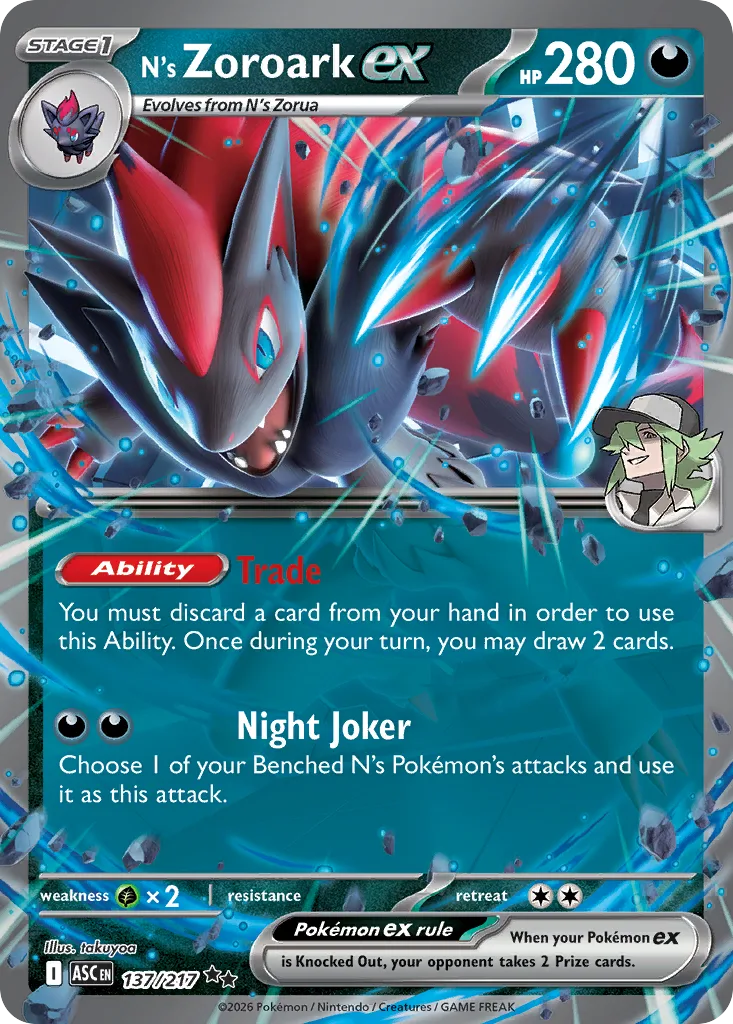
Pokémon TCG N's Zoroark ex Deck Guide: Builds and Matchups
N's Zoroark has been the second-most-registered deck at three of the 2027 season's first four Regionals, and it reaches Day 2 more often than the field. Then it stalls: 2 of 42 top-cut seats. We pulled all 564 lists and every match those players finished to find which build works, which cards came with worse results, and where the losses come from.
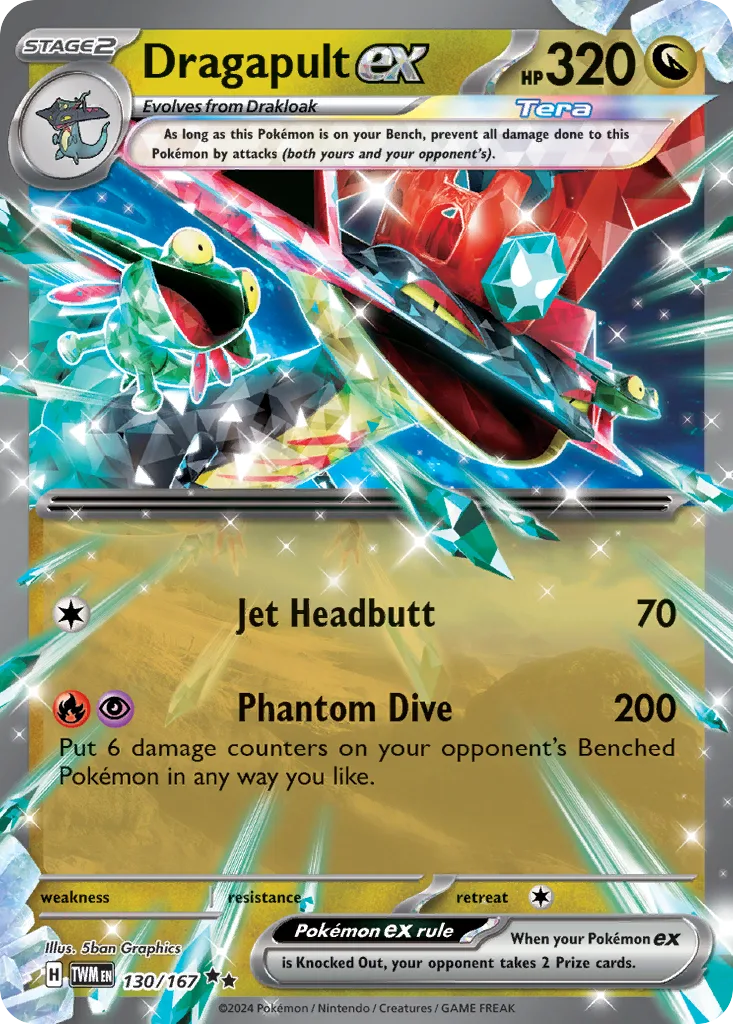
Pokémon TCG Dragapult ex Deck Guide: The Worlds-Winning 60
Dragapult ex is Standard's most-played deck by a clear margin, and it has been since Andrew Hedrick took it to the 2026 World Championship. Here is the exact 60 cards that won Worlds, the three variants the format has split into since, which decks actually beat it, and what happens to the matchup when Mew ex goes legal on September 30.
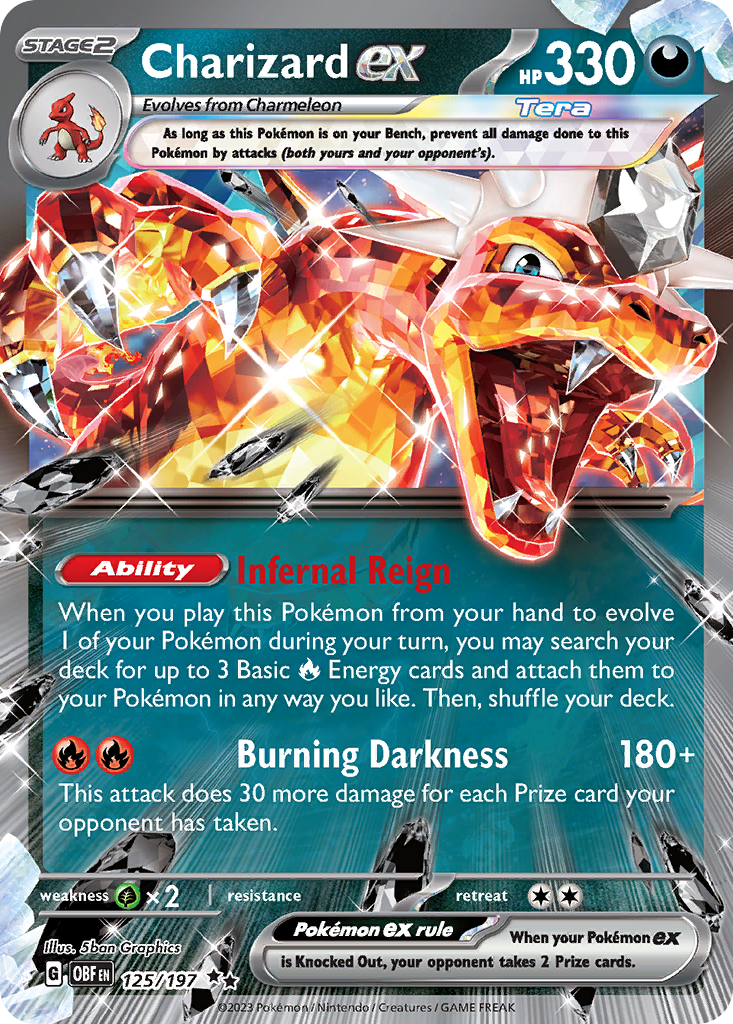
How to Play the Pokémon TCG — Full Rules and Turn Structure (2026)
Two players, 60 cards each, six face-down Prize cards, and a coin flip. That is the whole skeleton of the Pokémon TCG. Here is every rule that actually matters on turn one, from setup through the three ways to win.
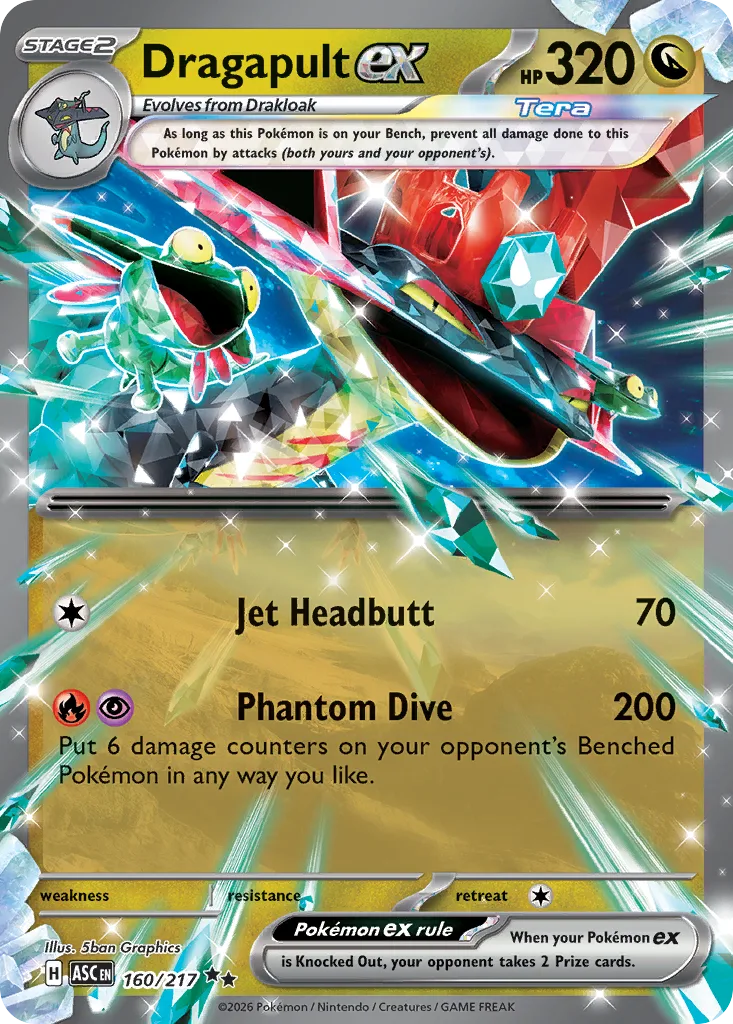
Pokémon TCG Louisville Regional 2026: Results and Top 9
Riley McKay won the Louisville Regional Championships without losing a match, on a Dragapult ex list two cards away from the one that won Worlds. Behind him, three decks that had not reached a Regional top cut all season got there at once: Sharpedo/Toxtricity, Dhelmise and Mew Box.
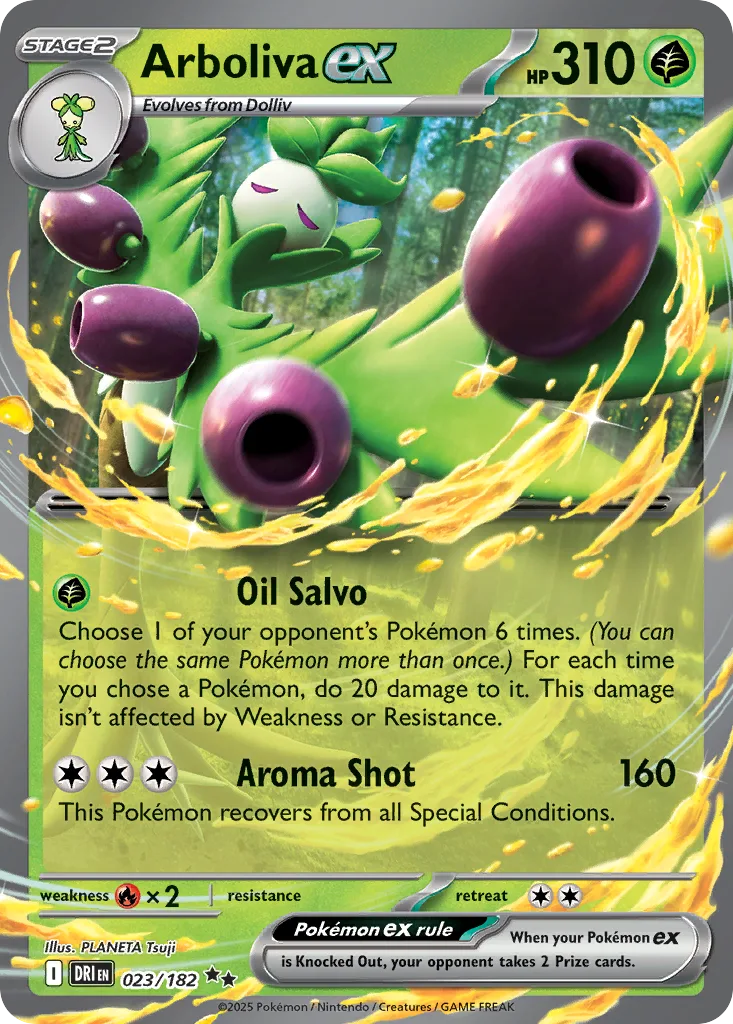
Pokémon TCG Recife Regional 2026: Results and Winning Deck
The fourth Regional of the 2027 season, and the first in Latin America, went to a deck only two of 1,074 Masters registered. Victor Carreira's Ogerpon/Meganium/Arboliva list beat three Dragapult ex players in the top cut, in a field where Dragapult builds were a bigger share than at any Regional so far this season.