Pokémon TCG Card Rarities Explained: Symbols, Secret Rares, and What Holds Value
You pulled something gold and you have no idea if it matters. Here is the whole Pokémon TCG rarity ladder - the three base symbols, the modern tiers above them, secret rares numbered past the set total, and what actually drives value.
Ten cards spill out of a booster pack and one of them is gold. Great. Is it gold because it is genuinely scarce, or gold because gold sells packs? Is the shiny one shiny in the way that matters, or is it a Common wearing a foil jacket? And why is the number on the bottom bigger than the set size?
The rarity vocabulary has been rebuilt several times since 1996, which is why so much advice about it is confidently wrong. What follows is the whole ladder as it stands, why the tiers above Rare are era-dependent, and the parts people get backwards. One rule for this post: no invented pull rates and no dollar figures. Those two numbers are where most rarity guides quietly start lying to you, and I will explain exactly why further down.
The three symbols that have always been there
The base of the ladder has not moved in decades. Every non-promo card in an expansion carries a small rarity symbol at the bottom of the card:
| Symbol | Rarity | Typically |
|---|---|---|
| ● Circle | Common | Basic, unevolved Pokémon; the bulk of a pack |
| ◆ Diamond | Uncommon | Evolved and unevolved Pokémon, plus most Trainer cards |
| ★ Star | Rare | Evolved Pokémon and Legendaries |
Two footnotes that trip people up. Basic Energy cards have no rarity at all - they are not part of the ladder. And rarity is not global: a card that is Common in Japanese can be Uncommon in English, because the two markets collate packs differently. Japanese releases dropped symbols entirely starting with the Black Collection and White Collection sets in favour of bolded letters - C, U, R, RR - which is why Japanese checklists read like a different language.
Worth internalising early: rarity is not power. A Common Trainer every deck plays four copies of does more work than the gold card you framed. If you are building an actual list, deck-building basics matters far more than your pulls, and if you are still learning the turn structure, start with how to play the Pokémon TCG.
Holo, reverse holo, and why they are not the same thing
This is the single most common beginner mix-up, and it costs people money on trades.
A Holofoil Rare has the foil pattern on the artwork. It carries the normal star symbol, and it is scarcer than a plain Rare. Historically the guaranteed rare slot in an English pack could hand you either a non-holo Rare or a holo one; since the Scarlet & Violet expansion, every Rare that comes out of a booster pack is a holofoil rare, which quietly retired the old non-holo Rare from modern packs.
A Reverse Holo is the opposite: foil on the card background, normal artwork. Every English pack has included one since the Legendary Collection expansion. Critically, a reverse holo can be a Common, an Uncommon, or a Rare - and it keeps that rarity. A reverse holo Common is still a Common. It is a shiny Common. People trade these like chase cards constantly, and they are not.
Useful side effect for anyone worried about fakes: the holo pattern changes by era and is hard to counterfeit convincingly. Base Set through Fossil used a blurry "Starlight" pattern; Base Set 2 through Call of Legends used "Cosmos" dots and swirls; Generation V ran "Tinsel" horizontal stripes; XY through Steam Siege used "Sheen"; Sun & Moon through Cosmic Eclipse used "Water-Web"; Sword & Shield through Crown Zenith used thin vertical stripes; Scarlet & Violet onward uses "Mirage". If the foil does not match the card's era, something is off.
Where the modern ladder goes above Rare
Here is where "rarity" stops being one ladder and becomes a set of parallel treatments. Scarlet & Violet realigned the English rarity names to match the Japanese scheme, so the current tiers above Rare are:
| Tier | Symbol | What gets it |
|---|---|---|
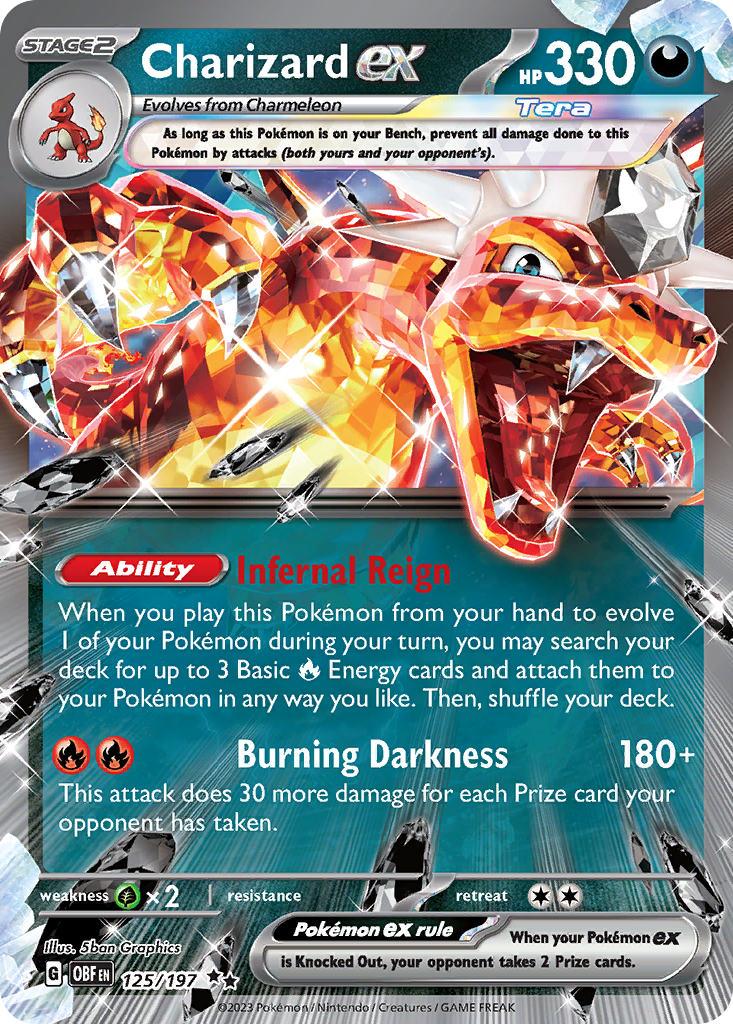
| Double Rare | Two stars | Pokémon ex (the standard, in-numbering printing) |
| Ultra Rare | Own star marking | Full Art Pokémon ex and full-art Supporter cards |
| Illustration Rare | One gold star | Alternate full-art Pokémon that are not ex |
| Special Illustration Rare | Two gold stars | Full Art Pokémon ex and Supporters with extended artwork |
| Hyper Rare | Three gold stars | The gold cards - any card type except Supporters |
Double Rare corresponds to the Japanese RR rarity and can replace the Rare card in a pack. Ultra Rare is the term that has shifted most: before Scarlet & Violet it was a catch-all for special-mechanic cards - Pokémon-ex, LV.X, LEGEND, Pokémon-EX, Pokémon V - and now it specifically means full-art ex and Supporters.
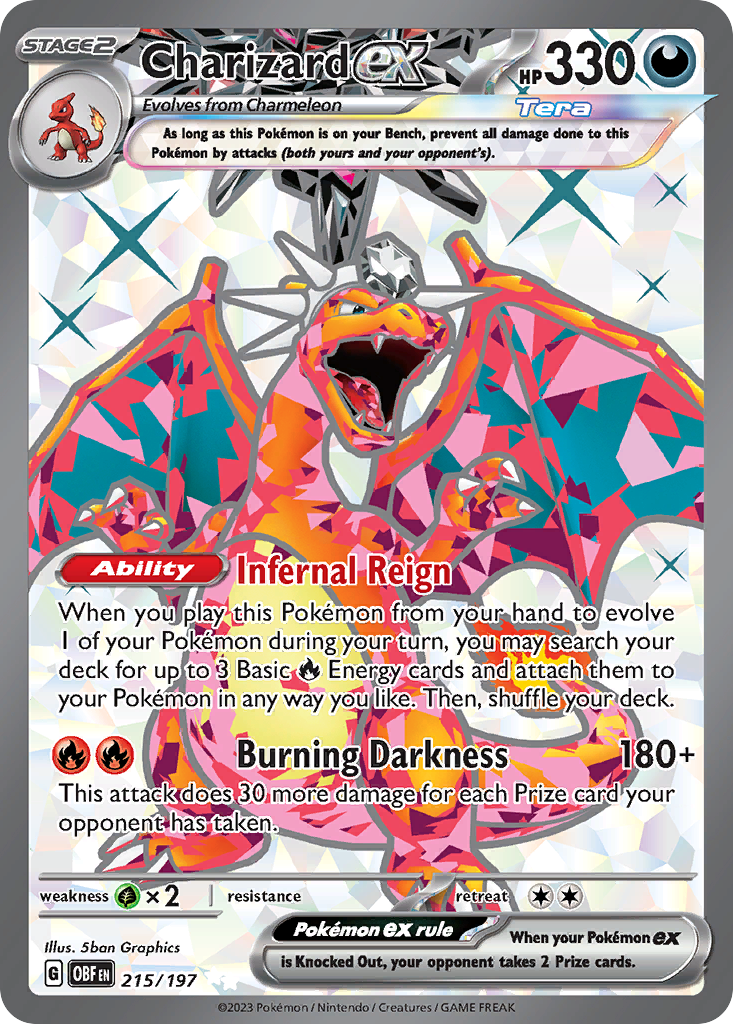
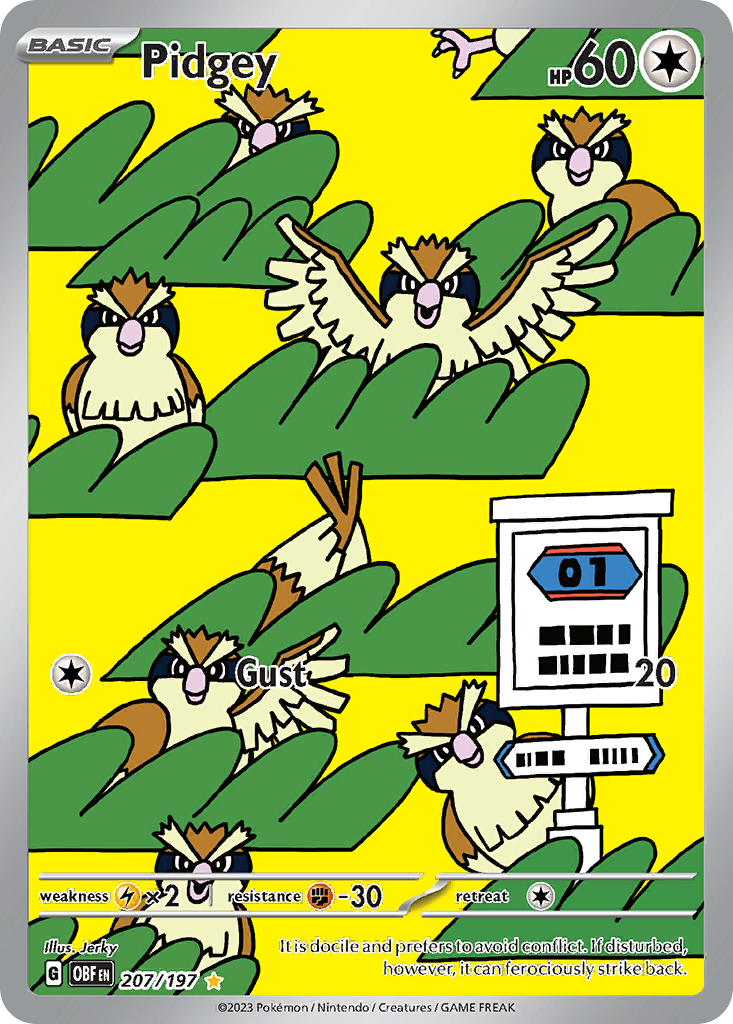
Illustration Rare (AR in Japan) is the tier collectors care about most per dollar spent, because the art is genuinely different rather than the same art in a shinier frame. It is usually an ordinary Pokémon rendered in a scene, and the Pokémon does not have to be a headliner for the card to be great.
Special Illustration Rare (SAR) is the same idea applied to ex Pokémon and Supporters, with extended artwork. Hyper Rare (UR) is the gold treatment, and it is where the ladder gets philosophically odd: a gold card is a reprint of a card you already have, in a finish some people love and some people think looks like a novelty coin.
The tiers that break the pattern
Four groups do not sit neatly on the ladder:
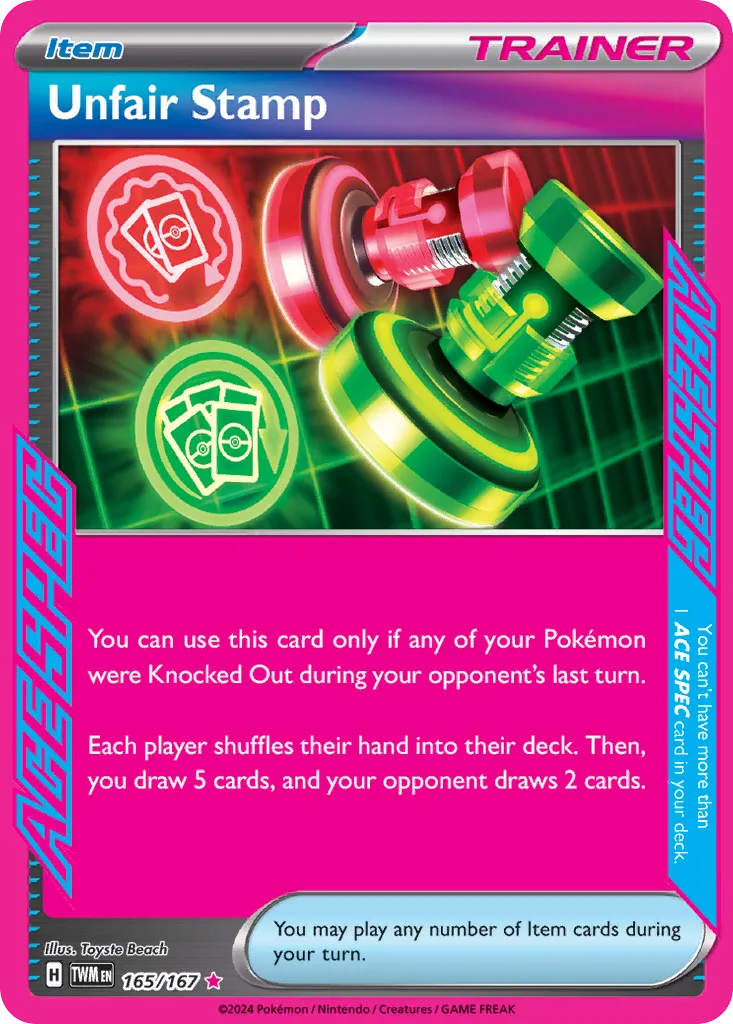
- ACE SPEC Rare - a pink star, introduced in Boundaries Crossed and revived from Temporal Forces through Prismatic Evolutions. Trainer or Energy cards only, and a deck may contain exactly one ACE SPEC card total. That deckbuilding restriction is the point of the rarity.
- Shiny Rare - a Shiny Pokémon tier, used in Shining Fates for the whole Shiny Vault subset (a full star next to "SH"), then reintroduced as a distinct rarity in Paldean Fates with a single hollow gold star.
- Mega Attack Rare and Mega Hyper Rare - from the Mega Evolution era. Mega Attack Rare renders the card pop-art style with the highlight attack in oversized text, swapping the attack text language between English and Japanese printings.
- Futuristic Rare, RGB Rare and Pikachu rare - all three arrived with 30th Celebration, the anniversary set released worldwide on September 16, 2026, and so far exist only there (plus Futuristic Rare promo cards). Futuristic Rare is an officially announced tier: full-art Pokémon ex secret cards by the artist YOSHIROTTEN, the Pokémon rendered with a metallic texture and surrounded by Energy symbols, a Poké Ball visible in the background, marked with a single star tinted to match the card (FUR in Asian-language printings). The set has two, Mewtwo ex 157/128 and Mew ex 158/128. RGB Rare is stranger: three Mew cards, each a saturated red, green or blue recolour of the same YOSHIROTTEN art, numbered R/RGB, G/RGB and B/RGB rather than anything past 128. The Pokémon Company has not named them, listed them among the set's features on its promotional site, or included them in the Elite Trainer Box checklist - "RGB Rare" is the community's label, via Bulbapedia - and their existence was only confirmed when the set landed in Pokémon TCG Live on September 15, 2026. Pikachu rare is the opposite of secret: 30 different Pikachu, one guaranteed in every pack, numbered 023 to 052 inside the printed total, and marked with their own rarity symbol - a Pikachu icon with a subset number from 01/30 to 30/30 - instead of a standard one.
The lesson: the ladder is era-dependent. A 2016 card and a 2026 card use different vocabularies for "special". Always read a rarity against the set it came from.
Secret rares: the cards numbered past the set total
A secret card is one whose collector number is higher than the printed size of the set. Card 223 in a 197-card set prints as 223/197. That is not an error, and it is not a fake.
The concept is nearly as old as the game. The first was Dark Raichu, numbered 83/82 in the Team Rocket expansion - a card Wizards of the Coast made itself, which did not exist even in the Japanese version of that set.
Since Scarlet & Violet the English rule got blunt: everything with a rarity other than Common, Uncommon, Rare, Double Rare, or ACE SPEC Rare is a secret card. Illustration Rares, Special Illustration Rares, Ultra Rares and Hyper Rares all live above the printed total, and 30th Celebration's two Futuristic Rares follow the same rule at 157/128 and 158/128. That set also bent the rule in both directions: its 30 Pikachu rares sit inside the numbering despite having their own rarity mark, and its three RGB Rare Mews are numbered R/RGB, G/RGB and B/RGB - outside the count entirely rather than past it. Its 30 Classic Collection reprints sidestep the numbering altogether: they keep their original set symbol, rarity symbol and collector number, so the Base Set Charizard in it still reads 4/102.
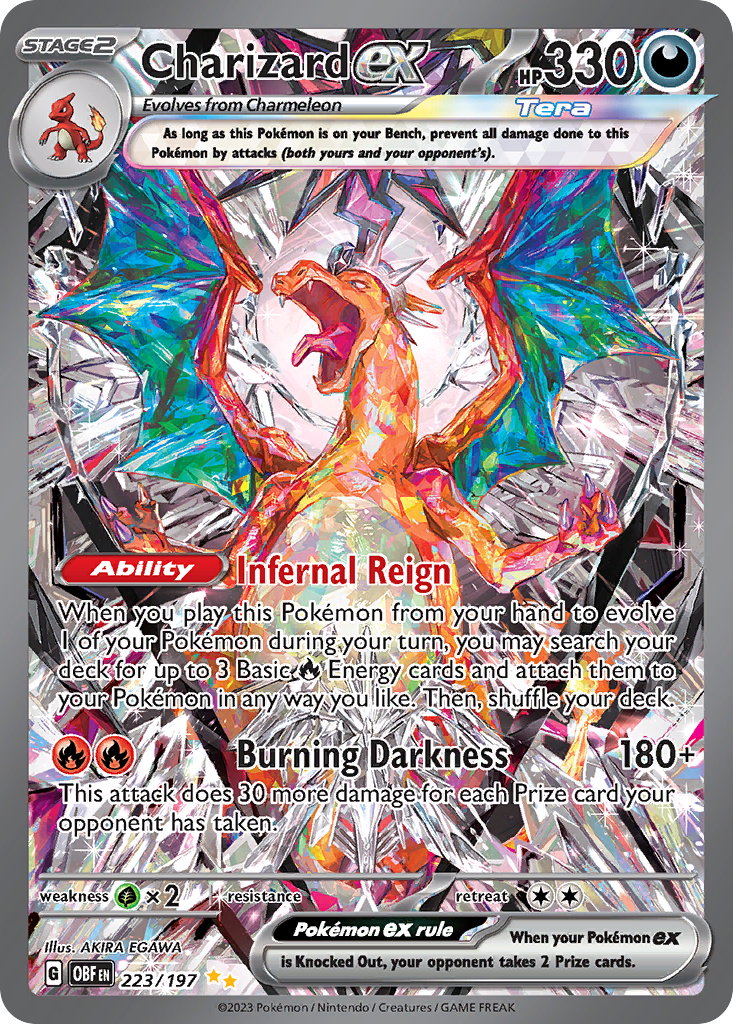
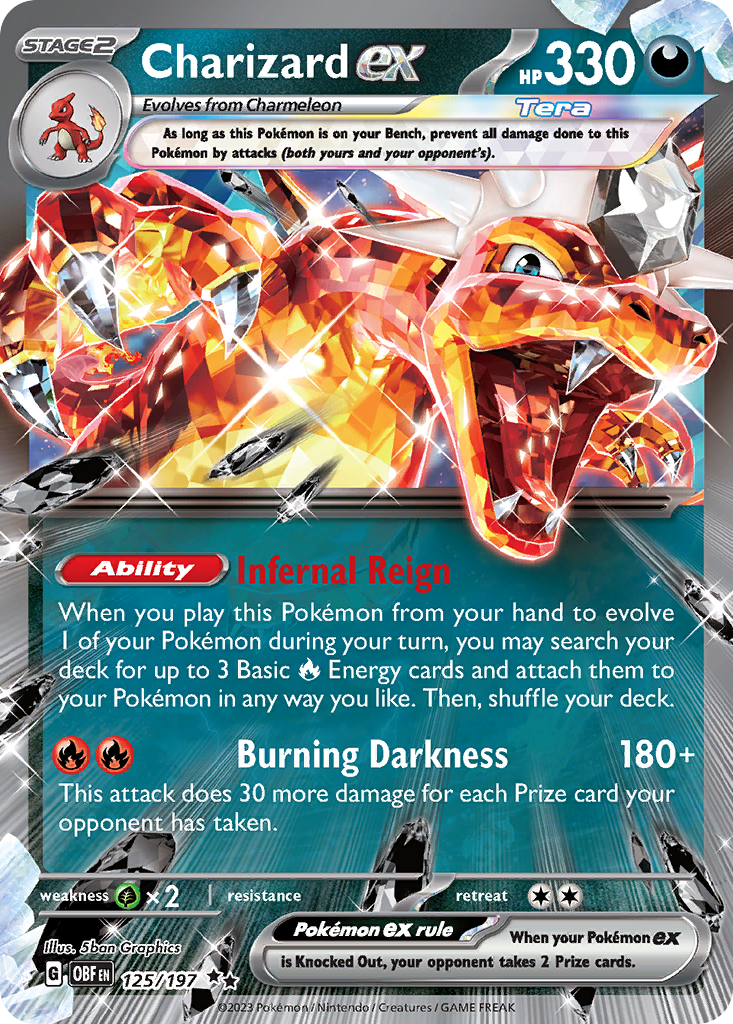
Obsidian Flames is a clean worked example - printed total 197, full set 230 cards. Charizard ex alone appears four times off the same card text:
| Printing | Number | Rarity |
|---|---|---|
| Standard ex | 125/197 | Double Rare |
| Full Art | 215/197 | Ultra Rare |
| Special Illustration | 223/197 | Special Illustration Rare |
| Gold | 228/197 | Hyper Rare |
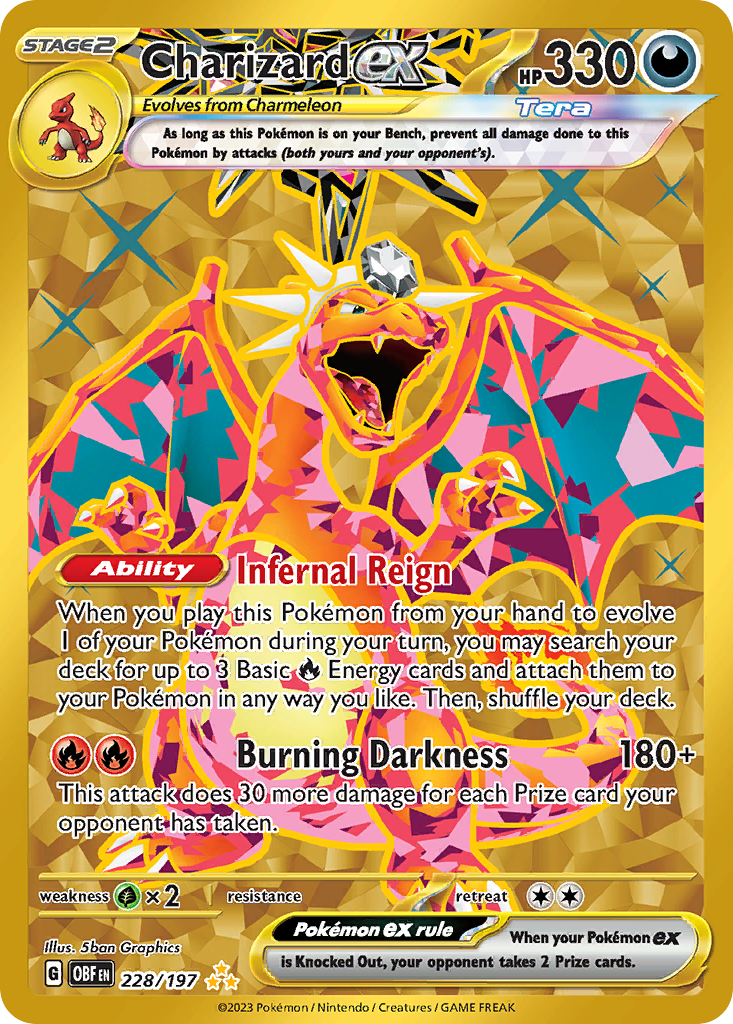
Four cards, four wildly different secondary-market tiers, identical rules text. In a deck they are interchangeable, so buy 125/197 and spend the difference on the rest of your list. This base-card-plus-treatments structure shows up across modern TCGs - it is exactly how Cookie Run: Braverse handles its Secret tiers, where the alt-art printing shares its number with the base card.
Set symbols and collector numbers
Every expansion has its own expansion symbol, a small icon printed on the card. Alongside it sits the collector number in x/y form, and the rarity symbol in the bottom right corner. Those three marks identify a card completely: which set, which slot in it, and which tier.
Promotional cards are the exception - they carry a Black Star Promo symbol where the rarity symbol would go, and a promo number rather than a set number. Trainer Kit and half-deck cards go further, printing a silhouette of the kit's featured Pokémon instead of a rarity symbol.
If you are cataloguing a collection, the collector number is the field that actually disambiguates. Names repeat constantly; numbers do not - the same discipline that makes card numbering systems worth learning in any TCG.
What is actually inside a Scarlet & Violet booster pack
Packs are collated by slot, not by luck-of-the-draw across the whole set. For international Scarlet & Violet-era releases, the structure is:
| Count | Slot contents |
|---|---|
| 4 | Common |
| 3 | Uncommon |
| 1 | Reverse Holo, or Shiny Rare / Shiny Ultra Rare (Paldean Fates), or ACE SPEC Rare (Temporal Forces through Prismatic Evolutions) |
| 1 | Reverse Holo, or Illustration Rare, or Special Illustration Rare, or Hyper Rare |
| 1 | Rare, or Double Rare, or Ultra Rare |
| 1 | Basic Energy card |
| 1 | Pokémon TCG Live code card |
Read that carefully and the "how do I pull a chase card" question answers itself: the good stuff comes out of one specific slot, upgrading over a Reverse Holo. You are not opening ten lottery tickets. You are opening one.
Pack size has moved around historically - 11 cards from Base Set through Neo Destiny, 9 across the e-Card and EX series, 10 from Diamond & Pearl onward, plus a Basic Energy since Sun & Moon. Japanese packs run 5. Current sealed sizes: Booster Box 36 packs, Booster Bundle 6, Elite Trainer Box generally 9 (Pokémon Center versions 11), Build & Battle Box 4 plus a 40-card deck.
Why nobody can give you honest pull rates
Here is the part other guides fudge. The precise odds of pulling ultra rares have never been officially published by Wizards of the Coast or The Pokémon Company. Early Wizards-era sets printed approximate holo rare odds; that practice did not survive. Everything quoted as "1 in X for a Special Illustration Rare" is a community estimate from mass box openings, not a published figure.
Those estimates are not worthless, but treat them as what they are: crowd-sourced samples of one product, one print run, one region. Collation differs between Japanese and international packs, between a Booster Box and an Elite Trainer Box, and across reprints of the same set. A ratio measured on launch-window boxes is not a law of nature.
So this post gives you the ladder and the slot structure, which are documented, and declines to give you ratios, which are not. If a guide hands you a confident decimal for a modern set, ask where it came from.
What actually holds value
Same discipline applies to prices: they move constantly, vary by region and condition, and any number written into an evergreen post is wrong within weeks. What does not change is the shape of demand:
- Character beats mechanics. Charizard, Pikachu, the Eeveelutions and a handful of other icons carry premiums that have nothing to do with playability. A dominant card attached to an unloved Pokémon does not behave the same way.
- Artwork tiers outrun frame tiers. Illustration Rares and Special Illustration Rares - where the art is genuinely new - hold interest better than the same card in a shinier frame, because they are the printing people want on a wall.
- Playability is a temporary multiplier. A Double Rare anchoring the Standard metagame is expensive while it is legal and much less so after rotation. That is a rental, not an asset.
- Condition is the whole game at the top end. Modern print runs are enormous; when thousands of copies exist, condition is what separates them.
- Sealed vintage is a separate market with its own authentication risks and its own scams.
And the practical rule: price a card off completed sales, not asking prices. Anyone can list a card for anything.
Grading: PSA, BGS, and CGC without the mystique
Third-party grading means sending a card to a company that authenticates it, assigns a numeric grade, and seals it in a tamper-evident slab. All three major graders assess the same four things: centering, corners, edges, and surface.
- PSA grades on a 1-10 scale. A PSA 10 is Gem Mint - described by PSA as a virtually perfect card with four perfectly sharp corners, sharp focus and full original gloss, free of staining, with only a slight printing imperfection allowed.
- BGS (Beckett) grades 1-10 in half-point increments and prints four subgrades, one per criterion. A BGS 10 with all four subgrades at 10 earns the Black Label, the rarest outcome in mainstream grading.
- CGC also runs 1-10 with half grades, topped by Gem Mint 10 and, above it, Pristine 10 - reserved for cards flawless under 10x magnification. CGC's older Perfect 10 was retired in 2023 when its trading card arm merged with CSG.
Two things nobody tells beginners. First, grading is priced per card plus shipping both ways plus insurance, so it only makes sense when the graded premium plausibly clears that cost - which for most modern bulk means never. Second, centering is the killer. A card can have perfect corners and still cap at a 9 because the factory cut it off-centre. Check centering on the front and back before you pay someone else to tell you. And if you are buying an already-graded card, verify the certification number on the grader's own lookup and study the photos - buy the card, not the label.
How to collect this without lighting money on fire
- Decide which hobby you are in. Playing and collecting are different budgets with different optimal buys. Doing both out of the same booster boxes is how people end up with neither.
- Buy singles for decks. Need four copies of one Uncommon Trainer? Buy four copies. Opening packs to find them is strictly worse - the same logic that makes MTG Limited a fun format and a terrible acquisition strategy.
- Buy the exact card you want. If you want the Special Illustration Rare, buy it. Chasing it through packs costs more in expectation, every time. Packs are worth it only if you enjoy opening packs as its own activity.
- Sleeve what you play, toploader what you chase. Penny sleeves are trivially cheap and shuffling is what actually destroys cards. Heat, sunlight and humidity handle the rest.
- Ignore the investment framing. Collect the Pokémon you like in the treatments you like. If the market runs your way later, lovely. If not, you still own art you chose on purpose.
Learn the ladder because it tells you what you are holding and stops you being talked out of it. It is not a price guide, and anything trying to be both is selling you something.
Frequently Asked Questions
What do the circle, diamond, and star symbols mean on Pokémon cards?
Is a reverse holo card rare?
What is a secret rare Pokémon card?
What is the difference between an Illustration Rare and a Special Illustration Rare?
What are Futuristic Rare and RGB Rare Pokémon cards?
What are the official Pokémon TCG pull rates?
How many cards are in a Pokémon booster pack and box?
Is it worth getting Pokémon cards graded by PSA, BGS, or CGC?
Does a higher rarity make a Pokémon card better in a deck?
Keep Reading
- Rarity (Bulbapedia)
- Booster pack (TCG) (Bulbapedia)
- Secret card (TCG) (Bulbapedia)
- PSA Grading Standards
- Official Pokémon TCG site
- Get Ready for Pokémon TCG: 30th Celebration (Pokémon.com)
- 30th Celebration (TCG) (Bulbapedia)
- Futuristic rare card (TCG) (Bulbapedia)
- RGB rare card (TCG) (Bulbapedia)
- Pikachu rare card (TCG) (Bulbapedia)
- Classic Collection (TCG) (Bulbapedia)
Related Guides
Pokémon TCG Live: Code Cards, Credits, and Free Packs
Pokémon TCG Live is free, runs the paper ruleset, and hands you a collection you then have to grow. The redemption limits are published — 400 booster codes per expansion, 25 Build & Battle codes, four per preconstructed deck. So is the rule that turns your fifth copy of a card into currency. Here is the whole acquisition economy, from The Pokémon Company's own documentation.
How to Play the Pokémon TCG — Full Rules and Turn Structure (2026)
Two players, 60 cards each, six face-down Prize cards, and a coin flip. That is the whole skeleton of the Pokémon TCG. Here is every rule that actually matters on turn one, from setup through the three ways to win.
Pokémon TCG Louisville Regional 2026: Results and Top 9
Riley McKay won the Louisville Regional Championships without losing a match, on a Dragapult ex list two cards away from the one that won Worlds. Behind him, three decks that had not reached a Regional top cut all season got there at once: Sharpedo/Toxtricity, Dhelmise and Mew Box.
Pokémon TCG N's Zoroark ex Deck Guide: Builds and Matchups
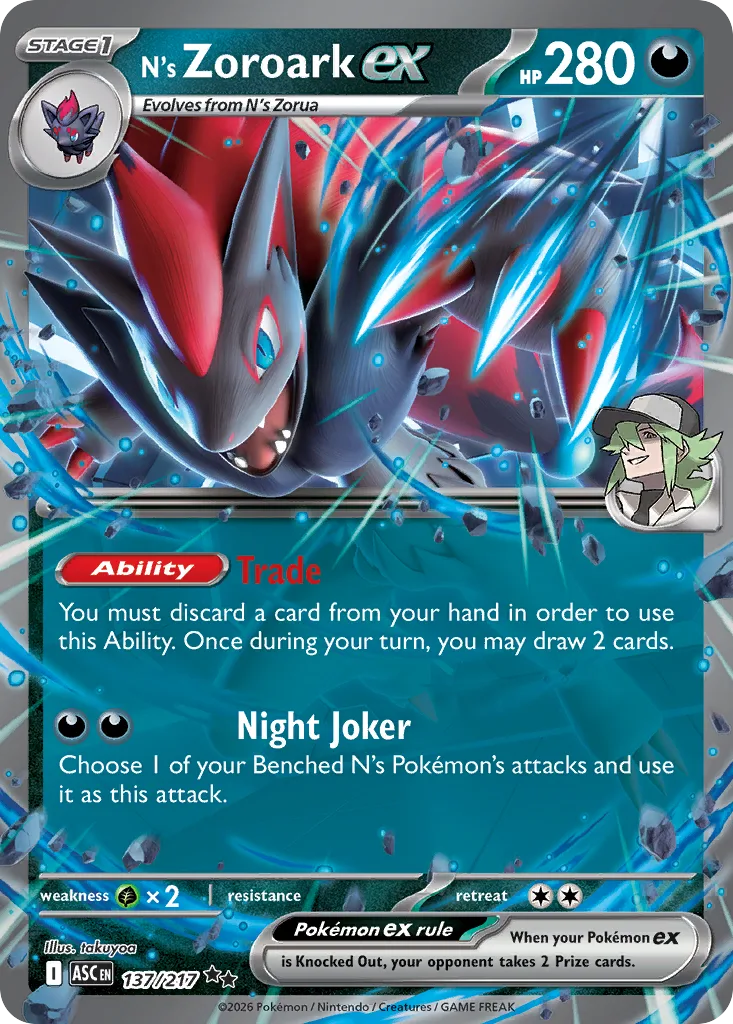
N's Zoroark has been the second-most-registered deck at three of the 2027 season's first four Regionals, and it reaches Day 2 more often than the field. Then it stalls: 2 of 42 top-cut seats. We pulled all 564 lists and every match those players finished to find which build works, which cards came with worse results, and where the losses come from.
Pokémon TCG Recife Regional 2026: Results and Winning Deck
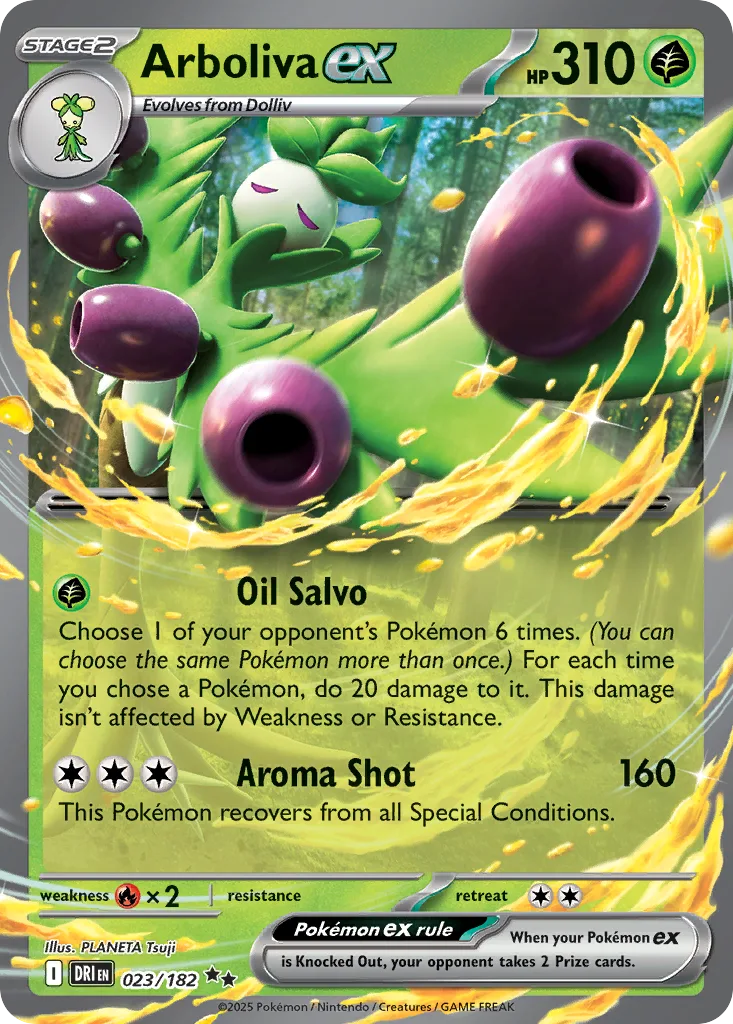
The fourth Regional of the 2027 season, and the first in Latin America, went to a deck only two of 1,074 Masters registered. Victor Carreira's Ogerpon/Meganium/Arboliva list beat three Dragapult ex players in the top cut, in a field where Dragapult builds were a bigger share than at any Regional so far this season.
Pokémon TCG ACE SPEC Cards: All 29 Legal, Ranked by Play
You get one ACE SPEC per deck, and Standard currently offers 29 of them. We pulled all 6,728 Masters decklists from the first three Regionals of the 2027 season to see which one players actually spend that slot on, archetype by archetype, and which ACE SPECs nobody registered at all.