Best Cookie Run: Braverse Item, Trap & Stage Cards, Ranked
Everyone chases the splashy Ultra Rare Cookies. But the cards that decide tight games are the support pieces - the Items that swing a combat, the Traps that tax a turn, the Stages that bend the rules. Here's the non-Cookie pool, ranked.
Open any "best Cookie Run: Braverse cards" list and it's all Cookies - the Ultra Rare bombs, the recursion engines, the board-wiping bosses. Fair enough; Cookies are the only cards that attack, hold HP, and actually win the game. But ask anyone who's lost a close match what beat them, and half the time it wasn't a Cookie. It was an Item they didn't see coming, a Trap that ate their attack, or a Stage quietly rewriting the math every turn.
This is the ranking nobody writes: the best non-Cookie cards in Braverse. The Items, Traps, and Stages - the official database lists 163 Items, 133 Traps, and 91 Stages - are the support layer, and the good ones are the difference between a deck that durdles and a deck that closes. We're ranking from the higher-rarity pool (Rare and up), quoting the real skill and attack text off the official card database, and we're deliberately leaving the Soul Jams out - those one-of-a-kind signature Items have their own dedicated ranking, so they'd just clog this list. If you're fuzzy on what these types even do, start with card types explained.
Why the support cards matter
Braverse ramps slowly - one Support card per turn - so every resource you spend is a real choice. A Cookie develops your board. A support card does something the board can't: it pushes damage at instant speed, punishes the opponent on their turn, or applies a passive effect that compounds. The trade is that a support card isn't a body. It doesn't attack, it doesn't hold HP, and a dead Trap is just a wasted card.
That tension is exactly why the good ones are so good. A great Item turns a stalled combat into a kill. A great Trap makes the opponent play scared around a face-down card that might not even matter. A great Stage taxes every turn the game runs long. The bad ones? They sit in your hand doing nothing while your opponent develops. The gap between the two is enormous, which is the whole reason to rank them.
The mental test for any support card: does it do something a Cookie in that slot couldn't? If the answer is "not really," play the Cookie.
How we ranked these
Three axes, same discipline as our overall card ranking:
- Raw impact. What the card does when it fires, read straight off the official text - damage, card advantage, recursion, disruption.
- Reliability. How often it's live. A card with a "if your break area is LV.6 or higher" clause does nothing in the early game; a card with no condition is always on.
- Deck fit. How many real decks want it. A narrow build-around ranks below a flexible card any deck in its color can run.
A quick honesty note, same as always: this isn't an official tier list. Devsisters publishes no power ranking, and nothing here is banned. The {R}/{Y}/{G}/{B}/{P} symbols are each color's resource, {N} is any color, and {K} is Black. Cost is shown in angle brackets the way the database prints it.
The best Item cards
Items are the one-shot effects - the "spell" layer. The best ones do two things at once: affect the board and keep your engine running. Ranked:
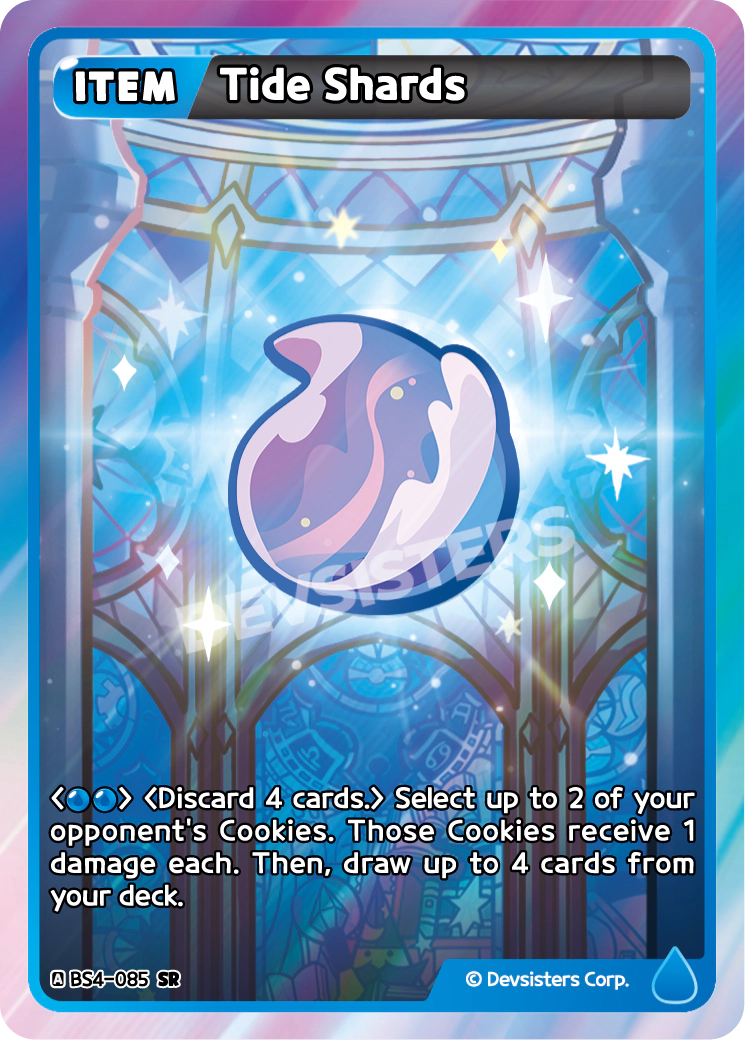
- Wind Gems (BS4-062, Green, Super Rare). For {G}{G}, you "Set up to 4 {G} cards in your support area as rested," then deal a Cookie damage equal to the number of cards rested. That's the best Item in the game and it isn't close: it's ramp and removal stapled together. Green wants a fat support area anyway, so the "cost" of resting four cards is something you were building toward, and you get up to 4 damage out of it. Scaling removal that also advances your game plan is exactly what a great Item looks like.
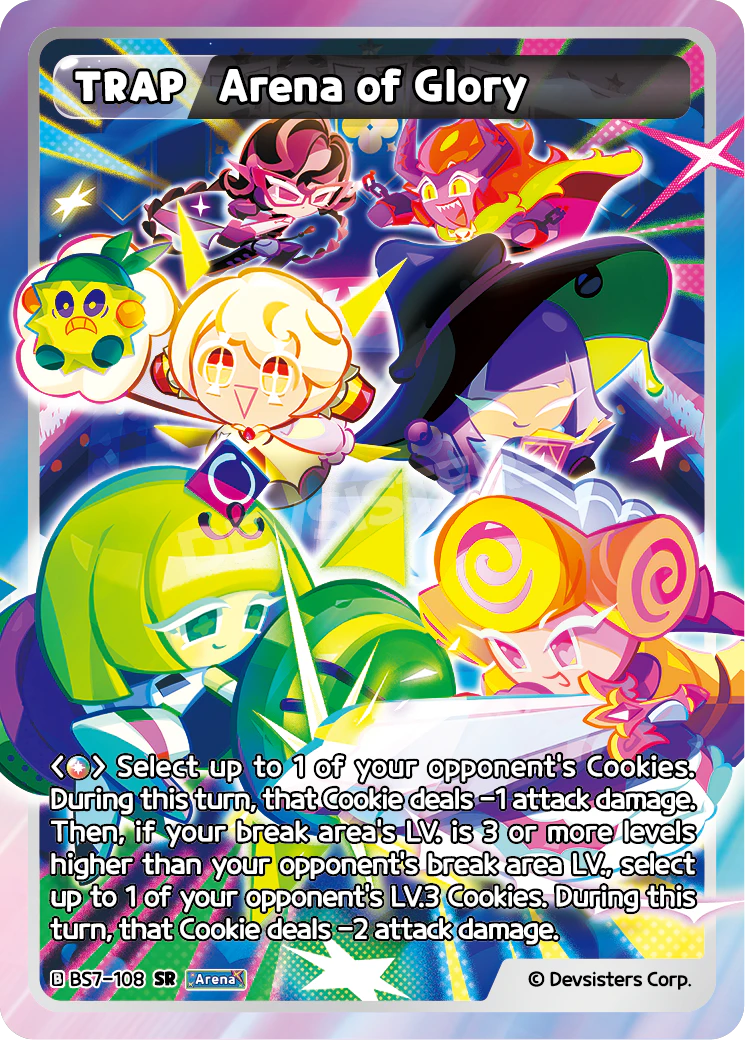
- Tide Shards (BS4-085, Blue, Super Rare). For {B}{B} and discarding 4 cards, hit up to two Cookies for 1 each, then draw up to 4. The discard cost is steep, but Blue is the color that wants a stuffed graveyard and a churning deck, so feeding it four cards to clear two small bodies and refill your hand is a genuine two-for-one. The best card-advantage Item in the pool.
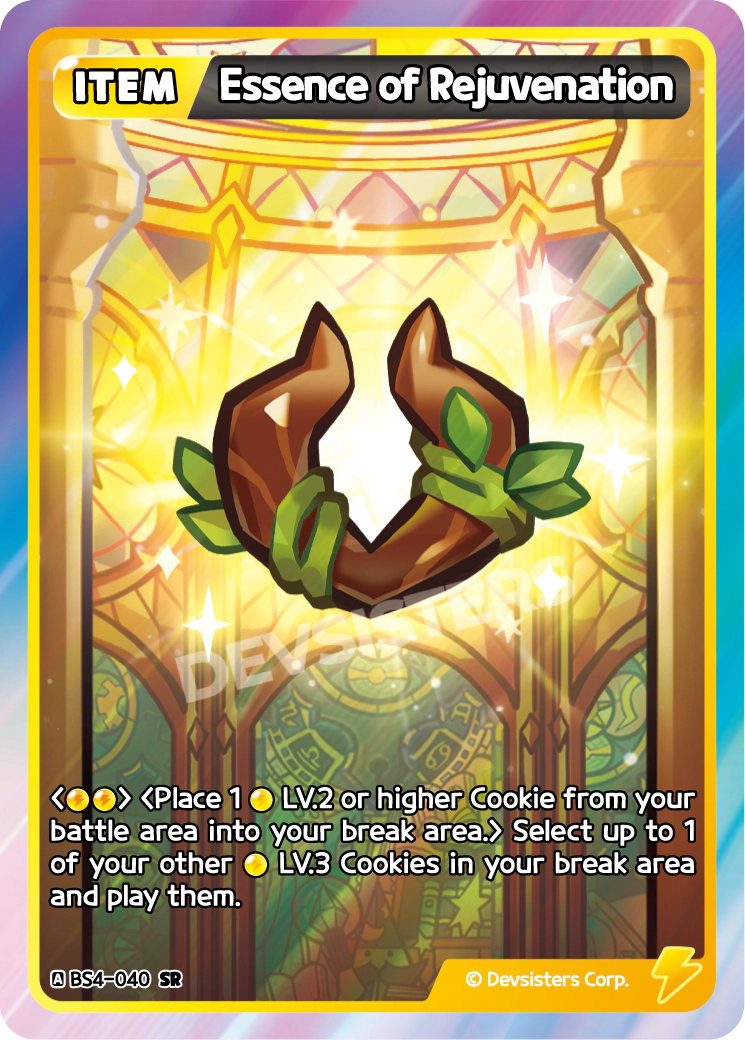
- Essence of Rejuvenation (BS4-040, Yellow, Super Rare). For {Y}{Y}, you place a {Y} LV.2-or-higher Cookie from your battle area into the break area, then play another {Y} LV.3 Cookie from your break area. This is the engine that makes Yellow recursion tick - it loops your big Ancients back onto the table for two resources. It's narrow (you need the targets), but in the deck that wants it, it's the glue.
- Tide Shards' little brother, Diving Goggles (BS2-047, Blue, Rare). For {B}{B}{B} and discarding 3, hit up to two Cookies for 2 each. No card draw, but 4 damage split across two bodies for a discard-heavy color is a clean, cheap board-control Item that's far easier to pull than the Super Rares above.
- Giant Cherry Bomb (BS1-022, Red, Rare). For {R}{R}{R} and discarding 1, a Cookie takes 3 damage. Pure reach - the burn Red aggro needs to close out the last few points when the board has stalled. Not flashy, but it does the one thing aggro is always short on.
The pattern at the top: the elite Items don't just remove or draw - they do both at once, or they advance a strategy your deck was already running. Wind Gems and Tide Shards are double-spells. Essence of Rejuvenation is an engine. That's the bar.
The best Trap cards
Traps are the reactive layer - set face-down, fire on a condition, usually on the opponent's turn. The strategic value is information warfare: a set Trap forces the opponent to play around something that might not be there. The catch is they're conditional, so the best Traps are the ones whose condition you can reliably meet. Ranked:
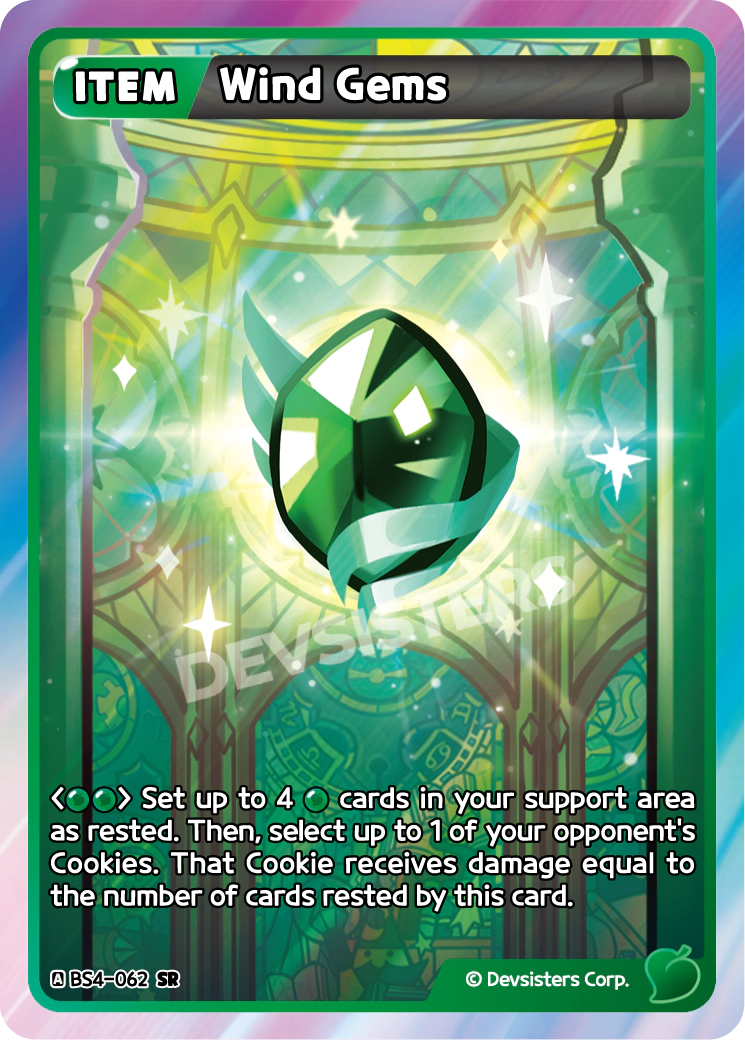
- Arena of Glory (BS7-108, Pure, Super Rare). Technically a Trap, and a strong one: for {N} it knocks -1 attack off an opposing Cookie this turn, then does more if your break area is 3+ Levels ahead of your opponent's. A flexible, any-color reactive card that scales with a board lead - the rare Trap that's playable in essentially any deck because its base mode is unconditional.
- Abandoned Cloud Nest (BS2-080, Purple, Rare). For {P}{P}, if you have 15+ cards in your trash, an opposing Cookie deals -3 attack this turn. That's a brutal blank on an attacker, and Purple's whole plan is filling its trash, so the condition is one you're building toward anyway. The best "punish their attack" Trap in the color that can actually turn it on.
Two things to flag honestly. First, the higher-rarity Trap pool is thin - most of the 133 Traps live at common and uncommon rarity, so the chase-worthy ones are fewer than the Items. Second, the exact mechanics of how Traps are set and when they trigger are the kind of edge-case rules worth confirming against the official rulebook before a sanctioned event; the reactive, face-down concept is solid, but Braverse is young and the fine print isn't pinned down everywhere online.
A Trap is only as good as your ability to predict the play that sets it off. Set Abandoned Cloud Nest when you can see the big attack coming next turn - a Trap that never fires is a card you didn't play.
The best Stage cards
Stages are the persistent layer - they stick in your stage area and keep working every turn. Their value compounds the longer the game runs, which is why they belong in slower decks. The two standout high-rarity Stages are both Pure (any-deck) Ultra Rares, and they're as build-around as cards get:
- Cookies of Legend (BS4-111, Pure, Ultra Rare). For five resources of any color you place it, and its activated attack - for another {N}{N}{N}{N}{N}, resting the card - sweeps both battle areas: every LV.2-or-lower Cookie goes to the bottom of its owner's deck, then you buff one of your surviving LV.3 Cookies. It's a repeatable, symmetrical board reset that a big-Cookie control deck breaks in its favor, because your LV.3 threats survive and theirs get swept. Expensive, but a Stage that wipes small boards on demand is a control deck's dream.
- Age of Heroes and Kingdoms (BS3-121, Pure, Ultra Rare). The famous one. For {R}{Y}{G}{B}{P} you place it, then its attack - rest the card, pay all five colors again - simply wins the game if your battle and support areas hold 5 different Ancient Cookies and 5 different Soul Jams. It is the single most spectacular line in Braverse and almost never practical, because assembling ten specific one-of-a-kind chase cards in one game is a meme more than a plan. We rank it second precisely because of that: enormous ceiling, near-zero reliability. A glorious collection piece and a terrible game plan.
That split - Cookies of Legend (always useful) over Age of Heroes (theoretically game-winning, practically a trophy) - is the whole reliability axis in one comparison.
What about Soul Jams
You'll notice the ten Soul Jams aren't here, even though every one of them is technically an Item. That's on purpose. Soul Jams are a different animal: one-of-a-kind Super Rare Items that double as removal-on-cast and a permanent buff once you Equip them to a specific Ancient or BEAST Cookie. They're build-arounds, they're chase cards by design, and lumping them in with general-purpose Items like Wind Gems would be comparing a wrench to a Swiss Army knife. We ranked all ten on their own in the best Soul Jam cards guide - if you want to know whether Light of Truth or Light of Destruction is the better pull, that's the post.
The set-named Stages explained
A quick word on the cards that share a name with a whole booster set, because it confuses people. Arena of Glory and Age of Heroes and Kingdoms aren't just cards - they're also the names of Braverse expansions, and the card is the marquee piece that headlines the set's mechanic. Age of Heroes and Kingdoms (the March 2025 set) is built around assembling Ancients and Soul Jams, and the Stage card is its over-the-top payoff. Arena of Glory (the September 2025 set) is built around the Arena keyword - cycling Cookies through your support and battle areas - and the Arena of Glory card rewards exactly the break-area lead that an Arena deck races to build. So when you see a card named after a set, read it as the set's thesis statement in card form. For the full release order and what each set added, see our set release timeline.
How to slot support into a deck
Support cards compete with Cookies for slots, and Cookies are your board and your clock, so the support package should be focused, not bloated. A sane frame for a 60-card deck:
| Support type | Rough share | Who wants more |
|---|---|---|
| Items | A solid secondary block | Every deck; aggro wants cheap burn, control wants card advantage |
| Traps | A focused set | Reactive control decks; aggro runs few |
| Stages | A small number | Slow control and ramp decks - the value compounds |
Match the card to the plan. Aggro wants Giant Cherry Bomb-style reach and cheap removal; it has no time for a five-cost Stage. Control and ramp want Cookies of Legend and the card-advantage Items; they can afford the setup. Green and Blue lean hardest on Items because Wind Gems and Tide Shards do double duty. The deck-construction limits - 60 cards, four copies max per card number, at least one Cookie, up to 16 FLIP cards - are well-corroborated, but confirm them against the official rulebook before a sanctioned event. For the full ratio discussion, see deck-building basics.
Quick Action Checklist
- Don't sleep on the support layer. The best Items, Traps, and Stages decide close games as often as the marquee Cookies do.
- Prize the double-spells. Wind Gems (ramp + removal) and Tide Shards (removal + draw) top the Item list because they do two jobs at once.
- Run Traps you can turn on. Abandoned Cloud Nest is great in a trash-filling Purple deck and dead anywhere else; Arena of Glory is the flexible, any-deck pick.
- Save Stages for slow decks. Cookies of Legend rewards a big-Cookie control shell; Age of Heroes is a collection trophy, not a plan.
- Read Soul Jams separately. They're Items on paper but build-arounds in practice - the dedicated Soul Jam guide ranks all ten.
- Match support to your plan. Cheap burn and removal for aggro; card advantage and compounding Stages for control.
- Confirm Trap timing against the official rulebook before a sanctioned event - it's the most ambiguous corner of the rules.
Frequently Asked Questions
What is the best Item card in Cookie Run: Braverse?
Are Soul Jams the best Item cards in Braverse?
What is the best Stage card in Cookie Run: Braverse?
How many Item, Trap, and Stage cards should my deck run?
Is Arena of Glory a Trap or a Stage card?
Do aggro decks want Trap and Stage cards in Braverse?
Keep Reading
Related Guides
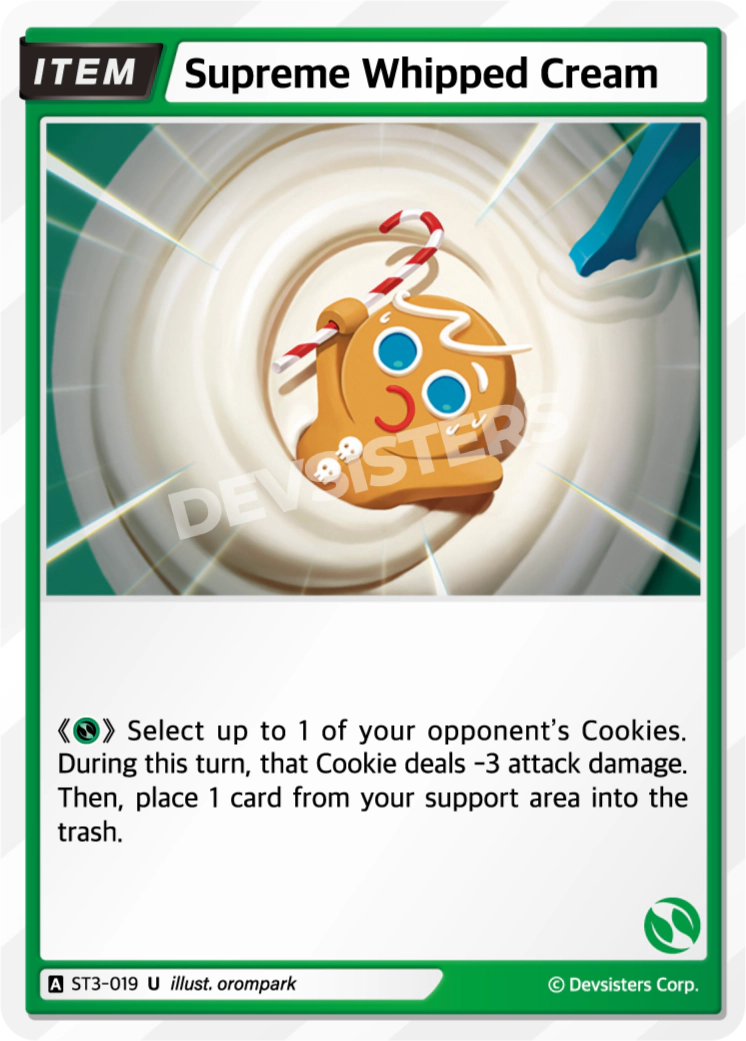
Best Trap Cards in Cookie Run: Braverse, Ranked
Braverse has 120 different Trap cards and 115 of them are Uncommons. There is not a single Ultra Rare Trap in the game. That means the entire interaction layer - the cards that decide close games - is fully available to anyone who owns a starter deck and a fistful of bulk.
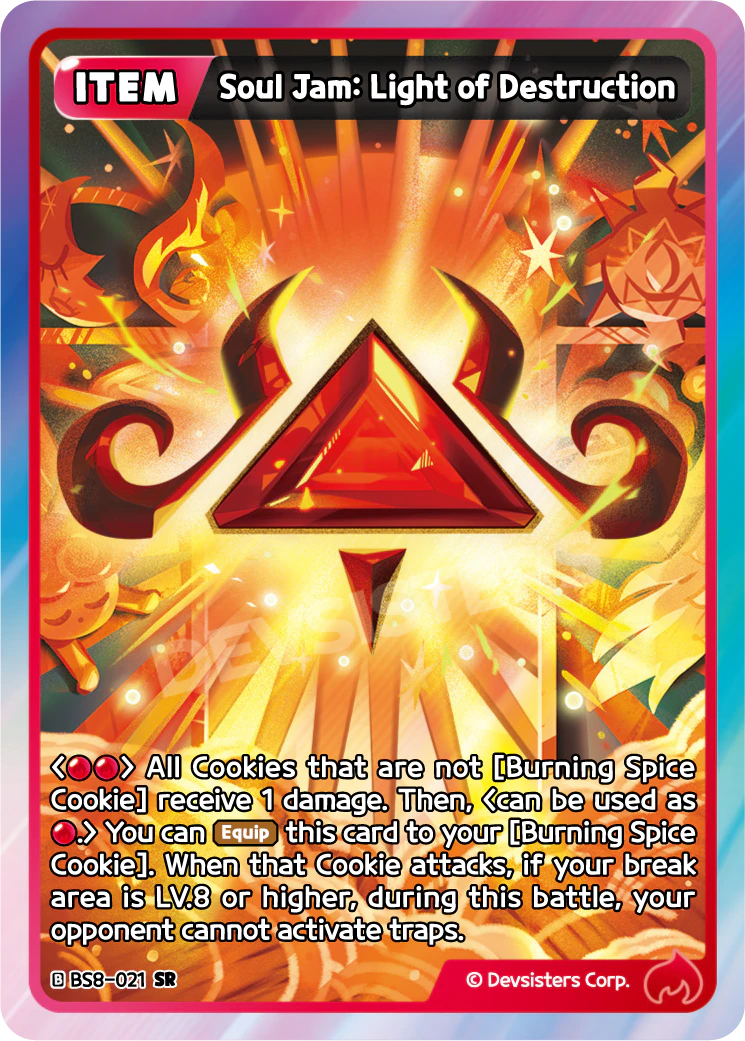
Best Cookie Run: Braverse Soul Jam Cards, Ranked
There are exactly ten Soul Jam cards in Braverse - one signature high-impact Item per legend, each tied to a specific Cookie. Here's all ten ranked by what their real cost and effect text actually does.
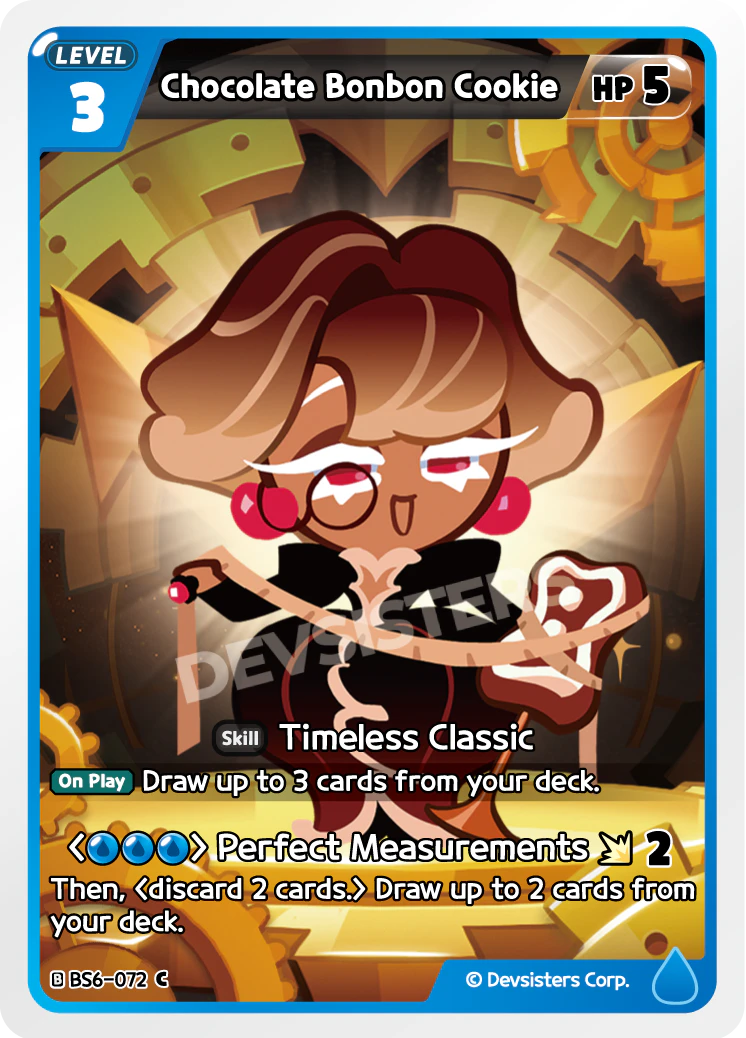
Best Draw and Search Cards in Cookie Run: Braverse
Search the official Braverse database for skills that draw two or more cards and you get 61 hits. Sixty of them charge you something - a discard, a mill, a hand-size cap, a body that has to die first. Exactly one doesn't, and it's a Common. Here's the full draw and search pool, color by color.

Best FLIP Cards in Cookie Run: Braverse, Ranked
FLIP is the signature Braverse mechanic where your own hit points punch back, and here is the strange part: the best FLIP cards are all cheap. Not one is above Rare. These are the standout FLIP Cookies ranked by color and role, with the exact flip text off the official database.

How to Play Cookie Run: Braverse - A Complete Beginner Guide
Cookie Run: Braverse is the rare TCG you can teach in a single match. This guide covers everything a first-time player needs: card types, setup, turn structure, how you pay for cards, the FLIP mechanic, and how to win.
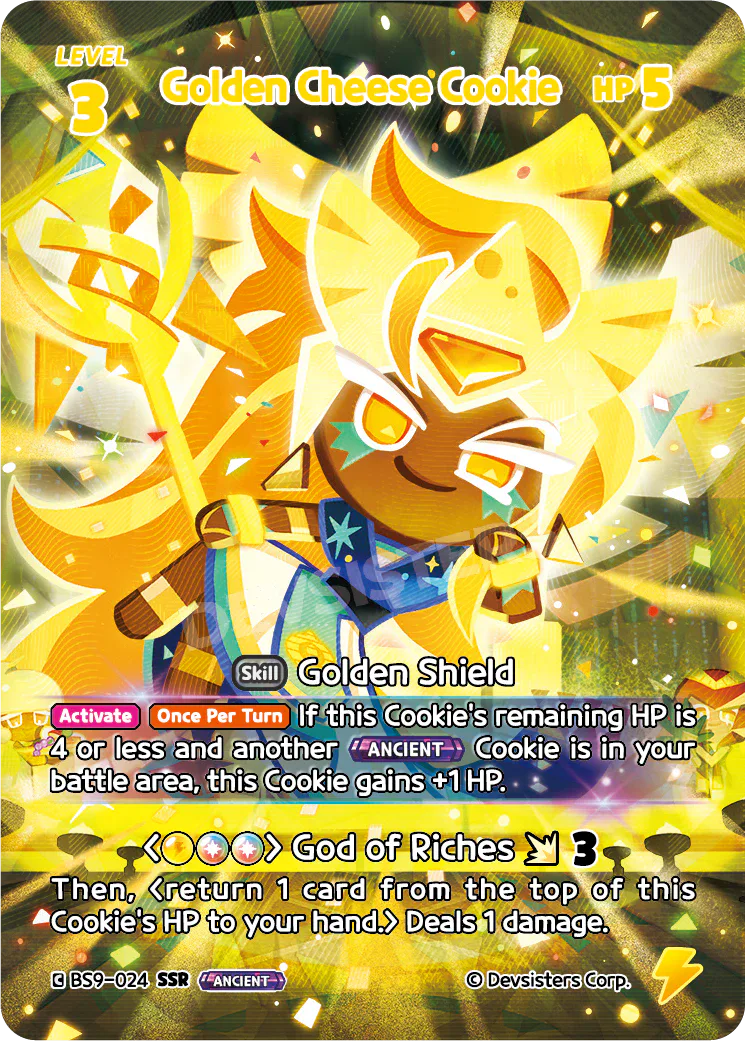
Cookie Run: Braverse Meta Tier List — Best Decks & Archetypes Ranked
Which Cookie Run: Braverse decks are actually carrying right now? Here's a meta tier list of the strongest archetypes - the real cards that anchor each one, why they rank where they do, and what's overrated.