Cookie Run: Braverse Meta Tier List — Best Decks & Archetypes Ranked
Which Cookie Run: Braverse decks are actually carrying right now? Here's a meta tier list of the strongest archetypes - the real cards that anchor each one, why they rank where they do, and what's overrated.
Most "meta tier list" posts for a TCG this young are just vibes dressed up as data, so let me be straight with you up front: there is no official global ranked ladder for Cookie Run: Braverse with published win rates, and the English-language competitive scene is still finding its feet. What there is - a 2,026-card pool in the official database, clear color identities, and a handful of cards that are obviously a cut above - is enough to rank the archetypes honestly as informed opinion. That's what this is. No invented tournament results, no fake percentages.
The ranking below is built from real cards and how their game plans interact, not from a leaderboard that doesn't exist. If you want the strategy theory underneath these tiers first, read deck archetypes explained; if you want individual card power levels, the best cards overall ranking is the companion piece. This post sits on top of both and answers one question: which decks are worth sleeving up right now?
How this tier list works
Three things decide where an archetype lands:
- Ceiling. How hard does the deck slam when it does what it wants? A deck that just ends games gets credit even if it's inconsistent.
- Floor. How does it play when the draw is mediocre? Decks that win ugly games rank above glass cannons.
- The matchup spread. Braverse archetypes form a rough rock-paper-scissors, so a deck that beats two of the three most-played strategies is worth more than one with a single great matchup.
One mechanical reminder that frames everything: almost every game ends when you fill the opponent's Break Area to a combined Cookie Level of 10. Aggro races to that 10; control grinds you there; the deck that controls how the 10 gets reached usually wins. Tiers are S (defines the format), A (consistently strong, beats most of the field), and B (real, fun, winnable, but asks more of you or the matchup).
The tier list at a glance
| Tier | Archetype | Home color | Win route | Skill floor |
|---|---|---|---|---|
| S | Control | Yellow | Grind, trade, Break Area math, LV.3 finishers | High |
| S | Arena go-wide | All five | Flood the board with Arena Cookies and pile on triggers | Medium |
| A | Aggro | Red | Cheap Cookies, fast Break Area damage | Low |
| A | Beast mill | Green | Trash the opponent's HP stacks until their Cookies fall over | Medium-high |
| B | Trash recursion | Purple | Deny resources, recur threats, win the attrition war | Medium-high |
| B | Tempo combo | Blue | Cycle, set up, and burst in one big sequence | High |
S tier: Yellow control
Yellow is the archetype the rest of the format has to beat, and it's earned that spot the boring, durable way - by being good at everything that matters in a long game. The plan is to trade efficiently, manipulate the Break Area, and close with Level-3 finishers the opponent simply can't out-grind.
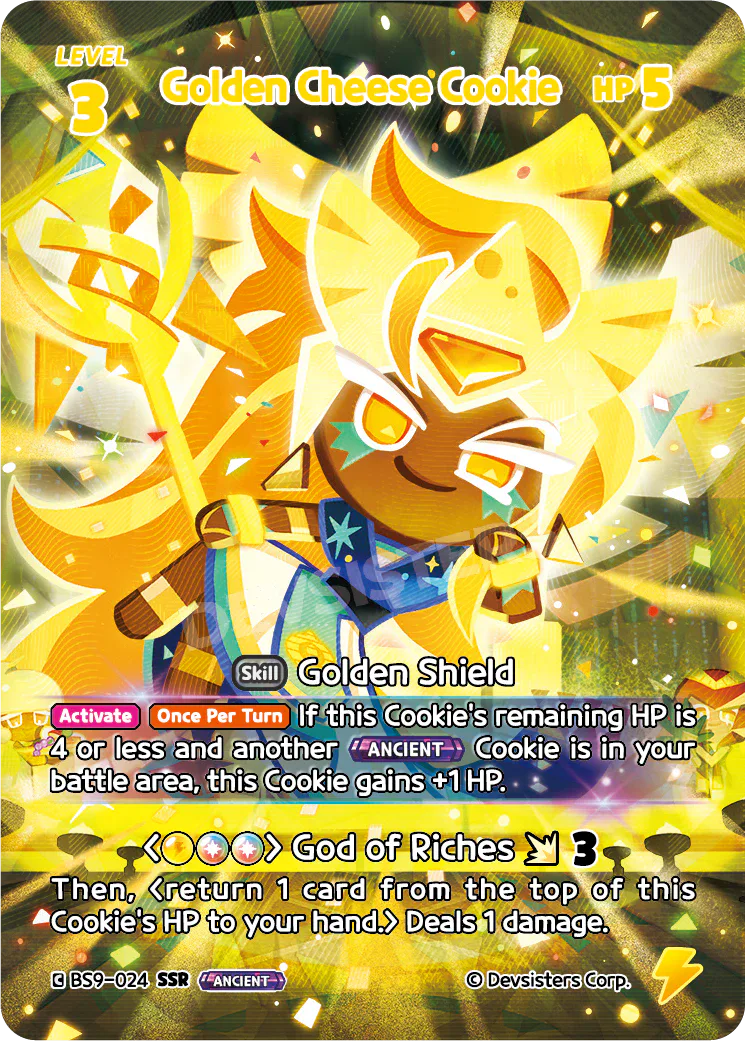
The anchor is Golden Cheese Cookie (BS9-024, SSR, Yellow Ancient, LV.3, 5 HP). Its attack, "God of Riches," deals 3 and then lets you return a card from the top of its own HP to your hand - so it pays you back while it swings - and its Activate skill regrows its own HP when another Ancient sits beside it. That's a finisher that refuses to die and refills your hand at the same time. Back it with Timekeeper Cookie (BS6-031, UR, Yellow), whose On Play pings a Cookie for 1, whose attack deals 3, and whose follow-up deals 2 more once your Break Area is LV.4 or higher - clean removal stapled to a body that scales as the game goes long.
Why S tier: the deck has no bad phase. It survives aggro's opening, out-values ramp, and its finishers go over the top of most B-tier strategies. Its real weakness is a combo deck that ignores the grind entirely - but those are the hardest decks to pilot, so you don't face a good one every round.
S tier: Arena go-wide
Arena is the trait the whole format quietly bends around, and the numbers explain why: it's the single most printed keyword in the pool, with Arena Cookies in all five colors. That breadth means an Arena deck isn't locked into one color's weaknesses - you build a board of Arena bodies and then cash in the cards that reward having "another Arena Cookie."
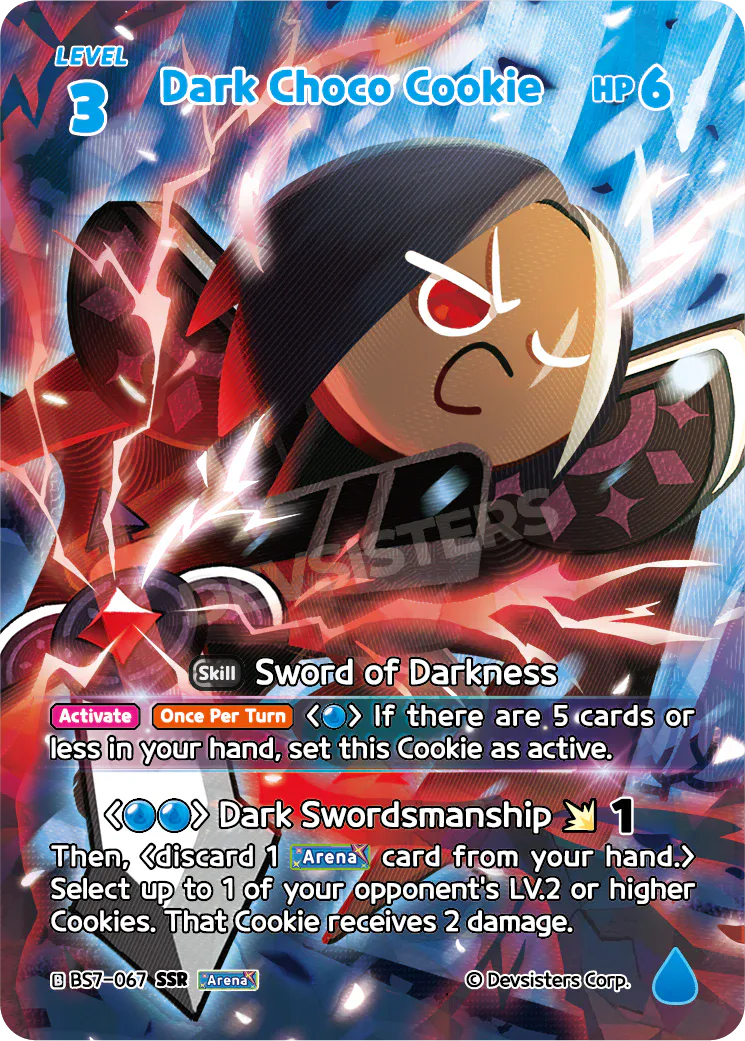
Jalapeño Cookie (BS7-018, UR, Red Arena, LV.3) is the payoff in miniature: it hits for 4, then if there's another Arena Cookie in your battle area, it pings an opposing Cookie for 1 on top. Dark Choco Cookie (BS7-067, SSR, Blue Arena, LV.3, 6 HP) is the engine - an Activate skill that re-readies him while your hand is low, plus an attack that discards an Arena card to deal 2 to a LV.2-or-higher Cookie. Financier Cookie (BS7-039, SSR, Yellow Arena) turns your board into a wrath, dinging all opposing Cookies for 1 when an Arena Cookie hits your Break Area.
Why S tier: it's the most flexible top deck, it punishes slow openers, and its individual cards are strong enough that "draw a random good Arena card" is rarely a dead turn. It loses tempo to the very fastest Red draws, which keeps it from running away with the whole format.
A tier: Red aggro
Red is the deck you hand a new player and the deck a veteran picks when they want to punish a greedy field. The plan never changes: cheap Cookies, proactive attacks, and Break Area damage before the opponent stabilizes. Because resources ramp one Support card per turn, the deck already attacking on turn two has a head start nobody gives back for free.
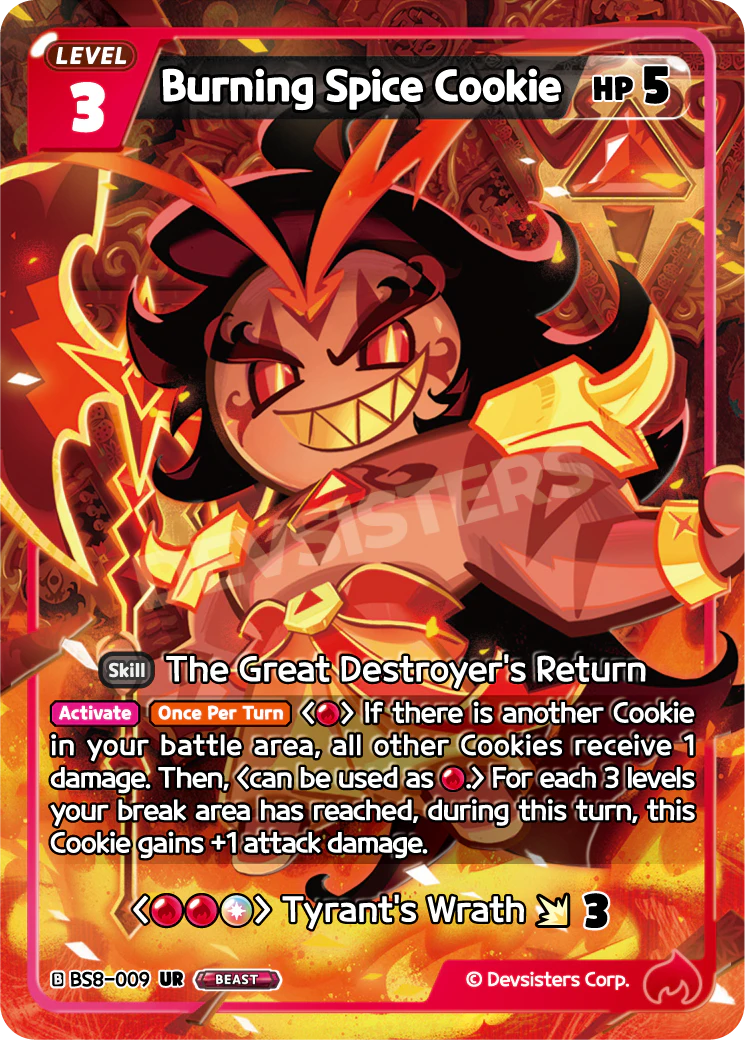
The curve writes itself. GingerBrave (BS1-013) costs a single Red, deals 2, and asks nothing - the platonic one-drop. Strawberry Cookie (BS9-003) buffs an attacker +1 the turn it lands. At the top end, Burning Spice Cookie (BS8-009, UR, Red Beast, LV.3) is the closer: its Activate skill scales its own attack by +1 for every 3 levels your Break Area has reached, so the longer the race goes, the harder it swings - exactly the payoff an aggro deck wants when the game threatens to go long.
Why A and not S: the matchup triangle is real. Red preys on ramp and combo setups but folds to a Yellow deck that survives the opening and stabilizes - and Yellow is the most-played thing you'll sit across. Red is a fantastic ladder-climber and a strong tournament choice into an unprepared field; it just doesn't get a free win against the format's best deck.
A tier: Green Beast mill
Green has a second gear beyond ramp, and it's nastier than it looks: attacking the opponent's HP stacks directly. Remember that a Cookie's HP in Braverse is a face-down stack of cards - thin that stack out and the Cookie falls over without you ever "dealing damage" in the normal sense.
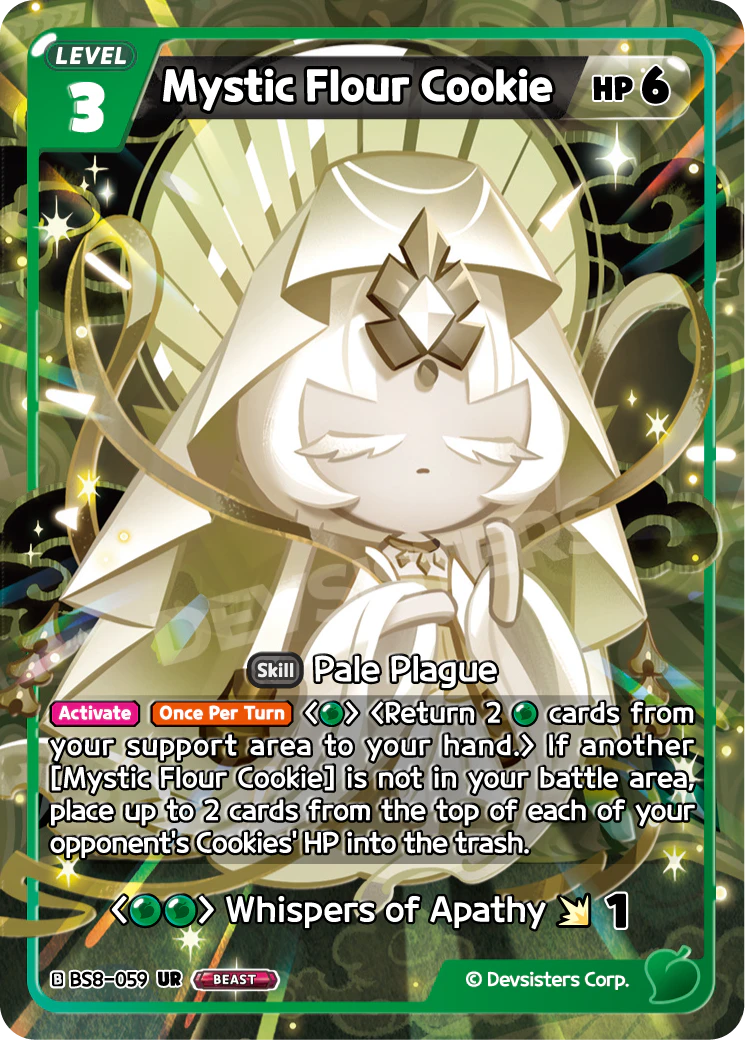
Mystic Flour Cookie (BS8-059, UR, Green Beast, LV.3, 6 HP) is the headliner. Its Activate skill - pay a Green and return two Green Support cards to hand - places up to two cards from the top of each of the opponent's Cookies' HP into the trash. That's a board-wide mill that can leave an entire team one hit from fainting. Pair it with Green's natural resource engine and you get a deck that builds, then dismantles.
Why A tier: when it sets up, it warps the game - opponents have to commit Cookies they can't afford to lose. It ranks below the S decks because the engine is mana- and hand-intensive (returning Support cards isn't free), and a fast Red draw can end the game during the turns you spend assembling it.
B tier: Purple trash recursion
Purple is the spoiler color, and its best build leans into "trash-based" attrition - deny the opponent's resources, grind down their HP stacks, and keep recurring your own threats until they run out of answers.
Dark Cacao Cookie (BS3-100, UR, Purple Ancient, LV.3) is the centerpiece. Its skill, for two Purple, places a card from the top of each of up to two opposing Cookies' HP into the trash, and its 4-cost attack does it again on hit. That's relentless, repeatable disruption of the exact resource Beast and FLIP decks care about most. Newer Purple Beasts like Silent Salt Cookie (BS10-122, UR, Purple Beast, LV.3, 6 HP) add a self-mill-into-draw engine and a refresh payoff that trashes the top of every opposing Cookie's HP.
Why only B: disruption is strong but it doesn't close games by itself - you still need a clock, and Purple's clock is the slowest of the bunch. Against a deck resilient enough to keep functioning through the denial, you can dismantle them and still lose the race. It's a knowledge-check archetype that rewards a pilot who knows exactly which piece to break.
B tier: Blue tempo combo
Blue is the highest-ceiling, highest-variance deck in the format - draw deep, cycle, and assemble a turn that does far more than your resources should allow. When it goes off, it goes over the top of control's grind; when it stumbles, you've spent your hand on nothing.
Pure Vanilla Cookie (BS9-088, UR, Blue Ancient, LV.3) is the marquee payoff: an EXTRA/Awaken Cookie whose On Play can swing it from 0 HP to a hand-refilling, board-healing threat when your deck cooperates. The supporting cast - cheap FLIP draw like Licorice Cookie (BS8-001) and cyclers that turn discard into fuel - is all there. The deck is real and genuinely fun.
Why B tier: consistency. Combo asks you to know your deck cold and find your pieces before Red ends the game or Purple strips them. It's the deck most likely to win a game out of nowhere and the deck most likely to brick - which is exactly why it sits below the steadier strategies even though its best turns are the best turns in the format.
What's overrated and underrated
A few honest takes to round this out:
- Overrated: raw Ancient power. The five keyword-tagged Ancients (Hollyberry, Golden Cheese, Pure Vanilla, White Lily, Dark Cacao) are great cards, but jamming one into a deck that can't support its color cost is a trap. Golden Cheese is S tier because Yellow control supports it, not on its own.
- Underrated: the Arena trait as a deckbuilding tool. New players read "Arena" as flavor. It's the widest synergy web in the game and the reason go-wide is a top archetype - if a card references "another Arena Cookie," the whole deck gets better the more Arena bodies you run.
- Overrated: hard-casting Beast finishers on curve. Cards like Shadow Milk Cookie want a board state met first (its EXTRA condition keys off your LV.1 Cookies fainting). Slamming it early because it's a chase rare is a misplay, not a power play.
How to use this list
Treat tiers as a starting map, not a verdict. If you're new and want to win while you learn, build A-tier Red aggro - lowest floor, fastest feedback, and it punishes the greedy decks you'll see most on a casual ladder. If you want to get genuinely good and have the patience, Yellow control will make you a sharper player and gives you the format's most reliable deck. Want to flex the most printed synergy in the game? Arena go-wide is the build with the deepest card pool to grow into.
Whatever you pick, get deep at one archetype before you chase the next shiny tier list - mastering a deck's lines, mulligans, and matchups wins more games than swapping decks every week. When a new set lands, the tiers will shift; we'll re-rank as the card pool and any real competitive results come in. For the layer underneath these picks, the colors explained primer and deck-building basics are the next two reads.
Frequently Asked Questions
What is the best deck in Cookie Run: Braverse right now?
Is Red aggro good in the Braverse meta?
What is the Arena archetype in Cookie Run: Braverse?
Are there any banned cards in Cookie Run: Braverse?
How reliable is a Cookie Run: Braverse tier list?
Keep Reading
Related Guides

Braverse Festival Arena Meta: 22 Winning Decks From Korea
Devsisters has posted the first 22 champion decklists from Korea's Brave League Season 4, the first Brave League events since Festival Arena went on sale there. Fourteen of them play no Festival Arena card. Here is the color split against the 63 Season 3 winners, the six near-identical Arena Green lists the set did change, and whether you can play these lists in English events.
Cookie Run: Braverse Summer Champion Cup 2026: What Won
Devsisters' 2026 Summer Champion Cup report is out, and three of the six champions it covers won with Purple decks built on the same self-milling core. Here are all six winners, each country's field and Top 16 color charts, the card cores the winning lists share, and the numbers behind Green's fall from four winter titles to none.
![Poison Mushroom Cookie BS12-111@3, the Genesis Extra Rare printing from Booster 12 [Festival Arena] - a Level 3 Black EXTRA Cookie with 5 HP and the MUSHY P. skill.](/images/blog/cookie-run-braverse-tcg/cookie-run-braverse-festival-arena-set-list/poison-mushroom-cookie-bs12-111-at3.webp)
Cookie Run: Braverse Festival Arena (BS12) Card List
Booster 12 [Festival Arena] appeared in the official CookieRun: Braverse English card database on August 31, 2026 - 148 rows of it, a month before the set is due in stores. Nobody has played with these cards. But the publisher has filed them, so here is what the data actually says: the 112-card skeleton, the parallel structure that turns 112 into 148, the six EXTRA cards, and the second Genesis Extra Rare ever to exist.
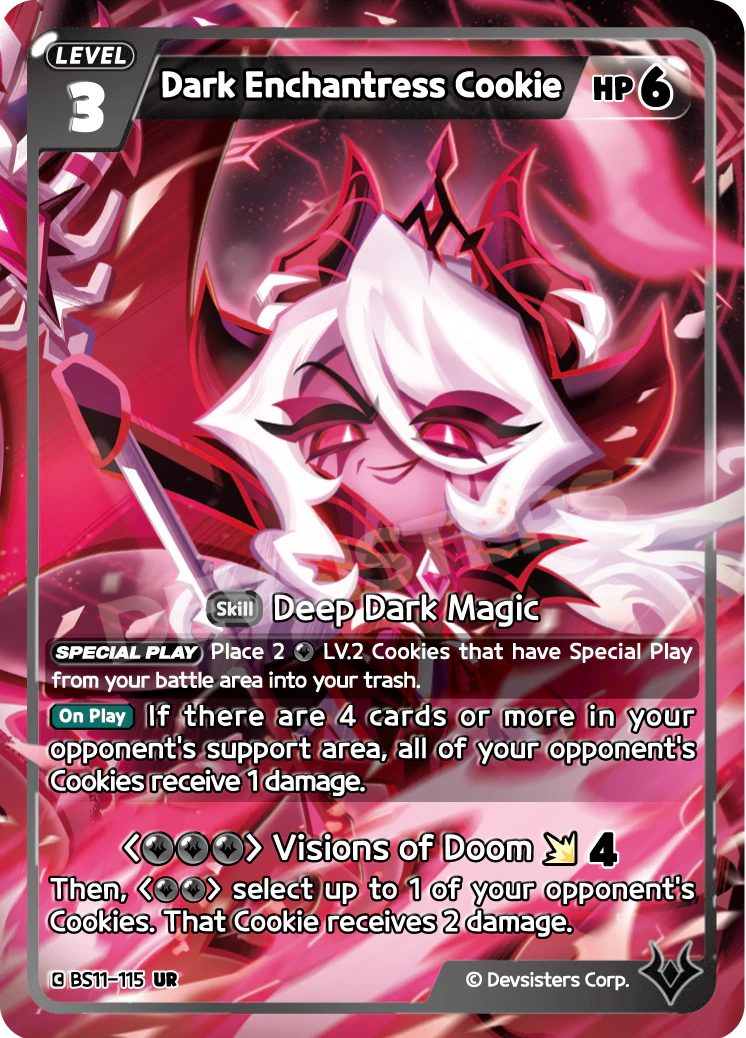
Best Legendary Cards in Cookie Run: Braverse (The Chase Pulls Actually Worth Playing)
There is no rarity called 'Legendary' in Cookie Run: Braverse - but the community uses the word for the top-rarity chase Cookies: the Beasts, the Ancients, and Dark Enchantress. Here's which are worth chasing to play, not just to collect.

How to Play Cookie Run: Braverse - A Complete Beginner Guide
Cookie Run: Braverse is the rare TCG you can teach in a single match. This guide covers everything a first-time player needs: card types, setup, turn structure, how you pay for cards, the FLIP mechanic, and how to win.

Best Cookie Run: Braverse Starter Deck for Beginners (Ranked)
All five Cookie Run: Braverse Starter Decks are legal and ready to play - but they're not equally easy to learn. Here's how we'd rank them for a brand-new player, and which one to grab first.