Cookie Run: Braverse Card Types Explained
The how-to-play guide gives you the speed-run. This is the deep dive: the four card types the rulebook defines, the seven labels the official database files cards under, what each one actually does, and how to think about each in your deck.

If you've read how to play Cookie Run: Braverse, you got the speed-run: here are the card types, here's how a turn goes, now play. This guide is the slower, deeper pass - the one that turns "I know what the cards are called" into "I know what each card type is for and how to use it." Understanding the card types properly is the difference between a beginner who reads each card cold and a player who already knows what to expect from a face-down Trap.
One thing to get right up front, because guides (including an earlier version of this one) keep muddling it: the Comprehensive Rules define exactly four card types - "There are four types of cards: Cookie cards, Item cards, Trap cards, and Stage cards" (section 2-2-2, Ver.1.8). But the official card database files its ~2,000 entries under seven labels: those four plus FLIP, EXTRA, and NPC. The extra three are real, useful categories - FLIP marks cards whose whole job is a flip effect (the rules classify FLIP as part of a card's card text, not a type), EXTRA marks the conditional payoff Cookies tied to the EXTRA deck zone, and NPC is a database label that appears nowhere in the rules document at all. This guide walks all seven labels, because that's how you'll actually encounter cards - just don't tell a judge there are seven card types.
A quick discipline note, because Braverse is a young game and a few exact rules - especially FLIP trigger timing and how Traps are set - aren't pinned down consistently across community sources. Where a specific ruling matters, confirm it against the official rulebook before a sanctioned event, and don't quote an edge-case ruling to a judge from memory.
Four rule types, seven database labels
The rulebook's four types are Cookie, Item, Trap, and Stage. The database adds FLIP, EXTRA, and NPC as filing labels. Here's the cheat sheet before we go deep on each:
| Card type | Role | When it acts |
|---|---|---|
| Cookie | Your fighters; the only cards that attack and hold HP | On the board, across turns |
| FLIP | Cards built to live in an HP stack and fire when flipped | When damage flips them face-up |
| Item | One-shot effects | When you play them |
| Trap | Reactive effects, set face-down | Triggered by a condition, often on the opponent's turn |
| Stage | Persistent battlefield effects | Continuously, while in play |
| EXTRA | High-impact Cookies gated behind a board-state condition | When you play them, if the condition is met |
| NPC | A database-only label (only three cards exist) | When you play them |
That's the full set of labels. The big mental adjustment from other TCGs is that FLIP isn't an afterthought - the rules file it under card text rather than making it a type, but it commands its own slice of the card pool, which is why it gets its own section right after Cookies instead of being tacked on at the end.
Cookie cards: the stars of the game
Everything in Braverse revolves around Cookies. They're the only cards that:
- Attack and trade in the Battle Area.
- Hold HP - a Cookie's hit points are a stack of cards placed face-down beneath it from your deck.
- Win the game - you win by filling the opponent's Break Area to a combined Cookie Level of 10, or by leaving them with no Cookie to replace an empty Battle Area.
Every legal deck must contain at least one Cookie, and in practice Cookies are the largest share of any deck. A Cookie card carries a Level (which feeds both win conditions and curve), a cost (paid by resting Support cards), an attack value, and usually a skill. When a Cookie's HP stack is exhausted and it faints, it goes to the Break Area - and its Level counts toward your opponent's win.
There are also special Cookie variants. Dragon Cookies were reportedly introduced in the Operation Timeguard set and appear as starter headliners (Pitaya Dragon, Longan Dragon, Lotus Dragon in the Arena of Glory wave). Purple's Dark Cacao Cookie anchors a trash-based "Awakening" strategy. These variants follow the Cookie rules but carry extra mechanics. The names are well-established, but the specific rules for Dragon Cookies and the Awakening mechanic are worth confirming against the official rulebook before a sanctioned event.
The mental model: Cookies are your board and your clock. Every other card type exists to make your Cookies better or your opponent's Cookies worse.
FLIP cards: the HP-stack layer

This is the layer that makes Braverse feel unlike any other TCG, and it's the one beginner guides most often get wrong. In the rulebook's terms, FLIP is card text, not a card type - "FLIP is part of a card's card text" (section 2-8-2) - but the official database files over 250 dedicated FLIP cards under their own label - more than any of Item, Trap, or Stage individually. And FLIP also exists as an ability that some ordinary Cookies carry. All of that is real, and keeping it straight is the whole trick.
A Cookie's HP isn't a number - it's a face-down stack of cards from your deck, placed beneath it. As the Cookie takes damage, those cards flip face-up one at a time. When a flipped card has a flip effect, that effect triggers right then, mid-combat, for the defender. So attacking a Cookie isn't pure upside: you might be the one setting off the defender's tucked-away effect.
The two ways a flip effect gets into your HP stack:
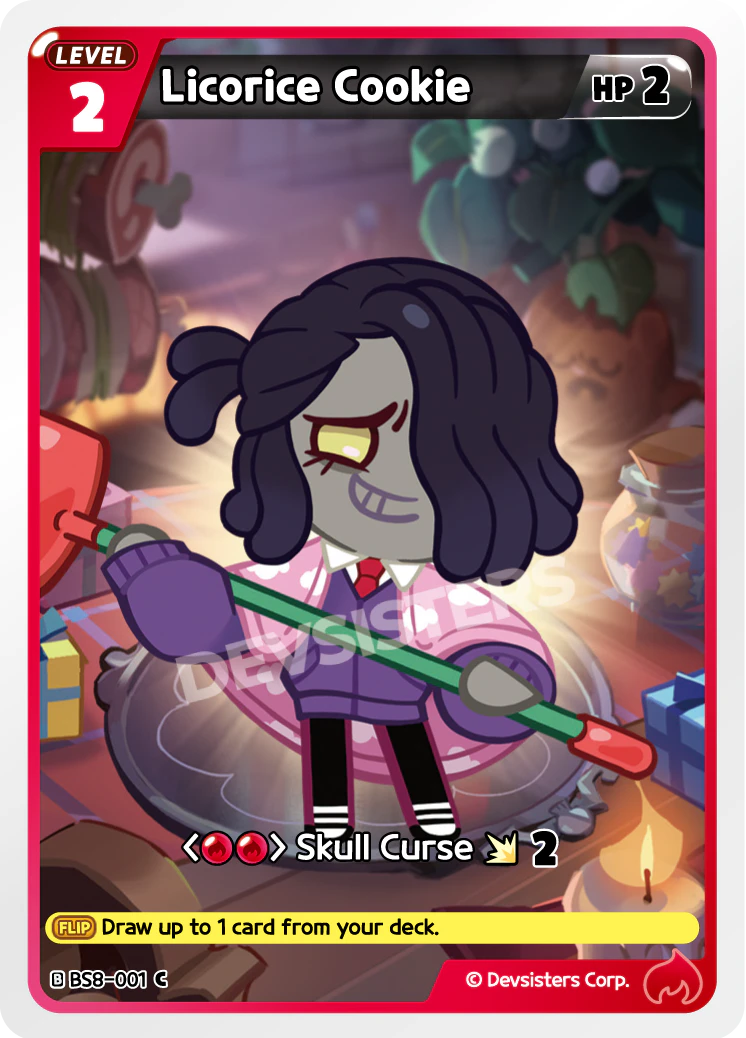
- Dedicated FLIP-type cards. Licorice Cookie (BS8-001, a Red FLIP-type card) carries the flip effect "Draw up to 1 card from your deck." Its whole reason to exist is to sit in an HP stack and pay you off when it flips. There are over 240 cards like it.
- Regular Cookies that also have a flip ability. Sorbet Shark Cookie (BS5-074) is a Blue Cookie - it attacks and holds HP like any Cookie - but it also carries the flip ability "Draw up to 1 card from your deck." So it does its normal Cookie job on the board and also fires that effect if it ends up buried in someone's HP stack.
That's why "what type is this card?" is only half the question in Braverse. The other half is "does it have a flip ability, and where is it right now?" For the full breakdown - exact trigger timing, deckbuilding, and the misplays that lose games - see the dedicated FLIP mechanic guide.
The deckbuilding lever: you can run up to 16 cards with a flip ability, counting both dedicated FLIP-type cards and flip-carrying Cookies. A deck near that cap turns every HP stack into a minefield. The 16-card cap is well-corroborated; the precise timing of a flip trigger relative to the rest of combat is the most-cited rules ambiguity in the game, so confirm it against the official rulebook before a sanctioned event.
Practical takeaway: when you attack, you're gambling that the defender's HP stack won't punish you. When you defend, FLIP cards are how you make attacking you a bad idea.
Item cards: your instant effects

Items are your one-shot effects - the cards you play for an immediate impact and then they're done. Think of them as the "spell" layer in most TCGs. A typical Item does something like push extra damage, remove or weaken an opposing Cookie, draw or cycle cards, or buff one of your Cookies for a turn.
Because Braverse resources ramp slowly (one Support card per turn), Items compete directly with Cookies for your limited resources. The skill is knowing when an Item's tempo swing is worth spending a turn's resources that aren't going onto the board. Aggressive decks want cheap, damage-pushing Items; control and combo decks want Items that generate card advantage or set up a payoff. The exact timing windows in which Items can be played are worth confirming against the official rulebook before a sanctioned event.
Trap cards: the reactive layer
Traps are the game's reactive layer. You set them face-down ahead of time, and they trigger when a condition is met - frequently on your opponent's turn, punishing them for an attack or a play they were going to make anyway. They're the "gotcha" cards, and they're what make a face-down card on the other side of the table something to respect.
The strategic value of a Trap is information warfare: a set Trap forces your opponent to play around something that might not even be there. Even a bluffed empty zone changes how the opponent attacks. The cost is tempo - you're spending resources on a card that does nothing until its condition fires, and a dead Trap is a wasted card.
Traps reward reading the opponent. The best Trap is one you set when you can predict what they'll do next turn - so it's almost guaranteed to fire.
The reactive, face-down nature of Traps is well-corroborated, but the mechanical specifics - exactly how they're set, what zone they occupy, and the precise timing of their triggers - are worth confirming against the official rulebook before a sanctioned event.
Stage cards: the persistent layer
Stages are the persistent layer - cards that stay in play and apply a continuous effect rather than resolving once. Where an Item is a single swing and a Trap is a single reaction, a Stage keeps working every turn it remains on the table.
Stages are typically build-around or value cards: a passive damage buff, an ongoing resource benefit, or a static rule change that nudges the whole game in your favor. Because their value compounds the longer they stick, they fit slower decks better than aggro - a Stage that pays off over five turns is worth more to a control or ramp deck than to a Red deck trying to end the game in four. How many Stages can be in play at once, and whether they can be removed, are details worth confirming against the official rulebook before a sanctioned event.
EXTRA cards: the conditional payoffs
EXTRA is the label most beginner guides forget exists - the database lists 42 of them as of August 2026 - and they're worth knowing because they're some of the most powerful cards in the game. In the rulebook's terms an EXTRA card is a Cookie card: the Comprehensive Rules define the EXTRA deck as "a deck containing EXTRA Cookie cards and Awakened Cookie cards" (5-1-1-5), played from that separate face-down deck once their requirement is fulfilled. Practically, it's a high-impact Cookie locked behind a condition: you can only play it once a specific board state is true, and in exchange the effect is well above curve.
The condition is the whole identity. Will of Nature (BS8-090, a Blue EXTRA) can only be played if you have two cards or fewer in hand - it rewards the empty-handed, top-decking style Blue likes. Jagae Cookie (BS10-098, Blue) flips that: you can play it if you have seven cards or more in hand, by discarding two. Dark Cacao Cookie (BS8-104, Purple) is the trash-fueled Awakening payoff - it can be played from your trash and Awakened, anchoring Purple's graveyard strategy. There's also a full cycle of EXTRA boss Cookies like Shadow Milk Cookie across multiple colors, each with its own brutal condition.
The strategic point: EXTRA cards aren't free. You build toward their condition - dumping your hand, filling your trash, fainting your own Cookies - and the payoff is a haymaker your opponent can see coming but can't easily stop. They reward decks built around a plan, not a pile of good cards.
The mental model: an EXTRA is a Cookie with a price of admission. Pay the board-state cost, and you get an effect no normal Cookie of that Level would be allowed to have.
NPC cards: the rare special type
NPC is the rarest type on the list - the official database holds just three NPC cards (the BS6 set's Yellow "TBD" trio, BS6-028 through BS6-030). They function like small support Cookies with an On Play effect: one draws a card if your Break Area is stocked, one buffs a Cookie's HP, one draws based on the Cookies in your Break Area.
You don't build a deck around NPCs, and you may never see one in casual play. Worth knowing: the string "NPC" does not appear anywhere in the Comprehensive Rules - it's purely a database label for these three oddballs, which play by the normal card rules. They exist mostly as set flavor, and they're here for completeness. Treat it as trivia, not a deckbuilding pillar.
How the card types work together
A good Braverse deck isn't a pile of card types - it's a system. Here's the interplay:
- Cookies are the board and the win condition.
- FLIP cards turn your HP stacks into a second defensive layer that hits back.
- Items create the tempo swings that win individual combats.
- Traps tax the opponent's turn and protect your board.
- Stages generate compounding value for the long game.
- EXTRA cards are the haymaker payoffs you build your whole plan toward.
- NPC cards barely register - a rare bit of set flavor you'll seldom touch.
Your color and archetype decide the mix. Red aggro leans Cookie-and-Item heavy with early-relevant FLIP. Yellow control wants more Traps, Stages, and value Items. Purple builds toward its EXTRA Awakening payoffs out of the trash. See deck archetypes for how each color weights these.
How many of each belong in a deck
There's no universal ratio, but here's a sane starting frame for a 60-card deck. Tune from your archetype, not from this table.
| Card type | Rough share | Notes |
|---|---|---|
| Cookies | The majority | Your board and clock; at least one is mandatory, in practice many |
| FLIP cards | Up to 16 (the cap) | An overlapping axis - counts dedicated FLIP cards and flip-carrying Cookies |
| Items | A solid secondary block | Tempo and reach; aggro wants cheap ones |
| Traps | A focused set | More in reactive/control decks, fewer in aggro |
| Stages | A small number | Build-arounds; value compounds, so slower decks want more |
| EXTRA | A few payoffs | Only if your deck builds toward their condition; pure top-end |
| NPC | Effectively none | A database-only label; not a deckbuilding consideration |
A wrinkle worth repeating: FLIP overlaps with the Cookie type. A dedicated FLIP-type card occupies its own slot, but a flip-carrying Cookie (like Sorbet Shark Cookie) counts as both a Cookie in your board math and one of your up-to-16 flip cards. So the 16-flip cap is a constraint layered on top of your type mix, not a separate slice of the pie. These deck-construction limits - 60 cards, four copies max of a card number, at least one Cookie, up to 16 flip cards - are well-corroborated, but confirm them against the official rulebook before a sanctioned event. For the full ratio discussion, see deck-building basics.
Quick Action Checklist
- Know the split - the rulebook defines four card types (Cookie, Item, Trap, Stage); the database adds FLIP, EXTRA, and NPC as filing labels.
- Build around Cookies first - they're your board, your HP, and your win condition. Everything else supports them.
- Treat FLIP as a pillar, not a footnote - the rules call it card text, but it's the second-largest slice of the card pool and the reason combat carries risk.
- Treat Items as tempo - only spend a turn's resources on one when the swing beats developing a Cookie.
- Use Traps to tax the opponent's turn - set them when you can predict the play that triggers them.
- Save Stages for slower decks - their value compounds, so aggro usually wants fewer.
- Build toward your EXTRA condition - they're haymakers, but only if your deck sets up the board state they demand.
- Mind the 16-flip cap - it counts dedicated FLIP cards and flip-carrying Cookies alike, layered on top of your type mix.
- Confirm edge-case rules - FLIP timing and Trap triggers are the most ambiguous; check the official rulebook before a sanctioned game.
Frequently Asked Questions
How many card types are in Cookie Run: Braverse?
Is FLIP a card type or just an ability in Braverse?
How is a Trap card different from an Item in Braverse?
What does a Stage card do in Braverse?
What is an EXTRA card in Braverse?
How many of each card type should my deck have?
Are Dragon Cookies a separate card type?
Keep Reading
Related Guides
Cookie Run: Braverse Glossary: Every Term Explained
Every Cookie Run: Braverse term in one place, defined plainly and consistently with our rules guides. Play areas, the card types, FLIP, the five colors, energy, Level, rarities, and keywords like Arena, Ancient, Beast, and Dragon.
The FLIP Mechanic in Cookie Run: Braverse, Explained
FLIP is the mechanic that makes Braverse feel unlike any other TCG: a Cookie's HP can fight back. Here's exactly what FLIP is, when it triggers, and the misplays that lose games.
Cookie Run: Braverse Win Conditions Explained
Braverse has two ways to win, and most new players only play toward one. Here's how the Break Area Level-10 path and the no-Cookie-to-deploy path actually work, how to build a deck that threatens both, and the on-board signs that tell you which one you're winning.
How to Read a Cookie Run: Braverse Card
Almost every element printed on a Braverse card face maps to a field in the official database. Here is the whole card decoded - the Level badge, the colored keyword pills, the attack line, the regulation letter - checked against all 2,093 entries.
How to Play Cookie Run: Braverse - A Complete Beginner Guide
Cookie Run: Braverse is the rare TCG you can teach in a single match. This guide covers everything a first-time player needs: card types, setup, turn structure, how you pay for cards, the FLIP mechanic, and how to win.
Cookie Run: Braverse Meta Tier List — Best Decks & Archetypes Ranked
Which Cookie Run: Braverse decks are actually carrying right now? Here's a meta tier list of the strongest archetypes - the real cards that anchor each one, why they rank where they do, and what's overrated.