Gundam Card Game Tournament Rules - BO3, Bans, Time Limits
Bandai has two live documents that disagree about whether the Gundam Card Game has a sideboard. It does now, and it is exactly 10 cards. This is the whole competitive rules layer - deck legality, match clocks, extra turns, the Swiss round table, tiebreaker maths, deck-check penalties, and the current banned list with the banned-pair category Bandai introduced in July 2026 - read off Bandai's own PDFs and rules pages.

Bandai has two rules documents live on the same website that flatly disagree about whether the Gundam Card Game has a sideboard.
Section 2.4 of the Organized Play Tournament Rules Manual says, in five words, "No side decks are permitted." The BO3 Match Rules page, updated 3 July 2026, tells you to build exactly 10 sideboard cards. The banned and restricted list, effective 24 July 2026, counts copies "in your deck and your sideboard combined."
The newer pages win. But nobody at your first Regional is going to explain that to you, and that is the shape of this entire rules layer: the answers exist, they are official, and they are scattered across a 46-page manual, a 10-page floor-rules PDF and five separate news posts. Here is all of it in one place.
The sideboard rule that contradicts itself
Best of Three is where the sideboard lives. Bandai's BO3 page defines the format as up to three one-on-one games inside a 60-minute limit, first to two game wins takes the match.
The sideboard rules attached to it:
- Exactly 10 cards, kept separate from your main deck.
- You may swap sideboard cards for main-deck cards between games, and that swapping time counts against the 60 minutes.
- Up to four copies of a card number across your main deck and sideboard combined - the sideboard does not give you a fifth copy of anything.
- The two-colour cap applies across main deck and sideboard together.
- Your main deck must be exactly 50 cards during every game, and must be returned to its originally presented state after the match ends and before the next one begins.
- The sideboard sits face down away from the centre of the table. Its contents are private; its card count is public, and your opponent may check that count whenever they like.
Player One and Player Two are decided randomly for game one. For games two and three, the player who lost the previous game chooses who goes first. Given how much the Gundam Card Game's turn structure rewards Player Two's EX Resource token, that is a real consolation prize.
The 10-card sideboard is not a bonus 10 cards of deck space. Because the four-copy cap spans deck plus sideboard, every sideboard slot you spend on a fifth Zaku is a slot you cannot legally fill. Sideboards here are answer cards, not redundancy.
If you built your list against our Gundam deckbuilding guide, the sideboard is the piece that changed after it was written. Anyone coming from Magic's sideboarding conventions should note the differences: fixed size rather than "up to", no swapping mid-game, and a hard reset between matches.
What counts as a legal tournament deck
Section 2.4 of the Tournament Rules Manual is the checklist judges actually use.
| Requirement | Rule |
|---|---|
| Main deck | Exactly 50 cards: Unit, Pilot, Command and Base only |
| Resource deck | Exactly 10 Resource cards |
| Colours | Up to two of red, blue, green, white, purple. A third colour is illegal |
| Copies | No more than four cards sharing a card number |
| Tokens | Every token your registered deck needs |
| Sleeves | Fully opaque, identical in colour, wear and design, all facing the same way |
The sleeve rules go further than most players expect. You may double-sleeve, up to two sleeves per card. Reflective backs and holographic fronts are banned outright. Resource cards and tokens must be sleeved in a way that visibly differentiates them from the main deck - clear sleeves, a different colour, or unsleeved - and if you do put opaque sleeves on them, the deck, resource deck and tokens each need their own distinct sleeves.
Three card-legality rules that catch people out:
- Altered cards are dead. Marked, signed, painted, stamped or graded and slabbed cards cannot be used in official events. Your signed Amuro stays home.
- English only in the West. Players in North America, Latin America, Europe and Oceania must use English-language cards for the main deck. Resource and token cards may be any language, anywhere.
- Seven-day quarantine on new cards. Cards released less than seven days before the event cannot be played at Premier-level events. The floor rules name Newtype Challenges and Championship events specifically. Cards carrying the same card number as an older printing are exempt, so a new alternate art of an old card is fine.
GUNDAM ASSEMBLE, the miniature Gunpla, may be placed on top of an appropriate token card. Using one instead of a token card is not allowed, and individual stores may ban them entirely.
The match clock and what happens when time is called
Section 3.5 sets four different clocks depending on where you are in the event.
| Match structure | Games to win | Match time | Extra time |
|---|---|---|---|
| Standard qualifying (best-of-one) | 1 | 30 minutes | 5 minutes |
| Online standard (best-of-one) | 1 | 35 minutes | 5 minutes |
| Top cut finals (best-of-three) | 2 | 60 minutes | 10 minutes |
| Championship top 2 (best-of-three) | 2 | No time limit | - |
Professional-level events are meant to run best-of-one through qualifying and switch to best-of-three for top cut. So the sideboard you spent a week tuning does not exist until you make cut.
When time is called mid-game, the procedure is fixed and worth memorising, because it decides more matches than you would think:
- Whoever has more game wins takes the match.
- If tied, the current active player finishes their turn. That is turn 0. If time expired on the designated first player's turn, play three more turns. If it expired on the second player's turn, play two more.
- Still nobody won? The player with more cards in their shield area - Base plus Shields - wins.
- Still tied? More cards left in deck wins.
- Still tied? Double game loss.
Extra turns get their own five-minute cap. If that expires while an attack is in progress, you finish the attack through the Battle End Step; a pending effect resolves and then play cuts off at the end of the Main Phase.
Single elimination adds two more tiebreakers after the deck count, because draws are not allowed there: more Units in your battle area wins, and failing that, the player who most recently removed a card from their own shield area wins.
That step-3 tiebreaker is a strategy instruction dressed as an administrative rule. In a match that is visibly going to time, your EX Base and your remaining shields are worth more than board presence. Six shields and a Base is seven cards in the shield area, and seven beats a wide board every time the clock beats you.
The sanctioned floor-rules PDF adds a blunter line for events with a hard finish time: if the scheduled end of the event arrives and no winner has been determined, both players lose.
How Swiss rounds and tiebreakers work
Round count comes off a table in section 3.6, and Bandai's own column headings carry two qualifiers most players read straight past.
| Number of participants | Expected number of Swiss rounds | Players qualifying for top cut (if applicable) |
|---|---|---|
| 4 - 8 | 3 rounds | None |
| 9 - 16 | 4 rounds | Top 2 |
| 17 - 32 | 5 rounds | Top 4 |
| 33 - 64 | 6 rounds | Top 8 |
| 65 - 128 | 7 rounds | Top 8 |
| 129 - 256 | 8 rounds | Top 16 |
| 257 - 512 | 9 rounds | Top 16 |
| 513 - 1024 | 10 rounds | Top 32 |
| 1025 - 2048 | 11 rounds | Top 32 |
"Expected" is doing work. An organiser may announce a variable range instead of a fixed number, so long as the criteria for ending the event come with it - Bandai's worked example is a 205-player Championship-level event announcing "6 to 8 rounds of qualifying", ending once one undefeated player is left. Note that 205 sits in the 129 - 256 row, which expects 8, the top of that announced range. And "if applicable" is doing the same work in the other column: an organiser may run no top cut at all, provided that is advertised before the event starts. What an organiser cannot do is move the number afterwards. The round count must be announced before the first round begins, and once announced it cannot be changed.
Wins and byes are worth 3 match points, draws 1, losses 0. Once the field is down to a single undefeated player, qualifying ends early and placements are calculated. Late entries added after registration closes do not change the round count or the top cut size.
Ties on points break on your own average match win rate excluding byes, then on your opponents' average match win rate. Any value below 0.33 is treated as 0.33, which is the floor that stops a 0-4 opponent from destroying your tiebreakers entirely. Top cut seeds pair 1v8, 2v7, 3v6, 4v5.
Two deadlines nobody tells you about. Win/loss records cannot be corrected once a second subsequent round has been paired - round 2 results are frozen the moment round 4 is paired, so check the posted standings every round. And in top cut, the player with the higher Swiss standing chooses who goes first in game one, not the random method you used all day.
Intentional draws are explicitly banned. So is agreeing on a result, playing to a draw on purpose, or conceding for anything of value. Bribery gets both players disqualified.
The banned list and the new banned pairs
The current framework took effect 24 July 2026, Bandai's list page was last dated 25 September 2026, and it is short but structurally strange.
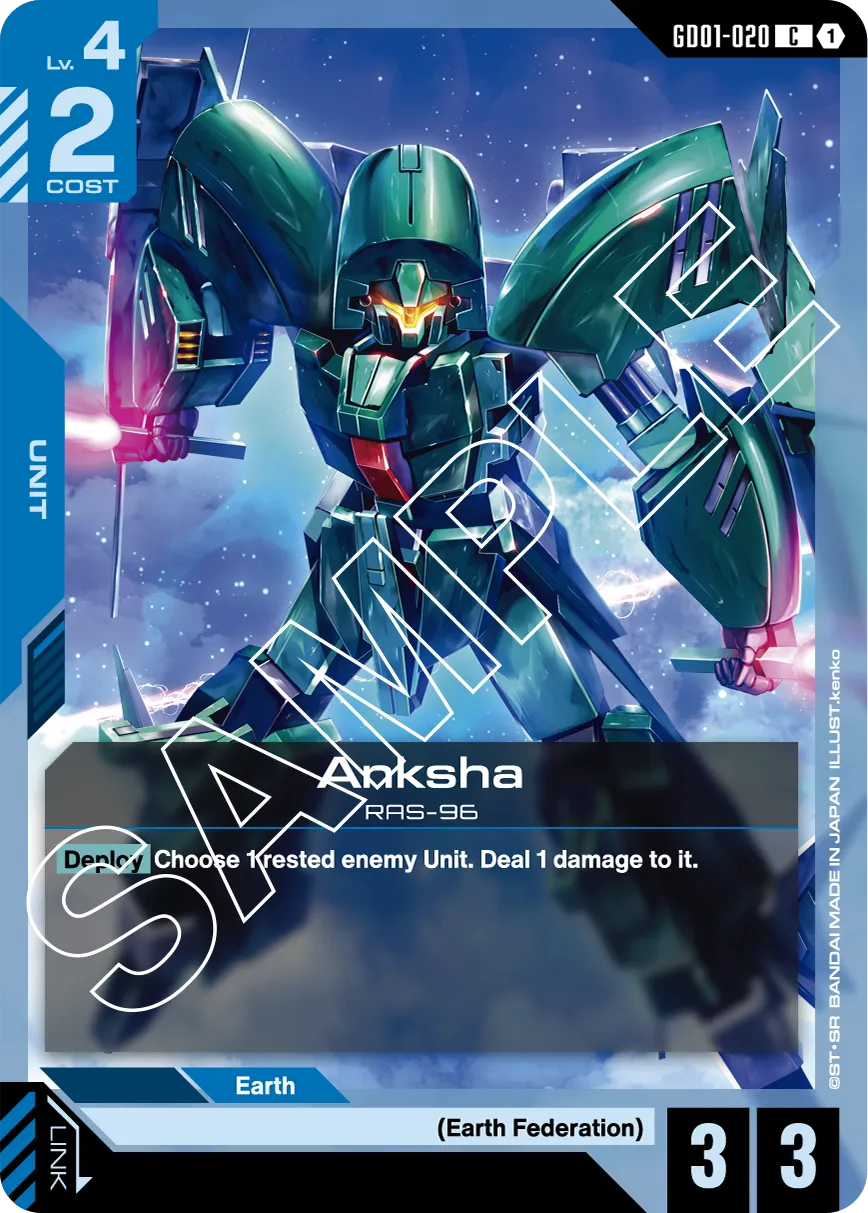
Banned outright: GD01-020 Anksha. One card. Bandai's stated reasoning is that blue-purple decks leaning on Anksha plus purple direct damage to enemy Units had a standout win rate.
Restricted (2): ST02-016 Corsica Base. Two copies maximum across deck and sideboard combined.
Banned pairs are the new category introduced with this update, and they are the interesting part. Rather than killing a card, Bandai forbids two specific cards from appearing in the same list:
| Card A | Card B |
|---|---|
| GD01-008 Guntank | GD05-015 M1 Astray Shrike |
| ST01-010 Amuro Ray | ST05-010 Mikazuki Augus |
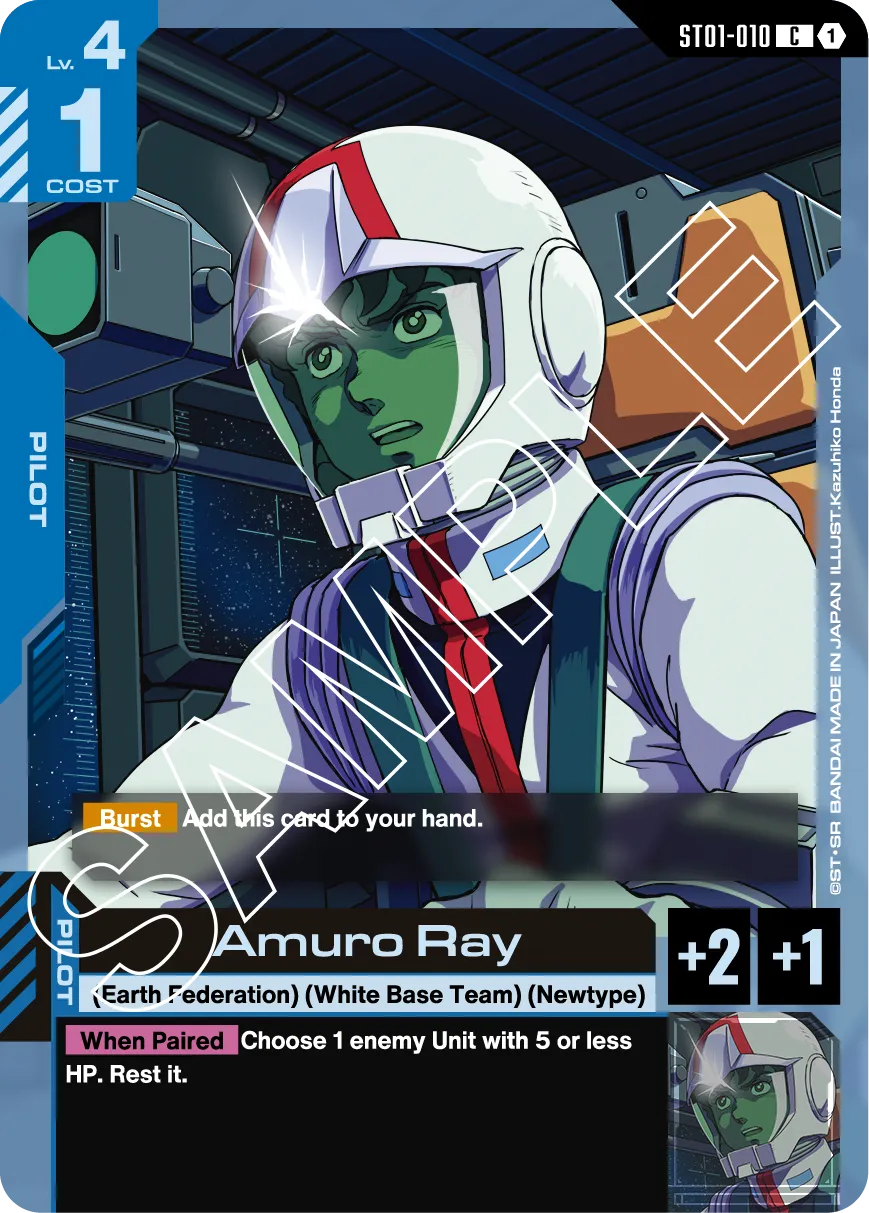
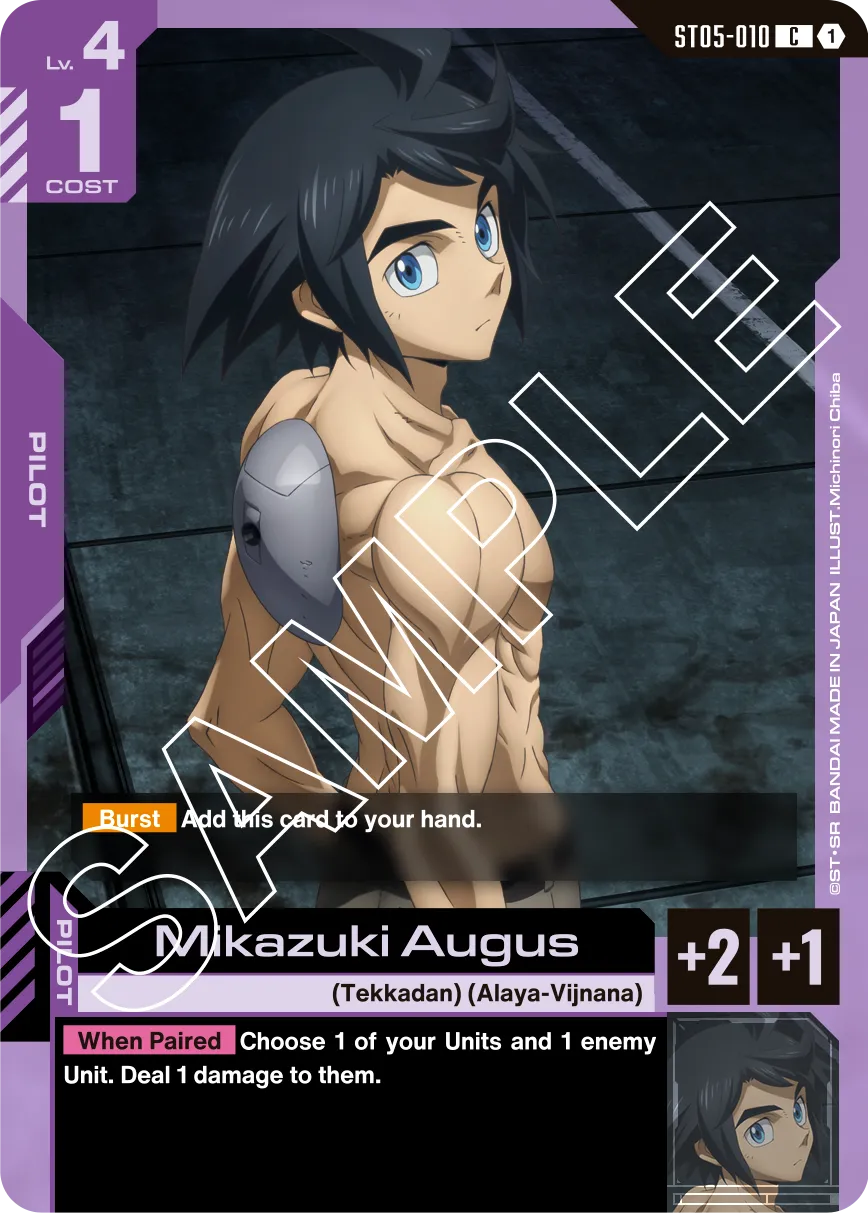
Then comes the clause that reshapes low-curve deckbuilding. Every Unit card that is Lv. 2, cost 1, 2 AP, 2 HP and has no effects is treated as a banned pair with every other card matching that description. Bandai's list page, dated 25 September 2026, names 22 of them - GD01-035 Zaku II through GD05-077 Leo on the booster side and ST01-005 GM through ST12-010 Slash Zaku Phantom on the starter side, nine of the 22 being starter-deck units. The July announcement had named 20; the two added since are both starter-deck cards, ST11-008 Daughseat from Aquatic Assault and ST12-010 Slash Zaku Phantom from Raging Onslaught. Bandai also stated that matching cards printed in GD05 and after join the banned-pair listing automatically at release.
In practice: you may play up to four copies of one vanilla 2/1/2/2 Unit, and zero copies of any other. The reasoning Bandai gave is that decks flooding the board with cheap bodies to break shields fast were producing games their opponents had no answer to - a direct consequence of the six-shields-at-1-HP defensive layer, where a 2 AP Unit and a 6 AP Unit break exactly the same number of shields.
Two footnotes that matter. The ST05 Iron Bloom starter deck contains two cards matching the description, and Bandai confirmed it stays tournament legal so long as you play it unmodified. And Bandai openly stated it is examining "a possible fundamental rule change" to address fast blue-purple and blue-green decks, calling this ban update a temporary rebalance - so treat the list as volatile and check it before every event.
Deck lists and deck checks
Every Championship-level event requires a deck list. Local events may require one only if that was advertised beforehand.
The formatting rules are stricter than they sound. No shorthand. Every entry needs the card's collector number and its full name, legibly written or printed. Once submitted, you cannot alter it unless a judge asks you to.
Deck checks are supposed to hit at least 10 percent of decks over an event, always at the transition from Swiss to single elimination and randomly during Swiss. Judges check your deck against your list and assess card condition, sleeve condition, and your deck box - nothing that could be confused with a game element may live in there.
| Deck infraction | Penalty |
|---|---|
| Illegible or incomplete deck list | Warning |
| Wrong number of cards in deck or on list | Game Loss |
| Deck does not match submitted list | Game Loss |
| Illegal or unofficial cards in deck | Game Loss |
| Arriving 5 to 10 minutes late to a match | Game Loss |
| Arriving 10 or more minutes late | Match Loss |
A failed post-game deck check applies its Game Loss to your next round, so a check that catches a 49-card deck after you won still costs you. You are allowed to consult your deck list between matches to confirm you have restored your deck - but not between games inside a match.
Rules you will break by accident
The Tournament Rules Manual bans a pile of things that are legal in other card games.
- No notes. At all. Section 4.8 prohibits note taking at official Bandai Organized Play events, and you should not have paper or stationery near you during play.
- One exception: a printed copy of Bandai's official errata document. It must be unmarked, and judges or your opponent may ask to inspect it. Spending too long reading it is itself flagged as slow play.
- No pile shuffling. Checking or arranging cards while shuffling is banned, and the manual names pile shuffling specifically. Searches and shuffles should resolve inside a minute.
- No electronics during a match. Phones included. Smart watches need messaging disabled. No headphones.
- No eating or drinking at tournament tables, including between rounds.
- Both hands above the table, always, with your hand of cards angled so your opponent sees card backs.
- Shields must be spaced so the count is readable at a glance, on the opposite side of the play area from your deck and trash. Stacking them to hide how many you have left is an infraction.
- Rotate cards 90 or 180 degrees only. No custom layouts - you must follow the official play sheet's zones.
Then there is the communication rule that decides arguments: if your verbal statement contradicts the action you physically took, and the verbal statement is legal, the verbal statement overrules the action. Say "I attack the Gelgoog" and touch the wrong card, and the Gelgoog is what you attacked.
Know the knowledge split, too. Public and answerable truthfully on demand: hand size, cards left in both decks, the number and names of cards in each trash, shields remaining, damage counters in public zones, and what has been played this turn. Private and never to be revealed: main deck contents, shield contents, hand contents, and what was played on previous turns. Lying about public knowledge and volunteering private knowledge can both escalate to disqualification.
Formats and the ladder above your store
Bandai sanctions three tournament formats - Constructed, Sealed and Draft, the last drafted in pods of four - plus casual multiplayer modes with their own published rules.
| Format | Deck size | Colour limit | Copy limit |
|---|---|---|---|
| Constructed | 50 + 10 resource | Two colours | Four per card number |
| Sealed, booster-only (4 packs) | Exactly 30 | None | Unlimited |
| Sealed, starter + 4 packs | Exactly 50 | None | Unlimited |
| Team Battle (2v2) | 50 + 10 resource | Two colours | Four per card number |
| Battle Royale (3+ players) | 50 + 10 resource | Two colours | Four per card number |
Sealed is the format most worth trying early, because the colour cap and the four-copy cap both vanish, and card availability does the deckbuilding for you. If you have played Magic's Limited formats, the instincts carry. Team Battle rewrites more than it looks - teammates share one shield zone of eight cards placed alternately, a team caps at six Units total, and both players take their turns simultaneously - which puts it closer to Riftbound's 2v2 rules than to a normal doubles format.
The ladder itself has three levels. Level 1 Casual is store organized play. Level 2 Competitive covers Store Championships and special events. Level 3 Professional is the Championship series.
As of August 2026 that means Store Tournament 2026 Season 3 running 1 July to 30 September, and Newtype Challenge 2026 Mission 4 running 1 to 30 August, which Bandai pitches at intermediate and advanced players and recommends running as Swiss. Its prize structure is public: GD04-066 Unicorn Gundam (Awakened) to the winner, GD01-088 Banagher Links to upper ranks - top 6 at up to 32 players, top 9 at 33 to 48, top 12 at 49 to 64 - and GD04-117 Graceful Demeanor to everyone who shows up.
Store-event check, 31 August 2026: Newtype Challenge Mission 4 closed on 30 August. Store Tournament 2026 Season 3 still runs to 30 September, and Bandai has since listed a 1st Anniversary Event for 12 September to 31 October 2026. The manual, the floor rules and the BO3 page are unchanged since 24 July 2026. Banned-list check, 26 September 2026: Bandai's list page is now dated 25 September 2026 and names two more vanilla Units than the July announcement did - the banned-list section above reflects it.
Above that sits WORLD CHAMPIONSHIPS 26-27. Level 1 is Regionals plus Store Championships (North America and Europe only), split into two seasons, with Regionals Season 2 running August to December 2026. Level 2 Area Finals happen in winter 2026-2027. The Level 3 Grand Final is 13-14 March 2027, invite only.
Entry to store events runs through the BANDAI TCG+ app, with applications opening two weeks before an event. Bring government photo ID to anything with an age limit or an invitational structure - the manual lists it alongside your TCG+ account as a registration requirement. Every deck you build to climb this, from an ST starter out of the box upward, gets measured against the same 50-card, two-colour, four-copy wall.
Quick Action Checklist
- Build the 10-card sideboard for BO3, and remember the four-copy and two-colour caps span deck plus sideboard.
- Re-check the banned list before every event - only GD01-020 Anksha is fully banned, but the vanilla Lv.2 / cost 1 / 2 AP / 2 HP banned-pair clause silently grows with each new set (20 named cards in July 2026, 22 by 25 September 2026).
- Write deck lists with full card names and collector numbers, legibly, with no shorthand.
- Sleeve the main deck in matching opaque sleeves, and give the resource deck and tokens visibly different sleeving.
- Leave your phone, headphones, notepad, drinks and slabbed cards off the table.
- In a match heading for time, protect your shield area - Base plus Shields is tiebreaker number one.
- Check the posted standings every round; your record freezes two rounds after the fact.
Frequently Asked Questions
Does the Gundam Card Game have a sideboard?
What is banned in the Gundam Card Game right now?
What is a banned pair in the Gundam Card Game?
How long is a Gundam Card Game tournament match?
What happens when time is called in a Gundam Card Game match?
Do you need a deck list for a Gundam Card Game tournament?
Can you take notes during a Gundam Card Game tournament?
Keep Reading
- Bandai Organized Play Gundam Card Game Tournament Rules Manual (PDF)
- Gundam Card Game Sanctioned Tournament Floor Rules Ver. 1.1.0 (PDF)
- BO3 Match Rules - GUNDAM CARD GAME Official Website
- Current List of Banned / Restricted Cards (page dated 25 September 2026)
- Gundam Card Game Banned and Restricted Card List from July 2026 (announcement, 10 July 2026)
- WORLD CHAMPIONSHIPS 26-27 - Official Event Page
Related Guides
How to Qualify for the Gundam Card Game World Championships
Eleven of the 22 Season 2 Regionals on Bandai's World Championships 26-27 calendar have been played, and the rest run from 3 October to 20 December 2026. Here is every route to an Area Finals seat - the Top 16 invite, the Store Championship lottery and its attendance cliffs, the Last Chance Qualifiers in Orlando and London, the open finals in Latin America and Oceania - plus the one Regional that falls inside Stardust Trails' first week, and a Season 2 prize ladder that turns out to be one Zeong board handed out in pieces.
Gundam Card Game ST11-ST14 Decklists Are Not the Box
Two weeks ago, the closest thing to an ST11-ST14 decklist was a guess. On 25 September 2026 - the day the boxes actually reach shelves - Bandai posted all four, and none of them is the starter deck you can buy. Raging Onslaught keeps nine of its own sixteen cards; Silent Barrage keeps eight. I read all four lists against the card database, checked what got cut, what got imported, and the banned-list update Bandai posted the same day quietly targeting two of the new starters' own vanilla Units.
Can You Play the Gundam Card Game Online?
Bandai's free Gundam Card Game Teaching App has been on the App Store since June 2025, and nothing in its description or its eight updates describes playing another person. Here is what its two modes do, what it has and has not been updated with, and the webcam rules Bandai wrote into its Tournament Rules Manual for playing a real opponent online.
![The official Gundam Card Game Unit token T-029 Bit / Funnel from Silent Barrage [ST13]: a beige-framed token card showing purple, red-capped bit pods and magenta funnels firing white beams through a blue starfield, with the line This Unit can't be paired with a Pilot or attack, the Long-Range Weapon trait, and 2 AP and 2 HP along the bottom, under a SAMPLE watermark.](/images/blog/gundam-tcg/gundam-card-game-tokens-guide/gundam-t-029-bit-funnel-token-card.webp)
Gundam Card Game Tokens - All 29, and What to Bring
The English card database holds 29 Unit tokens and 32 deck cards that make them, and Bandai's own Aquatic Assault build needs three token cards from a different starter deck. Here is every token, every card that makes one, the six-copy rule, what three Bandai documents say about substitutes, and where the database gets its own tokens wrong.
How to Play the Gundam Card Game - Resources, Shields, Pilots, and the Six-Card Life Total
Your entire life total in the Gundam Card Game is six face-down cards with 1 HP each, plus a token base with 3 HP. This is the complete rules walkthrough - the separate resource deck, the Level and Cost split, setup, the five card types, pairing Pilots into Link Units, the five phases, and combat - checked line by line against Bandai's Comprehensive Rules Ver. 1.8.0.
Gundam Card Game Errata and Comprehensive Rules Updates
Bandai has corrected the text of three Gundam Card Game cards, and on 30 September 2026 its own card database still shows the uncorrected wording on all three. Here is each errata and what it changes at the table, plus a version-by-version account of the Comprehensive Rules from 1.0 to 1.9.0, built by comparing every archived English PDF against the next - including three rules the official changelog never lists.