Gundam Card Game Deckbuilding - The 50/10 Split, Colour Rules, and Why Level Is Your Real Curve
Every single one of the 119 Pilot cards in the Gundam Card Game costs exactly 1. That one fact tells you almost everything about how this game's curve works - and it is not the number most new players are building around. I pulled seven official Bandai decklists and the entire card database to work out what a legal, functional 50-card deck actually looks like: type ratios, colour splits, how many Pilots you need per linkable Unit, and the beginner mistakes the rules quietly punish.
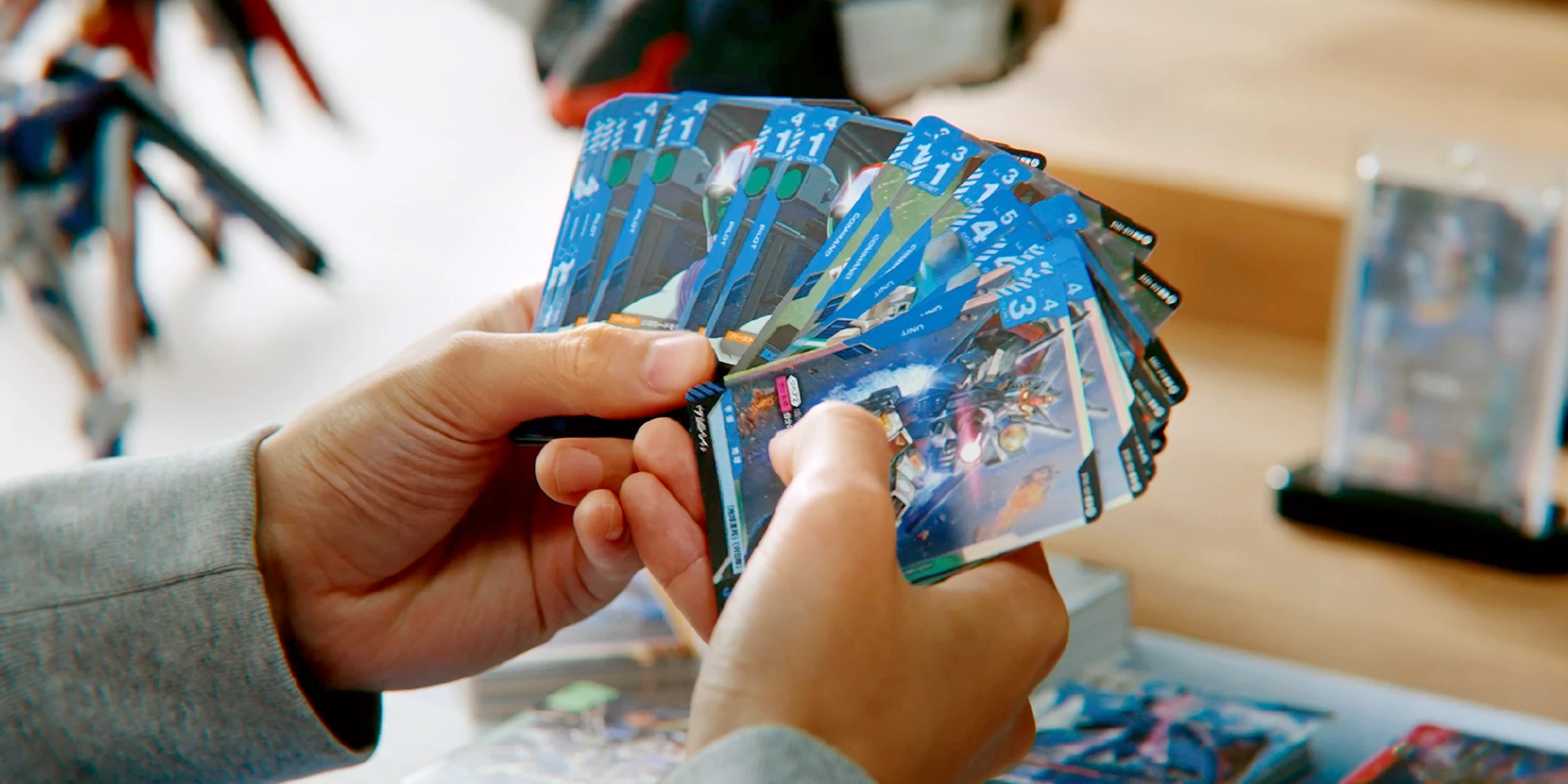
Every single Pilot card printed in the Gundam Card Game costs 1. All 119 of them. I filtered Bandai's own card database by card type and cost on 15 August 2026, and cost 1 returned every Pilot printing in the database while cost 2 through cost 8 each returned zero.
That is not trivia. It is the load-bearing fact of deckbuilding in this game, and it is invisible if you are building around the cost number - because the cost number on a Pilot never changes and therefore never tells you anything. The number that varies is Level, and Level is where your entire curve lives.
Most deckbuilding advice for a game this young is somebody's vibes. So this is built the other way round: from Bandai's Comprehensive Rules Ver. 1.8.0, the Tournament Rules Manual, the official banned and restricted list, and seven decklists that Bandai published themselves. Where I counted something, I say what I counted.
The number nobody builds around
If you have come from Magic or the Pokemon TCG, your instinct is to build a mana curve out of costs. Do that here and your deck will look fine on a spreadsheet and stall out on turn four.
Level and Cost are two separate checks on every card, and rule 2-9-1 defines Level as "the number of resources that are required when playing a card," satisfied when your resource count is equal to or greater than that number, with active or rested making no difference. Cost, by rule 2-10-1, is paid by resting that many active Resources.
So Level asks how deep into the game you are. Cost asks what you can afford this turn. They are almost never the same number.
I checked how often they diverge across those seven official decklists - 350 card copies in total. Only 10.3% of cards had Level equal to Cost. Nearly half, 47.7%, had Level exactly one higher than Cost, and another 25.4% were three or more higher.
| Level minus Cost | Card copies | Share |
|---|---|---|
| 0 | 36 | 10.3% |
| 1 | 167 | 47.7% |
| 2 | 58 | 16.6% |
| 3 | 67 | 19.1% |
| 4 | 14 | 4.0% |
| 5 | 8 | 2.3% |
Read the bottom four rows together: 42% of the cards Bandai puts in its own decks cost at least two fewer Resources than the Level they demand. You will hold those cards with the payment sitting right there and no legal way to play them. Build your curve on the left-hand number.
The rules you cannot argue with
Straight out of section 6-1 of the Comprehensive Rules, and repeated in section 2.4 of the Tournament Rules Manual:
- Your deck is exactly 50 cards. Not fifty or more. Exactly.
- Your resource deck is exactly 10 cards, all Resource cards.
- Your deck contains only Unit, Pilot, Command and Base cards.
- One or two card colours. The rules give the examples themselves: an all-red deck is legal, a green-and-white deck is legal.
- Up to four copies of cards sharing a card number.
- You bring one EX Base and one EX Resource token.
And one rule that changes how you think about the whole thing: for most of the day, you get no sideboard at all.
Bandai's two live documents disagree here, so be precise about which one applies to you. Section 2.4 of the Organized Play Tournament Rules Manual says "No side decks are permitted." The newer BO3 Match Rules page, updated 3 July 2026, defines a mandatory 10-card sideboard, and the banned list effective 24 July 2026 counts copies "in your deck and your sideboard combined." The newer pages win - but BO3 only applies to top cut. Professional events run best-of-one through the qualifying rounds, so every Swiss round you play is sideboard-free.
That is why the official lists lean so heavily on flexible, generically-good cards instead of narrow hate pieces. For the rounds that decide whether you make cut, your 50 cards face every deck in the room unchanged, and "I will just board into it" is not an argument you get to make. See the tournament rules guide for the full BO3 sideboard rules once you are in top cut.
Two more caps that quietly shape ratios: rule 4-5-4 allows at most six Units in your battle area, and rule 4-6-3 allows at most one Base in your base section. A seventh Unit forces you to trash one already there.
Colour is a wall, not a tax
Here is the part that trips up everyone with a Magic background, and it trips them in the opposite direction to what they expect.
Resource cards have no colour. Rule 2-4-2 says that with the exception of Resource cards and tokens, all cards have a colour - which means Resources do not. And rule 2-10-1 says you pay a cost by resting active Resources, full stop. No colour requirement, no fixing, no pips.
So splashing a second colour costs you nothing mechanically. There is no punishment for a 25/25 split, no untapped-land tax, no reason your green cards come down a turn late because you drew the wrong Resource. Every Resource pays for everything.
Which makes the two-colour rule a hard wall rather than a soft cost. You get two colours, you pick them once, and inside those two colours you are completely unconstrained. Compare that to Lorcana's ink system, where the resource itself is a card you sacrificed from hand - here the ramp is free and automatic, and the only real decision is which two colours you are allowed to draw from at all.
The five colours are blue, green, red, white and purple. Colour still matters for card text - plenty of cards reference colours - but it never gates payment.
One thing worth knowing before you build a colour pair around a Pilot: rule 2-4-3 states the colour of a Unit in the battle area is not affected by the colour of a card paired with it, and rule 3-3-7 says a Pilot's traits are not gained by the Unit it is paired with. You can pair a green Pilot to a blue Unit and the Unit stays blue with blue traits.
What Bandai's own decklists actually look like
I took the seven most recent decklists Bandai published on the official DECKS page - the five dated 24 July 2026 and two from 26 June 2026 - and counted every card by type. That is 350 card copies across seven legal 50-card decks.
| Card type | Total copies | Share | Average per deck |
|---|---|---|---|
| Unit | 215 | 61.4% | 30.7 |
| Pilot | 62 | 17.7% | 8.9 |
| Command | 44 | 12.6% | 6.3 |
| Base | 29 | 8.3% | 4.1 |
The spread is tighter than the averages suggest. Unit counts ran from 23 to 36. Pilot counts sat between 8 and 10 in every single deck. Base counts were 4 in six of the seven lists, and 5 in the seventh.
The other number that jumps out: these decks are not built from a wide card pool. Distinct card numbers per deck ran 13, 13, 13, 13, 15, 15 and 16. The Blue-White Orb list is thirteen distinct cards, twelve of them as four-ofs and one as a two-of. That is not a beginner simplification - it is how a 50-card deck with no Swiss-round sideboard and a guaranteed resource drop wants to be built. Consistency is the whole game when your ramp cannot fail.
Colour splits were lopsided more often than not. The seven decks ran secondary colours at 10, 14, 18, 19, 22, 22 and 18 cards - an average of about 18 out of 50. Given that splashing is mechanically free, that tells you the second colour is chosen for a specific package, not for general goodstuff.
Level is your curve, cost is your change
Across those same 350 copies, here is where the Levels landed:
| Level | Copies | Share |
|---|---|---|
| 1 | 6 | 1.7% |
| 2 | 43 | 12.3% |
| 3 | 79 | 22.6% |
| 4 | 113 | 32.3% |
| 5 | 41 | 11.7% |
| 6 | 30 | 8.6% |
| 7 | 20 | 5.7% |
| 8 | 16 | 4.6% |
| 9 | 2 | 0.6% |
Level 4 is the fat part of the curve by a wide margin, and it is not close. Roughly a third of every official deck cannot be played until you have four Resources on the table.
Now overlay the turn clock. Player One places one Resource per resource phase and has no EX Resource, so they have N Resources on turn N - Level 4 arrives on turn four. Player Two starts with an EX Resource token in their resource area (rule 6-2-4) and therefore hits four Resources a turn earlier.
Which makes turn four the pivot of the entire format, and it is worth doing the arithmetic on exactly what you can deploy there. With four Resources you can rest at most four of them. A Level 4 Unit costing 2, plus a Level 4 Pilot costing 1, is three Resources for a Link Unit that attacks the same turn. That is the play the curve is shaped around.
There is a trap buried in Player Two's advantage, though. Rule 5-17-3-2-3: when an EX Resource is used to pay a cost, it is removed from the game. Rule 2-9-4 counts EX Resources toward your Level. Spend it on turn one to squeeze out an extra deploy and your Level drops back by one - so you can genuinely delay your own Level 4 turn by cashing in the thing that was supposed to accelerate it.
Why every Pilot costs exactly 1
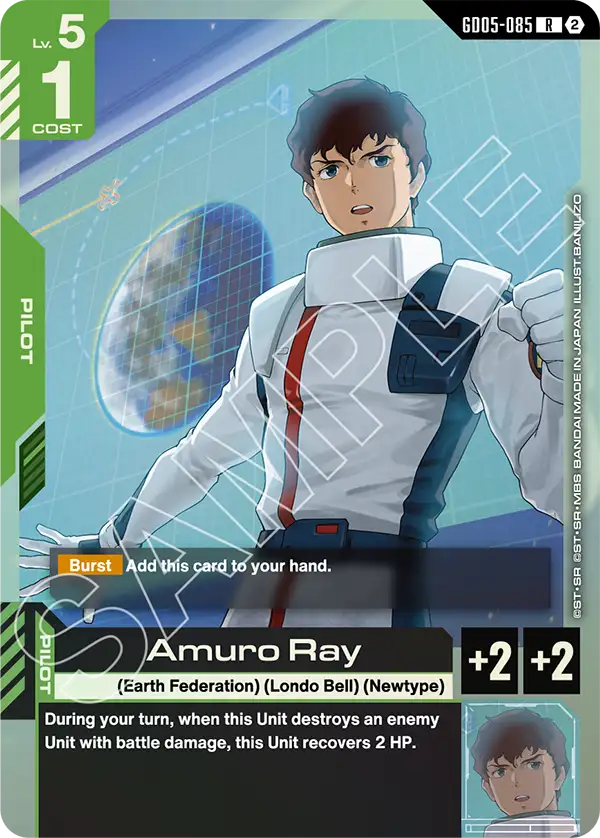
Back to the opening fact. All 119 Pilot cards cost 1. The design lever Bandai uses on Pilots is Level, and it uses it hard. Filtering the card database by Pilot and by each Level on 15 August 2026:
| Pilot level | Cards | Share of all Pilots |
|---|---|---|
| Lv. 2 | 1 | 0.8% |
| Lv. 3 | 37 | 31.1% |
| Lv. 4 | 65 | 54.6% |
| Lv. 5 | 14 | 11.8% |
| Lv. 6 | 2 | 1.7% |
No Pilot in the game is Level 1, and exactly one is Level 2. Sixty-eight percent of Pilots are Level 4 or higher.
So the practical statement is this: Pilots are always cheap and almost never early. You cannot build a curve that pairs on turn two, because the cards to do it barely exist. What you can do is make sure that when Level 4 arrives, you have both halves of a pairing in hand at once, which is precisely why the official lists run Pilots as four-ofs rather than singleton toolbox picks.
Compare that to Units, where cost does real work. Of the 560 Unit cards in the database, 221 cost 2, 127 cost 3 and 54 cost 1 - so your cheap plays and your resource-hungry finishers are both Units, and your Pilots are a flat 1 forever.
Pairing ratios, and how many Pilots is enough
Only Unit cards have link conditions (rule 2-12-2). Pair a Pilot that satisfies one and you get a Link Unit, which by rule 3-2-6-3 can attack the turn it is deployed instead of sitting there for a rotation. That is the payoff you are building toward.
In the seven official decks, 150 of the 215 Unit copies - 69.8% - carried a link condition. Against 62 Pilots, that is roughly 0.41 Pilots per linkable Unit, or about two Pilots for every five linkable Units. Nobody is trying to pair everything.
That ratio makes sense once you accept three constraints working together:
- A Unit can have at most one Pilot (rule 3-3-4).
- You cannot freely remove or swap a paired Pilot afterwards (rule 3-3-5).
- If the Unit dies, the Pilot goes to the trash with it (rule 3-3-6).
Pairing is a two-card investment in one target that your opponent can answer with one removal. Flooding on Pilots means holding cards that do nothing without a specific partner already on board.
Two details that decide whether your Pilots are live at all. First, link requirements check card names and traits, and rule 3-2-6-4 lets a bracketed name match on a substring - a Unit requiring Amuro Ray is satisfied by a Pilot whose card name contains that text. Second, Command cards with a Pilot effect on the lower half can be paired as a Pilot instead of being played as a Command (rule 3-4-6-2), which is the closest this game has to a flexible slot.
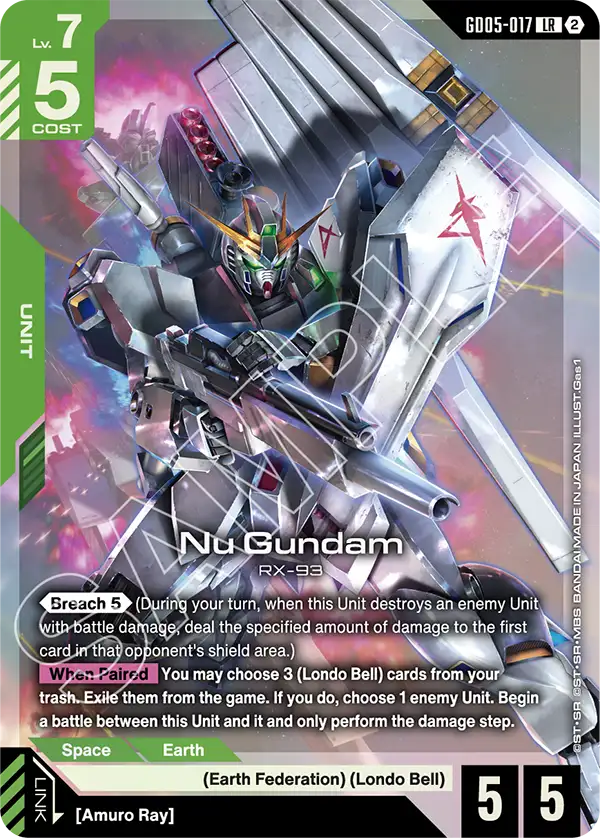
The Blue-Green Londo Bell list Bandai published is a clean demonstration of why the two-colour rule exists in the first place. It runs GD05-017 Nu Gundam, a green Level 7 Unit with the link requirement Amuro Ray - and then it runs both Amuro Ray Pilots, the blue ST01-010 at Level 4 and the green GD05-085 at Level 5. The deck is blue-green specifically so it can hold two different versions of the same Pilot for the same Unit. That is a colour pair chosen for a package, not for a colour identity.
The resource deck has no decisions in it
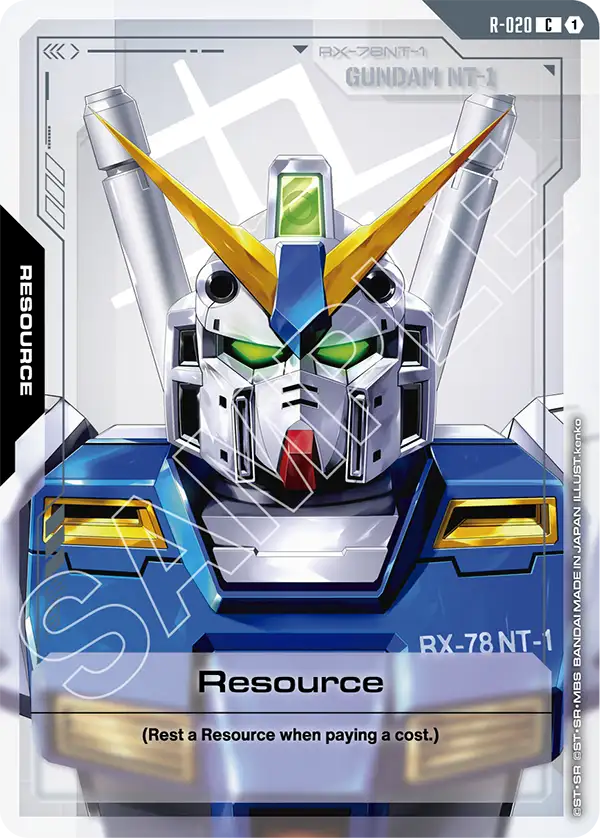
I want to save you some time here, because "10-card resource deck" sounds like a deckbuilding puzzle and it is not one.
Every Resource card in the database has the same name - Resource - no Level, no Cost, no colour, no trait, and the only text on the card is the parenthetical note that you rest a Resource when paying a cost. Rule 2-11-4 says text in parentheses is explanatory and has no influence on the game. The card numbers R-001 through R-041, plus the RP-numbered parallel versions, are art variants. Different mobile suits on the front, identical function.
Rule 6-1-1-5 permits any number of Resource cards with the same card number in a resource deck. So ten copies of whichever art you like is legal and optimal, because there is no other option that differs.
The only resource-side numbers worth remembering are the caps in rule 4-4-2: up to 15 Resources in your resource area, of which at most five may be EX Resources. Your 10-card resource deck gets you to ten; anything past that comes from card effects that generate EX Resources.
Bases, the quiet four-of
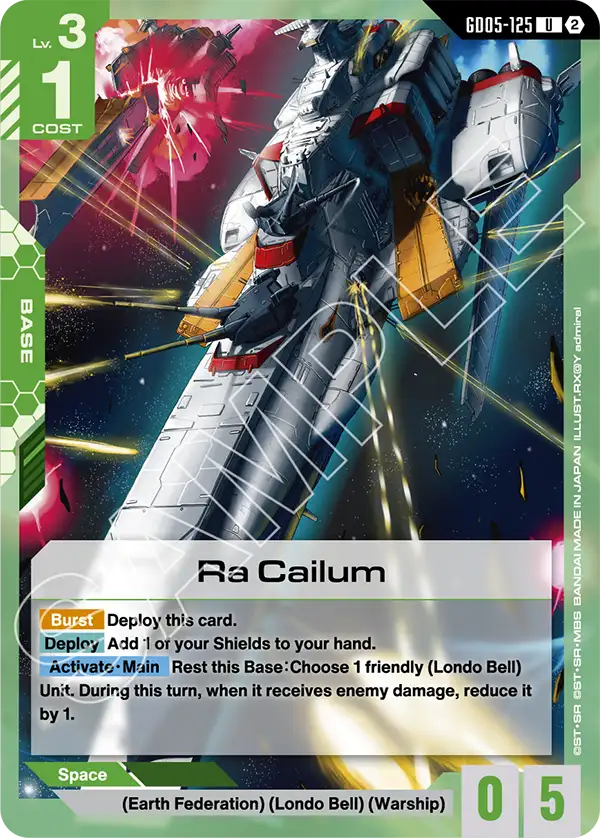
Six of the seven official lists ran exactly four Base cards. The seventh ran five. That is the tightest agreement of any slot in the whole sample, and it is worth taking seriously as a default.
The Bases those decks used were all Level 2 to Level 6 with a cost of 1 or 2, and HP of 5 or 6. Since a Base absorbs all damage aimed at your shield area while it stands (rule 3-5-3), and you start with only a 3 HP EX Base token, a real Base is a large defensive upgrade for a single Resource. Four copies of one Base card is the modal build.
The cap is one Base in the section at a time, so more than about five copies is dead weight - you are not stacking them, you are just replacing them.
The banned list is a deckbuilding rule
As of the list effective 24 July 2026, this is short but genuinely restrictive:
- Banned: GD01-020 Anksha. Zero copies.
- Restricted to 2: ST02-016 Corsica Base.
- Banned pairs: ST01-010 Amuro Ray cannot be in the same deck as ST05-010 Mikazuki Augus. GD01-008 Guntank cannot be in the same deck as GD05-015 M1 Astray Shrike.
And then the one that actually affects new builders. Bandai lists 20 Unit cards matching the description "a Unit card that is Lv.2 with cost 1, 2 AP, and 2 HP, and without effects" - the vanilla two-drops, spread across GD01 through GD05 and ST01 through ST10. All combinations of them are treated as banned pairs, and no more than four copies of one card matching that description may be used in a deck.
Translated: you get four vanilla 2-drops total, all of the same card number. If your plan was eight generic bodies to fill the early turns by running two different ones, that plan is illegal. Given that Level 2 was only 12.3% of the official decks' curve anyway, the format was already pointing away from that build.
Check the current list before an event rather than trusting a list you found online. It changes.
Nine beginner mistakes worth naming
- Building the curve on Cost. Nearly 90% of cards in the official lists have a Level higher than their Cost. Sort your list by Level first.
- Treating Pilots like early plays. They cost 1, which feels early, but 68% of them are Level 4 or higher and none are Level 1.
- Running Pilots that do not match your Units' link requirements. A Pilot with the wrong name and traits still adds AP and HP, but you have paid two cards for a Unit that cannot attack this turn - the entire point of pairing.
- Splashing a second colour thinly "because it's free." It is free, which is exactly why a 5-card splash is pointless. Bandai's own lists average around 18 cards of the second colour, and they are there for a specific package.
- Building 25 different cards. The official lists run 13 to 16 distinct card numbers. With guaranteed ramp and no sideboard in Swiss, consistency beats coverage.
- Expecting a sideboard before top cut. BO3 gives you exactly 10 sideboard cards, but qualifying rounds are best-of-one and give you none. Build the main deck to survive the whole day on its own.
- Running two different vanilla 2-drops. The banned-pair rule caps you at four copies of one of them.
- Spending Player Two's EX Resource immediately. It is removed from the game when used to pay a cost, and it counts toward your Level, so cashing it early can push your Level 4 turn back.
- Over-stuffing Bases or Units. One Base in the section, six Units in the battle area. Deploy a seventh Unit and rules management makes you trash one - and that trashing is explicitly not "destroyed," so nothing triggers off it.
A starting template
If you want a shape to start from rather than a decklist to copy, this is what Bandai's own lists average out to, rounded to something buildable:
- 30 to 32 Units, weighted toward Level 3 and Level 4, with the majority carrying link conditions.
- 8 to 10 Pilots, chosen so that their link names actually appear on Units you are running, and played as four-ofs.
- 5 to 7 Commands.
- 4 Bases, almost certainly four copies of one card.
- 10 identical Resource cards.
- 13 to 16 distinct card numbers total, most of them at four copies.
- Two colours, with the second one at roughly 15 to 22 cards and pulling its weight as a package.
Then check one thing before you sleeve it: count how many cards you can legally play on the turn you have four Resources. If that number is small, your Levels are too high, no matter how cheap the costs look.
What I could not confirm
A few honest gaps, so you know what this piece is and is not.
I did not measure a competitive metagame. I counted Bandai's published decklists, which are teaching tools and product showcases, not tournament-winning lists. Their ratios are a sane starting point and a real signal about intended design, but they are not evidence about what wins events.
I also have no tournament results data, no card price or availability data, and no information on how these ratios shift by archetype - aggressive shells almost certainly want a lower Level curve than the 32% Level 4 concentration in this sample, but I have not verified that against results.
Finally, the card counts here are distinct card numbers in Bandai's English card database as of 15 August 2026, with parallel-art variants collapsed. New sets will move every one of those numbers. The rules citations, by contrast, come from Comprehensive Rules Ver. 1.8.0 dated 10 July 2026, and those are stable until Bandai updates the document.
If you have not played a game yet, start with the full rules walkthrough and then work out which product to actually buy - a starter deck is a legal 50-card deck and a legal 10-card resource deck in one box, which makes it a better first build than any pile of boosters.
Frequently Asked Questions
How many cards do you need to build a Gundam Card Game deck?
How many colours can a Gundam Card Game deck have?
Does the Gundam Card Game have a sideboard?
How many Pilots should a Gundam Card Game deck run?
Why does every Pilot card cost 1 in the Gundam Card Game?
Should I build my curve around Level or Cost?
Is there anything to decide when building the 10-card resource deck?
How many copies of the same card can a Gundam Card Game deck have?
Keep Reading
Related Guides
Gundam Card Game Series - All 20, and Which Are Buildable
Gundam 00 has 65 cards in the Gundam Card Game and Gundam Wing has 50 - and Wing is the far easier deck to build, because all 50 Wing cards sit inside one legal colour pair and Gundam 00 is split across four colours. Card count is not the number that decides whether your favourite series is playable. I read the Source Title field off all 892 deck-legal cards and worked out which of the 20 series survive contact with the two-colour rule.
Can You Play the Gundam Card Game Online?
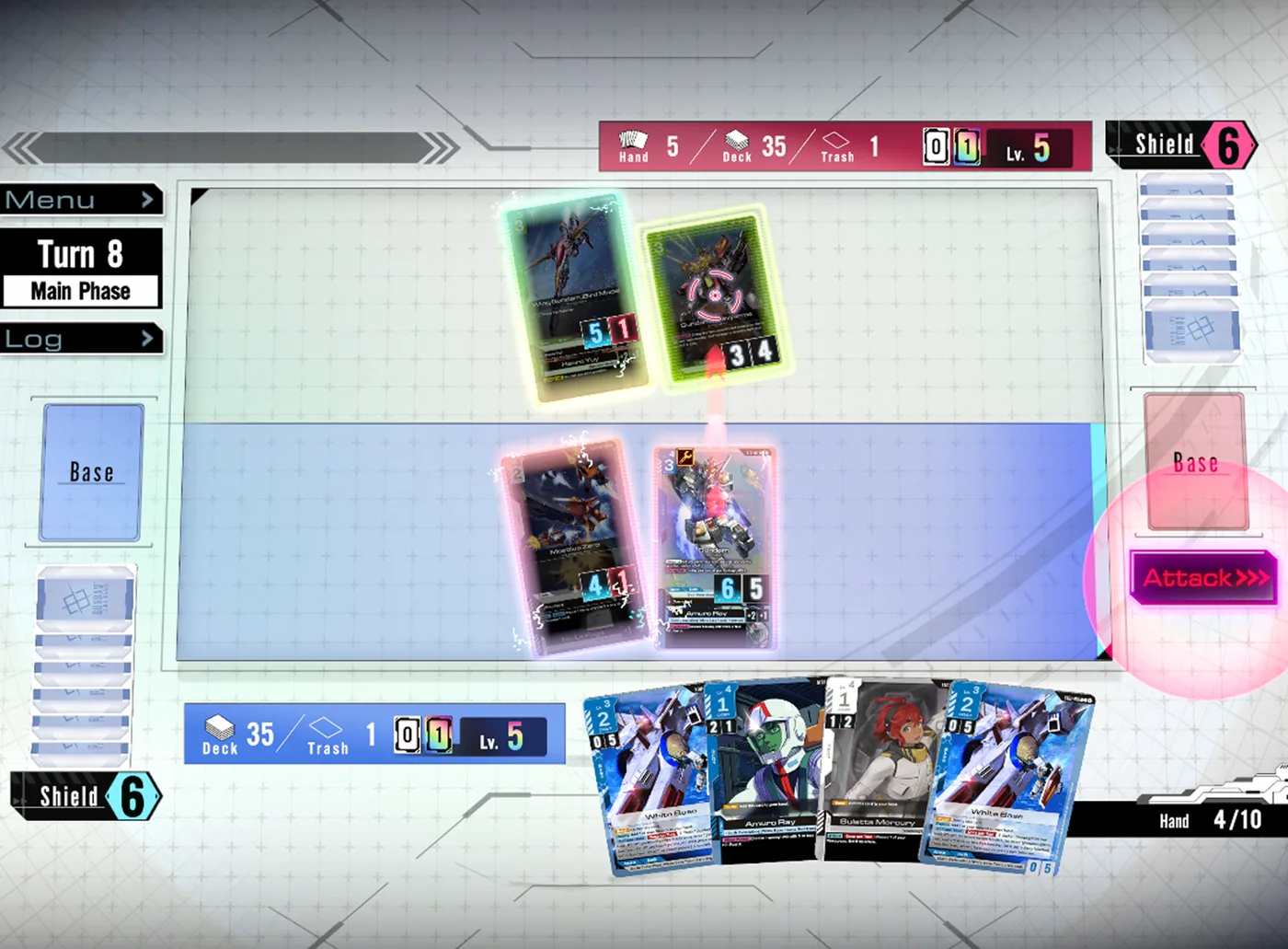
Bandai's free Gundam Card Game Teaching App has been on the App Store since June 2025, and nothing in its description or its eight updates describes playing another person. Here is what its two modes do, what it has and has not been updated with, and the webcam rules Bandai wrote into its Tournament Rules Manual for playing a real opponent online.
Gundam Card Game Timing Keywords: All 13 and When They Fire
Section 13-2 of the Gundam Card Game Comprehensive Rules defines 13 timing keywords, and 715 of the 956 main-deck cards open an effect with at least one. Here is what each one is, when it fires, how many cards print it, the colour it wears on the printed card, and the rulings that separate When Paired, During Pair, When Linked and During Link.
Gundam Card Game Commands - All 145, and When to Play Them
Comprehensive Rules 9-2 makes Command the only card type in the Gundam Card Game you can play out of your hand on someone else's turn, and whether a given Command can is written on one line of the card: 84 of the 145 Commands in the game carry an Action effect, which Bandai's own FAQ says can be played during your action steps or your opponent's. I read the timing line off all 145 of them, then counted what Bandai actually puts in its own 41 decklists - and 15 of those lists run none of it at all.
How to Play the Gundam Card Game - Resources, Shields, Pilots, and the Six-Card Life Total
Your entire life total in the Gundam Card Game is six face-down cards with 1 HP each, plus a token base with 3 HP. This is the complete rules walkthrough - the separate resource deck, the Level and Cost split, setup, the five card types, pairing Pilots into Link Units, the five phases, and combat - checked line by line against Bandai's Comprehensive Rules Ver. 1.8.0.
Gundam Card Game Bases - All 68 Counted, and Which to Run
Every Base card in the Gundam Card Game opens with the same two lines. Not most of them - all 68, across five colours and sixteen products, with zero exceptions. That template is why the Base slot is not the throwaway it looks like, and the whole type tops out at Rare - no Base has ever been printed above it. I pulled all 68 out of the official database and cross-referenced them against 41 decklists Bandai published itself.