Riftbound Multiplayer Rules - How 2v2, Skirmish and War Actually Work
Riftbound has five sanctioned modes and almost everyone plays one of them. The team format is called Magma Chamber, it wants 11 points instead of 8, your partner cannot reinforce your battlefield, and it has a ban list of its own containing exactly one Legend that is legal everywhere else.
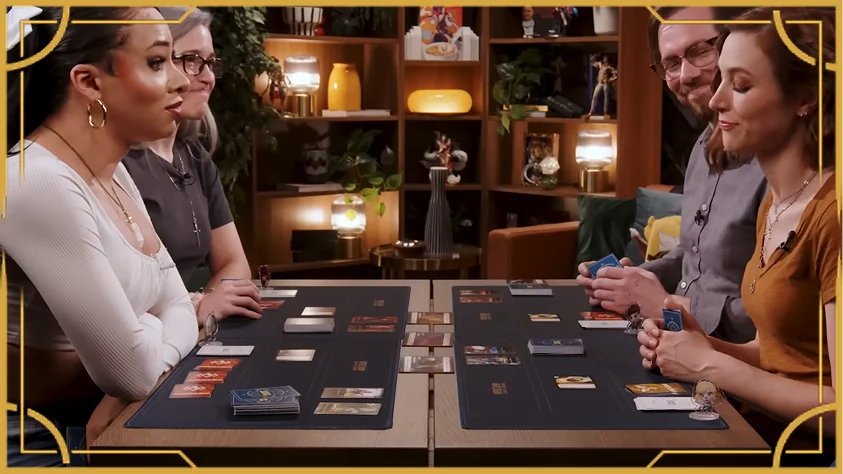
Riot banned a Legend in July that is still perfectly legal in every 1v1 tournament on the planet. One card, one format - and it is the format most Riftbound players have never sat down and played on purpose.
That format is 2v2. Riot calls it Magma Chamber, it has been sitting in the Core Rules since launch next to two free-for-all modes almost nobody reads, and as of 17 July 2026 it has a ban list of its own. Gen Con ran 2v2 Sealed on the Friday night of the convention. Your local store can fire one at a Nexus Night this week.
Everything below comes out of the official Core Rules and Tournament Rules dated 16 July 2026, which stay in force until 15 October, plus Riot's own ban announcements. Riot published new versions of both documents on 9 October, effective 16 October 2026 with the Radiance Pre-Rift (what that update changed). The 2v2 rules below read the same in both versions apart from Riot's 2v2 scoring clarification, flagged where it applies. If you have not read the 1v1 rules yet, start with how to play Riftbound - this is the delta, not the whole game.
The five modes Riot actually sanctions
The Core Rules define a Mode of Play as a set of variables: player count, formation, victory score, battlefield count, setup changes, first-turn adjustments and any unique rules. Five modes are listed as sanctioned.
| Mode | Players | Victory Score | Battlefields in play | Match format |
|---|---|---|---|---|
| 1v1 (Duel) | 2 | 8 | 2 | Best of 1 |
| 1v1 (Match) | 2 | 8 | 2 | Best of 3, optionally 5 |
| FFA3 (Skirmish) | 3 | 8 | 3 | Best of 1 |
| FFA4 (War) | 4 | 8 | 3 | Best of 1 |
| 2v2 (Magma Chamber) | 4 | 11 | 3 | Best of 1 |
Two things jump out of that table. Every mode past the duel puts three battlefields on the table regardless of how many players are sitting at it. And exactly one mode moves the finish line.
Magma Chamber wants 11 points, not 8
2v2 is four players, two teams of two, and the first team to 11 points wins the match. Points are shared: both players on a team always have the same total, and if either of you gains or loses points, the team gains or loses them. Any card that checks whether a player gained points is checking the team.
Teammates also win and lose together, and the rules are blunt about how far that goes. If one player concedes, the entire team loses. If one player loses, the entire team loses. There is no playing on down a partner.
The three battlefields come from three of the four players. Everyone brings three battlefields in their deck as normal, the player taking the first turn removes theirs entirely, and each of the other three randomly picks one of their three to put in play. Two teammates may not register the same battlefields, so a table always presents three different objectives.
Why 11 is slower than it sounds
Eleven looks like a small bump over eight until you work out how fast a team can actually bank points.
Scoring works exactly as it does in a duel - conquer a battlefield you have not scored this turn, or hold one you already control during your Beginning Phase, one point either way, once per battlefield per turn. But 2v2 adds a clause that changes the arithmetic: battlefields controlled by your teammate at the scoring step of your Beginning Phase are disqualified from being scored by your team that turn, through hold or conquer, by any means. Riot's 9 October Core Rules, effective 16 October, add one more 2v2 line: a battlefield can be scored only once per team per turn, by hold or conquer.
So picture the dream scenario. Your team owns all three battlefields and nothing changes hands. On your turn, you hold your battlefields and score them. On your partner's turn, everything your team controls is controlled by their teammate - you - so your team scores nothing. Total damage for a full four-turn round of complete board dominance: 3 points.
Eleven points is therefore a minimum of four full rounds - eight player turns - of holding everything. Compare that to a duel, where sitting on both battlefields banks 2 points a turn and closes a game from zero in four turns. Magma Chamber games are structurally long, and that is deliberate.
Going first costs you a card and your battlefields
Every multiplayer mode uses the same first-turn adjustment, and it is heavier than the one in a duel.
- The player going first does not draw a card during their first Draw Phase.
- The player going last channels an extra rune during their first Channel Phase.
In 2v2 and 4-player War there is a third tax nobody mentions: the player taking the first turn has their battlefields removed from the game entirely. They contribute zero objectives to a table of three. In 3-player Skirmish that does not happen - all three players put one battlefield in, which is why Skirmish is the only free-for-all where everybody gets a say in the terrain.
Turn order alternates teams. First player, an opponent, the first player's partner, the other opponent, repeat. If allies sit across from each other, that is just clockwise; if allies sit next to each other, turn order passes across the table.
Friendly stops meaning yours
Here is the single line that reshapes every card in your deck:
Friendly describes controlled Game Objects by a player or their Teammate.
In a duel, "friendly" is a synonym for "mine." In 2v2 it is not. The Core Rules use the example of a card reading "when you play me, ready a friendly unit" - in Magma Chamber that can target your partner's unit as happily as your own.
Read your deck again with that in mind. Every buff, every ready effect, every "friendly units get" static ability now has twice the board to work with. Some cards go from fine to absurd on that clause alone.
Riot found this out the expensive way.
The one Legend banned in teams and nowhere else
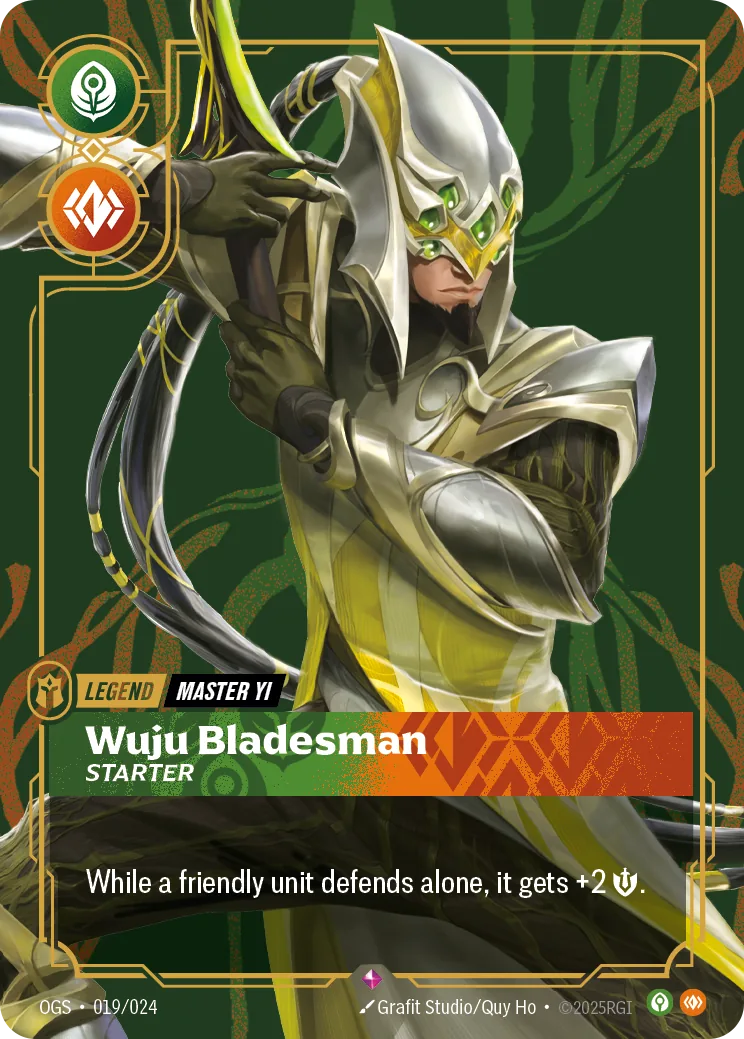
On 17 July 2026, effective 24 July, Riot introduced a separate 2v2 ban list. It is the entire Standard list plus exactly one card: the Legend Master Yi, Wuju Bladesman.
Riot's stated reason is worth quoting because it is a direct consequence of the friendly rule:
While the Proving Grounds Master Yi has solidly proven himself as a 1v1 competitor, his Legend has been consistently overshadowing other options in 2v2 to the detriment of that format. Since the defensive bonus extends to both you and your ally, he is providing far more stats from the start of the game than are healthy.
The card is Wuju Bladesman - Starter, OGS 019/024, a Calm and Body Legend whose entire text is "While a friendly unit defends alone, it gets +2 Might." In a duel that reads a solo blocker. In Magma Chamber it reads every solo defender on your side of the table, permanently, from turn one, at zero cost - and the two of you can cover three battlefields between you without ever stacking up.
The detail I like most: it is a Proving Grounds card. The only card on the 2v2 list that is not on the Standard list came out of the beginner box, not a booster set. Riot also noted they had "already seen a huge overrepresentation of Master Yi, Wuju Bladesman among top teams" while experimenting with 2v2 as a competitive format, which tells you the format is getting more internal attention than its event calendar suggests.
For reference, the rest of both lists as of the Rules Hub update dated 18 September 2026: the cards Called Shot; Draven, Vanquisher; Ekko, Recurrent; Fight or Flight; Scrapheap; Stacked Deck; and Stealthy Pursuer, plus the battlefields The Arena's Greatest, Aspirant's Climb, Dreaming Tree, Obelisk of Power and Reaver's Row. Those are banned in Standard and in 2v2 alike. Ekko and Stacked Deck joined both lists effective 18 September - our September ban list breakdown covers why.
Control is not shared, and that is the whole format
If you come to this from Two-Headed Giant in Magic, unlearn it now. Riftbound teams share points. They do not share a board.
The rules state it flatly - control is not shared - and then spell out the consequences:
- You may not move units to a battlefield your teammate occupies. The Core Rules make teammate-occupied battlefields invalid destinations for moves of all kinds, standard or otherwise.
- You may not issue a standard move to your teammate's units. They drive their own pieces.
- You may not hide cards at a battlefield your teammate controls. Hiding requires a battlefield you control.
- XP is not shared between allies. If your deck levels up off Hunt triggers, your partner's conquests do nothing for your counter.
That first bullet is the one that decides games. You cannot pile both players' units onto the same objective to make an unkillable stack. Whoever gets to a battlefield first owns that fight alone, and the best your partner can do is take a different battlefield or take one back later. Three battlefields between two players means somebody is usually holding two, and holding two with a split board is exactly as fragile as it sounds.
Your partner's battlefields are dead ground to you
Worth restating on its own because people misplay it every single game: your team cannot score a battlefield your teammate was sitting on at the start of your turn.
The rules even pre-empt the cute version. There is an explicit example forbidding the play where you get your partner to retreat off an objective so that you can walk in and conquer it for a fresh point. Battlefields their teammate controlled during that Beginning Phase scoring step are disqualified for the team, that turn, by any means.
So the correct 2v2 instinct is not "help my partner hold." It is "take the thing my partner is not on." Two players spreading across three objectives is the whole strategic engine of the format, and the entire ruleset is built to force it.
Closing the game from 10 points
The final-point rule that eats duels has a team-specific rewrite, and this one actually rewards having a partner.
In 1v1, if you are one point from the victory score and you try to close by conquering, you only gain that final point if you scored every battlefield that turn. Otherwise you draw a card instead. In a duel with two battlefields, that means taking both.
In 2v2, the requirement becomes: score every battlefield in the same turn, excepting any that were occupied by your ally during the scoring step of that turn's Beginning Phase. With three battlefields on the table, if your partner is holding one when your turn begins, you only need to score the other two to close the game.
Which produces a genuinely fun endgame: at 10 points, your partner parking on an objective is not a lost point, it is a discount on your win condition. The restriction only applies to conquer - points from other sources, including holding your way to the eleventh, are not gated.
From 16 October, Riot's updated Core Rules (published 9 October) narrow the ally exception to a final point conquered during your own turn or your teammate's turn. Conquer for the final point during an opponent's turn and the standard rule applies: you must have scored every battlefield that turn.
Combat is still a duel at a table of four
The most common multiplayer question in any card game is "can we gang up." In Riftbound, no.
Combat can only occur between Units controlled by exactly two players.
All choices that would produce a combat between more than two players simultaneously are invalid and cannot be completed. And the rules build a fence around any fight already happening: in modes with more than two players, a battlefield with a staged combat or a combat in progress is an invalid destination for moves by anyone not already involved, and it cannot be chosen as a place to play a unit by a non-participant either. If an effect would force a unit there, it is played to its controller's base instead.
Practically, that means a contested battlefield is a sealed room. Two players go in, the damage math resolves the way it always does - sum the Might on each side, assign as one pool, lethal in full before you touch the next unit - and nobody outside gets to add a body mid-fight. The window to influence a fight you are not in is spells and abilities, not units.
Skirmish and War: the free-for-all modes
The two free-for-all modes are the same game with the seat count changed and no ban list of their own.
FFA3 (Skirmish) is three players, 8 points, three battlefields. Every player randomly selects one of their three battlefields and all three go into play between the players.
FFA4 (War) is four players, 8 points, three battlefields. The first-turn player's battlefields are removed and the other three each contribute one.
Both are best of one, both use the skip-a-draw-if-you-are-first and extra-rune-if-you-are-last adjustment, and both inherit the no-three-way-combat lockout above. The result is a politics game with a very short leash - you can talk all you like, but you cannot physically help anybody, and the mode gives you no shared resource to trade. If you want the version of this with actual deal-making tools, that is Magic's politics cards, not Riftbound.
One asymmetry worth naming: an 8-point race with three or four players and only three battlefields means whoever gets ignored wins. There is no life total to notice being at 4. There is a scoreboard, and it is public, so the table can and will focus the leader. That is a feature.
Building two decks that have to coexist
2v2 deckbuilding uses the same construction rules as 1v1 - one Legend, exactly 40 in the Main Deck for sanctioned play, 12 runes, three battlefields with unique names, three total Signature cards, and the copy limits. If those numbers are new to you, our deckbuilding basics guide covers the whole checklist.
Two extra restrictions apply across the team:
- Teammates may not use the same Champion Legend. Two Shen decks is not a team.
- Teammates may not use the same battlefields. You are registering six battlefields between you, all different names, and only three of them will ever hit the table.
That second one is a real constraint on a small card pool. The best battlefields are contested between you and your own partner before an opponent is even involved, and because the first-turn player's picks get binned, roughly a third of your team's battlefield planning is decided by a coin flip.
The strategic layer sitting on top: three objectives, two players, no stacking allowed. Somebody has to build the deck that can hold two battlefields alone. That deck wants cheap bodies and reach, not a top-end bomb it plays once. Riot's 9-plus units at 2 to 4 Energy guideline goes from advice to requirement here.
What 2v2 looks like at a sanctioned event
The Tournament Rules give 2v2 its own section, and it is more structured than a kitchen-table pairing.
- A team registers together, with each player supplying their own registration details, and nominates an A player and a B player for seating.
- Teammates sit next to each other in registered AB order, which means turn order at an event is always: first team's A, second team's A, first team's B, second team's B.
- A random method decides which team picks where in that order play begins. After game one, the losing team of the previous game chooses.
- If one player drops, the whole team drops. If one player is disqualified, the whole team is disqualified.
- Teams may be asked to supply a team name, which officials can reject for any reason.
- A 2v2 competition can be constructed or sealed. In sealed 2v2, the team shares a single pool of 8 packs.
That last number is the sharpest one in the document. Solo sealed hands each player 6 packs. Team sealed hands two players 8 - four each, a third less card pool per person, and out of it you have to build two legal decks that cannot share a Legend or a battlefield. Team sealed is not solo sealed with a friend. It is a harder deckbuilding problem with a stranger's opinions attached.
On communication: teammates may share private information, including directly showing each other the cards in their hand, and communication between teammates is explicitly allowed and encouraged - but it has to happen at a reasonable pace, or you are into slow play penalties. Your partner may also play spells and activate abilities during your turn, including cards without Action or Reaction, but only when you invite them to do so using your own priority. You are the one holding the door.
Where you can actually play it
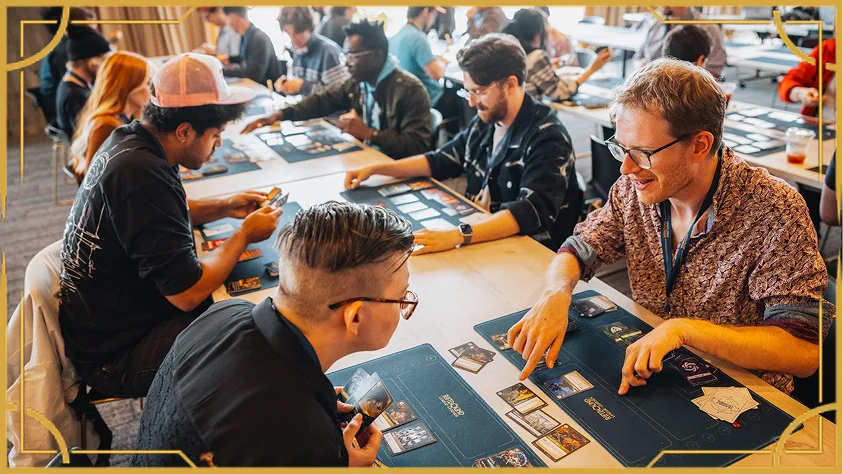
Honest answer: at the bottom of the ladder and at conventions.
Nexus Nights are the weekly store-level event, they run on whatever day the store prefers, and the format is the store's choice - Riot's own copy offers "1v1, or throw down the gauntlet in a 2v2 or free-for-all brawl." Rewards are 3-card packs including promos. This is where multiplayer Riftbound actually lives.
Gen Con 2026 ran a 2v2 Sealed block on Friday 31 July from 5 PM to 9 PM ET, followed by a Saturday Night Super Nexus Night from 5 PM on 1 August, with Multi-Set Sealed closing the convention on Sunday 2 August.
Above that, it is side-event territory. Summoner Skirmish (twice per set, until Riot retires it after Radiance - see the 2027 organized play changes), Regional Qualifiers and Regional Championships all run 1v1 Constructed as their main event - the entire path to Worlds is duels. Riot's own organized play page does say premier events will host side events "including structured free-for-all and team matches," and the ban list is evidence they are taking it seriously, since you do not ban a Legend for a format nobody is testing. But as of August 2026 there is no published 2v2 qualifier ladder.
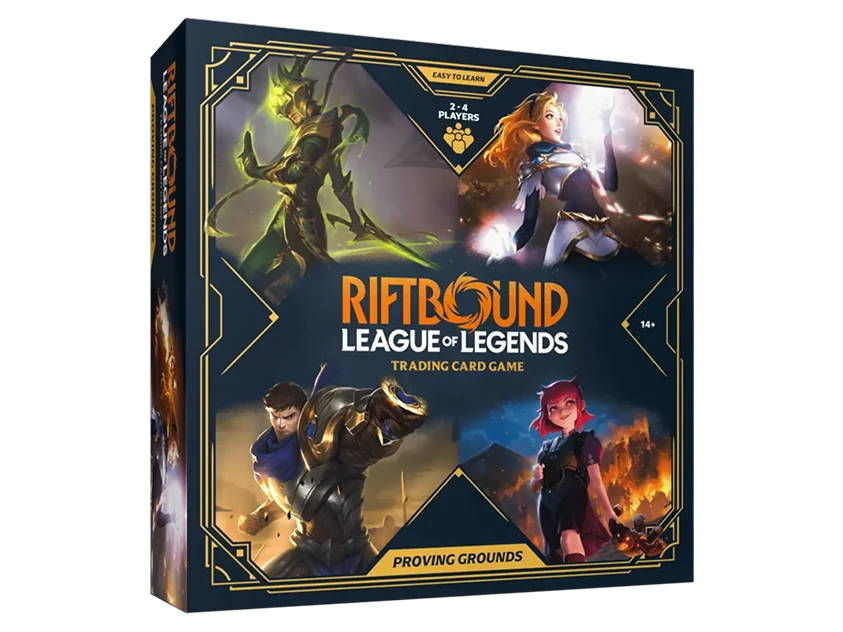
If you want to try any of this tonight, the Proving Grounds box is the cheapest door: 2 to 4 players, four preconstructed decks, a rulebook, playmats and tokens. It is also, amusingly, the box that produced the only Legend Riot has banned in teams. Beyond that, the newest sealed-product entry point is the Vendetta Showdown Decks, and the 2026 set schedule covers what each release put in the box.
Quick reference
- Five sanctioned modes: 1v1 Duel, 1v1 Match, FFA3 Skirmish, FFA4 War, 2v2 Magma Chamber.
- 2v2 wins at 11 points, shared across the team. Everything else wins at 8.
- Three battlefields in every mode above two players. In 2v2 and War, the first-turn player contributes none.
- First player skips their first draw. Last player channels an extra rune.
- Friendly means yours or your partner's - re-read your buffs.
- Control is never shared. No moving onto your partner's battlefield, no moving their units, no hiding at their objectives, no shared XP.
- Your partner's battlefields cannot be scored by your team that turn, hold or conquer.
- The final point from conquer on your turn needs every battlefield that turn, minus any your ally held at your Beginning Phase. From 16 October, a final-point conquer on an opponent's turn gets no ally exception.
- Combat is strictly two players. Third parties cannot move or play units into an active fight.
- 2v2 ban list = the Standard list plus Master Yi, Wuju Bladesman.
- Teammates cannot share a Legend or a battlefield. Team sealed shares 8 packs.
Play a Nexus Night 2v2 before you decide the format is a novelty. The no-stacking rule alone makes it a different game to the duel, and the eleventh point is a much longer walk than it reads on paper.
Frequently Asked Questions
How many players can play Riftbound?
How many points do you need to win Riftbound 2v2?
Can you move units onto your teammate's battlefield in Riftbound 2v2?
Why is Master Yi banned in Riftbound 2v2?
What is on the Riftbound 2v2 ban list?
Can teammates look at each other's hands in Riftbound 2v2?
How do you play Riftbound with 3 players?
Can you play 2v2 in Riftbound tournaments?
Keep Reading
- Riftbound Rules Hub (Riot Games) - Core Rules and Tournament Rules last updated 9 October 2026 (effective 16 October), Standard and 2v2 ban lists last updated 18 September 2026
- Radiance Patch Notes (Riot Games) - Radiance Rules Update effective 16 October 2026, including the 2v2 scoring clarification
- October 2026 Tournament Rules Changelog (Riot Games) - effective with the Radiance Pre-Rift on 16 October 2026
- July Ban List Updates (Riot Games) - creation of the 2v2 ban list, effective 24 July 2026
- September Ban List Updates (Riot Games) - Ekko, Recurrent and Stacked Deck added to the Standard and 2v2 Constructed ban lists, effective 18 September 2026
- August 2026 State of Play (Riot Games) - Summoner Skirmish retired after Radiance
- Riftbound Organized Play (Riot Games) - Nexus Nights, Summoner Skirmish, Regional Qualifiers and Championships
- Riftbound at Gen Con 2026 (Riot Games) - 2v2 Sealed and Super Nexus Night schedule
- Riftbound - Your Journey Starts Here (Riot Games) product and multiplayer overview
- Riftbound Official Card Gallery (Riot Games)
Related Guides
Riftbound Tournament Rules Explained - What Actually Gets You a Game Loss
Riftbound has two rulebooks, and the one that decides tournaments is not the Core Rules. The Tournament Rules define three enforcement levels, a round-end procedure that hands out draws, a penalty ladder with hard upgrade thresholds, and - as of 24 July 2026 - a Disciplinary Code that can reach your Riot account.
Riftbound Radiance Rules Update: Neeko Rulings and Errata
Riot published three Radiance rules documents on 9 October: Core Rules patch notes with ten official rulings, an errata article for four cards, and a Tournament Rules update. Together they settle how Neeko works, what happens to Equipment that Orianna turns into a unit, and what changes at your table from the 16 October Pre-Rift.
Riftbound Chains and Focus: The HOT FEPR Timing Rules
Riftbound's turn is always in one of four states, and the state - not the card - decides whether you are allowed to play anything. The Core Rules run the whole timing system on two separate permissions called priority and focus, a stack called the chain, and a five-step resolution loop the rulebook actually names in the text: HOT FEPR.
Riftbound Vendetta Rules FAQ: Key Rulings Explained
Riot published the Vendetta Rules FAQ on 14 August 2026 and gave it precedence over the Core Rules Document until a new one was released. That new rulebook arrived on 9 October, effective 16 October. The FAQ also reverses a ruling Riot published in January, explains why Kayle can hold three copies of a status the rules call binary, and admits to a bug the Vendetta rules update introduced.

How to Play Riftbound — The League of Legends TCG Rules, Explained (2026)
Riftbound has no life total. You take objectives. Eight points ends it. Here is the whole rules set as Riot actually wrote it - runes, domains, battlefields, showdowns, deck construction, and the final-point rule that decides more games than any card does.
Riftbound Keywords Explained: All 28 in the Core Rules
The Riftbound Core Rules in force until 15 October 2026 define 25 keywords, and Riot's 9 October update adds Deploy, Disarm and Show Off from 16 October, for 28. The reminder text printed on the card is a summary, not the rule. Here is the whole glossary sorted by what each keyword actually is - passive, triggered, activated, permissive, dependent, cost, or a deck-construction rule that never does anything at the table.