Best Goad Cards in MTG Commander, Ranked
Goad is the closest thing Commander has to a mind-control button that nobody resents. Here are the best goad cards, ranked — the mass goads, the engines, and the payoffs that turn a four-player table into your personal demolition crew.
The best political play in Commander isn't a well-timed counterspell or a smug Rhystic Study tax. It's making the scariest creature at the table swing into the person sitting next to you while you lean back and watch two of your opponents beat each other into the dirt. That's goad. It's the closest thing the format has to a mind-control button that nobody at the pod actually resents you for pressing — because you're not stealing their stuff, you're just politely insisting they use it on someone else.
Goad rewards the part of Commander that a lot of players ignore: the game is four-player, and the fastest way to win is often to let the other three do the hard work. This is a ranking of the cards that make that happen — the mass goads that turn an entire battlefield against your opponents, the repeatable engines, and the payoffs that convert all that forced combat into card advantage and life loss. Every card here has been legality-checked against Scryfall and confirmed Commander-legal, with the exact mana cost and effect verified. No fabricated cards, no wishful text.
What goad actually does
Goad is a keyword action with a very specific rules meaning, and understanding it precisely is what separates a player who jams goad cards from a player who wins with them. When you goad a creature, until your next turn that creature attacks each combat if able, and it must attack a player other than you if able.
Read that second clause again, because it's the whole engine. A goaded creature can't sit back on defense, and it can't come at you — it has to go swing at one of your other opponents. You are effectively renting someone else's army and pointing it at a third party. The creature's controller still owns it, still takes the risk of it dying in combat, and still has to make blocking decisions with a board that's now committed to attacking elsewhere.
A few rules details that matter at the table:
- Goad lasts until your next turn, so a creature you goad on your turn is forced to attack during every one of your opponents' turns that comes before your next one. In a four-player game, one goad can mean up to three forced attacks.
- "If able" does real work. A creature that's tapped, or has summoning sickness, or is somehow prevented from attacking, doesn't have to. But if it can attack a non-you player, it must.
- Goad does not give the creature to you and does not stop its controller from having it around as a blocker on your turn. It just wrecks their turn-by-turn defense.
- Multiple goad sources stack fine, and a creature can be goaded by more than one player — it still just has to attack someone other than each goader if able.
The upshot: goad is removal-adjacent without being removal. You don't kill the threat; you turn it into a liability for the person who spent mana building it. For a deep dive on how forced combat interacts with the rest of the turn, our Commander format primer covers the multiplayer turn structure that makes all of this work.
Mass goad vs targeted goad
There are two flavors of goad, and a good deck wants both.
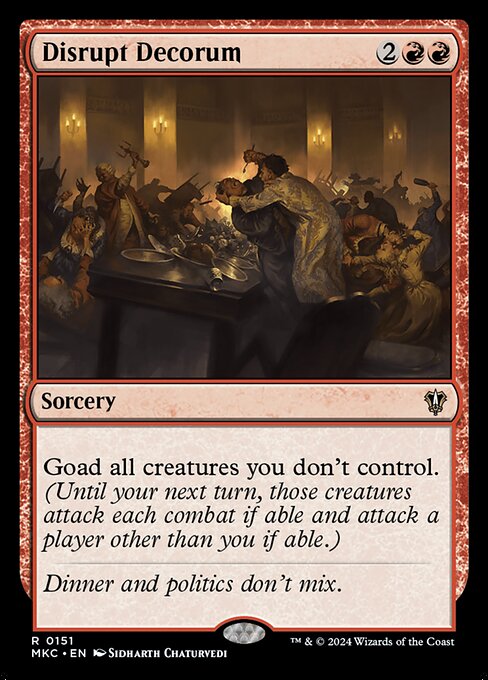
Mass goad hits everything at once. Cards like Disrupt Decorum goad every creature your opponents control in one shot. This is the nuclear option: you untap the whole table's board and force all of it to crash into each other. It's a blowout when three opponents have developed big boards and nobody wants to attack into open mana — you make the decision for them. Mass goad is at its filthiest right before your own turn, so the forced attacks resolve on their turns and their boards are tapped out and battered when you finally go to win.
Targeted goad points at one creature, usually the biggest threat or the one you most want dead in combat. It's cheaper, more repeatable, and more surgical. You use it to send a Blightsteel-sized commander into the strongest opponent, or to peel a key blocker off defense so your own attack gets through. Grenzo, Karazikar, and Bloodthirsty Blade all live here.
The reason you want both: mass goad is a haymaker you draw once a game, while targeted goad is the jab you throw every turn. A dedicated goad deck runs a handful of mass effects as finishers-of-chaos and a stack of repeatable single-target goad as its engine. Think of it the way an aggressive deck thinks about removal: you want cheap repeatable answers plus a couple of blowout sweepers.
The best goad cards, ranked
Ranked on raw impact in a four-player game, weighing how much forced combat each card generates, how repeatable it is, and whether it comes stapled to a payoff.
- Disrupt Decorum — {2}{R}{R}. Goad all creatures you don't control. This is the ceiling of the archetype: one sorcery, the entire table's army turned against itself. Cast it before your turn with a fast clock ready and it routinely ends games — everyone's boards trade down, nobody's untapped to block, and you swing into the wreckage. The best single goad card in Magic.
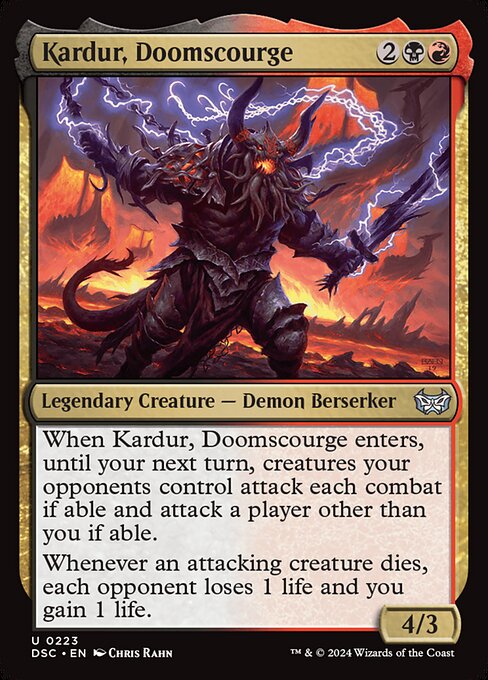
- Kardur, Doomscourge — {2}{B}{R}. A commander and a payoff in one card. When it enters it mass-goads every opponent, and then it drains each opponent for 1 (and gains you 1) every time an attacking creature dies — which, in a table you just goaded, is constantly. Blink or reanimate it to re-goad. The best commander for the deck.
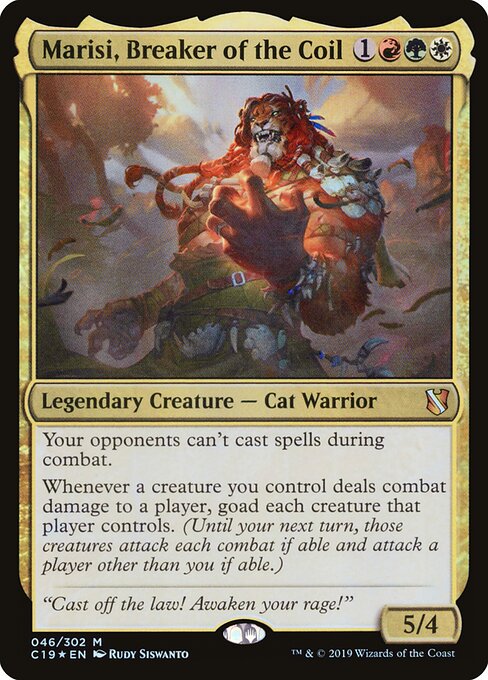
- Marisi, Breaker of the Coil — {1}{R}{G}{W}. Whenever a creature you control deals combat damage to a player, goad each creature that player controls — and your opponents can't cast spells during combat, so no instant-speed escape. It turns your own attacks into a repeatable mass-goad engine and shuts off the counterspell/removal that would stop the chaos. A brutal Naya commander.
- Karazikar, the Eye Tyrant — {3}{B}{R}. Whenever you attack a player, tap and goad one of their creatures. And here's the payoff: whenever an opponent attacks another opponent, you and the attacker each draw a card and lose 1 life. Goad the table, then get paid in cards and chip damage every time they swing. A full engine on a commander.
- Grenzo, Havoc Raiser — {R}{R}. A two-mana engine: whenever a creature you control deals combat damage to a player, you either goad one of their creatures or exile-and-steal the top card of their library. Cheap, aggressive, and it converts your combat damage into either more chaos or free spells. Absurd value for the cost.
- Agitator Ant — {2}{R}. The pillow-fort-breaker. At your end step, each player may put two +1/+1 counters on one of their creatures — and every creature that got counters is goaded. It's a group-hug trap: opponents happily buff their own beaters, then the whole buffed board is forced to swing at each other. Repeatable, political, and it grows the chaos every turn.
- Bloodthirsty Blade — {2}. An Equipment that gives +2/+0 and goads the equipped creature, and for just {1} you can re-attach it to any creature an opponent controls at sorcery speed. Two mana to permanently rent out the table's biggest threat, moving it wherever the fight needs to go. The most efficient repeatable single-target goad in the game, and it slots into any Equipment shell.
- Fumiko the Lowblood — {2}{R}{R}. A static, no-strings mass-forcer: creatures your opponents control attack each combat if able. It's not technically the goad keyword (it doesn't force them off you), so pair it with a pillow-fort or a fat blocker — but as a permanent "everyone must attack every turn" engine, it warps the whole game around chaos.
- Grand Melee — {3}{R}. Symmetric and gloriously dumb: all creatures attack each combat if able, and all creatures block each combat if able. Everyone's forced into combat every turn, boards grind to powder, and you build a deck that profits from the carnage. A budget chaos enchantment that does a lot of work.
- Coveted Peacock — {3}{U}{U}. The rare blue goad. A 2/3 flyer that goads a creature the defending player controls whenever it attacks. It's here mostly because blue-inclusive goad decks have almost nothing else — evasive, repeatable, and a fine include if your colors already run blue.
One honorable mention that gets miscategorized: Curse of the Nightly Hunt ({2}{R}) enchants a single player and forces their creatures to attack each combat if able. It's a cheap way to make one specific opponent's turns miserable, though like Fumiko it doesn't redirect them off you, so it plays best against the pod's aggressor rather than as a centerpiece.
The goad payoffs that turn chaos into wins
Goad on its own is a tempo and political tool — it slows opponents down and makes them fight each other. But a deck built only on goad can end up as the table's referee without ever closing the game. The payoffs are what turn all that forced combat into an actual win.
Death payoffs. Goaded creatures die in combat constantly, and cards that drain the table when creatures die cash that in. Kardur, Doomscourge is the headliner — every attacking creature that dies is a point off each opponent and a point onto you. Aristocrat-style drains from our sacrifice and aristocrats guide do the same work even when the dying creatures aren't yours.
Attack payoffs. Karazikar pays you cards and chip damage every time an opponent attacks another opponent — so you're literally drawing off the chaos you created. This is the engine that keeps a goad deck's hand full while everyone else empties theirs.
A fat blocker or a pillow fort. Because targeted goad forces creatures off you but static forcers like Fumiko and Grand Melee don't, you want a way to survive the swings that do come your way. A big defensive creature, a Ghostly Prison effect, or protection and fog effects let you sit safely behind the wall while the table grinds itself down. This is also why goad decks lean on stax and tax pieces — anything that makes attacking you expensive makes the goad's "attack someone else" clause redundant.
The formula: mass goad to create the chaos, a death or attack payoff to profit from it, and a defensive shell so you're the last one standing. Get those three pillars and goad stops being a cute political gimmick and becomes a real win condition.
Building a goad deck: colors and shell
Goad is heavily concentrated in red. Red owns the chaos-and-forced-combat slice of the color pie, so almost every goad card is either mono-red or has red in its cost. From there, the two best directions are:
Rakdos (black-red) is the sharpest home. Black brings the death payoffs (Kardur being both commander and drain), removal to clear your own path, and the aristocrat drains that profit off all the creatures dying in forced combat. Kardur, Doomscourge and Karazikar, the Eye Tyrant are both Rakdos and both do double duty as engine and payoff.
Naya (red-green-white) is the Marisi build — green for ramp and big blockers, white for pillow-fort enchantments that make attacking you a bad idea, and Marisi turning your own combat into a repeatable goad engine. It's more of a beatdown-plus-politics deck than a pure chaos build.
Whatever the colors, the deckbuilding math is the same as any focused strategy: a cluster of goad enablers, a few real payoffs, a defensive backbone, and enough Commander staples — ramp, card draw, and interaction — to actually function. Don't run twenty goad cards and no payoffs; you'll spend the whole game as the table's traffic cop and lose to the person who quietly built a combo while you were refereeing.
Budget-wise, goad is one of the cheapest archetypes to assemble. Disrupt Decorum, Grand Melee, Bloodthirsty Blade, Fumiko, and Curse of the Nightly Hunt are all inexpensive, and the expensive slots are the generic staples every deck wants anyway. You can build a genuinely oppressive goad table-controller without a single chase card.
Quick Action Checklist
- Run a mix of mass goad (Disrupt Decorum) as blowout finishers and repeatable single-target goad (Bloodthirsty Blade, Grenzo) as your turn-to-turn engine
- Cast mass goad right before your own turn so the forced attacks resolve while opponents are tapped out
- Never build goad without payoffs — Kardur for death drains, Karazikar for card-draw-on-attack, or aristocrat drains to profit from the carnage
- Add a defensive shell: a fat blocker, pillow-fort enchantments, or stax pieces so the swings that come at you fizzle
- Base the deck in red; Rakdos for death payoffs or Naya for the Marisi beatdown-politics build
- Remember the rule: a goaded creature must attack, and must attack someone other than you, if able
- Double-check Commander legality on Scryfall before buying any staple
Frequently Asked Questions
What is the best goad card in MTG Commander?
What does goad do in Magic: The Gathering?
Does a goaded creature have to attack me?
What colors are best for a goad deck?
Is goad any good, or just a casual gimmick?
Keep Reading
Related Guides
Best +1/+1 Counter Cards in MTG Commander, Ranked
Kill the anthem and the board shrinks. Kill the creature that placed a +1/+1 counter and nothing changes — the counter is already part of the creature. Here are the best +1/+1 counter payoffs and multipliers in Commander, ranked, plus the stacking order that turns one counter into eight.
Best Graveyard Hate Cards in MTG Commander, Ranked
Every Commander pod has a reanimator deck, an aristocrats deck, and a guy whose commander says "return target creature card from your graveyard." Here is the best graveyard hate in the format, ranked — and the timing rules that separate a blowout from a wasted card.
Best Mill Cards in MTG Commander, Ranked
Milling one player out is a chore. Milling three at once, before they punch your face in, is a real deck. Here are the best mill cards in Commander, ranked — plus the doublers and win conditions that make 300 total cards of library actually beatable.
Best Double Strike Cards in MTG Commander, Ranked
Double strike is the only keyword that literally doubles your damage, and it multiplies with every buff you have already committed. Here are the best double strike cards in Commander, ranked — the equipment, enchantments, instants and creatures that turn a fair attack into a dead opponent.
MTG Commander Format Guide — How to Start Playing EDH (2026)
Commander is the most-played MTG format on the planet and the easiest one for new players to start in. The rules look intimidating on paper. They are not. Here is the full beginner guide.

Best Commander Staples Every Deck Wants, Ranked
There's a short list of cards that show up in basically every Commander deck regardless of theme — the silent 25 that make the splashy 75 work. Here are the staples worth a slot in almost any list, sorted by the job they do, with the legality double-checked.