MTG Commander Brackets Explained (The Power-Level System)
"What's your power level?" used to be the most useless question in Commander. WotC's official Bracket system finally gives it real numbers. Here's what Brackets 1 through 5 actually mean and how to use them so nobody gets stomped.

"What's your power level, 1 to 10?" was, for a decade, the most useless question in Commander. Everyone's answer was a 7. The scale was made up, nobody calibrated it the same way, and the result was a turn-three combo deck sitting down across from a precon that hadn't been touched since the box was opened. The whole "Rule 0" pre-game talk was supposed to fix this and mostly didn't, because nobody had shared language to talk about how strong a deck actually was.
WotC's official Commander Bracket system, introduced in 2025, is the attempt to fix that. Instead of a vibes-based 1-to-10, it gives you five named tiers with actual definitions attached — built around how fast a deck wins, how it wins, and which high-impact cards it runs. It's not a rulebook and it's not enforced; it's a shared vocabulary so the pre-game conversation produces a fair game instead of a stomp. This guide walks through all five brackets, the Game Changers list that anchors the upper tiers, and how to actually use the system at a table.
A note on accuracy up front: the bracket system is an evolving framework maintained by Wizards and the Commander format leadership, and the exact card lists shift over time. Where a specific detail could change, this guide describes it as defined by WotC's bracket guidelines rather than treating it as fixed forever. Always check the current official list before a tournament-adjacent game.
Why the bracket system exists
Commander is a social format with no built-in matchmaking. You sit down with three strangers or three friends, and the single biggest factor in whether the game is fun is whether the four decks are roughly the same strength. A balanced pod is a great game; a mismatched pod is one person winning on turn four while everyone else watches.
The old tools didn't work:
- The 1-to-10 scale had no shared anchor. My 7 was your 4. The number carried no information.
- "Casual vs competitive" was too coarse — there's an enormous range between a precon and a tuned cEDH list, and "casual" covered most of it.
- Rule 0 conversations depended on everyone being honest and calibrated, which they rarely were, sometimes by accident.
The brackets replace the made-up number with definitions tied to observable things: how early the deck can win, whether it runs infinite combos, how much fast mana and tutoring it packs, and how many cards from the Game Changers list it includes. Two players who've never met can say "Bracket 2" and "Bracket 4" and immediately know they shouldn't sit down together — or can adjust before they do.
The bracket isn't a grade. A Bracket 2 deck isn't "worse" than a Bracket 4 deck — it's built for a different kind of game. The point is matching, not ranking. The best pod is four decks in the same bracket, whatever that bracket is.
The five brackets at a glance
Here's the shape of the whole system before we go tier by tier. The names are WotC's official bracket labels.
| Bracket | Name | The vibe | Game Changers |
|---|---|---|---|
| 1 | Exhibition | Ultra-casual, themed, jank, "for the bit" decks | None |
| 2 | Core | Precon-level — an unmodified or lightly tuned preconstructed deck | None |
| 3 | Upgraded | A precon meaningfully upgraded; stronger but still fair | A small number permitted |
| 4 | Optimized | High-power, no restrictions short of cEDH | No limit |
| 5 | cEDH | Competitive EDH — winning is the only goal, metagame-tuned | No limit |
The cleanest mental model: Bracket 2 is the precon baseline. Everything below it (Bracket 1) is intentionally weaker or weirder; everything above it gets progressively more powerful, faster, and less restricted. The Game Changers list (more on that below) is the main lever WotC uses to separate the middle brackets — how many of those high-impact cards a deck runs helps place it in 2, 3, or 4.
Bracket 1: Exhibition
Bracket 1 is the ultra-casual floor. These are decks built around a theme, a joke, a single beloved card, or a deliberate constraint — not around winning. Think a deck where every creature is a Goblin, a "group hug" deck that helps everyone, or a pile built entirely from one set's draft chaff.
The defining traits, per WotC's guidelines:
- Winning is not the priority. The deck is built for an experience — a theme, a story, a gimmick.
- No Game Changers and no infinite combos as a primary plan.
- Games are slow and grindy by design. Nobody's racing.
You don't see Bracket 1 at most tables, and that's fine — it's an explicit "we are here to mess around" signal. If three people brought Bracket 3 decks and one brought a Bracket 1 theme pile, that's a mismatch the pre-game talk should catch.
Bracket 2: Core
Bracket 2 is the anchor of the whole system: the power level of a modern preconstructed deck, unmodified or only lightly tuned. This is the most common bracket in casual play and the baseline everything else is measured against.
What a Bracket 2 deck looks like:
- Roughly precon-strength. A current Commander precon out of the box lands here, as do home-brews built to that ceiling.
- No Game Changers (or essentially none) and no early infinite combos.
- A reasonable game length — wins come together in the mid-to-late game, not on turn four.
- Some fast mana like Sol Ring is fine — Sol Ring is in nearly every precon and is legal at every bracket. The line isn't any single staple; it's the overall package.
If you bought a precon, swapped a few cards for ones you owned, and called it a night, you're playing Bracket 2. The vast majority of kitchen-table Commander lives here, which is exactly why it's the baseline.
Bracket 3: Upgraded

Bracket 3 is where most engaged players actually live: a deck that's been meaningfully upgraded past precon level — better mana base, tighter curve, stronger removal, a real gameplan — but still built for fair, interactive games rather than the fastest possible kill.
Per WotC's guidelines, Bracket 3 decks:
- Are noticeably stronger than a precon but not fully optimized.
- May run a limited number of Game Changers — a small handful, not a pile. The exact cap is set by the official guidelines and is the key thing separating Bracket 3 from Bracket 4.
- Can have combos, but generally not the cheapest, fastest game-ending ones, and not as the entire deck.
- Still expect interactive, multi-turn games.
This is the bracket the system arguably exists to define, because "upgraded but not cutthroat" is the single biggest band of decks and the one the old 1-to-10 scale handled worst. If you've spent real money tuning a deck but you're not trying to win on turn four, you're probably Bracket 3.
Bracket 4: Optimized
Bracket 4 is high power with no restrictions short of full cEDH. These decks are built to win as efficiently as the pilot can manage, with no limit on Game Changers, fast mana, tutors, or combos — but they aren't necessarily tuned against a competitive metagame the way Bracket 5 is.
The Bracket 4 profile:
- No restrictions on the Game Changers list — run as many as you want.
- Fast mana, heavy tutoring, and efficient combos are all on the table.
- Games can end quickly if the deck draws well.
- The difference from cEDH is intent and tuning, not a hard card restriction. A Bracket 4 deck is optimized; a Bracket 5 deck is optimized and metagamed against the best decks in the room.
If your deck has every fast-mana piece you can legally run, a tutor package, and a tight combo finish, but you built it for your local high-power table rather than a cEDH tournament, that's Bracket 4.
Bracket 5: cEDH

Bracket 5 is competitive EDH — the top of the system, where winning is the only goal and decks are tuned against the current cEDH metagame. This is the tournament tier: fast combos, dense interaction, premier win conditions like Thassa's Oracle, and games that are often decided in the first few turns by whoever resolves their plan or counters everyone else's.
Bracket 5 decks:
- Are built to win as fast and consistently as the format allows.
- Run the full suite of fast mana, tutors, free interaction, and the strongest win conditions (Thassa's Oracle combos, Demonic Consultation lines, and the rest of the cEDH toolbox).
- Are tuned against other top-tier decks, not just built strong in a vacuum — that metagame-awareness is what separates Bracket 5 from Bracket 4.
cEDH is its own scene with its own deck lists, tournaments, and theory. If you're not deliberately playing it, you're not in Bracket 5 by accident — these decks are unmistakable at the table.
What the Game Changers list is
The Game Changers list is WotC's curated list of cards considered powerful enough to meaningfully push a deck up the bracket scale. It's the main mechanical lever the bracket system uses to separate the middle tiers.
How it works:
- It's a list of high-impact cards — think powerful fast mana, efficient tutors, and cards that warp games (cards in the spirit of Jeweled Lotus, premier tutors, and the strongest staples).
- Brackets 1 and 2 run none. Bracket 3 permits a limited number. Brackets 4 and 5 have no limit.
- The count is the signal. Saying "I'm running two Game Changers" immediately tells the table roughly where your deck sits, without you having to defend a made-up number.
- The list is maintained and updated by Wizards as the format evolves — cards get added or removed, so check the current official list rather than relying on a snapshot.
The list does not replace the Commander ban list. Banned cards (Mana Crypt, Jeweled Lotus, and others banned in 2024-2025) are simply illegal in the format — the Game Changers list governs legal cards that are strong enough to define a deck's bracket. A card can be perfectly legal and still be a Game Changer that bumps you from Bracket 2 to Bracket 3.
The smart way to read the list: it's not a "naughty cards" list, it's a calibration tool. If your deck runs five Game Changers and your opponent's runs zero, you're not in the same game, and now you both know it before a card is played.
How to use brackets for a fair pod
The bracket system is only worth anything if you actually use it in the pre-game talk. Here's the practical version.
- State your bracket before decks come out. "I've got a Bracket 3 deck" is a one-sentence Rule 0 conversation that used to take five minutes of hedging.
- Match the table, don't out-build it. The goal is four decks in the same bracket. If everyone's at 2 and you brought a 4, sleeve a different deck or play to the table's level.
- Use Game Changer counts to settle disputes. When two people disagree on a deck's bracket, count the Game Changers and fast mana. The number is more honest than the vibe.
- Bracket up or down for the night. Many players keep multiple decks across brackets specifically so they can match whatever pod forms. That's the system working.
- Don't weaponize it. The brackets are for matching, not for policing or sandbagging. Calling your tuned deck a "Bracket 2" to ambush a casual table is exactly the behavior the system exists to stop.
The honest takeaway: the brackets don't make Commander competitive, and they don't make casual decks weaker. They give four people a shared language to set up a game where everyone has a real chance to win, which is the entire point of a social format. For the broader rules and color-identity basics underneath all of this, our Commander format guide covers how the format actually works, and the how to build a Commander deck guide walks through assembling a list at any bracket.
Quick Action Checklist
- Learn the five brackets: 1 Exhibition, 2 Core, 3 Upgraded, 4 Optimized, 5 cEDH
- Treat Bracket 2 as the precon baseline — most casual decks live in 2 or 3
- Count your Game Changers — zero for Brackets 1-2, a small number for 3, unlimited for 4-5
- State your bracket out loud before decks come out, every game
- Aim for a pod where all four decks share a bracket
- Keep decks at more than one bracket so you can match the table
- Check the current official Game Changers list before a tournament-adjacent game — it updates
- Never sandbag your bracket to stomp a casual pod
Frequently Asked Questions
What are the MTG Commander brackets?
What is the Game Changers list?
What bracket is a precon Commander deck?
What's the difference between Bracket 4 and Bracket 5?
Are the Commander brackets enforced rules?
How do I figure out which bracket my deck is in?
Keep Reading
Related Guides

MTG Commander Banned List: Every Card and Why
Wizards' banned list page gives Commander 42 card names and four lines of small print. Scryfall says the real number is 83. The gap is 41 cards banned by category rather than by name — Conspiracies, ante cards, and the seven banned everywhere for offensive content. Here is the entire list, grouped by what each card actually does, plus the one change the Commander Format Panel made this year.
Mystery Booster Commander Edition: Packs, Draft, Legality
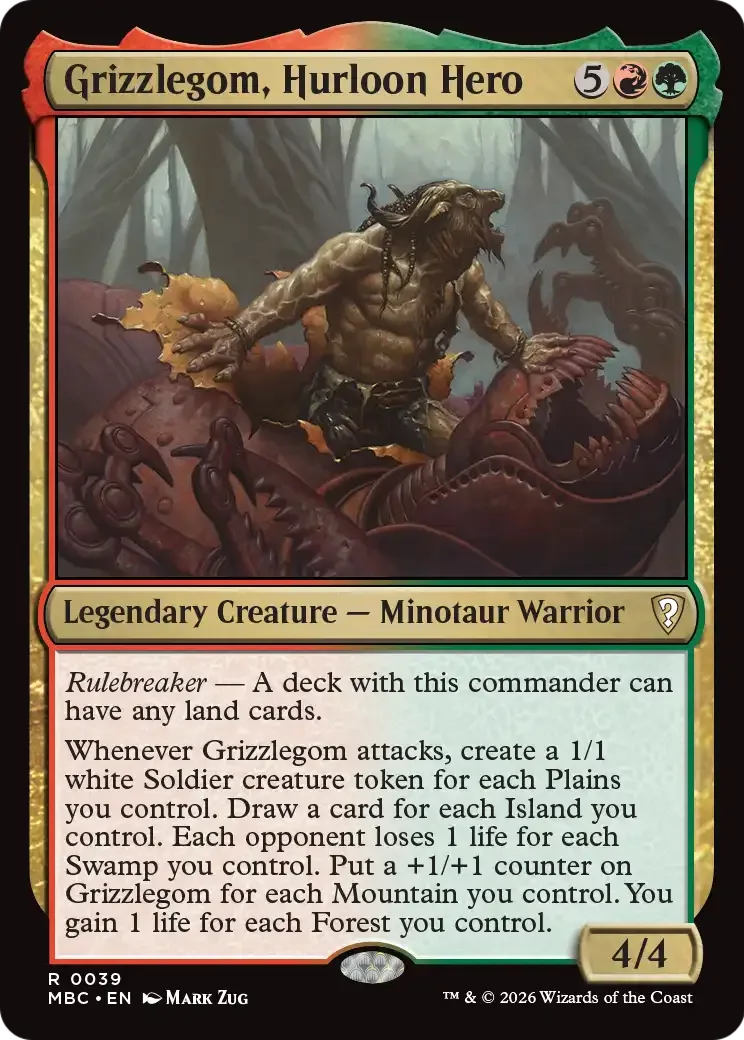
Festival in a Box: Atlanta 2026 goes on sale October 19 for $249.99 with a full box of Mystery Booster Commander Edition inside, and one box is exactly one eight-player Commander Draft. Here is the booster slot by slot, the draft rules, all 60 new commanders by color, the eight rulebreakers, and when the cards become legal.
How to Upgrade a Commander Precon (Without Rebuilding It)
Precons are mediocre in predictable ways, and predictable is cheap to fix. Here are the four flaws every Commander precon ships with, the cuts to make first, and a fully priced under-$16 swap menu that takes a stock deck from Bracket 2 to Bracket 3.
MTG Commander Format Guide — How to Start Playing EDH (2026)
Commander is the most-played MTG format on the planet and the easiest one for new players to start in. The rules look intimidating on paper. They are not. Here is the full beginner guide.

Best Commander Staples Every Deck Wants, Ranked
There's a short list of cards that show up in basically every Commander deck regardless of theme — the silent 25 that make the splashy 75 work. Here are the staples worth a slot in almost any list, sorted by the job they do, with the legality double-checked.

How to Build a Commander Deck — The 10/10/10 Template
Most bad Commander decks fail on category balance, not card choice. Here is the 10/10/10 skeleton that fixes ramp, draw, removal, and lands in one move.