Minecraft Combat Guide: Cooldown, Crits and Axe vs Sword
Every hit in Minecraft is worth less than you think until a hidden meter fills back up. That meter is the whole combat system: it decides whether you land a critical hit, whether your sword sweeps the mob standing next to your target, and why an axe that hits for more per swing can still lose a straight fight to a sword. Here is the cooldown formula, the seven-condition checklist for a crit, the sweep and mace damage math, and the edition split that makes Bedrock a completely different game.
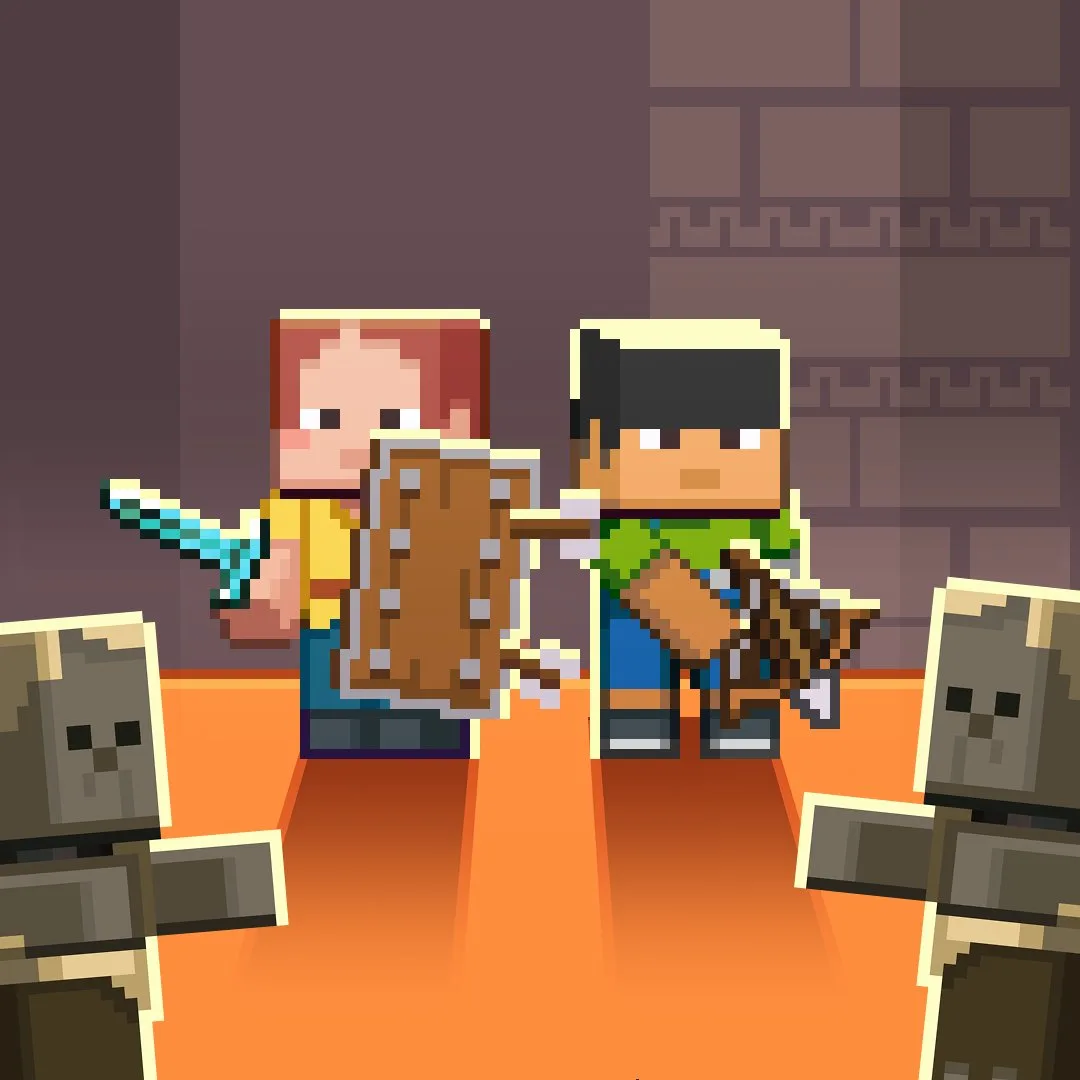
Attack a mob the instant you switch weapons and you deal barely a fifth of that weapon's listed damage. Wait roughly two-thirds of a second and the same swing lands for full. That gap is not lag or a UI glitch — it is the attack cooldown, a per-hit charge meter every melee weapon in Java Edition carries, and it is the one system underneath critical hits, sweep attacks, and why an axe that hits harder than a sword can still lose a sustained fight to one.
Here is the formula, the exact seven-condition checklist for a crit, the sweep and mace damage math worked out in full, and the edition split that makes Bedrock combat a genuinely different game rather than the same one with worse graphics settings.
The attack cooldown is the whole combat system
Every weapon has an attack speed attribute. That number sets how many game ticks it takes to go from empty to fully charged: recovery time in seconds equals 1 ÷ attack speed. A sword's attack speed is 1.6, so 1 ÷ 1.6 = 0.625 seconds, or 12.5 ticks, to recharge.
Swinging early does not fail — it just deals less. The Minecraft Wiki's own formula for damage scaling is:
Damage multiplier = 0.2 + ((t + 0.5) ÷ T)² × 0.8, clamped between 0.2 and 1.0, where t is ticks since your last attack and T is the weapon's full recovery time in ticks.
At t = 0 (you just switched weapons or just swung) the multiplier bottoms out at 0.2 — a diamond sword's 7 damage becomes 1.4. Wait the full 12.5 ticks and the multiplier hits 1.0 for the full 7. Attacking or switching weapons resets the timer, which is the entire reason "sword spamming" — clicking as fast as possible — is worse than timing your hits: every early swing is a discounted one.
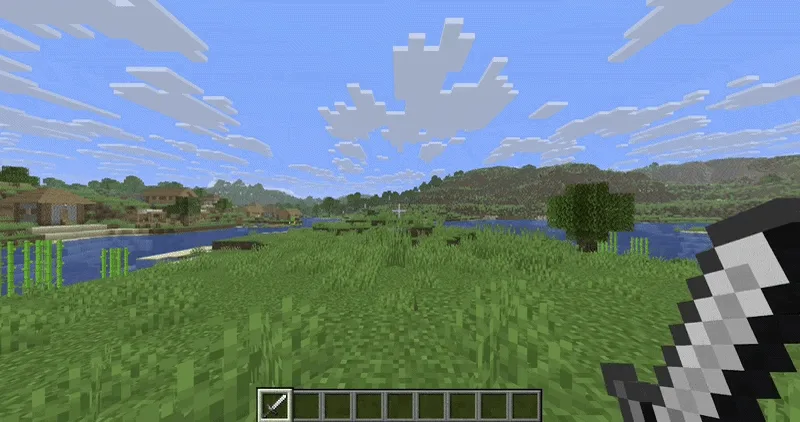
One more threshold matters more than the damage curve itself: an attack charge of 84.8% or higher is required before a critical hit, a sweep attack, or a sprint-knockback lunge can happen at all, regardless of how much damage the hit itself deals. Below that number none of the three are possible, full stop.
What every weapon actually recovers in
Attack speed is set per item type and, for swords and axes, per material tier. Every number below is the wiki's own attribute value, converted with the formula above.
| Weapon / tool | Attack speed | Full recovery |
|---|---|---|
| Bare hand | 4.0 | 0.25 s |
| Hoe (diamond, netherite) | 4.0 | 0.25 s |
| Hoe (iron) | 3.0 | 0.333 s |
| Hoe (stone, copper) | 2.0 | 0.5 s |
| Sword (any material) | 1.6 | 0.625 s |
| Pickaxe (any material) | 1.2 | 0.833 s |
| Trident | 1.1 | 0.909 s |
| Axe (gold, diamond, netherite) | 1.0 | 1.0 s |
| Shovel / Hoe (wood, gold) | 1.0 | 1.0 s |
| Axe (iron) | 0.9 | 1.111 s |
| Axe (wood, stone, copper) | 0.8 | 1.25 s |
| Mace | 0.6 | 1.667 s |
The sword's 1.6 is the fastest weapon-class recovery in the game outside a bare fist or an endgame hoe, which is the mechanical reason it is the default PvP pick — not just habit.
Critical hits need seven things true at once
A critical hit adds +50% damage, applied after Strength but before enchantments and armor reduction. Cross-shaped particles fly off the target when it lands. But it only triggers when every one of these is true on the same swing, in Java Edition:
- You are falling — moving downward — at the moment of the hit.
- Your attack charge is at 84.8% or above.
- You are not in water.
- You are not climbing a ladder or vine.
- You are not affected by Slow Falling, Blindness, or Levitation.
- You are not riding a boat, horse, or other vehicle.
- You are not gliding on an elytra.
Miss any one of those seven and the hit lands as a normal swing, no matter how hard you jump. This is also why jumping before you swing reliably produces a critical hit: a jump guarantees you are falling by the time the hit connects, satisfying condition one.
Sweep attacks hit everyone standing next to your target
Land a fully charged sword hit while grounded and not sprint-attacking, and it also strikes every other entity within a 1×0.25×1 block area of your target, out to about 3 blocks from your own feet. Unenchanted, that sweep deals a flat 1 HP to each of them — small, but free.
Sweeping Edge (sword-only, max level III) scales that bonus off your weapon's own attack damage:
| Sweeping Edge level | Sweep damage as % of attack damage |
|---|---|
| I | 50% |
| II | ~67% |
| III | 75% |
The formula is 1 + attack damage × (level ÷ (level + 1)), rounded. A Sweeping Edge III diamond sword (7 attack damage) sweeps for 1 + 7×0.75 ≈ 6 HP to everything around the target — nearly as much as the direct hit itself.
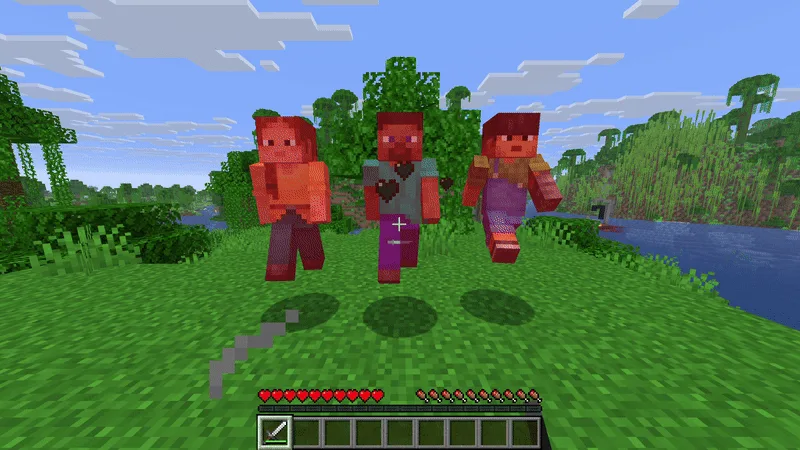
Two limits worth knowing before you build around it: sweep attacks and Sweeping Edge are both exclusive to swords in the shipped game — axes cannot sweep, and Bedrock Edition has no sweep attack mechanic at all, enchanted or not, which is covered in full below.
Axe vs sword: the sustained-DPS math
The numbers below are Java Edition, unenchanted, per hit:
| Material | Sword damage | Axe damage |
|---|---|---|
| Wood / Gold | 4 | 7 |
| Stone / Copper | 5 | 9 |
| Iron | 6 | 9 |
| Diamond | 7 | 9 |
| Netherite | 8 | 10 |
An axe out-damages a sword of the same tier on every single hit, per the table above. That per-hit number is only half the picture, because the axe recovers slower — except at the gold tier, where it doesn't. Multiplying each weapon's damage by its attack speed gives a theoretical sustained-DPS figure — assuming every swing is a fully charged hit that lands, with no misses, no travel time, and no crits or sweep factored in:
| Material | Sword: dmg × speed | Axe: dmg × speed |
|---|---|---|
| Wood | 4 × 1.6 = 6.4 | 7 × 0.8 = 5.6 |
| Gold | 4 × 1.6 = 6.4 | 7 × 1.0 = 7.0 |
| Stone / Copper | 5 × 1.6 = 8.0 | 9 × 0.8 = 7.2 |
| Iron | 6 × 1.6 = 9.6 | 9 × 0.9 = 8.1 |
| Diamond | 7 × 1.6 = 11.2 | 9 × 1.0 = 9.0 |
| Netherite | 8 × 1.6 = 12.8 | 10 × 1.0 = 10.0 |
At almost every tier the sword's sustained figure comes out higher — a diamond sword's 11.2 against a diamond axe's 9.0, for example — except gold. A golden axe shares the same 1.0 attack speed as diamond and netherite axes rather than the slower 0.8 of wood/stone/copper, so at the gold tier the axe's sustained DPS (7.0) actually edges out the sword's (6.4). It's a curiosity more than a build decision — gold's poor durability means it's rarely anyone's deliberate loadout — but it's the one tier where the "sword always wins the sustained trade" rule breaks. The axe's per-hit number is the one that shows up on the tooltip and the one people quote; the sword's is generally the one that wins a fight where both players land every swing at full charge. Real fights rarely look like that — movement, misses, and shield play change the picture — so treat this as the mechanical baseline, not a verdict on which weapon to bring. The axe's actual trump card isn't damage at all: it's the shield-disabling crushing blow covered further down, which a sword cannot do at any tier.
The mace turns fall distance into damage
The mace, added in the Tricky Trials update, does not fit the sword/axe pattern at all. Base attack damage is 6, attack speed is 0.6 (1.667 seconds to recover — the slowest recovery of any weapon), and on its own it is a mediocre weapon. Its entire design is the smash attack: swing it after falling 1.5 blocks or more and it converts fall distance directly into bonus damage.
The wiki's formula: +4 damage per block for the first 3 blocks fallen, +2 damage per block for the next 5 blocks, +1 damage per block for every block after that. Smash attacks are also almost always critical hits, since falling is a hard requirement for both — so the final number gets the standard +50%.
| Blocks fallen | Bonus damage | Total (base 6 + bonus) | With crit ×1.5 |
|---|---|---|---|
| 1.5 (minimum) | 6 | 12 | 18 |
| 3 | 12 | 18 | 27 |
| 5 | 16 | 22 | 33 |
| 8 | 22 | 28 | 42 |
| 10 | 24 | 30 | 45 |
| 20 | 34 | 40 | 60 |
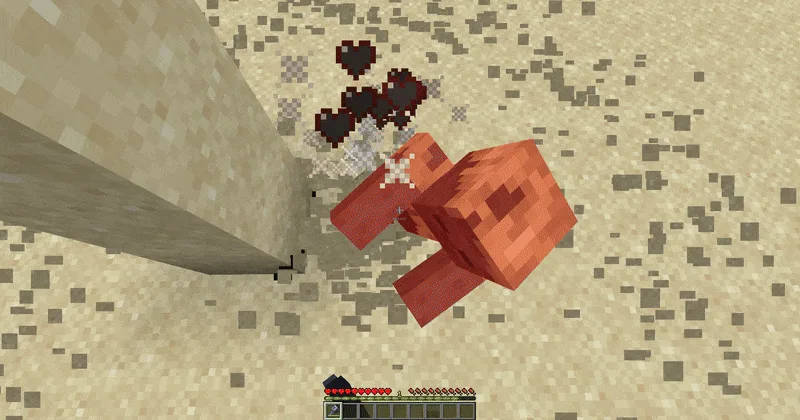
Three enchantments push that further, though not all on the same mace: Density (max V) adds roughly another 0.5 damage per block fallen for each level, stacking with the base scaling above, while Breach (max IV) instead ignores 15% of the target's armor effectiveness per level, cutting through heavy armor the smash formula alone can't. Density and Breach are mutually exclusive — the game will not let you enchant a single mace with both — so it's one damage path or the other, not a combo. Wind Burst (max III) is the one that pairs with either: it launches you roughly 8 blocks upward per level on a successful smash, letting you chain fall damage into the next hit instead of walking back up, which is what makes a Density or Breach mace something you can keep using instead of a one-shot gimmick.
Shields block almost everything, except
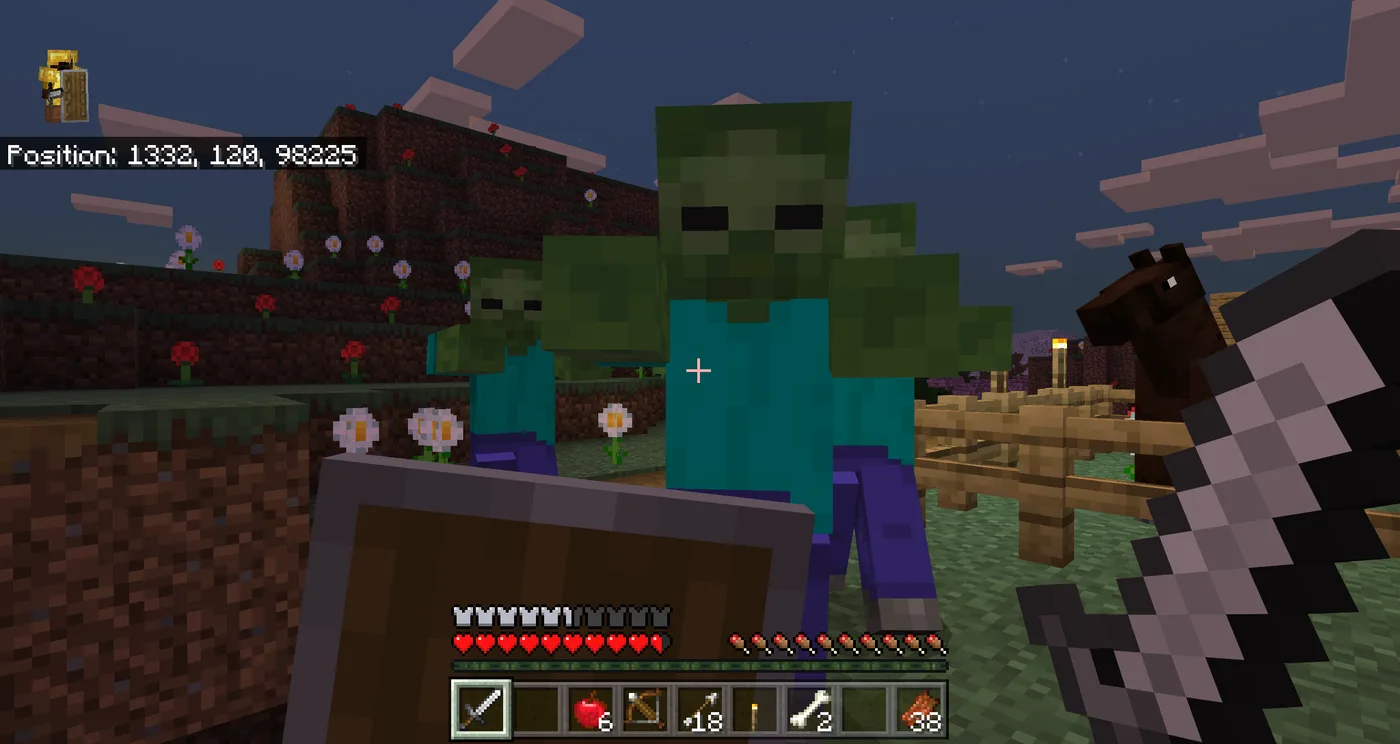
Raise a shield (right-click and hold on Java, sneak on Bedrock) and after a 5-tick (0.25-second) raise delay, it blocks a full semicylinder of coverage in front of you: melee hits, most arrows (Piercing-enchanted crossbow bolts punch straight through — see below), tridents, snowballs, eggs, shulker bullets, ghast and blaze fireballs, wither skulls, ravager headbutts, bee stings, and — on Java specifically — explosions.
It does not block: fall damage, splash and lingering potions, evoker fangs, the ender dragon's breath, the warden's sonic boom, lightning or Channeling-enchanted tridents, or piercing-enchanted crossbow bolts. A shield blocking a hit of 3 or more HP takes durability damage equal to that hit's strength, rounded up — chip damage adds up fast against a horde.
Axes disable shields for five full seconds
The axe's actual identity in combat isn't its damage — it's the crushing blow: hit a player or mob whose shield is actively raised with an axe, and every shield that player is holding is disabled for 5 real seconds, with no durability cost to the axe doing it. This applies whether the axe is player-wielded or carried by a mob — vindicators, piglin brutes, and axe-wielding zombie variants all trigger it. Five seconds is longer than most fights, which is why a raised shield stops being a safe default the moment an axe enters the fight.
Java and Bedrock are playing different combat games
This is the split that changes strategy, not just numbers. Seven things differ, and the first one reshapes everything else:
| Java Edition | Bedrock Edition | |
|---|---|---|
| Attack cooldown | Full system above | Does not exist — every swing deals full damage, as fast as you can click |
| Sweep attack | Sword-only, requires 84.8% charge | Does not exist, enchanted or not |
| Sweeping Edge enchantment | Exists, sword-only | Does not exist |
| Sword damage | 4 / 5 / 6 / 7 / 8 (wood→netherite) | +1 across the board: 5 / 6 / 7 / 8 / 9 |
| Axe damage | 7 / 9 / 9 / 9 / 10 | Sword damage minus 1: 4 / 5 / 6 / 7 / 8 |
| Critical hit + enchantments | Sharpness/Smite added after the crit multiplier | Sharpness/Smite added before the crit multiplier — stronger crits |
| Shield activation | Right-click / use | Sneak — usable even while another item occupies right-click |
The Bedrock damage swap is the one worth sitting with: because Bedrock removes the barehand-damage-doesn't-stack rule that Java uses, every weapon gains the 1 HP a bare fist would have added — except tridents and maces, which are unaffected. The knock-on effect is that axes deal less than swords of the same tier on Bedrock, the exact opposite of Java, where the axe is the harder-hitting weapon at every tier. A Java player's "always axe" instinct is a liability on Bedrock, and a Bedrock player's "sword is just better" instinct doesn't carry over to Java, where the axe still wins the raw per-hit trade.
What to actually carry
None of this adds up to one correct loadout — it adds up to knowing what each tool is actually for. A sword's 1.6 attack speed and access to sweep attacks make it the pick for groups and for any fight where you can land full-charge hits consistently. An axe trades that recovery speed for more damage per swing and the only shield-disable in the game, which matters most in PvP where the other player can just put a shield up and wait you out. A mace is dead weight without verticality — towers, elytra, wind charges, anything that puts you above the fight — and turns into the hardest-hitting weapon in the game the moment you have it. And on Bedrock, forget the Java hierarchy entirely: no cooldown means no crit-timing game, and the axe's usual damage lead is gone.
The one universal: check the attack charge indicator on your crosshair before you swing. Every mechanic in this guide — the crit, the sweep, the sprint-knockback lunge — is locked behind that same 84.8% number, on Java, regardless of which weapon is in your hand.
Frequently Asked Questions
What is attack cooldown in Minecraft and how does it work?
How do you get a critical hit in Minecraft?
Is an axe or a sword better in Minecraft?
How does the mace's smash attack damage work in Minecraft?
Do axes really disable shields in Minecraft?
Does Bedrock Edition have attack cooldown like Java Edition?
Keep Reading
- Minecraft Wiki — Attack cooldown: the recovery formula, damage-scaling curve, and 84.8% crit/sweep threshold
- Minecraft Wiki — Attack speed: exact attribute values for every weapon and tool type
- Minecraft Wiki — Damage: critical hit requirements and the +50% multiplier ordering
- Minecraft Wiki — Sweep attack: base 1 HP damage, area, trigger conditions, Java-exclusivity
- Minecraft Wiki — Sweeping Edge: per-level damage formula and sword-only restriction
- Minecraft Wiki — Sword: per-material Java and Bedrock attack damage tables
- Minecraft Wiki — Axe: per-material damage/speed tables and the crushing blow shield-disable mechanic
- Minecraft Wiki — Mace: base stats, smash attack fall-distance formula, Density/Breach/Wind Burst
- Minecraft Wiki — Shield: raise delay, blockable/unblockable damage list, durability loss, axe disable duration
- Minecraft Wiki — Combat: Java vs Bedrock damage and cooldown differences, shield activation controls
- Minecraft Wiki — Weapon: Bedrock sword/axe damage relationship and the trident/mace exceptions
Related Guides
Minecraft Spear Guide: Jab, Charge Damage, and Lunge
A diamond spear jabs for 4 damage. Held low on an elytra at rocket speed, the same spear charges for 37. The spear's charge takes its damage from how fast you are moving, and the weapon breaks several rules the rest of Minecraft combat runs on. Here are the real numbers for every tier, both attacks, and Lunge.
Minecraft Wandering Trader Guide: Trades, Spawns and Llamas
Every wandering trader shows 9 offers drawn from a pool of 100 that is the same on Java 26.3 and Bedrock 26.50. Here is the full price list from the game's own trade files, the odds of seeing the offer you want, what the trader buys from you, how long one takes to spawn, and why a name tag will not keep it.

Minecraft on Switch 2: Free Upgrade, Price and Minecoins
Digital owners of Minecraft for Nintendo Switch get the native Switch 2 version free in most regions until January 31, 2027. Cartridge owners have been offered nothing so far. Here are the editions, the US prices, what the native version changes, and the Minecoins change that lands on the same day.
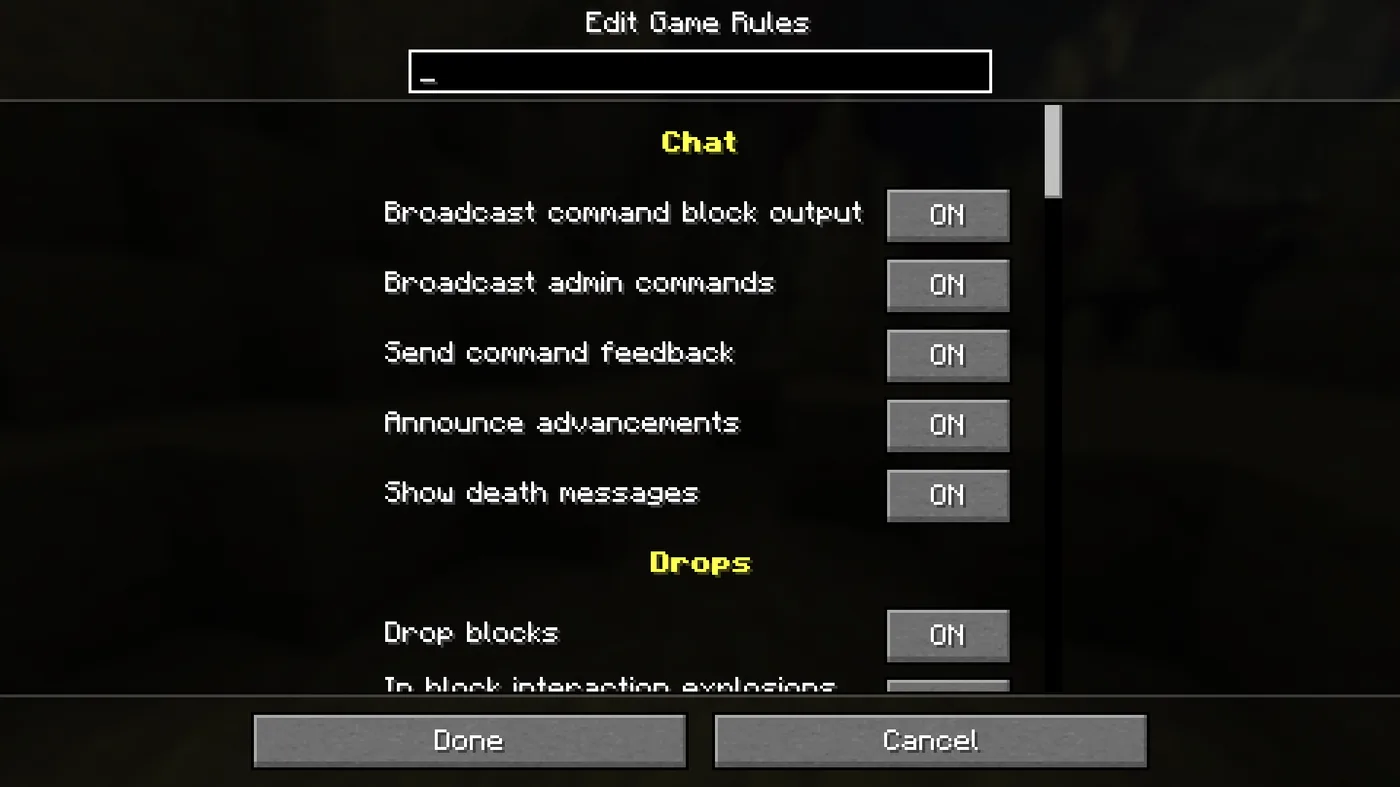
Minecraft Game Rules List: Every Rule and Its New Name
Java 1.21.11 renamed every game rule: keepInventory is keep_inventory now, doDaylightCycle is advance_time, and doFireTick is gone entirely. Here is the full list for Java 26.3 and Bedrock 26.50, with old names, new IDs, menu labels, defaults, and the 19 Bedrock rules that switch your achievements off for good.
Minecraft Survival Guide for Beginners: Your First Days
You have about ten minutes of daylight before the sun sets and the world tries to kill you. Here is exactly what to do with them — punch a tree, build a tool chain, and get a roof over your head before the zombies arrive.
Best Minecraft Enchantments, Ranked — The Ones Worth Your XP
Mending is the enchantment that ends the grind — gear that repairs itself forever. Everything else is a fight over your XP and anvil uses. Here is what actually earns a slot, ranked, with the real max levels.