Minecraft Wandering Trader Guide: Trades, Spawns and Llamas
Every wandering trader shows 9 offers drawn from a pool of 100 that is the same on Java 26.3 and Bedrock 26.50. Here is the full price list from the game's own trade files, the odds of seeing the offer you want, what the trader buys from you, how long one takes to spawn, and why a name tag will not keep it.
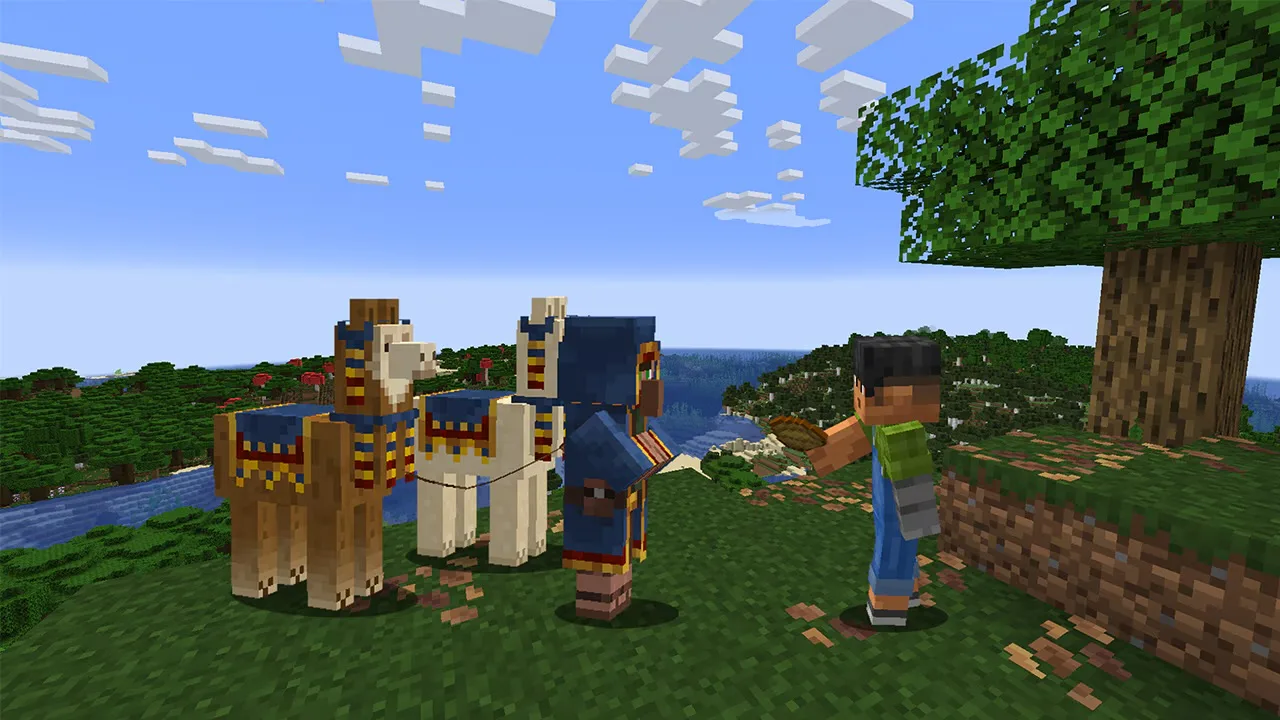
Every wandering trader rolls nine offers from a pool of exactly 100, and that pool is the same on Java 26.3 and Bedrock 26.50, down to the quantities, with one stock difference. So the useful question is not what the trader sells. It is how likely this particular trader is to be carrying the one thing you want. Blue ice turns up on one trader in eight. A name tag or a nautilus shell, about one in sixteen. A stack of logs of some kind, seven in eight.
The tables below come from the game's own trade files: Java's data-driven trade sets and the Bedrock trading table Mojang publishes in its bedrock-samples repository. The list has grown in each of the last three drops, so a price list from before 2026 is missing items. After the prices come the parts that decide whether you ever see one: what it buys from you, how long it takes to spawn, why a name tag will not keep it, and the two llamas it brings.
Wandering trader at a glance
| Detail | |
|---|---|
| Offers per trader | 9: two things it buys, two from a rarer pool, five common items |
| Offer pool | 100 on Java 26.3 and Bedrock 26.50 (6 buy, 16 rarer, 78 common) |
| Currency | Emeralds, on every offer |
| Restocks | No: a sold-out offer stays locked |
| Spawn roll | Once every 20 minutes (one in-game day), at 2.5%, then 5%, then 7.5% |
| Where it appears | On the surface, within 48 blocks of a player or of a bell near that player |
| How long it stays | 40 minutes on Java; 40 or 60 minutes on Bedrock |
| Comes with | 2 trader llamas on leads |
| Health | 20 |
| Does a name tag keep it? | No |
Nine offers from a pool of 100
The trading screen always lists the nine in the same order. First come two things the trader wants to buy, then two offers from a pool of 16 rarer goods, then five from a pool of 78 plants, dyes and blocks. Within each pool every offer is equally likely, and on Java the trade-set rules stop the same offer appearing twice on one trader.
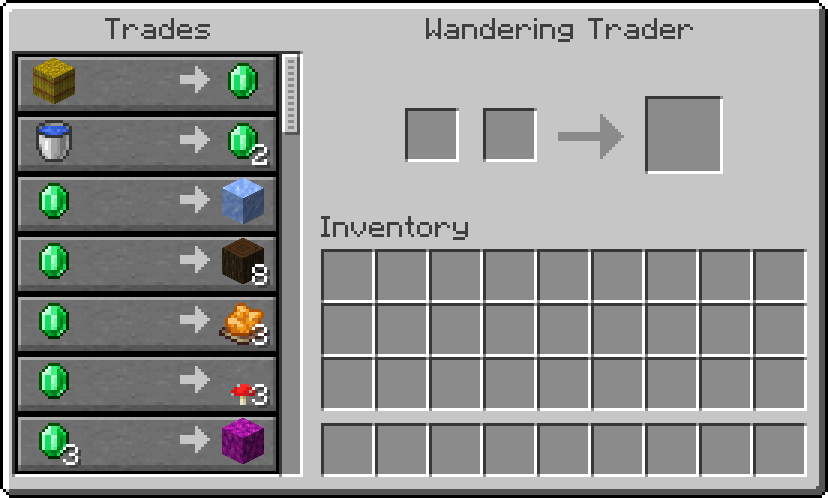
That screen is the order in practice: two buy offers, packed ice and a log stack from the rarer pool, then the commons. It also gives every offer a fixed chance of being on any given trader:
| Slots | Group | Pool size | Chance a given offer is on a trader |
|---|---|---|---|
| 1-2 | Buys from you | 6 | 1 in 3 (33%) |
| 3-4 | Rarer goods | 16 | 1 in 8 (12.5%) |
| 5-9 | Common goods | 78 | About 1 in 16 (6.4%) |
Whole categories are far likelier than any one item. Ten of the 16 rarer offers are log stacks, so 87.5% of traders carry at least one. With 16 dyes in the common pool, about 69% carry at least one dye; with ten saplings, about half carry a sapling; with five coral blocks, about 29% carry coral. Those four figures are our arithmetic from the pool sizes, not numbers from the game or the wiki.
What the trader buys from you
Since the Spring to Life drop (Java 1.21.5, March 25, 2025; Bedrock 1.21.70), the first two slots run the other way: the trader pays you. It picks two of these six, and each can be used twice.
| It buys | You get | Uses |
|---|---|---|
| Water bottle | 1 emerald | 2 |
| Water bucket | 2 emeralds | 2 |
| Milk bucket | 2 emeralds | 2 |
| Fermented spider eye | 3 emeralds | 2 |
| 4 baked potatoes | 1 emerald | 2 |
| Hay bale | 1 emerald | 2 |
So every trader is worth 4 to 10 emeralds before you buy anything: two 1-emerald offers used twice at worst, fermented spider eyes plus a bucket offer at best.
The six do not cost the same to fill:
- Water bottle is close to free. Three glass make three glass bottles, and the water comes from any source block.
- Hay bale beats a farmer. A bale is 9 wheat, and a novice farmer's wheat offer on Java is 20 wheat per emerald.
- Baked potatoes beat a farmer by more. Four cooked potatoes earn an emerald here; a novice farmer's potato offer on Java wants 26 raw ones.
- Fermented spider eye pays the most: 3 emeralds for a spider eye, a brown mushroom and sugar.
- Water and milk buckets take the bucket with them. That is 3 iron ingots for 2 emeralds, which only adds up if an iron farm is running.
Keep a few water bottles and a couple of hay bales in a chest where traders tend to appear, and the buy slots cover part of whatever you take from the rest of the list.
The 16 rarer offers
Slots 3 and 4 come from this pool. Ten of its 16 entries are 8-log stacks, one for each kind of overworld log.
| Offer | Price | Uses |
|---|---|---|
| Packed ice | 1 emerald | 6 |
| Blue ice | 6 emeralds | 6 |
| 4 gunpowder | 1 emerald | 2 |
| 3 podzol | 3 emeralds | 6 |
| 8 logs: acacia, birch, cherry, dark oak, jungle, mangrove, oak, pale oak, spruce or poplar | 1 emerald | 4 |
| Enchanted iron pickaxe | 6-20 emeralds (Java) | 1 |
| Potion of Invisibility, 8:00 | 5 emeralds | 1 |
Three of those need a note:
- Blue ice at 6 emeralds beats the packed ice offer. Nine packed ice craft one blue ice, so building it from the packed ice offer costs 9 emeralds, and natural blue ice drops nothing unless you break it with Silk Touch. A trader carrying it sells six blocks. Our transportation guide covers what a blue ice boat road is worth.
- The pickaxe is a gamble. On Java it is enchanted at levels 5 to 19 and priced at 1 emerald plus that level. It draws from the non-treasure enchantments, so it can roll Silk Touch or Fortune but never Mending.
- The potion is the long 8-minute version. Brewing it yourself takes nether wart, a golden carrot, a fermented spider eye and redstone; the potion brewing guide has the chain.
The 78 common offers
Slots 5 to 9 come from here. Rows that share a price and stock are grouped.
| Offer | Price | Uses |
|---|---|---|
| 3 of any of the 16 dyes | 1 emerald | 12 |
| Dandelion, poppy, allium, azure bluet, red, orange, white or pink tulip, oxeye daisy, cornflower, wildflowers | 1 emerald | 12 |
| Blue orchid | 1 emerald | 8 |
| Lily of the valley, open eyeblossom | 1 emerald | 7 |
| Wheat, beetroot, pumpkin or melon seeds | 1 emerald | 12 |
| Fern, tall dry grass | 1 emerald | 12 |
| Sugar cane | 1 emerald | 8 |
| Pumpkin | 1 emerald | 4 |
| 3 vines, 3 pale hanging moss, 3 brown mushrooms or 3 red mushrooms | 1 emerald | 4 |
| 3 shelf mushrooms | 1 emerald | 12 |
| 5 lily pads | 1 emerald | 2 |
| 8 sand | 1 emerald | 8 |
| 4 red sand | 1 emerald | 6 |
| 2 pointed dripstone, rooted dirt, moss blocks, pale moss blocks, small dripleaf or sulfur spikes | 1 emerald | 5 |
| Name tag | 1 emerald | 5 |
| Golden dandelion | 2 emeralds | 12 |
| Sea pickle, glowstone | 2 emeralds | 5 |
| Bucket of tropical fish, bucket of pufferfish | 3 emeralds | 4 |
| Kelp | 3 emeralds | 12 |
| Cactus | 3 emeralds | 8 |
| Firefly bush | 3 emeralds | 12 (Bedrock: 8) |
| Brain, bubble, fire, horn or tube coral block | 3 emeralds | 8 |
| Slimeball | 4 emeralds | 5 |
| Acacia, birch, cherry, dark oak, jungle, oak, pale oak, spruce or poplar sapling, or a mangrove propagule | 5 emeralds | 8 |
| Nautilus shell | 5 emeralds | 5 |
What the list leaves out matters as much. It has no tall flowers, no torchflowers, no pitcher plants, no wither roses, and only open eyeblossoms, not closed ones; the dye guide covers where those come from instead. In the other direction, the Minecraft Wiki lists the trader as the only glitch-free renewable source of sand, red sand, coral blocks and small dripleaf, which is a footnote in most worlds and the whole point in a skyblock or a desert-free seed.
What is worth your emeralds
Our call, based on how hard each item is to get any other way:
| Verdict | Offers | Why |
|---|---|---|
| Buy on sight | Blue ice; saplings for woods you lack, such as cherry, pale oak, mangrove or poplar; nautilus shells; coral blocks | Each one otherwise means Silk Touch, a long trip to one biome, or a slow fishing grind |
| Buy if you need it | Name tag, Invisibility potion, glowstone, slimeball, podzol, gunpowder, rare-wood logs | Fair prices for things you can also craft, brew, farm or find |
| Skip | Kelp and cactus at 3 emeralds each, pumpkins, seeds, ferns, the pickaxe | Easy to gather in the wild, or a random roll at up to 20 emeralds |
Two of those deserve a line each. A sapling is a one-off cost for a permanent tree farm, which makes it one of the better long-term buys in the pool even at 5 emeralds. And the nautilus shell trade caps at 5 per trader, so the 8 shells a conduit needs cannot come from a single visit. Since Java 26.1 and Bedrock 26.10 you can also craft a name tag from paper and a metal nugget, which our name tags guide covers.
How often a wandering trader spawns
The spawn logic, per the Minecraft Wiki, runs on one world-wide timer. It starts at 24,000 ticks, which is 20 minutes or one Minecraft day, and counts down. Each time it runs out it resets, and the game rolls: a 25% chance to attempt a spawn the first time, 50% the second, 75% from then on. An attempt picks a random player and has a 10% chance to place a trader near them. Multiply through and the real odds are 2.5%, then 5%, then 7.5% per day until a trader appears, after which the cycle starts over.
Those odds compound slowly. Worked through day by day (our arithmetic, assuming each successful roll finds somewhere to stand):
| In-game days played | Chance at least one trader has spawned |
|---|---|
| 1 | 2.5% |
| 2 | 7.4% |
| 5 | 26.7% |
| 10 | 50.4% |
| 20 | 77.2% |
| 30 | 89.6% |
The median wait is 10 in-game days, about 3 hours 20 minutes of play, and the average is about 14 days, close to 4 hours 45 minutes. A trader on your first evening is the lucky case, not the normal one.
Three rules decide where and whether it lands:
- Near a player, on top of the terrain. It spawns within 48 blocks of the chosen player, on the surface. If you are mining at diamond level, it spawns on the ground above you, not in your tunnel.
- The mob cap does not block it. Per the wiki, traders and their llamas still spawn when the passive mob cap is full.
- Game rules can switch it off. On Java it needs both
spawn_wandering_tradersandspawn_mobson. Bedrock has no dedicated game rule and uses/mobevent minecraft:wandering_trader_eventinstead. Our game rules list has both.
A bell decides where it shows up
On Java, if a bell is within 48 blocks of the chosen player, the nearest bell becomes the spawn centre instead. Put one bell where you want to do business, and a trader that spawns while you are nearby lands around the bell rather than wherever you happen to be standing. On Bedrock, traders also try to spawn by a claimed bell in a village. Our villages guide covers what else a bell does.
Why it leaves, and what will not stop it
A trader is a visitor on a timer:
- Java: it leaves after 48,000 ticks, 40 minutes, of being loaded near a player. Time spent with its trading screen open does not count, and the timer freezes while its chunk is unloaded.
- Bedrock: Mojang's entity file gives it a timer of 40 or 60 minutes, a coin flip, after which it leaves as soon as no player is within 24 blocks. It also leaves early if it has nothing left to sell and nobody is within 24 blocks, so buying it out and walking off ends the visit.
A name tag, a boat or a minecart will not keep it. Mojang closed the named-trader report, MC-143982, as working as intended. On Java, a trader from a spawn egg or /summon starts with no despawn timer and stays, which is the route for a permanent trader in a creative build.
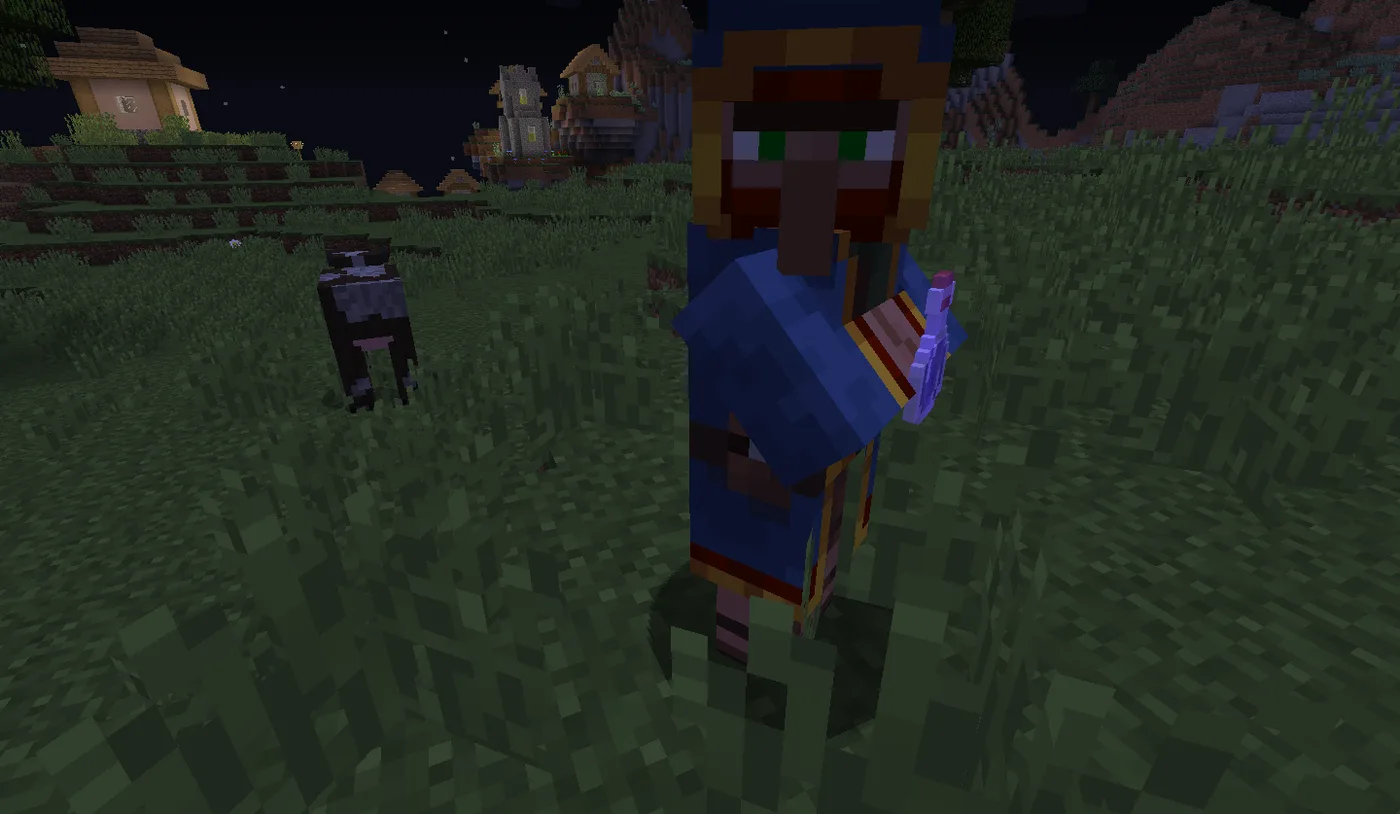
Two behaviours explain a trader you have lost track of. At dusk it drinks a Potion of Invisibility, and at dawn it drinks milk to clear the effect, so a trader you saw at sunset may simply be invisible. And it keeps at least 8 blocks between itself and zombies and illagers. A trader killed by a zombie does not become a zombie villager, and hitting one does not anger iron golems, though its llamas will fight back.
The trader llamas are the free loot
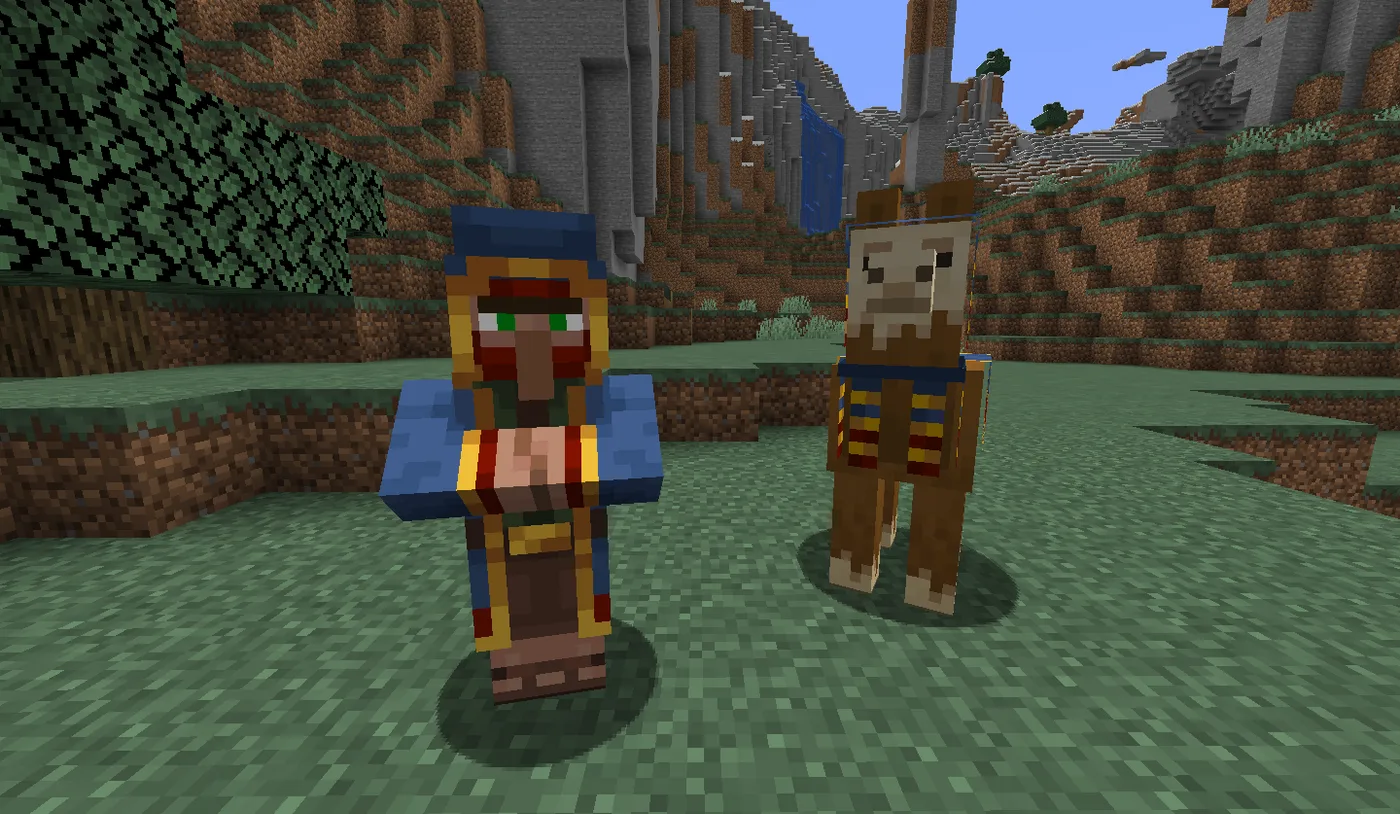
Each trader spawns with two trader llamas on leads, and they are the part of the visit you can keep:
- Two free leads. Snip each lead with shears and it drops at its llama, per the wiki.
- Two llamas you can keep. On Bedrock a trader llama is tamed the moment it is off the trader's lead, and it stays. On Java it only becomes tamable, and cutting the lead is not enough on its own: per the wiki's Java despawn rules, an untamed trader llama keeps counting down to roughly the moment its trader would have left, then vanishes. Tame it and it stays for good; while it is on your own lead, tied to a fence post or ridden, the countdown pauses.
- Pack animals. A tamed llama carries a chest with 3 to 15 slots depending on its strength, and putting a lead on one pulls up to nine nearby llamas into a caravan behind it. The horses and mounts guide covers llama hauling.
They are not decoration. Hit the trader, or let a mob hit it, and the llamas spit for 1 damage, 1.5 on Hard; on Peaceful they never attack. On Java, breeding a trader llama with a regular llama always gives a regular llama.
Java vs Bedrock: the delta list
The trade pool is where the editions match most closely. The differences sit around it:
| Java 26.3 | Bedrock 26.50 | |
|---|---|---|
| Offers and quantities | 100 | The same 100 |
| Firefly bush stock | 12 | 8 |
| Turning spawns off | spawn_wandering_traders game rule | /mobevent minecraft:wandering_trader_event false |
| Spawn centre | The chosen player, or the nearest bell within 48 blocks of them | Near a player; also tries claimed village bells |
| Leaves after | 40 minutes loaded | 40 or 60 minutes, once no player is within 24 blocks |
| Sold out | Timer only | Leaves once no player is within 24 blocks |
| Hero of the Village discount | No | Yes, per the wiki |
| Unleashed trader llama | Tamable; despawns on its old timer unless tamed | Tamed immediately |
| Spawn egg | Arrives without llamas and has no despawn timer | Llamas always come with it |
What changed, and what comes next
| Version | What the trader gained |
|---|---|
| Java 1.21.5 / Bedrock 1.21.70 (Spring to Life) | The two buy slots, better prices and more stock, plus log stacks, the enchanted iron pickaxe and the Invisibility potion |
| Java 26.1 / Bedrock 26.10 (Tiny Takeover) | Name tags at 1 emerald, as master librarians stopped selling them; golden dandelions |
| Java 26.2 / Bedrock 26.30 | Sulfur spikes |
| Java 26.3 / Bedrock 26.50 (Wilderness Bound) | Poplar saplings, poplar logs and shelf mushrooms |
| Java 26.4 Snapshot 3 (October 6, 2026) | 2 icicles for 1 emerald and 1 ice crystal for 2 emeralds, 5 uses each |
That last row is snapshot-only. Mojang's Snapshot 3 changelog does not mention it, but the snapshot's trade files and the wiki both list the two offers, and the trade table in Bedrock Preview 26.60.29 does not have them yet. When 26.4 ships with them, the common pool grows to 80 and the full pool to 102, and the ice crystals from the snapshot's ice caves get a renewable source on Java. Each recent addition also saves a trip to a new biome: sulfur spikes grow in sulfur caves, and poplar and shelf mushrooms come from the dappled forest added in Wilderness Bound.
Quick Action Checklist
- Expect a long wait. The median is about 10 in-game days of play before the first trader; the game rolls once every 20 minutes at 2.5% to 7.5%.
- Put a bell where you want to trade. On Java, a bell within 48 blocks of you becomes the spawn centre.
- Stock the buy slots. With water bottles, hay bales, baked potatoes, fermented spider eyes and a couple of spare water or milk buckets on hand, every trader is worth 4 to 10 emeralds.
- Check slots 3 and 4 first. Blue ice at 6 emeralds is the one rarer-pool offer on our buy-on-sight list.
- Buy the sapling, not the logs, for any wood you want to keep growing.
- Take the llamas. Snip both leads with shears for two free leads, then tame the llamas on Java so they stay (Bedrock tames them for you).
- Do not bother with a name tag. It does not stop a trader leaving.
- On Java 26.4 snapshots, look for icicles and ice crystals in the common slots.
Frequently Asked Questions
How do you make a wandering trader spawn in Minecraft?
How long does it take for a wandering trader to spawn in Minecraft?
What does the wandering trader sell in Minecraft?
What does the wandering trader buy in Minecraft?
Can you stop a wandering trader from despawning in Minecraft?
Does the wandering trader sell blue ice and name tags?
Keep Reading
- Java Edition 26.3 vanilla data (misode/mcmeta): every wandering trader offer, with prices and max uses
- Java Edition 26.3 vanilla data (misode/mcmeta): the 78-offer common trade pool (buying and uncommon tags sit alongside it)
- Mojang bedrock-samples v1.26.50.4: Bedrock wandering trader trade table (2 / 2 / 5 offers from 6 / 16 / 78)
- Mojang bedrock-samples v1.26.50.4: Bedrock wandering trader entity (40 or 60 minute timer, 24-block despawn check)
- Java 26.4 Snapshot 3 vanilla data (misode/mcmeta): ice crystal offer (2 emeralds, 5 uses)
- Minecraft Wiki — Wandering Trader: spawn timer and odds, bell rule, despawning, behaviour and trade history
- Minecraft Wiki — Trader Llama: leads, taming once unleashed, the Java despawn countdown, caravans and spit damage
- Minecraft.net — Minecraft 26.4 Snapshot 3 (October 6, 2026): adds icicles and ice crystals; the changelog does not mention the new trader offers
- Minecraft Wiki — Trade set: Java trade sets do not allow duplicate offers by default
- Minecraft Wiki — Sand: the wandering trader as the only renewable source
- Minecraft Wiki — Blue Ice: Silk Touch requirement and 9 packed ice per block
- Minecraft.net — Minecraft Java Edition 1.21.5 (March 25, 2025): wandering trader trade rebalance and buy offers
- Minecraft.net — Minecraft Java Edition 26.1 (March 24, 2026): name tags move from master librarians to the wandering trader
- Minecraft.net — Minecraft Java Edition 26.3 (September 15, 2026): poplar saplings and shelf mushrooms in wandering trader trades
- Minecraft.net — Test new ways of exploring (February 12, 2025): source of the hero image
Related Guides
Minecraft Dye Guide: How to Make All 16 Colors
Fifteen of Minecraft's sixteen dyes come from a single item you can pick up, smelt or squid. Purple is the only one that does not exist outside a crafting grid, and green is the only one with no crafting recipe at all. Here is the whole palette in one table, which biome hands you eight of the sixteen for free, and the sheep trick that turns one dye into unlimited coloured wool.

Minecraft Name Tags Guide: How to Get, Use & Secret Names
A name tag is the cheapest insurance policy in Minecraft: name a mob and it will never despawn, no matter how far you roam. Recent versions finally let you craft one from a scrap of paper and a metal nugget, so there's no excuse for losing that perfect horse anymore. This guide covers every way to get one, the anvil step people skip, and the hidden names that flip mobs upside down.

Minecraft Villager Jobs Guide: Professions & Workstations
Every villager job comes down to one block. Put down a lectern and you get a librarian; put down a composter and you get a farmer. Here is the full profession-to-workstation map, how the claiming actually works, and how to force the exact villager you want.

Minecraft on Switch 2: Free Upgrade, Price and Minecoins
Digital owners of Minecraft for Nintendo Switch get the native Switch 2 version free in most regions until January 31, 2027. Cartridge owners have been offered nothing so far. Here are the editions, the US prices, what the native version changes, and the Minecoins change that lands on the same day.

Minecraft Survival Guide for Beginners: Your First Days
You have about ten minutes of daylight before the sun sets and the world tries to kill you. Here is exactly what to do with them — punch a tree, build a tool chain, and get a roof over your head before the zombies arrive.

Best Minecraft Enchantments, Ranked — The Ones Worth Your XP
Mending is the enchantment that ends the grind — gear that repairs itself forever. Everything else is a fight over your XP and anvil uses. Here is what actually earns a slot, ranked, with the real max levels.