Minecraft Trident Guide: Drop Rates, Riptide, Channeling
The trident is the only weapon in Minecraft with no crafting recipe, and the drop chain behind it is worse than most players think — roughly one trident per 188 drowned. Here is the real math, the farm rules that actually produce tridents, and every Java-versus-Bedrock number that matters.
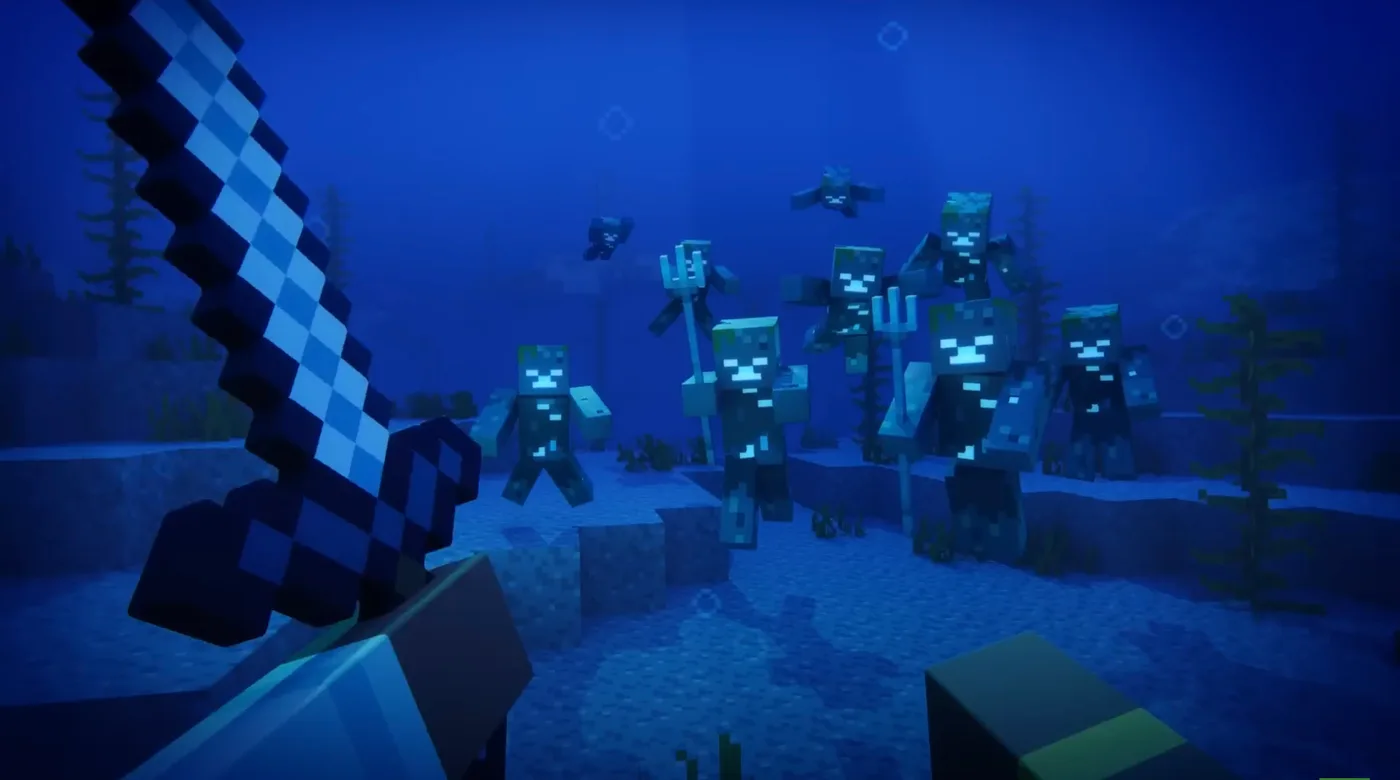
Roughly one drowned in 188 hands you a trident. That is the honest number, and it explains why so many players spend an evening at a river, kill sixty zombies, and conclude the game is broken. It is not broken — you are fighting two separate dice rolls stacked on top of each other, and most guides only ever mention one of them.
The trident is also the only weapon in the game with no crafting recipe at all. No amount of diamonds, prismarine, or nautilus shells makes one. You take it off a corpse or you go without. Everything below is checked against Java Edition 26.2 and Bedrock Edition 26.40, the current releases as of August 2026 — which matters more than usual here, because Bedrock quietly rewrote its trident drop rate in the 1.21.120 cycle and a lot of the advice still floating around is now wrong.
Why you cannot craft a trident
There is no recipe. There is no smithing template, no upgrade path, no villager who sells one. In survival the trident has exactly two sources:
- Drowned. A small slice of naturally-spawned drowned come into the world already holding a trident, and killing one of those has a small chance of making it drop.
- Trial chamber vaults. Tridents appear in vault and reward chest loot at a 2.1% chance per container. If you are already running trial chambers for a heavy core you may stumble into one — but 2.1% is not a plan.
That is the whole supply chain. Everything else you have heard — fishing it up, trading for it, shipwreck loot — is wrong. Drowned or vaults.
The real drop math behind every trident
Here is the part that ruins people. Getting a trident requires two successes in a row:
- 6.25% of naturally-spawned drowned spawn holding a trident. (Another 3.75% spawn holding a fishing rod instead — the two are mutually exclusive.)
- If you kill one of those trident-holders yourself, or with a tamed wolf, there is an 8.5% chance it drops the trident. Looting adds a flat 1% per level, capping at 11.5% with Looting III.
Multiply those and the chance that any given drowned you meet eventually becomes a trident is 0.53% without Looting, or 0.72% with Looting III. Which works out like this:
| Drowned killed | At least one trident (no Looting) | At least one trident (Looting III) |
|---|---|---|
| 50 | 23% | 30% |
| 100 | 41% | 51% |
| 200 | 65% | 76% |
| 400 | 88% | 94% |
The median is about 130 kills bare-handed and about 96 kills with Looting III. Half of everyone reading this will need more than that. It is not bad luck; it is the design.
Bedrock players: burn your old notes. Bedrock used to drop tridents at a flat 25% with no Looting scaling, which is why every "Bedrock is easier" claim exists. In Bedrock 1.21.120 that was cut to 8.5% to match Java, and Looting now applies. The same update let drowned spawn with enchanted tridents and stopped them dropping a held trident in place of a nautilus shell. Then Bedrock 26.0 brought the spawn ratios in line with Java too. As of 26.40 the two editions produce tridents at the same rate.
One more trap: the trident only drops when you or a tamed wolf land the killing blow, and Looting only counts on the hit you deliver. A drowned that dies to fall damage, suffocation, lava, or a cactus still drops its rotten flesh — that has no player-kill flag on it — but you lose the trident, the copper ingot and the XP. This single rule invalidates most generic mob-farm designs.
Where drowned actually spawn: Java vs Bedrock
Drowned generate in water blocks with a block light level of 0 and an internal sky light of 7 or lower, in ocean biomes, river biomes, and the aquifers of dripstone caves. Rivers and dripstone caves spawn them at a noticeably higher rate than oceans do. Beyond that shared baseline, the editions diverge in ways that decide where you build:
Java Edition
- Drowned spawn individually, inside flowing or source water that is 2 blocks or taller — waterlogged blocks and bubble columns count.
- In oceans and dripstone caves they only spawn at Y < 58. That restriction does not apply to rivers.
- Because rivers have no Y limit, a deep enough river spawns drowned in broad daylight, as long as the water column drops the sky light to 7 or below.
Bedrock Edition
- Drowned spawn in groups of 2 to 4 in oceans, frozen rivers, and dripstone caves, but individually in rivers.
- River spawns work in water of any depth, though water 2 blocks or taller still spawns them faster.
- They only generate on the highest spawnable block at a given X/Z column — surface spawns only, no stacking depth.
- They carry density caps on top of the normal hostile mob cap: 5 in oceans, 2 in rivers.
That last Bedrock line is the one that catches people. A Bedrock river farm can only ever hold two drowned at a time, so a big beautiful river build throttles itself; deep ocean is the better Bedrock canvas even though rivers spawn faster per attempt.
Building a drowned farm that actually drops tridents
The single most common mistake: zombie-conversion farms produce zero tridents. Drown a zombie and you get a drowned, but in Java a converted drowned never receives new equipment — it just keeps whatever the zombie was already holding. In Bedrock, converted drowned are explicitly never equipped with tridents, and anything the zombie was carrying is dropped at full durability during the conversion. Either way, no tridents. Conversion farms are fine for rotten flesh, fishing rods, copper ingots, and (on Bedrock) nautilus shells. They will never give you a trident.
So a trident farm must harvest naturally-spawned drowned. The rules that follow from that:
- Build in a river on Java. No Y < 58 restriction, higher spawn rate than ocean, and it runs during the day. Confirm the biome on the F3 screen before you place a single block — river biomes are narrow and it is easy to be one chunk outside.
- Build in deep ocean on Bedrock if you want throughput, because of that 2-drowned river density cap.
- Stay at least 24 blocks away. Nothing spawns inside a 24-block radius of you. Java gives you room out to 128 blocks; Bedrock's tighter despawn window means you have to hover much closer, in the 24-to-44 block band.
- Kill them yourself. Fall damage into a collection chamber is the classic design and it is exactly what you cannot do here. Drop them to near-death and finish with a Looting III weapon, or let a tamed wolf do it — wolf kills count.
- Light everything else. Any other valid spawn space in range steals from your farm's share of the mob cap.
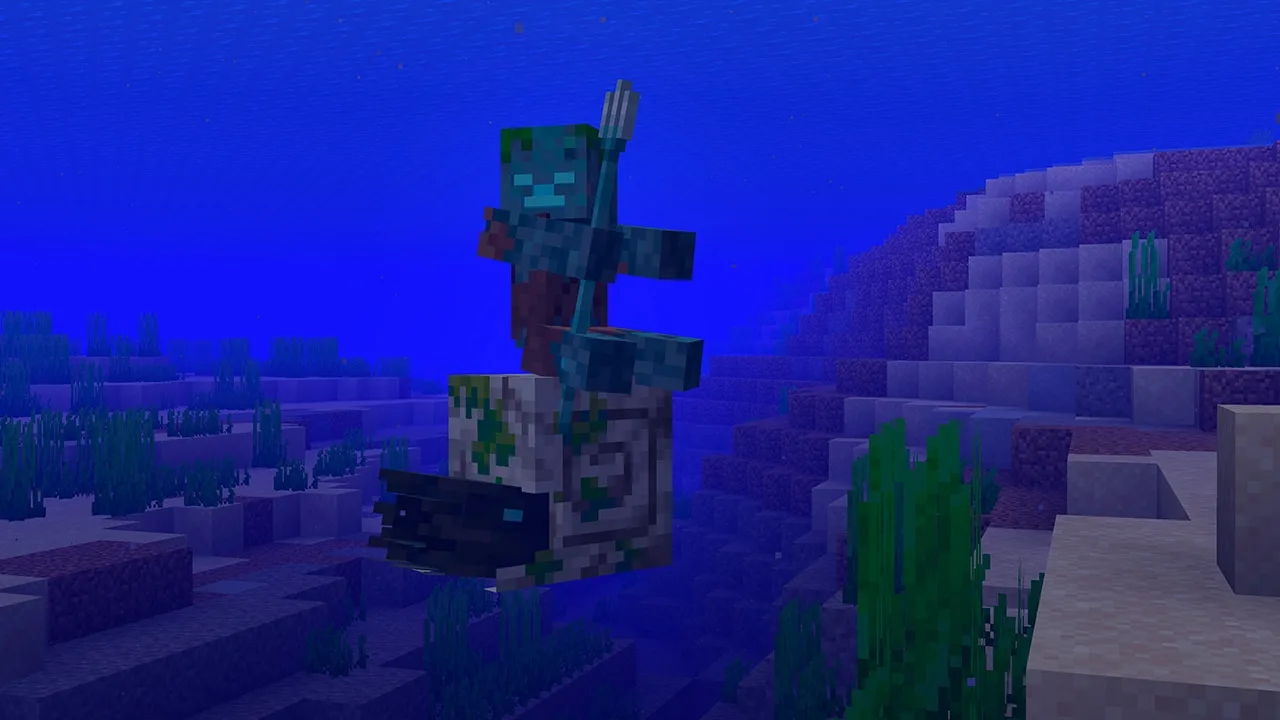
There is a newer wrinkle that most farm tutorials predate. Since Java 1.21.11 and Bedrock 1.21.130, an adult drowned that spawns holding a trident outside a river biome has a 50% chance to spawn riding a zombie nautilus — a zombie nautilus jockey. Half your ocean farm's trident-holders now arrive mounted on a 15-health mob that swims independently, does not despawn if it came from an ocean ruin, and generally clogs collection systems built for single mobs. Frozen rivers and regular rivers are exempt. That is a fresh argument for the river build on both editions.
Do not drop your trident near a drowned. As of Java 1.21.4, drowned that can pick up loot prefer tridents over everything else on the ground. Lose one in a farm and something down there will grab it — but picked-up equipment drops at 100%, at whatever durability it already had, so kill the thief and you get the trident straight back. The cost is finding it in a tank full of identical mobs, not another 8.5% roll.
The byproducts are decent while you grind: adult drowned drop 5 XP (gurgles, the baby variant renamed in the 26.1 update, drop 12 XP), 0-2 rotten flesh, and an 11% chance of a copper ingot that scales at 2% per Looting level. Nautilus shells are the real prize — 3% of Java drowned and 8% of Bedrock drowned spawn with one in the offhand, and a held shell always drops. Eight of those plus a heart of the sea is a conduit.
Trident damage: the numbers that differ by edition
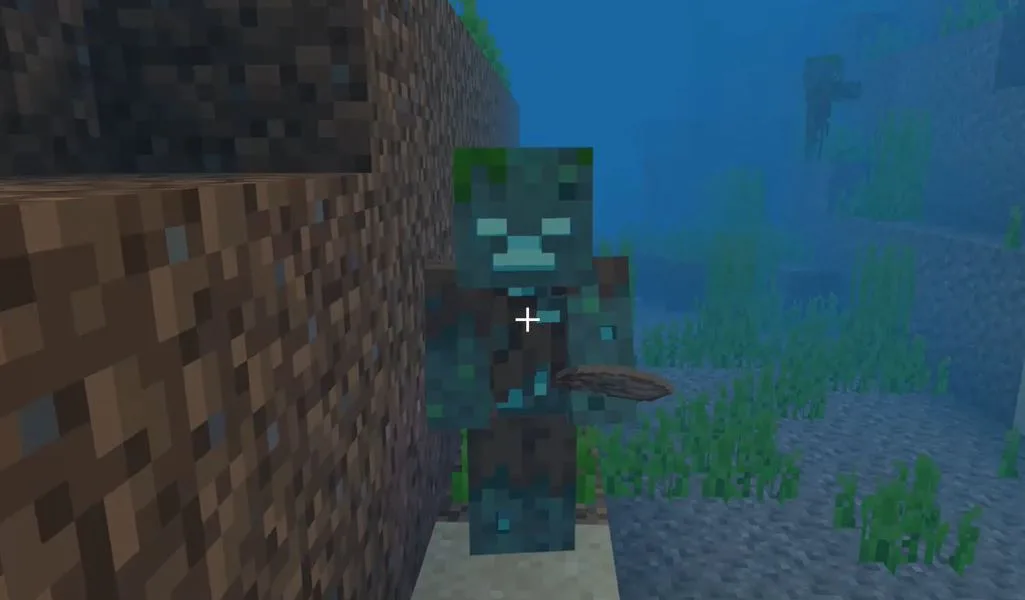
The trident is unusual: it is the only item that is a full-strength melee weapon and a throwable projectile, and the two modes have separate stat lines.
| Stat | Java Edition | Bedrock Edition |
|---|---|---|
| Melee damage | 9 (4.5 hearts) | 9 (4.5 hearts) |
| Melee critical | 13.5 | 13.5 |
| Attack speed | 1.1 (0.909s cooldown) | no cooldown |
| Melee DPS | 9.9 | 18 |
| Thrown damage | 8 (4 hearts) | 8 (4 hearts) |
| Charge time | 0.5s | 0.5s |
| Thrown DPS | 16 | 16 |
| Attack range | 3 blocks | 3 blocks |
| Durability | 250 | 251 |
| Enchantability | 1 | 1 |
Two things jump out. First, Bedrock has no attack cooldown, so the same 9-damage swing produces 18 DPS instead of 9.9 — the trident is close to twice as strong in melee on Bedrock, exactly as every melee weapon is. Second, throwing out-damages swinging on Java (16 DPS versus 9.9) because the 0.5-second charge beats the 0.909-second attack cooldown, while on Bedrock melee is the stronger option. If you play Java, the trident wants to be thrown; if you play Bedrock, it wants to be swung.
Also worth knowing: the trident has no special attack. Swords sweep, axes land crushing blows, the mace smashes, and the spear added in 1.21.11 jabs and charges — the trident does none of it. What it does have is a projectile that does not slow down in water or lava, which no other ranged option manages.
Two edition-specific projectile quirks:
- Java: a thrown trident damages only one entity per throw and despawns after 60 seconds if you do not pick it up.
- Bedrock: a thrown trident never despawns, and it can damage multiple entities as long as it touches a solid block between hits. Bedrock also lets dispensers fire tridents regardless of enchantment.
The four exclusive enchantments
Four enchantments exist only on tridents, plus the usual durability set:
| Enchantment | Max level | What it does | Conflicts with |
|---|---|---|---|
| Loyalty | III | Returns the trident to you after it lands; higher levels return it faster | Riptide |
| Riptide | III | Replaces the throw with a launch that hurls you forward in water or rain | Loyalty, Channeling |
| Channeling | I | Calls a lightning bolt when the thrown trident hits during a thunderstorm | Riptide |
| Impaling | V | Bonus damage — see the edition split below | — |
| Unbreaking | III | Chance to skip durability loss | — |
| Mending | I | Repairs the trident with collected XP | — |
| Curse of Vanishing | I | Destroys the trident on death | — |
Impaling is the biggest hidden edition difference in the whole item. In Java, Impaling only boosts damage against aquatic mobs — guardians, drowned, squid, dolphins, turtles, fish. In Bedrock, it boosts damage against any mob or player that is standing in water or being rained on. That makes Impaling a niche monument-clearing enchantment on Java and a genuinely strong general-purpose enchantment on Bedrock every time it rains.
The per-level values differ slightly too:
| Impaling level | Java melee damage | Bedrock melee damage |
|---|---|---|
| None | 9 | 9 |
| I | 11.5 | 11 |
| II | 14 | 14 |
| III | 16.5 | 16 |
| IV | 19 | 19 |
| V | 21.5 | 21 |
The trident has an enchantability of 1 — the lowest value in the game. Slapping one on an enchanting table gives you miserable rolls no matter how many bookshelves you own. Enchant books instead and combine them at an anvil. Channeling is also the rarest of the four by enchantment weight (1, against Loyalty's 5), so expect to hunt for that book specifically.
Loyalty and Channeling can coexist. Riptide excludes both. That means there are exactly two endgame tridents, and you probably want one of each: a Loyalty III + Channeling I + Impaling V + Unbreaking III + Mending throwing trident, and a separate Riptide III movement trident.
Riptide and Channeling: the two trick enchantments
Riptide stops being a weapon enchantment and becomes a transport system. Charge it while you are standing in water, or while rain is falling on your block, and it flings you forward instead of leaving your hand. Distance scales at +6 blocks per level: 9 blocks at Riptide I, 15 at II, 21 at III. Snowy weather in some biomes triggers it as well.
Two consequences most players miss:
- You can no longer throw a Riptide trident. At all. The throw is gone, replaced by the launch. This is why a Riptide trident is a second trident, never your only one.
- The launch itself deals damage. Collide with a mob mid-flight and it takes melee damage — including critical damage if you are falling — plus splash damage to everything in an 8.25 x 8.25 x 4.25 box around the impact. That splash stacks with Impaling and with the Strength effect.
Pair it with an elytra and the numbers get silly: a riptide boost can push you to roughly 125 blocks per second, against about 33.5 blocks per second from firework rockets. It only works while you are wet, so it is a burst tool rather than a rocket replacement — but as a way to get airborne from a standing start in the rain with no launch tower, nothing else comes close.
Channeling is the lightning button, and the two editions gate it differently:
- Java: a thunderstorm must be active, and you have to hit a mob or player who is themselves standing in the rain, or hit a lightning rod that is in the rain.
- Bedrock: hitting a lightning rod calls lightning down even in ordinary rain, no thunderstorm needed.
A Channeling hit deals 13 damage ranged instead of the base 8, and the lightning does the rest. Use it to make charged creepers for mob heads, turn a pig into a zombified piglin, a villager into a witch, or a red mooshroom into a brown one — on demand, instead of waiting on the sky.
Repairing a trident without wrecking it
The trident has the most restrictive repair rules of any weapon: the only material that repairs a trident is another trident. No iron ingots, no diamonds, no netherite. Combine two damaged tridents on an anvil and you get their durability added together plus a 5% bonus, with both sets of enchantments preserved. A grindstone does the same durability math but strips the enchantments off, so use the anvil.
Given that the second trident costs another ~130 drowned, Mending is not optional on a trident — it is the difference between a permanent weapon and a consumable. Get Mending on it before you get attached to it.
The rest of the durability rules:
- Throwing costs 1 durability whether or not the throw hits anything. Riptide launches cost 1 as well, plus 1 more if you collide with an entity.
- A trident with 1 durability or less cannot be thrown at all — it silently refuses.
- Java: throwing a Loyalty trident into the void destroys it. Bedrock: it returns to you. Bedrock players get a free pass on the single most expensive mistake in the game.
- Loyalty tridents survive lava. They take fire damage and come back anyway, which makes a Loyalty trident a surprisingly good Nether ranged option.
- If your inventory is full when a Loyalty trident returns, it hovers next to you until you make room rather than dropping.
One last thing on the receiving end: a drowned holding a trident throws it every 1.5 seconds out to 20 blocks, for 8 damage on Normal — 5 on Easy and 12 on Hard in Java, a flat 8 at every difficulty on Bedrock — and keeps throwing long after you leave the water. On Java, though, a trident-holding drowned is neutral during the day and only fights back if provoked — at night or during a thunderstorm they turn hostile on sight. Raid your farm in daylight and a shield handles the rest.
Quick Action Checklist
- Accept the math: 6.25% spawn with a trident, 8.5% drop it — about 1 trident per 188 drowned
- Bring Looting III to the kill; it raises the drop to 11.5% and only counts on your own killing blow
- Never build a zombie-conversion farm for tridents — converted drowned never carry them on either edition
- Farm natural spawns in a river biome on Java (no Y < 58 limit, works in daylight); deep ocean on Bedrock (rivers cap at 2)
- Stay at least 24 blocks from the spawn platform, and closer than 44 blocks on Bedrock
- Build two tridents: Loyalty III + Channeling I + Impaling V for combat, Riptide III for travel
- Put Mending on it early — the only other repair material is a second trident
- Remember Impaling hits aquatic mobs on Java but anything wet on Bedrock
Frequently Asked Questions
How do you get a trident in Minecraft?
What is the trident drop rate in Bedrock Edition?
Why does my drowned farm never drop tridents?
What is the difference between Impaling on Java and Bedrock?
Can you have Riptide and Loyalty on the same trident?
How do you repair a trident in Minecraft?
What is a zombie nautilus jockey?
Keep Reading
Related Guides

Minecraft Nautilus Guide: Taming, Riding, and the Dash
Nine months after Mojang shipped the first mount you tame with a fish instead of a carrot, the site still has no dedicated guide to it — just scattered mentions across the armor drop table, the trident guide's jockey mechanic, and the status effects list. Here is the whole pipeline: taming odds, the dash mechanic, breeding, and the effect that stops you from drowning while you ride one.
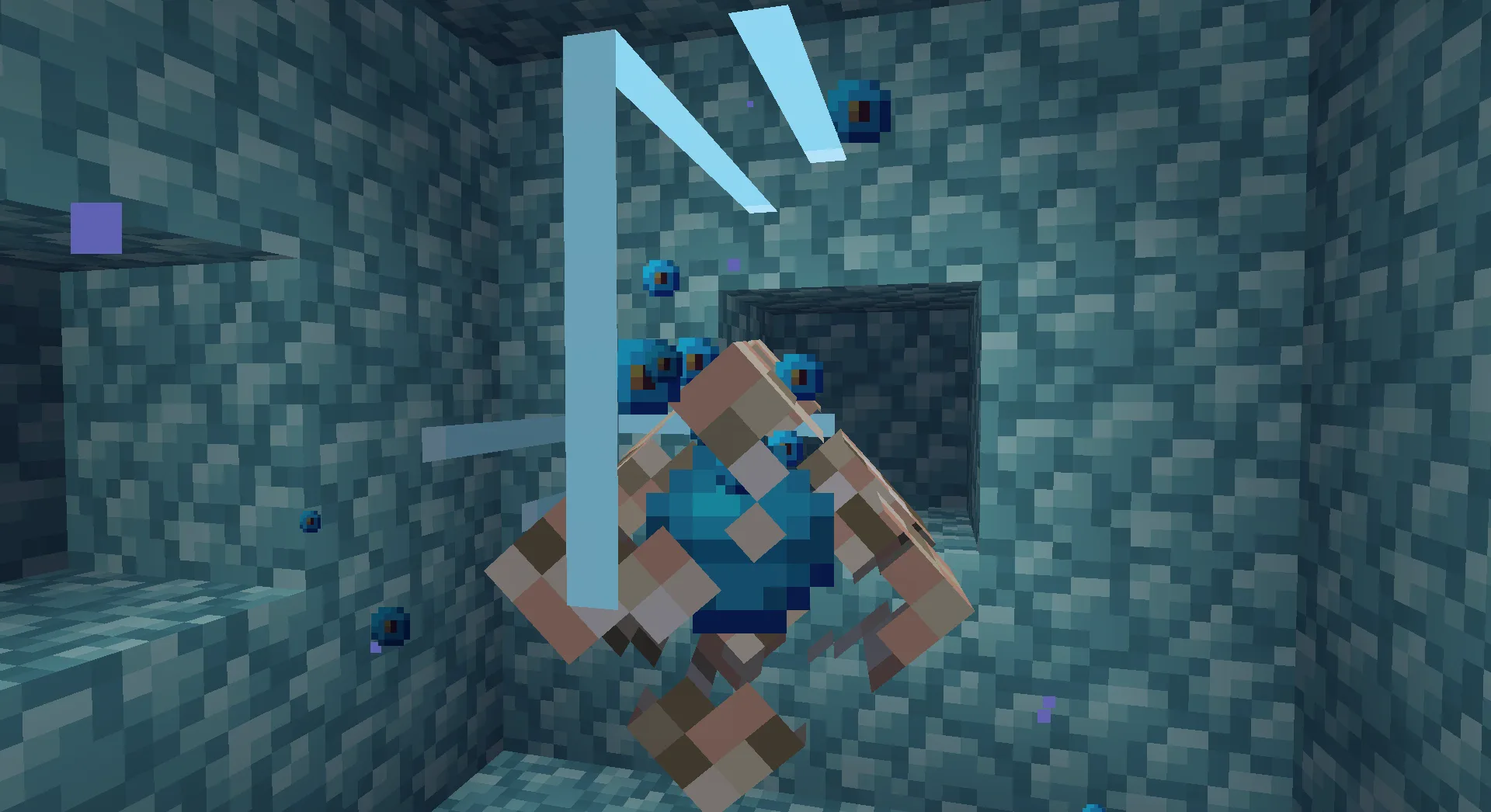
Minecraft Conduit Guide: Build and Power the Ocean Beacon
A conduit is the ocean version of a beacon — it hands you unlimited underwater breathing, night vision, and faster mining, then punches nearby drowned to death on its own. The catch is the prismarine frame and the nautilus shells. Here is the whole build, block by block.
Minecraft Advancements List and How to Get the Hard Ones
Minecraft Java has 126 advancements, but only 23 pay XP, and one of them pays 1,000. Here is every advancement by tab for Java 26.3, the challenges ranked by reward, the full Adventuring Time, Monsters Hunted, A Balanced Diet and Two by Two checklists, the descriptions that mislead you, and what the 26.4 snapshots change.
How to Make a Saddle in Minecraft: Recipe and Loot Odds
Saddles have been craftable since June 2025: three leather and one iron ingot. Here is the recipe and what it really costs, every chest, trade and mob drop that still gives one with Java and Bedrock odds, the five chests that stopped, all eleven mobs it fits, and how shears take it back.

Minecraft Survival Guide for Beginners: Your First Days
You have about ten minutes of daylight before the sun sets and the world tries to kill you. Here is exactly what to do with them — punch a tree, build a tool chain, and get a roof over your head before the zombies arrive.
Best Minecraft Enchantments, Ranked — The Ones Worth Your XP
Mending is the enchantment that ends the grind — gear that repairs itself forever. Everything else is a fight over your XP and anvil uses. Here is what actually earns a slot, ranked, with the real max levels.