Kayou Naruto Fake Cards: The Check Is Not on the Card
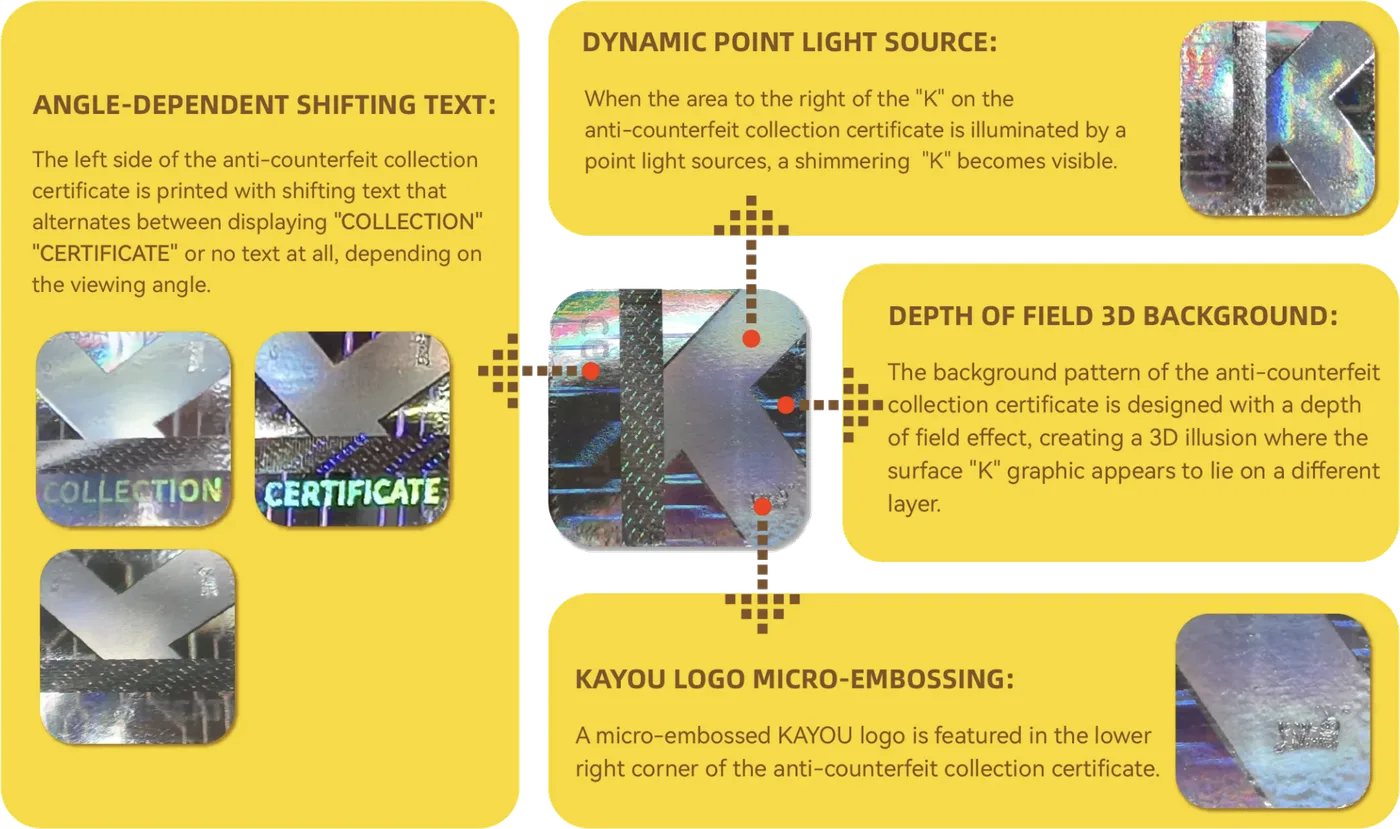
Kayou’s FAQ answers "How to verify the authenticity of a KAYOU product?" with a single image and no text at all. That image names four security features — shifting text, a point-light "K", a depth-of-field background and a micro-embossed logo — and every one of them lives on the anti-counterfeit collection certificate rather than on a Naruto card. Two of the nine regions in Kayou’s own country registry carry the page at all, and the site’s product pages never say which products ship a certificate.
Ask Kayou how to tell a real card from a fake and you do get an answer. You just do not get any words.
"How to verify the authenticity of a KAYOU product?" is a real entry on Kayou's official US FAQ. Open it and it expands into a single image, 2,075 by 1,229 pixels, and that image is the entire answer. No sentence above it, no sentence below it, no link out, no follow-up. Whatever Kayou wants you to look at, it is inside that picture or it is nowhere.
So I read the picture, and then I went looking for what it leaves out. The short version: it is a genuinely useful set of four checks, and not one of them is a check you can run on a Naruto card.
The whole answer is one picture
In the FAQ's page data the answer is typed as a single block of type "image" with no accompanying text block, and the image element itself ships with an empty alt attribute. That has consequences beyond pedantry. The guidance is not selectable, not translatable, not readable by a screen reader, and its words are nowhere in the page's HTML for a search engine or an answer engine to pick up. The official answer exists. It is just not in a form anything can quote back to you.
Here is what it contains, transcribed.
The four checks, in Kayou's own words
| Check | Where Kayou says to look | What you should see |
|---|---|---|
| Angle-dependent shifting text | Left side of the certificate | Text that alternates between "COLLECTION", "CERTIFICATE", and no text at all, depending on viewing angle |
| Dynamic point light source | The area to the right of the "K" | A shimmering "K" becomes visible when that area is lit by a point light source |
| Depth-of-field 3D background | The background pattern | A depth-of-field effect creating a 3D illusion, with the surface "K" graphic appearing to lie on a different layer |
| Kayou logo micro-embossing | Lower right corner | A micro-embossed KAYOU logo |
The diagram illustrates each one with a macro photograph, and the shifting-text example is the most convincing of the four: the same patch of foil photographed three times, reading "COLLECTION" at one angle, "CERTIFICATE" at another, and nothing at all at a third.
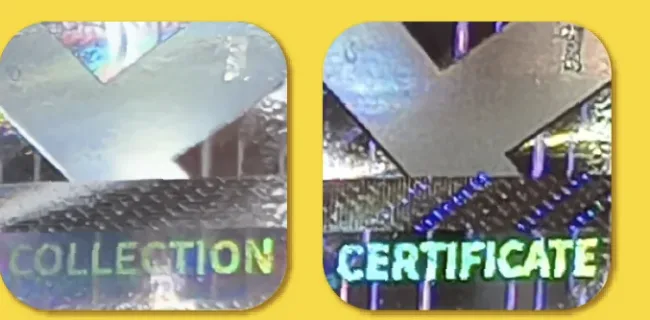
Only one of the four is defined by change: the shifting text, which alternates as the viewing angle moves. The point-light "K" needs a particular kind of light rather than any motion, the depth-of-field background is a property of the printed pattern, and the micro-embossing is a static mark you can point at. All four describe the same object: a foil label dominated by a large angular "K".
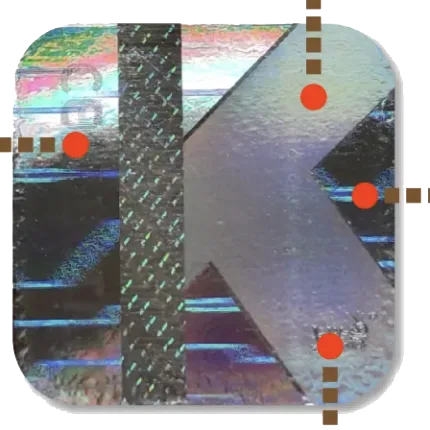
Every check is on the certificate, not the card
This is the part the diagram never says out loud, and it is the part that matters most.
Read the four captions again and every one of them names the same thing: "the anti-counterfeit collection certificate". Not the card. Not the pack. Not the sealed box. The four features are properties of a certificate, and the guidance is a guide to authenticating that certificate.
Which raises the obvious question, and Kayou's own site does not answer it. I pulled the US product pages for NARUTO Smriti Heaven Scroll Series 1, Earth Scroll Series 2 and the Ninja Age Premium Collector Box and searched all three for the word "certificate". Zero hits. Those pages carry model numbers, packaging specs, package dimensions, rarity tiers and card counts — they do not state which Naruto products include an anti-counterfeit collection certificate, or where it sits in the packaging when they do.
So the honest summary of Kayou's published position is this: there is a documented way to authenticate a certificate, and there is no documented way to authenticate a card. If you are holding a loose single bought off a marketplace with no certificate attached, the official guidance has nothing for you. That is not me being cynical about it — it is the scope of the document.
It also lines up with what is physically printed on the cards themselves. Going through the official card images for the rarity ladder and card anatomy, a Kayou Naruto card carries art, a name plate, a rarity badge and a card code along the bottom edge. Nothing Kayou publishes describes any of those as a security feature.
Two of nine regions carry the page
Kayou runs separate regional storefronts, and the authenticity entry is not on all of them. Kayou's own country registry — shipped in the page data behind every one of its FAQ pages — lists nine published regions. Six are served on kayouofficial.com itself: the United States, United Kingdom, Germany, France, Spain and Italy. The other three, Japan, Vietnam and Indonesia, carry a redirect to a separate domain, and their FAQ URLs on kayouofficial.com render Kayou's "MORE ANSWERS COMING SOON — Published FAQ entries are not available yet for this region" empty state with no questions in it at all.
So the six below are every region whose FAQ Kayou actually publishes here. I opened all six in English and listed every question each one has.
| Region | Authenticity entry | Retailers Kayou names | Support address |
|---|---|---|---|
| United States | Yes | Target, Amazon, Walmart, Best Buy, GameStop, Barnes & Noble, local hobby stores, Kayou's own store, TikTok Shop | us.cs@kayouofficial.com |
| United Kingdom | Yes | Waterstones, HMV, Smyths, Cardfactory, Amazon, local hobby stores and card shops | emea.cs@kayouofficial.com |
| Germany | No | Media Markt, Rossmann, Thalia, Müller, local hobby stores | emea.cs@kayouofficial.com |
| France | No | Auchan, E.leclerc, Carrefour, local hobby stores | emea.cs@kayouofficial.com |
| Spain | No | Amazon, Carrefour, Fnac, local hobby stores | emea.cs@kayouofficial.com |
| Italy | No | No "where to buy" entry published either | emea.cs@kayouofficial.com |
The US FAQ publishes five questions, the UK five, France four, Germany and Spain three, Italy two. The authenticity diagram appears on the US and UK pages only. The two images are the same file — identical bytes, same MD5 — served from two upload paths dated 17 June and 1 July 2026. So it is one document, published twice, and seven of Kayou's nine published regions do not have it.
Italy is the thin one: two questions, covering box labels and card bending, with nothing on buying and nothing on authenticity. An Italian buyer following Kayou's own site gets neither the check nor the list of shops.
The QR-code answer that never shipped
There is a fifth thing worth knowing about, because it is the kind of detail that gets quoted as official once and then repeated forever.
Every one of those six FAQ pages — the four without an authenticity entry included — ships an unrendered template string in its JavaScript payload containing a different authenticity answer. It reads, in full: "Each KAYOU card comes with unique security features, including holographic stamps and QR codes that can be scanned via our official app for instant verification."
It does not render. Not on any locale. It sits in the bundle next to other obviously unfinished placeholder copy — a retailer answer that just says to "check our partners section", pull-rate blurbs promising "oversized odds for top-tier chase cards" that no product page repeats — and there is no App Store or Google Play link anywhere on the pages I pulled.
Treat it as what it is: template text that was never turned on. If you encounter "scan the QR code in the Kayou app" presented as official guidance, that sentence is where it came from, and Kayou is not currently publishing it. The rendered answer is the diagram, and the diagram says nothing about QR codes, apps or scanning.
What a point light source means in practice
Two of the four checks are written in optical terms that are easy to skim past, so, plainly:
A point light source is a small, single, undiffused light — a phone torch, a bare bulb, a pen light. It is the opposite of a window or an overhead office panel, which spread light from a wide area. Kayou's "shimmering K" check is specified against a point source, so a diffuse light is not the condition it describes.
Angle-dependent means exactly that: the shifting text is defined by what happens as the viewing angle changes, so the check involves tilting the certificate or moving relative to it rather than looking at it straight on. The depth-of-field background is a different kind of thing — Kayou describes it as a property of the printed background pattern, a 3D illusion of layering, not as something that only appears in motion.
None of that is exotic. It does mean that a check run flat on a shop shelf under ceiling lighting is not the check Kayou described for the shimmering "K". It also means the shifting text is the one feature a single photograph cannot show you, and Kayou's own diagram is built that way: it spends three separate stills on the shifting text and demonstrates the point-light "K" and the micro-embossed logo in one frame each, with the layered background called out on the main photograph.
What to do when you cannot run the check
If there is no certificate in front of you, or you cannot get the light right, the site still gives you three practical things.
Buy from a retailer Kayou names for your region. The table above is that list. On the six FAQ pages it is the only counterfeit-adjacent advice outside the diagram itself, and it lives in the "Where can I buy KAYOU Cards?" answer rather than the authenticity one.
Use a grader if the card is worth it. Encapsulation by a major grading company includes an authentication step, and Kayou has worked directly with one: its own news post for the 2026 National Sports Collectors Convention advertised "Complimentary INSTANT Beckett On-Site Grading" at booth #2820, alongside early access to the Ninja Age Premium Collector Box. On the other side of the counter, CGC's census already holds 1,668 graded Kayou Naruto cards, so graders are already taking the material in.
Email the regional address. us.cs@kayouofficial.com for the US, emea.cs@kayouofficial.com for the UK and the European storefronts. That is the customer service contact Kayou publishes in its own site footer, and it is the route that puts your specific item in front of a person.
One thing that is not evidence of a fake: a Heaven Scroll card that appears to be peeling, or a card with a slight bend. Kayou's own FAQ explains both — a protective film applied to PTR cards in that release, and hygroscopic cardstock reacting to humidity — and both are covered in more detail in our Kayou collector guide.
What this does and does not tell you
What Kayou has actually published:
- One authenticity document, a single image with no text, on the US and UK storefronts only — byte-identical on both.
- Four named security features: angle-dependent shifting text, a point-light-revealed "K", a depth-of-field 3D background, and a micro-embossed KAYOU logo in the lower right corner.
- All four located on the anti-counterfeit collection certificate.
- A per-region list of retailers it names, and a per-region support address.
What it does not publish:
- Which Kayou Naruto products include an anti-counterfeit collection certificate. The Heaven Scroll, Earth Scroll and Ninja Age product pages do not mention one.
- Any check you can run on a card, a pack or a sealed box.
- Any code, serial-number or app-based lookup. The QR-code-and-app line exists only as unrendered template text.
- Any verdict on a specific item. Four security features describe what a real certificate does; that is a description, not a test that clears the card in your hand.
Frequently Asked Questions
How do you check if Kayou Naruto cards are real?
Do Kayou Naruto cards have an anti-counterfeit feature printed on the card?
Does Kayou have a QR code or app to verify cards?
Where should you buy Kayou Naruto cards to avoid counterfeits?
Is a peeling or bent Kayou Naruto card a fake?
Which Kayou regional sites publish authenticity guidance?
Keep Reading
- KAYOU Official US FAQ, opened 12 September 2026 — carries the "How to verify the authenticity of a KAYOU product?" entry whose entire answer is one image with no text; also the US retailer list and us.cs@kayouofficial.com
- The authenticity answer image itself (2,075 x 1,229) — names angle-dependent shifting text, dynamic point light source, depth-of-field 3D background and KAYOU logo micro-embossing, all on the anti-counterfeit collection certificate
- KAYOU Official UK FAQ — the only other Kayou regional site carrying the authenticity entry; serves a byte-identical copy of the same image and names the UK retailer list
- KAYOU Official Germany FAQ — three questions, no authenticity entry; names Media Markt, Rossmann, Thalia, Müller
- KAYOU Official France FAQ — four questions, no authenticity entry; names Auchan, E.leclerc, Carrefour
- KAYOU Official Spain FAQ — three questions, no authenticity entry; names Amazon, Carrefour, Fnac
- KAYOU Official Italy FAQ — two questions, no authenticity entry and no retailer list
- NARUTO Smriti Heaven Scroll Series 1 product page — model NR-RDIV-Z001-NA, 158 cards, 10 rarity tiers, 8 cards/pack, 24 packs/box; no mention of a certificate or any security feature
- NARUTO Smriti Earth Scroll Series 2 product page — checked for "certificate", zero occurrences
- NARUTO Smriti Ninja Age Premium Collector Box product page — checked for "certificate", zero occurrences
- KAYOU Latest Activities — the KAYOU x BECKETT post for NSCC 2026 (booth #2820, 29 July–2 August) advertising complimentary on-site Beckett grading and early access to the Ninja Age Premium Collector Box
Related Guides
NARUTO Mythos TCG: Breakflip and Zvezdar Disagree
Our own NARUTO Mythos TCG explainer, five days old, named Zvezdar Toys as the company bringing the game to Europe and North America — sourced to trade press, because Cicaboom's own site never spelled it out anywhere we could find. This morning Cicaboom published a company update naming a different company, Breakflip, as the coordinator for those exact regions, and stated in writing that Breakflip is 'not the distributor.' Its own Products page, three clicks away, still names Zvezdar for the same three regions using the same three email addresses. Zvezdar's own site still calls itself the official distributor. All three pages are live right now, and none of them mentions the other two.
Naruto Card Game Distributors: 16 Names, No Order Date
The third item in the NARUTO CARD GAME site's navigation is FOR RETAILERS. It carries a full OFFICIAL DISTRIBUTOR list — 16 companies across North America, Europe, Oceania, Latin America and the Middle East — and then stops. There is no ordering window, no enrollment path, no product to order. Here is the whole list, what the page does not say, and how it lines up against the same page on Bandai's four shipped English-language card games.
Kayou Naruto Grading: 82% of CGC Grades Are a 10
CGC publishes a live population report for Kayou Naruto cards, and reading all 1,668 entries answers the question the product pages cannot: what actually happens when you send these things off. The short version is that the grade is barely a lottery — and the set code the grader files your card under is not the one printed on it.
Kayou Has Six Naruto Sets in the US Now — and the Series Numbers Do Not Mean What You Think
Kayou's US site now lists six NARUTO Smriti sets across three product lines, 880 cards in eleven months. The box names say Heaven Scroll, Chapter Jin and Earth Scroll with series numbers attached — but the codes printed on the cards tell a completely different story about which set follows which, and one line quietly carries Boruto-generation cards that the others do not.
Naruto Card Game Explained: Bandai, Kayou or Mythos?
Search "Naruto cards" and you get three unrelated products stacked on top of each other: a competitive TCG from Bandai that nobody can buy until Summer 2027, a line of Chinese-made collectible cards from Kayou that has been in Walmart since 2025, and a third game — Cicaboom's NARUTO Mythos TCG — that has been on European shelves since March 2026 and is already running sanctioned tournaments. Here is exactly what each one is, what each publisher has actually confirmed, and which one the person asking the question actually wants.
Kayou Naruto Cards Explained — A Collector Guide With No Hype Attached
Kayou Naruto cards are stacked in Target, Walmart and GameStop, and almost nobody selling them can tell you what the letters on the corner mean. They are collectibles, not a playable game, and the rarity ladder is rebuilt from scratch every set. Here is the whole vocabulary, straight off Kayou official product pages, with no prices and no pull rates.