Naruto Card Game Explained: Bandai, Kayou or Mythos?
Search "Naruto cards" and you get three unrelated products stacked on top of each other: a competitive TCG from Bandai that nobody can buy until Summer 2027, a line of Chinese-made collectible cards from Kayou that has been in Walmart since 2025, and a third game — Cicaboom's NARUTO Mythos TCG — that has been on European shelves since March 2026 and is already running sanctioned tournaments. Here is exactly what each one is, what each publisher has actually confirmed, and which one the person asking the question actually wants.
Somebody in your life is going to buy the wrong Naruto cards this year. Probably for a birthday. They will search "Naruto card game," see a wall of orange packaging with Naruto's face on it, hit buy, and hand over a product that does not do the thing the recipient wanted.
That is not the buyer being dumb. It is genuinely confusing right now, because three unrelated companies are selling three unrelated things under names that read almost identically. One is a competitive trading card game from Bandai that you cannot buy yet, and so far can only play at a convention tutorial session. One is a collectible line from Kayou that has been sitting in Walmart since fall 2025 and has no gameplay attached to it at all. And one — NARUTO Mythos TCG, from an Italian publisher called Cicaboom — is a competitive card game that has been on European shelves since March 2026 and ran its first Regional Championship in September 2026. This post did not mention it until its 26 September 2026 update.
Here is the whole mess, sorted, using only what the publishers have actually said.
The short answer, before you spend anything
If you want a card game you can buy and play against another human being right now: that is NARUTO Mythos TCG, not Bandai. Cicaboom's game released its first set in Europe, the UK, Turkey and the MENA region on 13 March 2026, links a downloadable rulebook from its official site, and has run a Store Championship season and two Regional Championships in 2026: Paris in mid-September and Orlando on 27 September. US distribution is still being sorted out — more on that below.
If you want Bandai's game specifically: there is no game product to buy yet. Bandai's NARUTO CARD GAME had its world debut at Gen Con 2026 (July 30 to August 2, Indianapolis) and Bandai has stated a worldwide launch of Summer 2027. That is roughly a year out from this post. No cards on sale. No preorders. No decks you can take home: for now, the only way to play it is a tutorial session at a convention, and at Gen Con, New York Comic Con, PAX Aus, SPIEL Essen, Paris Games Week, Lucca and Tabletop.me those sessions are free and the demo deck stays at the table. In-store tutorials follow in January 2027.
If you want cards to collect, open, and look at: that is Kayou. Kayou's NARUTO Smriti collectible cards launched in the US market in fall 2025 and are stocked at mainstream retail. They are collectibles in the sports-card sense. There is no ruleset, no format, no tournaments.
Those three sentences are the entire post if you are in a hurry. Everything below is the receipts.
Bandai's NARUTO CARD GAME: the real TCG
Bandai announced NARUTO CARD GAME on June 18, 2026 under its BANDAI CARD GAMES brand, with a newly commissioned key visual, a promo video, and a statement from Masashi Kishimoto himself. Kishimoto's line in the announcement — "I'm glad to see the world of NARUTO grow larger once again" — is the tell that this is a first-party, creator-blessed project, not a licensing side-quest.
Bandai is not a stranger here. This is the same publisher currently running the One Piece Card Game, Dragon Ball Super Card Game Fusion World, and the Gundam Card Game. Those are all genuine competitive TCGs with organized play, and NARUTO CARD GAME slots into that same brand family. The framing Bandai has used from day one is "strategy" and "competitiveness" — not "collect them all."
The content pool covers NARUTO, NARUTO: Shippuden, and BORUTO: NARUTO NEXT GENERATIONS. So the card pool is not limited to the Part 1 nostalgia window.
The one thing that matters most: it does not release until Summer 2027. Anybody telling you otherwise, or selling you something that they claim is "the new Bandai Naruto TCG," is selling you something else.
What Bandai has actually revealed about the rules
On July 29, 2026 — one day before the Gen Con debut — Bandai published the first real mechanical detail. This is what is confirmed, and I am deliberately not going past it:
Deck construction. A player brings a Leader card, a 51-card deck, 5 Chakra cards, and 1 Summon card.
Win condition. Reduce your opponent's Leader's Life to zero. That is it. One win condition, stated plainly, which is a good sign for a game that wants to be teachable in a convention hall.
The five card types Bandai has named:
- Leader card — the heart of the deck. It determines your color, and your color determines which Characters you are allowed to include. It also carries the Life total you are defending.
- Character card — your front line. Characters attack, and Characters activate Jutsu by paying Chakra.
- EX Character card — stronger characters that only come online after you meet certain conditions during the match. Bandai's framing is momentum-shifting, which reads like a comeback or escalation mechanic.
- Chakra card — the resource pool. You spend Chakra to fire off Jutsu and Support effects. Note that Chakra is a separate five-card allotment, not part of the 51 — so your resource engine is a fixed, non-random element rather than something you draw into.
- Summon card — required to bring Character cards into battle. One per deck. Bandai's ABOUT page adds that you rest the Summon card to put a Character on the field.
That last pair is the genuinely interesting design decision. Most TCGs make resources a deck problem: Magic makes you draw lands, Pokémon makes you draw Energy, and both games are famous for the losses that come from drawing the wrong amount. Bandai carving Chakra out into its own five-card allotment, plus a single mandatory Summon card, suggests they are deliberately removing the classic "I got mana screwed" feel-bad.
Two mechanics that were unknown at launch have since been printed on Bandai's own sample cards, and are worth pulling out here because people still repeat the old version. Spending Chakra turns a Chakra card face-down, and both published Leader cards carry an identical ◇Recovery line: "If it is the second turn or later, rest this card and flip all of your CHAKRA face-up." So the resource does reset, on the Leader, from turn two. And Shikamaru Nara's sample Character card prints "[During Your Opponent's Attack] Summon this card and interrupt that attack" — an off-turn response window, printed on a card. We transcribed all seven of those cards in Naruto Card Game rules text.
What Bandai has NOT published as of August 2026: turn phases and their order, how much Chakra you can spend in a turn, the full list of colors, how DMG, POW and HP resolve against each other in combat, deck-building restrictions like copy limits, a keyword glossary, the set list, product SKUs, or MSRP. If you see any of those specifics stated as fact somewhere, it did not come from Bandai.
What the first sample cards show
Bandai has put a set of English sample cards on the official site — twelve of them in the showcase gallery as of 31 August 2026 — and they are worth actually looking at rather than reading about, because the layout answers questions the press release did not.
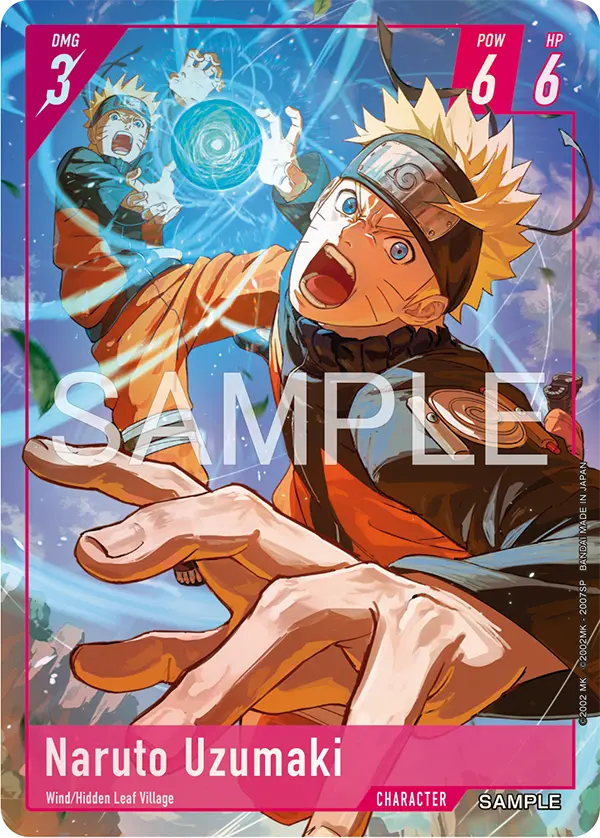
Every sample Character card carries three numbers: DMG in the top-left corner, and POW and HP paired in the top-right. Underneath the card name sits a trait line — Naruto's reads "Wind / Hidden Leaf Village," a different Sasuke sample reads "Lightning / Uchiha Clan," and another Naruto sample reads "Special / Jinchuriki / Hidden Leaf Village / Team 7." So traits carry an element or attribute first, then affiliations: village, clan, team.
That last one is a tribal-deck signal you can read from three feet away. If "Team 7" and "Uchiha Clan" are printed traits, cards that care about traits are coming. Every TCG that prints faction tags on cards eventually prints a card that says "for each Team 7 character you control."
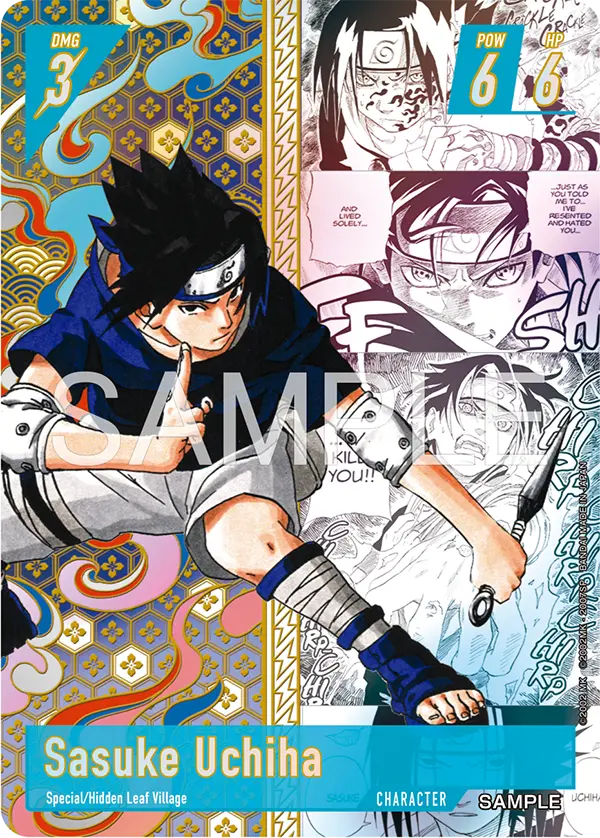
The art direction is doing more work than usual. Some samples are clean single-character illustrations. Others build the frame out of actual manga panels from Kishimoto's original pages — screentone, speech bubbles, sound effects and all. Bandai has also said guest artists are contributing original illustrations. This is the same "chase card as art object" playbook One Piece runs, and it works.
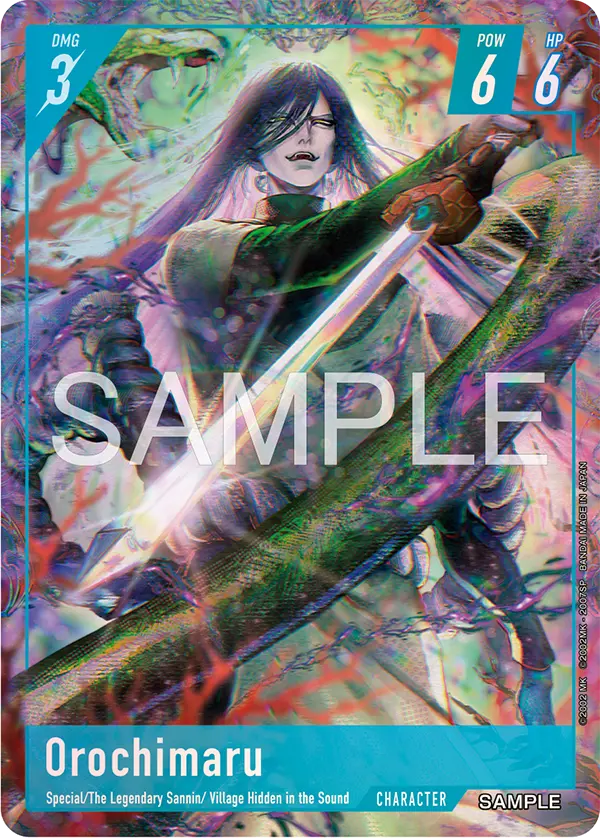
Two honest caveats about the showcase gallery specifically, because this is where people start inventing things.
First, the stat numbers are placeholders. All twelve gallery Character samples show DMG 3, POW 6, HP 6 — Naruto, Sasuke, Sakura, Jiraiya, Orochimaru, Itachi, Boruto and Tsunade, three separate Sasuke cards among them, every one identical. Nobody balances a TCG by giving every character the same stat line. Treat those digits as art-mockup filler, not as a preview of the power curve. The cards Bandai prints real numbers on, elsewhere on its site, do vary: DMG 1 and 2, POW 3 to 10, HP 4 and 8.
Second, none of the twelve gallery cards shows a rules box. The art is full-bleed with a SAMPLE watermark over it and no text box. That is a property of the gallery, not of the game — Bandai's ABOUT page carries seven other sample cards that do print rules text, including a named Jutsu (Shikamaru Nara's Shadow Possession Jutsu), a printed Chakra cost of 1, and a LIFE 15 box on both published Leader cards. If someone quotes you Naruto TCG card text, check it against that page before assuming it is invented.
The gallery frames come in three distinct colors — a pink/magenta, a blue/cyan, and a green/teal on the Tsunade card — which lines up with the Leader-determines-color rule. Bandai has not published how many colors there are total.
Every confirmed date between now and launch
This is the roadmap Bandai published on 29 July, plus the one stop it has added since (Dubai), with where each stands on 10 October 2026. It is unusually specific for a game this far from release:
| When | What | Where it stands on 10 Oct 2026 |
|---|---|---|
| Jul 30 – Aug 2, 2026 | Gen Con 2026, Indianapolis — world debut, free tutorial sessions with demo decks | Over |
| Oct 8–11, 2026 | New York Comic Con — tutorials at the BANDAI CARD GAMES booth, #2705 | Under way; same-day tutorial tickets each morning |
| Oct 9–11, 2026 | PAX Australia, Melbourne | Under way; TCG+ sign-up opened 20 Sep |
| Oct 2026 – early 2027 | BANDAI CARD GAMES Fest 26-27, an 11-city tour | Under way; first stop Jakarta, Oct 10–11 |
| Oct 22–25, 2026 | SPIEL Essen — Hall 5, stand 5J500 | Sign-up opens Wed 14 Oct, 18:00 CEST |
| Oct 22–25, 2026 | Paris Games Week — booth E8 | Sign-up opens Wed 14 Oct, 18:00 CEST |
| Oct 28 – Nov 1, 2026 | Lucca Comics & Games — Piazza Santa Maria | Sign-up opens Wed 14 Oct, 11:00 CEST |
| Nov 6–8, 2026 | Tabletop.me, Dubai — added by Bandai on 9 Oct | On-site sign-up planned; no gifts or session times listed yet |
| December 2026 | Bandai says further information drops | — |
| January 2027 | In-store tutorial sessions roll out at local stores | — |
| Summer 2027 | Worldwide release | — |
The registration details matter more than the dates now, because they differ by stop. New York Comic Con has no advance sign-up: tutorial tickets go out first come, first served each morning at Bandai Namco's Naruto booth (#3001), and the sessions run at the BANDAI CARD GAMES booth (#2705). Bandai's roadmap also flagged NYCC for "more information," and the "NARUTO: What's Next?" panel listed on its NYCC page for 10 October is billed with updates on the card game; anything announced there post-dates this update. SPIEL Essen and Paris Games Week each take sign-ups through their own Weeztix online shop, linked from Bandai's event pages, one free ticket per order. Bandai's pages print "06:00 PM CET," but Germany and France stay on summer time until 25 October and both shops are set to open at 18:00 CEST (16:00 UTC) on Wednesday 14 October. Lucca registers on BANDAI TCG+ from 11:00 CEST (09:00 UTC) the same day; its registration button was not linked yet when we checked. Essen, Paris and Lucca each allow one tutorial session per person, and the playmat rules differ from stop to stop. Our Paris Games Week and Lucca guide has the full terms. The BANDAI CARD GAMES Fest 26-27 stops work differently again: in Jakarta, Manila, Bangkok, Hong Kong, Singapore, Kuala Lumpur and Taipei, the NARUTO CARD GAME teaching sessions are pre-registered through the BANDAI TCG+ app, with winners announced before the event. Singapore (5 to 6 December) takes applications until 12 October, Kuala Lumpur (12 to 13 December) until 25 October and Taipei (19 to 20 December) until 3 November; our BCG Fest teaching-session guide covers every stop.
The Gen Con tutorial gift set is worth flagging for anyone who was there: it contains a CP-001 Chakra Card -Gen Con 2026 Ver.- promo, a backpack, a sticker, and a purchase ticket for a NARUTO CARD GAME Official Playmat arriving in 2027. Gen Con was the first event to host the tutorials and the demo decks stayed at the table, so that CP-001 promo was the first NARUTO CARD GAME card players could take home, roughly a year before the game is buyable. A CP-001 Chakra Card is also among the participant gifts Bandai lists for NYCC, PAX Aus, SPIEL Essen, Paris Games Week and Lucca, for players registered to the "NARUTO TCG UPDATES CHANNEL" on TCG+ who complete the post-session survey. Make of that what you will.
The January 2027 in-store tutorial line is the piece I would actually watch. Bandai putting demo product into local game stores six months before launch is how One Piece built its player base, and it is a much stronger commitment signal than any convention booth.
Kayou Naruto cards: a completely different product
Kayou is a Chinese trading card company — it describes itself as China's number one trading card company and says it is trusted by a portfolio of nearly a hundred licensed properties, among them Naruto, My Little Pony, Demon Slayer, Monster Jam and tokidoki.
Kayou announced its US market entry by press release on 17 September 2025, said the launch would be "officially revealed" at New York Comic Con — which ran 9 to 12 October 2025, where Kayou took booth #1217 — and began North American sales that fall, launching three lines at once: MY LITTLE PONY Friendship Eternal Cards, NARUTO Smriti Collectible Cards — Heaven Scroll Edition, and tokidoki Wonder Voyage. Distribution went straight to mainstream retail: Amazon, Walmart, Target, GameStop, Barnes & Noble, and TikTok Shop.
The product is built entirely around rarity chasing and print treatments. Kayou's own announcement leads with ukiyo-e style Scenario-E (SE) cards and stained-glass style Special (SP) cards, holographic foil backgrounds and gold silk-screen printing. Not a single line about how you play with them, because you don't. There is no rulebook and no tournament structure.
Kayou expanded the Naruto line with two more editions — Chapter Jin, on shelves from November 2025, and Earth Scroll, from December 2025, per the release dates on Kayou's own US series pages — and used its Toy Fair New York debut in February 2026 to preview Demon Slayer: Infinity Castle cards for summer 2026 plus Monster Jam later in the year.
Here is the cleanest proof that Kayou themselves draw this line: at that same Toy Fair, Kayou announced the MY LITTLE PONY Card Game — Friendships Begin for that spring, and described it in the same breath as a trading card game. Their Naruto product is described as Collectible Cards. Kayou uses different words for those two things on purpose, in their own press materials. So should you.
NARUTO Mythos TCG: the one you can play today
This is the product the first version of this post did not know about, and it changes the "want to play?" answer. NARUTO Mythos TCG is published by Cicaboom Srl, a company based in Genoa, Italy — its name and VAT number sit in the footer of the official site, narutotcgmythos.com. Cicaboom's own release announcement dates the first set, Konoha Shidō, to 13 March 2026 across "Europe, the United Kingdom, Turkey and the MENA region." That is more than four months before this post was first published, and more than a year before Bandai's game ships.
It is a real game, with the rules Bandai has not published yet. The official How to Play page says every game "takes place over exactly 4 Rounds," with a new Mission card revealed each round; players spend Chakra (a base of 5 per round) to deploy Character cards, each Character carries a Power value that decides who wins a Mission, and "the player with the most total mission points wins the game." The page links the full rulebook as a PDF, and the Starter Pack lists a rulebook and a token in the box alongside four boosters, two HOLO cards and a MAXI card.
And it has organized play that has actually happened. Cicaboom's Store Championship season ran from 26 June to 12 July 2026, with stores and players registering through TopDeck. The first Regional Championship ran 11 to 13 September 2026 at Paris Montreuil Expo, and a second followed on 27 September 2026 at Osceola Heritage Park in Kissimmee, Florida, inside the Pro-Play Summit: Orlando convention (results and decklists). Cicaboom's pages for both put an exclusive Gold Card on the line for the champion and promised every entrant a Regional Participation Card, a playmat and six Set 2 boosters.
Two things to be straight about. First, where you can buy it: Cicaboom's own 21 September 2026 distribution update names a "distribution facilitator," Breakflip, for Europe, the UK, North America and Latin America, while its Products page still lists a different company, Zvezdar, for Europe, the UK and Turkey — we track that mess in the Breakflip distribution post. Second, licensing: Bandai's official site and Kayou's product images both carry a Masashi Kishimoto copyright credit, and we could not find an equivalent line on the homepage of Cicaboom's site; the full Mythos explainer lays out what is and is not confirmed on that front. Neither point makes it less of a game. They are just the caveats a buying guide owes you.
Why everyone confuses these three
Three reasons, and they compound.
The names collide. "Naruto Card Game" is Bandai's actual product name. "Naruto cards" is what everybody calls the Kayou product. "NARUTO Mythos TCG" is Cicaboom's, and it is the only one of the three currently on sale with a rulebook. Search engines and marketplace listings do not respect any of those distinctions, and neither do resellers.
The timing is backwards from expectations. Normally the buzzy new thing is the one you can buy. Here the game with all the announcement noise is the one that is a year away, and the quiet retail product is the one on the shelf. Someone reading a Gen Con headline in August 2026 and then buying "Naruto cards" the same day ends up with Kayou.
Bandai and Kayou are both legitimately licensed. This is not a bootleg situation. Kayou's cards are officially licensed, well-printed, and genuinely nice objects. Nobody is getting scammed. They are just getting a different category of thing than the one the headline was about. Mythos is the one whose licensing credit we could not confirm ourselves — that is the caveat in its section above, not a verdict.
There was already a Naruto card game, and it died
Worth knowing, because it changes how you read the 2027 launch.
Bandai already ran a Naruto Collectible Card Game. It launched in English in 2006, ran for about seven years, and was discontinued in 2013 after 28 sets. It was a duel-based game built on Ninja cards supported by Jutsu, Mission, and Client cards — recognizably a cousin of what is being described now, though not the same game. It is long out of print.
So this is a revival, not a first attempt, and Bandai's TCG operation in 2026 is a fundamentally different organization than it was in 2006. One Piece has been one of the best-performing TCG launches of the decade. The infrastructure that failed the 2006 Naruto CCG — distribution, organized play, digital support, a companion app — is all built now. That is the actual argument for taking Summer 2027 seriously.
It is also a reason to be patient. A game that already got cancelled once has to prove it holds an audience past its first year, and you learn nothing about that from a convention demo.
So which one do you actually want?
You want to play a real TCG with Naruto characters, this year. That is NARUTO Mythos TCG. A Starter Pack ships with the rulebook, and the game already has a Store Championship season and two Regionals behind it. Check the distribution caveat above before you order, and read the full Mythos explainer first. If somebody is selling you a playable Bandai Naruto product before Summer 2027, it is either the old 2006–2013 CCG or it is not what they say it is.
You want Bandai's game specifically. Wait. There is no game product to buy. Follow the official site or the BANDAI TCG+ app, watch for the December 2026 information drop, and either grab a free tutorial seat at one of the convention stops above (SPIEL Essen, Paris Games Week and Lucca open sign-ups on Wednesday 14 October) or go find a January 2027 in-store tutorial session.
You want cards to collect, open, sort, and display. Kayou is the correct purchase and it is available at ordinary retail right now. Buy the edition whose art you actually like — Heaven Scroll, Chapter Jin, and Earth Scroll all exist in the US — and buy it because you want to look at it, not because you expect a competitive scene to show up. It is not coming.
You are buying a gift for a Naruto fan and you have no idea which they want. Ask them one question: "do you want to play with them or collect them?" That single question resolves most of the problem. If they say play, a Mythos Starter Pack is the thing that exists this year — unless they specifically said Bandai, in which case buy them something else and put a reminder in your calendar for Summer 2027.
You collect old cardboard. The 2006–2013 Bandai Naruto CCG is out of print and floats around secondary markets. That is a collector hunt, not an on-ramp to anything current.
What is still unknown as of August 2026
Being straight about the gaps is more useful than pretending the picture is complete. Two things people still list as unknown are not: the official site says the release is "confirmed for a simultaneous global release," and the 29 July press release says that after launch Bandai plans organized play "from store-level events for players of all skill levels up to major tournaments culminating in a World Championship."
What Bandai genuinely has not published, as of 31 August 2026:
- A specific launch date inside Summer 2027, or which regions and languages are in the simultaneous release
- Product lineup: starter decks, booster boxes, cards per pack, MSRP
- The full turn structure, phase order, or combat resolution rules
- How much Chakra you can spend per turn, or any deck-building copy limits
- The complete color list, or how many Leaders ship at launch
- Dates, formats or structure for that organized-play programme
- A keyword glossary or comprehensive rules document
- Whether there will be a digital or simulator client
Every one of those is a thing people will confidently "leak" between now and next summer. This post gets updated when Bandai says something, and not when a reseller does.
Verified against the official NARUTO CARD GAME site, its ABOUT page and the 18 June and 29 July 2026 Bandai press releases on 31 August 2026. NARUTO Mythos TCG details verified against the official narutotcgmythos.com site — its release announcement, How to Play, Products, Store Championship and Regional pages, and its 21 September 2026 distribution update — on 26 September 2026. Event dates and tutorial registration details re-checked against Bandai's NARUTO CARD GAME event pages, the two Weeztix shops its Essen and Paris pages link to, and the BANDAI CARD GAMES Fest 26-27 site on 10 October 2026.
Frequently Asked Questions
When does the Bandai Naruto Card Game come out?
Can I buy or play the Naruto Card Game right now?
What is the difference between Bandai and Kayou Naruto cards?
Is there a Naruto card game you can actually play right now?
How does the Naruto Card Game work?
Are Kayou Naruto cards official?
Was there a Naruto card game before this one?
What is a Chakra card in the Naruto Card Game?
Keep Reading
- Naruto Card Game Blog Hub
- Every NARUTO CARD GAME card with printed rules text
- NARUTO Mythos TCG: The Card Game Already on Shelves
- NARUTO Mythos TCG distribution: Breakflip and Zvezdar disagree
- Two Naruto TCGs at Paris Games Week and Lucca 2026
- NARUTO Mythos TCG Orlando Regional: Results and Decklists
- Naruto Card Game Teaching Sessions: How to Get a Seat
- Gundam Card Game Coverage
- How to Play the Pokémon TCG
- How to Play Disney Lorcana
- How to Play Cookie Run: Braverse
- MTG Commander Format Guide
- NARUTO CARD GAME Official Site (Bandai Card Games)
- Bandai Card Games Reveals NARUTO CARD GAME (June 18, 2026)
- NARUTO CARD GAME Shows Its Hand — rules, first cards, event roadmap (July 29, 2026)
- Anime News Network: Naruto Card Game Trailers Reveal Cards, Rules
- NARUTO CARD GAME official news index — event pages for Gen Con, NYCC, PAX Aus, SPIEL Essen, Paris Games Week, Lucca and Tabletop.me (checked 10 October 2026)
- NARUTO CARD GAME — Gen Con 2026 Event Information: first tutorial sessions; CP-001 Gen Con 2026 Ver., backpack, sticker and playmat purchase voucher
- NARUTO CARD GAME — New York Comic Con 2026 Event Information: booth #2705, same-day tutorial tickets at booth #3001, 10 October panel
- NARUTO CARD GAME — PAX Aus 2026 Event Information: TCG+ registration from 20 September 2026
- NARUTO CARD GAME — SPIEL Essen Event Information: stand H5 J500, online-shop registration from Wednesday 14 October (page prints 06:00 PM CET)
- NARUTO CARD GAME — Paris Games Week Event Information: booth E8, online-shop registration from Wednesday 14 October (page prints 06:00 PM CET)
- Weeztix tutorial shop linked from Bandai's SPIEL Essen page — tickets on sale from 14 October 2026, 18:00 UTC+2 (CEST)
- Weeztix tutorial shop linked from Bandai's Paris Games Week page — tickets on sale from 14 October 2026, 18:00 UTC+2 (CEST)
- NARUTO CARD GAME — Lucca Comics & Games Event Information: Piazza Santa Maria, TCG+ registration from 11:00 AM CEST on Wednesday 14 October
- NARUTO CARD GAME — Tabletop.me Event Information (9 October 2026): Dubai, 6–8 November 2026, on-site tutorial registration planned
- BANDAI CARD GAMES Fest 26-27 official site — 11 stops from Jakarta (10–11 October 2026) into 2027
- BANDAI CARD GAMES Fest 26-27 Singapore — NARUTO CARD GAME teaching session, 5–6 December 2026, applications 11 September to 12 October 2026
- BANDAI CARD GAMES Fest 26-27 Kuala Lumpur — NARUTO CARD GAME teaching session, 12–13 December 2026, applications 18 September to 25 October 2026
- BANDAI CARD GAMES Fest 26-27 Taipei (Traditional Chinese) — NARUTO CARD GAME teaching session, 19–20 December 2026, applications 25 September to 3 November 2026
- Kayou Enters the U.S. Market (September 2025)
- Kayou at New York Comic Con 2025 — booth #1217, 9–12 October 2025
- Kayou Makes Its Official New York Toy Fair Debut (February 2026)
- Narutopedia: Naruto Collectible Card Game (2006-2013)
- NARUTO Mythos TCG Official Website — published by Cicaboom Srl, Genoa, Italy (checked 26 September 2026)
- NARUTO Mythos TCG: the first expansion now has an official release date — 13 March 2026 in Europe, the UK, Turkey and MENA
- NARUTO Mythos TCG How to Play — 4-round structure, Chakra and Power, rulebook PDF
- NARUTO Mythos TCG Products page — Starter Pack contents; official distributors list still naming Zvezdar for Europe, the UK and Turkey (checked 26 September 2026)
- NARUTO Mythos TCG Store Championship — inaugural season 26 June to 12 July 2026, TopDeck registration
- The First NARUTO Mythos TCG Regional — Paris Montreuil Expo, 11–13 September 2026
- NARUTO Mythos TCG Regional Orlando — 27 September 2026, Osceola Heritage Park, Kissimmee
- Important update: NARUTO Mythos TCG distribution & partners — Cicaboom, 21 September 2026
Related Guides
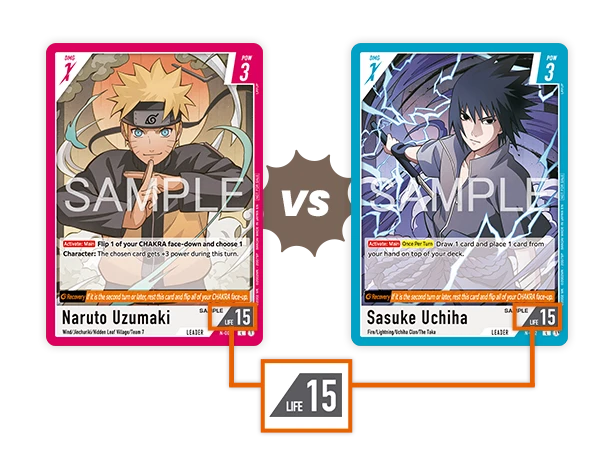
Naruto Card Game Rules Text: 15 Life, 4 Card Backs
The NARUTO CARD GAME sample cards that circulated around Gen Con were full-art showcase pieces with no text box, and the honest summary at the time was that Bandai had published no card text at all. That is no longer the case. Bandai's own ABOUT page carries seven cards with printed rules text, sitting in the card-type and how-to-play blocks rather than the showcase gallery, and between them they cover three of the gaps our launch coverage listed as unknown: the Leader's starting Life, how a Chakra cost is notated, and what the keyword vocabulary looks like.
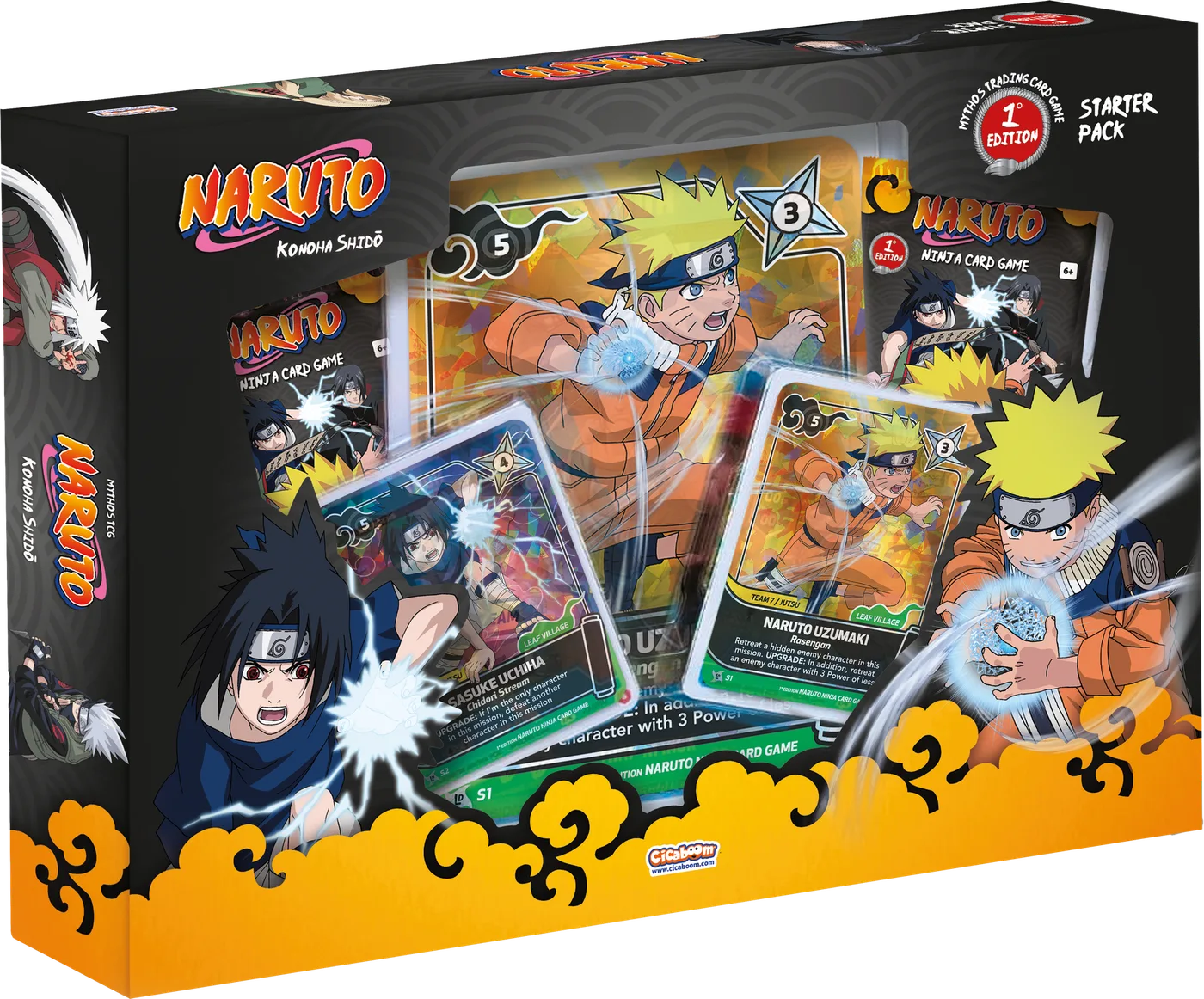
NARUTO Mythos TCG: The Card Game Already on Shelves
Our own coverage of this vertical has treated the Naruto card question as a two-way choice: Bandai's NARUTO CARD GAME, which does not release until Summer 2027, or Kayou's collectibles, which are not a game at all. There is a third product neither of those posts mentions. NARUTO Mythos TCG — published by Italy's Cicaboom — has been on European shelves since 13 March 2026, ships with a full public rulebook, and ran a three-day Regional Championship in Paris the week before this was published. Here is what it actually is, and where it leaves the "Bandai vs Kayou" framing.
Naruto Card Game Premier Demo Events: Dates and Prices
Bandai published its NARUTO CARD GAME Premier Demo Event pages on 13 October, and its four regional sites describe three different versions of the event. English-site stores run two waves from 5 February to 5 March 2027, Japan names 11 stores from 16 January, and the Asia pages plan early January behind a face-photo check. Here are the dates, how to apply, the two demo decks, and what the $20 CHAKRA Set and $40 playmat actually contain.
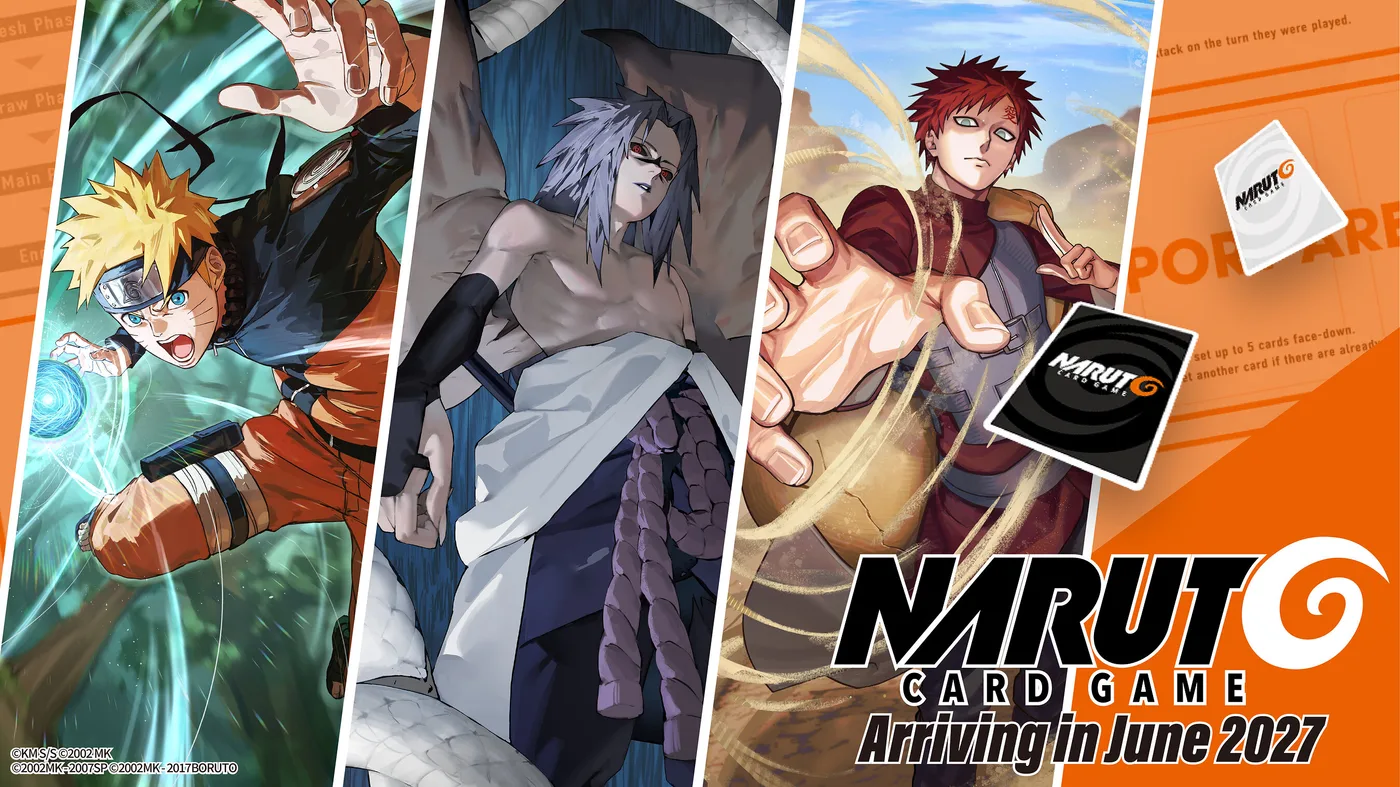
Naruto Card Game Release Date: June 2027, 3 Starter Decks
Bandai used New York Comic Con to put a month on its NARUTO CARD GAME: June 2027, with three Starter Decks led by Naruto, Sasuke and Gaara and a first booster called "Enter: Naruto Uzumaki!". It also announced in-store demo events from February, a million Demo Decks from spring, and two products you can only buy at those events or selected BANDAI CARD GAMES Fest stops. Here is what was announced, what changed from the July roadmap, and what is still missing.
Two Naruto TCGs at Paris Games Week and Lucca 2026
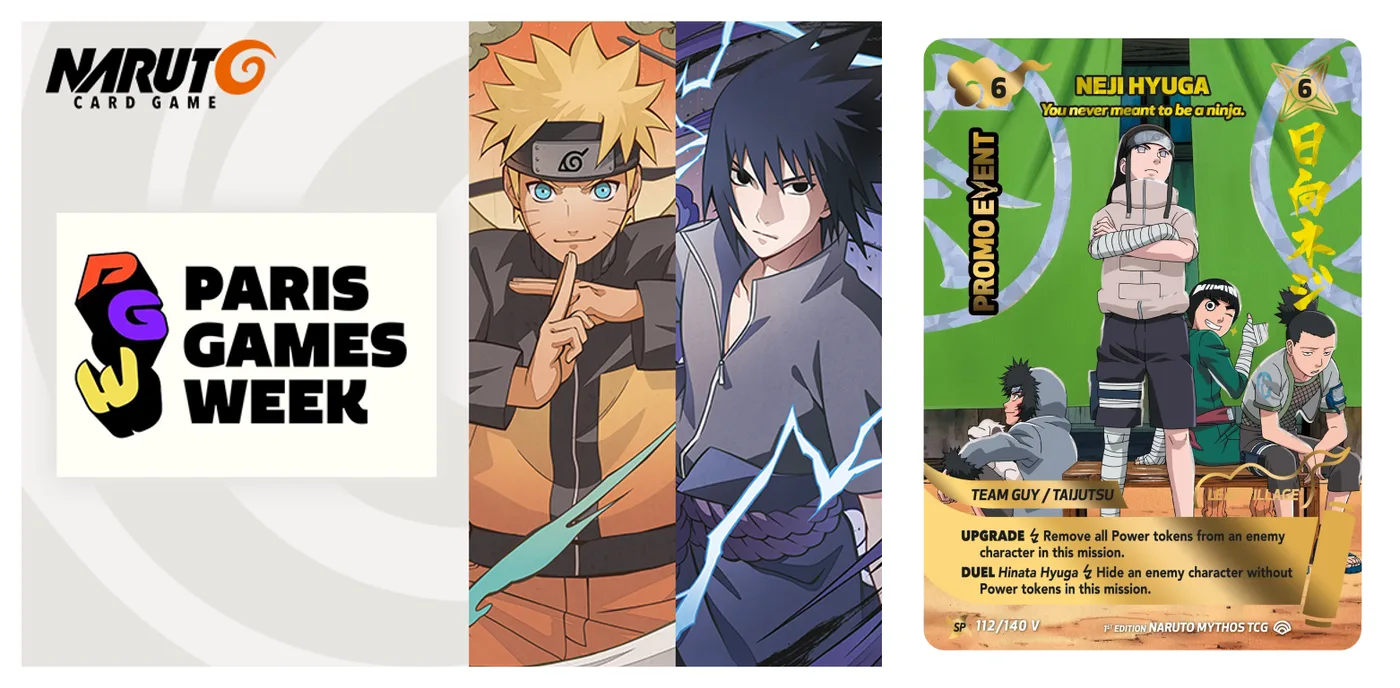
Bandai's NARUTO CARD GAME and Cicaboom's NARUTO Mythos TCG have booked the same two European shows. At Paris Games Week they are at booths E8 and E30; at Lucca, in Piazza Santa Maria and the Padiglione Carducci. Bandai's tutorial seats now have to be booked in advance, from Wednesday 14 October, and each of its stops sells its playmat a different way. Cicaboom's booths are about promo cards, including a Lucca demo card printed with two rules terms no published Mythos document defines.
NARUTO Mythos TCG Shinobi Shiren: Set 2 Cards and Rarities
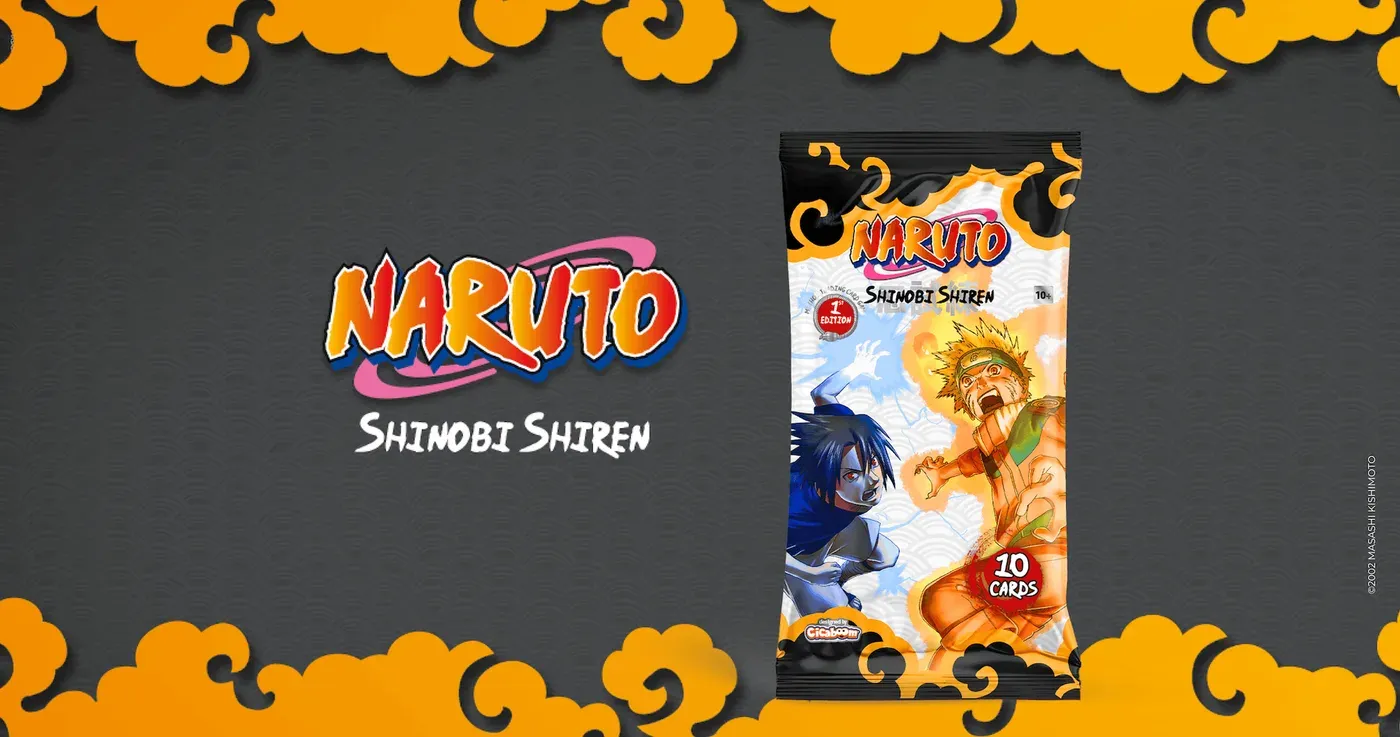
Set 2 of NARUTO Mythos TCG has been in European stores since 4 September, and Cicaboom's Products page still lists it as "Coming soon". The official Collection Guide says a great deal more: 150 numbered cards, a new Attachment card type, four rarities Set 1 never had, and serialized runs of 300, 400 and 1,500. Here is the whole set, rarity by rarity, checked against the official card gallery and events page.