Kayou Naruto Cards Explained — A Collector Guide With No Hype Attached
Kayou Naruto cards are stacked in Target, Walmart and GameStop, and almost nobody selling them can tell you what the letters on the corner mean. They are collectibles, not a playable game, and the rarity ladder is rebuilt from scratch every set. Here is the whole vocabulary, straight off Kayou official product pages, with no prices and no pull rates.
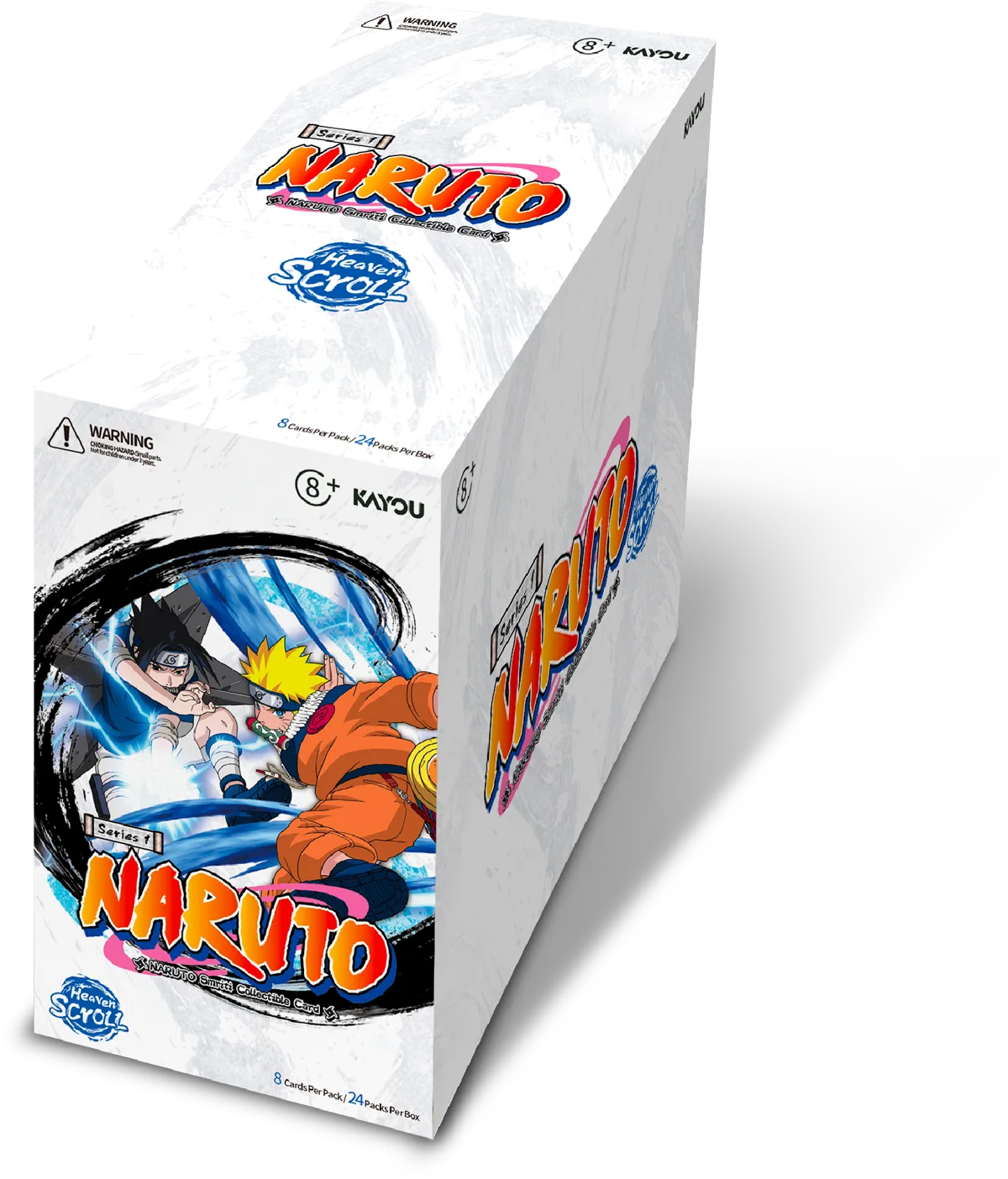
Walk into a Target card aisle and the Naruto packaging is impossible to miss — bright orange logo, white box, Sasuke and Naruto mid-clash. Pick one up and ask the employee what SE means, or why one box says Platinum and the one next to it says Titanium, and you will get a shrug. Fair enough. Kayou prints as many as thirteen different rarity codes on a single set and does not put a legend anywhere on the box.
The good news is that Kayou publishes all of it. Every set has an official product page with the full rarity ladder, the exact card counts per tier, the packaging spec, and the release month. It is just buried on a site nobody thinks to check. So here is the entire vocabulary, pulled off those official pages as of August 2026, with no prices, no resale talk, and no pretending I know what any of it is worth.
What Kayou actually is
Kayou is a Chinese collectible card company. Its own About page describes it as one of the most influential brands in China's pan-entertainment industry, specialising in collectible cards and creative stationery, running an integrated operation right down to the printing floor — German Manroland presses, automated logistics, in-house studios developing original IP alongside the licensed stuff. It lists offices in Hong Kong, Japan, the United States and Europe, and claims 70-plus IP collaborations. The press release announcing the US entry put the figure at nearly 100 licensed properties and noted Kayou's inclusion in the Hurun Global Unicorn Index 2025.
Kayou announced its US expansion on 17 September 2025, timed to New York Comic Con. Three franchises led the launch: NARUTO, MY LITTLE PONY, and tokidoki. Kayou then took booth #1217 at the Javits Center from 9 to 12 October 2025, with Maile Flanagan — the English voice of Naruto Uzumaki — signing at the booth, plus daily limited NYCC-stickered card drops. North American sales began that October.
By the time Kayou hit Toy Fair New York — booth #6735, 14 to 17 February 2026 — it was calling 2026 its first full year in the US market and had Naruto, My Little Pony, Demon Slayer, Monster Jam and tokidoki lines on the slate.
Collectibles, not a card game
This is the part that costs people money, so read it twice.
Kayou's Naruto cards are collectibles. There is no rulebook. There is no format. There is no organised play, no tournament circuit, no ban list, no deck-building restriction, because there is no deck. As of August 2026, Kayou publishes no Naruto rules document on its US site — the product pages list rarity tiers, card counts and packaging specs, and nothing else, because there is nothing else to list.
You buy them, you open them, you look at them, you put them in a binder. That is the entire activity loop. If that sounds thin, it is exactly the same loop as sports cards, which is a market older than most of us, so no judgement — just be clear about what you are signing up for.
Two things muddy this. First, Kayou's own FAQ describes its entry-level box tiers as "great for trying out the game," which is marketing language for a product that has no game attached. Second, Kayou genuinely does make playable card games — it announced MY LITTLE PONY Card Game: Friendships Begin as a playable TCG for spring 2026. So the company is capable of shipping rules. It just has not done so for the Naruto line in North America.
The six Naruto sets sold in North America
Everything Kayou has put out under the NARUTO Smriti banner in the US so far, straight from the official product pages, oldest first. Four product lines, six sets — and the numbering restarts inside each line, so "Series 1" means the first Earth Scroll or the first Heaven Scroll, never the first Naruto set overall.
Heaven Scroll, Series 1 (model NR-RDIV-Z001-NA, released September 2025). Eight cards per pack, 24 packs per box, eight boxes per carton. 158 different cards across 10 rarity tiers. The box is rated 8+. Retail listings describe the content as covering roughly the first 19 episodes — the Land of Waves arc — which matches the cast in the gallery: Team 7, Kakashi, Iruka, Hiruzen, Zabuza, Haku, Tazuna, Mizuki.
Chapter Jin, Series 2 (model NR-KP-CC-ZZZ-002A-NA, released November 2025). Eight cards per pack, 12 packs per box, 16 boxes per carton. 168 cards across 11 rarity tiers. Kayou's US site lists no Chapter Jin Series 1 — the line starts at Series 2 here.
Earth Scroll, Series 1 (Collector Box 001, released December 2025). Eight cards per pack, five packs per box, 72 boxes per carton. 131 cards across 8 rarity tiers. This is not a different printing of the Earth Scroll below, it is a different product: five packs per box instead of twenty, and an SP tier that Series 2 drops in favour of ◇UR.
Earth Scroll, Series 2 (model NR-KP-DZJ-002A-NA, released March 2026). Seven cards per pack, 20 packs per box, 24 boxes per carton. 132 cards across 8 rarity tiers. The gallery cast — Tsunade, Jiraiya, Itachi, Gaara, Kimimaro, the Sound Four — puts it in the Chunin Exams through Sasuke Retrieval window.
Chapter Jin, Series 3 (model NR-KP-CC-ZZZ-003A-NA, released April 2026). Eight cards per pack, 12 packs per box, 16 boxes per carton. 185 cards across 13 rarity tiers, the longest ladder of the six. It carries three codes that appear in no other US Naruto set — HR for Holo Rare, plus a paired ASP and ◇ASP Amber Special tier — and Kayou notes its ◇UR group, Graffiti Sketches, contains two US-exclusive cards.
Ninja Age, Premium Collector Box 001 (model NR-KP-RZSD-LH-001-NA, released August 2026). Five cards per pack, 16 packs per box, including one promo card. 106 cards across 10 rarity tiers.
That last one is worth flagging because it landed this month and it is structurally different from the other five. Look at its tier list and there is no R and no SR anywhere — the 50-card Rare tier that anchors every one of the other five sets is simply gone. A premium box that removes commons entirely changes what every rarity code means inside it, which brings us to the actual trap.
The rarity ladder is rebuilt every single set
Most TCGs pick a rarity scale and keep it for a decade. Kayou does not. Each Naruto set gets its own ladder, its own codes, and its own tier names, and Kayou numbers them 01 through however many there are — 01 being the top.
Here is Heaven Scroll Series 1, top to bottom, with the official tier names and the number of cards in each:
| Code | Tier name | Cards |
|---|---|---|
| SE | Scenario-E | 4 |
| SP | Special | 4 |
| BP | Brush Rare | 7 |
| MR | Miracle Rare | 6 |
| PU | Parallel Universe | 8 |
| PTR | Platinum Rare | 20 |
| UR | Ultra Rare | 15 |
| SSR | Super Secret Rare | 24 |
| SR | Super Rare | 20 |
| R | Rare | 50 |
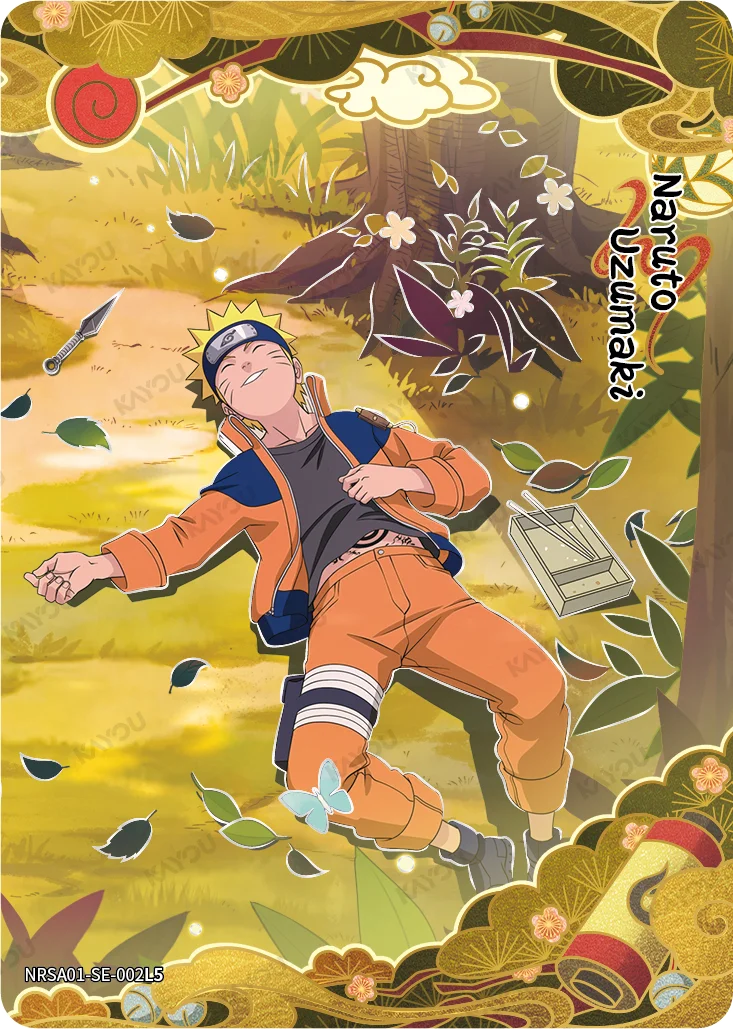
Now here is Earth Scroll Series 2, the very next set, where four of those codes vanish and three brand-new ones appear — and where each tier is a themed art collection rather than just a foil grade:
| Code | Tier name | Art theme | Cards |
|---|---|---|---|
| CR | Creative Rare | Fantastical Chronicle: Scroll of Ninja | 4 |
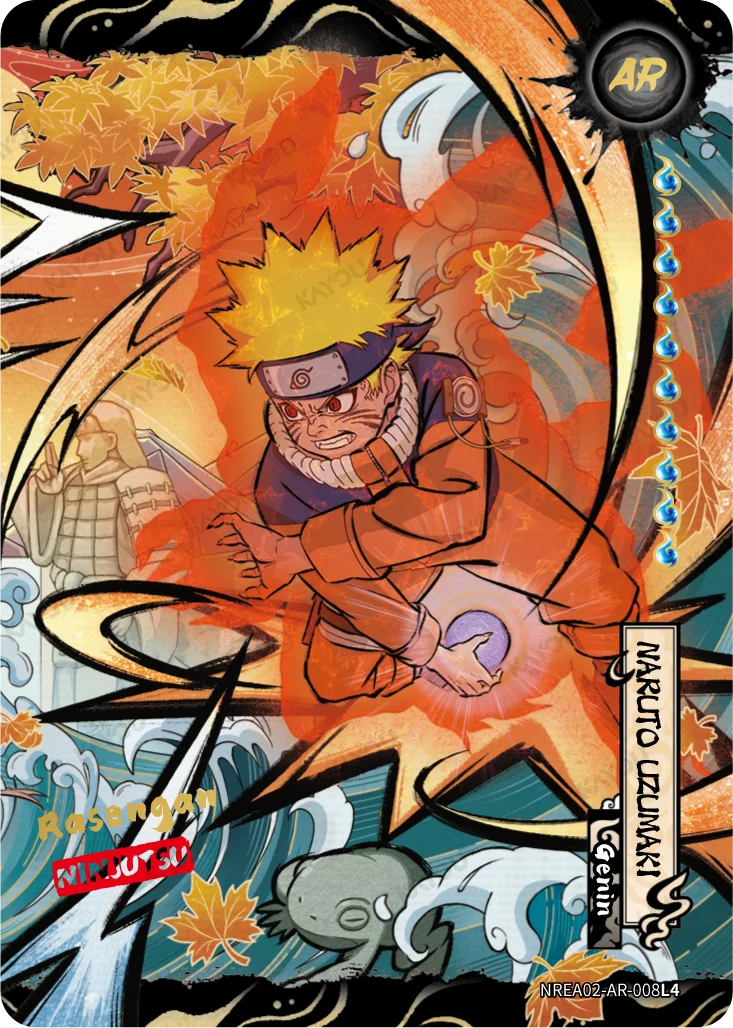
| AR | Amber Rare | Ukiyo-e Battle | 10 |
| MR | Miracle Rare | Tarot | 4 |
| ◇UR | Parallel Ultra Rare | Pop Art | 4 |
| UR | Ultra Rare | Ninja Profiles | 15 |
| SSR | Super Spark Rare | Ninjutsu Showcase | 25 |
| SR | Super Rare | Reappearance of Story Characters | 20 |
| R | Rare | Story Recap | 50 |
That theme column is the single most useful thing on the whole product page and nobody talks about it. AR is not "a shinier UR" — AR is the ukiyo-e set. MR is the tarot set. If you like woodblock-print Naruto, you are not chasing rarity, you are chasing AR specifically, and there are exactly ten of them.
Kayou's official page also notes that the Pop Art ◇UR group contains one US-exclusive card. And the diamond prefix — ◇UR, and in Ninja Age ◇XR, ◇MR, ◇QR — marks a parallel or "Shining" variant of a tier that also exists in plain form. Ninja Age adds two more names to the pile that appear nowhere in the scroll sets: XR for Extreme Rare and QR for Cute Rare.
Practical takeaway: a rarity code only means something inside the set it was printed in. Learn the ladder per set. There is no universal Kayou rarity chart, and anyone who hands you one is flattening three different systems into a lie.
SSR sits below UR, and that trips everyone up
In Pokémon, in Yu-Gi-Oh, in basically every anime TCG a Western collector has touched, more S means more rare. SSR beats SR, SSR beats UR, everybody knows this.
Kayou does not do that. In Heaven Scroll Series 1, the official order runs UR at position 07 and SSR at position 08. SSR is one rung below UR. The card counts back it up: 15 UR versus 24 SSR. Earth Scroll repeats the pattern — UR at 05, SSR at 06, 15 versus 25.
The name changes too. SSR is "Super Secret Rare" in Heaven Scroll and "Super Spark Rare" in Earth Scroll and Ninja Age. Same two letters, different words, two sets apart. If you are cataloguing a collection and you assume the codes are stable, your spreadsheet is already wrong.
What is actually printed on the card
I pulled the official card images and looked at what is physically on them, because this is the fastest way to prove the collectible-not-game point.
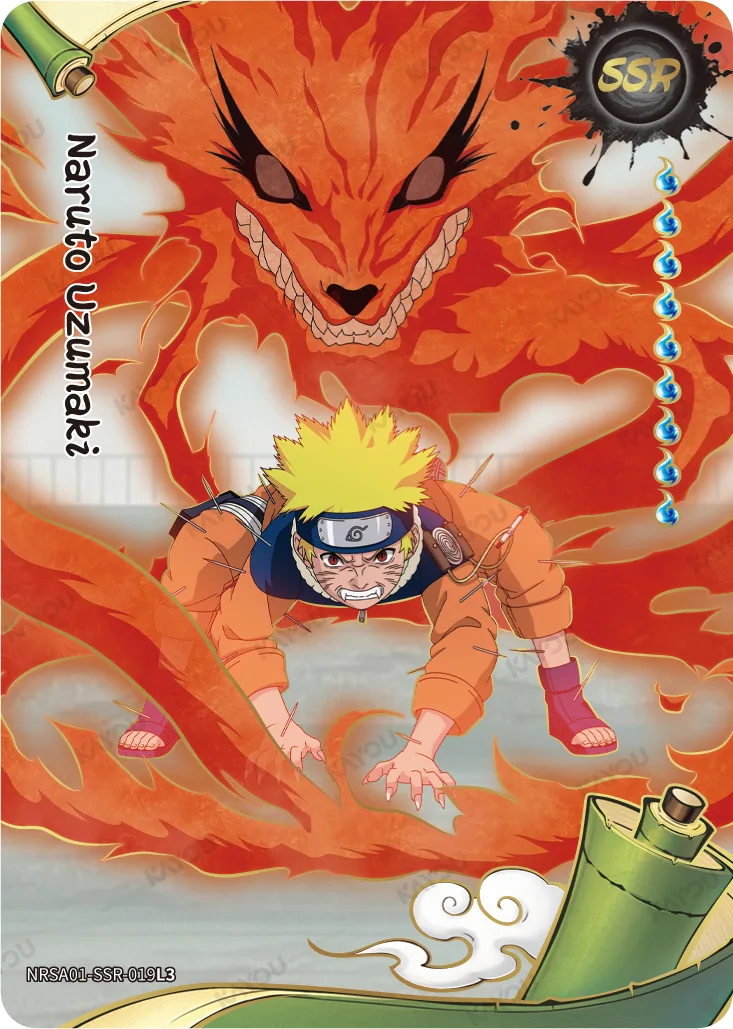
A Kayou Naruto card carries: character art, the character's name on a side plate, a rarity badge in a corner, and a card code along the bottom edge like NRSA01-SE-002L5. Some carry a flavour label — the AR Naruto above says "Rasengan / NINJUTSU" and lists his rank as Genin. Some carry a scene title.
What no Kayou Naruto card carries: an attack value, a health value, a cost, an ability text box, or anything you could resolve against another card. There is nothing to play. The Genin rank is a fact about Naruto, not a stat.
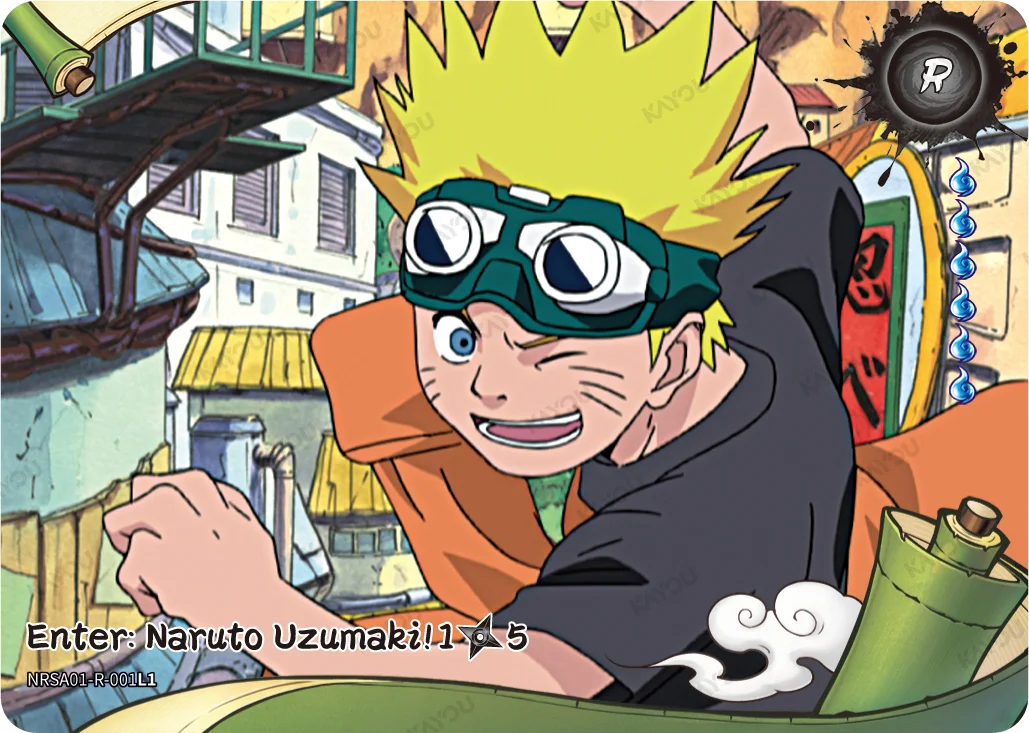
The R tier is the sneaky-good part of the design. R cards are landscape-orientation, and they come in five-card sets that assemble into a single scene — the bottom of one reads "Enter: Naruto Uzumaki! 1/5". Ten different episode moments, five cards each, fifty R cards total. That is the cheapest tier in the set and it is the one that rewards actually completing something.
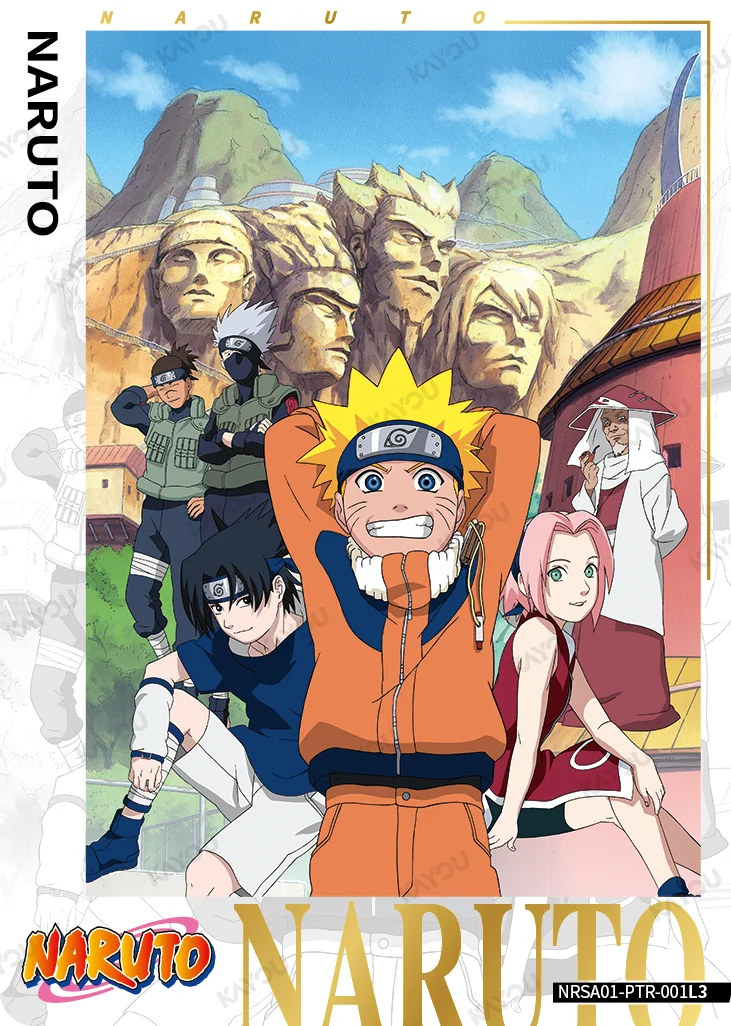
PTR is the other one worth understanding. In Heaven Scroll it is a 20-card subset labelled NARUTO CLASSIC, and they are not character cards at all — they are anime key visuals reprinted poster-style with the NARUTO logo across the bottom. Team 7 in front of the Hokage Rock, that kind of thing. Kayou's own FAQ treats PTR as something every Heaven Scroll buyer will run into.
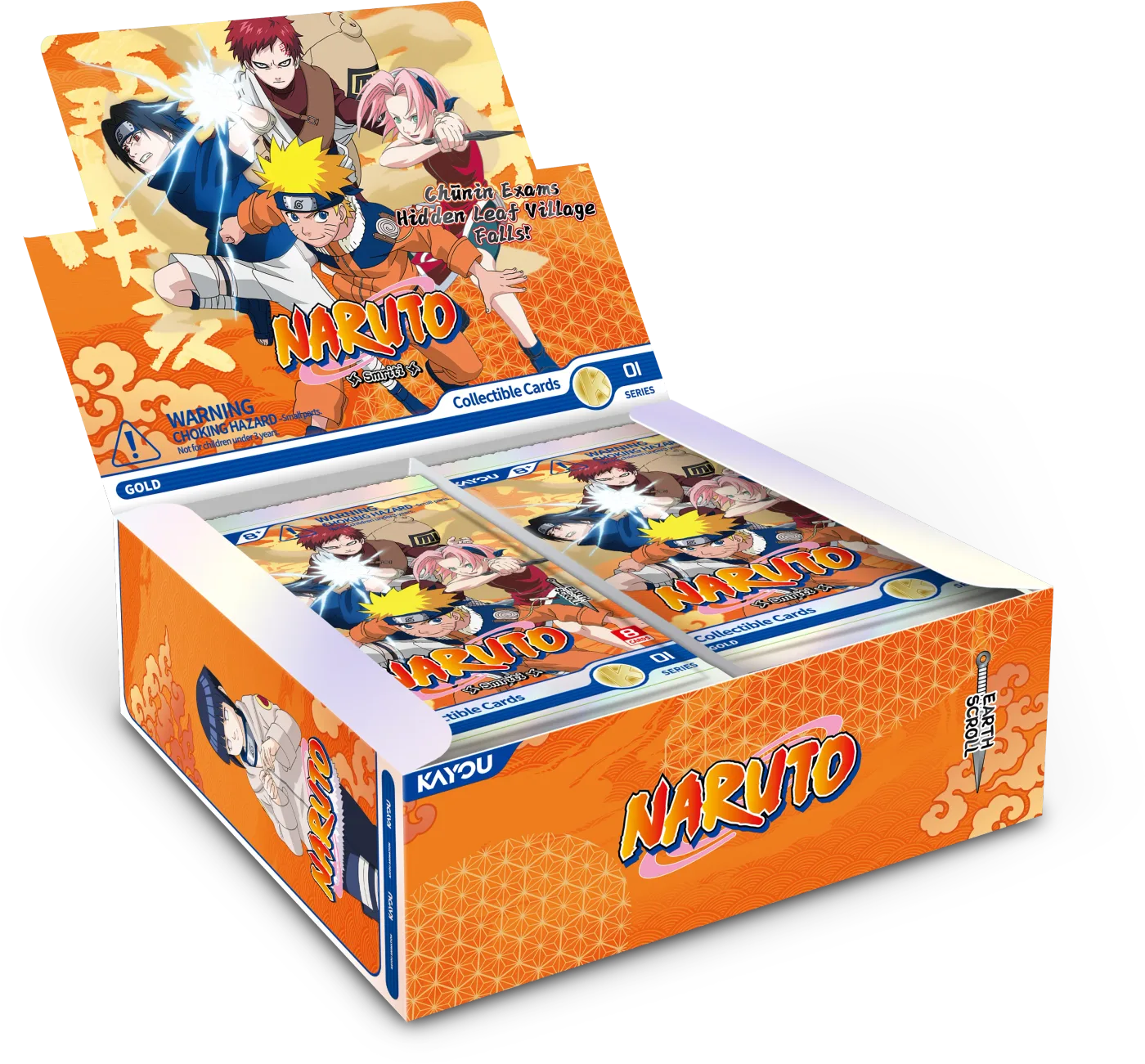
The box labels: Silver, Platinum, Titanium, Pearl
This is the other bit of Kayou vocabulary that shows up on shelves with zero explanation, and the FAQ is the only place it is defined. In Kayou's own words, the labels indicate the product's price tier and value for collectors:
- Silver / Gold / Pink Diamond — entry-level sets, aimed at casual fans and first-time collectors.
- Platinum — a balanced set, collectible and chaseable, still achievable to complete.
- Titanium — premium sets for serious collectors, featuring exclusive cards such as autographs, special parallels, or serialised editions.
- Pearl — bundles containing multiple packs or a mix of items in one package.
So the label on the front of the box is a product-tier marker, not a rarity. Two boxes of the same set at different tiers are different products with different contents. Check the label before you assume you are comparing like with like.
Peeling film and warped cards are normal
Two things happen to new Kayou cards that make people think they got a defective product, and Kayou answers both directly.
The peeling layer. Kayou states that all PTR cards in the Heaven Scroll release ship with a protective film applied during production, there to prevent scratches, stains and wear during shipping and storage. It also boosts colour saturation and gloss. Kayou's own instruction is to gently peel it off before use. Your card is not delaminating. It is packaging.
The bend. Kayou explains that its cardstock is hygroscopic — it absorbs and releases moisture with the air. When humidity shifts, the paper fibres expand or contract, the foil layer does not move at the same rate, and the tension between the layers curves the card. Their recommended fixes: sleeve the cards, store them upright in albums or boxes so both faces are supported, and keep them out of high humidity, direct sun and sudden temperature swings.
Neither of these is a defect and neither is a secret. It is on the FAQ page.
Where Kayou says to buy them
Kayou's FAQ lists Target, Amazon, Walmart, Best Buy, GameStop and Barnes & Noble, plus local hobby stores, plus direct purchase through its own official store and TikTok Shop. The original US launch announcement also named the livestream commerce platform Crossing.
The reason to care about that list is counterfeits. Kayou runs an authenticity verification section on its site, which tells you the problem exists. Buying from the retailers Kayou itself names is the low-effort way to avoid the entire category of problem.
How I would actually start a collection
Honest advice, no upsell:
Pick a set, not a rarity. "I want the Earth Scroll ukiyo-e AR set" is a goal with a finish line — ten cards. "I want to pull something good" is not a goal, it is a mood, and it is the thing that empties wallets.
Start with the cheapest complete-able tier. In both scroll sets that is R, at 50 cards, and in Heaven Scroll the R tier is the five-card scene puzzles, which are the most satisfying thing in the product. Completing a set of R cards teaches you the set structure for free.
Buy singles for the specific cards you want. Sealed product is a randomiser. If you want one specific SE card, chasing it through packs is the most expensive route to it that exists.
Sleeve everything immediately. See the hygroscopic-cardstock section above. This is not precious behaviour, it is the manufacturer's own advice.
Read the product page before the pack. Every Kayou set page lists the tier count, the card count per tier, and the packaging spec. Five minutes there tells you more than an hour of unboxing videos.
What I am not going to tell you
No prices, no resale values, no pull-rate maths, and no framing of any of this as an investment.
Collectible card markets are volatile. Values move on reprints, on anime news, on whatever a large account posted last week, and on nothing at all. A card that seems significant in August 2026 may be a bulk card by next spring, and the reverse happens too. Kayou is one company controlling supply of a licensed IP with no published print runs, which means there is no floor anyone can point to.
Buy Kayou Naruto cards because you want to look at Naruto art on nice cardstock. That is a completely legitimate reason and it is immune to the market. If you buy them expecting a return, you are speculating on an asset class with no transparency, and you should size that bet accordingly.
For what it is worth, Kayou does publish per-pack production ratios on each official set page. I am deliberately not reprinting them here, because odds pulled out of context are the exact thing that gets used to justify a case purchase. If you want them, they are on the page, next to everything else Kayou is straightforwardly honest about.
The Bandai game is a completely different product
Last thing, because the search results blur them together constantly.
Bandai's NARUTO CARD GAME — a genuine competitive TCG with a Leader card, a 51-card deck, Chakra cards and a Summon card — had its world debut at Gen Con 2026 and is scheduled for worldwide launch in Summer 2027. It is not out. You cannot buy it, preorder it, or play it as of August 2026.
Kayou's cards are on shelves today and are not that game. They are not compatible with it, they will not be legal in it, and neither company has suggested any relationship between the two. If someone tells you the Kayou cards are "the new Naruto TCG," they are either confused or hoping you are.
Buy the one that matches what you actually want to do on a Saturday afternoon.
Frequently Asked Questions
Are Kayou Naruto cards playable, or just for collecting?
What do SE, SP, PTR, UR and SSR mean on Kayou Naruto cards?
Is SSR rarer than UR in Kayou Naruto sets?
Which Kayou Naruto sets are available in North America?
What do the Silver, Platinum, Titanium and Pearl labels on Kayou boxes mean?
Why is my Kayou Naruto card peeling or bending?
Where can I buy Kayou Naruto cards in the US?
Are Kayou Naruto cards the same as the new Bandai Naruto Card Game?
Keep Reading
- KAYOU Official — NARUTO Smriti Heaven Scroll Series 1 product page (specs and rarity tiers)
- KAYOU Official — NARUTO Smriti Earth Scroll Series 2 product page (specs and rarity tiers)
- KAYOU Official — NARUTO Smriti Ninja Age Premium Collector Box product page
- KAYOU Official FAQ — box tier labels, card care, authorised retailers
- About KAYOU — official company profile
- Kayou Enters the U.S. Market — press release, 17 September 2025
- Kayou at New York Comic Con 2025 — press release (booth #1217, 9-12 October 2025)
- NARUTO CARD GAME Official Site (Bandai) — the separate competitive TCG, Summer 2027
Related Guides
Kayou Naruto Grading: 82% of CGC Grades Are a 10
CGC publishes a live population report for Kayou Naruto cards, and reading all 1,668 entries answers the question the product pages cannot: what actually happens when you send these things off. The short version is that the grade is barely a lottery — and the set code the grader files your card under is not the one printed on it.
Kayou Has Six Naruto Sets in the US Now — and the Series Numbers Do Not Mean What You Think
Kayou's US site now lists six NARUTO Smriti sets across three product lines, 880 cards in eleven months. The box names say Heaven Scroll, Chapter Jin and Earth Scroll with series numbers attached — but the codes printed on the cards tell a completely different story about which set follows which, and one line quietly carries Boruto-generation cards that the others do not.
NARUTO Mythos TCG: Breakflip and Zvezdar Disagree
Our own NARUTO Mythos TCG explainer, five days old, named Zvezdar Toys as the company bringing the game to Europe and North America — sourced to trade press, because Cicaboom's own site never spelled it out anywhere we could find. This morning Cicaboom published a company update naming a different company, Breakflip, as the coordinator for those exact regions, and stated in writing that Breakflip is 'not the distributor.' Its own Products page, three clicks away, still names Zvezdar for the same three regions using the same three email addresses. Zvezdar's own site still calls itself the official distributor. All three pages are live right now, and none of them mentions the other two.
Kayou Naruto Fake Cards: The Check Is Not on the Card
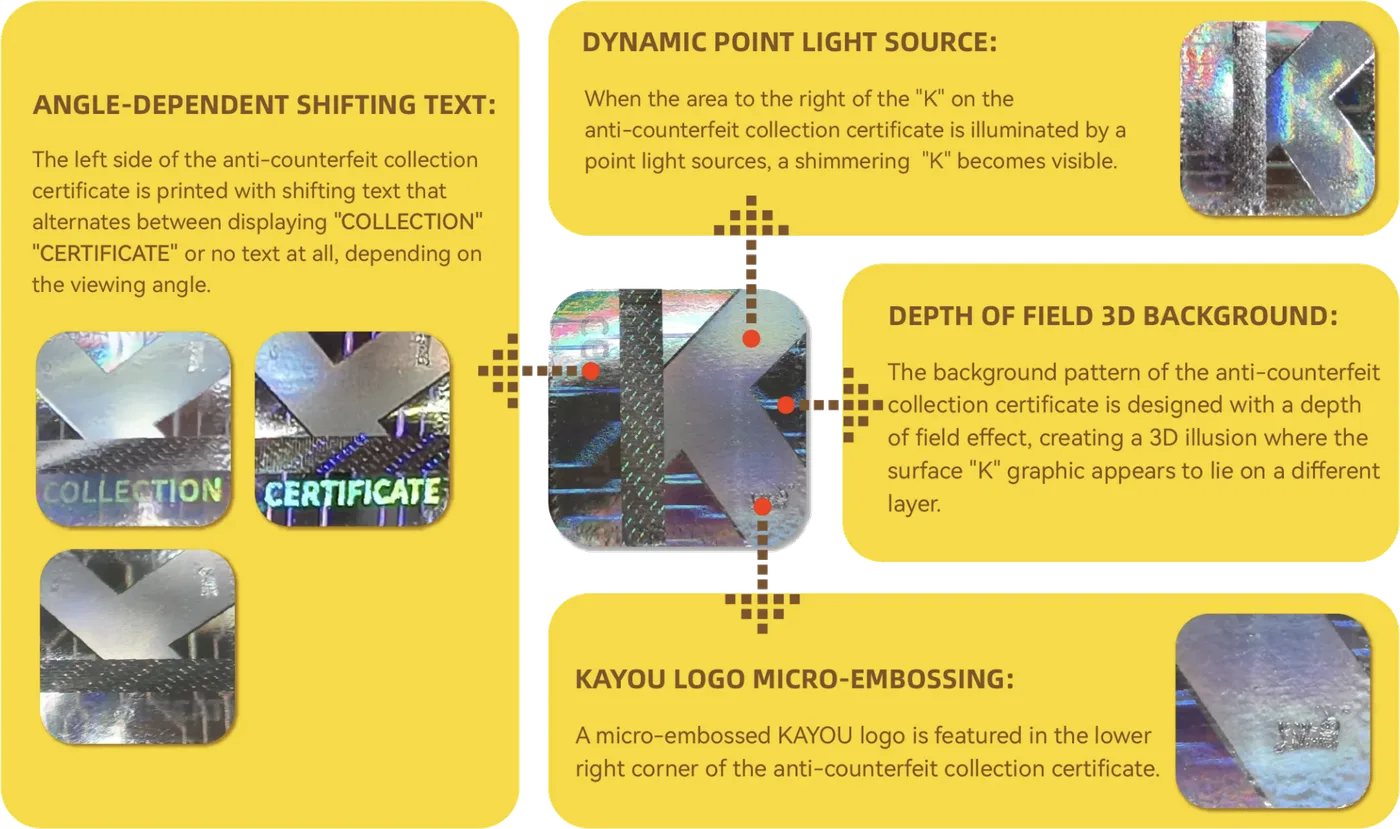
Kayou’s FAQ answers "How to verify the authenticity of a KAYOU product?" with a single image and no text at all. That image names four security features — shifting text, a point-light "K", a depth-of-field background and a micro-embossed logo — and every one of them lives on the anti-counterfeit collection certificate rather than on a Naruto card. Two of the nine regions in Kayou’s own country registry carry the page at all, and the site’s product pages never say which products ship a certificate.
Naruto Card Game Explained: Bandai, Kayou or Mythos?
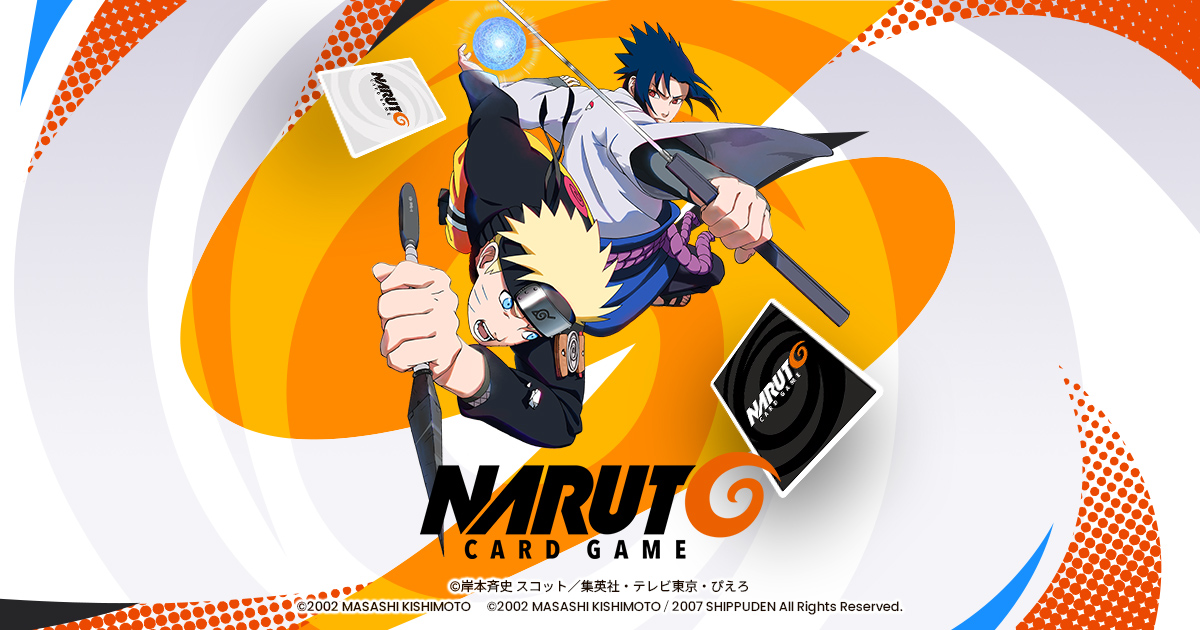
Search "Naruto cards" and you get three unrelated products stacked on top of each other: a competitive TCG from Bandai that nobody can buy until Summer 2027, a line of Chinese-made collectible cards from Kayou that has been in Walmart since 2025, and a third game — Cicaboom's NARUTO Mythos TCG — that has been on European shelves since March 2026 and is already running sanctioned tournaments. Here is exactly what each one is, what each publisher has actually confirmed, and which one the person asking the question actually wants.
Naruto Card Game Distributors: 16 Names, No Order Date
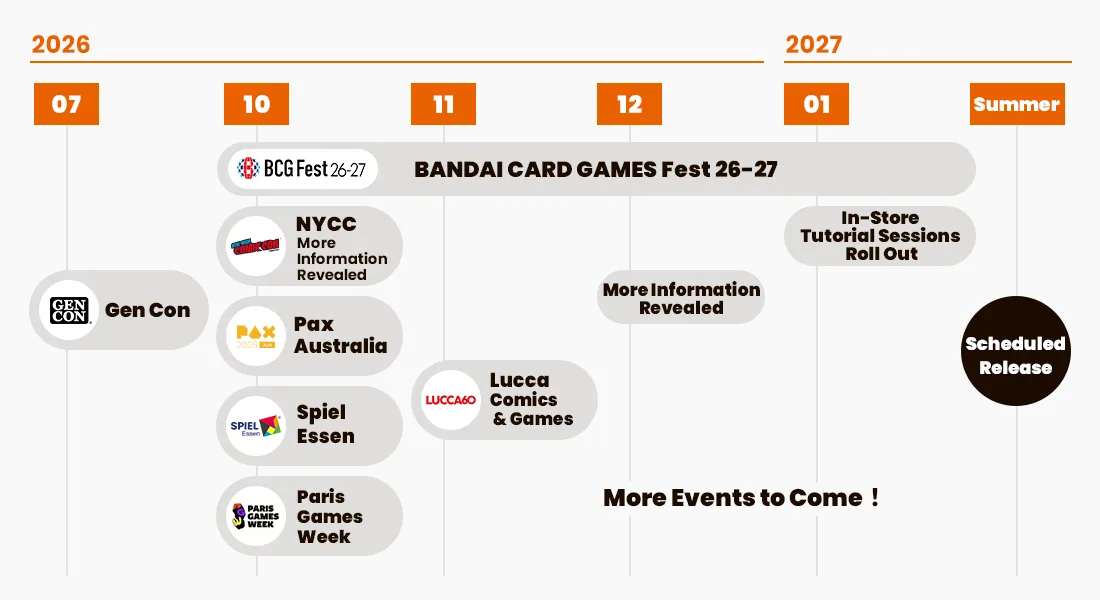
The third item in the NARUTO CARD GAME site's navigation is FOR RETAILERS. It carries a full OFFICIAL DISTRIBUTOR list — 16 companies across North America, Europe, Oceania, Latin America and the Middle East — and then stops. There is no ordering window, no enrollment path, no product to order. Here is the whole list, what the page does not say, and how it lines up against the same page on Bandai's four shipped English-language card games.