Baldur's Gate 3 Elixirs and Potions Guide: The Buff Slot You Are Wasting
Every elixir in the game ends with the same line: replaces effects from other elixirs when drunk. That makes your elixir slot a loadout choice, not a consumable — and a 30-gold bottle can outperform a rare weapon on the right character.

Open your alchemy tab right now. I will wait. If it is anything like mine was on my first run, there are eleven Elixirs of Fire Resistance in there, four Elixirs of Barkskin, and a Potion of Speed you have been saving for a boss since Act 1.
That is the normal experience, and it is a UI problem more than a player problem. The consumables screen is buried, the descriptions are terse, and nothing in the game ever tells you the one rule that makes elixirs make sense. So people hoard them, feel vaguely guilty, and go into every fight with an empty buff slot.
Elixirs are the cheapest raw combat power in Baldur's Gate 3. A 30-gold bottle can swing more damage on a Fighter than a Rare weapon does. Here is the math on which ones earn the slot — and the rule you have to understand first.
The rule that makes elixirs weird
You can only have one elixir active at a time. Every single elixir item page on the wiki carries the same note: replaces effects of other elixirs when drunk. Drink Hill Giant Strength, then drink Heroism ten seconds later, and your Strength is gone. No stacking. No warning prompt. Just a quietly deleted buff.
That turns elixirs from a consumable into a loadout slot. Each character gets exactly one, and picking what goes in it is a decision on the level of picking a feat — except you get to change your mind every morning for pocket change.
Three consequences that matter:
- Elixirs last until Long Rest. The Resting page states it plainly: on a long rest, "any effects of Elixirs end." Your buff slot runs on the same clock as your spell slots.
- Drinking one costs a bonus action, not an action. You can pop it on turn one of a fight if you forgot, though you would rather not spend the bonus action.
- Every party member has their own slot. Four characters, four different elixirs, and the correct answer is almost never "the same elixir on all four."
There is one exception worth knowing and one quirk worth exploiting. The exception is the Elixir of Universal Resistance — despite the name, the wiki notes it behaves like a regular potion: it lasts 10 rounds and does not overwrite other elixirs. The quirk is temporary hit points. Both Bloodlust and Heroism grant temp HP, and that temp HP survives being overwritten by a different elixir. Drink Heroism for the 10 temp HP, drink your actual pick, keep the hit points.

Elixirs and potions are two different budgets
This trips up a lot of people because both live in the same inventory category. They are not the same system.
| Elixirs | Potions | |
|---|---|---|
| Active at once | One, exclusive | Multiple, they stack |
| Duration | Until Long Rest | Turn-based, usually 3-10 turns |
| Cost to use | Bonus action | Bonus action |
| When you drink | At camp, before you leave | Mid-fight |
So the correct mental model is: elixirs are your morning routine, potions are your panic button. A character can be sitting on Cloud Giant Strength from breakfast, then drink a Potion of Speed and a Potion of Superior Healing in the same fight without disturbing any of it.
The morning slot: what actually deserves it
Giant Strength, and the math that sells it
The Elixir of Hill Giant Strength (uncommon, 30 gold) sets your Strength to 21. Not plus something — to 21, flat. The Elixir of Cloud Giant Strength (rare, 160 gold) sets it to 27. Neither will lower a score that is already higher.
Now do the point-buy math. In Baldur's Gate 3 you have 27 points and a maximum starting score of 17. So the best Strength a fresh character can walk out of chargen with is 17, which is a +3 modifier. Hill Giant hands you 21 (+5). Cloud Giant hands you 27 (+8).
That means the elixir is not a small top-up. It is strictly better than the best Strength you could have bought, and it refunds every point you would have spent getting there. Dump Strength to 8 at creation, spend the 9 points on Constitution and Dexterity, and drink a 30-gold bottle every morning to end up ahead of where you started.
The build where this stops being nice and starts being silly is Tavern Brawler. That feat adds your Strength modifier to damage and attack rolls an additional time for unarmed strikes, thrown weapons, and improvised weapons. Stack it with Cloud Giant Strength:
- Strength 27 gives a +8 modifier.
- Tavern Brawler applies it twice, so +16 before proficiency.
- At character level 9 or above your proficiency bonus is +4.
- Total attack bonus: +20.
Compare that to the same character with a legitimately excellent 17 Strength: +3 doubled is +6, plus +4 proficiency, for +10. The elixir is worth ten points of accuracy on that build, and 160 gold does not buy you ten points of anything else in this game.
Get Cloud Giant Strength early by buying Cloud Giant Fingers from Blurg or Derryth Bonecloak at the Myconid Colony in the Underdark once they hit merchant level 6, then brewing it yourself with any Suspension. Most players do not find it until Act 3 merchants stock it.
Elixir of Bloodlust
Uncommon, 25 gold, brewed from Ashes of Worg Fang and any Salt. The text: once per turn when you kill a foe, you gain 5 temporary HP and an additional action.
An extra action, not a bonus action. On a character who reliably deletes a trash mob with their first swing — a Thief Rogue, a Battle Master, a Sorcerer with a scaling cantrip — Bloodlust turns every wave fight into a chain. Kill, take a second action, kill again, and you have doubled your turn without spending a resource.
It is genuinely bad on a controller or a healer, because the trigger is kills. Do not put this on Shadowheart and then wonder why nothing happened. Put it on whoever your party's blender is.
Elixir of Heroism

Uncommon, 30 gold: gain 10 temporary hit points and a 1d4 bonus to Attack Rolls and Saving Throws until the next long rest.
Read that again, because it is Bless with no strings attached. Bless is a 1st-level spell that gives 1d4 to attack rolls and saves — and it requires concentration, covers a limited set of allies, and evaporates the moment your caster eats a crossbow bolt. Heroism gives the same 1d4 to one character, all day, with zero concentration cost and no spell slot.
Average value: +2.5 to every attack roll and every saving throw you make between rests. On a Paladin making three attacks a turn across a dozen fights, that is not a rounding error.
This is my default recommendation for a character who does not have an obvious specialist pick. Mol at the Tiefling hideout sells them in Act 1, and Quartermaster Talli has them on the main floor of Moonrise Towers.
Elixir of Viciousness
Rare, 50 gold, brewed from Vitriol of Shadowroot Sac and any Ashes: the number you need to roll to land a Critical Hit is reduced by 1.
You crit on a 19 or 20 instead of just a 20. That is a doubling of your critical hit rate, from 5% to 10% per attack roll, and the wiki confirms it stacks additively with class features that do the same thing — so a Champion Fighter, whose Improved Critical already drops the threshold, goes further still.
Where it earns its keep is on characters with a lot of attack rolls and a big crit payload. A Paladin who crits on a Divine Smite rolls double the smite dice. A dual-wielding Rogue with two attacks plus an offhand plus Sneak Attack rolls the dice often enough that a 5% bump compounds. On a Wizard who casts save-based spells, it does almost nothing.
Elixir of Vigilance
Uncommon, 25 gold: +5 bonus to Initiative, and you can't be Surprised.
That is the Alert feat, verbatim, in a bottle. The feat's own description reads "+5 to initiative and can no longer be surprised." One of these costs you a feat slot at level 4, 8, or 12. The other costs 25 gold and can be brewed from a Sublimate of Bloodstained Hook.
Going first in Baldur's Gate 3 is worth more than it sounds, because the game front-loads so much damage. If your Sorcerer opens with a Hold Person before anything moves, the encounter is a formality. This is the best elixir in the game for a glass-cannon caster who dies if the enemy Barbarian gets a turn first.
Elixir of Peerless Focus
Uncommon, 20 gold, from Sublimate of Belladonna and any Ashes: advantage on concentration saves, advantage against being Charmed, and magic can't put you to sleep.
Concentration checks in BG3 are a Constitution save against a DC equal to half the damage taken, or 10, whichever is higher. So any hit under 20 damage is a flat DC 10 — and advantage on a DC 10 save takes a character with a +2 Constitution modifier from about 65% to roughly 88% success. Over a fight where your Wizard gets hit five times holding a Hunger of Hadar, that is the difference between the spell lasting and the spell dying on hit two.
This is half the War Caster feat, which grants exactly the same advantage on concentration saves, for 20 gold. If your control caster does not have War Caster, this is the slot.
Arcane Cultivation and the Colossus
Two more that quietly earn a slot on the right character.
The Arcane Cultivation line grants one extra spell slot until long rest, scaling by tier: the base version gives a level 1 slot, Greater gives level 2, Superior gives level 3, and Supreme gives a level 4 slot. A Supreme Elixir of Arcane Cultivation on your Wizard is one extra Wall of Fire or Banishment every single day. That is a lot of value for a bottle.
The Elixir of the Colossus (uncommon, 25 gold) grants Enlarged: your weapons deal an additional 1d4 damage and you get advantage on Strength checks and saves. Critically, it requires no concentration, unlike the Enlarge spell it copies. On a Great Weapon Master build swinging twice a turn, that is an average +5 damage per round for free — though it competes directly with Giant Strength, and Giant Strength usually wins.
The potions that break encounters
Because potions stack freely with each other and with your elixir, they are pure upside. The ones actually worth carrying:
- Potion of Healing tiers: 2d4+2, then Greater at 4d4+4, Superior at 8d4+8, and Supreme at 10d4+20 (average 45). All are a bonus action, and all remove Burning.
- Throwing a healing potion is the trick most people never learn. Thrown, it creates a small area of effect and heals everyone in it — including downed allies you cannot reach. Same bonus action cost. One potion, three heals.
- Potion of Invisibility, 10 turns. The cheapest escape hatch in the game and a free approach for a Rogue setting up a Sneak Attack.
- Elixir of Universal Resistance, very rare, 200 gold: resistance to all damage for 10 rounds, and it does not eat your elixir slot. Save it for a boss opener.
- Antidote and Basilisk Oil are situational, but petrification is a run-ender in Honour Mode and Basilisk Oil removes it.
Potion of Speed and the Lethargic tax
Everyone knows Potion of Speed grants Hastened for 3 turns. Fewer people read the second half: when Hastened ends, the creature normally receives Lethargic, and misses its next turn.
Three hasted turns, one dead turn. Net gain of two, which is still excellent — but it means you cannot fire it off casually. Drink it on turn one of a fight you expect to win in three rounds and the Lethargic never lands because the fight is over.
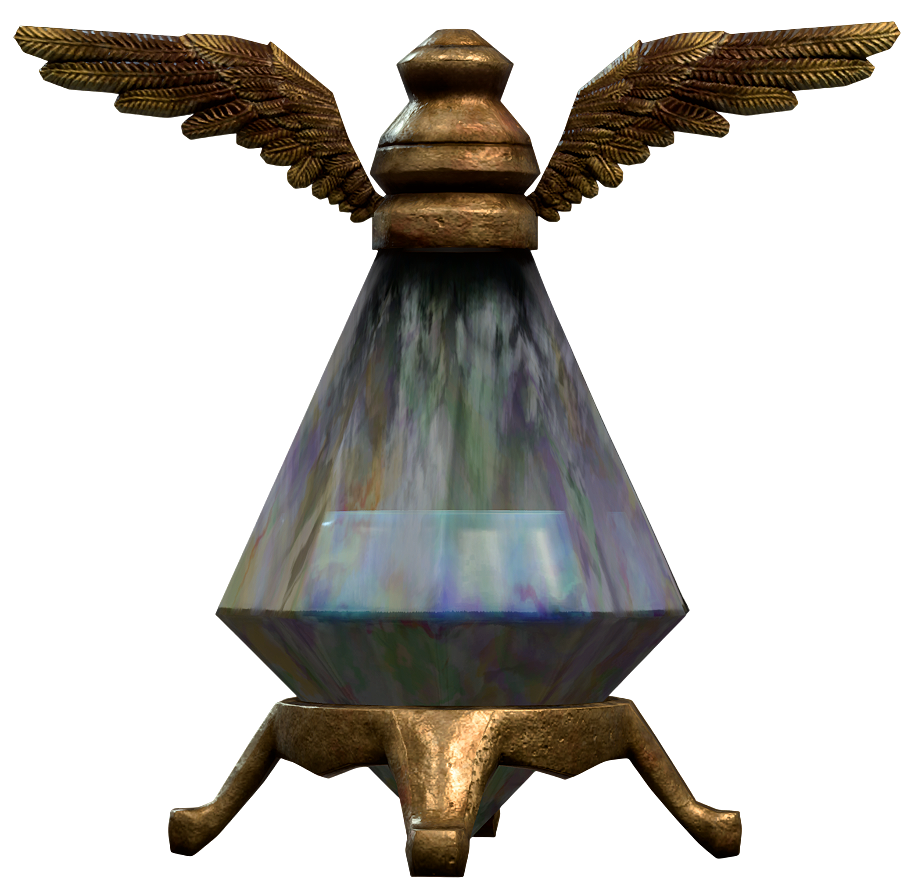
It can also be thrown to hand Hastened to every creature in a small radius, which is the version worth planning around: one bonus action, three party members accelerated. Line your melee up before the fight, throw one potion, and you have effectively bought six extra turns for 20-ish gold of ingredients.
The counter-play everyone eventually discovers is that drinking a second Potion of Speed while already Hastened refreshes the timer and pushes the Lethargic window back. Useful, expensive, and worth exactly one bottle in a boss fight.
Alchemy: brew, do not buy
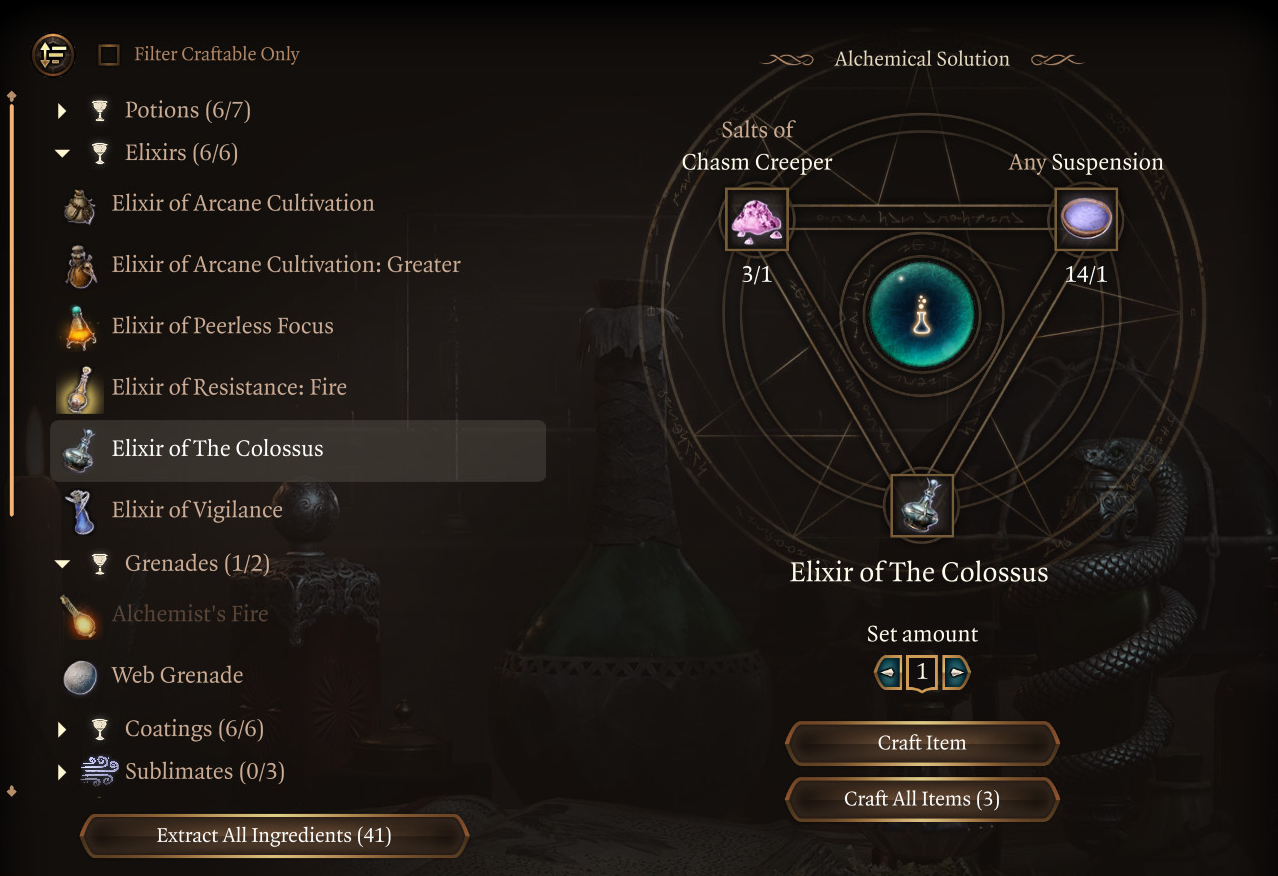
The alchemy system is two steps and both are free.
- Extract. Combining three of the same ingredient produces an extract — three Mugwort becomes Salt of Mugwort. There are six extract types: Ashes, Essences, Salts, Sublimates, Suspensions, and Vitriols. There is an "Extract All Ingredients" button that does the whole inventory at once.
- Brew. Every elixir recipe is one specific extract plus one any-of-a-type extract. Elixir of Heroism, for example, is Sublimate of Pegasus Feathers plus any Ashes.
Two practical notes. Extracts weigh less than the three ingredients that made them, so hitting Extract All is a free inventory cleanup even if you never brew anything. And because the second half of most recipes is "any Ashes" or "any Salt," the pile of junk herbs you have been ignoring is the exact currency the good recipes want.
The gold difference is real. A Cloud Giant Strength elixir costs 160 gold from a merchant, or one Cloud Giant Finger plus any Suspension from your bag. Buy the fingers, not the bottles.
Two permanent Strength boosts, one of them a trap
Act 2 and Act 1 spoilers ahead.
The Potion of Everlasting Vigour permanently increases Strength by +2. It is given by Araj Oblodra at Moonrise Towers, and getting it requires convincing Astarion to bite her. The bonus persists through death and through respeccing with Withers, and it applies after Ability Score Improvements — which is how characters end up with a legal 20 becoming a 22.
One important interaction: it does not override a fixed Strength value. If you are drinking Hill Giant Strength, your Strength is 21 whether or not you drank the Vigour potion. Everlasting Vigour is for characters who invest in Strength normally; Giant Strength elixirs are for characters who dumped it.
The trap is Broken Promises, one of Auntie Ethel's hag potions. It grants +2 Strength — and then applies -1 indefinitely after you rest. Free power now, a permanent penalty later. Ethel's shelf in general is a minefield: Lover's Avarice costs you a point of Wisdom, Wilted Dreams deals 3d6 psychic damage during your next long rest, and Insanity's Kiss makes you hostile to everything for five turns. Read hag potions before you drink them.
What this costs you: the long rest bill
Since elixirs die on a long rest, the whole system is priced per rest, and rests are not free. A long rest costs 40 camp supplies on Explorer and Balanced, 80 on Tactician and Honour Mode, and up to 120 on custom difficulty.
So on Honour Mode your daily buff bill is 80 supplies plus roughly 25-160 gold per character. In practice that is trivial — this game drowns you in food and gold by Act 2 — but it does mean the correct habit is to drink your elixirs immediately after resting, at camp, before you walk out. Not when you remember mid-dungeon. Not never.
For Honour Mode specifically, my four-slot default is Vigilance on the caster who needs to go first, Peerless Focus on the concentration holder, Giant Strength on whoever throws or punches, and Heroism on the fourth. It costs about 100 gold a day and it is the highest-value 100 gold in the game.
Quick Action Checklist
- Only one elixir works at a time. Drinking a second one deletes the first — no stacking, no warning.
- Elixirs last until Long Rest; potions last turns. Potions stack with everything, including your active elixir.
- Drink at camp, right after resting. Both elixirs and potions cost a bonus action, so do it out of combat.
- Hill Giant Strength sets Strength to 21, Cloud Giant sets it to 27 — both beat the 17 maximum you can buy at character creation.
- Dump Strength to 8 on any character who will drink Giant Strength daily, and spend the points elsewhere.
- Tavern Brawler plus Cloud Giant Strength is +16 to hit before proficiency, for +20 total at level 9 and above.
- Elixir of Heroism is Bless with no concentration — 1d4 to attacks and saves plus 10 temp HP, all day.
- Elixir of Vigilance is the Alert feat for 25 gold. Put it on your opener.
- Elixir of Peerless Focus is half of War Caster for 20 gold. Put it on your concentration caster.
- Throw healing potions to heal a group, including downed allies out of reach.
- Potion of Speed costs you a turn to Lethargic when it ends. Budget for it.
- Hit "Extract All Ingredients" now. Extracts weigh less than their components, and most recipes only need "any Salt" as the second half.
- Avoid Broken Promises and the rest of Auntie Ethel's hag potions unless you have read the fine print.
Frequently Asked Questions
Do elixirs stack in Baldur's Gate 3?
What is the best elixir in Baldur's Gate 3?
How long do elixirs last in BG3?
Is Elixir of Hill Giant Strength worth it if my character already has high Strength?
Does Potion of Speed have a downside in Baldur's Gate 3?
How do you craft elixirs in Baldur's Gate 3?
Keep Reading
Related Guides

Baldur's Gate 3 Multiclassing Guide: Rules and Real Builds
BG3 dropped the ability score prerequisites tabletop 5e uses, which means nothing stops you from building a Barbarian who casts. The level 12 cap is the only real brake — and understanding Effective Spellcaster Level is what separates a build from a mess.

Baldur's Gate 3 Patch 8 Subclasses: Which of the 12 Survive the Level Cap
Patch 8 gave every class a new subclass. The level cap is still 12, and three of those subclasses put their signature feature at level 11 — so you get it for the last two levels of a hundred-hour campaign. Here is all twelve, sorted by when they actually pay you.
Best Baldur's Gate 3 Classes for Beginners, Ranked
Fighter gets four feats by level 12 while everyone else gets two, and it never runs out of resources. That is the whole beginner-class argument in one sentence. Here is the full ranking, with the numbers behind each call.

Baldur's Gate 3 Weapon Actions: One Use Per Short Rest
The little icons under your attack button are not free. Unless the action says otherwise, a weapon action in Baldur's Gate 3 is capped at one use per short rest, the charge belongs to the character rather than the weapon, and it is spent even when the attack misses. Here is what each weapon type actually hands you, and which of them are worth the charge.

Baldur's Gate 3 Beginner Guide: What Nobody Tells You
The tutorial teaches you to move and attack. It does not teach you that advantage is worth more than any weapon you will find in Act 1, or that Withers will rebuild your entire character for 100 gold. Here is the actual onboarding.

Baldur's Gate 3 Coatings, Grenades and Arrows: Carry These
The elixir slot gets all the attention, but Baldur's Gate 3 has a second consumables budget nobody spends: the things you smear on a weapon or throw at a formation. A 3-gold bulb that yanks a whole enemy line into one spot, a 40-gold oil that cuts an enemy caster's save DC by 3, and a paralysis poison whose victim loses a turn before it can even roll to shake it off.