Baldur's Gate 3 Coatings, Grenades and Arrows: Carry These
The elixir slot gets all the attention, but Baldur's Gate 3 has a second consumables budget nobody spends: the things you smear on a weapon or throw at a formation. A 3-gold bulb that yanks a whole enemy line into one spot, a 40-gold oil that cuts an enemy caster's save DC by 3, and a paralysis poison whose victim loses a turn before it can even roll to shake it off.

A Void Bulb costs 3 gold. Thrown, it pulls every creature within 5 metres of the impact point into one spot unless they pass a DC 18 Strength save, and hands your caster a pre-packed formation for whatever area spell comes next. Omeluum sells them. The Nautiloid is littered with them during the prologue.
That is the state of the third consumables budget. The elixir slot is your morning routine and potions are your panic button — but coatings, grenades and special arrows are a separate pile of combat power with its own rules, and the rules are documented almost nowhere in-game.
The consumables budget nobody spends
The three item families do three different jobs:
- Coatings ride on a weapon. One bonus action smears a vial onto your equipped weapon set, and for the next 10 turns every hit carries the rider — a poison tick, a paralysis save, a −3 to an enemy caster's spell DC.
- Grenades are thrown as an action and hit an area: damage, surfaces, blinds, or a DC 18 pull.
- Special arrows replace a single ranged attack with a better one — extra elemental damage, a surface, a teleport, or double weapon damage against the right creature type.
None of these touch your elixir slot, your spell slots, or your concentration. They stack on top of everything else you are already doing, which is exactly why they win the fights where everything else is spent.
How coatings actually work
The wiki's Coatings page carries the rules the tooltips skip:
- Applying a coating costs a bonus action and works on any weapon type.
- The coating lasts 10 turns, and only one coating can be on a weapon set at a time — a second application replaces the first.
- Dual-wielders coat both weapons with one bonus action. Melee and ranged weapon sets are separate, though: coating your sword does nothing for your bow, and each set needs its own vial.
- Poison coatings do not add on-hit damage. They apply a condition that deals its damage at the end of the afflicted creature's turn, and re-applying the same coating gives no extra effect. The exceptions that do add flat on-hit damage are the coating from Broodmother's Revenge and the Dipped in Poison condition from dipping.
- Poison-immune enemies shrug off more than the damage. Per the wiki, most creatures immune to Poison damage are also immune to Basic Poison, Drow Poison, Crawler Mucus, Karabasan's Poison and Malice — the five coatings whose payload is a condition rather than a number. It also records exceptions: Ketheric Thorm is not immune to Crawler Mucus despite his Poison immunity.
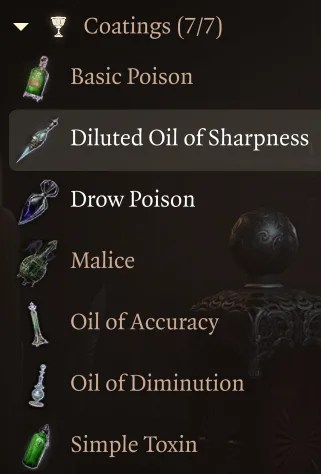
Like elixirs, most coatings are craftable: one specific extract plus one any-of-a-type extract. Basic Poison is Vitriol of Bonecap plus any Ashes; Wizardsbane Oil is Essence of Gremishka Tail plus any Suspension. The wiki notes on several item pages that buying the finished vial from a merchant is usually cheaper than buying the ingredients — the opposite of the elixir economy, where brewing wins.
Every coating in the game
Eighteen coatings are obtainable in a normal run. The condition, its save DC, how long it sticks to the target, and the item's value in gold:
| Coating | What a hit inflicts | Save DC | Sticks for | Value |
|---|---|---|---|---|
| Arsonist's Oil | Strips the target's Fire resistance | — | 2 turns | 25 |
| Basic Poison | Poisoned: Disadvantage on attacks and checks | 11 CON | Until save | 20 |
| Crawler Mucus | Poisoned and Paralysed | 13 CON | Until save | 50 |
| Diluted Oil of Sharpness | Weapon becomes magical, +1 enchantment | — | 10 turns (buff) | 25 |
| Drow Poison | Poisoned and Asleep | 13 CON | Until save or damage | 30 |
| Karabasan's Poison | Same condition as Crawler Mucus | 13 CON | Until save | 50 |
| Malice | Blinded and Poisoned | 15 CON | Until save | 90 |
| Oil of Accuracy | Weapon gets +2 to attack rolls | — | 10 turns (buff) | 20 |
| Oil of Bane | Bane: −1d4 to attacks and saving throws | 11 CHA | 2 turns | 40 |
| Oil of Combustion | Explodes for 3d6 Fire in 3 m when the target takes fire damage | — | 2 turns | 30 |
| Oil of Diminution | Reduced: −1d4 weapon damage, Disadvantage on Strength | 11 CON | 2 turns | 30 |
| Oil of Freezing | Encrusted with Frost: Disadvantage on Dexterity saves | — | 2 turns | 50 |
| Purple Worm Toxin | 1d10 Poison at the end of its next turn | 19 CON | 1 turn | 160 |
| Serpent Fang Toxin | 1d6 Poison at the end of its next turn | 13 CON | 1 turn | 40 |
| Simple Toxin | 1d4 Poison at the end of its next turn | 11 CON | 1 turn | 25 |
| Thisobald's Brewed-Up Bellyglummer | Disadvantage on attacks and checks, 1d6 Poison per turn | 17 CON | Until save | 65 |
| Wizardsbane Oil | −3 to spell attacks and spell save DC, Disadvantage on concentration saves | — | 2 turns | 40 |
| Wyvern Toxin | 1d8 Poison at the end of its next turn | 15 CON | 1 turn | 65 |
Read the toxin rows honestly: 1d4 to 1d10 once is not why you carry these. The damage toxins are the weakest use of the slot. The conditions are the point.
Four coatings worth memorising
Crawler Mucus is a save-or-lose in a 50-gold bottle. A hit forces a DC 13 Constitution save; on a failure the target is Poisoned and Paralysed until it makes the save — and the wiki spells out the vicious part: the save happens at the end of the affected creature's turn, so a creature that starts its turn paralysed loses that turn before it even gets to roll. Paralysis also hands your melee auto-crits from within range, the same interaction that makes Hold Person the workhorse of Honour Mode. Karabasan's Poison applies the identical condition; Sister Lidwin in the House of Healing sells exactly four of them, and they do not restock.
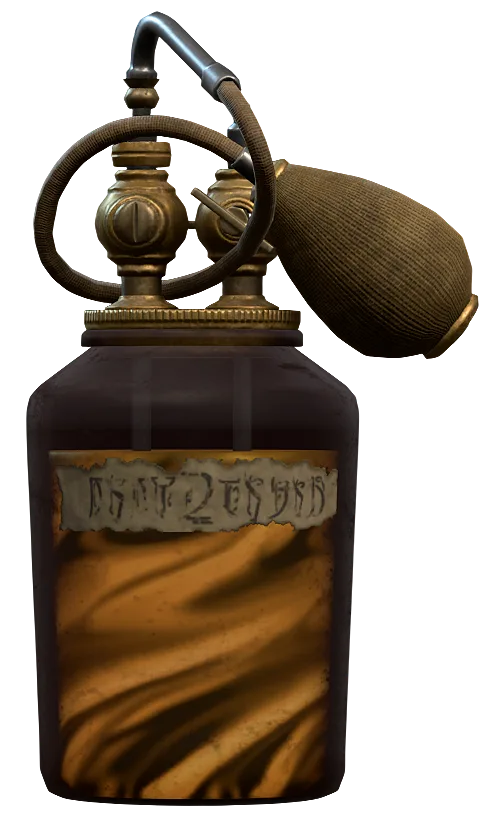
Drow Poison is the budget version: 30 gold, DC 13 Constitution, and the target is Poisoned and Asleep until it saves or takes damage. That "or takes damage" clause makes it self-defeating on a damage-dealer's weapon — put it on a support character's offhand, drop one enemy out of the fight, and hit that enemy last.
Wizardsbane Oil is the anti-caster tool the game never advertises. While its condition sits on the target — 2 turns per hit — the victim takes a −3 penalty to spell attack rolls and spell save DC and has Disadvantage on concentration saves. Ten turns of that on a martial's weapon turns an enemy mage fight into a formality, for 40 gold, no save attached.
Purple Worm Toxin is the one damage toxin that earns its price, and not for the 1d10 — for the DC 19 Constitution save, the highest of any coating. The wiki also logs a bug worth knowing in both directions: Advantage on saves against being Poisoned — Dwarven Resilience, Protection from Poison — has no effect against this toxin due to an incorrect line of code. On an attack that hits multiple targets, only one of them can be affected per swing.
Dip: the coating that costs nothing
Dip is a common bonus action every character has, and it is a free coating with a 3-metre reach. Per the wiki's Dip page:
- Dipping into a Fire or Hellfire surface, or any Burning object — a torch, a candle, a burning party member — grants Dipped in Fire for 3 turns. Dropping a carried torch costs no action, which makes fire damage a bonus action away in any fight.
- Dipping into a Simple Toxin, Serpent Venom, Wyvern Poison or Purple Worm Poison surface grants the corresponding coating for the full 10 turns.
- Dipping into Water washes your current coating off.
- The dipped effect is mutually exclusive with bottled coatings — it is a coating as far as the game cares.
The one-vial party trick
The two rules above combine into the best consumable economy in the game. Thrown toxins do not just splash a target — per the Coatings page, each thrown toxin also creates a surface of 1-metre radius, and those toxin surfaces are permanent. The Dip page completes the loop: the surface persists between Long Rests, and dipping a weapon into it grants the coating effect.
So one 65-gold vial of Wyvern Toxin, thrown at your own camp's floor, becomes a puddle the entire party can dip into for a 10-turn coating — every fight, forever. Four coated weapons per rest for the price of one vial, and it costs bonus actions only.
Grenades: split the stack first
Grenades trigger when the item is destroyed — usually by the 1 Bludgeoning damage the throw itself deals. That produces an expensive mistake, straight from the wiki: a stack of grenades detonates identically to a single grenade. Throw a stack of five Smokepowder Bombs and you get one explosion and four vaporised bombs. Split stacks into single items before you throw.
The regular grenades worth carrying, with the numbers:
| Grenade | Radius | Damage | Save | What else it does |
|---|---|---|---|---|
| Acid Vial | 2 m | 2d6 Acid | DEX 13 negates | Leaves an Acid surface |
| Alchemist's Fire | 3 m | — | — | Fire surface for 3 turns, Burning |
| Caustic Bulb | 3 m | — | — | Caustic Brine surface and condition |
| Flashblinder | 6 m | — | CON 16 negates | Blinded 10 turns; Malfunctioning on Steel Watchers with no save |
| Grease Bottle | 3 m | — | DEX 12 negates Prone | Grease surface, difficult terrain |
| Holy Water | 2 m | 3d6 Radiant | DEX 13 halves | Damages only Fiends and Undead; Water surface |
| Sanguine Explosive | 2 m | 4d8 Force + 4d8 Fire | DEX 17 halves | Burning for 2 turns; sold by Araj Oblodra |
| Smokepowder Bomb | 4 m | 3d4 + 9 Force | DEX 12 halves | Pure damage, 16 gold |
| Void Bulb | 6 m | 1 Force | STR 18 negates | Pulls creatures within 5 m to the impact point |
| Web Grenade | 3 m | — | — | Web surface for 10 turns |
Three standouts:
- Void Bulb at 3 gold is the best action a non-caster can donate to a caster: pull the room into a ball, then drop the Fireball or the Ice surface chain onto the pile.
- Smokepowder Bomb averages 16.5 Force damage in a 4-metre radius for 16 gold, and Force is the damage type almost nothing resists. Act 1 sells them at the Risen Road tollhouse, the Myconid Colony and the Shattered Sanctum.
- Flashblinder is a DC 16 Constitution save against 10 turns of Blinded — and against Steel Watchers the Malfunctioning rider lands with no save at all, which is why Bumpnagel sells them in Act 3.
One documented bug to price in: Alchemist's Fire lists Burning for 3 turns, but the 1-turn Burning from the fire surface it creates overwrites the longer condition, so in most cases targets burn for 1 turn. Buy it for the 3-turn surface, not the condition.
Special arrows: no quiver required
Baldur's Gate 3 has no ammunition system — every bow and crossbow fires for free, and "arrows" as items are all special consumables that replace one attack. The wiki's Arrows page carries the rules that matter:
- Special arrows work with Extra Attack, so a level 11 Fighter can fire three of them in one turn. The exceptions are Arrow of Salving and Arrow of Transposition, which cost the whole action.
- They cannot be used on off-hand ranged attacks or on special attacks like Horde Breaker.
- On the area-effect arrows, the damage applies only to the primary target — nearby creatures receive the conditions and surfaces, not the dice.
- Arrows cannot be crafted. Coatings and many grenades come out of the alchemy tab; arrows are loot-and-vendor only, which is the actual reason to stop hoarding them — the supply is not in your hands anyway.

| Arrow | Rarity | Value | What it does |
|---|---|---|---|
| Arrow of Acid / Fire / Ice / Lightning | Common | 10 | Weapon damage + 2d4 of the element (DEX save negates the rider); Acid, Fire and Ice also leave the matching surface, Lightning does not |
| Arrow of Darkness | Uncommon | 20 | Weapon damage + a 3 m Darkness cloud that Blinds for 3 turns |
| Arrow of Ilmater | Uncommon | 20 | Weapon damage + 1d4 Necrotic; the target cannot regain hit points for 1 turn |
| Arrow of Roaring Thunder | Uncommon | 20 | Weapon damage + knocks the blast area back 5 m (STR save negates) |
| Arrow of Arcane Interference | Rare | 50 | Weapon damage, breaks the target's concentration, and Silences |
| Arrow of Many Targets | Rare | 50 | Weapon damage, plus half that damage to three other targets in range |
| Arrow of Salving | Rare | 50 | Cures Poisoned, Paralysed and Blinded (full action) |
| Arrow of Transposition | Rare | 50 | Teleports the shooter to wherever the arrow lands (full action) |
| Smokepowder Arrow | Rare | 80 | 4d6 Fire + 4d6 Force in a 5 m blast, knocks targets back 3 m |
| Arrows of Slaying (by creature type) | Uncommon–Very rare | 10–80 | Doubles the weapon's base damage against that creature type |
The wiki singles out Arrow of Ilmater as one of the earliest and cheapest healing-prevention tools in the game — 20 gold to switch off a boss's healing for a turn. Arrow of Arcane Interference is a no-roll concentration break: where a coating like Wizardsbane makes the enemy caster likelier to drop the spell, the arrow just ends it. And Arrow of Transposition costs your action, but it is a 50-gold teleport with no spell slot and no class requirement.
Slaying arrows double your weapon damage
The slaying arrows work nothing like their tabletop namesakes, and the difference is the build advice. In 5th Edition they force a save against a pile of extra dice. In Baldur's Gate 3, per the wiki, they incur no saving throw and no damage roll of their own — they simply double the base damage of the weapon used to fire them against the matching creature type.
Doubling base damage means everything that inflates base damage gets doubled too, which is why the wiki calls out passives like the Sharpshooter feat as the natural pairing. A heavy crossbow Sharpshooter firing an Arrow of Undead Slaying at a mummy is doubling a number that already had +10 baked in. The family covers Aberrations, Beasts, Constructs, Dragons, Elementals, Fiends, Humanoids, Monstrosities and Undead — and the Humanoid one is very rare for the obvious reason that most of the game's dangerous enemies are humanoids.
Quick Action Checklist
- Coatings: bonus action, 10 turns, one per weapon set. Dual-wield coats both weapons; melee and ranged sets need separate vials.
- Poison coatings tick at the end of the target's turn, not on hit — the conditions, not the dice, are what you are buying.
- Crawler Mucus paralyses until a DC 13 save that only happens at end of turn — a creature that starts its turn paralysed loses that turn before it can roll.
- Wizardsbane Oil is −3 enemy spell save DC and Disadvantage on their concentration for 40 gold, no save.
- Purple Worm Toxin forces a DC 19 CON save, and save-advantage against poison does not work on it (documented bug).
- Dip is a free coating: fire surfaces and burning objects give 3 turns of fire damage; toxin surfaces give the real 10-turn coating.
- Throw one toxin vial at the ground and the surface is permanent — the whole party can Dip into it, and it survives Long Rests.
- Split grenade stacks before throwing. A thrown stack detonates as a single grenade and destroys the rest.
- Void Bulb: 3 gold, 6 m radius, DC 18 STR pull — the cheapest area-spell setup in the game.
- Special arrows fire with Extra Attack (except Salving and Transposition), and they cannot be crafted.
- Slaying arrows double base weapon damage with no save — Sharpshooter's +10 gets doubled too.
- Arrow of Ilmater blocks all healing on the target for 1 turn for 20 gold.
Frequently Asked Questions
How do weapon coatings work in Baldur's Gate 3?
Do coatings stack in BG3?
What is the best weapon coating in Baldur's Gate 3?
What does the Dip action do in BG3?
Why did my whole stack of grenades disappear when I threw it?
How do Arrows of Slaying work in BG3?
Can you craft arrows in Baldur's Gate 3?
What is the Void Bulb and why is it good?
Keep Reading
- BG3 Wiki — coating rules, the full coating table, and thrown-toxin surfaces
- BG3 Wiki — grenade tables, stack detonation, and trigger mechanics
- BG3 Wiki — arrow rules, Extra Attack interaction, and the slaying-arrow doubling
- BG3 Wiki — Dip surfaces, durations, and persistent toxin puddles
- BG3 Wiki — Crawler Mucus end-of-turn save behaviour
- BG3 Wiki — Purple Worm Toxin DC 19 and the save-advantage bug
- BG3 Wiki — Wizardsbane Oil penalties and crafting recipe
- BG3 Wiki — Alchemist's Fire surface duration and the Burning overwrite bug
- BG3 Wiki — Smokepowder Bomb damage and Act 1 vendors
- BG3 Wiki — Void Bulb pull radius, save DC, and sources
Related Guides

Baldur's Gate 3 Initiative and Surprise: How to Go First
Tabletop D&D rolls initiative on a d20. Baldur's Gate 3 rolls it on a d4, which turns a +5 from Alert from a nudge into something close to a guarantee. Here is how turn order is built, what Surprised takes away, and the line-of-sight rule that decides whether your ambush gets a surprise round at all.
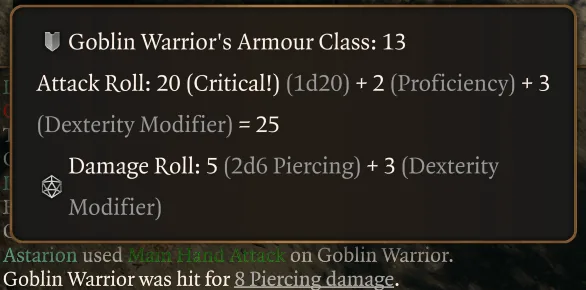
Baldur's Gate 3 Critical Hits: What Actually Doubles
A natural 20 doubles your damage in Baldur's Gate 3 — but "doubled" hides real nuance: which half of that number actually doubles, which of the game's dozen crit-threshold sources stack together, and how "immune to critical hits" still lets a natural 20 miss outright. bg3.wiki's own combat-log breakdown settles all three.

Baldur's Gate 3 High Ground: It's Not Advantage
The standard beginner tip in this game is "take the high ground" — and it leaves it there, as if it works the same way a Prone target or an unseen attacker does. It does not. High ground is a flat, separately tracked +2 or -2 bolted onto the attack roll, and bg3.wiki's own numbers show it does things the "it's advantage" version of the rule never predicted.
Baldur's Gate 3 Karmic Dice: What It's Secretly Fixing
There is a setting on by default in every new Baldur's Gate 3 save that changes the odds of your next roll based on how badly the last one went, and the game never tells you it exists. Here is the formula bg3.wiki has worked out, the three roll types it can and cannot touch, and the two documented bugs sitting on top of it.

Baldur's Gate 3 Beginner Guide: What Nobody Tells You
The tutorial teaches you to move and attack. It does not teach you that advantage is worth more than any weapon you will find in Act 1, or that Withers will rebuild your entire character for 100 gold. Here is the actual onboarding.
Baldur's Gate 3 Reactions: Why Yours Did Not Trigger
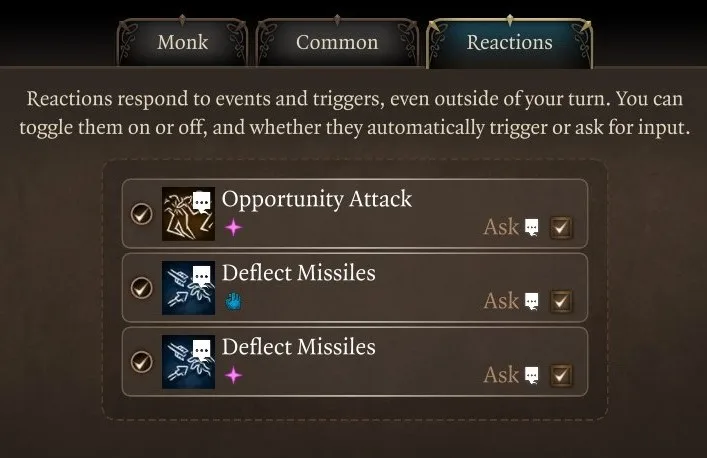
Every creature in Baldur's Gate 3 carries exactly one Reaction charge and gets it back at the start of its turn. What that charge can answer is narrower than the tooltips suggest: the game decides which reactions are eligible for an event before any of them resolve, and whole categories of damage and saving throws are invisible to the system entirely. Here is the reaction list by source and cost, the rules that gate it, and the bugs the wiki has documented on top.