Baldur's Gate 3 Best Feats: You Only Get Three of These
Three feats. Four if you are a Fighter or a Rogue. That is the entire budget for a hundred-hour campaign, and most players spend at least one of them on something that does nothing. Here is what each pick is actually worth.

There is a moment in most first playthroughs where the level 4 screen appears, offers a list of thirty-odd feats with names like Dungeon Delver and Moderately Armoured, and the player picks +2 Strength because it is the option that obviously does something. That is not a terrible choice. It is also, in a game where you make this decision a grand total of three times, worth ten minutes of thought.
Feats in Baldur's Gate 3 are not incremental. Two of them roughly double a martial character's damage. One stacks your Strength modifier onto your attack rolls a second time, which is a bigger accuracy swing than anything else in the game. And several do effectively nothing for a party that already has a Rogue.
Three feats. Four if you are a Fighter or Rogue
Every class takes a feat at levels 4, 8, and 12. Fighters get a bonus one at level 6; Rogues get a bonus one at level 10. That is the entire list. Nobody else gets extras.
Two things follow from that. First, because the level cap is 12, there is no "I will pick that up later" — level 12 is later. Second, Fighter and Rogue are unusually strong dip targets for reasons that have nothing to do with their class features, since a Fighter 6 / anything 6 build walks away with four feats instead of three. If you are already weighing splits, our multiclassing guide covers which dips are worth the delay.
Also worth stating plainly: Ability Improvement is itself a feat. It is not a separate reward you get alongside a feat, the way some players assume from other RPGs. Every +2 you take is a feat you did not take.
The +2 stat bump is the floor, not the default
Ability Improvement raises one score by 2 or two scores by 1, capped at 20. It is the safe pick and it is genuinely fine — going from 16 to 18 in your attack stat is +1 to hit and +1 damage on every single attack, forever, with no toggles and no conditions.
But run the comparison honestly. A Fighter with Extra Attack swings twice a round. Ability Improvement gives that Fighter +2 damage per round. Great Weapon Master's damage toggle gives the same Fighter up to +20 per round when the attacks land. The gap is not close, and it only widens as you find items that fix your accuracy.
The rule of thumb: take Ability Improvement when you are at an odd primary score and one bump lands you on 18 or 20, or when your build has no damage-multiplying feat that fits. Otherwise, the specialist feats win.
The damage feats that actually move the number
Tavern Brawler is the broken one
Tavern Brawler raises Strength or Constitution by 1, and then does the thing that breaks the game: when you make an unarmed attack, use an improvised weapon, or throw something, your Strength modifier is added twice — to the damage roll and to the attack roll.
Read that again, specifically the attack roll part. Every other damage feat in Baldur's Gate 3 asks you to trade accuracy for damage. Tavern Brawler hands you both. At Strength 20 that is +5 damage and +5 to hit on top of what you already had, which pushes your hit chance to the point where you are only missing on a natural 1.
It powers three things: Monk unarmed strikes, Throwzerker Barbarians chucking javelins (and, occasionally, gnolls), and Druids in Wild Shape, whose forms get the bonus except Fire, Water, and Air Myrmidons. One Honour Mode caveat: improvised melee weapon attacks lose the extra damage there, though they keep the attack roll bonus. Throw attacks keep both.
If you are running a Strength-based Monk, Throw Barbarian, or a Moon Druid, this is your level 4 pick and it is not a discussion.
Great Weapon Master: the crit snowball
Great Weapon Master is two separate passives bundled together, and players consistently underrate the first one.
Great Weapon Master: Bonus Attack — when a melee weapon attack lands a critical hit or kills a creature, you get another melee weapon attack as a bonus action. Crit or kill, not both. And it benefits from Extra Attack. On a Barbarian in Rage swinging into a crowd of goblins, this triggers most rounds, for free, with no downside whatsoever.
Great Weapon Master: All In — a toggle that applies a -5 penalty to your attack roll for +10 damage, using a two-handed or versatile weapon you are proficient with.
The toggle is the famous half and the conditional half. Turned on against a high-AC target with no accuracy support, you will whiff and feel foolish. Turned on when you have advantage, a Bless, or a boss with soft AC, it is the single biggest damage swing available to a martial character. Learn to toggle it per fight rather than setting and forgetting.
Sharpshooter quietly fixes a positioning problem
Sharpshooter is Great Weapon Master for ranged builds, plus one rider that matters:
- Low Ground — your ranged weapon attacks are not penalised by high ground rules. Normally shooting up at an enemy 2.5 metres or more above you eats a flat -2 "Low Ground" penalty on the attack roll — a fixed number, not disadvantage. With this, that -2 goes away. It does not hand you the +2 High Ground bonus; that still belongs to whoever is actually standing higher.
- All In — the same -5 to hit for +10 damage toggle, on proficient ranged weapons.
Low Ground is the sleeper. High ground is the dominant tactical mechanic in this game, and Sharpshooter means your own footing stops working against you when the enemy archer got to the rooftop first. Our high ground guide has the full numbers, including the 2.5-metre threshold.
Savage Attacker is the lowest-effort pick in the game
Savage Attacker: on melee weapon attacks, you roll your damage dice twice and keep the higher result. Each die independently. No toggle, no penalty, no condition.
That works out to roughly a 25% to 31% damage increase on your weapon dice depending on die size, and since Patch 7 it also covers Sneak Attack, Battle Master manoeuvres, and Bard Blade Flourishes. It stacks with damage riders like Divine Smite on melee attacks.
It is strictly worse than Great Weapon Master on a greataxe build with accuracy support. It is strictly better than Great Weapon Master on a Rogue rolling 6d6 of Sneak Attack, or on a Paladin dumping smites. Match the feat to how your damage is actually delivered.
Feats that keep the build alive
War Caster
Advantage on Constitution saving throws to maintain concentration, plus the ability to cast Shocking Grasp as a reaction when an enemy leaves your melee range. If your caster's job is holding a concentration spell — Hold Person, Haste, Spirit Guardians, Hunger of Hadar — this feat is the difference between the spell lasting the fight and lasting one turn. On a build whose entire plan is a single concentration spell, this is a level 4 pick, not a level 12 one.
Alert
+5 to initiative and you cannot be Surprised. Boring on paper, brutal in practice: going first in Baldur's Gate 3 frequently means a full party round before the enemy acts, and a full party round is often the whole fight. It is the most commonly recommended safety feat for Honour Mode runs, where losing initiative to an ambush ends the save file.
Lucky
Three Luck Points per Long Rest. Spend one for advantage on an attack roll, ability check, or saving throw, or to force an enemy to reroll an attack against you. It is one of the very few ways to buy advantage on any d20 roll in the game, including the failed save that would otherwise wipe you.
Two things to know. It stacks with Halfling Luck, which is why halflings are quietly excellent here. And there is a known quirk: the toggleable passive defaults to off and cannot be switched on until after that character has made an ability check, used a reaction, or taken a rest.
Tough and Durable
Tough gives +2 maximum HP per character level, applied retroactively — take it at level 8 and you instantly gain 16 HP, ending at 24 extra by level 12. Durable is the smaller cousin: +1 Constitution and full hit points back on every Short Rest, which is a real reduction in healing spent across a party that short rests twice per Long Rest.
Neither wins a damage race. Both are legitimate on a frontliner in a run where dying is expensive.

The half-feats and the odd-number trick
Because ability modifiers move on even numbers, a score of 17 and a score of 16 are mechanically identical — both give +3. Any odd score is a wasted point sitting there. Half-feats fix that: they give a real effect and +1 to an ability, so you convert dead points into a modifier while getting something else for free.
The ones that carry a +1 in BG3: Actor (Charisma, plus expertise in Deception and Performance), Athlete (Strength or Dexterity, plus faster standing and +50% jump distance), Durable (Constitution), Heavily Armoured and Heavy Armour Master (Strength), Lightly Armoured and Moderately Armoured (Strength or Dexterity), Performer (Charisma), Resilient (any ability, plus saving throw proficiency in it), Tavern Brawler (Strength or Constitution), and Weapon Master (Strength or Dexterity, plus four weapon proficiencies).
Resilient: Constitution is the standout. Proficiency in Constitution saves plus a +1 that usually turns an odd Con into a real modifier is the concentration-caster's other answer alongside War Caster — and there is no rule against running both.
Actor is the pick most parties overlook. If your protagonist is the face, expertise in Deception doubles your proficiency bonus on the checks that gate the game's best dialogue outcomes — worth remembering when you decide which class leads your party.
Reaction feats: Sentinel, Polearm Master, Mage Slayer
These three are for characters who want to control space rather than delete a target.
Sentinel does three things: a reaction attack when an enemy in your melee range attacks an ally, opportunity attacks that drop a target's movement to zero, and advantage on those opportunity attacks. It is the closest thing to a tank tool in a game with no aggro system.
Polearm Master gives you a bonus action attack with the butt end of a glaive, halberd, pike, quarterstaff, or spear, plus an opportunity attack when an enemy enters your reach rather than leaves it. Paired with Sentinel on a reach weapon, enemies stop moving through your frontline entirely.
Mage Slayer gives advantage on saves against nearby casters, a reaction attack against a caster who casts within melee range, and disadvantage on their concentration saves when you hit them. Situational, but Act 2 and Act 3 are stuffed with casters.
The catch on all three: you get one reaction per round. Loading a character up with three reaction feats does not give them three reactions.

Feats that look good and are not
- Dungeon Delver. Advantage on Perception checks to spot hidden objects and on saves against traps, plus trap damage resistance — all of which any party with a high-Perception character already gets for free.
- Ritual Caster. Two ritual spells. Long Rests are cheap here and Camp Supplies are abundant, so casting without a slot is worth far less than it is at a tabletop.
- Magic Initiate. Two cantrips and one 1st-level spell per Long Rest. Almost never better than a stat bump on a character who already casts.
- Spell Sniper. Lowers the crit threshold for spell attacks by 1 — but only for spell attack rolls, not the save-based spells that make up most of a caster's best list.
- Shield Master. +2 to Dexterity saving throws and a reaction to reduce damage on them. The wiki flags bugs on this one, and the effect is small even when it works.
None of these are broken. They are just not three of the best ones, and three is all you have.
Feat plans by archetype
- Strength melee (Barbarian, Fighter, Paladin): Great Weapon Master at 4, Ability Improvement at 8 to reach 20 Strength, Savage Attacker or Sentinel at 12.
- Throw or unarmed (Throwzerker, Monk): Tavern Brawler at 4, Ability Improvement at 8, Alert or Ability Improvement at 12.
- Ranged (Ranger, Fighter archer, Rogue): Sharpshooter at 4, Ability Improvement at 8, Alert at 12. Rogues slot Savage Attacker into their level 10 bonus feat.
- Concentration caster (Wizard, Druid, Cleric): War Caster or Resilient: Constitution at 4, Ability Improvement at 8, Alert or Lucky at 12.
- Charisma caster and party face (Bard, Sorcerer, Warlock): Ability Improvement at 4, Actor or War Caster at 8, Alert at 12.
- Honour Mode, any build: slot Alert somewhere. Losing initiative is how single-save runs die.
Quick Action Checklist
- You get feats at levels 4, 8, and 12 — plus level 6 for Fighters and level 10 for Rogues. That is the whole budget.
- Ability Improvement is a feat, not a freebie alongside one.
- Take Tavern Brawler on any unarmed, throwing, or Wild Shape build. Double Strength on the attack roll is the biggest accuracy swing in the game.
- Take Great Weapon Master on two-handed melee, and treat All In as a per-fight toggle, not a permanent setting.
- Take Sharpshooter on ranged builds — the Low Ground clause alone removes the flat -2 Low Ground penalty on ranged weapon attacks (it is a -2, not disadvantage).
- Take Savage Attacker when your damage comes from many dice: Sneak Attack, smites, manoeuvres.
- Take War Caster or Resilient: Constitution on any character whose plan is holding one concentration spell.
- Alert (+5 initiative, no Surprise) is the safest slot in an Honour Mode run.
- Use half-feats to convert odd ability scores into real modifiers instead of burning a full Ability Improvement.
- Do not stack three reaction feats on one character. You still only get one reaction per round.
Frequently Asked Questions
How many feats do you get in Baldur's Gate 3?
What is the single best feat in Baldur's Gate 3?
Is Great Weapon Master worth it in BG3?
Should I take Ability Improvement or a real feat?
What are half-feats in Baldur's Gate 3?
Is Savage Attacker good in BG3?
Which feat is best for Honour Mode?
Can I change a feat after choosing it?
Keep Reading
- BG3 Wiki — full feat list and level progression
- BG3 Wiki — Tavern Brawler mechanics and Honour Mode notes
- BG3 Wiki — Savage Attacker damage scaling and Patch 7 coverage
- BG3 Wiki — Great Weapon Master bonus attack and All In toggle
- BG3 Wiki — High ground rules: the flat +2/-2 attack roll modifier at 2.5 m and what Sharpshooter removes
Related Guides
Baldur's Gate 3 Initiative and Surprise: How to Go First
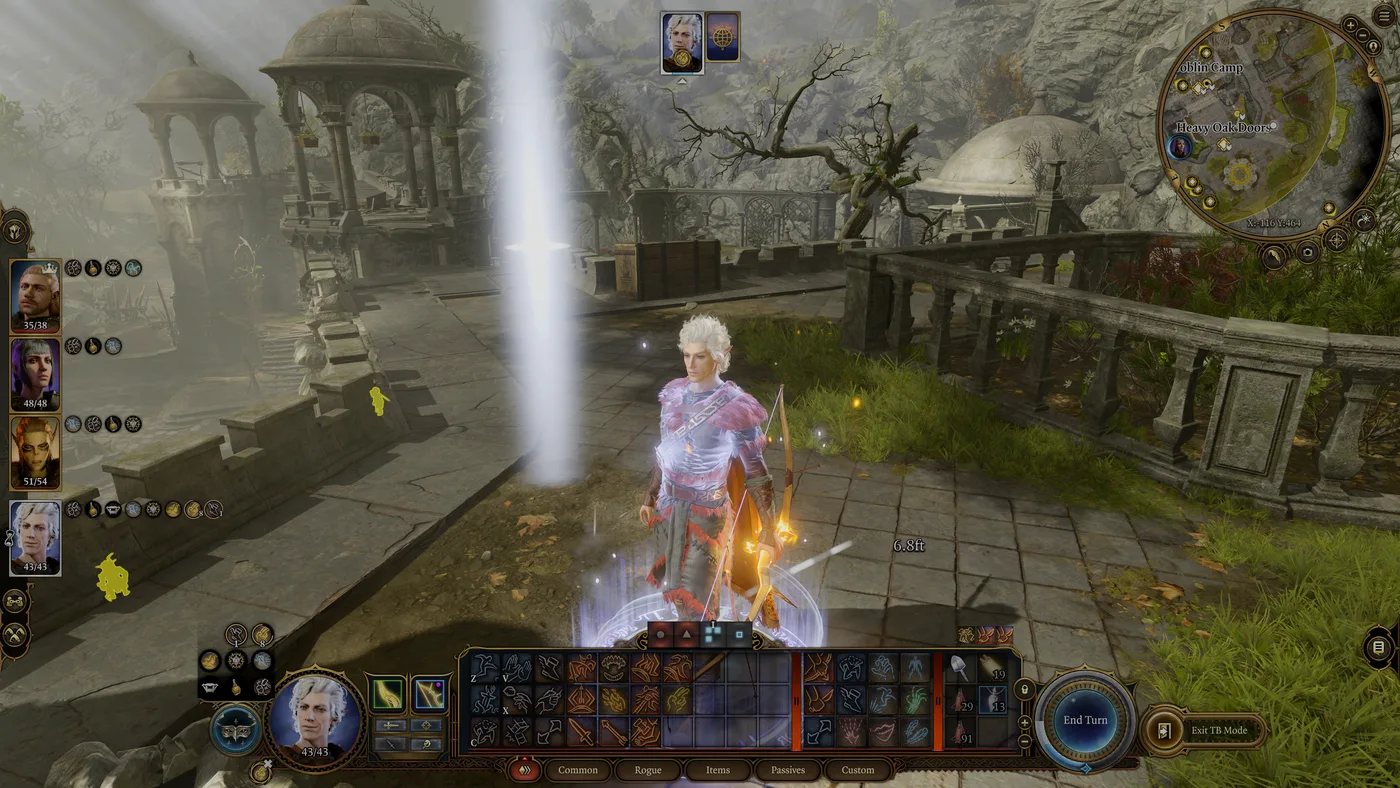
Tabletop D&D rolls initiative on a d20. Baldur's Gate 3 rolls it on a d4, which turns a +5 from Alert from a nudge into something close to a guarantee. Here is how turn order is built, what Surprised takes away, and the line-of-sight rule that decides whether your ambush gets a surprise round at all.
Baldur's Gate 3 Critical Hits: What Actually Doubles
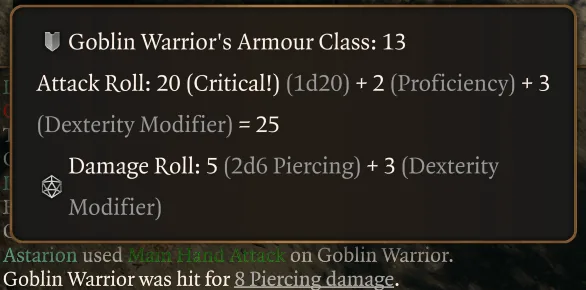
A natural 20 doubles your damage in Baldur's Gate 3 — but "doubled" hides real nuance: which half of that number actually doubles, which of the game's dozen crit-threshold sources stack together, and how "immune to critical hits" still lets a natural 20 miss outright. bg3.wiki's own combat-log breakdown settles all three.

Baldur's Gate 3 High Ground: It's Not Advantage
The standard beginner tip in this game is "take the high ground" — and it leaves it there, as if it works the same way a Prone target or an unseen attacker does. It does not. High ground is a flat, separately tracked +2 or -2 bolted onto the attack roll, and bg3.wiki's own numbers show it does things the "it's advantage" version of the rule never predicted.
Baldur's Gate 3 Karmic Dice: What It's Secretly Fixing
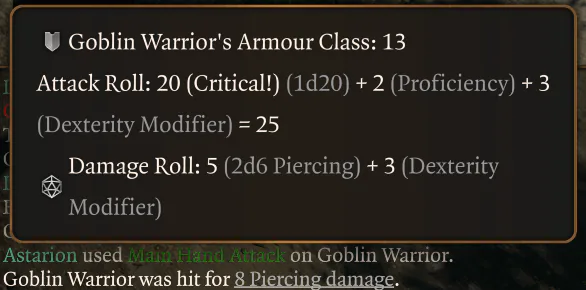
There is a setting on by default in every new Baldur's Gate 3 save that changes the odds of your next roll based on how badly the last one went, and the game never tells you it exists. Here is the formula bg3.wiki has worked out, the three roll types it can and cannot touch, and the two documented bugs sitting on top of it.
Baldur's Gate 3 Beginner Guide: What Nobody Tells You
The tutorial teaches you to move and attack. It does not teach you that advantage is worth more than any weapon you will find in Act 1, or that Withers will rebuild your entire character for 100 gold. Here is the actual onboarding.
Baldur's Gate 3 Reactions: Why Yours Did Not Trigger
Every creature in Baldur's Gate 3 carries exactly one Reaction charge and gets it back at the start of its turn. What that charge can answer is narrower than the tooltips suggest: the game decides which reactions are eligible for an event before any of them resolve, and whole categories of damage and saving throws are invisible to the system entirely. Here is the reaction list by source and cost, the rules that gate it, and the bugs the wiki has documented on top.