Best Arena Cards in Cookie Run: Braverse, Ranked
Arena is the tribal synergy keyword: the more Arena Cookies you stack on board and the more Arena cards you bury in your trash, the harder every one of them hits. Here are the real Arena cards worth building around, ranked top to bottom.
Most keywords in Cookie Run: Braverse are descriptive - they tell you a Cookie is an Ancient or a Dragon and then the card text does the heavy lifting. Arena is different. Arena is the one keyword the cards actively check for, over and over, on themselves and on each other. Half the Arena Cookies in the official database read some version of "if there is another Arena Cookie in your battle area, do something nasty," and the rest reward you for filling your trash with Arena cards. It's Braverse's tribal deck, and when the board tips in your favor it tips hard.
This is a ranked tour of the real Arena cards worth building around, pulled from the official card database, plus the framework for evaluating any new Arena card. Stats below - cost, HP, and effect text - are quoted from the official listings; the {R} symbol is a single Red resource, {N} is any color, and {da} is "deals damage," so a cost like "two Red, one any" is what a card actually demands. The whole Arena package debuted in the BS7 set, so if you want the set-level pull-value angle instead of the archetype angle, that's our Arena of Glory set review; this post is about how to actually build and pilot the deck. If you're brand new, start with the five colors explained.
What the Arena keyword actually does
Arena is a synergy keyword, not a faction with one home color. Arena Cookies live in all five colors - the database has Red, Yellow, Green, Blue, and Purple Arena Cookies - which means an Arena deck is built around a keyword, not a color identity. That's the first thing that makes it weird and the first thing that makes it strong: you get to cherry-pick the best Arena Cookie out of every color and glue them together with shared energy costs.
The payoff pattern is consistent across the keyword. Arena cards reward two things:
- Going wide with Arena Cookies. A huge share of Arena cards check "if there is another Arena Cookie in your battle area" and then add damage, ping a Cookie, or shut off the opponent's defense. One Arena Cookie alone is mediocre; two or three on board is where the deck wakes up.
- Filling your trash with Arena cards. Several Arena cards scale off how many Arena cards are sitting in your trash, so discarding and trading aren't downside - they're fuel. Prune Juice Cookie literally counts seven Arena cards in the trash before it pings.
The Arena test: a card earns a slot if it either enables the board (cheap Arena bodies that come down early) or pays off a board you've already built (the cards that check for other Arena Cookies). A deck that's all payoff and no early bodies never gets to fire.
So Arena is a go-wide, snowball aggro-tempo archetype that wants to flood the board with cheap synergy pieces and then turn a full battle area into a pile of free damage. It is fast, it is proactive, and it punishes a slow opening hand from the opponent.
How to read this list
We're grouping by role, because role is what survives a meta shift - but within each role the picks are ranked, real cards with their actual numbers. The buckets are: payoff Cookies (the ones that turn a wide board into damage), enablers and engine pieces (the cheap bodies and recursion that build the board), and the support cards plus the trap that round out the shell. Costs and effects are quoted from the official database. The named trio you'll see referenced on the cards themselves - Capsaicin, Prune Juice, and Kouign-Amann - is the deck's intended core, and the cards are explicitly written to find each other.
The payoff Cookies
These are the cards that convert a board full of Arena Cookies into a finished game. Ranked top to bottom:
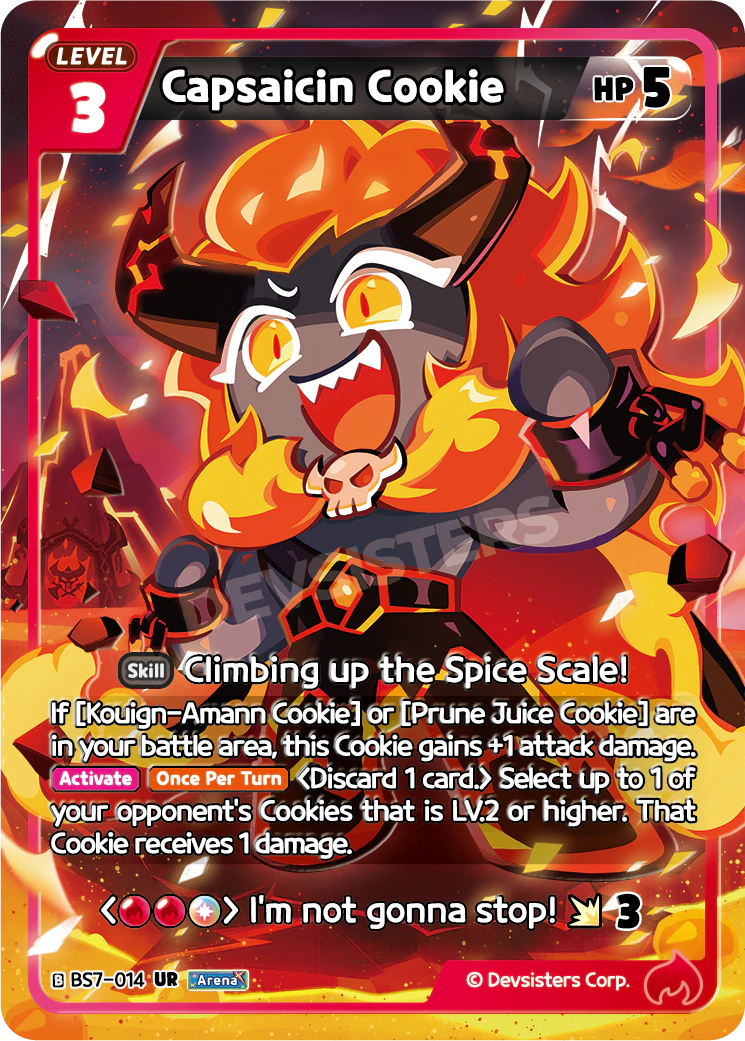
- Capsaicin Cookie (BS7-014, Ultra Rare, LV.3, 5 HP). The flagship Arena payoff. It gains +1 attack damage while Kouign-Amann Cookie or Prune Juice Cookie is in your battle area, and its Activate ability - once per turn, discard a card - pings an opposing LV.2-or-higher Cookie for 1. So it hits harder and reaches across the board to clear blockers, exactly the two things an aggro deck needs from its top end. Its attack swings for 3 for two Red and one any. This is the card the whole deck is built to support.
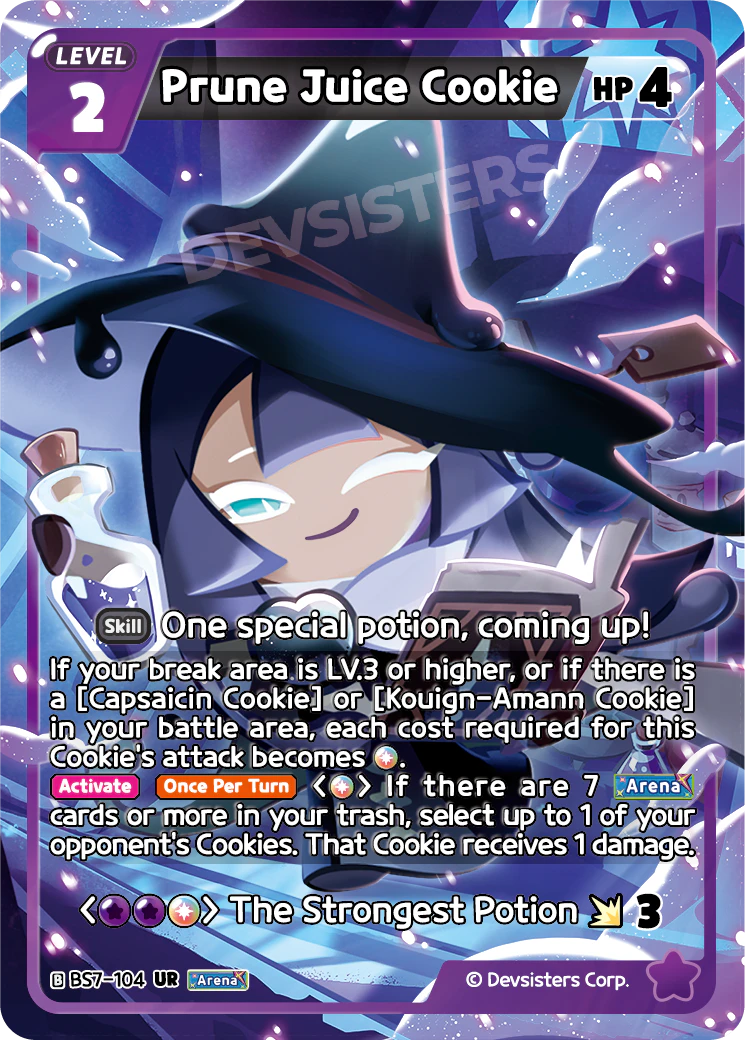
- Prune Juice Cookie (BS7-104, Ultra Rare, LV.2, 4 HP). The Purple engine-payoff. While your break area is LV.3 or higher, or a Capsaicin or Kouign-Amann Cookie is out, every cost on its attack becomes any-color {N} - so it casts for next to nothing. And its Activate ability, once you have seven Arena cards or more in your trash, pings an opposing Cookie. It's the reward for a long, grindy Arena game and the reason your discards are never wasted.
- Jalapeño Cookie (BS7-018, Ultra Rare, LV.3, 5 HP). The straightforward beater. Its attack deals 4 for three Red and one any, and then - if there's another Arena Cookie in your battle area - it pings an opposing Cookie for 1. A LV.3 that swings for 4 and clears a blocker is a clean way to push the last few points of damage.
What you're hunting for in this slot, set after set, is the card that does the most when your board is already wide. Capsaicin is the benchmark: it scales off the trio and carries reach. The discipline is that a payoff with nothing to pay off is a dead draw, so you never run more payoffs than your enabler count can support.
An Arena deck wants two-to-three Arena Cookies on the board by mid-game. If your hand is all payoffs and no cheap bodies, you don't have an aggro deck - you have a pile of cards waiting for a board that never arrives.
The enablers and engine pieces
Payoffs are half of it; the other half is the cheap bodies that get the board wide enough for those payoffs to fire. Ranked:
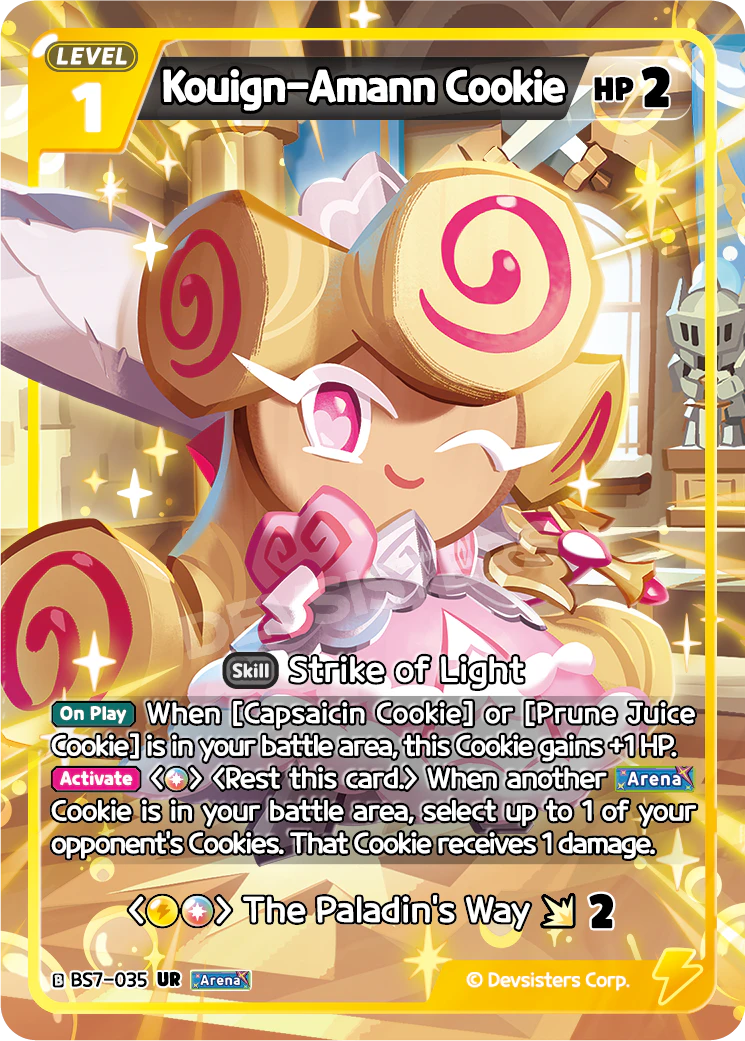
- Kouign-Amann Cookie (BS7-035, Ultra Rare, LV.1, 2 HP). The perfect one-drop for the deck. Its On Play gives it +1 HP when Capsaicin or Prune Juice is out, and its Activate ability - pay any, rest this card - pings an opposing Cookie for 1 whenever another Arena Cookie is on board. A LV.1 that comes down turn one and immediately becomes removal-on-a-stick the moment a second Arena Cookie lands. The third member of the named trio.
- Green Tea Mousse Cookie (BS7-046, Super Rare, LV.2, 4 HP). The engine body. When it's played from the support area it digs a card off the top of your deck, and its attack lets you play an Arena Cookie straight out of your support area - free board development that keeps the go-wide plan rolling without spending cards from hand.
- Crushed Pepper Cookie (BS7-015, Super Rare, LV.2, 4 HP). The cheap tempo hit. Its attack deals 1 for two Red and one any, then deals 2 more if there's another Arena Cookie in your battle area - so on a developed board it's a three-cost swing for 3 that also fills the curve between your one-drops and your top end.
The best enablers are cheap, come down early, and turn on a payoff just by existing. The risk: lean too hard on tiny bodies with no follow-through and you run out of gas against a deck that trades one-for-one and stabilizes. Pair the bodies with the recursion (Green Tea Mousse, and the support-area plays) so the board refills after a trade.
If you can't reliably have two Arena Cookies down by your third turn, your curve is too top-heavy. Cut a payoff for another one- or two-drop and watch the deck come online a full turn earlier.
The support cards and trap
Beyond the Cookies, the Arena package brings a few non-Cookie pieces that earn their slots. Ranked:
- Choco Drizzle Cookie (BS7-059, Ultra Rare, LV.3, 6 HP). Technically a Cookie, but it plays like a support-area finisher. When it's played from the support area it deals 2 to an opposing Cookie, and its attack deals 3 and then bounces one of your own LV.2-or-lower Green Cookies back to the support area as active - resetting a value body to reuse next turn. A sticky, six-HP top end that keeps recurring your enablers.
- Arena of Glory (BS7-108, Super Rare, Pure Trap). The keyword's namesake trap. For one any, it drops an opposing Cookie's attack damage by 1 this turn, and if your break-area Level is at least three higher than the opponent's, it cripples a LV.3 attacker for -2. A clean defensive speed bump that's strongest in exactly the grind Prune Juice wants.
- Financier Cookie (BS7-039, Super Rare, LV.3, 5 HP). The board-wide closer. Its Activate ability buffs its own HP by placing a Cookie from hand into the break area, and its attack deals 3 - then, if an Arena Cookie was placed in your break area this turn, all of the opponent's Cookies take 1. A sweep stapled to a beater for a wide aggro mirror.
The discipline with these is restraint: a couple of the trap and one or two support-area engines are plenty. Over-loading on traps slows the aggro plan you're actually trying to execute.
Building an Arena deck
A clean Arena shell, role by role, looks roughly like this. Treat it as a starting skeleton you tune, not gospel - and remember a legal deck is exactly 60 cards with up to four copies of any card number, at least one Cookie, and up to 16 FLIP cards.
| Role | Rough share of the deck | Anchor cards |
|---|---|---|
| Payoff Cookies | A solid core block | Capsaicin, Prune Juice, Jalapeño |
| Enablers / one-drops | The largest single block | Kouign-Amann, Crushed Pepper |
| Engine / recursion | A focused package | Green Tea Mousse, Choco Drizzle |
| Support cards / trap | A small, deliberate set | Arena of Glory, Financier |
| FLIP cards | Up to the 16-card cap | Cheap Arena FLIP draws that stabilize the early board |
The 60-card, four-copy, and 16-FLIP figures are the standard deck-construction limits; confirm them against the official rulebook before a sanctioned event. Because Arena Cookies span five colors, watch your energy carefully - the named trio is built around mixed costs, so you can run two or three colors, but a four-color pile will choke on its own resources. For the broader rules on ratios and curve, see deck-building basics, and for where Arena sits among the other strategies, our deck archetypes guide.
Cards that look good but underperform
A few archetypes of card consistently fool new Arena players:
- Big Arena bodies with no synergy text. A LV.3 Arena Cookie that just attacks for 3 and never checks for "another Arena Cookie" is splashy but off-plan. The keyword's whole edge is the synergy clauses; a vanilla body with the Arena tag is just a worse generic beater.
- Payoff overload. Stacking Capsaicin, Jalapeño, and every flashy LV.3 feels powerful, then your opening hand is three top-end Cookies and no board. Arena wins by going wide first; the payoffs are the reward, not the plan.
- Greedy four-color piles. It's tempting to jam the single best Arena Cookie from all five colors. The mixed-energy costs on the trio give you some room, but every off-color body you add is a turn you stumble on resources. Two colors with a light third splash is the sweet spot.
Deckbuilding tip: when in doubt, cut the slowest payoff for another one-drop. The most common reason an Arena deck loses is that it never got wide enough to turn its synergy on - more cheap bodies fixes that, a fourth finisher does not.
Quick Action Checklist
- Build around the trio. Capsaicin, Prune Juice, and Kouign-Amann are written to find each other - they're the spine of the deck, not just three good cards.
- Go wide before you go big. Aim for two-to-three Arena Cookies on board by mid-game; that's the line where the synergy clauses start firing.
- Treat your trash as fuel. Prune Juice and friends reward Arena cards in the trash, so discarding and trading are advancing your plan, not paying a cost.
- Mind your energy. Arena spans all five colors - pick two or three and lean on the trio's mixed costs; don't drown in a four-color pile.
- Keep the curve low. Cut a payoff for a one-drop if your openers keep stalling; the deck comes online a full turn earlier when it's cheap.
- Use the support-area engines. Green Tea Mousse and Choco Drizzle refill the board after a trade - that recursion is what keeps an aggro deck from running out of gas.
- Don't over-trap. One or two copies of Arena of Glory are plenty; you're the aggressor, so spend most slots on bodies and damage.
Frequently Asked Questions
What are the best Arena cards in Cookie Run: Braverse?
What does the Arena keyword do in Cookie Run: Braverse?
Is Arena a single-color deck?
How many payoff cards should an Arena deck run?
What is the Capsaicin, Prune Juice, and Kouign-Amann trio?
Keep Reading
Related Guides

Best Red Cards in Cookie Run: Braverse (Aggro Staples Worth Building Around)
Red is the aggression color, and a Red deck lives or dies on whether its cards close before the opponent stabilizes. Here's how to evaluate Red cards and which ones are worth building around.
Best Trap Cards in Cookie Run: Braverse, Ranked
Braverse has 120 different Trap cards and 115 of them are Uncommons. There is not a single Ultra Rare Trap in the game. That means the entire interaction layer - the cards that decide close games - is fully available to anyone who owns a starter deck and a fistful of bulk.
Best Draw and Search Cards in Cookie Run: Braverse
Search the official Braverse database for skills that draw two or more cards and you get 61 hits. Sixty of them charge you something - a discard, a mill, a hand-size cap, a body that has to die first. Exactly one doesn't, and it's a Common. Here's the full draw and search pool, color by color.

Best FLIP Cards in Cookie Run: Braverse, Ranked
FLIP is the signature Braverse mechanic where your own hit points punch back, and here is the strange part: the best FLIP cards are all cheap. Not one is above Rare. These are the standout FLIP Cookies ranked by color and role, with the exact flip text off the official database.
How to Play Cookie Run: Braverse - A Complete Beginner Guide
Cookie Run: Braverse is the rare TCG you can teach in a single match. This guide covers everything a first-time player needs: card types, setup, turn structure, how you pay for cards, the FLIP mechanic, and how to win.
Cookie Run: Braverse Meta Tier List — Best Decks & Archetypes Ranked
Which Cookie Run: Braverse decks are actually carrying right now? Here's a meta tier list of the strongest archetypes - the real cards that anchor each one, why they rank where they do, and what's overrated.