Best Cards from Cookie Run: Braverse — Brave Beginning
Brave Beginning is the set that started the game on October 30, 2024. Most of it is power-crept now, but a handful of cards from the foundational booster still earn slots. Here's what's worth owning, with real database text.
Brave Beginning is where the whole thing started. It launched on October 30, 2024 as the first Cookie Run: Braverse set, set code BS1, and every mechanic the game now leans on - colors, the break area, support resources, FLIP - debuted here. Which means two things at once: a lot of it has been gently power-crept by the sets that followed, and a handful of these cards are still quietly excellent because they did something timeless on a clean stat line.
This is a set review of the booster, not a "best in the game" list - we're ranking the standouts from Brave Beginning specifically, the ones still worth owning whether you're a player or a collector. Costs, HP, and skill text below are quoted off the official card database. The {R}/{Y}/{G}/{B}/{P} symbols are each color's resource, {N} is any color, "Mix" means you can pay with any colors, and a number after an attack is its damage. New to the game? Read the five colors explained first, then come back.
What Brave Beginning is
Brave Beginning is the foundational booster - the set that taught the game its vocabulary. It's where the five colors first got their identities: Red's aggression, Yellow's healing and recursion, Green's support-stacking, Blue's card flow and bounce, Purple's removal and trash payoffs. The chase cards were the Ultra Rares - a small handful per color - and they're where most of the lasting value sits.
Because it's the first set, the power level is honest. There are no Beasts, no Ancients-as-a-tribe, no Dragon cycle yet; those came later. What Brave Beginning has instead is a set of clean, format-defining role-players - a 4-damage Blue bomb, a Purple board wipe, a couple of removal Cookies - that still slot into modern decks because their effects never got worse. That's the lens for this review: not nostalgia, but which BS1 cards a 2026 deck would still run.
How we ranked these
Same discipline as our overall card ranking: raw effect impact (what the card does, read off the official text), how well it has aged against everything printed since, and how playable it still is in a current deck rather than how splashy it looked at launch. A card that was a launch-day chase but does nothing a newer common can't ranks below a quiet role-player that still earns its slot. As always, this is our read - Devsisters publishes no tier list, and none of these are banned.
1. Sea Fairy Cookie (Blue)
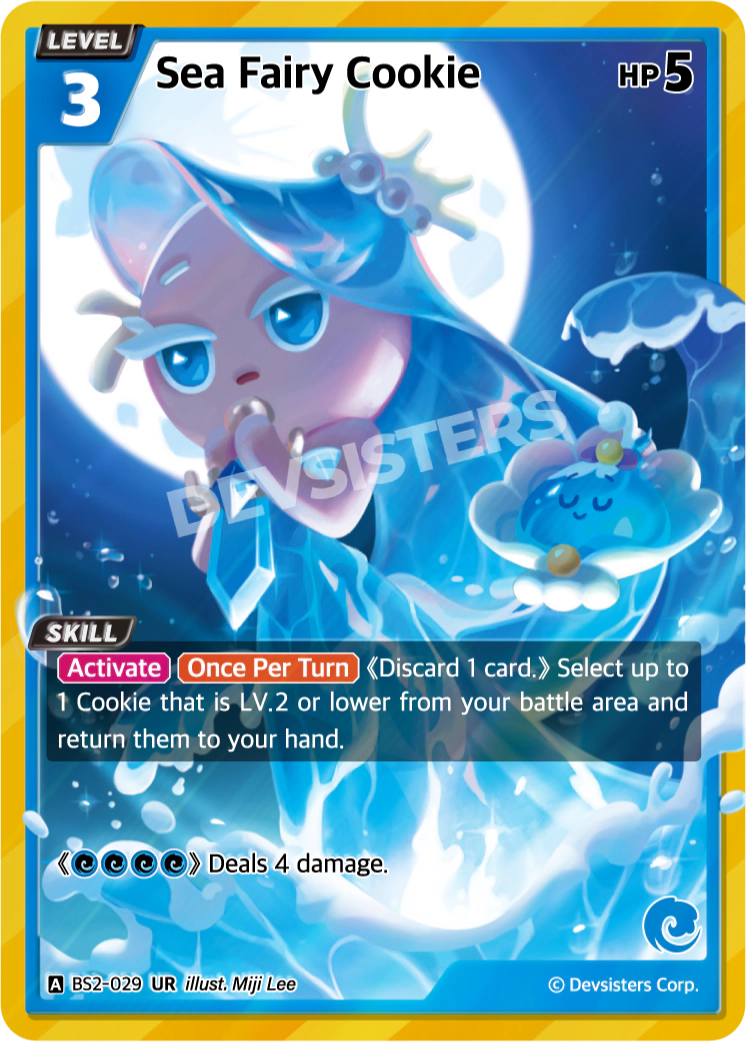
Sea Fairy is the best card in the set because she does the two things Blue most wants - tempo removal and a hard hit - on one efficient body. The BS2-029 printing (Blue, Ultra Rare, 5 HP) has a mob skill: discard 1 card, then select a LV.2-or-lower Cookie from your battle area and return it to your hand. That bounce reads as defensive, but the way you actually use it is offensive tempo - reset an opponent's developing threat, or pick up your own Cookie to re-trigger an On Play. Then her attack just deals 4, which is a top-end number off a single-color body.
Five HP, a 4-damage swing, and a repeatable bounce that messes with the opponent's curve every turn: that's a card that would be playable if it were printed today, let alone in the first set. Blue is the value-and-tempo color, and Sea Fairy is the cleanest expression of it in Brave Beginning. She's the BS1 card I'd most want to open.
2. Poison Mushroom Cookie (Purple)
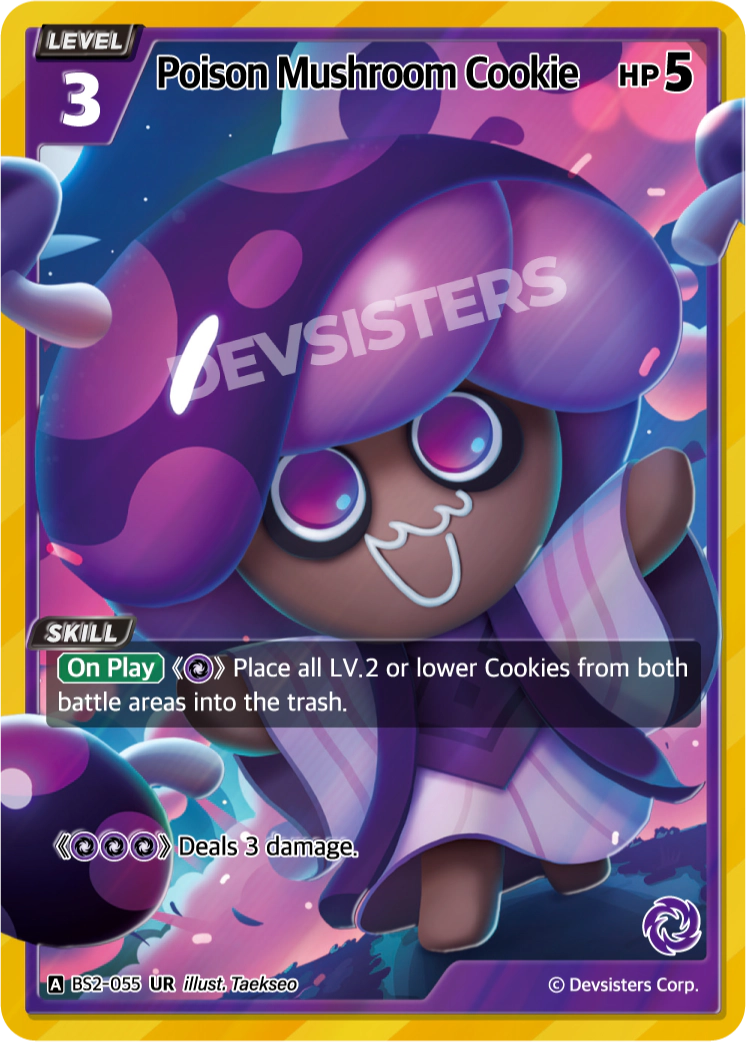
Poison Mushroom is the set's board wipe, and board wipes age well. The BS2-055 printing (Purple, Ultra Rare, 5 HP) has a skill that, for {P}, places all LV.2-or-lower Cookies from both battle areas into the trash - a one-sided-ish sweep that erases the entire early game. Against any go-wide deck built on cheap LV.1 and LV.2 Cookies (which is most aggro), that's a reset button that buys you the whole midgame. Her attack deals 3 off three resources, so she's not dead weight after the wipe either.
The catch is right there in the text: it clears both battle areas, so you sequence it to land when your board is light and theirs is heavy. In a Purple control deck that wants to grind into the late game off removal and trash payoffs, a 5-HP sweeper that also swings for 3 is exactly the kind of inevitability the color is built around. It ranks second only because it's narrower than Sea Fairy - it's a punish-aggro tool that's awkward in the mirror against other control decks. When the matchup is right, it's the best card in the set.
3. Wind Archer Cookie (Purple)
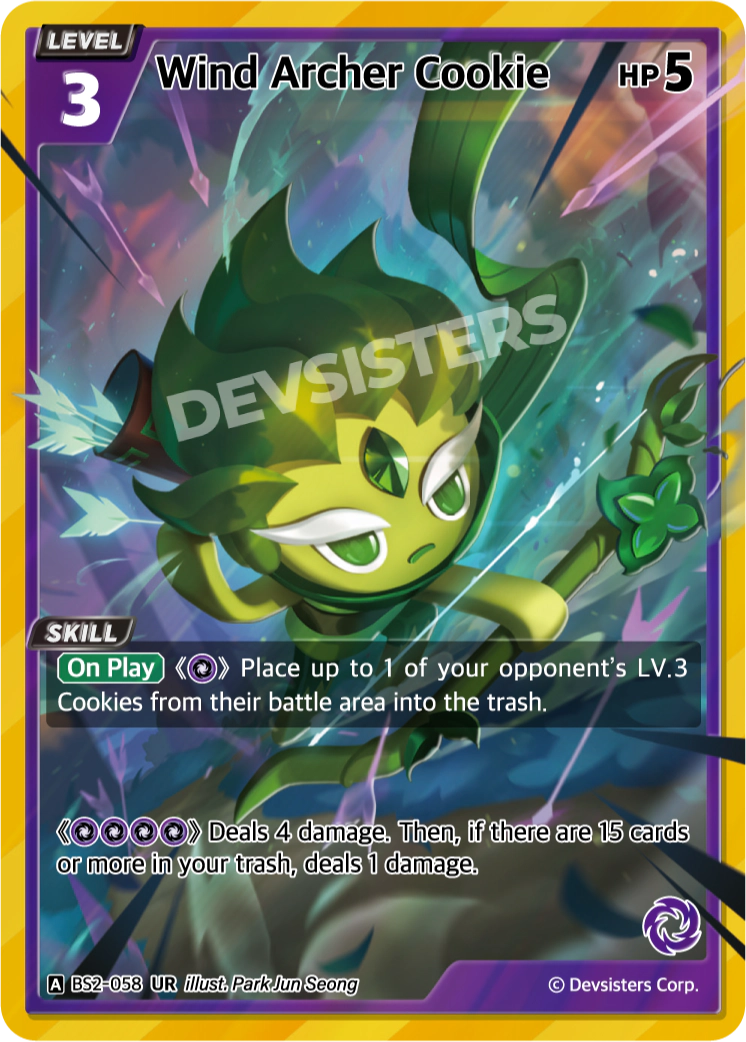
Wind Archer is the set's premium spot-removal, and the other half of Brave Beginning's strong Purple core. The BS2-058 printing (Purple, Ultra Rare, 5 HP) has a skill that for {P} places an opposing LV.3 Cookie into the trash - and LV.3 Cookies are the biggest, most expensive threats on the board, so this kills exactly what Poison Mushroom's sweep can't reach. Between the two, a Purple deck answers the small stuff (Poison Mushroom) and the big stuff (Wind Archer) with two Ultra Rares from the same set.
His attack is the trash-payoff flourish that defines Purple: deals 4, then if there are 15+ cards in your trash, deals 1 more. Off a four-resource cost that's a 5-damage swing in the late game, when your trash is naturally stocked. A 5-HP body that point-removes the opponent's best Cookie and then hits for up to 5 is a genuine finisher. He's third behind the wipe only because targeted LV.3 removal is slightly more situational than a board sweep - but in a control mirror, Wind Archer is the better of the two.
4. Timekeeper Cookie (Yellow)
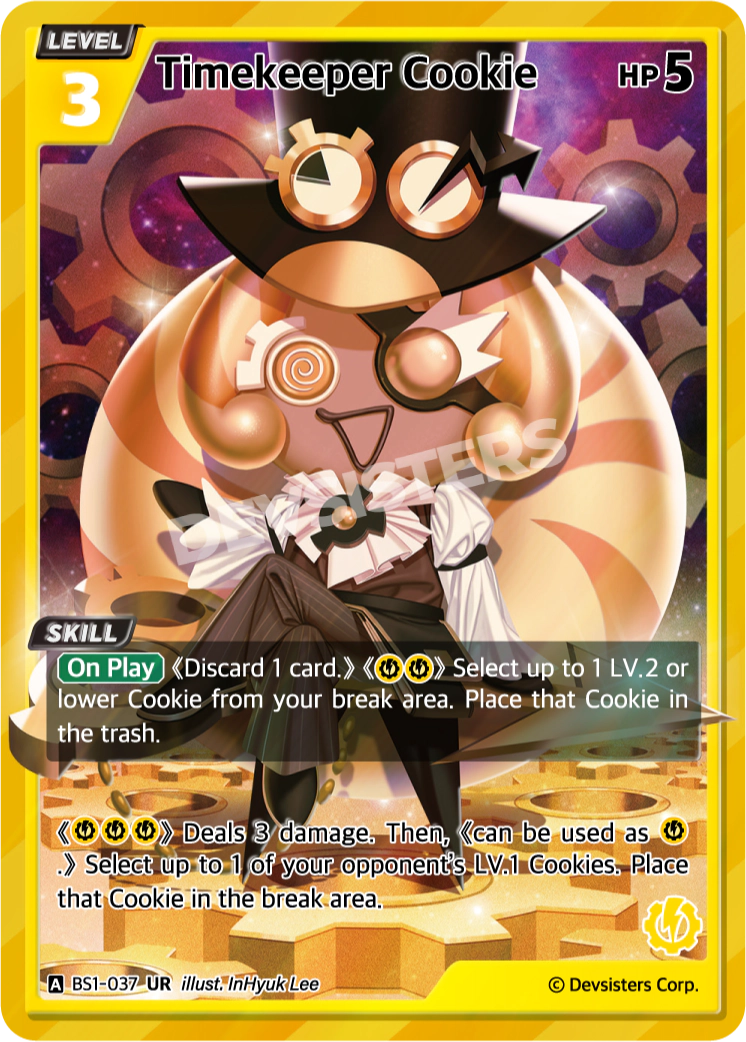
Timekeeper is the disruption Ultra Rare, and the most Yellow card in the set - it messes with the opponent's resources rather than just trading bodies. The BS1-037 printing (Yellow, Ultra Rare, 5 HP) has a skill: discard 1 card and pay {Y}{Y} to select a LV.2-or-lower Cookie from your break area and place it in the trash - graveyard hate that shuts off recursion decks (and there are a lot of those). Its attack deals 3, then for {Y} demotes an opposing LV.1 Cookie down into the break area, undoing their leveling and tempo.
That break-area demotion is the spicy part: leveling Cookies up is how the game generates board presence, and Timekeeper actively reverses it on the opponent's side. It's a tempo-and-hate piece, not a beater, which is why it's fourth - but in a Yellow control or anti-recursion deck it does work no newer Yellow card has fully replaced. A 5-HP body that punishes both the trash and the board is still a real card.
5. Roguefort Cookie (Green)
Roguefort is the set's engine card - the one that doesn't win games but makes the rest of your deck run smoother, which is precisely what Green wants. The BS1-053 printing (Green, Ultra Rare, but only 2 HP) has a mob skill: for {G}, if you have 6 or fewer cards in hand, return a support card to your hand, then bank the top card of your deck into your support area as rested. That's card filtering plus support-area ramp every turn - the slow, grinding advantage Green decks are built on.
The body is the problem and the reason he ranks fifth: 2 HP dies to almost anything, and his attack only deals 1, so he's a pure support piece you have to protect. But a recurring "fix your hand and ramp your support" engine on a 1-cost-equivalent Green body is genuinely good plumbing, and Green's whole identity is winning the long game off a stocked support area. Roguefort is the BS1 card that makes a Green deck consistent - it just needs the rest of the deck to do the killing.
The rest of the honor roll
Not everything that's still playable cracks the top five. A few more Brave Beginning cards earn a mention:
| Card | Color / rarity | HP | Why it still matters |
|---|---|---|---|
| Black Raisin (BS2-031) | Blue, Super Rare | 5 | Discard 3 to deal 2 + 1 to two targets - flexible removal in a discard-friendly Blue shell |
| Wildberry (BS1-012) | Red, Super Rare | 6 | A 6-HP body with a 4-damage attack that becomes +2 at a LV.9 break area - a clean Red beater |
| Latte (BS1-028) | Yellow, Super Rare | 5 | Heals your board, and its attack pings every opposing Cookie for 1 at a LV.5+ break area |
| Sherbet (BS2-036) | Blue, Ultra Rare | 5 | A Mix-cost cantrip body - bounce a LV.1 to the bottom of your deck to draw |
| Dark Choco (BS1-003) | Red, Super Rare | 4 | A cheap removal mob - discard to ping an opposing Cookie for 1, plus a 3-damage attack |
| Clotted Cream (BS2-069) | Purple, Super Rare | 4 | Discard to trash an opposing LV.1, plus a 3-damage attack - efficient early removal |
The pattern across the honor roll: Blue and Purple got the deepest playable benches in Brave Beginning, Red got clean beaters, and Yellow got utility. Green outside Roguefort is mostly support glue - fine, but rarely a chase.
GingerBrave: the mascot tax
You can't review the first set without GingerBrave (BS1-014, Red, Ultra Rare). He's the franchise mascot, he's on the box, and he's the most collectible card in Brave Beginning by a mile. He's also, mechanically, a 2-HP body whose skill pumps himself +1 attack for {R}{R} and whose attack deals 2. That's a fine early aggressive Cookie and a fun nod to the source material - but he is not a top-five competitive card, and it's worth being honest about that on a set-review.
So treat GingerBrave as two different cards depending on why you're buying. As a collector, he's the heart of the set and arguably its single most desirable pull. As a player, he's a curve-filler aggressive body that the better Red cards (and later sets) outclass. Both things are true at once, and a good set review says so instead of pretending the mascot is secretly the best card.
Is Brave Beginning worth buying now
Honest answer: as a player, you don't chase sealed Brave Beginning in 2026 - the format has moved on, and most of what you want from BS1 (Sea Fairy, the Purple removal package, Timekeeper) is cheaper to buy as singles than to gamble for in old packs. As a collector, it's the opposite: it's the first set, GingerBrave and the original Ultra Rares are foundational, and first-print foundational cards are exactly what holds value in any TCG.
The smart play for most people is singles. Pick up Sea Fairy and the two Purple Ultra Rares (Poison Mushroom, Wind Archer) if you're building Blue or Purple control, grab Roguefort if you're on Green, and buy GingerBrave because you want him on the shelf, not because he'll win you games. For how these slot into real decks, see our deck-building basics and deck archetypes guides.
Quick Action Checklist
- Brave Beginning (BS1) launched October 30, 2024 - the first set, where colors, the break area, support resources, and FLIP all debuted.
- Sea Fairy (Blue) is the best card in the set - 5 HP, a 4-damage attack, and a repeatable bounce. Still playable today.
- Poison Mushroom (Purple) is the board wipe - clears every LV.2-or-lower Cookie from both sides. The anti-aggro reset.
- Wind Archer (Purple) is the premium spot-removal - trashes an opposing LV.3 and swings for up to 5 with a stocked trash.
- Timekeeper (Yellow) is the disruption piece - graveyard hate plus a break-area demotion. Best in anti-recursion decks.
- Roguefort (Green) is the engine - hand-fix and support ramp, but a fragile 2-HP body to protect.
- GingerBrave is the collector's card, not the competitive one - the mascot and the heart of the set, but outclassed as a player.
- Buy singles, not sealed - the playable BS1 cards are cheaper as singles; chase sealed packs only for the collectible value.
Frequently Asked Questions
When did Brave Beginning release for Cookie Run: Braverse?
What is the best card in Brave Beginning?
Is GingerBrave a good card in Cookie Run: Braverse?
Should I buy Brave Beginning packs now?
What are the best Purple cards in Brave Beginning?
Are Brave Beginning cards still playable in 2026?
Keep Reading
Related Guides
Best Ancient Cards in Cookie Run: Braverse, Ranked
The Ancient Heroes are the closest thing Braverse has to a true tribe: the five legendary Cookies, printed and reprinted across every set, that buff each other when they share a board. Here's how the Ancient pool ranks, with real database text.
Best Dragon Cards in Cookie Run: Braverse, Ranked
Dragon is the smallest, snootiest tribe in Braverse: exactly five Ultra Rare Cookies, one per color, every one a five-cost 5-HP body. Here's how all five rank by power and role, with their real skill text.
Best Trap Cards in Cookie Run: Braverse, Ranked
Braverse has 120 different Trap cards and 115 of them are Uncommons. There is not a single Ultra Rare Trap in the game. That means the entire interaction layer - the cards that decide close games - is fully available to anyone who owns a starter deck and a fistful of bulk.
Best Draw and Search Cards in Cookie Run: Braverse
Search the official Braverse database for skills that draw two or more cards and you get 61 hits. Sixty of them charge you something - a discard, a mill, a hand-size cap, a body that has to die first. Exactly one doesn't, and it's a Common. Here's the full draw and search pool, color by color.

How to Play Cookie Run: Braverse - A Complete Beginner Guide
Cookie Run: Braverse is the rare TCG you can teach in a single match. This guide covers everything a first-time player needs: card types, setup, turn structure, how you pay for cards, the FLIP mechanic, and how to win.
Cookie Run: Braverse Meta Tier List — Best Decks & Archetypes Ranked
Which Cookie Run: Braverse decks are actually carrying right now? Here's a meta tier list of the strongest archetypes - the real cards that anchor each one, why they rank where they do, and what's overrated.