Best Dragon Cards in Cookie Run: Braverse, Ranked
Dragon is the smallest, snootiest tribe in Braverse: exactly five Ultra Rare Cookies, one per color, every one a five-cost 5-HP body. Here's how all five rank by power and role, with their real skill text.
Dragon is the most exclusive club in Cookie Run: Braverse. Not "rare and expensive" exclusive - literally small. There are exactly five Dragon Cookies carrying the keyword across the whole game, one per color, and they all arrived together in the Operation Timeguard booster (BS5). Every one of them is the same skeleton: a five-cost, 5-HP, Ultra Rare body. That symmetry is the whole point - Dragon isn't a tribe you splash into; it's a color's prestige top-end, and each color got exactly one.
So this is a focused, five-card ranking, and because the pool is tiny we can go deep on each. Costs, HP, and skill text below are quoted off the official card database - the {R}/{Y}/{G}/{B}/{P} symbols are each color's resource, {N} is any color, and a number after an attack name is its damage. There's also one older Pitaya printing from an earlier set that confuses search results, and we'll clear that up at the end. New to the game? Read the five colors explained first.
What the Dragon keyword actually is
Here's the part people get wrong: in Braverse, "Dragon" is a keyword on five specific Cookies, not a sprawling tribal engine like you'd see in other TCGs. As of the current pool there are no "if you control a Dragon" payoffs, no Dragon lords, no Dragon-fetching Items. The keyword exists, but it doesn't yet do anything mechanically on its own. What you're actually buying when you pick up a Dragon Cookie is a color's best Ultra Rare five-drop, dressed in scales.
That changes how you evaluate them. You don't rank these as a tribe - you rank them as five individual five-cost finishers competing for the top of five different color decks. The common thread is the stat line:
| Dragon Cookie | Color | Cost | HP | Card no. |
|---|---|---|---|---|
| Pitaya Dragon Cookie | Red | RED (5) | 5 | BS5-013 |
| Ananas Dragon Cookie | Yellow | YELLOW (5) | 5 | BS5-040 |
| Longan Dragon Cookie | Green | GREEN (5) | 5 | BS5-056 |
| Lotus Dragon Cookie | Blue | BLUE (5) | 5 | BS5-071 |
| Lychee Dragon Cookie | Purple | PURPLE (5) | 5 | BS5-093 |
Five cost, five HP, Ultra Rare, one per color. The differences are entirely in the text - the skill, the attack, and the conditional rider each one tacks on. That's what we're ranking.
How the Dragon theme plays
Every BS5 Dragon shares a design signature once you read the text closely:
- A damage-dealing skill that pings an opponent's Cookie for 1-2, usually with a cost attached (discard, mill your own HP, return cards).
- A three-resource attack of its own color, dealing 2 or 3, almost always with a "Then," rider that pays off a condition.
- A "remaining HP is 4 or less" or break-area condition that turns the Dragon from a fair body into a problem once the game develops.
In other words, Dragons are designed to get better as they take damage or as the board state matures. They're not aggro drops - they're five-cost payoffs you land in the mid-to-late game when their conditions are live. The skill gives you reach (damage that doesn't need an attack), the attack gives you a real swing, and the rider rewards you for being deep into the game. That's a control/midrange profile, not a curve-out. Build them as the apex of a color deck, not as something you rush out on turn five and hope.
1. Pitaya Dragon Cookie (Red)
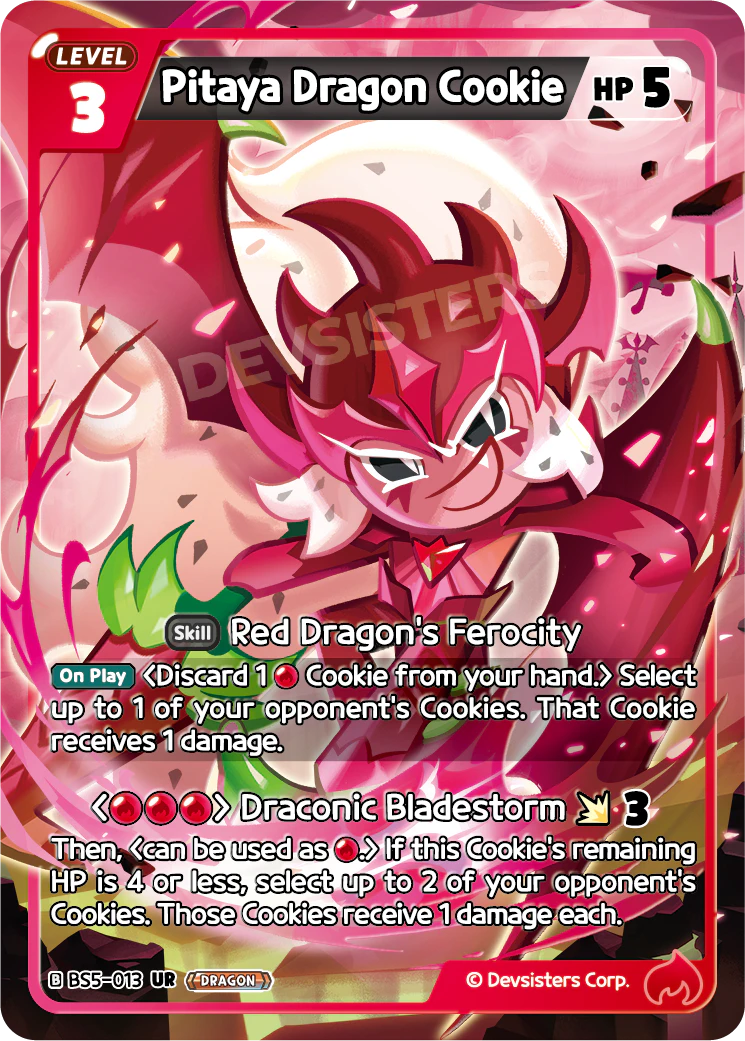
Pitaya Dragon Cookie (BS5-013, Red, Ultra Rare, 5 cost, 5 HP). The best of the five, because it asks the least and delivers the most reliably. Its skill, Red Dragon's Ferocity, is an On Play: discard 1 Red Cookie from your hand, and deal 1 damage to an opponent's Cookie. That's removal the moment it lands - no waiting, no board condition.
Then the attack, Draconic Bladestorm, deals 3 and can be used as a Red resource, and here's the kicker: if Pitaya's remaining HP is 4 or less, you select up to two of the opponent's Cookies and deal each of them 1 damage. A 5-HP body drops to "4 or less" the first time anything chips it, which is almost immediately - so in practice you're getting a 3-damage swing plus two extra pings nearly every turn it attacks. On Play removal, a hard-hitting attack, and a board-wide rider that activates trivially. Red's aggression color gets a top-end that punches in three directions at once. This is the Dragon to build around if you build around any of them.
2. Longan Dragon Cookie (Green)
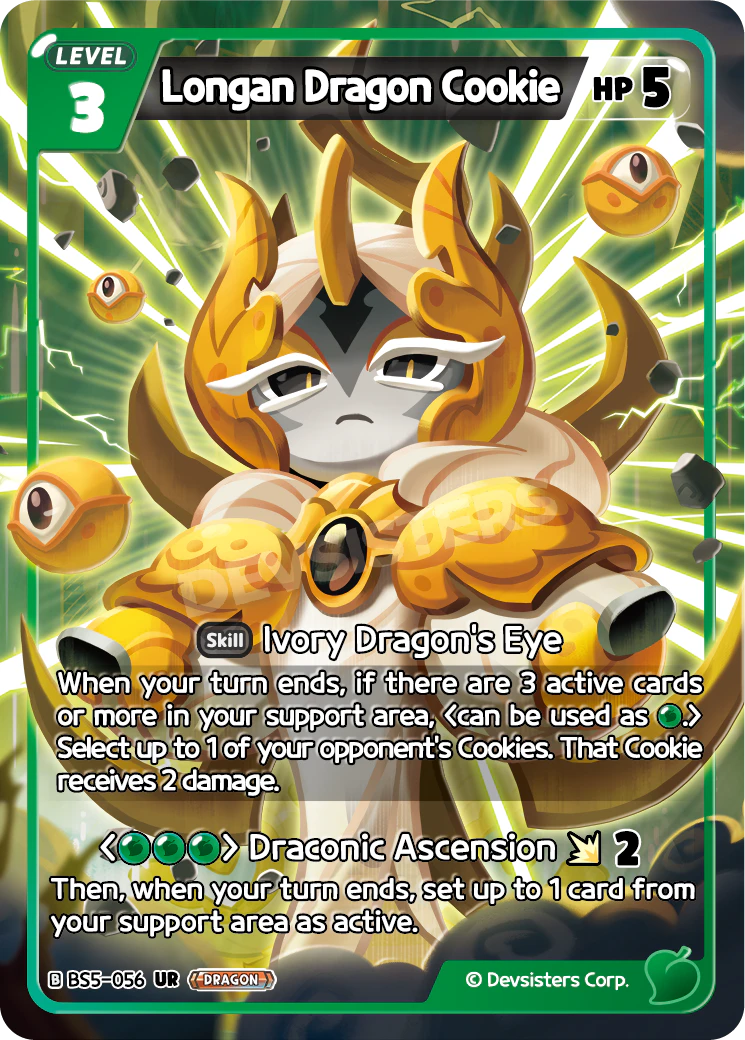
Longan Dragon Cookie (BS5-056, Green, Ultra Rare, 5 cost, 5 HP). The grindiest of the five and the one that scales best in the deck built to support it. Its skill, Ivory Dragon's Eye, triggers when your turn ends: if you have 3 or more active cards in your support area, it can be used as a Green resource, and you deal 2 damage to an opponent's Cookie. Two damage is the biggest ping in the cycle, and it fires on your end step every turn the condition holds - that's a recurring clock a control deck can't out-stall.
The attack, Draconic Ascension, deals 2, then at end of turn sets up to 1 card in your support area as active. That's the self-fueling part: the attack literally re-arms the engine that powers the skill. Green is the support-stacking color, so Longan slots perfectly into a deck already flooding its support area - it turns that resource pile into a damage faucet. Slightly behind Pitaya only because the 3-active-card condition takes setup, where Pitaya just needs to be slightly hurt. But in the right Green shell, this is the most oppressive Dragon to play against.
3. Lotus Dragon Cookie (Blue)
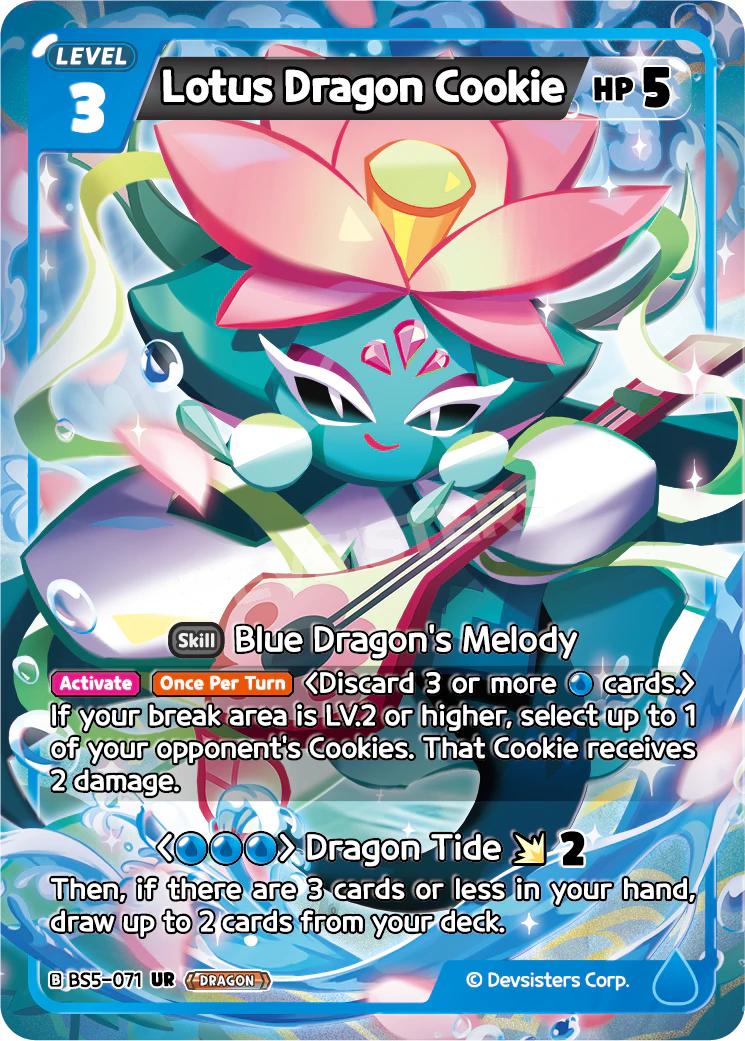
Lotus Dragon Cookie (BS5-071, Blue, Ultra Rare, 5 cost, 5 HP). The card-advantage Dragon, and the one whose ceiling is highest if your deck is built for it. Its skill, Blue Dragon's Melody, is an Activate, once per turn: discard 3 or more Blue cards, and if your break area is LV.2 or higher, deal 2 damage to an opponent's Cookie. Two damage again - but the discard-3 cost is steep, which is why it's third and not first. You need a deck that wants to be dumping Blue cards (and Blue, the recursion/value color, often does).
The payoff is the attack, Dragon Tide: deals 2, then if you have 3 or fewer cards in hand, draw up to 2. That's the elegant loop - you empty your hand into the skill's discard cost and the attack refills it. In a dedicated Blue deck that recurs from the trash, feeding Lotus's discard isn't a cost, it's fuel, and the draw keeps you stocked. Outside that shell it's a fair five-drop with an awkward activation cost. High skill ceiling, real deckbuilding tax.
4. Ananas Dragon Cookie (Yellow)
Ananas Dragon Cookie (BS5-040, Yellow, Ultra Rare, 5 cost, 5 HP). The self-sustaining Dragon - the one that wants to grind a long game and outlast you. Its skill, Radiance of the Golden Dragon, is an Activate, once per turn: place 1 card from the top of this Cookie's HP into the trash, then deal 1 damage to an opponent's Cookie. You're spending your own durability to ping - aggressive, but it shrinks your body.
That's where the attack, Dragon Geomancy, ties the bow: deals 3, can be used as a Yellow resource, and if Ananas's remaining HP is 4 or less, it gains +1 HP. So the design wants you to spend HP on the skill, then claw it back by attacking - a Cookie that heals itself the lower it gets. It's a genuinely sticky body that's hard to kill through, and 3 attack is respectable. It ranks fourth because its ping is only 1 (versus the 2 on Longan and Lotus) and the HP-shuffling is more about staying alive than closing games. A defensive Dragon in a color that likes recursion - solid, just not a finisher.
5. Lychee Dragon Cookie (Purple)
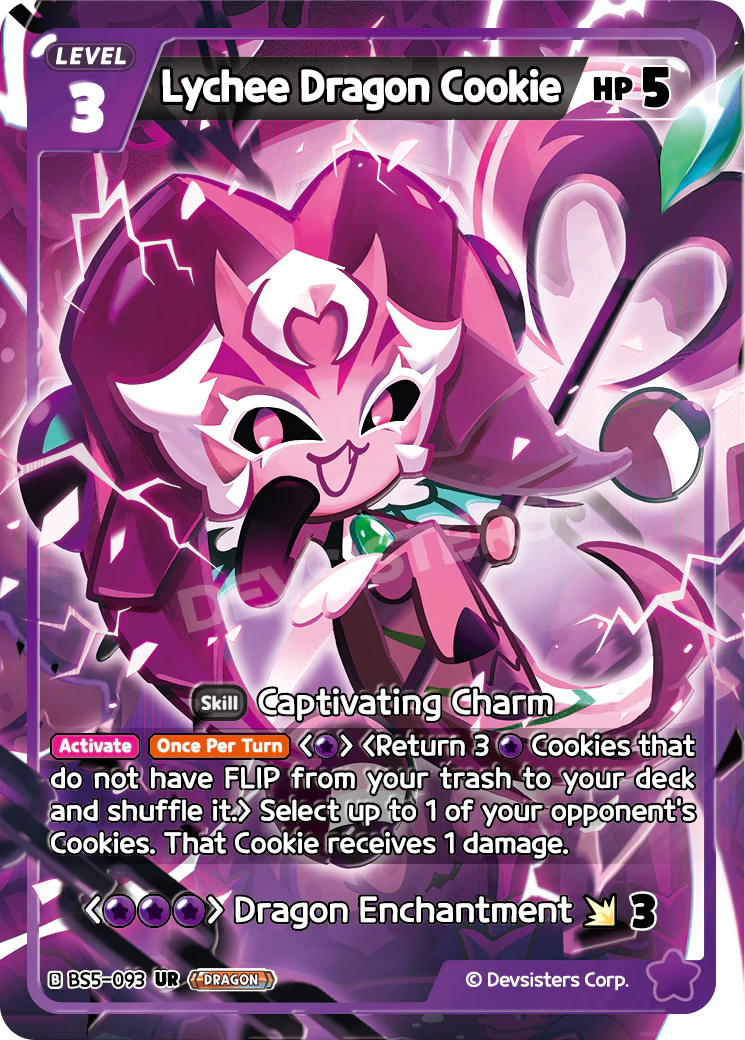
Lychee Dragon Cookie (BS5-093, Purple, Ultra Rare, 5 cost, 5 HP). The cleanest attack of the cycle, but the clunkiest skill, which is why it lands last. The attack, Dragon Enchantment, just deals 3 - no rider, no condition, the highest unconditional attack number among the five. As a raw five-cost body, Lychee hits hardest.
The problem is the skill, Captivating Charm: Activate, once per turn, pay a Purple resource AND return 3 Purple Cookies without FLIP from your trash to your deck (shuffling it), to deal just 1 damage. That's an enormous cost - a resource plus three specific cards out of your graveyard - for the smallest ping in the cycle. Purple is the recursion color, so returning cards to deck isn't pure downside (it refills your library and re-buys those Cookies), but as a removal engine it's the weakest by a wide margin. You play Lychee for the clean 3-damage attack and treat the skill as a rare-use button when your trash is overflowing. A fine Purple top-end, the worst Dragon skill. Last by a hair.
The older Pitaya printing worth knowing
One thing that trips up anyone searching "Pitaya Dragon Cookie": there are two of them. The one we ranked is BS5-013 from Operation Timeguard. There's also an earlier Pitaya Dragon Cookie, BS3-010, from the Age of Heroes and Kingdoms booster - also Red, also Ultra Rare, also a 5-HP Dragon.
The BS3 version plays differently. Its skill, Dragon Roar, faints an opponent's LV.1 Cookie outright (great against go-wide early boards), and its attack, Endt Ihn Daond!, deals 3 then can be used as a Red resource to ping an opponent's Cookie for 1. It's a perfectly good card - arguably better against aggressive LV.1-heavy decks because of the outright faint - but it's the older design. When this guide says "the five Dragons, one per color," we mean the BS5 cycle, since that's the set that printed a matched Dragon in every color. The BS3 Pitaya is the only Dragon that exists outside that cycle, and it's worth a slot in a Red deck that fears early swarms.
Should you build a Dragon deck
Short answer: no - because "Dragon deck" isn't a real archetype yet. With no payoffs that care about the keyword, you don't get a bonus for running multiple Dragons, and you can't even run more than one easily since each is a different color and Braverse decks reward color focus. What you should do instead is treat the relevant Dragon as the top of your color deck's curve:
- Building Red aggro-midrange? Pitaya (BS5-013) is a near-auto-include payoff, and the BS3 Pitaya is a fine second Dragon against swarm.
- Building Green support-stacking? Longan is one of the best end-of-turn engines in the color.
- Building Blue recursion/value? Lotus turns your discard pile into removal and card draw.
- Building Yellow grind? Ananas is a sticky, self-healing body for the long game.
- Building Purple recursion? Lychee is a clean 3-attack top-end; lean on the attack, not the skill.
For how these fit a real 60-card list, see our deck-building basics and deck archetypes guides. And if Pitaya is your pick, our best Red cards guide covers the rest of the shell.
Quick Action Checklist
- There are five Dragons, one per color, all from BS5 Operation Timeguard, all five-cost 5-HP Ultra Rares. Plus one older BS3 Pitaya.
- Pitaya (BS5-013) is the best. On Play removal, a hard swing, and a board-ping rider that turns on the instant it's chipped.
- Longan is the grind engine. Build it in a Green support-stacking deck and it pings for 2 every end step.
- Lotus has the highest ceiling in Blue - but only if your deck wants to discard three cards to fire its skill.
- Ananas is the defensive, self-healing pick for a long Yellow game; small ping, sticky body.
- Lychee has the best raw attack (3, no condition) but the worst, most expensive skill. Play it for the swing.
- Don't build a "Dragon tribe" deck - the keyword has no payoffs. Slot the right Dragon as your color deck's top end.
Frequently Asked Questions
How many Dragon cards are there in Cookie Run: Braverse?
Which Dragon Cookie is the best in Braverse?
Is there a Dragon tribal deck in Cookie Run: Braverse?
What set are the Dragon Cookies from?
Why are there two Pitaya Dragon Cookies?
Are Dragon Cookies good for beginners?
Keep Reading
Related Guides
Best Cards from Cookie Run: Braverse — Brave Beginning
Brave Beginning is the set that started the game on October 30, 2024. Most of it is power-crept now, but a handful of cards from the foundational booster still earn slots. Here's what's worth owning, with real database text.
Best Ancient Cards in Cookie Run: Braverse, Ranked
The Ancient Heroes are the closest thing Braverse has to a true tribe: the five legendary Cookies, printed and reprinted across every set, that buff each other when they share a board. Here's how the Ancient pool ranks, with real database text.
Best Trap Cards in Cookie Run: Braverse, Ranked
Braverse has 120 different Trap cards and 115 of them are Uncommons. There is not a single Ultra Rare Trap in the game. That means the entire interaction layer - the cards that decide close games - is fully available to anyone who owns a starter deck and a fistful of bulk.

Best Draw and Search Cards in Cookie Run: Braverse
Search the official Braverse database for skills that draw two or more cards and you get 61 hits. Sixty of them charge you something - a discard, a mill, a hand-size cap, a body that has to die first. Exactly one doesn't, and it's a Common. Here's the full draw and search pool, color by color.

How to Play Cookie Run: Braverse - A Complete Beginner Guide
Cookie Run: Braverse is the rare TCG you can teach in a single match. This guide covers everything a first-time player needs: card types, setup, turn structure, how you pay for cards, the FLIP mechanic, and how to win.

Cookie Run: Braverse Meta Tier List — Best Decks & Archetypes Ranked
Which Cookie Run: Braverse decks are actually carrying right now? Here's a meta tier list of the strongest archetypes - the real cards that anchor each one, why they rank where they do, and what's overrated.