Cookie Run: Braverse Black & Pure Cards, Explained
Seven color types, not five. Black is the newest color, debuted in The Dark Enchantress War with its own {K} energy; Pure is a tiny set of universal, multi-color specials. Here's what each one actually is, straight from the official database.
Open the official card database, filter by color, and you'll count seven options - not five. That isn't a quirk of the filter: the Comprehensive Rules (Ver. 1.8, rule 2-3-3) list seven main color types - Red, Yellow, Green, Blue, Purple, Black, and Pure. Neither of the last two has a Starter Deck, so here's what the official database actually says about each.
Short version up front. Black is the game's newest color - Devsisters debuted it in Booster 11, The Dark Enchantress War, built around Dark Enchantress Cookie and her minions, and as of 26 October 2026 the official database lists 49 distinct Black cards across that set, Booster 12 Festival Arena, and promos, and the color has its own {K} energy symbol. Pure is a grab-bag of universal specials - seven distinct cards that cost any color (or all of them) and slot into any deck rather than belonging to one. If you've already read the five colors explained and the seven card types, this is the footnote that finally fills in the rest of the color filter.
A standing caveat for the whole piece: card text below is quoted from the official database, but several of these cards introduce mechanics - Special Play, Awaken, the Extra Deck, alternate win conditions - whose precise interactions are worth confirming against the official rulebook before a sanctioned event. We'll flag those as we go rather than overclaim a ruling.
Black and Pure at a glance
Here's the cheat sheet, then we go deep on each.
| Color | What it is | Count in the database (26 Oct 2026) | Where it comes from |
|---|---|---|---|
| Black | The newest color: a Special Play-driven roster with its own {K} energy | 49 distinct cards | The Dark Enchantress War (25) and Festival Arena (19), plus five promos |
| Pure | Universal multi-color "specials" that fit any deck | 7 distinct cards | Spread across four booster sets and promos |
The key difference: Black is a full sixth color with a complete toolkit - Cookies, EXTRA cards, FLIP cards, Items, Traps, and Stages - that wants to be built around. Pure isn't a deck you build; it's a handful of powerful cards that cost generic or rainbow energy and get splashed into decks of other colors. One is a color you commit to; the other is a color you splash.
Black: the newest color
Black is the closest thing Braverse has to a "boss color." Devsisters' July 23, 2026 Community Letter calls it "a new color" and describes "the debut of the Black color in Booster 11." As of 26 October 2026 the official database lists 49 distinct Black card numbers: 25 from The Dark Enchantress War, 19 from Booster 12 Festival Arena (all carrying the [Arena] keyword), and five promos - Licorice Cookie (P-147), Black Sapphire Cookie (P-156), Candy Apple Cookie (P-162), Jerky Cookie (P-173), and B!TES (P-180). That's a tell: Black wasn't seeded across the game's history like Red, Yellow, Green, Blue, and Purple. It dropped as a themed package built around one villain, and Festival Arena is the first booster set to extend it.
In The Dark Enchantress War, Black's 25 cards break down as 14 Cookies, 1 EXTRA card (the Awakened Dark Enchantress), 5 FLIP cards, 2 Traps, 2 Items, and 1 Stage - a complete deck's worth of card types, all keyed to the same energy. And that energy is the headline mechanical quirk: Black cards cost {K} (a black/dark energy symbol), distinct from the {R}/{Y}/{G}/{B}/{P} of the five core colors and the {N} "any color" symbol. So Black isn't just a flavor label slapped on Purple cards. It's its own resource, which is exactly why it's a color in its own right rather than a Purple sub-theme.
In that first set, the cast sells the fantasy hard. You've got the boss herself (Dark Enchantress Cookie), her loyal Pomegranate Cookie, Licorice Cookie, and a whole army of cake-and-dough minions: Jam Skelecake Grunt, Cream Skelecake Archer, Skelecake Bomber, Cake Warrior, Cake Witch, Mold Dough Cookie, Pom-pom Dough Cookie, Venom Dough Cookie, and a Red Velvet Dragon for good measure. Even the support cards are on-theme - Dark Enchantress's Castle (Stage), Emblem of Darkness (Item), World-reflecting Mirrors and Draining Magic Circle (Traps). This is a villain deck-in-a-box, not loose singles.
How the Black engine works

Read the Black cards together and a mechanic jumps out repeatedly: Special Play. Several minions (Cream Skelecake Archer, Cream Jelly Worm, Red Velvet Dragon) unlock extra damage or removal only "if there is a Cookie that has Special Play" in your battle area, and the boss cards cost Special Play Cookies to deploy. Concretely, the database text describes a sacrifice loop:
- The dough Cookies (Mold Dough, Pom-pom Dough, Venom Dough) and the Licorice promo (P-147) each have a Special Play clause reading "Place 1 {K} LV.1 Cookie from your battle area into your trash" - you feed cheap minions to play your bigger threats.
- Cake Witch's skill fires "when this Cookie faints," digging a {K} card off the top of your deck - so your minions are meant to die.
- Skelecake Bomber returns "a Cookie that has Special Play from your trash to your hand," recycling the fuel.
- Dark Enchantress's Castle (the Stage) lets you "draw up to 1 card from your deck and discard 1" during a turn you played a Cookie via Special Play.
If you've played other TCGs, this is an aristocrats/sacrifice deck wearing a {K} coat: spend small bodies to enable big ones, profit when things die, and rebuild from the trash. That makes Black genuinely Purple-adjacent in feel (trash matters, recursion matters) without sharing Purple's energy. The exact rules for Special Play, Awaken, and the Extra Deck aren't something I'd quote to a judge cold - confirm those against the official rulebook - but the intent in the card text is unambiguous.
The cards that anchor Black
The two cards that define the Dark Enchantress deck are both Dark Enchantress Cookie, and the split between them is the whole payoff structure:
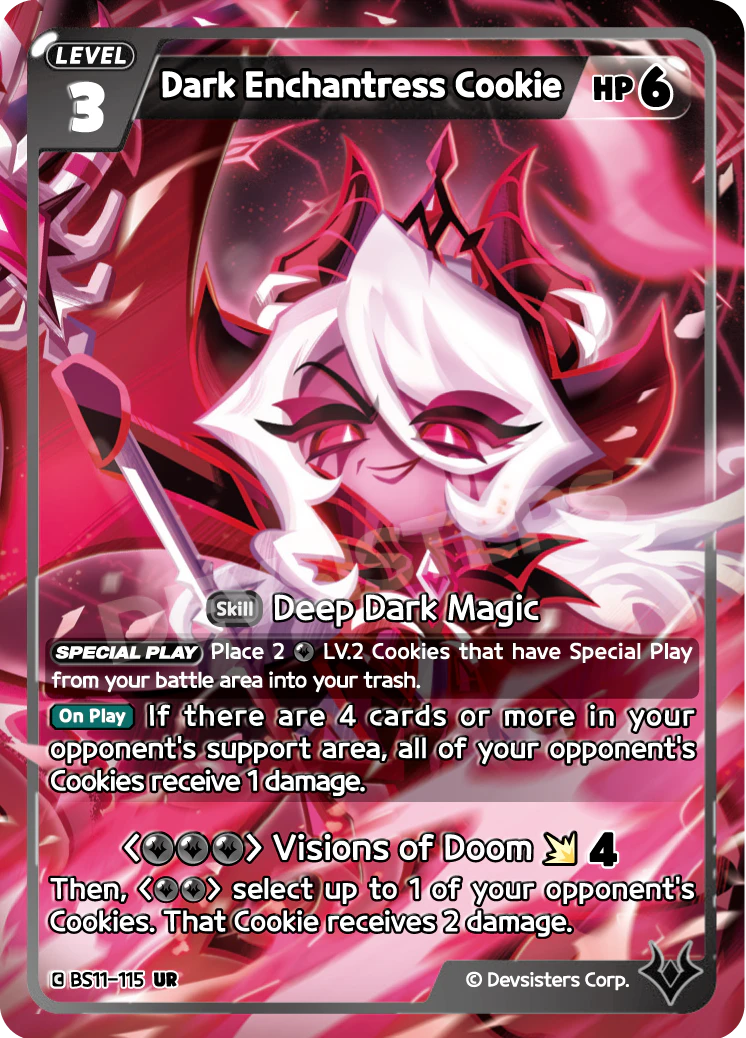
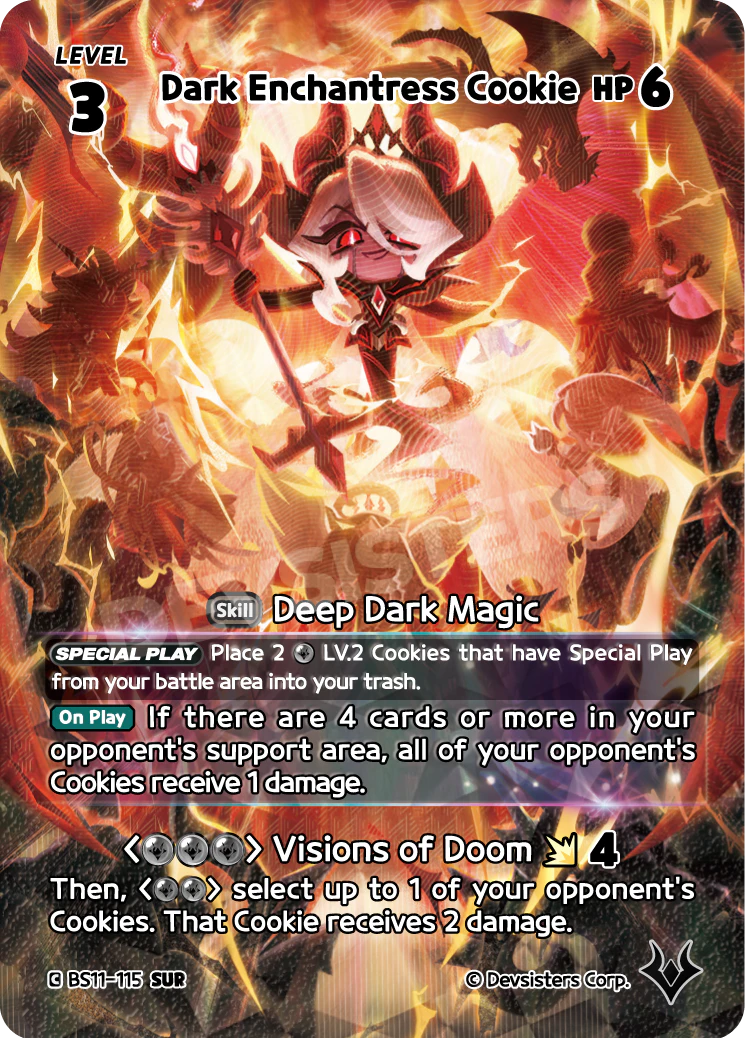
- Dark Enchantress Cookie (BS11-115, Ultra Rare, 6 HP, costs {K}; her @3 parallel is one of only two Genesis Extra Rare printings in the database, alongside Festival Arena's Poison Mushroom Cookie, BS12-111@3). Her Deep Dark Magic Special Play places "2 {K} LV.2 Cookies that have Special Play from your battle area into your trash," and her On Play deals 1 damage to all of the opponent's Cookies if their support area is loaded (4+ cards). Her attack, Visions of Doom, deals 4, then can pay extra {K}{K} to deal 2 more to a chosen Cookie. That's a board-wide ping plus a heavy single-target swing on one body.
- Dark Enchantress Cookie (BS11-116, Ultra Rare, the Awakened form). This is an EXTRA card with a hard gate: "If your break area is LV.7 or higher and [Dark Enchantress's Castle] is in your stage area, you can Awaken your LV.3 Dark Enchantress Cookie that has Special Play." The reward is Fornacem Accende!, a 7-damage attack, on a Cookie that "cannot be moved from the battle area by your opponent's effects." It's the deck's finisher, and it literally requires you to have built the rest of the package (the Castle, a high break area, the LV.3 boss in play).
Around them, Pomegranate Cookie (BS11-114, Super Rare) is the devoted lieutenant - her attack can "return up to 1 Dark Enchantress Cookie from your trash to your hand," so the boss keeps coming back. And Mold Dough Cookie (BS11-111, Rare) is the workhorse Special Play minion that pings on entry. The promo Licorice Cookie (P-147) is a hand-disruption flavor of the same shell - on play, "if there are 4 cards or more in your opponent's hand, your opponent places 1 card from their hand into their trash."
The honest read on Black: it's the most "built-around" color in the game. You don't splash a Black card into a Red deck - you commit to {K} or you don't run it. That's the opposite of how Pure works.
Pure: the universal specials
If Black is a color you build around, Pure is the splash pile. There are only seven distinct Pure cards in the database (you'll see more entries in the filter because several have alternate-art and promo printings - Age of Heroes and Kingdoms alone has multiple versions). What unites them isn't a playstyle; it's that they cost generic or rainbow energy - {N} "MIX," or all five colors at once - so they don't lean on any one of the other colors' resource base. Pure is still a color type in its own right under rule 2-3-3; it's just the one whose cards are built to splash.
Mechanically they're a spread, not a deck: 3 Stage cards, 2 Cookies (one of them, Avatar of Destiny, an EXTRA card), 1 Item, and 1 Trap. A few are clearly the marquee, big-table cards of their sets - alternate win conditions and Ancient payoffs - and a couple are narrower utility splashes. None of them define a playstyle; they're tools that powerful decks reach for.
The seven Pure cards

Here's the entire Pure group, with what each one actually does per the database:
| Card | Type | Cost | What it does |
|---|---|---|---|
| Age of Heroes and Kingdoms (BS3-121) | Stage | All five colors | Alternate win condition - rest it with 5 different [Ancient] Cookies and 5 different [Soul Jam] cards in play and "you win the game" |
| Cookies of Legend (BS4-111) | Stage | {N}x5 | Bounces all LV.2-or-lower Cookies on both sides to the bottom of their decks, then buffs one of your LV.3 Cookies +1 HP |
| Hall of Ancient Heroes (P-032) | Stage (promo) | Five colors / MIX | Changes an [Ancient] Cookie's attack costs to {N}, smoothing the resource demands of a rainbow Ancient deck |
| White Lily Cookie (BS11-090) | Cookie (Ancient) | {PURE} | 6 HP Ancient; can faint herself to "play [Avatar of Destiny] from your Extra Deck, ignoring its play requirements," then gain +3 HP |
| Avatar of Destiny (BS11-091) | EXTRA Cookie | {PURE} | An EXTRA Cookie gated behind both break areas being LV.6+ and both hands at 3 cards or less; a 5-attack payoff |
| Wrath of the Dragons (BS5-111) | Item | {N} | Equips to a [Dragon] Cookie; if that Cookie is at 3 HP or less, +1 attack and -1 damage taken |
| Arena of Glory (BS7-108) | Trap | {N} | Drops an opposing Cookie's attack by 1; if your break area lead is big enough, hits a LV.3 Cookie for -2 |

A couple of these deserve calling out. Age of Heroes and Kingdoms is one of the game's rare alternate win conditions - it's the card the entire ten-piece Soul Jam suite is built to enable, since you need "5 different Soul Jam cards" in play to fire it. (For the Soul Jam side of that combo, see our ranking of the best Soul Jam cards.) And the White Lily Cookie / Avatar of Destiny pair is a self-contained Extra Deck mini-combo from the Dark Enchantress War set: sacrifice White Lily to cheat out the Avatar. Both lean on the Extra Deck and Awaken/EXTRA rules, which are exactly the mechanics to verify against the official rulebook before you bank a tournament line on them.
How you actually encounter these cards
For a new player, the practical questions are "where do I get these" and "will I face them." The database answers both.
You pull them from the same booster packs as everything else - they're not a separate product line. Black is split between The Dark Enchantress War and Festival Arena, so cracking either set turns up {K} cards; the five Black promos come through promotional distribution. Pure cards are scattered: Arena of Glory is from the Arena of Glory set, Wrath of the Dragons from Operation Timeguard, the two big Stages from Age of Heroes and Kingdoms, and the White Lily / Avatar pair from Dark Enchantress War again, plus promo printings of a few.
You'll face Black as a coherent deck if your opponent is on the Dark Enchantress strategy - it plays like a sacrifice/aristocrats list and telegraphs itself the moment they start feeding minions to the trash. You'll face Pure cards as splashes inside other decks - an Ancient-rainbow deck running Age of Heroes and Kingdoms as a backup win con, a Dragon deck packing Wrath of the Dragons, a control deck holding Arena of Glory. Recognizing them on sight is the real benefit of reading this list.
Do you need them
Mostly, no - and that's fine. These are not the cards a beginner needs to chase. The five colors are where you learn the game, pick a starter deck, and build your first real list off deck-building basics.
Black matters if the Dark Enchantress sacrifice plan is the fantasy that excites you - it's a committed, build-around color with a high-rarity payoff, and it's a real deck, not a gimmick. Pure matters as a deckbuilding awareness: when you're ready to splash a universal bomb or chase the Ancient/Soul Jam alternate win condition, these seven cards are the tools you reach for. Neither color changes the "learn one color first" advice - they're the layer you add once the five-color core makes sense.
Quick Action Checklist
- Treat Black as a full color, not a splash. It's one of the seven color types in the Comprehensive Rules (rule 2-3-3), runs on its own {K} energy, and wants the whole Special Play package - don't splash a single Black card into a deck built on the other colors.
- The Black plan is sacrifice/recursion. Feed cheap Special Play minions to deploy Dark Enchantress Cookie (BS11-115), then Awaken into the BS11-116 finisher.
- Treat Pure as splashes. All seven cost generic or rainbow energy, so they fit any deck rather than defining one.
- Know the alternate win con. Age of Heroes and Kingdoms (BS3-121) wins the game with 5 Ancients and 5 Soul Jams in play - it's the payoff the Soul Jam suite enables.
- Don't count alt-art as new cards. The Pure filter shows extra entries because several cards (like Age of Heroes and Kingdoms) have multiple printings - there are still only seven distinct Pure cards.
- Verify the deep mechanics. Special Play, Awaken, the Extra Deck, and the alternate win condition are the rules to confirm against the official rulebook before a sanctioned event.
- You don't need either color to start. Learn the five colors first; reach for Black or Pure once your core deck makes sense.
Frequently Asked Questions
What are Black cards in Cookie Run: Braverse?
What are Pure cards in Cookie Run: Braverse?
How many Black and Pure cards are there?
What is the Dark Enchantress Cookie's role in Black?
Do I need Black or Pure cards as a new player?
Why are Black cards a separate energy and not just Purple?
Keep Reading
- Official Cookie Run: Braverse site
- Official Card Database (English JSON) - Black and Pure color filters, checked 26 Oct 2026
- Devsisters - CookieRun: Braverse TCG Comprehensive Rules Ver. 1.8 (July 27, 2026): rule 2-3-3, the 7 main color types
- Devsisters - Community Letter (July 23, 2026): development direction for the Black color
- Cookie Run Braverse Wiki
Related Guides
Cookie Run: Braverse Black Cards: How Black Actually Plays
At The Dark Enchantress War's launch, Black was the smallest color in Cookie Run: Braverse by an absurd margin: 28 distinct cards against roughly 290 for every other color. That is not a color - it is one deck, shipped whole. Here is every card in it, what the skill text actually says black does, and the awkward internal tension in its own design.
Best Ancient Cards in Cookie Run: Braverse, Ranked
The Ancient Heroes are the closest thing Braverse has to a true tribe: the five legendary Cookies, printed and reprinted across five booster sets, that buff each other when they share a board. Here's how the Ancient pool ranks, with real database text.
Best Cookie Run: Braverse Soul Jam Cards, Ranked
There are exactly ten Soul Jam cards in Braverse - one signature high-impact Item per legend, each tied to a specific Cookie. Here's all ten ranked by what their real cost and effect text actually does.
Best Trap Cards in Cookie Run: Braverse, Ranked
The official Braverse database lists 135 different Trap cards, and 127 of them are Uncommons. There is not a single Ultra Rare Trap in the game. That puts nearly the whole Trap pool - the reactive cards you play from your hand when an attack is declared - one rung above Common on the rarity ladder.

How to Play Cookie Run: Braverse - A Complete Beginner Guide
Cookie Run: Braverse is the rare TCG you can teach in a single match. This guide covers everything a first-time player needs: card types, setup, turn structure, how you pay for cards, the FLIP mechanic, and how to win.
Cookie Run: Braverse Meta Tier List — Best Decks Ranked
Which Cookie Run: Braverse decks look strongest on card quality? Here's an opinion tier list of the archetypes - the real cards that anchor each one, why they rank where they do, what's overrated, and where official tournament results disagree.