Cookie Run: Braverse Black Cards: The Whole Pool and How Black Actually Plays
Black is the smallest color in Cookie Run: Braverse by an absurd margin: 28 distinct cards against roughly 290 for every other color. That is not a color - it is one deck, shipped whole. Here is every card in it, what the skill text actually says black does, and the awkward internal tension nobody is talking about two days into the set.
Filter the official card database by color and you get 292 distinct Red cards, 292 Green, 291 Yellow, 291 Blue, 286 Purple - and 28 black. Not 28 percent of a color. Twenty-eight cards, total, in the entire game.
That is not a color the way Red or Blue is a color. It is a single archetype Devsisters printed whole and dropped into one booster set with no on-ramp and no back catalogue. Two days after The Dark Enchantress War went live on July 24, 2026, the entire black experience is 28 card numbers and one mechanic.
Here is the card-by-card version: the pool, what the skill text says black actually does, the tension in its own design, and the deck those 28 cards force you to build. The set as a whole - rarity ladder, chase cards, meta impact - is in our Dark Enchantress War set guide, and the rules reading of the mechanic black runs on is in the Special Play mechanic guide. Never met black at all? Start with Black and Pure cards explained.
Black has 28 cards. Every other color has almost 300
| Color | Distinct cards | Share that is MIX (splashable) |
|---|---|---|
| Red | 292 | 21.2% |
| Green | 292 | 18.2% |
| Yellow | 291 | 17.2% |
| Blue | 291 | 16.5% |
| Purple | 286 | 15.7% |
| Black | 28 | 7.1% |
The obvious takeaway is depth. The right-hand column matters more.
"MIX" is the database's tag for cards leaning on the {N} any-color symbol - the ones that let you splash a color without committing your resource base to it. The five colors sit between 15 and 22 percent. Black sits at 7.1 percent, which is two cards: Jam Skelecake Grunt (BS11-094), attacking for {K}{N}, and Cake Warrior (BS11-102), attacking for {N}{N}. Everything else demands straight {K}.
Since your Support Area pays costs in the colors of the cards you put there, and only 28 black cards exist to put there, black can neither be splashed into another deck nor splash another color into itself. Our mono-color deck guide treats mono as a choice. In black it is the only option.
I checked the timestamps: black was not seeded early
Thirty-three of black's 37 printings sit in BS11. Four do not: a promo Dark Enchantress's Castle in the Eternal Farewell promotion pack, Black Sapphire Cookie (P-156) and Candy Apple Cookie (P-162) in the Ancient Scriptures Promotion Pack, and a promo Licorice Cookie (P-147). The tempting story writes itself - black quietly seeded in promos before its own set landed.
It was not. Every row carries a creation timestamp, and here is the real sequence:
| Date added to the database | What landed |
|---|---|
| 2026-05-27 | The 25 base BS11 black cards, all at once |
| 2026-05-29 | Licorice Cookie P-147 |
| 2026-06-08 | Every alternate-rarity parallel (SEC, SSR, SUR, EXR, GXR) |
| 2026-07-15 | Dark Enchantress's Castle BS11-108@1, the Eternal Farewell promo |
| 2026-07-21 | Black Sapphire P-156 and Candy Apple P-162 |
| 2026-07-24 | Set release |
No black card predates the set. The whole color entered inside a 56-day window that opens with BS11's base roster and closes three days before launch. P-147 Licorice, the closest thing to a precursor, showed up two days after the set's cards.
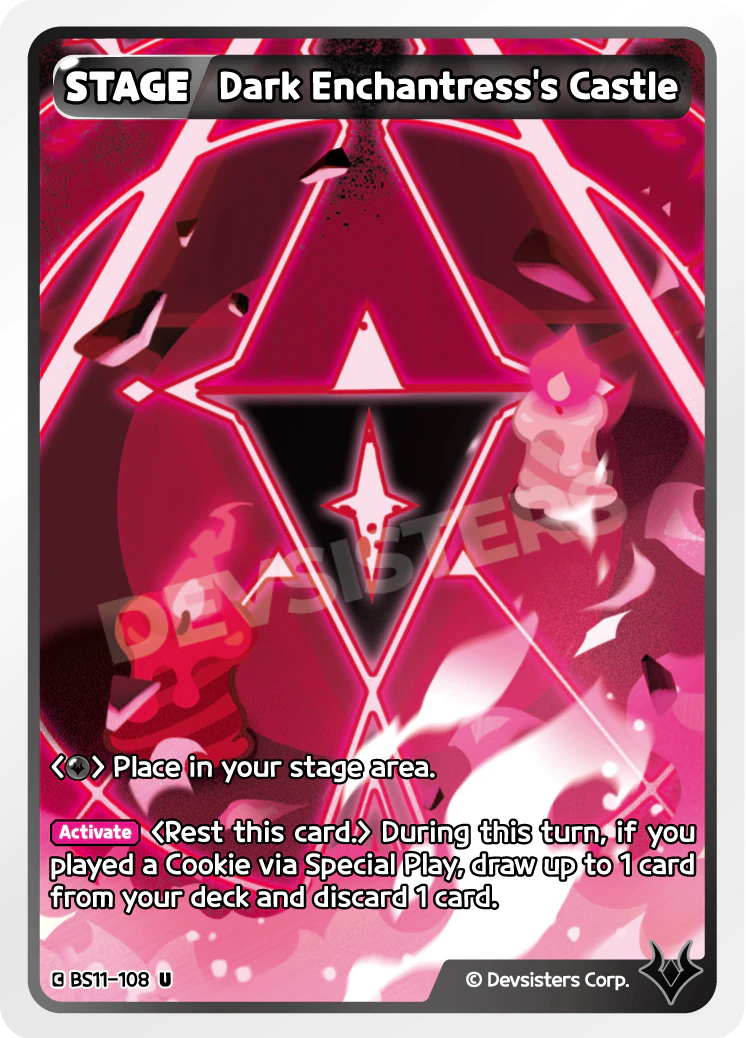
The genuinely sharp detail is that July 15 entry. BS11-108@1 is an alternate printing of Dark Enchantress's Castle - and the Castle is not a nice-to-have, it is a named requirement on the Awakened boss's play condition. Devsisters put a second source of a mandatory combo piece in a promotion pack nine days before the set it belongs to. If you cannot find four Castles in boosters, that promo is your relief valve. (See our promo cards guide.)
The set list is still half published
The press release for The Dark Enchantress War describes 239 regular cards and 66 hidden cards, 305 total. The database currently returns 158 BS11 rows, every one flagged as not hidden - and there are zero hidden-flagged cards anywhere in its 2,092 rows.
So the database is incomplete. The 239/66 figure is the publisher's; the 158 is mine; both are true statements about different sources, and I am not reconciling them by inventing cards. Practically: black's 33 BS11 printings are a floor, not a ceiling.
What the skill text says black actually is
Read all 28 cards and three patterns show up that owe nothing to genre assumptions about what "black" means in a card game.
1. Black sacrifices to the trash, not the Break Area. Every Special Play clause reads some variant of "Place 1 {K} LV.1 Cookie from your battle area into your trash." Not the Break Area. Since you lose when your own Break Area hits Level 10 (win conditions guide), every other way of clearing your own bodies costs you scoreboard. Black's does not. You can eat five of your own Cookies across a game and hand your opponent nothing. That is the single best reason to take the color seriously.
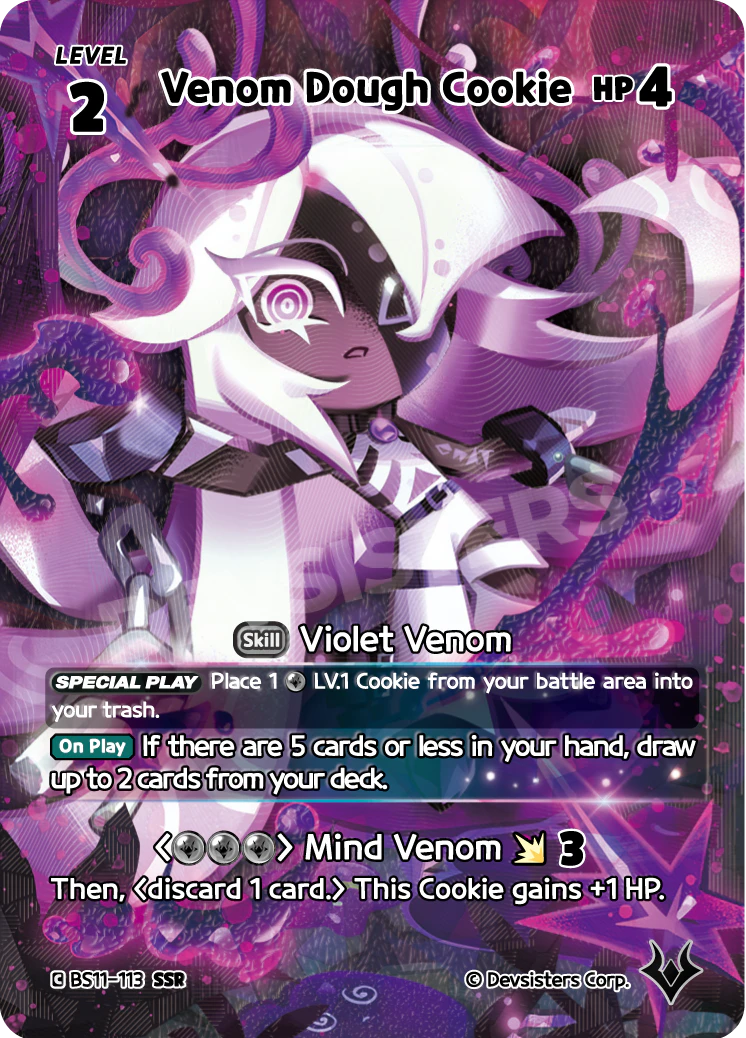
2. Black pays you for an empty hand. Four cards - Skelecake Bomber (BS11-103), Pom-pom Dough (BS11-112), Venom Dough (BS11-113) and Pomegranate Cookie (BS11-114) - gate their best effect on "if there are 5 cards or less in your hand," and 10 of the 28 carry a discard clause. Discarding is not a tax black grudgingly pays; it is how black switches its payoffs on.
3. Black is the FLIP-densest color, and its FLIPs are the dullest. Seven of 28 cards are FLIP type - 25 percent, against 12.2 to 14.8 percent for the five colors. Those seven do exactly two things: three draw a card, four read "Discard 1 card - the Cookie with this card attached for HP gains +1 HP." No traps, no punishes, no tempo swings. And the self-heal ones discard, feeding pattern two. (General mechanic: FLIP guide.)
Together that reads as a grind engine, not a beatdown color: shed cards, eat your own board for free, refill from the trash, and never pay the scoreboard price for your own attrition.
The engine, in the order it happens
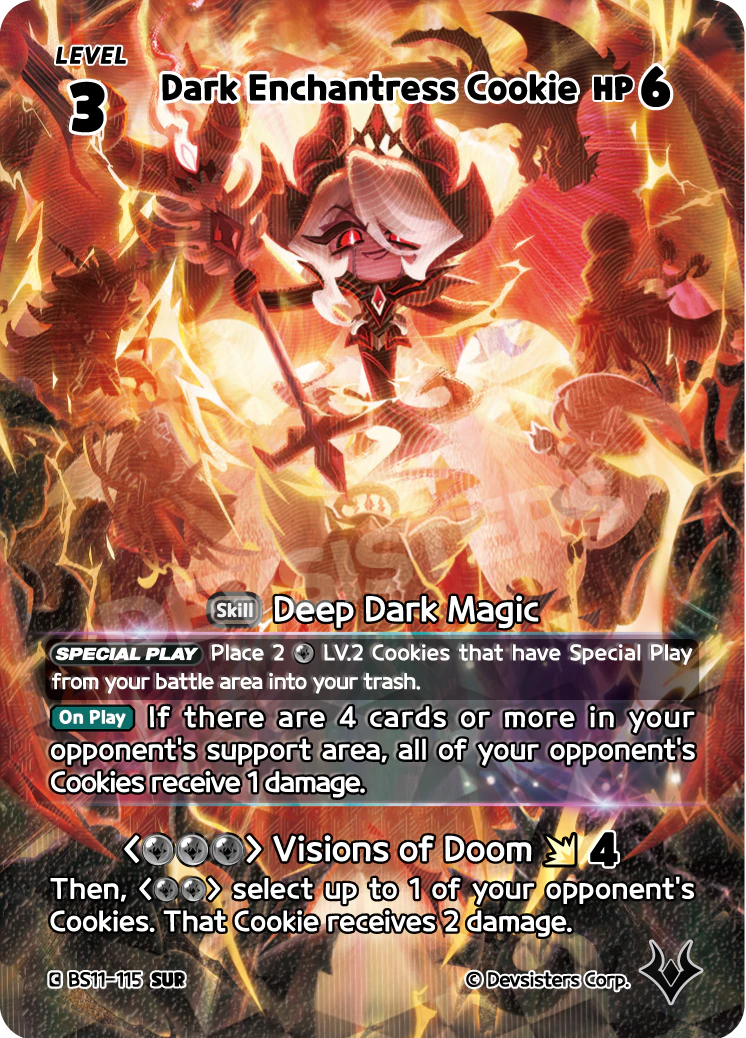
Ten of black's 28 cards check for a Special Play Cookie on your board. Only five actually have Special Play: Mold Dough (BS11-111), Pom-pom Dough (BS11-112), Venom Dough (BS11-113), Dark Enchantress Cookie (BS11-115), and the promo Licorice (P-147). That two-to-one payoff-to-enabler ratio is the deck in one number - most of your cards are spectators until a specific five hit the table.
- Layer 1, fodder. Eight distinct LV.1 black Cookies. Three of them (Cream Jelly Worm, Cream Skelecake Archer, Cream Roll Hog Rider) have skills that only switch on once a Special Play Cookie is out, so early they are just bodies.
- Layer 2, the dough trio. Each reads "【Special Play】 Place 1 {K} LV.1 Cookie from your battle area into your trash." Venom Dough draws 2 on entry at low hand size; Pom-pom Dough returns a {K} Cookie from trash on the same condition; Mold Dough discards to ping for 1.
- Layer 3, the boss. Dark Enchantress Cookie (BS11-115), LV.3 with 6 HP, whose Special Play reads "Place 2 {K} LV.2 Cookies that have Special Play from your battle area into your trash." That wording restricts the fuel to the dough trio or promo Licorice. Visions of Doom hits for 4, then pays {K}{K} for 2 more.
Do the arithmetic: two LV.2s, each of which already ate a LV.1, plus the boss. Six cards' worth of board becomes one 6 HP body. That conversion rate is why the color needs its trash recursion - Pom-pom Dough, Skelecake Bomber, and Pomegranate's attack rider that returns a Dark Enchantress Cookie from the trash - to avoid simply running out of game.
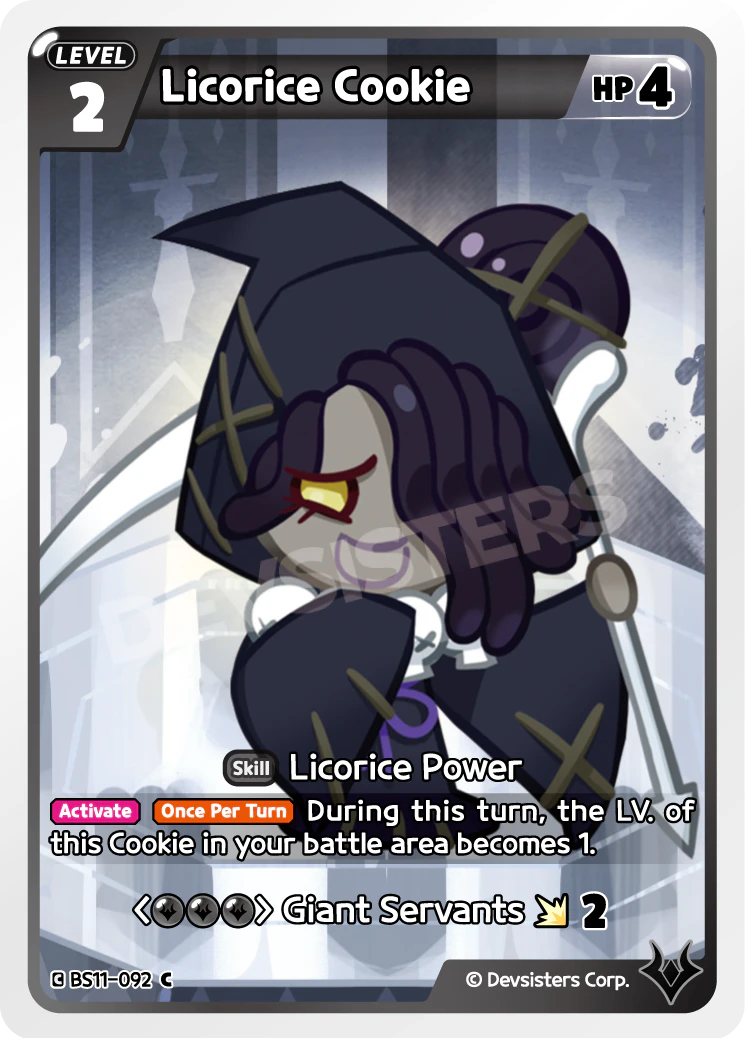
The clever bit almost nobody spots on a first read: Licorice Cookie (BS11-092) is a Common LV.2 with 4 HP whose only skill reads "During this turn, the LV. of this Cookie in your battle area becomes 1." Every Special Play clause wants a {K} LV.1 Cookie to eat. Licorice is a four-HP body that becomes legal fodder the moment you need it - and unlike a real LV.1, it survived the early turns. That is a Common doing a rare's job.
One wording caveat worth flagging rather than guessing at: most black cards say "a Cookie that has Special Play," while the Castle says "if you played a Cookie via Special Play." Those are plausibly two different conditions - the printed ability versus the action you took. Nail that down in the Special Play mechanic guide and against the rulebook before a sanctioned event.
The Awaken gate is a comeback button, not a finisher
Black's top end is Dark Enchantress Cookie BS11-116, an EXTRA at LV.5 with a printed +2 HP and a four-energy attack, Fornacem Accende!, for 7 damage - nearly double anything else in the color - on a body your opponent's effects cannot move.
Now read the gate: "If your break area is LV.7 or higher and [Dark Enchantress's Castle] is in your stage area, you can 【Awaken】 your LV.3 [Dark Enchantress Cookie] that has Special Play."
Your Break Area holds your own fallen Cookies, and your opponent wins when it reaches Level 10. So the condition is not "you are winning." It is: you are seven levels into a ten-level loss.
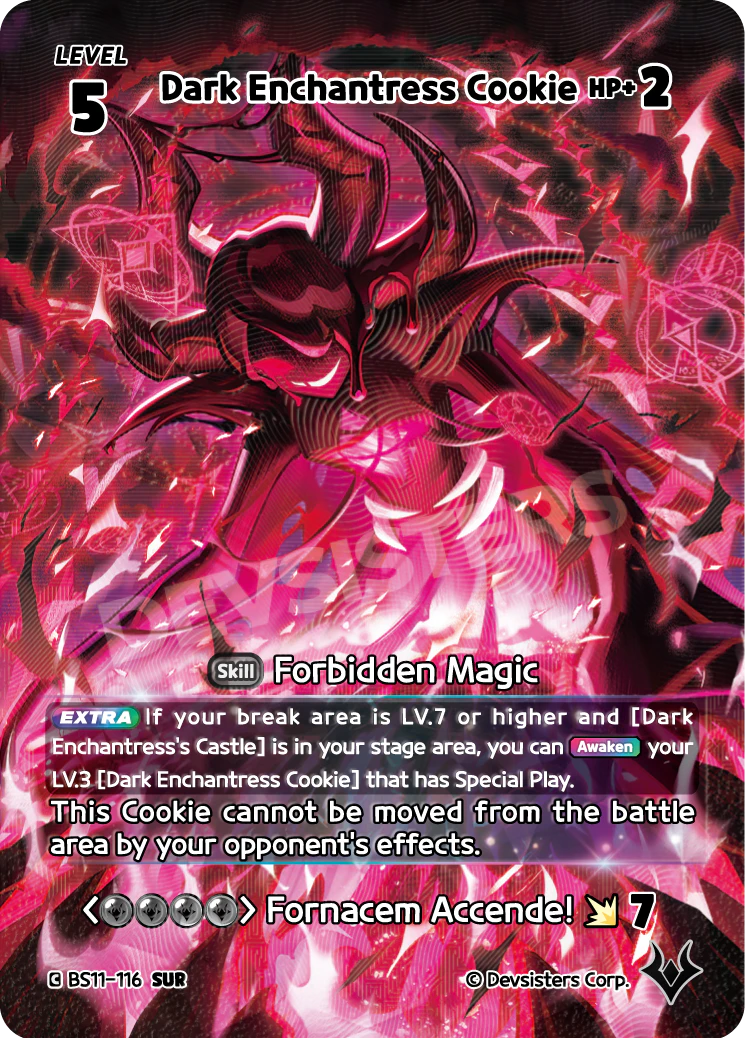
And here is the tension nobody has said out loud two days in: Special Play sacrifices go to the trash, so they do not advance you toward the gate. The mechanic that makes black good at not losing refuses to fuel its own finisher. Awakening needs real combat losses - seven levels of your Cookies actually fainting - which is the exact outcome the rest of the color is engineered to avoid.
My read: BS11-116 is a comeback card in a chase-rarity coat, and the black deck that gets to cast it is the black deck that has been losing. That is not bad design - insurance against a collapsing board is real, and a 7-damage unmovable body steals games. But if you are buying in expecting the Awakened boss to be your reliable win condition, adjust. Your win condition is BS11-115 plus attrition. The Awaken is the parachute. (Extra Deck guide · Break Area guide)
The full black pool
Twenty-eight distinct numbers, 37 printings once you count @-suffixed parallels. All of it from the official database.
The Cookies
| Card | LV / HP | Rarity | What it does |
|---|---|---|---|
| Jam Skelecake Grunt (BS11-094) | 1 / 3 | C | Blocker for {K}. The color's only defensive keyword body |
| Cream Jelly Worm (BS11-097) | 1 / 3 | C | With a Special Play Cookie out: {K} and a discard to faint an opposing LV.1 with no 【Skill】 |
| Cream Skelecake Archer (BS11-098) | 1 / 2 | C | With a Special Play Cookie out: {K} to deal 1 damage, once per turn |
| Cream Roll Hog Rider (BS11-099) | 1 / 2 | C | With a Special Play Cookie out, places itself in the trash |
| Cake Warrior (BS11-102) | 1 / 2 | C | Vanilla. Attacks for 2 on {N}{N} - the only fully off-color cost in black |
| Skelecake Bomber (BS11-103) | 1 / 2 | C | On Play at 5 or fewer cards in hand: return a Special Play Cookie from trash to hand |
| Cake Witch (BS11-104) | 1 / 2 | U | When it faints, view 3, take a {K} card, trash the rest |
| Pomegranate Cookie (BS11-114) | 1 / 2 | SR / SSR | Discard a {K} card to draw 2 at low hand size; attack returns a Dark Enchantress Cookie from trash |
| Licorice Cookie (BS11-092) | 2 / 4 | C | Once per turn, becomes LV.1 for the turn - self-made sacrifice fodder |
| Mold Dough Cookie (BS11-111) | 2 / 4 | R / SEC | Special Play; On Play discard 1 to ping for 1 |
| Pom-pom Dough Cookie (BS11-112) | 2 / 4 | R / SEC | Special Play; recurs a {K} Cookie from trash; attack rider shuts off opposing LV.2+ 【On Play】 |
| Venom Dough Cookie (BS11-113) | 2 / 4 | SR / SSR | Special Play; draws 2 at low hand size; attack rider discards for +1 HP |
| Licorice Cookie (P-147) | 2 / 4 | P | Promo. Special Play; On Play strips a card from a hand of 4 or more |
| Red Velvet Dragon (BS11-105) | 3 / 5 | U | No skill. Attacks for 3, plus 1 more damage if a Special Play Cookie is out |
| Dark Enchantress Cookie (BS11-115) | 3 / 6 | UR / SUR / EXR / GXR | The boss. Eats two Special Play LV.2s; board ping on entry; 4 damage plus a {K}{K} follow-up for 2 |
| Dark Enchantress Cookie (BS11-116) | 5 / +2 | UR / SUR | EXTRA. Awakens off a LV.7+ Break Area and the Castle. 7 damage, unmovable |
The FLIP cards
Seven numbers, two effects, and that is the whole menu:
- Draw 1 - Matcha Cookie (BS11-095), Agar Agar Cookie (BS11-100), Black Sapphire Cookie (P-156)
- Discard 1, attached Cookie gains +1 HP - Poison Mushroom Cookie (BS11-093), Butter Roll Cookie (BS11-096), Schwarzwälder (BS11-101), Candy Apple Cookie (P-162)
Five are BS11 Commons, which at four copies apiece is 20 cards - already past the 16-FLIP deck ceiling. The two promos are upgrades on availability, not power.
The support cards
| Card | Type | What it does |
|---|---|---|
| Dark Enchantress's Castle (BS11-108) | Stage | Rest it: on a turn you played a Cookie via Special Play, draw 1 and discard 1. Also the named requirement for Awakening BS11-116 |
| Emblem of Darkness (BS11-109) | Item | {K}: view 5, take a Special Play Cookie, trash the rest. The color's only tutor |
| Oven of Burning Fate (BS11-107) | Item | {K}{K}: 2 damage if the total LV. of your battle area is 5 or higher |
| Draining Magic Circle (BS11-110) | Trap | {K}: an opposing Cookie deals -1 attack damage, -2 with a LV.5+ or Special Play Cookie out |
| World-reflecting Mirrors (BS11-106) | Trap | The same -1 attack damage effect, plus the color's only cost-reduction clause |
Oven of Burning Fate is the one card actively fighting the rest of the color: it wants the total Level of your battle area at 5 or higher, and Special Play spends your board down. Play it on a turn you have not sacrificed, not as a staple.
What black simply cannot do
- No real hard removal. The only "make that Cookie faint" line is Cream Jelly Worm's, and it needs a Special Play Cookie out, a {K}, a discard, and an opposing LV.1 Cookie with no 【Skill】. Four conditions to kill the smallest thing on the board.
- No board wipe. BS11-115's entry ping is 1 damage to all opposing Cookies, and only if their support area holds 4 or more cards.
- Both traps do the same thing. The entire reactive suite is attack-damage reduction. No counter-trap, no denial, no punish.
- No splash in either direction. 7.1 percent MIX.
- One tutor, one Stage, one EXTRA. If your Castle is buried, BS11-116 is a blank in your Extra Deck.
Building a black deck from a 28-card pool
Standard construction: exactly 60 cards, up to 4 copies of any number, up to 16 FLIP. What makes black weird is that 28 options against 60 slots means you are choosing ratios, not cards. Nearly the whole pool makes the deck.
- Fodder is the resource, not filler. Every Special Play activation eats a {K} LV.1 body; a full boss chain eats four. Black has eight LV.1 Cookies for a reason. Run them high and stop reading them as weak cards.
- Licorice (BS11-092) at four. A 4 HP body that becomes LV.1 on demand is better fodder than a real LV.1, because it survives long enough to be fodder. It is a Common. No excuse.
- The dough trio is the deck. Ten other cards are dead text without one of them on board. Maximum counts. Venom Dough is the best on raw card advantage.
- Emblem of Darkness is not a luxury slot. One tutor in the color, and a payoff structure that needs a specific card type on board.
- Cap FLIPs deliberately. Twenty available Commons against a 16-card ceiling means cutting. Bias toward the discard-for-HP ones - the discard is an enabler for your hand-size payoffs, not a cost.
- Castle count is a real decision. It gates BS11-116 and it loots on your Special Play turns. If the Eternal Farewell promo is cheaper than a fourth booster copy, buy it.
- Mulligan for a LV.1 plus a dough Cookie. Three payoffs and no enabler is a mulligan; fodder plus a Special Play body is a keep. (Mulligan guide.)
Where I will not pretend to have data: nobody has a tested 60 two days after release, there is no tournament result to point at, and half the set is unpublished. That is what the card text forces, not a tuned list.
Quick Action Checklist
- Black is 28 distinct cards (37 printings) against ~290 for every other color - one archetype, not a color.
- It is mono or nothing. 7.1 percent splashable versus 15-22 percent for the five colors.
- Nothing predates the set. Every black card entered the database between May 27 and July 21, 2026, BS11's base roster first - the four non-BS11 printings are launch-window promos, not seeds.
- Sacrifices go to the trash, not the Break Area - black eats its own board without feeding your opponent's Level-10 clock.
- Low hand size is a payoff. Four cards check for 5 or fewer in hand; 10 of 28 discard.
- Ten cards check for Special Play, only five have it. Enabler density is the whole deckbuilding problem.
- Licorice Cookie BS11-092 is the sleeper Common - a 4 HP body that becomes LV.1 to feed a Special Play cost.
- The Awakened boss is a parachute, not a plan. BS11-116 needs your own Break Area at Level 7 of a losing 10, plus the Castle.
- The database is incomplete. 158 BS11 rows published against an announced 239 regular plus 66 hidden.
Frequently Asked Questions
How many Black cards are there in Cookie Run: Braverse?
Did Black cards exist before The Dark Enchantress War?
Can you splash Black cards into another color deck?
What does Special Play cost in a Black deck?
Is the Awakened Dark Enchantress Cookie worth building around?
What are the best Black cards to prioritise when building?
Keep Reading
Related Guides
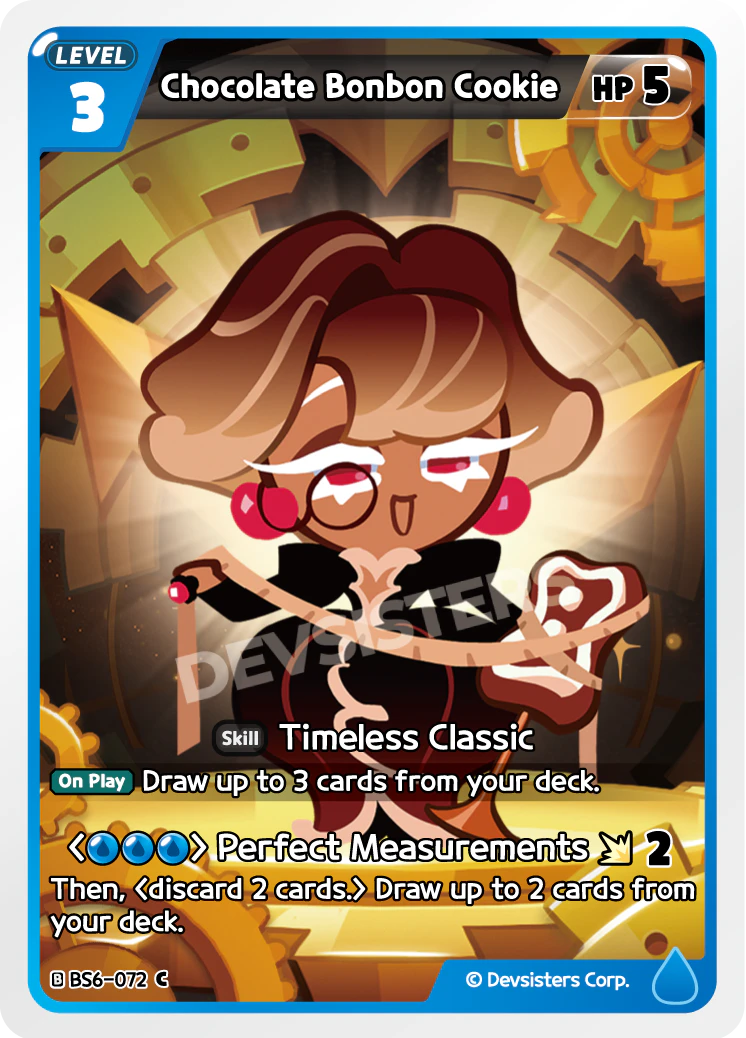
Best Draw and Search Cards in Cookie Run: Braverse
Search the official Braverse database for skills that draw two or more cards and you get 61 hits. Sixty of them charge you something - a discard, a mill, a hand-size cap, a body that has to die first. Exactly one doesn't, and it's a Common. Here's the full draw and search pool, color by color.
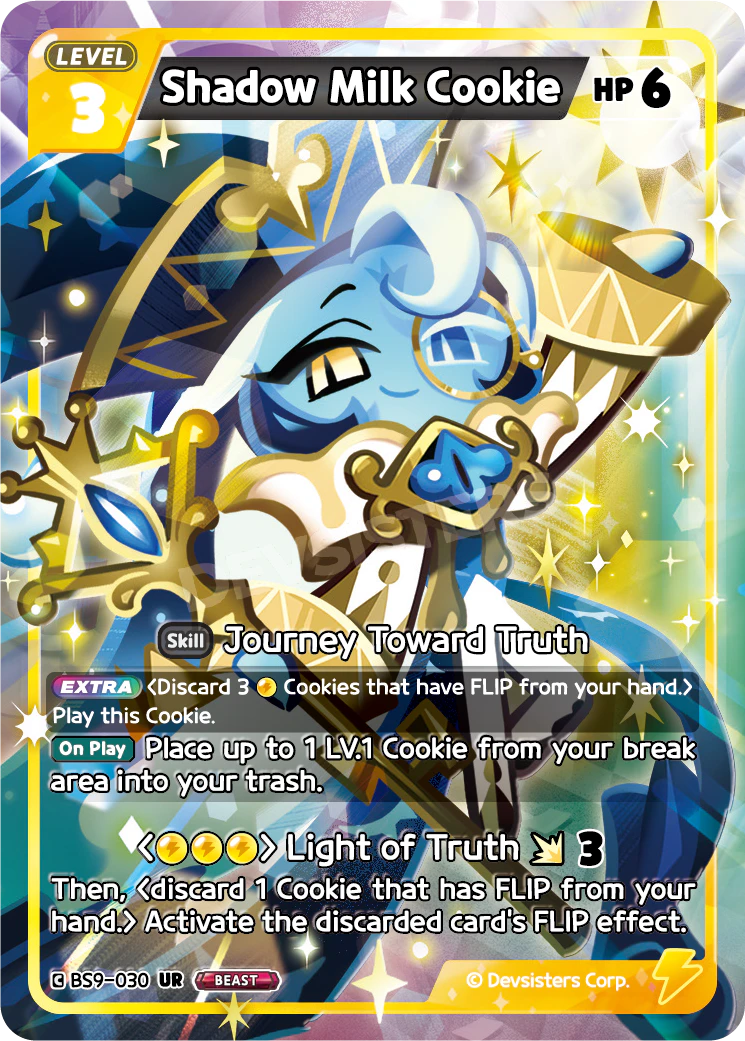
Best Beast Cards in Cookie Run: Braverse, Ranked
The Beast Cookies are Braverse's villain tribe: five legendary Cookies of Darkness, one per color, all printed at the very top of the rarity ladder. Here's how all five rank by power and ceiling, with their real database text.
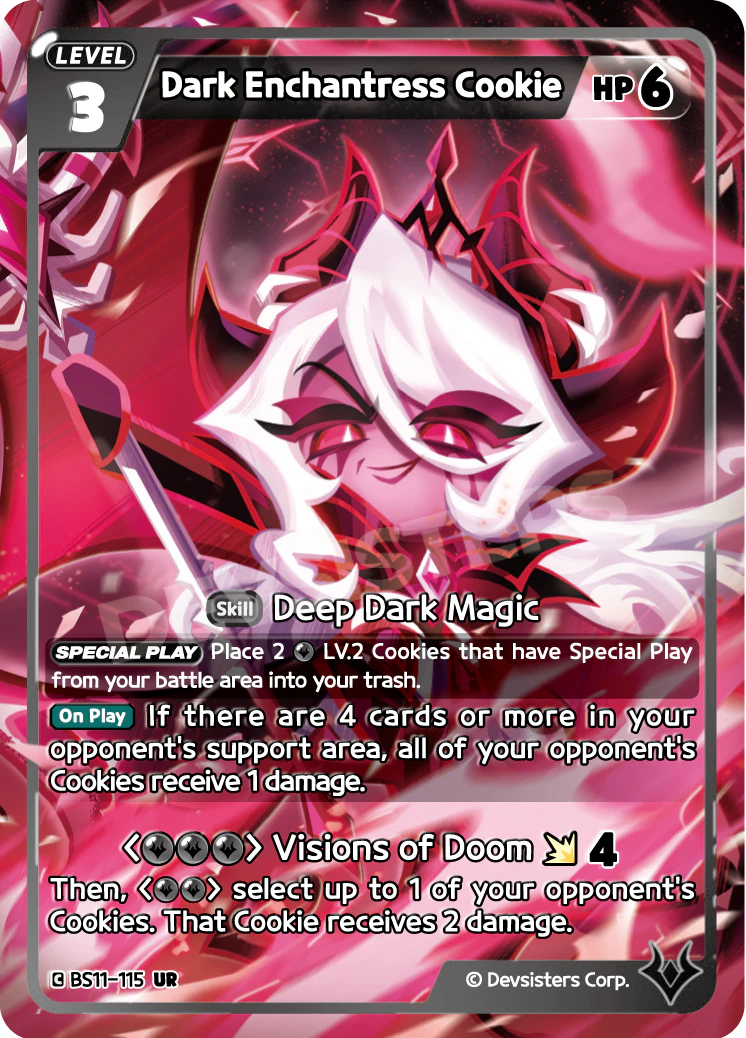
Cookie Run: Braverse Black & Pure Cards, Explained
Five colors, plus two groups that don't play by the color rules. Black is the Dark Enchantress War's villain faction with its own energy; Pure is a tiny set of universal, multi-color specials. Here's what each one actually is, straight from the official database.
Best Trap Cards in Cookie Run: Braverse, Ranked
Braverse has 120 different Trap cards and 115 of them are Uncommons. There is not a single Ultra Rare Trap in the game. That means the entire interaction layer - the cards that decide close games - is fully available to anyone who owns a starter deck and a fistful of bulk.

How to Play Cookie Run: Braverse - A Complete Beginner Guide
Cookie Run: Braverse is the rare TCG you can teach in a single match. This guide covers everything a first-time player needs: card types, setup, turn structure, how you pay for cards, the FLIP mechanic, and how to win.
Cookie Run: Braverse Meta Tier List — Best Decks & Archetypes Ranked
Which Cookie Run: Braverse decks are actually carrying right now? Here's a meta tier list of the strongest archetypes - the real cards that anchor each one, why they rank where they do, and what's overrated.