There Are 17 Different GingerBraves: How Cookie Run: Braverse Card Numbers Actually Work
Search the official database for GingerBrave and you get twenty entries across five colors and three levels. They are not reprints - they are different cards that happen to share a face. Here's how to read Braverse card numbers so you stop buying the wrong single.
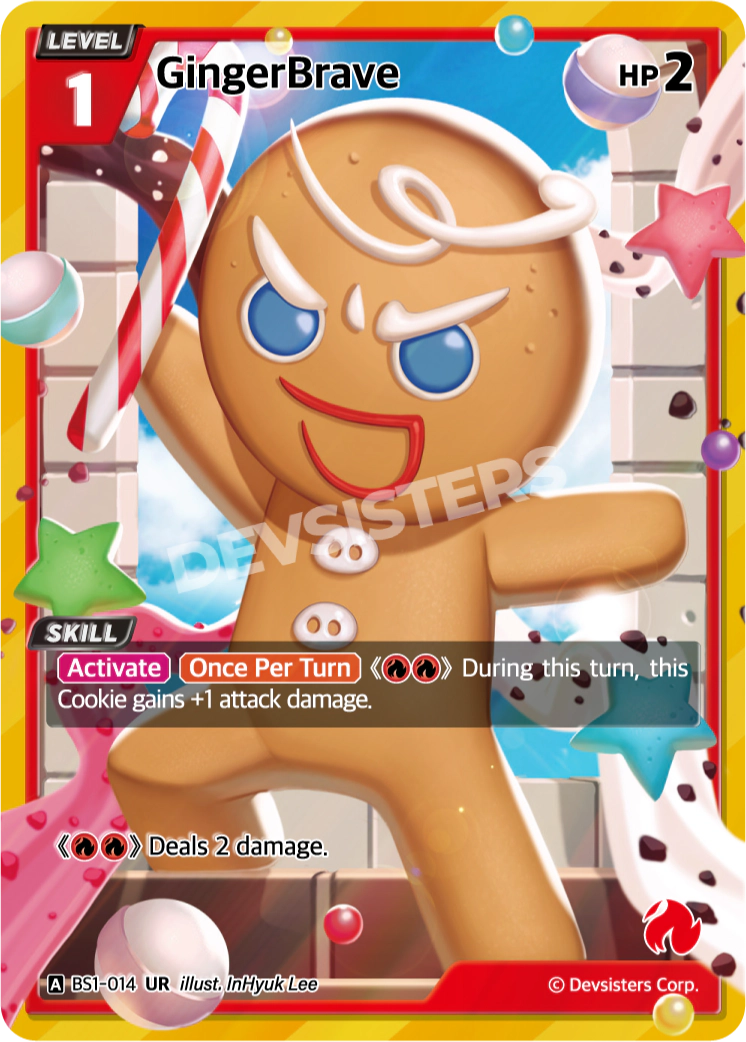
Search the official Cookie Run: Braverse database for GingerBrave and you get twenty results. Not twenty copies of one card - twenty separate entries, spread across seventeen distinct card numbers, five colors, and three levels. One of them is a Level 1 Red with 1 HP that makes you discard. Another is a Level 3 Blue that ignores effect damage. Another is a Purple two-drop that mills your opponent if your trash is stuffed.
They are all "GingerBrave." None of them are the same card.
This is the single most expensive misunderstanding in the game for new players, because it is the one that makes you buy the wrong single, register an illegal decklist, or pay Ultra Rare money for art you already own in Common. The fix takes about five minutes of reading, and after that you will never search Braverse by name again.
The name is flavor, the number is the card
In Braverse, the card number printed in the corner is the card's identity. The name is a character, and characters get printed over and over in different roles as the sets roll out. The official database currently holds 2,093 entries under only 816 distinct names - so on average every name in the game has been printed more than twice.
That matters because the construction rules count numbers. A legal deck is exactly 60 cards with a maximum of four copies of any one card number, at least one Cookie, and up to 16 FLIP cards (the full framework is in deck-building basics). Four copies of BS6-004 is a playset. Four copies of BS6-004 plus four of ST1-007 is eight cards that both say "Mint Choco Cookie" on the front and both count separately, because they are different cards.
Rule of thumb: if a Braverse player tells you to run a card and does not give you a number, they have not actually told you anything.
How to read a Braverse card number
Every number has a prefix, a dash, and a three-digit index. Some also carry a suffix. Here is the whole system:
- BS1 through BS11 - booster sets. Two prefixes can share one product: BS1 and BS2 are both BRAVE BEGINNING, BS3 and BS4 are both Age of Heroes and Kingdoms, BS5 and BS6 are both Operation Timeguard. From there it is one prefix per booster: BS7 is Arena of Glory, BS8 is Land of Fire & Ruin / Realm of Apathy, BS9 is A Game of Truth and Deceit, BS10 is Paradise of Passion & Sloth / Catacombs of Silence, and BS11 is The Dark Enchantress War.
- ST1 through ST5 - the five color starter decks (Red, Yellow, Green, Blue, Purple, in that order).
- ST6 through ST10 - the named starter decks: Flames of Immortality, Tree of Life, Guardian Winds, Seas of Fate, and Glorious Moonlight, at exactly 20 database entries each.
- P- - promotional cards. Tournament prizes, release events, promotion packs, and league distributions all live here.
- A trailing @1, @2, @3 - an alternate printing of the same card. Same number, same card. More on that below.
Learn the prefix table and a decklist stops being a wall of jargon. BS7-013 tells you "Arena of Glory booster, thirteenth card." ST3-012 tells you "you already own this if you bought the Green starter."
GingerBrave exists in all five colors
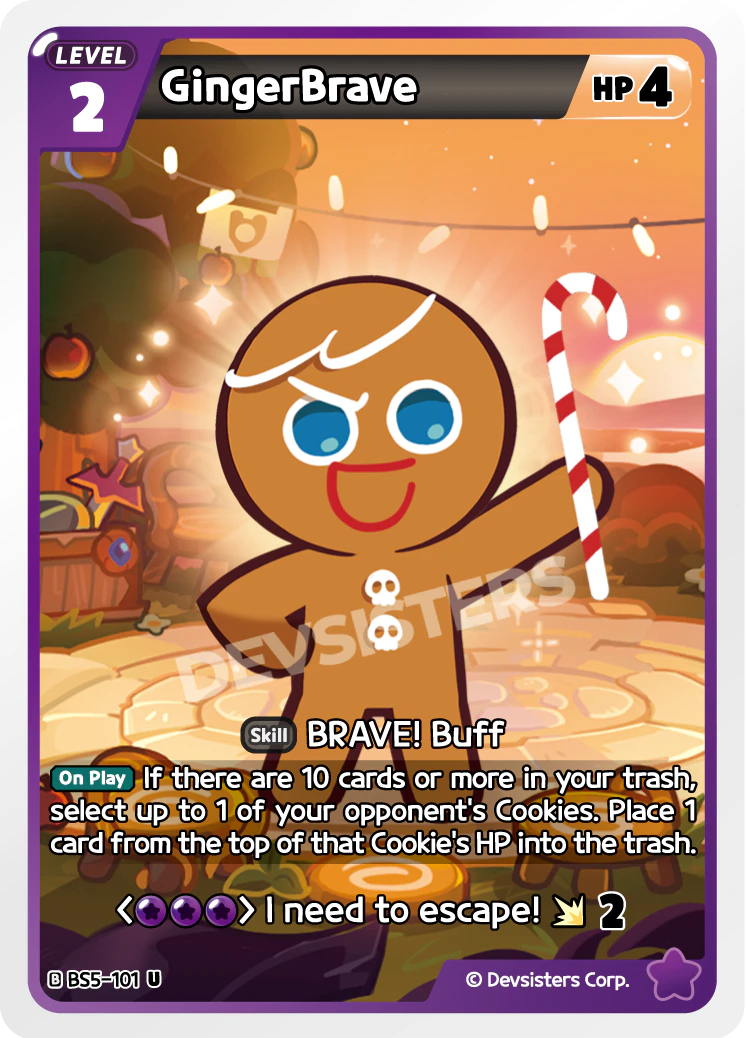
GingerBrave is the cleanest demonstration of the problem because the mascot gets printed in everything. His seventeen card numbers cover the entire color wheel:
- Red - BS1-013 (Level 1, 1 HP, attacks for 2 but forces a discard) and BS1-014 (Level 1, 2 HP, Ultra Rare, can pump its own attack). Plus two promos, including P-036@1 at Level 3 with 5 HP and an On Play that damages every Cookie on the table, yours included.
- Yellow - BS9-033 (Level 1, 3 HP, discards a FLIP card to refill your hand) and BS4-036 (Level 3, 3 HP, no skill at all, just a body that hits for 3).
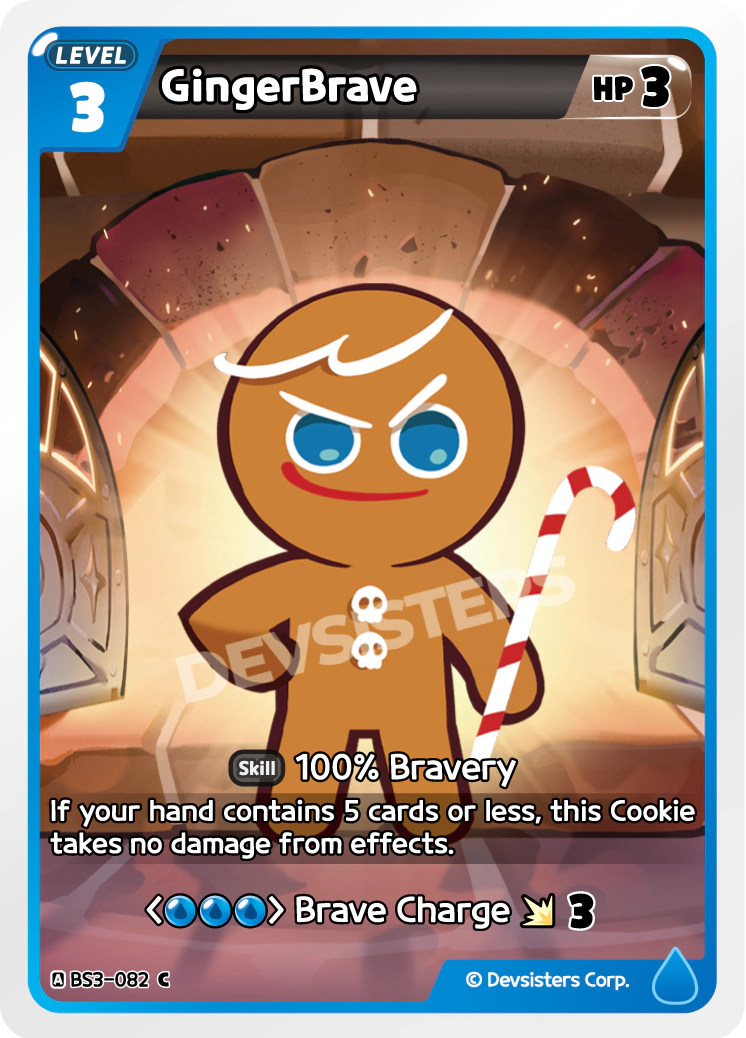
- Blue - BS3-082 (Level 3, 3 HP, takes no damage from effects while your hand is five cards or fewer).
- Purple - BS5-101 (Level 2, 4 HP, mills a card off an opposing Cookie if your trash has ten or more cards).
- Green - P-089, a Level 2 promo with 5 HP.
Same face, five colors, wildly different jobs. The Blue one is a resilient wall for a low-hand deck. The Purple one is a graveyard-payoff two-drop. The Yellow BS9-033 only works if you are running FLIP cards to throw away. If you search "GingerBrave" on a marketplace and buy the cheapest result, you have a roughly one-in-seventeen chance of getting the one your list actually wanted.
The starter deck loophole
Here is where the number rule turns into an actual deckbuilding tool rather than a gotcha.
All five color starter decks contain a GingerBrave - ST1-011, ST2-009, ST3-012, ST4-011, and ST5-009. Check their stat lines in the database and they are identical: Level 1, 2 HP, MIX energy, no skill text, one attack that deals 1 damage for a single generic energy. Functionally the same card, printed five times with five different numbers.
Because the four-copy cap counts numbers, that is twenty legal copies of the same effect in one 60-card deck if you ever wanted them. Nobody is building GingerBrave Tribal Twenty as a serious list - it is a vanilla 1-drop - but the principle behind it absolutely matters. When you want more copies of an effect than the cap allows, the first question is whether the same effect exists under a second card number. In Braverse it very often does, because the starters and promos re-cut the same basic bodies.
This is also the one place I would double-check before a sanctioned event: the number-based cap is how the game and the database treat these cards, but if a judge document ever adds a name-based restriction, the twenty-GingerBrave build is exactly the trick it would be written to stop.
Timekeeper Cookie: four cards, one set
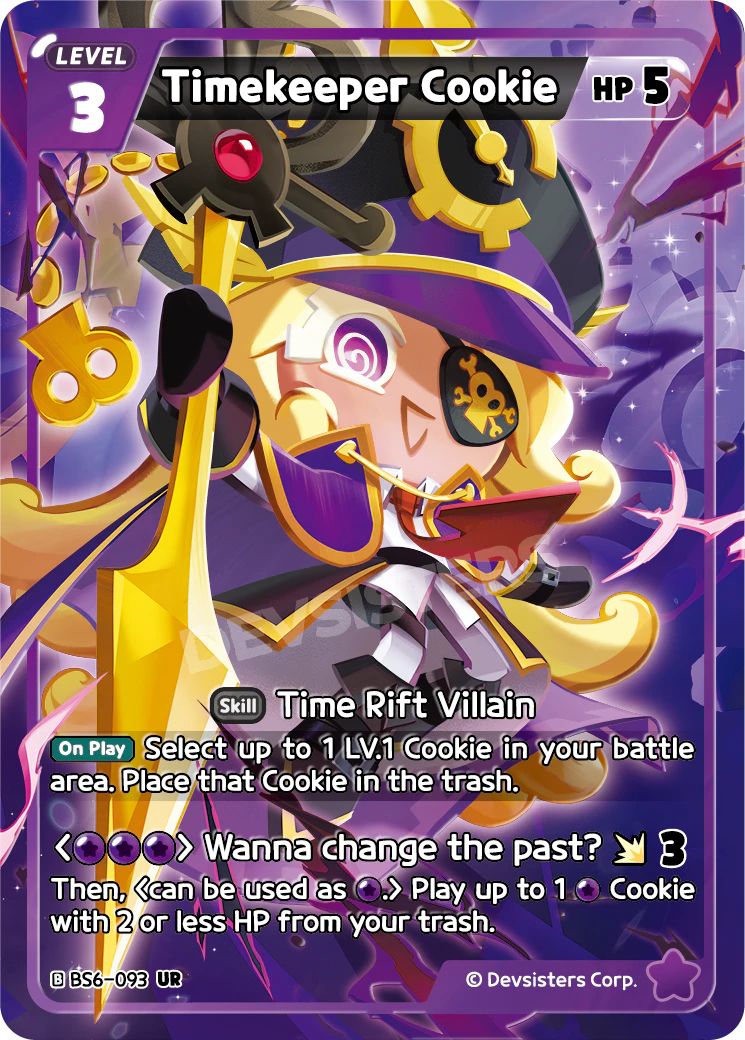
If you think one printing per set is the norm, Operation Timeguard says otherwise. Timekeeper Cookie appears four separate times inside the BS6 range alone:
- BS6-010 - Level 2 Red, 4 HP, skill "Shackles of Love."
- BS6-031 - Level 3 Yellow, 5 HP, "A Moment of Fun."
- BS6-051 - Level 3 Green, 5 HP, "Ruler of the Ephemeral Flow."
- BS6-093 - Level 3 Purple, 5 HP, "Time Rift Villain."
Four colors, four skills, one set, one character. Every one of them is Ultra Rare or higher, so the price tags are similar enough that a careless buy costs real money. "I need the Timekeeper from Timeguard" is not a sentence that identifies a card.
The Mint Choco trap
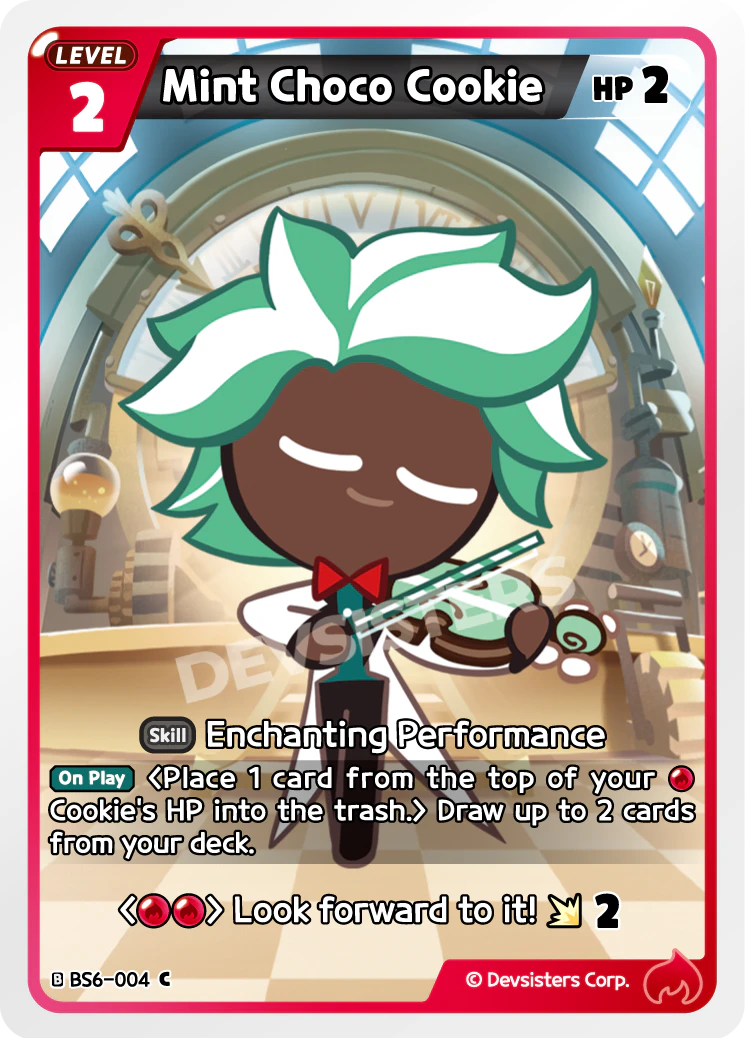
Mint Choco Cookie has seven printings, and two of them are the ones budget builders actually argue about.
BS6-004 is a Common, Level 2 Red with 2 HP. Its On Play trashes a card off the top of one of your Red Cookies' HP and draws you two cards. That is one of the best draw rates available at Common rarity, and it is the reason the card shows up in nearly every budget Red list - see the budget upgrade path.
ST1-007 is also a Common, also Red, but Level 3 with 3 HP, and its ability pumps another Cookie's attack by 1. It comes free in the Red starter deck. It draws you nothing.
A new player reads "run four Mint Choco" in a budget guide, opens the Red starter, sees Mint Choco Cookie already sitting there, and builds a deck with no draw engine at all. The list did not lie. The player read the name instead of the number.
What the at-sign suffix means
553 of the 2,093 database entries carry an @ suffix - roughly a quarter of the game. These are the alternate printings: Secret Rare and Secret Ultra Rare alternate arts, foil treatments, tournament promos of an existing card.
An @ suffix is the one case where two different-looking entries really are the same card. BS1-014 and BS1-014@1 are both GingerBrave, both Level 1 Red with 2 HP, both the same attack and skill text. One is Ultra Rare and one is Secret Ultra Rare. In a deck, they share the four-copy cap between them, because the base number is the same.
So the rule splits cleanly:
- Different base numbers, same name - different cards. Read both.
- Same base number, different @ suffix - same card, different finish. Buy whichever is cheaper unless you want the art.
That second line is the whole thesis of the rarities and collecting guide, and it is worth repeating every time someone quotes you an Ultra Rare price for a card that also exists at Common.
Database quirks that will bite you
The official JSON is the best source in the game, and it is still a database maintained by humans. If you use it seriously - and you should, before spending money - know its rough edges:
- Two grades are misspelled in the data. Seven entries carry "ULTLA RARE" and one carries "UOMMON." They are Ultra Rare and Uncommon; a text filter that does not account for the typos will silently drop cards.
- Some Wind Archer promos use an underscore instead of a dash - BS2_058@2 rather than BS2-058@2 - and list their color as "PULPLE." Same card, mangled record.
- Old cards use old notation. BS1-era entries print attacks as "Deals 3 damage" while the same card's later alternate art uses the modern symbol style. The card did not change; the text convention did.
- Blank fields are not blank cards. Several entries have empty skill names while an alternate printing of the same number lists one. Trust the printed card and the most recent entry.
None of this is disqualifying. It just means "I searched and found nothing" is often a search problem, not a card problem.
Quick action checklist
- Buy by number, never by name. Write the number in your shopping list, not the Cookie.
- Learn six prefixes. BS is booster, ST1 to ST5 are the color starters, ST6 to ST10 are the named decks, P is promo. That covers the whole game.
- Treat @ as cosmetic. Same base number equals same card equals shared four-copy cap.
- Before you buy an expensive single, search its name. If a Common with different art does the same job, you are buying a finish.
- When you want a fifth copy of an effect, check whether a second card number prints the same thing - the starters and promos frequently do.
- Cross-check anything load-bearing against the official card database rather than a wiki table or a marketplace listing.
Frequently Asked Questions
How many GingerBrave cards are there in Cookie Run: Braverse?
Does the four-copy limit in Braverse count card names or card numbers?
What does the @ symbol in a Braverse card number mean?
Which Braverse set does each card number prefix belong to?
Which Mint Choco Cookie should I buy for a budget Red deck?
Keep Reading
Related Guides

Braverse Festival Arena Reprints: What Devsisters Promised
Five days after Festival Arena went on sale, Devsisters apologized for the older cards it had reprinted into the set and promised standard boosters will not be built that way again. It never said how many reprints there were. Its own product listing and card database imply 48.
Cookie Run: Braverse Old Sets Won't Be Reprinted - For Now
A collector asked Devsisters whether it would ever issue second printings of BS1 boxes. The answer, published August 18, is no - not in their existing form. The replacement plan is already sitting in the official card database under a name nobody announced.
Braverse Landed on TCGplayer and Three Set Names Vanished
Search TCGplayer for Operation Timeguard and you get nothing, even though 274 of its cards are listed on the site right now under a different set name. The marketplace files Braverse under five booster sets; the official card database uses eight. Here is the map between them.
Cookie Run: Braverse Promo Cards: Where Every One Comes From
There is a Braverse promo whose printed skill makes your opponent wish you a happy birthday - and whose attack gets stronger if it actually is your birthday. That card explains the promo pool better than any rarity chart: mostly party favors, occasionally a card that changes a deck.

How to Play Cookie Run: Braverse - A Complete Beginner Guide
Cookie Run: Braverse is the rare TCG you can teach in a single match. This guide covers everything a first-time player needs: card types, setup, turn structure, how you pay for cards, the FLIP mechanic, and how to win.
Cookie Run: Braverse Meta Tier List — Best Decks & Archetypes Ranked
Which Cookie Run: Braverse decks are actually carrying right now? Here's a meta tier list of the strongest archetypes - the real cards that anchor each one, why they rank where they do, and what's overrated.