Fortnite Cash Cups & Competitive Guide: How Tournaments Work
Ranked sorts you against your skill level; Cash Cups put you in scheduled, multi-game tournaments where consistency pays out. Here's how the competitive ladder actually works — divisions, scoring, how you qualify up, and how to prep so you don't tilt away a session.

The first time you queue a Cash Cup expecting it to feel like Ranked with a prize, you get a rude surprise: the lobby is sweatier, the games run on a hard clock, and one tilted decision in game three can wreck a whole session you can't just re-queue out of. Cash Cups aren't "Ranked but the stakes are higher." They're a different format with their own rules, and treating them like a continuous ladder is exactly how people throw away sessions they had every right to do well in.
This guide is the competitive ladder above casual and Ranked — the scheduled, points-based tournaments where consistency over a set number of games is the entire point. We'll cover how the structure works, what divisions are and how you move between them, how the scoring actually rewards you, what "qualifying" means and what you're playing toward, and how to prep so you show up sharp instead of cold. We're sticking to the durable structure here — divisions, points-based scoring, fixed game counts, qualification gates — and deliberately not quoting this week's dates, prize values, or exact point thresholds, because Epic changes those constantly. Check the in-client compete tab for the current numbers; the shape of how it works is what lasts.
Cash Cups are not just spicy Ranked
Start with the core difference, because everything else follows from it. Ranked is a continuous ladder; a Cash Cup is a bounded session. In Ranked you grind whenever you want and your rank drifts up or down over hundreds of games. A Cash Cup is a scheduled event with a window — you play a fixed number of matches inside a set time, your points from those games are added up, and where you finish on the leaderboard at the end is your result. There's no "I'll just play more to fix it." The session is the session.
That single fact reshapes how you play:
- Every game in the set matters proportionally more. With a capped number of games, one bombed match is a bigger fraction of your total than one bad Ranked game ever is.
- Consistency beats spikes. A player who scores solid in every game out-places a player who pops off once and bombs the rest. The format rewards the floor of your performance, not the ceiling.
- Tilt is lethal. In Ranked you can rage-queue and average it out. In a Cash Cup, tilting after a rough game two can torch games three through six while the clock runs out.
Think of a Cash Cup as a match in the sports sense — a bounded contest you prepare for and pace yourself through — not a ladder you grind. That mindset shift alone separates people who do well from people who melt.
How the competitive ladder is structured
Fortnite's competitive scene stacks in rough tiers, and Cash Cups sit in the middle as the on-ramp to real competition:
- Casual — pubs and LTMs. No stakes, full of bots and disengaged players. Practice, not competition.
- Ranked — skill-based matchmaking that sorts you into tiers (Bronze up to Unreal). This is your competitive training ground and the place to build the placement-first habits Cash Cups demand. If you haven't read it, our Fortnite Ranked guide covers how those tiers and scoring work.
- Cash Cups and online tournaments — scheduled, points-based events where you play a fixed set of games for a leaderboard result. This is where "competitive Fortnite" actually starts.
- Qualifiers and major events — the path that, for the very best, leads toward the top of the official competitive circuit. Strong Cash Cup results are the gateway into this layer.
Most events are mode-specific — there are separate cups for Solo, Duos, Trios, and for Build versus Zero Build — and like Ranked, your Build and Zero Build competitive progress are entirely separate. You pick the format you're best at and pour your prep into it rather than splitting across all of them.
Divisions and how you move between them
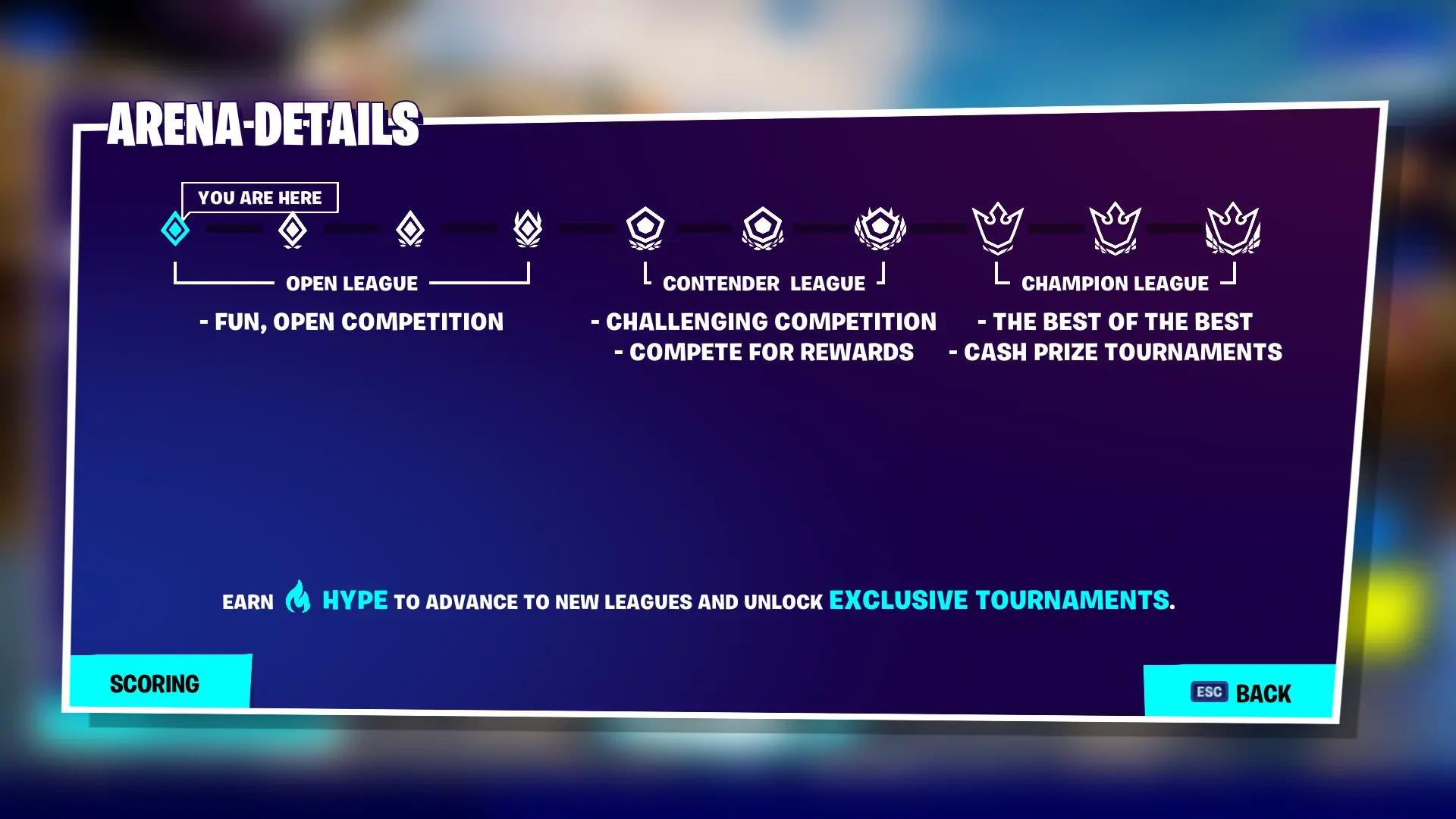
To keep brand-new competitors from getting fed to established players, tournaments are commonly split into divisions — separate brackets stacked by skill, with the lowest division as the entry point and higher divisions holding progressively stronger fields. The structure exists so you're competing against people roughly at your level instead of getting stomped your first session.
The durable mechanic for moving up: you earn promotion to the next division by performing well enough in your current one. Hit the result threshold the event sets — finish high enough on the leaderboard, accumulate enough points across the session — and you move up to face a tougher field next time. The specific gates (how many points, what placement) are the part Epic tunes per event, but the principle is constant: do well where you are to earn a harder lobby.
A couple of things to internalize about divisions:
- Higher division means a harder field, not a different game. The skills that promote you out of a low division are the same ones you need in a high one — they just have to be sharper. There's no shortcut that skips the fundamentals.
- Your division is honest feedback. Where you settle reflects your real competitive level. If you're stuck in a lower division, the leak is almost always decision-making and consistency, not a single highlight skill — exactly like being hard-stuck in Ranked.
How Cash Cup scoring works
Cash Cup scoring runs on the same DNA as Ranked but with the stakes cranked up: points come from placement and eliminations, and placement is weighted heavily. You bank points each game for surviving deep (top finishes pay out big, with bonus weight for an actual Victory Royale) plus points per elimination. Add up your best games in the session and that total is your leaderboard score.
The exact values rotate every event, but the durable math doesn't, and it's the single most important thing to understand:
- Placement is the backbone. Consistently reaching the late game scores far more reliably than chasing kills. A player who lands safe and finishes top-10 every game banks a steady, high floor; a player who hot-drops for kills and dies early bombs the session even with a flashy frag count.
- Eliminations are a multiplier on good placement, not a substitute. Kills are worth the most when you're already deep — late-game elims in a thin lobby stack on top of a strong placement. Early kills that come at the cost of dying early are a net loss.
- Many formats count your best N games, which means a single disaster game hurts less if you can recover with strong games after — another reason not to tilt after one bad drop.
If you've read the Ranked guide, this is the same placement-first lesson with money on the line: survive first, frag second. The scoring rewards the player who's alive in the final circles game after game, and punishes the one who treats it like a kill race.
Qualifying and what you're actually playing for
"Qualifying" is the word that confuses newcomers, so pin it down: qualifying means hitting a result good enough to advance to the next stage — whether that's promoting to a higher division, earning a spot in a later round of a multi-round event, or reaching a payout threshold. You're not just playing for a single leaderboard rank; you're playing to clear a bar the event sets.
What that bar is depends on the event, but the common shapes are:
- Leaderboard cutoff. Finish in the top X of your division/region by total points and you advance or get paid. Everyone below the line gets nothing for that round, which is why consistency matters so much.
- Point threshold. Hit a target score across your games and you qualify regardless of exact rank — reach the number and you're through.
- Multi-round progression. Round one feeds round two feeds finals; you qualify through each stage by placing well enough in the previous one.
The practical takeaway: before you queue, know exactly what you're playing for this event. Is it a top-cutoff you need to be near the top to clear, or a points threshold you just need to reach? That answers whether you should play it safe to lock a result or push for a big game to climb the board. Playing without knowing your target is how people leave points — and qualification — on the table.
How to prep for a Cash Cup session

Showing up cold to a bounded, high-stakes session is malpractice. Because you can't average out a bad start over hundreds of games, your first game needs to count, which means prep:
- Warm up before the session, not in game one. Spend time in aim trainers and creative warm-up maps so your hands are live when the first match starts — game one in a Cash Cup is worth the same as game six, so don't spend it warming up. Our warm-up and practice routine is built for exactly this.
- Know the current map and loot pool cold. Where you land, your rotation routes, and which weapons matter shift every season. Walking into a competitive session unfamiliar with the current map is a self-inflicted handicap.
- Have a drop plan and backup spots. Competitive lobbies contest the same strong drops. Know your primary landing zone and a fallback for when it's taken, so you're not improvising under pressure.
- Sort your sensitivity, keybinds, and FPS beforehand. A competitive session is the worst possible time to discover your settings are off. Lock them in advance — see our best Fortnite settings and keybinds guides.
- Pick one format and commit. Don't bounce between Solo and Duos cups in a night. Prep the one you're playing and pour your focus there.
Use Ranked as your competitive gym between cups. The placement-first habits, rotation reads, and endgame composure that win Cash Cups are exactly what climbing Ranked builds — Ranked is the cheapest place to train them.
In-session strategy that actually scores

Once you're in, the strategy is the placement-first scoring made concrete:
- Land to survive, not to fight. Pick a drop where you can gear up uncontested or win a clean early fight, not a hot drop where you're coin-flipping your first game. A safe, fully-looted start beats a 50/50 brawl.
- Rotate early and play for zone. Reaching the late game alive is the bulk of your points. Move early through cover, take the safe side of the zone, and don't get caught crossing the open — our rotation guide is the most useful read for scoring well.
- Pick fights that protect placement. Take fights you'll clearly win or that you have to take to survive; disengage from coin-flips and third-party traps. A fight that risks your placement for a single elim is usually a bad trade in a points format.
- Frag in the endgame. Late kills in a thin lobby are both safer and worth the most — that's where elims stack on top of placement, and with siphon active in competitive playlists each of those kills also heals you for the next one. Bring full mats and heals so you can actually fight in the final circles; the endgame strategy guide covers converting good position into Victory Royales.
- Manage the session, not just the game. Track your running total against the qualification target. If you're close to clearing a threshold, lock it in; if you need a big game to make a cutoff, that's when calculated aggression is worth the risk. Play the leaderboard, not just the lobby.
Mistakes that tank your session
The habits that wreck Cash Cup runs, so you can drop them:
- Treating it like Ranked or pubs. Hot drops and kill-chasing that you can average out in Ranked bomb a bounded session fast.
- Tilting after a bad game. The single biggest session-killer. One rough drop is recoverable in a best-games format — rage-forcing the next three is not. Reset between games.
- Warming up in game one. Cold hands cost you a game that counts as much as any other. Warm up before, not during.
- Not knowing the qualification target. Playing without knowing whether you need a cutoff or a threshold means you can't make the right risk decisions late.
- Chasing kills over placement. Same lesson as Ranked, higher stakes: dying early for frags torches a points session built on survival.
- Splitting focus across formats. Bouncing between Solo, Duos, and modes in one night means you're under-prepped in all of them. Commit to one.
Cash Cups are where the placement-first discipline you (hopefully) built in Ranked gets tested with real pressure and a hard clock. Prep like it's a match, pace yourself across the session, play for zone, frag late, and don't let one bad drop take the other five with it.
Quick Action Checklist
Your competitive-session game plan:
- Treat the cup as a bounded session, not a ladder — every game in the set matters proportionally
- Know the format and your division — events are mode-specific and Build/Zero Build are separate
- Play placement-first — placement is weighted far above kills, every event
- Know your qualification target before you queue — leaderboard cutoff vs point threshold changes your risk
- Warm up before game one, not during it
- Know the current map, loot pool, and your drop plan (plus a backup spot) cold
- Lock settings, sens, and FPS in advance — never mid-session
- Land safe, rotate early, pick your fights, frag late with full resources
- Don't tilt — one bad game is recoverable; rage-forcing the rest is not
- Use Ranked as your training ground between cups
Frequently Asked Questions
How do Fortnite Cash Cups work?
How is Cash Cup scoring different from Ranked in Fortnite?
What does qualifying mean in a Fortnite tournament?
How do divisions work in Fortnite competitive?
How do you prepare for a Fortnite Cash Cup?
Keep Reading
Related Guides

Fortnite Third-Partying Guide: When to Push, When to Hold
Third-partying is the most reliable way to win a fight without earning it — you let two players gut each other, then collect. But the same logic points back at you the second you start shooting. Here's how to be the third party instead of the corpse two of them split.

Fortnite Duos & Trios Strategy: How to Win in Small Teams
Duos and Trios aren't just Squads with empty slots. With fewer guns, every knock swings the math harder, every res is riskier, and one bad split loses the game. Here's how to play 2s and 3s — roles, comms, trading, reboots, shared loot, and third-partying as a small unit.
Fortnite Weak Spots & Aiming Guide: Where to Aim
Two players land the same shots and one does way more damage. The difference isn't aim — it's where they're aiming. Here's the where: headshots and weak spots, crosshair centering, pre-aiming, tracking vs flicking, and aiming the gaps in someone's build.

Fortnite Tunneling Guide: Cross Open Ground Without Dying
Tunneling is how good players cross open ground while being shot at and live to fight in the next zone. It's the move-and-rebuild rhythm that turns a death-march across a field into a moving box nobody can crack. Here's how to actually do it.
Fortnite Weapon Tier List: How to Rank Any Loot Pool
Any Fortnite tier list is stale the second a patch drops. So instead of memorizing this season's gun names, learn how to rank weapons by class and role — the framework that's S-tier in every season.

Best Fortnite Settings for PC & Console
Half your settings menu is noise; a handful of options decide whether you can see, aim, and build. Here's what to change on PC and console, why, and the one number nobody else can pick for you.