Fortnite Ranked Guide: How Ranks Work and How to Climb
Fortnite Ranked rewards placement more than kills, and Build and Zero Build are two completely separate ladders. Here's how the tiers work from Bronze to Unreal, what actually earns you points, and the climbing strategy that gets you out of your bracket.
The fastest way to lose rank in Fortnite is to play like it's casual — drop hot, chase every kill, and die 40th with three elims and a great highlight clip. Ranked does not reward that. It rewards the player who reaches the final circles alive, game after game, and picks up kills along the way. Once that clicks, the whole mode makes sense: Ranked is a placement game with a kill bonus, not a kill race with a placement footnote.
This guide covers how the system actually works — every tier from Bronze up to Unreal, how your points move from placement and eliminations, and the one structural fact most new ranked players miss: Build and Zero Build are two entirely separate ladders, so your rank in one says nothing about the other. Then we get into the climbing strategy that gets you out of your current bracket. We're sticking to the durable system here, not any single season's exact point thresholds, because Epic re-tunes those regularly — the shape of how you climb is what lasts.
What Ranked is, and why it exists
Ranked is Fortnite's competitive matchmaking mode. Instead of throwing you into a lobby with whoever's queuing, it sorts you into a tier based on a hidden-to-you skill rating, then tries to match you against players near your level. Win and place well, your rank goes up; get matched against people your skill and lose, it goes down. The point is simple: you spend most of your time fighting people who are actually around your level, which is both better practice and less miserable than getting stomped by sweats or farming bots.
Each match adjusts your rank based on how you did relative to the lobby. Do better than the system expected for your tier and you gain; do worse and you lose. As you climb, the lobbies get harder, so the rank you settle at is a real reflection of where you stand. That's the whole appeal — it's a measuring stick that means something, unlike a casual win against a half-bot lobby.
A few durable facts to anchor on before the tiers: your Ranked progress is tracked per mode and per input style, the tiers run from Bronze at the bottom to Unreal at the top, and placement is weighted heavily in scoring. Everything else — exact points per kill, how many points a Victory Royale is worth this season — is the part Epic tweaks, so treat any specific number you read as this-season-only.
The rank tiers from Bronze to Unreal
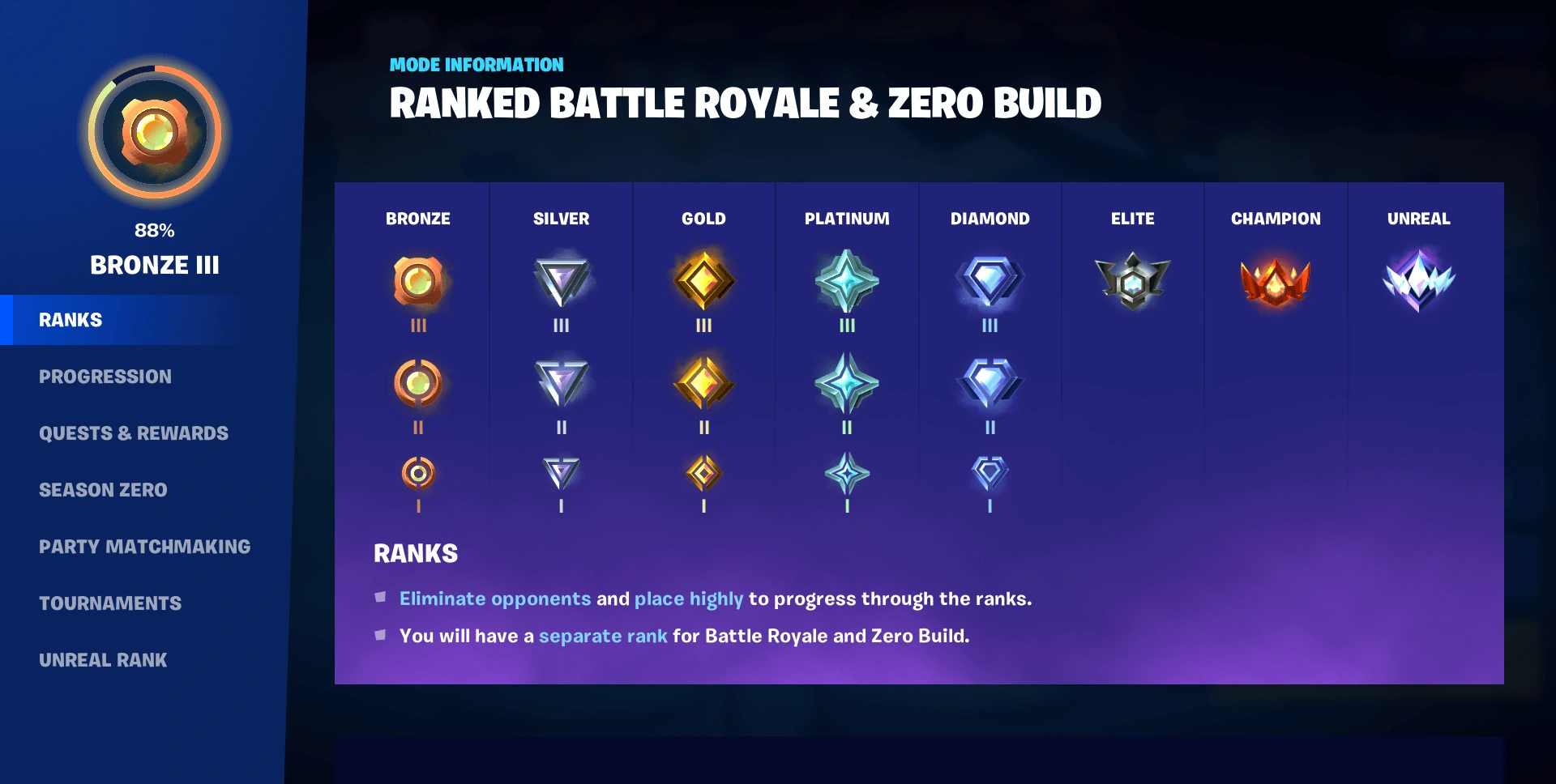
The ladder has eight named tiers. The lower tiers are each split into divisions (typically three — like Bronze I, II, III) that you climb through before promoting to the next tier. From bottom to top:
| Tier | Where it sits | What it means |
|---|---|---|
| Bronze | Entry | The starting bracket. Learning the basics, lots of disengaged players |
| Silver | Low | Players who survive the early game but lose endgames |
| Gold | Low-mid | The big middle. Solid fundamentals, inconsistent endgames |
| Platinum | Mid | Reliable mechanics, the climb starts demanding real game sense |
| Diamond | Upper-mid | Strong players; sloppy rotations and bad fights get punished hard |
| Elite | High | The skill ceiling steepens; mechanics and decisions both have to be sharp |
| Champion | Very high | Near-top bracket; consistent endgame play is the baseline, not a bonus |
| Unreal | Top | The highest rank — leaderboard territory, the strongest players in your region |
Bronze through Diamond are where most of the player base lives, and they're climbed by playing for placement with clean fundamentals. Elite, Champion, and Unreal are where the lobbies turn genuinely hard and the margin for a bad rotation or a forced fight disappears. Unreal is the only tier without divisions — once you reach it, you're effectively on a regional leaderboard, ranked by score against everyone else who's hit it.
The honest read: most players who think they're "stuck in Gold" are actually playing Gold-level decisions with Diamond-level aim. The tier you settle at is your game sense talking, not your mechanics, which is exactly why the climbing section below is mostly about decisions.
How you earn points: placement vs elims

Your rank moves on a score each match, and that score comes from two sources: placement (how long you survive / how high you finish) and eliminations (kills and assists). The exact values shift between seasons, but the durable principle does not: placement is weighted far more heavily than kills.
Here's why that's the single most important thing to internalize. A player who consistently finishes top 10 with one or two kills gains rank steadily. A player who drops hot, racks up five kills, and dies 30th loses rank, because dying 30th is a placement disaster that a handful of early kills can't offset. The math rewards survival because survival is harder and more consistent than fragging out — anyone can get lucky kills off a hot drop, but reaching the final circles alive every game takes real skill.
That doesn't mean kills are worthless. The optimal Ranked game is high placement plus elims — reach the endgame and win the fights you're forced into there. Kills late, when the lobby is small and every elimination is a real threat removed, are worth more to your placement than kills early. So the priority order is: survive to the late game first, then frag. Not the other way around. If you only remember one thing about scoring, remember that placement is the floor your kills build on, not the other way around.
Build and Zero Build Ranked are separate
This trips up almost everyone new to Ranked: Build and Zero Build have completely separate ranked tracks. Your Build rank and your Zero Build rank are tracked independently. You can be Diamond in Zero Build and Gold in Build, or Unreal in one and barely Platinum in the other. Grinding one does nothing for the other's rank.
That's by design, because they're genuinely different games:
- Build Ranked rewards the full Fortnite skill stack — aim plus building plus editing. Endgames are vertical build battles, high ground matters enormously, and a player who can't build gets walled out and third-partied. If you're climbing Build, your building and editing are as important as your aim. The Fortnite building basics and box fighting guide are core climbing tools here.
- Zero Build Ranked strips building out entirely, so it leans on aim, movement, cover usage, and positioning. Natural terrain and cover replace your walls, the overshield adds a layer to every fight, and rotations matter even more because you can't just wall up in the open. If you're climbing Zero Build, your aim and positioning carry you — see the Fortnite Zero Build guide.
Pick the ladder that matches the game you actually want to play and the skills you have. There's no shame in being a Zero Build main — it's a fully legitimate competitive path with its own Unreal. Just don't expect your rank in one to mean anything in the other, and don't split your grind across both if you're trying to climb fast. Focus one ladder.
How to actually climb
Climbing is mostly the consequence of internalizing the scoring: play for placement, take fights on your terms, and frag late. Concretely:
- Survive to the late game, every game. This is 80% of climbing. Land somewhere you can loot uncontested, rotate early through cover, and reach the final circles alive. A boring top-8 is worth more than a flashy 30th. Our rotation guide is the single most useful read for climbing because rotation is where placement is won.
- Pick your fights. Not every fight is worth taking in Ranked. A fight you might lose, or one that exposes you to a third party, costs more in placement risk than it's worth in kill points. Disengage from bad fights and save your aggression for late, when kills count most and the lobby is thin.
- Frag in the endgame. Once the lobby's small, kills are both safer to take and worth more to your placement. The endgame is where Ranked points are really made — bring full mats and heals so you can actually fight there. The Fortnite endgame strategy guide covers the final-circle play that converts good placement into Victory Royales.
- Warm up before you queue Ranked. Cold hands cost you the early fights that knock you out before the late game even starts. A ten-minute warm-up before ranked is rank points — see the Fortnite warm-up and practice routine.
- Climb in one mode. Don't split your grind across Build and Zero Build. Pick the ladder you're better suited to and pour your games into that one rank.
The pattern that climbs is unglamorous: land safe, rotate early, dodge bad fights, reach endgame with resources, win the fights that matter. Do that consistently and you climb, because consistency is exactly what the placement-weighted scoring rewards.
Mistakes that keep you hard-stuck
The habits that cap your rank, so you can drop them:
- Playing Ranked like casual. Hot drops and kill-chasing tank your placement. The instinct that wins casual lobbies loses you rank.
- Chasing kills over placement. The single biggest one. Dying 25th with four kills is a net loss. Reaching top 10 with one kill is a net gain. Believe the scoring.
- Taking every fight. A forced fight you might lose, or one that invites a third party, is a placement gamble that rarely pays. Disengage and play for zone.
- Queuing cold. Losing the early game to stiff hands before the placement points are even on the table. Warm up.
- Splitting your grind across both ladders. Build and Zero Build are separate ranks; splitting your games halves your progress in each. Commit to one.
- Blaming aim when the leak is decisions. If your mechanics are fine but you keep finishing 20th–30th, the problem is rotation and fight selection, not your crosshair. Fix the decisions.
Quick Action Checklist
The climb, distilled:
- Play for placement first — placement is weighted far more than kills, every season
- Survive to the late game every match — land safe, rotate early through cover
- Pick your fights — disengage from bad ones, save aggression for the thin endgame
- Frag late, not early — kills in a small lobby are worth more and safer to take
- Know your ladder — Build and Zero Build are separate ranks; commit to one
- Match the ladder to your skills — Build rewards building, Zero Build rewards aim and positioning
- Warm up before you queue Ranked — cold hands lose the early fights that end your placement
- Fix decisions, not just aim — if you're stuck with good mechanics, it's rotation and fight selection
Frequently Asked Questions
What are the Fortnite ranks in order?
How do you earn points in Fortnite Ranked?
Are Build and Zero Build Ranked the same rank in Fortnite?
What is the highest rank in Fortnite?
How do you climb in Fortnite Ranked?
Why am I stuck at the same rank in Fortnite?
Keep Reading
Related Guides
Fortnite Reload Nitemare Island: Map, Loot and Rewards
Nitemare Island came back to Reload on October 8 with something the 2025 version never had: a match modifier that hands you a rival and pays out a Kado Thorne Exotic when you drop them. Here is the map, the three-map rotation it sits in, the loot you can only find there, and what the new Ranked and Map Mastery tracks pay.
Fortnite Blitz Royale Guide: How the 5-Minute Mode Works
Blitz Royale was meant to close on July 15, 2025. Fifteen months later it has its own dev team, a $1,000,000 mobile tournament and a victory emote you can only earn inside it. Here is how a match actually runs: the kit everyone lands with, what Blitz Levels pay out, where the gold loot is, how fast the storm kills, and what Epic has and has not changed this season.

Fortnite Kingdom Hearts Skins: Price, Keyblade and More
Our Chapter 7 Season 4 weapons post named the Kingdom Key and Rebecca's Guns as arrivals Epic had announced but not shipped — 'neither is in the pool yet,' it said, three weeks ago. Update v42.20 shipped both, plus a four-skin Kingdom Hearts bundle tied for the most expensive in the game's history, four new Sprites, and six new Match Overrides. Here's what actually landed, what it costs, and what Epic still hasn't published.
Fortnite OG Season X: The BRUTE and Rift Zones Return
Our OG mode guide explains how the permanent playlist works in general. It doesn't tell you what's live right now, because that changes every season — and on September 3, the tenth one brought back a two-person mech, a fully automatic sniper, and three Rift Zones with rules of their own.
Fortnite Weapon Tier List: How to Rank Any Loot Pool
Any Fortnite tier list is stale the second a patch drops. So instead of memorizing this season's gun names, learn how to rank weapons by class and role — the framework that's S-tier in every season.

Best Fortnite Settings for PC & Console
Half your settings menu is noise; a handful of options decide whether you can see, aim, and build. Here's what to change on PC and console, why, and the one number nobody else can pick for you.