MTG Arena Formats Guide: Alchemy, Historic, Timeless
Arena has three constructed formats that do not exist in paper, and they are far less alike than the shared 'digital-only' label suggests. Historic bans 77 cards that Timeless lets you play, Alchemy has a smaller card pool than the Standard it is built on, and a card can be legal in one and illegal in another while sharing a name.
Paper formats come with tidy one-line pitches. Standard is the last few sets. Modern is 2003 onward. Commander is the one with the 100-card decks and the arguments. Arena's three digital-only constructed formats get no such courtesy, and "like Standard but online" does not survive contact with any of them.
Here is the actual shape of them, checked against Scryfall's legality data and Wizards' own format and banned-restricted pages on 15 August 2026. The headline: Historic bans 77 cards that Timeless is happy to let you play, and Alchemy's legal card pool is smaller than the Standard pool it is built on top of. Neither of those is intuitive, and both change what you should be spending wildcards on.
What digital-only actually means on Arena
Two separate things get lumped under "digital-only," and keeping them apart makes the rest of this straightforward.
Designed-for-digital cards are cards that only exist on Arena because they could not work on cardboard. They lean on randomness, on cards generated from outside your deck, and on tracking hidden information — things a human playgroup cannot referee. The mechanic list Wizards has shipped includes Boon, Conjure, Double team, Draft, Heist, Incorporate, Intensity, Perpetually, Seek, Specialize and Spellbook, plus the Chorus card subtype. They are not a fringe experiment either: on Scryfall, 238 digital cards use perpetually, 169 use conjure, 108 use seek, and 19 use specialize.
Perpetually is the one that best explains why these cannot be printed. A perpetual effect changes a card for the rest of the game across every zone — if a card gets +1/+1 perpetually and then gets shuffled back into your library, it is still bigger when you draw it again. Paper Magic has no way to track that without sticky notes and trust.
Rebalanced cards are the second thing, and they are a completely different animal. These are existing paper cards whose Arena versions have been tuned up or down for digital play. They show up with an "A-" prefix on the name and an Arena "A" stamp on the card. Scryfall currently lists 216 of them.
The critical part, and the thing that trips people up: a rebalanced card and its paper original are separate cards with separate legalities. That single fact explains most of the confusion below.
Alchemy: Standard with a shorter memory
Alchemy launched in December 2021 as a digital-first, fast-moving format. The pitch was simple: take the Standard card pool, add designed-for-digital cards, and rebalance things freely so the metagame never sits still. Each Premier set gets an adjacent Alchemy set of roughly 30 cards, landing in the weeks following the paper set — usually two to three.
Best-of-one and best-of-three, ranked and unranked. Standard's deckbuilding rules apply — 60-card minimum, four copies max.
Now the counterintuitive part. Alchemy is built on Standard and adds cards to it, so you would expect its pool to be bigger. It is not. As of this writing Scryfall lists 4,887 cards legal in Standard and 3,915 legal in Alchemy — 1,302 cards are Standard-legal but Alchemy-illegal, while only 330 go the other way.
The reason is rotation, not curation. In May 2023 Wizards moved Standard to a three-year rotation but kept Alchemy on a two-year rotation, starting with Wilds of Eldraine. So an entire year of sets sits in Standard while having already rotated out of Alchemy. Right now that gap covers Wilds of Eldraine, The Lost Caverns of Ixalan, Murders at Karlov Manor and Outlaws of Thunder Junction — all legal in Standard, none legal in Alchemy.
If you build Alchemy decks off a Standard list you saw somewhere, check every card. A quarter of Standard is not there.
Cards that rotate out of Alchemy are not destroyed — they fall through into Historic, which is where this gets interesting.
Historic: the eternal format that stopped being eternal
Historic was supposed to be Arena's eternal format: never rotates, play your whole collection. Minimum 60 cards, up to 15 sideboard cards in best-of-three (seven in best-of-one), four copies maximum.
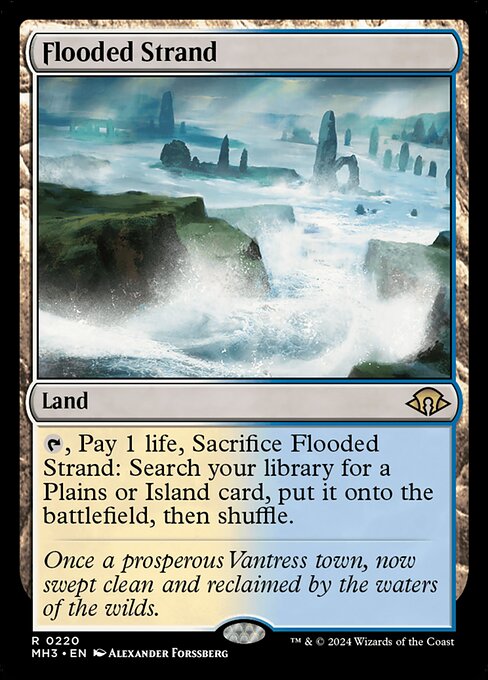
It did not stay that. As Arena started absorbing paper products that were never balanced for a 60-card digital ladder — bonus sheets, The List, straight-to-Modern sets — Wizards began banning cards pre-emptively, before anyone had cast them in anger. The clearest example is the Khans of Tarkir fetch lands. Flooded Strand, Polluted Delta, Bloodstained Mire, Wooded Foothills and Windswept Heath are all banned in Historic and all legal in Modern, a considerably more powerful paper format.
Scryfall puts Historic's banned list at 77 cards. That is not a light touch. Historic is best understood not as "everything on Arena" but as a heavily curated digital format that happens not to rotate — which is exactly why Wizards eventually built a second one.
Historic is also where rotated Alchemy cards go to live permanently, and it uses the rebalanced A- versions of cards rather than their paper originals.
Timeless: a restricted list instead of a banlist
Timeless was announced on 4 December 2023 and went live on 12 December 2023, built on a deliberately different philosophy: instead of banning problem cards, restrict them, the way Vintage does.
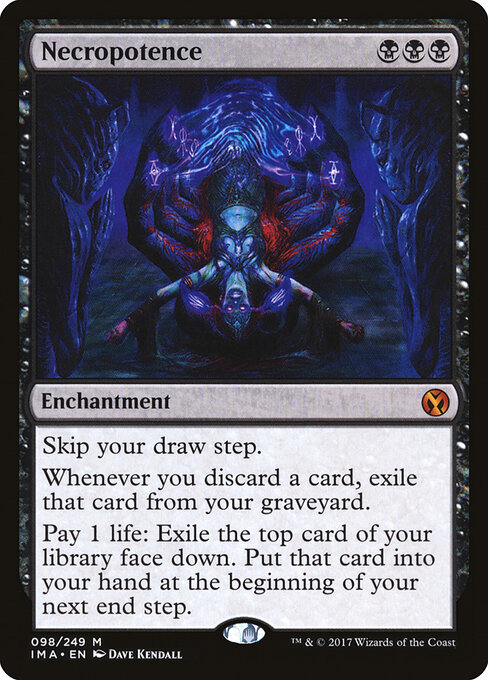
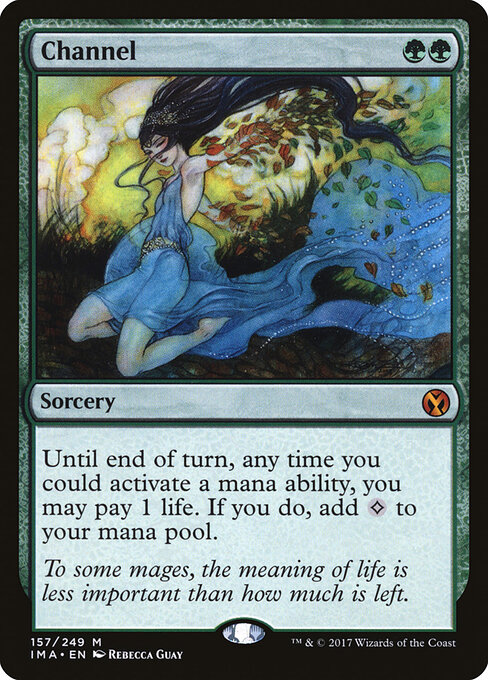
Timeless has zero banned cards. It has exactly four restricted ones — Channel, Demonic Tutor, Necropotence and Tibalt's Trickery — and "restricted" means one copy total across your maindeck and sideboard combined. Three of those four (Channel, Demonic Tutor, Necropotence) are also restricted in paper Vintage, which tells you how seriously the format takes them. Tibalt's Trickery is the odd one out: it is fully legal in Vintage and restricted here.
The comparison that makes the whole format click: every one of the 77 cards Historic bans is playable in Timeless. Four of them only as a single restricted copy, but playable. Fetch lands, Brainstorm, Chrome Mox, Ancient Tomb, Blood Moon — all live.
Deckbuilding is standard constructed: 60-card minimum, four copies max, 15-card sideboard for best-of-three. Ranked best-of-one, traditional best-of-three, and an unranked queue.
One caveat worth stating plainly, because Wizards' own announcement pitched Timeless as containing "every card on MTG Arena": that is not literally true. Some cards are programmed into Arena but cannot be crafted, and those are not legal. Black Lotus and Ancestral Recall are both unplayable in Historic and Timeless despite existing in Arena's code. Timeless is every craftable Arena card, which is a meaningfully different claim.
The rebalance rule that decides which version you play
This is the single most useful thing to internalise, and it is a one-liner: Historic and Alchemy use the rebalanced A- versions of paper cards. Timeless uses the original paper printings.
The numbers back it exactly. Of Scryfall's 216 rebalanced cards, zero are legal in Timeless. All of them are legal in Historic. Only six are currently legal in Alchemy — A-Cori-Steel Cutter, A-Gnarlid Colony, A-Heartfire Hero, A-Leyline of Resonance, A-Vivi Ornitier and A-Kona, Rescue Beastie — because the rest have rotated out of Alchemy's two-year window and now live in Historic.
Cori-Steel Cutter is the case study. It is banned in Standard and banned in Pioneer. In Alchemy and Historic you do not play it at all — you play A-Cori-Steel Cutter, the toned-down version. In Timeless you play the original, unmodified, exactly as printed. Same name on three different ladders, three different realities.
Wizards' banned-and-restricted page currently lists four cards under Alchemy: Cori-Steel Cutter, Leyline of Resonance, Monstrous Rage and Sewer-veillance Cam. For two of those, the rebalanced version is still legal — the card did not leave the format, it got nerfed and kept playing.
Practical upshot for your wildcards: crafting a card does not always get you the version you were picturing. Check which format you are building for before you spend, and check the specific printing.
Explorer is gone, and that is fine
If you are returning to Arena after a break and looking for Explorer, stop. Explorer was introduced in 2022 as a placeholder — every Pioneer-legal card that happened to exist on Arena — with Wizards saying from the start that it would eventually be retired and simply called Pioneer.
That happened on 10 May 2025. Explorer became Pioneer on Arena, its ban list was aligned with tabletop Pioneer's rather than maintained separately, Tibalt's Trickery was unbanned in the process, and eleven cards were added to Arena for the first time to close the remaining gaps. Practically, Arena's Pioneer is now the paper format, not an approximation of it. If you want a format that plays identically in paper and on Arena, that is your answer — and our Pioneer format guide covers it as a paper format in full.
There are now no Arena-only "bridge" formats. What remains digital-only, once you set the singleton Brawl queues aside, is Alchemy, Historic and Timeless.
Which one should you actually queue into
Short version, based on what each format is actually for:
- Play Alchemy if you like a metagame that shifts constantly and you enjoy the digital-only mechanics on their own terms. Understand that it rotates faster than Standard and your Standard list will not port over cleanly.
- Play Historic if you want a non-rotating format at a moderate power level with a heavy referee's hand on it. The 77-card banned list is doing a lot of work to keep the format where Wizards wants it.
- Play Timeless if you want the highest-power constructed experience Arena offers and you want paper cards to behave like paper cards. Fetch lands, free spells, the whole toolbox — with four restricted cards instead of a banlist.
On wildcards: Timeless is the safest long-term investment of the three, because it never rotates and its banned list is currently empty. Alchemy is the riskiest, because a two-year rotation plus active rebalancing means the card you crafted can both leave the format and stop being the card you crafted.
If you came here from Commander and want the singleton commander experience on Arena instead, that is Brawl, which is a different thing again — our Brawl format guide covers Standard Brawl and Historic Brawl. And if the restricted-list concept is what interests you, Timeless borrowed it wholesale from Vintage, covered in our Vintage format guide.
Quick Action Checklist
- Check the format's pool before copying a decklist: 1,302 Standard-legal cards are not legal in Alchemy.
- Remember Alchemy rotates on two years while Standard rotates on three — the gap is roughly four sets.
- Assume nothing about Historic being "eternal." Check its 77-card banned list first; fetch lands are on it.
- In Timeless, look for the restricted four — Channel, Demonic Tutor, Necropotence, Tibalt's Trickery — and build to one copy each.
- Before crafting, confirm whether the format wants the paper printing or the A- rebalanced version. Historic and Alchemy take A-, Timeless takes the original.
- Stop looking for Explorer. It became Pioneer on Arena in May 2025.
- Verify current legality on Scryfall or Wizards' banned-and-restricted list rather than a guide, this one included — digital formats change faster than articles do.
Frequently Asked Questions
What is the difference between Historic and Timeless in MTG Arena?
Is Alchemy bigger than Standard on MTG Arena?
What are the restricted cards in Timeless?
What happened to the Explorer format on MTG Arena?
Are rebalanced A- cards legal in Timeless?
Can you play Black Lotus in Timeless?
Keep Reading
- Wizards of the Coast — official banned and restricted list
- Wizards of the Coast — official Timeless format page
- Wizards of the Coast — official Historic format page
- Wizards of the Coast — official Alchemy format page
- Wizards of the Coast — Pioneer comes to MTG Arena (Explorer retirement, 10 May 2025)
- Scryfall — card legality data for alchemy, historic and timeless
Related Guides
MTG Arena Is Retiring Alchemy: Dates and What You Keep
Wizards announced on September 11, 2026 that the Alchemy format is being retired from MTG Arena on February 2, 2027, alongside the 2027 Standard rotation. The shutdown runs in three dated stages, and the first one lands on September 22 — every rebalanced version of a tabletop card reverts to its paper printing across every format, and five cards get banned in Historic as a direct consequence. Here is the timeline, what happens to the cards you already own, and what none of it changes.
MTG Arena Competitive Brawl: Rules and Banned Commanders
On October 12, 2026, Wizards banned three more commanders in Competitive Brawl and moved nine cards, Oko and Ragavan among them, from fully banned to banned only as your commander. Here is what Competitive Brawl is, how it differs from the Brawl queue next to it, the full list, and the one card the official page has gone quiet on.
MTG Brawl Format Guide: Standard Brawl vs Historic Brawl
Brawl is singleton Commander squeezed into a one-on-one Arena format that doesn't take forty minutes a game. Here's what Brawl is, how Standard Brawl and Historic Brawl differ, how to pick a commander, and how to build your first deck.
Magic: The Gathering Standard Format Guide: Where to Start
Standard is the format Wizards balances the hardest and the one new players actually have a shot in. Here is what Standard is, how rotation works, the archetypes that define it, and how to build your first deck without setting money on fire.
MTG Commander Format Guide — How to Start Playing EDH (2026)
Commander is the most-played MTG format on the planet and the easiest one for new players to start in. The rules look intimidating on paper. They are not. Here is the full beginner guide.

Best Commander Staples Every Deck Wants, Ranked
There's a short list of cards that show up in basically every Commander deck regardless of theme — the silent 25 that make the splashy 75 work. Here are the staples worth a slot in almost any list, sorted by the job they do, with the legality double-checked.