MTG Arena Competitive Brawl: Rules and Banned Commanders
On October 12, 2026, Wizards banned three more commanders in Competitive Brawl and moved nine cards, Oko and Ragavan among them, from fully banned to banned only as your commander. Here is what Competitive Brawl is, how it differs from the Brawl queue next to it, the full list, and the one card the official page has gone quiet on.
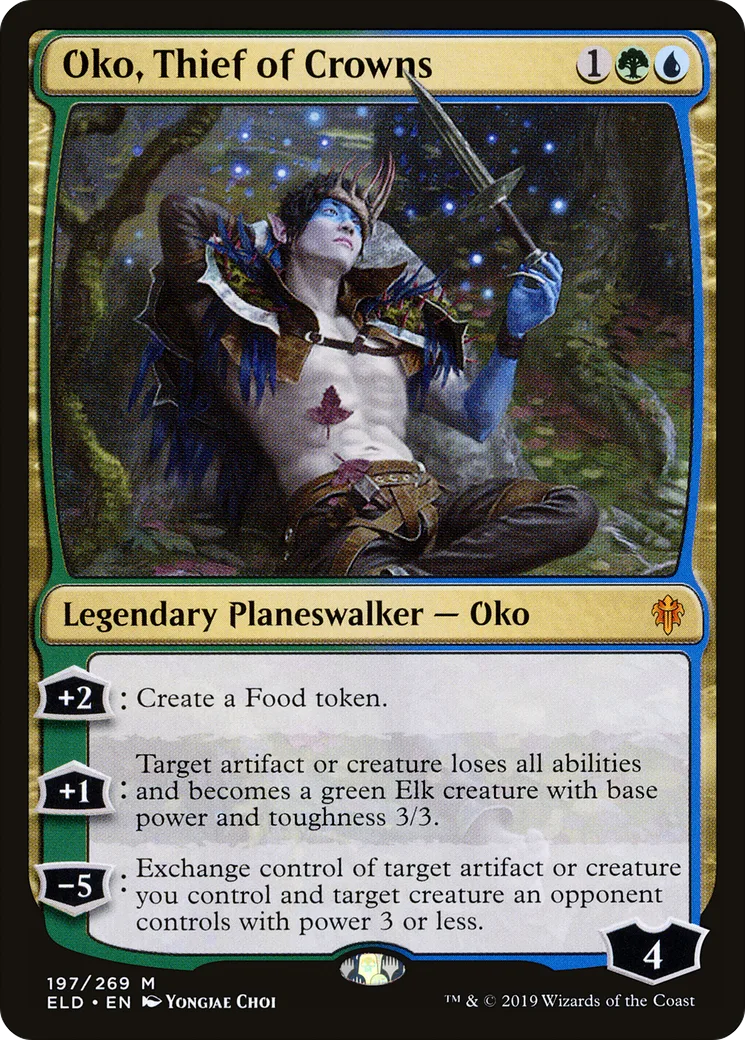
On October 12, 2026, Wizards did something new on MTG Arena: it banned cards from the command zone and nowhere else. Oko, Thief of Crowns, Ragavan, Nimble Pilferer and Wrenn and Six can now go in a Competitive Brawl deck. They just cannot lead one. Oko is still banned outright in regular Brawl, so the same 100 cards can be legal in one Brawl queue and illegal in the one next to it.
That split is the whole idea behind Competitive Brawl, and the October 12 banned and restricted announcement is the first time its list has changed since launch. Here is what the format is, how it differs from Brawl, what changed, and the one card the official list has gone quiet on. The sources, all checked on October 14:
- Wizards' June 1 introduction to the format, updated June 8.
- MTG Arena's State of the Formats 2026, published September 11.
- The October 12 announcement and that day's MTG Arena announcements.
- The live banned and restricted list, plus Scryfall's legality data.
What Competitive Brawl is
Wizards announced the format on June 1, 2026 as "Ranked Brawl" and renamed it a week later. Players had read the old name as a promise that the ranked and unranked queues would share a banned list, and they do not. In Wizards' words, Competitive Brawl "is not just a ranked version of Brawl." It went live on June 23, reachable from both the Competitive and Brawl tabs.
Wizards' June 1 article gives the reason. Brawl had become Arena's second most played Constructed format, and one queue was serving two kinds of player. The State of the Formats article describes them: some bring "well-tuned, incredibly efficient, and powerful decks that could win in just a few turns," while others "just want to build a deck with every Dinosaur they have in their collection." Splitting the queue let Wizards balance each format for its own players. Wizards compares it to Timeless taking the pressure off Historic.
By Wizards' own numbers, it worked. As of September 11, Competitive Brawl was "just under ten percent of all queue matches played on MTG Arena." Wizards adds that it drew in a small share of unranked Brawl and Historic players but was "mostly additive to the overall player base."
Competitive Brawl vs Brawl vs tabletop Brawl
Several formats share the name, Arena's Standard Brawl among them. These are the three to keep apart here. The tabletop rules live in the Comprehensive Rules (rule 903.12, effective September 25, 2026). The two Arena columns come from Brawl's format page, the June 1 article and the State of the Formats article.
| Tabletop Brawl (CR 903.12) | Brawl on Arena | Competitive Brawl on Arena | |
|---|---|---|---|
| Deck size | Exactly 60, commander included | 100 (commander plus 99) | 100 (commander plus 99) |
| Card pool | "Usually" Standard | Cards on MTG Arena, digital-only Alchemy cards included | Cards on MTG Arena, digital-only Alchemy cards included |
| Commander | Legendary creature, planeswalker, Vehicle, or Spacecraft with power/toughness | Legendary creature, planeswalker, Vehicle or Spacecraft | Legendary creature, planeswalker, Vehicle or Spacecraft |
| Starting life | 25 with two players, 30 multiplayer | 25 | 25 |
| Free first mulligan | Yes (rule 903.12g) | Yes | No |
| Ranked | — | No | Yes: counts toward your Constructed rank and season rewards |
| Matchmaking | — | Deck power, "mostly weighted by commander choice," plus skill rating | Constructed rank and rating; deck composition is not a factor |
| Ban philosophy | — | Bans many cards in the 99, few commanders | Bans commanders, very few cards in the 99 |
Singleton and color identity work the same in all three. One caveat on the commander row: Arena's Brawl format page still says "legendary creature or Planeswalker." The June 1 article lists Vehicles and Spacecraft too, and introduces that list with "Like Brawl," so the format page is behind.
Two rows decide most of your deckbuilding. The first is the mulligan. Tabletop Brawl and the Arena Brawl queue both make your first mulligan free. Competitive Brawl does not, so shipping a bad seven costs you a real card, as in any other ranked format. Build your mana so you keep more hands. The second is the ban philosophy, which gets its own section below.
Our Brawl format guide covers Standard Brawl, Brawl and how to build a first deck. This post sticks to the competitive queue.
What changed on October 12
Thirteen changes, effective October 12, 2026:
| Change | Cards |
|---|---|
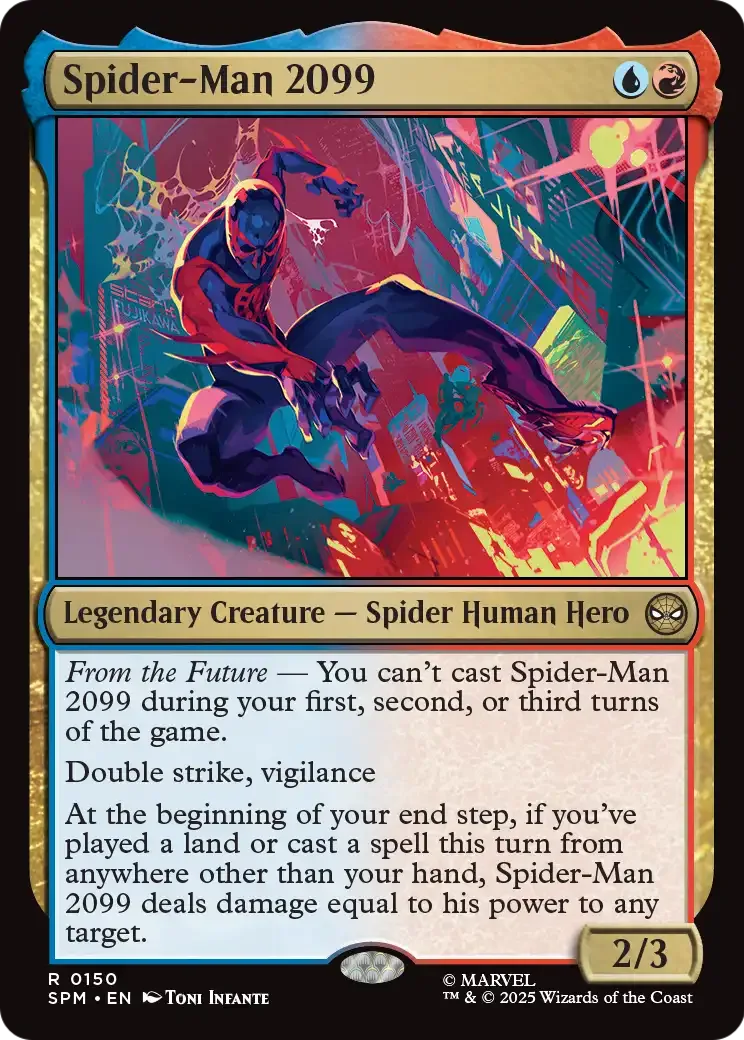
| Newly banned as a commander | Yuriko, the Tiger's Shadow; Spider-Man 2099; Light-Paws, Emperor's Voice |
| Was fully banned, now banned only as a commander | Ajani, Nacatl Pariah; Nadu, Winged Wisdom; Oko, Thief of Crowns; Old Stickfingers; Ragavan, Nimble Pilferer; Rusko, Clockmaker; Tamiyo, Inquisitive Student; Wrenn and Six; Tajic, Legion's Valor |
| Rebalanced | Nashi, Illusion Gadgeteer loses flash |
Every other format in the announcement, Brawl included, had no changes.
Wizards' reason for the three new bans is a single line: "some commanders emerge with win rates high enough to make them problematic." It did not publish the win rates. For context, on August 10 Wizards wrote that no individual commander made up more than one percent of the Competitive Brawl metagame. In between came the September 22 revert of every rebalanced tabletop card to its printed version. Wizards says Competitive Brawl "got a bit of the same impact Historic did" from that revert, but it does not tie the three bans to it. Read that as timeline, not cause.
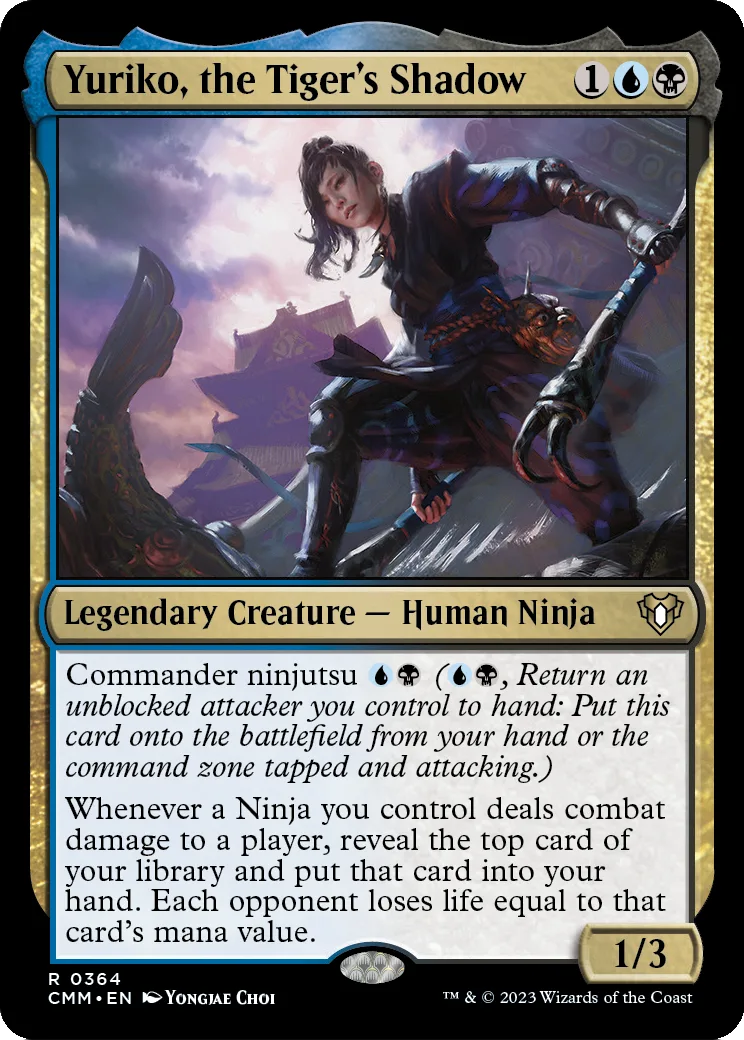
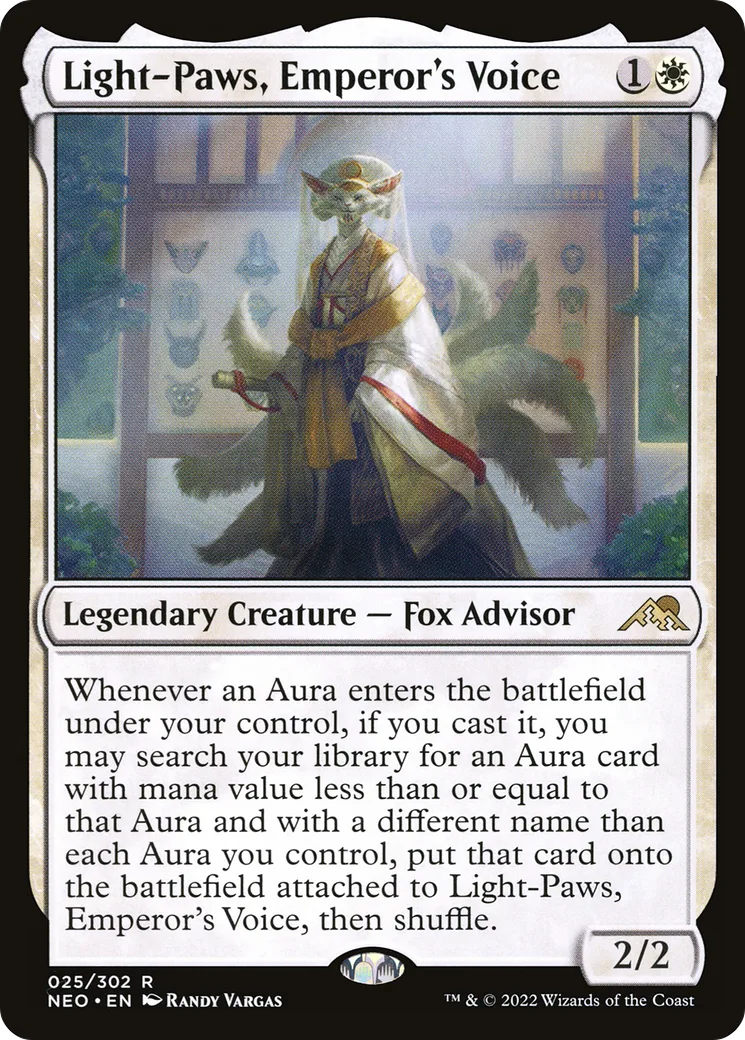
The three new bans, by their own text:
- Yuriko, the Tiger's Shadow ({1}{U}{B}) has commander ninjutsu, so it comes out of the command zone in place of an unblocked attacker. Each time a Ninja connects, you reveal the top card of your library, put it in your hand, and each opponent loses life equal to its mana value.
- Spider-Man 2099 ({U}{R}) is a 2/3 with double strike and vigilance. It cannot be cast in your first three turns. At your end step, it deals damage equal to its power to any target if you played a land or cast a spell from anywhere other than your hand that turn.
- Light-Paws, Emperor's Voice ({1}{W}) triggers whenever an Aura you cast enters under your control. You may search your library for an Aura with equal or lower mana value and a different name from each Aura you control, and put it onto the battlefield attached to Light-Paws.
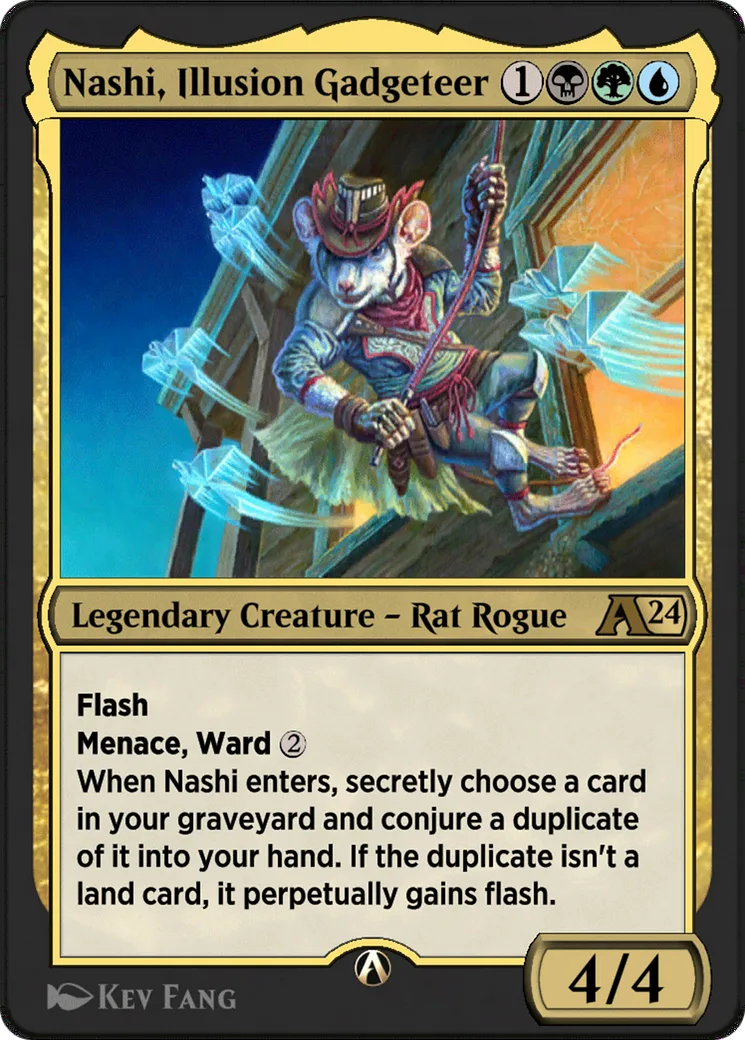
Nashi, Illusion Gadgeteer is the odd one. It is a digital-only Alchemy card, from Alchemy: Outlaws of Thunder Junction. Because it exists only on Arena, Wizards can edit the card directly, and it did: Nashi now has no flash. The two announcements describe this differently. The banned and restricted write-up calls it "removing the flash keyword," while the Arena announcement says it is "reverting a previous change that gave it flash." Wizards adds that it does not "expect to make this sort of change frequently." Scryfall's text for Nashi still shows Flash as of October 14, so trust the in-game card.
Wildcards: you get up to one wildcard for each of the three newly banned commanders in your collection. That follows the policy Wizards set on June 1: one wildcard per crafted banned card, similar to restricted cards in Timeless, and no refunds for the launch list. The compensation covers the three new bans. The nine cards that moved became more playable, not less. How wildcards are earned and spent is in our Arena wildcards guide.
The full list: 12 commanders you cannot lead with
This is the Competitive Brawl section of Wizards' banned and restricted list as of October 14. Costs, color identities and the Brawl column are checked against Scryfall and the same official page.
| Card | Cost | Color identity | Type | In Brawl (unranked) |
|---|---|---|---|---|
| Ajani, Nacatl Pariah | {1}{W} | Red-white | Creature, transforms into a planeswalker | Legal |
| Light-Paws, Emperor's Voice | {1}{W} | White | Creature | Legal |
| Nadu, Winged Wisdom | {1}{G}{U} | Green-blue | Creature | Banned |
| Oko, Thief of Crowns | {1}{G}{U} | Green-blue | Planeswalker | Banned |
| Old Stickfingers | {X}{B}{G} | Black-green | Creature | Legal |
| Ragavan, Nimble Pilferer | {R} | Red | Creature | Legal |
| Rusko, Clockmaker | {2}{U}{B} | Blue-black | Creature | Legal |
| Spider-Man 2099 | {U}{R} | Blue-red | Creature | Legal |
| Tajic, Legion's Valor | {2}{R}{W} | Red-white | Creature | Legal |
| Tamiyo, Inquisitive Student | {U} | Green-blue | Creature, transforms into a planeswalker | Legal |
| Wrenn and Six | {R}{G} | Red-green | Planeswalker | Legal |
| Yuriko, the Tiger's Shadow | {1}{U}{B} | Blue-black | Creature | Legal |
Five of the 12 have a fixed cost of one or two mana and can come down on your first or second turn: Ragavan, Tamiyo, Ajani, Light-Paws and Wrenn and Six. Spider-Man 2099 also costs two, but its own text keeps it in the command zone until your fourth turn. The pattern makes sense. A cheap commander is available every game, because it starts in the command zone, and in a 25-life one-on-one game it can start working before an opponent has had many turns to answer it. Ten of the 12 are legal commanders in the unranked Brawl queue, where Wizards relies on matchmaking to pair commanders of similar power against each other.
Banned as commander, legal in the 99
Wizards' explanation is short: these cards "will still be legal among the 99 other cards in your deck. Now that we have the tech to enable this, we are applying it to cards banned on the grounds of being too strong as a commander." That implies the client could not do this before. It also tells you how to read the nine moves: they were banned for what they did from the command zone, not for what they do as one card in a 100-card deck.
Three things to know before you craft:
- Color identity still applies, and two of these are sneakier than they look. Tamiyo costs {U}, but her planeswalker back face is green-blue, so she only fits a deck whose commander has both colors. Ajani costs {1}{W}, but his back face is red-white, so a mono-white deck cannot run him.
- Legal in your Competitive Brawl 99 does not mean legal in Brawl. Oko and Nadu are still on Brawl's own banned list, so a Competitive Brawl deck with either one is not legal in the unranked queue.
- Scryfall labels these cards "restricted," not "banned." Searching restricted:competitivebrawl returns exactly the 12. Searching banned:competitivebrawl returns only Lutri, the Spellchaser (more on that next). This is Scryfall's label for banned-as-commander. It has nothing to do with Vintage's restricted list, where restricted means one copy.
Paper Commander has a comparable rule. The official list's Commander section reads "Lutri, the Spellchaser - only banned as a companion," which our Commander banned list breakdown covers. Arena now has the mirror image: cards banned only from the command zone.
The Lutri question
Lutri, the Spellchaser was on Competitive Brawl's launch list in June. Here is the record since then:
- A Wayback Machine capture of the official list, taken less than an hour after the October 12 announcement went up, still shows the June list of ten fully banned cards, Lutri included.
- The page was then updated. The current version lists only the 12 banned-as-commander cards and no fully banned cards. Lutri appears nowhere in the Competitive Brawl section.
- Neither October 12 announcement mentions Lutri.
- Scryfall still marks Lutri as banned in Competitive Brawl on October 14.
So either Lutri came off the list without a mention, or the page edit dropped it. Wizards has not said which. Until it does, do not spend a wildcard on Lutri for Competitive Brawl. Check whether the Arena deck builder accepts it first. In the unranked Brawl queue, Lutri is still on Wizards' list.
Why the two ban lists point in opposite directions
Brawl and Competitive Brawl ban different kinds of card, by design.
Brawl's list mostly targets the 99. It names 35 cards on the official page, and the June 29 additions show the targets: Force of Will, Subtlety and Wash Away (free counterspells), Ugin's Labyrinth (fast mana), and Time Warp and Temporal Manipulation (extra turns). Wizards' stated philosophy for Brawl is to ban cards that "homogenize the format, are too efficient, or are simply polarizing," while banning very few commanders and letting matchmaking sort power levels. Nadu followed on September 22. One caveat if you check Brawl legality on Scryfall: its Brawl data currently flags 37 cards, adding Disruptor Flute and Eye of Ugin, which the official page does not list. For Brawl, the client is the final word.
Competitive Brawl's list targets commanders. Wizards' pre-launch testing found that "cards in the 99 do not have as much of an impact on win rates as commanders do. No matter how powerful a card is, you still need to draw it from your large deck." Its own example: Mana Drain has a lower win rate than ramp cards like Noble Hierarch. The stated aim is a power level "closer to Timeless's."
You can see the gap in the decks Wizards featured at launch. On June 22 its Arena announcements showcased a player-built Ral, Crackling Wit Competitive Brawl list. Eight of its cards are on Brawl's banned list today: Ancient Tomb, Chrome Mox, Fierce Guardianship, Force of Will, Mana Drain, Strip Mine, Subtlety and Wash Away. Wizards showed it off as a Competitive Brawl deck, and under today's Brawl list it could not enter the Brawl queue at all.
The practical upshot: treat the two as separate decks, not one deck with a switch. Crafting Force of Will or Chrome Mox for Competitive Brawl is reasonable. Expecting to take that deck to the casual queue is not. For Arena's other nonrotating formats, Historic and Timeless among them, see our Arena formats guide.
Dates to put in your calendar
| Date | What happens |
|---|---|
| October 12, 2026 | The bans, the nine moves and the Nashi change take effect |
| October 23–25, 2026 | Competitive Brawl Metagame Challenge on MTG Arena, per the Reality Fracture event schedule |
| November 30, 2026 | Next banned and restricted announcement, moved up from December |
| February 2, 2027 | The Alchemy format leaves MTG Arena; digital-only Alchemy cards stay legal in Competitive Brawl |
The October 23–25 Metagame Challenge is the only Competitive Brawl event on the Reality Fracture schedule, and the first one to run under the new list. The February date matters because Competitive Brawl is one of the places Alchemy designs like Nashi keep living after the format they were made for is gone. Our Alchemy retirement breakdown has that timeline.
Quick Action Checklist
- Competitive Brawl is ranked and Brawl is not. Both use 100-card decks and 25 life, but Competitive Brawl has no free mulligan and matches you on Constructed rank, not deck power.
- Twelve cards are banned as your commander: Ajani, Light-Paws, Nadu, Oko, Old Stickfingers, Ragavan, Rusko, Spider-Man 2099, Tajic, Tamiyo, Wrenn and Six and Yuriko.
- All 12 are legal in your 99, within color identity. Tamiyo needs green and blue in your commander's color identity, and Ajani needs red and white.
- Oko and Nadu are still fully banned in Brawl, so a Competitive Brawl deck with them is not legal in the unranked queue.
- Nashi, Illusion Gadgeteer has no flash on Arena now, even though Scryfall still shows it.
- Do not craft Lutri for Competitive Brawl yet. The official page dropped it without an announcement, and Scryfall still calls it banned.
- On Scryfall, search restricted:competitivebrawl for the banned-as-commander list.
- If you owned Yuriko, Spider-Man 2099 or Light-Paws, you get up to one wildcard for each.
- The next Competitive Brawl Metagame Challenge is October 23–25, and the next banned and restricted announcement is November 30, 2026.
Frequently Asked Questions
What is Competitive Brawl in MTG Arena?
What is the difference between Brawl and Competitive Brawl?
Which commanders are banned in Competitive Brawl?
What does banned as a commander mean in Competitive Brawl?
Is Lutri, the Spellchaser banned in Competitive Brawl?
Do you get wildcards back when a Competitive Brawl card is banned?
Keep Reading
- Wizards of the Coast — Banned and Restricted Announcement, October 12, 2026 (Competitive Brawl bans, banned-as-commander moves, Nashi rebalance; no changes elsewhere; next announcement November 30, 2026)
- Wizards of the Coast — MTG Arena Announcements, October 12, 2026 (Competitive Brawl changes, wildcard compensation, Nashi flash reversion)
- Wizards of the Coast — Banned and Restricted List (Competitive Brawl and Brawl sections, checked October 14, 2026)
- Wizards of the Coast — An Update on Ranked Competitive Brawl (Dave Finseth, June 1, 2026, updated June 8: rules, matchmaking, banned list philosophy, launch list, wildcard policy)
- Wizards of the Coast — MTG Arena Announcements, June 22, 2026 (Competitive Brawl begins June 23; featured Ral, Crackling Wit and Kiora, Behemoth Beckoner lists)
- Wizards of the Coast — MTG Arena State of the Formats 2026 (September 11, 2026: Competitive Brawl at just under ten percent of queue matches, Brawl and Competitive Brawl ban philosophies)
- Wizards of the Coast — Banned and Restricted Announcement, June 29, 2026 (six Brawl bans: fast mana, free spells, extra turns)
- Wizards of the Coast — Banned and Restricted Announcement, August 10, 2026 (Competitive Brawl: no commander above one percent of the metagame)
- Wizards of the Coast — Brawl format page (100 cards, 25 life, best of one with a free mulligan)
- Wizards of the Coast — Reality Fracture MTG Arena event schedule (Competitive Brawl Metagame Challenge, October 23–25)
- Wizards of the Coast — Magic: The Gathering Comprehensive Rules, effective September 25, 2026 (rule 903.12 Brawl option)
- Internet Archive — Banned and Restricted List capture, October 12, 2026 15:53 UTC (Competitive Brawl list before the update, Lutri included)
- Scryfall — restricted:competitivebrawl search (the 12 banned-as-commander cards)
Related Guides
MTG Brawl Format Guide: Standard Brawl vs Historic Brawl
Brawl is singleton Commander squeezed into a one-on-one Arena format that doesn't take forty minutes a game. Here's what Brawl is, how Standard Brawl and Historic Brawl differ, how to pick a commander, and how to build your first deck.
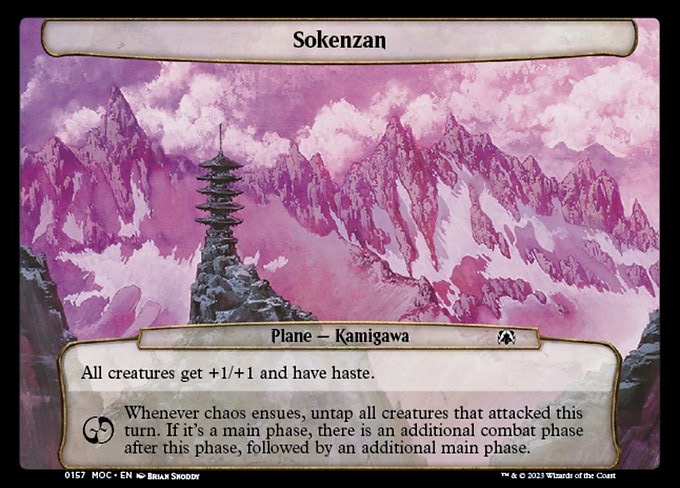
MTG Planechase Rules: Planar Die, Planes and Phenomena
Your first roll of the planar die each turn is free. The sixth costs five mana on its own, and the six together cost fifteen. Here is how Planechase actually works, from the planar deck and the starting plane to the die, chaos, phenomena and Commander pods, checked against the Comprehensive Rules effective September 25, 2026.
MTG Arena Is Retiring Alchemy: Dates and What You Keep
Wizards announced on September 11, 2026 that the Alchemy format is being retired from MTG Arena on February 2, 2027, alongside the 2027 Standard rotation. The shutdown runs in three dated stages, and the first one lands on September 22 — every rebalanced version of a tabletop card reverts to its paper printing across every format, and five cards get banned in Historic as a direct consequence. Here is the timeline, what happens to the cards you already own, and what none of it changes.
MTG Commander Banned List: Every Card and Why
Wizards' banned list page gives Commander 42 card names and four lines of small print. Scryfall says the real number is 83. The gap is 41 cards banned by category rather than by name — Conspiracies, ante cards, and the seven banned everywhere for offensive content. Here is the entire list, grouped by what each card actually does, plus the one change the Commander Format Panel made this year.
MTG Commander Format Guide — How to Start Playing EDH (2026)
Commander is the most-played MTG format on the planet and the easiest one for new players to start in. The rules look intimidating on paper. They are not. Here is the full beginner guide.

Best Commander Staples Every Deck Wants, Ranked
There's a short list of cards that show up in basically every Commander deck regardless of theme — the silent 25 that make the splashy 75 work. Here are the staples worth a slot in almost any list, sorted by the job they do, with the legality double-checked.