MTG Layers Explained: How Continuous Effects Resolve
Turn to Frog a 5/5 with three +1/+1 counters and you get a 4/4, not a 1/1. That is the layer system doing its job. Here is rule 613 in plain English — all seven layers, the four sublayers of layer 7, timestamps, dependency, and the interactions that actually decide games.
Your commander is a 5/5 carrying three +1/+1 counters. Someone casts Turn to Frog on it — "target creature loses all abilities and becomes a blue Frog with base power and toughness 1/1." Is it a 1/1 or a 4/4?
It is a 4/4. If you played it as a 1/1 and let the block through, you gave away a game you should have won.
That answer comes from the part of the rules everyone skips: the layer system, comprehensive rule 613. It is not optional trivia. The rules explicitly say the layer system is applied continuously and automatically by the game, and that every resulting change to a permanent is instantaneous. It is running right now on your board whether you understand it or not. Here is the whole thing in plain English, checked against the Comprehensive Rules effective June 19, 2026.
What the layer system actually solves
The stack answers "what happens next." Layers answer a completely different question: what is true right now.
Once a spell resolves, its continuous effect stops being an event and becomes a standing condition on the board. Anthems, Auras, animation effects, control-change effects, Blood Moon — none of these are on the stack. They are just facts, and multiple facts can fight over the same permanent at the same time.
The intuitive answer is "whichever resolved last wins." That is wrong often enough to lose games. The rules instead sort every continuous effect by what kind of change it makes, and apply the categories in a fixed order. Start with the printed card. Apply every layer in sequence. Whatever comes out the other end is the permanent's real characteristics.
The key consequence: an effect that came down first can still be applied last, if its category sits later in the order. Timestamps only break ties within a layer.
The seven layers, in order
Rule 613.1 lists them a through g:
- Layer 1 — copiable values. Copy effects and merged permanents. This layer has two sublayers of its own: 1a for copy effects, 1b for face-down permanents. Whatever comes out of layer 1 is the object's copiable values.
- Layer 2 — control-changing effects. Act of Treason, Mind Control, threaten effects.
- Layer 3 — text-changing effects. Anything that rewrites words on a card, like changing every instance of one land type to another.
- Layer 4 — type-changing effects. Card types, subtypes, supertypes. Blood Moon, Song of the Dryads, Life and Limb, man-lands turning on.
- Layer 5 — color-changing effects. Painter's Servant is the famous one.
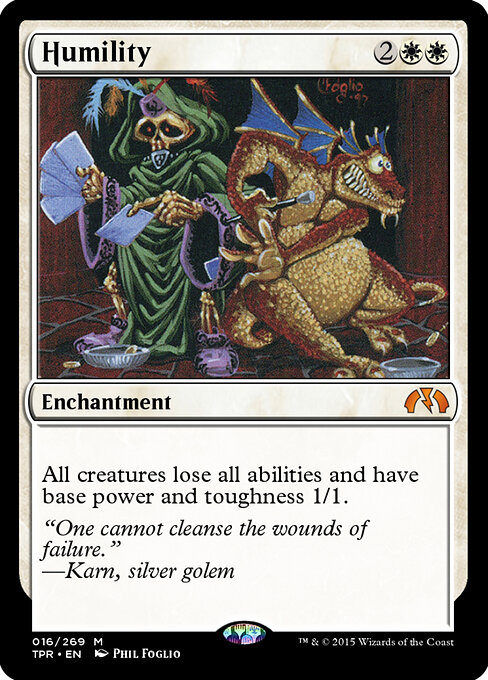
- Layer 6 — abilities. Adding abilities, removing abilities, keyword counters, and effects saying an object cannot have an ability. Humility lives here.
- Layer 7 — power and toughness. Every pump spell, every anthem, every counter, every "becomes a 3/3."
Within layers 2 through 6, characteristic-defining abilities are applied first, then everything else in timestamp order.
Two things trip people immediately. First, a single card can operate in several layers at once. The rules use Act of Treason as the example: its gain-control clause applies in layer 2, and its "gains haste" clause applies in layer 6, from the same resolution. Second, an effect that has started applying keeps applying even if the ability that generated it gets removed partway down the stack of layers. Hold onto that one — it is the entire explanation for the Humility puzzle later.
Layer 7 is where the arguments happen
Layer 7 has four sublayers, and they run in this order:
- 7a — characteristic-defining abilities that define power and toughness. Cards whose printed P/T box is a star and whose text defines it.
- 7b — effects that set power and/or toughness to a specific number. "Becomes a 3/3." "Has base power and toughness 0/1." Effects that reference base power and toughness land here too.
- 7c — effects and counters that modify power and toughness without setting it. Giant Growth, Glorious Anthem, +1/+1 counters, -1/-1 counters.
- 7d — effects that switch power and toughness.
If you learned layers from a guide that lists five sublayers with counters sitting in their own 7d, that guide predates the April 2021 rules update, which folded counters into 7c alongside every other modification effect and moved switching up to 7d.
Here is the rules' own worked example, and it is the single most useful thing in this article. Start with a 2/2 Gray Ogre.
- Put a +1/+1 counter on it (7c). It is a 3/3.
- Resolve "target creature gets +4/+4 until end of turn" (7c). It is a 7/7.
- An enchantment reading "creatures you control get +0/+2" enters (7c). It is a 7/9.
- Now resolve "target creature becomes 0/1 until end of turn" (7b).
The Ogre is a 5/8. Not a 0/1. The setting effect applies in 7b, which runs before 7c, so it overwrites the base but everything in 7c stacks back on top: 0/1, plus 4/4, plus 0/2, plus the counter's 1/1.
That is the rule of thumb worth memorizing: setting effects beat modifying effects on order, never on math. A "becomes a 1/1" wipes the printed numbers and nothing else. This is why Turn to Frog on a countered-up commander produces a 4/4.
Timestamps: the default tiebreaker
Inside a single layer or sublayer, order is decided by timestamp — earlier applies first, later applies on top. The timestamp rules that matter in practice:
- A permanent gets its timestamp when it enters the zone, not when you cast it.
- A continuous effect from a resolving spell or ability gets its timestamp at resolution.
- Counters get a timestamp when they are put on. Add another counter of the same kind and every existing counter of that kind is re-stamped to match.
- An Aura, Equipment, or Fortification gets a brand-new timestamp every time it becomes attached to something. Moving an Equipment is a re-stamp. This one wins arguments.
- If several objects would be stamped simultaneously, the active player's go first, then each other player in turn order.
The classic illustration in the rules: one Aura grants flying, another Aura takes flying away. Neither depends on the other, so the later timestamp simply wins. That is also true if one of them is a "loses flying until end of turn" spell or a board-wide effect. Latest wins.
Dependency: when timestamps get overruled
Timestamps are the default, not the law. Rule 613.8 introduces dependency, and dependency overrides timestamps.
An effect depends on another when all three of these hold:
- Both effects apply in the same layer (and sublayer, if there is one).
- Applying the other effect would change the first effect's text, its existence, what it applies to, or what it does to the things it applies to.
- Neither effect is from a characteristic-defining ability, or both are.
A dependent effect waits until every effect it depends on has been applied. If a group of effects forms a dependency loop, the rules give up on dependency and fall back to timestamp order.
The plain-English test at the table: if I apply the other effect first, does my effect change what it says, who it hits, or what it does to them? If yes, mine waits. If it just produces a different final answer, that is not dependency — that is two effects overriding each other, and timestamps decide.
Worked example: Darksteel Mutation and counters
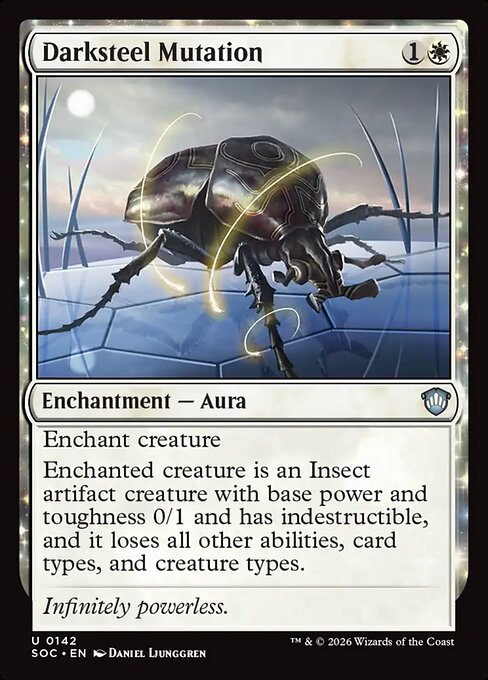
Darksteel Mutation is a {1}{W} Aura, and it is the most common way a Commander table shuts a general off without letting it go back to the command zone. Its text does four different things in three different layers:
- Layer 4: the creature becomes an Insect artifact creature and loses all other card types and creature types.
- Layer 6: it gains indestructible and loses all its other abilities.
- Layer 7b: its base power and toughness become 0/1.
Now the part people get wrong. The official ruling on the card is explicit: Darksteel Mutation does not overwrite effects that change power or toughness without setting a value — it names Giant Growth and Glorious Anthem specifically — and it does not overwrite counters.
So a mutated commander sitting under a Glorious Anthem with a single +1/+1 counter on it is a 2/3, not a 0/1. It still has no abilities, it is still indestructible, it is still legendary, and it is still your commander — the Aura strips card types and creature types but leaves supertypes and commander status alone. Kenrith's Transformation behaves identically at 3/3: its ruling says counters and modifying effects apply no matter when they started.
Worked example: Blood Moon vs. Urborg
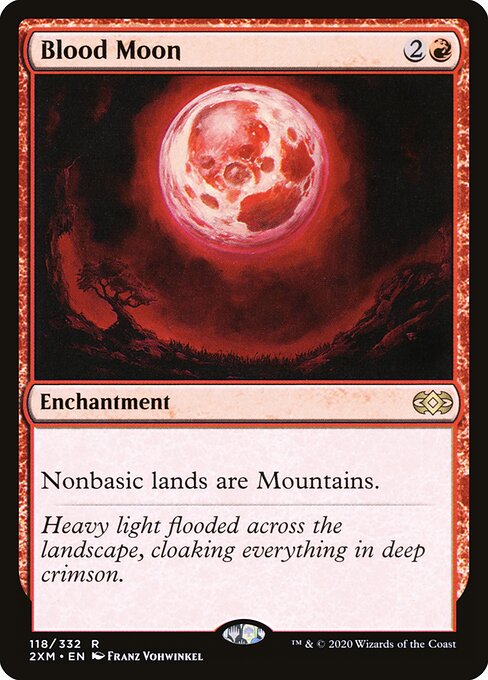
Blood Moon reads "Nonbasic lands are Mountains." Urborg, Tomb of Yawgmoth reads "Each land is a Swamp in addition to its other land types." Both are layer 4. Both are on the battlefield. Who wins?
The instinct is to check timestamps. The instinct is wrong.
Rule 305.7 is the hinge: setting a land's subtype to a basic land type strips its old land types and every ability generated from its rules text. Blood Moon does exactly that to Urborg, because Urborg is a nonbasic land. Apply Blood Moon first and Urborg has no ability left to generate an effect at all.
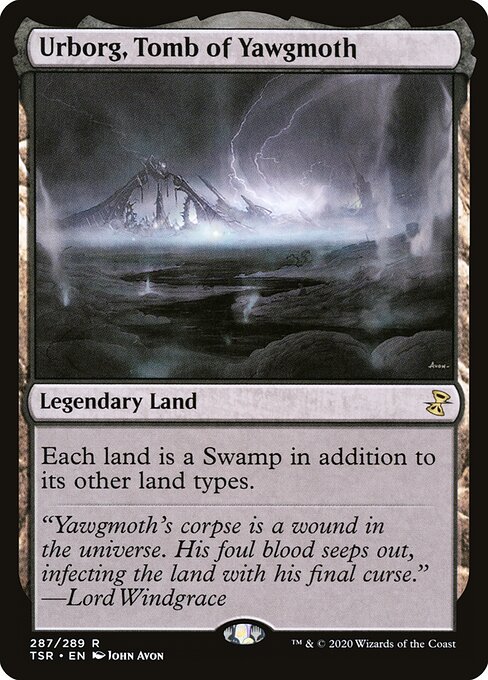
That is textbook dependency. Applying Blood Moon changes the existence of Urborg's effect, so Urborg's effect depends on Blood Moon's and has to wait — and by the time it is Urborg's turn to apply, there is nothing to apply. Meanwhile Blood Moon does not depend on Urborg, because adding the Swamp type to lands does not change which lands are nonbasic.
Urborg's own official ruling says the same thing directly: if an effect like Magus of the Moon's sets Urborg to a basic land type rather than adding one, Urborg stops turning lands into Swamps no matter which order the effects started applying in. Blood Moon has the identical four words of rules text as Magus of the Moon, so it gets the identical answer. Blood Moon wins. Always.
Worked example: Humility and Opalescence
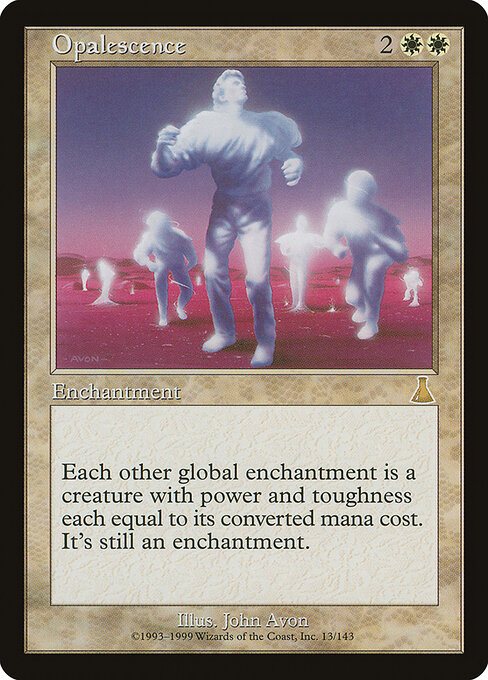
This is the interaction judges use to haze each other, and it is genuinely instructive. Put Opalescence, Humility, and Worship on the battlefield together. Opalescence and Worship both cost four mana; Humility costs {2}{W}{W}, so it is also mana value 4.
Walk the layers:
- Layer 4: Opalescence turns each other non-Aura enchantment into a creature. Humility and Worship are now enchantment creatures. Opalescence itself is not affected by its own effect.
- Layer 6: Humility strips all abilities from all creatures — including Worship's damage prevention and, absurdly, Humility's own ability. Opalescence is not a creature, so it keeps its ability.
- Layer 7b: this is a straight timestamp race between Opalescence's "base P/T equal to mana value" and Humility's "base 1/1."
Humility's ability was removed in layer 6, yet its layer 7b effect still applies, because an effect that has started applying keeps applying even after the ability generating it is gone. That is rule 613.6 earning its keep.
So the whole board hinges on entry order. Opalescence first, Humility second: everything ends at 1/1. Humility first, Opalescence second: Humility and Worship are both 4/4. Either way Worship is a creature with no abilities and is no longer keeping anyone alive — which is usually the part that actually decides the game.
Layer rulings that come up at real tables
The practical residue, in bullet form:
- Clones copy the card, not the board state. Copiable values come out of layer 1, and the rules are explicit that type-changing effects, text-changing effects, status, counters, and stickers are not copied. Cloning a 7/7 that is only that big because of counters and anthems gets you the printed body.
- Re-attaching an Equipment re-stamps it. If two effects are fighting inside one layer and one of them comes from an Equipment, moving that Equipment can flip the answer.
- A removed ability does not undo work already done. Kill the source, and effects mid-application still finish out the remaining layers on the same set of objects.
- Damage is not a characteristic. Shrinking a creature's toughness under its marked damage kills it through state-based actions, not through layers. Layers set the number; state-based actions read it.
- Effects on players and on the game rules come last. Protection granted to a player, maximum hand size changes, "creatures must attack if able" — those are applied after every object's characteristics are settled.
Quick Action Checklist
- Layers answer what is true now; the stack answers what happens next. Different systems.
- The order is copy, control, text, type, color, abilities, power/toughness — 1 through 7, always.
- Layer 7 runs 7a CDAs, 7b setting, 7c modifying and counters, 7d switching.
- Setting effects run before modifying effects, so pumps and counters always survive a "becomes a 1/1."
- Inside a layer, earlier timestamp applies first — and Auras and Equipment get a new timestamp every time they attach.
- Dependency beats timestamps. If applying the other effect would change what yours says or hits, yours waits.
- Blood Moon beats Urborg regardless of order, because Blood Moon deletes Urborg's ability.
- An effect keeps applying through the remaining layers even after its source ability is removed.
- Clones copy printed values only — no counters, no anthems, no animation.
- When a board looks impossible, stop arguing about who resolved first and walk the seven layers in order. The answer falls out.
Frequently Asked Questions
What are layers in Magic: The Gathering?
What are the seven layers in MTG?
How many sublayers does layer 7 have?
Do +1/+1 counters still apply after a creature becomes a 1/1?
What is the dependency rule in MTG?
Does Blood Moon beat Urborg, Tomb of Yawgmoth?
Keep Reading
Related Guides
MTG Turn Structure: Every Phase and Step, Explained
A Shock in your own end step finishes off a 3/3 your attacker already hit for 2. The same Shock in your opponent's upkeep does not. The difference is a step in which nobody normally gets priority: cleanup. Here is the whole Magic turn in order — what the game does automatically at the start of each phase and step, where you get priority and where you don't, checked against the Comprehensive Rules effective September 25, 2026.
MTG Keyword Abilities Explained: From Flying to Ward
Magic packs whole rules into single words. Flying, trample, deathtouch, ward — each keyword is shorthand for a specific effect, and knowing them is the difference between reading a card and understanding it. Here is every common keyword, grouped and explained.

How the Stack and Priority Work in Magic: The Gathering
The stack is the single rules concept that decides whether you actually understand Magic or just play the cards. Here is how it resolves, when you get priority, how to respond to a spell, and the timing rulings that trip up every new player.
Best MTG Stax Pieces for Commander, Ranked
Stax is the most hated archetype in Commander and the most misunderstood. Done right, it slows everyone but you. Here are the best resource-denial pieces, ranked, and the asymmetry rule that separates a winning lock from a salt mine.
MTG Commander Format Guide — How to Start Playing EDH (2026)
Commander is the most-played MTG format on the planet and the easiest one for new players to start in. The rules look intimidating on paper. They are not. Here is the full beginner guide.

Best Commander Staples Every Deck Wants, Ranked
There's a short list of cards that show up in basically every Commander deck regardless of theme — the silent 25 that make the splashy 75 work. Here are the staples worth a slot in almost any list, sorted by the job they do, with the legality double-checked.