MTG World Championship 32: Schütz Wins on Izzet Mission
Stefan Schütz won Magic World Championship 32 in Atlanta on November 15, 2026 with a creatureless Izzet deck built around a three-mana Star Trek uncommon that hit tabletop the same day round one began. Here is the full 75, how the Top 8 went, the field it beat, and what it costs to build.
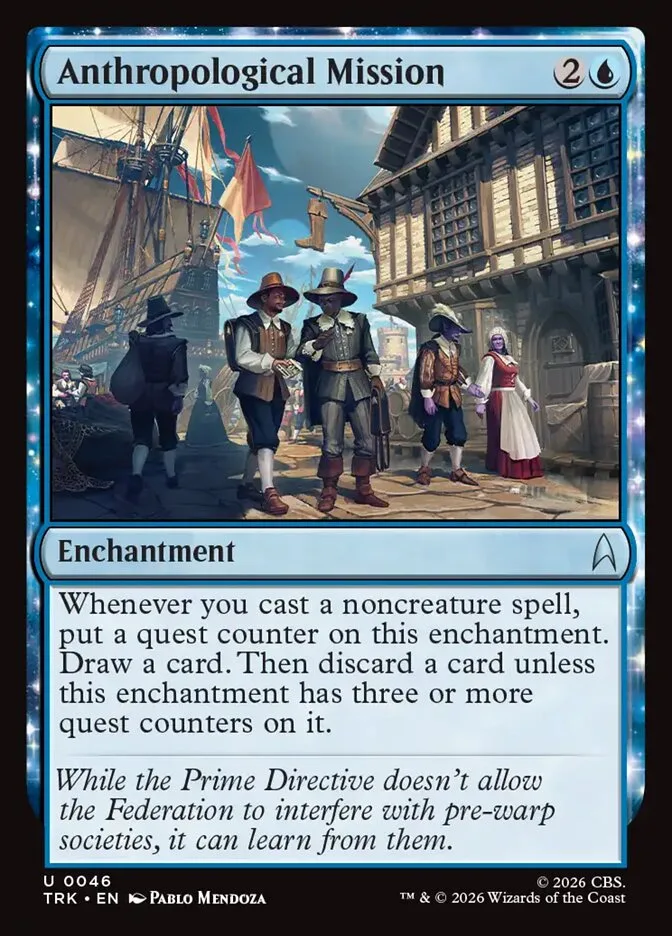
Two players out of 128 registered Izzet Mission for Magic World Championship 32. One of them, Stefan Schütz, went home with the title.
The deck is named for Anthropological Mission, a three-mana blue uncommon from Magic: The Gathering | Star Trek. That set hit MTG Arena on November 10 and tabletop on November 13, 2026, per Wizards' Collecting Star Trek article, and Worlds 32 decklists were due on November 11. Round one was the same day as the tabletop release. Wizards' Day Two report says the list "wasn't on anyone's radar heading into the event." Schütz, of Team Handshake Moxfield, beat Eduardo Sajgalik 3-0 in Sunday's final at MagicCon: Atlanta on November 15.
This is the record: the Top 8, the 75, how the engine works, and what changed between Friday's metagame numbers and Sunday's trophy. If you want the event's format and prize structure as it looked beforehand, our MagicCon Atlanta and Worlds 32 preview has it.
The Top 8 and how the bracket went
Worlds 32 ran six rounds of Star Trek Booster Draft and eight rounds of Standard across Friday and Saturday, then a single-elimination Standard Top 8 on Sunday with best-of-five matches. The competitor fact sheet sets the first two games of each playoff match as pre-sideboard. 62 of the 128 starters made Day Two. The Top 8 had eight different archetypes:
| Player | Deck | Result |
|---|---|---|
| Stefan Schütz | Izzet Mission | Champion |
| Eduardo Sajgalik | Selesnya Michelangelo | Finalist |
| Kellen Pastore | Boros Pixie | Lost semifinal to Sajgalik, 1-3 |
| James Drake | Selesnya Landfall | Lost semifinal to Schütz, 1-3 |
| Arne Huschenbeth | Azorius Control | Lost quarterfinal to Sajgalik, 2-3 |
| Shuhei Nakamura | Azorius Momo | Lost quarterfinal to Schütz, 2-3 |
| Abe Schnake | Jund Sacrifice | Lost quarterfinal to Pastore, 2-3 |
| Charis Kikidis | Izzet Prowess | Lost quarterfinal to Drake |
The match scores come from magic.gg's game-by-game Top 8 report. It does not give a final score for Drake against Kikidis, so that cell is blank. Kikidis was the first player to lock a Top 8 seat, in Round 12, and finished the Swiss as the top seed.
Schütz's path was not clean. Against Nakamura, a Hall of Famer who made his first Pro Tour Top Finish in ten years here, per magic.gg, he won the first two games and then dropped the next two before taking the fifth. Against Drake he lost game one to an early Sazh's Chocobo and Icetill Explorer, then won three straight.
The winning 75
This is Schütz's list as published on magic.gg's Top 8 players and decks page, grouped by job. It is 60 cards main and 15 sideboard, and every card in it was Standard-legal on Scryfall when this was written.
| Role | Main deck (60) |
|---|---|
| The engine | Anthropological Mission (4), Ral, Crackling Wit (3) |
| Cantrips and card selection | Opt (4), Sleight of Hand (4), Consult the Star Charts (2) |
| Recursion | Flashback (4) |
| Removal | Into the Flood Maw (3), Torch the Tower (2), Burst Lightning (1), Impractical Joke (1), Sear (1), Fire Magic (1), Traumatic Critique (1), Engineered Explosives (1) |
| Counterspells | Spell Snare (2), Spell Pierce (2), Long River's Pull (2) |
| Lands (22) | Island (6), Riverpyre Verge (4), Steam Vents (4), Spirebluff Canal (4), Great Hall of the Biblioplex (2), Stormcarved Coast (1), Multiversal Passage (1) |
| Sideboard (15) |
|---|
| Bothersome Noisemaker (3), Stock Up (2), Essence Burn (2), Annul (2), Flashfreeze (1), Impractical Joke (1), Ghost Vacuum (1), Fire Magic (1), Spell Snare (1), Petrified Hamlet (1) |
Read the curve before the card names. Of the 38 nonland cards, 24 cost one mana. Five more cost two, the four Missions cost three, the three Rals cost four, and the last two (Traumatic Critique and Engineered Explosives) have X in their cost. Thirty of the 38 are instants or sorceries, which is what Flashback needs to be live.
How Anthropological Mission turns cantrips into cards
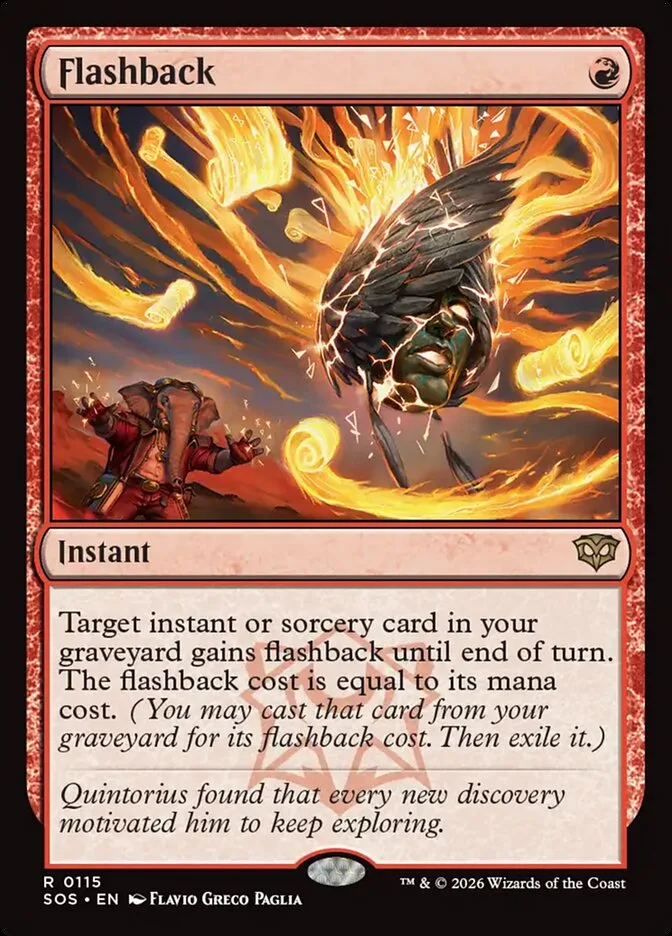
Anthropological Mission is a {2}{U} enchantment with one ability. Whenever you cast a noncreature spell, it gets a quest counter, and you draw a card. Then you discard a card unless it has three or more quest counters.
So it starts life as a loot on every spell. Once it reaches three counters it stops asking you to discard, and every noncreature spell you cast draws a card outright. In a deck where every nonland card is a noncreature spell, that is the point.
The one-mana spells are what make it go. Opt and Sleight of Hand already replace themselves; with a powered-up Mission, each one draws a second card as well. Flashback, the {R} instant from Secrets of Strixhaven, gives an instant or sorcery in your graveyard flashback until end of turn at its own mana cost. Pointing it at a spent Opt is one cast, one more cast, and two Mission draws for two mana.
The final showed the ceiling. With Mission on three counters, Schütz cast Flashback, used it to flash back a second Flashback from his graveyard, and used that one on a third spell, drawing off each cast along the way. That sequence is described in magic.gg's final report.
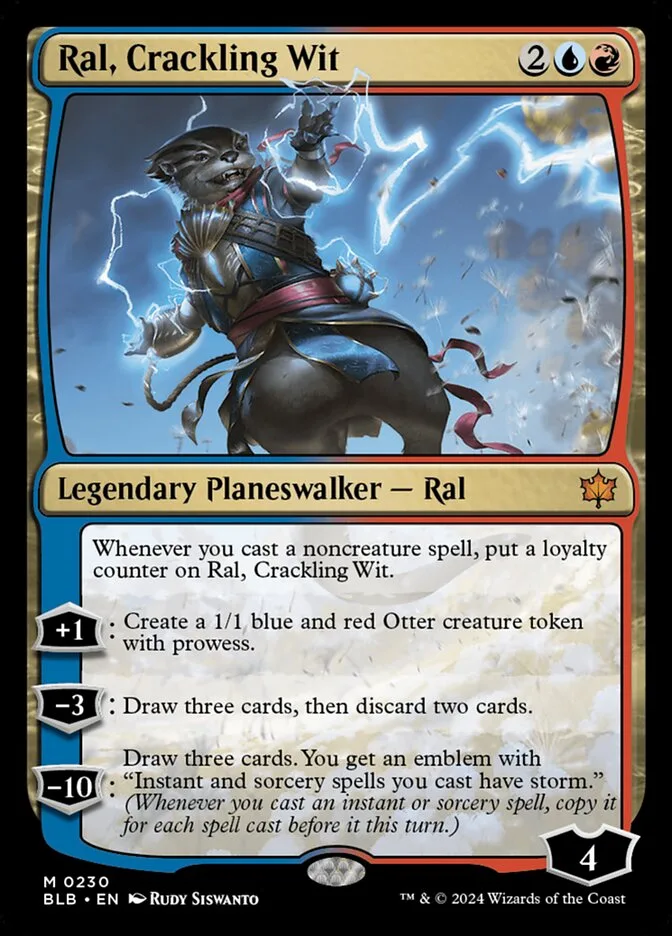
Ral, Crackling Wit is the second payoff on the same trigger. Ral gains a loyalty counter whenever you cast a noncreature spell, its +1 makes a 1/1 Otter with prowess, and its −10 draws three and gives you an emblem that grants storm to your instants and sorceries. In game two of the semifinal against Drake, Schütz powered up a Mission and protected Ral long enough to untap, and magic.gg reports Ral reached its ultimate within a turn cycle to even the match.
No creature cards, and why that mattered
The main deck runs no creature cards at all. (Great Hall of the Biblioplex can become a 2/4 creature for {5}, but it is a land.) magic.gg's final report credits that choice with blanking opposing removal, and the Worlds field had a lot of creature decks to bring removal for. Boros Pixie, Selesnya Landfall, Selesnya Michelangelo, Mono-Green Landfall and Jund Sacrifice together were 67 of the 128 decks.
That leaves Izzet Mission with a different problem, which is how to deal with all those creatures. Its answer is cheap interaction:
- Spell Snare counters a spell with mana value 2, exactly. Michelangelo, Weirdness to 11 costs {1}{G}, and in game one of the final Spell Snare caught Sajgalik's turn-two Michelangelo. In game three, another copy caught a follow-up Michelangelo.
- Into the Flood Maw bounces an opposing creature for {U}, or any opposing nonland permanent if you promise the opponent a tapped 1/1 Fish.
- Torch the Tower, Burst Lightning, Sear and Impractical Joke cover the creatures that need to die, at one or two mana each.
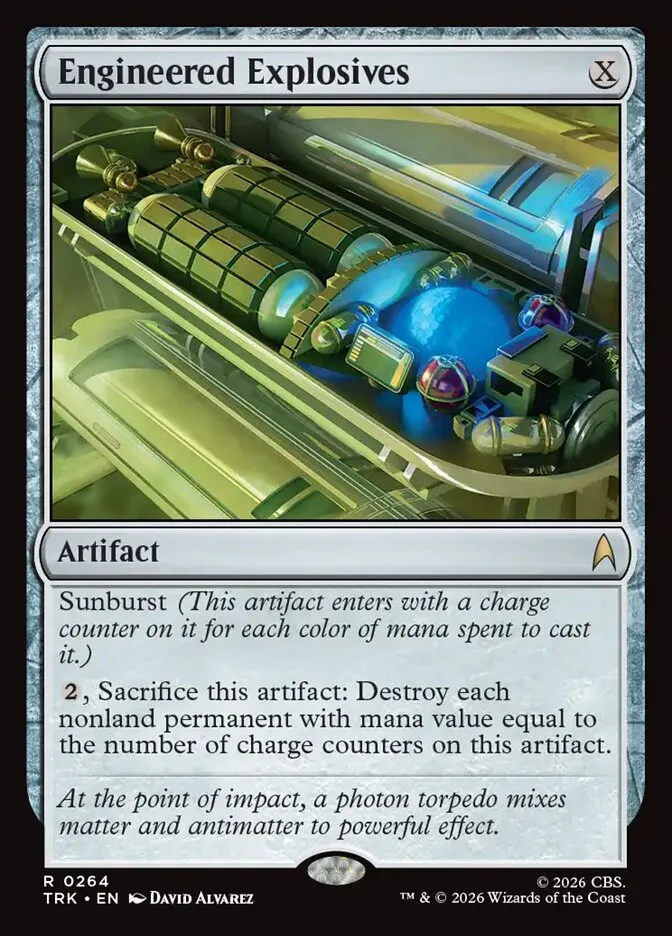
Engineered Explosives is one of two main-deck cards that answer a whole board; the other is the single Fire Magic, which deals 1, 2 or 3 damage to each creature depending on which tier you pay for. Explosives has sunburst, so it enters with a charge counter for each color of mana spent on it, and {2} plus sacrificing it destroys each nonland permanent with mana value equal to its counters. In a blue-red deck you are realistically setting it to 0, 1 or 2. The Star Trek reprint is a rare, and magic.gg's final report names Explosives as the card that shaped game two of the final.
The sideboard plan: Bothersome Noisemaker
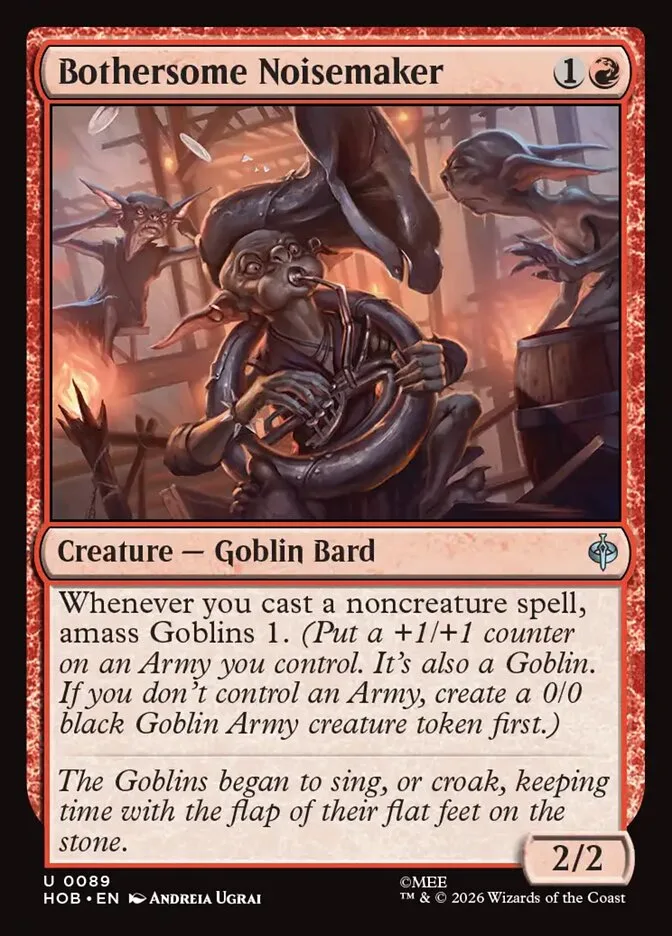
After game two, Schütz's sideboard changes what the deck is. Three Bothersome Noisemaker, a {1}{R} 2/2 from The Hobbit, say: whenever you cast a noncreature spell, amass Goblins 1. The first trigger makes a 0/0 Goblin Army token and puts a +1/+1 counter on it. Each spell after that adds another counter.
In a deck where every one-mana cantrip now adds a counter, the Army grows fast. magic.gg's Top 8 report calls Noisemaker the breaking point against Nakamura: the Army grew until it outsized Quantum Riddler and Nakamura conceded. Against Drake, the report credits Noisemaker and a powered-up Mission with both sideboarded games.
The rest of the sideboard is more interaction. Annul counters an artifact or enchantment spell for {U}, Essence Burn and Flashfreeze are more answers, Stock Up is extra card selection, and Ghost Vacuum is graveyard hate.
The final, game by game
The final was also the last match of the Player of the Year race. magic.gg wrote that Sajgalik would take the Kai Budde Player of the Year trophy if he won, and that Christoffer Larsen would take it if he lost.
| Game | What decided it, per magic.gg |
|---|---|
| 1 | Spell Snare on Sajgalik's turn-two Michelangelo. Schütz's Mission reached three counters, the Flashback chain drew him three cards, and Ral finished the game. |
| 2 | Engineered Explosives and a Mission controlled the early board, and magic.gg says Sajgalik kept drawing blanks against a deck with no creatures. |
| 3 | Sajgalik mulliganed to five. Noisemaker started an Army. A first Leatherhead, Swamp Stalker died in combat; the second arrived with a hexproof counter that Schütz's removal could not target. Schütz pointed two Torch the Tower at his own Noisemaker, holding priority, so each cast grew the Army and drew off Mission. The Army got big enough to block Leatherhead, and Fire Magic, cast and then flashed back, cleared it. |
That third game is worth a second look if you play this deck. Removal that targets your own creature still counts as a noncreature spell cast, so it still triggers Mission and Noisemaker. And holding priority means you cast the second spell before the first one resolves, while Noisemaker is still on the battlefield, so it triggers for both casts. Our stack and priority guide covers how holding priority works.
The field it beat
Frank Karsten's Standard metagame breakdown, published before round one, counted 29 archetypes among 128 players. The top of the table, plus the deck that won:
| Archetype | Players | Share |
|---|---|---|
| Boros Pixie | 24 | 18.8% |
| Selesnya Landfall | 19 | 14.8% |
| Dimir Control | 10 | 7.8% |
| Selesnya Michelangelo | 9 | 7.0% |
| Mono-Green Landfall | 8 | 6.3% |
| Dimir Midrange | 8 | 6.3% |
| Jund Sacrifice | 7 | 5.5% |
| Azorius Momo | 4 | 3.1% |
| Izzet Mission | 2 | 1.6% |
Boros Pixie was the breakout. It uses The Naked Time, a two-mana Star Trek Saga, to give the creatures entering that turn haste and a +1/+1 counter, with Nurturing Pixie bouncing the Saga to reuse it. The Day Two report says it finished Day Two with nearly a 60% win rate, and Kellen Pastore took it to the semifinals.
Two more things from the breakdown are worth knowing if you play Standard. First, three decks that had been popular at the Standard events before Worlds were barely there: Izzet Spellementals went from 7.5% at earlier events to zero, Dimir Uldaros to 2.3%, and Orzhov Life Gain to 1.6%. Second, Karsten names Llanowar Elves (158 copies) and Practiced Offense (126) as the two most-played nonland main-deck cards in the room. For where Standard stood on bans going in, see our Standard banned list and meta page.
What the weekend paid
From the fact sheet, Worlds 32 had a $1,000,000 prize pool:
| Finish | Prize | Invitations |
|---|---|---|
| 1st | $100,000 | Every 2026–27 Pro Tour and that season's World Championship, plus the 2027 Magic Limited Championship |
| 2nd | $50,000 | Every 2026–27 Pro Tour and that season's World Championship |
| 3rd–4th | $25,000 | Every 2026–27 Pro Tour and that season's World Championship |
| 5th–8th | $20,000 | Every 2026–27 Pro Tour and that season's World Championship |
| 9th–24th | $15,000 to $11,000 by band | Pro Tour Nauctis in Detroit |
The fact sheet says prizes are subject to change. The metagame breakdown adds that the champion gets the Black Lotus-themed trophy and the chance to work with the design team on a future card bearing their likeness.
The weekend also produced news beyond the bracket. The final report says a new Hall of Fame class of three was inducted. Going by magic.gg's stated condition, Schütz's win gave the 2026 Player of the Year title to Christoffer Larsen, who made two Pro Tour finals this season and won one. And on November 14 Wizards published Everything New for Competitive Play in 2027: Pioneer returns as the format for the April 10–May 23, 2027 Regional Championship round, the Spotlight Series grows from 12 events to 14, and a fourth, all-Limited Pro Tour replaces the Limited Championship from 2028. Our Pro Tour qualification guide covers the current path in.
Building Izzet Mission yourself
On MTG Arena, the full 75 costs 3 mythic, 26 rare, 25 uncommon and 15 common wildcards if you own none of it, plus six basic Islands. That counts each card at the lowest rarity among its Arena printings on Scryfall. The main deck alone is 3 mythic, 24 rare, 14 uncommon and 13 common. Most of the rare count is the mana base. The four Riverpyre Verge, four Steam Vents, four Spirebluff Canal, two Great Hall, Stormcarved Coast and Multiversal Passage are 16 of the 24 main-deck rares. The deck's namesake is an uncommon. Our Arena wildcards breakdown covers what those wildcards cost to get.
Three things to know before you sleeve it up:
- Spell Snare only hits mana value 2. Michelangelo and The Naked Time both cost two, but how good Snare is depends on how many two-drops your local metagame plays. Check before you copy the 2+1 split.
- Don't cut the cantrips for more removal. The deck needs cheap spells to get Mission to three counters. Opt and Sleight of Hand are what get it there without costing you a card.
- Rotation is close. Wizards' Collecting Nauctis article puts the next Standard rotation on January 29, 2027. Check each card's Standard legality after that date before you keep the deck together. For how rotation works, see our Standard format guide.
Quick Action Checklist
- Winner: Stefan Schütz, Izzet Mission, 3-0 over Eduardo Sajgalik (Selesnya Michelangelo) in the final on November 15, 2026.
- The engine: 4 Anthropological Mission, 3 Ral, Crackling Wit, 4 Flashback, 24 one-mana spells and no creature cards in the main deck.
- The sideboard plan: 3 Bothersome Noisemaker turn every noncreature spell into a counter on a Goblin Army.
- The metagame: Boros Pixie was 18.8% of the field and Izzet Mission 1.6%; eight archetypes made the Top 8.
- Arena cost: 3 mythic, 26 rare, 25 uncommon and 15 common wildcards for the 75.
- Next: Standard rotates January 29, 2027. If you're drafting the set Worlds 32 used, start with our Star Trek draft archetypes.
Frequently Asked Questions
Who won Magic World Championship 32?
What is the Izzet Mission deck in MTG Standard?
How many players played Izzet Mission at World Championship 32?
What was the most-played deck at Magic World Championship 32?
Who made the Top 8 of Magic World Championship 32?
How much does Izzet Mission cost to build on MTG Arena?
Keep Reading
- Mythras blog
- Magic: The Gathering coverage hub
- MagicCon Atlanta 2026 and World Championship 32 preview
- How to qualify for the MTG Pro Tour
- Pro Tour Secrets of Strixhaven winning deck
- How the stack and priority work in MTG
- Standard banned list and meta
- MTG Standard format guide
- MTG Arena wildcards economy
- MTG Star Trek draft archetypes
- Magic.gg — The Finals of Magic World Championship 32 (Corbin Hosler, November 16, 2026: Schütz 3-0 over Sajgalik, game-by-game, Player of the Year condition)
- Magic.gg — Magic World Championship 32 Top 8 Highlights (Corbin Hosler, November 15, 2026: quarterfinal and semifinal games)
- Magic.gg — Magic World Championship 32 Top 8 Players and Decks (November 15, 2026: all eight decklists)
- Magic.gg — Magic World Championship 32 Day Two Highlights (November 15, 2026: 62 players in Day Two, Top 8 archetypes, Boros Pixie win rate)
- Magic.gg — Magic World Championship 32 Standard Metagame Breakdown (Frank Karsten, November 12, 2026: 29 archetypes among 128 players)
- Magic.gg — World Championship 32 Fact Sheet for Competitors (structure, playoff rules, prize table and invitations)
- Wizards of the Coast — Everything New for Competitive Play in 2027 (November 14, 2026)
- Wizards of the Coast — Collecting Magic: The Gathering | Star Trek (MTG Arena release November 10, tabletop release November 13, 2026)
- Wizards of the Coast — Collecting Nauctis: The Sunken Realm (Standard rotation January 29, 2027)
- Scryfall — Anthropological Mission (Star Trek 46, Oracle text and legality)
- Scryfall — Bothersome Noisemaker (The Hobbit 89, Oracle text and legality)
- Scryfall — Engineered Explosives (Star Trek 264, Oracle text and legality)
Related Guides
Nathan Steuer Won Pro Tour Strixhaven on Selesnya Landfall
Nathan Steuer beat Christoffer Larsen in a Selesnya Landfall mirror final at Pro Tour Secrets of Strixhaven. Here is his full list, why it beat a Day One field that was 30.5% Izzet Prowess, and what the August 10 Badgermole Cub ban means for it today.
Best MTG Star Trek Commanders: Precons and Top Picks
The Wizards schedule set the full Magic: The Gathering | Star Trek gallery for October 30, and Scryfall lists 198 cards in the main set and the Commander set can lead a deck. Here is which commander to run in each of the four precons, the picks outside them, and the color identity traps that catch people on cards like Captain Benjamin Sisko.
Secret Lair Star Trek Superdrop: Full Card List and Prices
Wizards' Star Trek Secret Lair, Set Phasers to Superdrop, went on sale November 9. Here are all six drops and 35 cards, what each bundle actually saves, why two small bundles beat the Everything Bundle for the promo, and what the Lower Decks crew does in Commander.
MTG Star Trek Draft Archetypes: All 10 Color Pairs
Wizards' Prerelease Guide names ten two-color draft archetypes for Magic: The Gathering | Star Trek, each with two multicolor signpost uncommons. Here is what each pair does, which cards carry it, the Planet dual that fixes it, and the common removal in every color, for Prerelease week, Arena Draft and Sealed.
MTG Commander Format Guide — How to Start Playing EDH (2026)
Commander is the most-played MTG format on the planet and the easiest one for new players to start in. The rules look intimidating on paper. They are not. Here is the full beginner guide.

Best Commander Staples Every Deck Wants, Ranked
There's a short list of cards that show up in basically every Commander deck regardless of theme — the silent 25 that make the splashy 75 work. Here are the staples worth a slot in almost any list, sorted by the job they do, with the legality double-checked.