Minecraft Horses & Mounts Guide: Every Rideable Animal
Every rideable mob in Minecraft does one job better than the rest — horses for speed and fences, llamas for caravans, striders for lava, camels for two-up desert travel. Here is how to tame each one, what its real stats are, and how to breed a horse that actually clears a five-block wall.
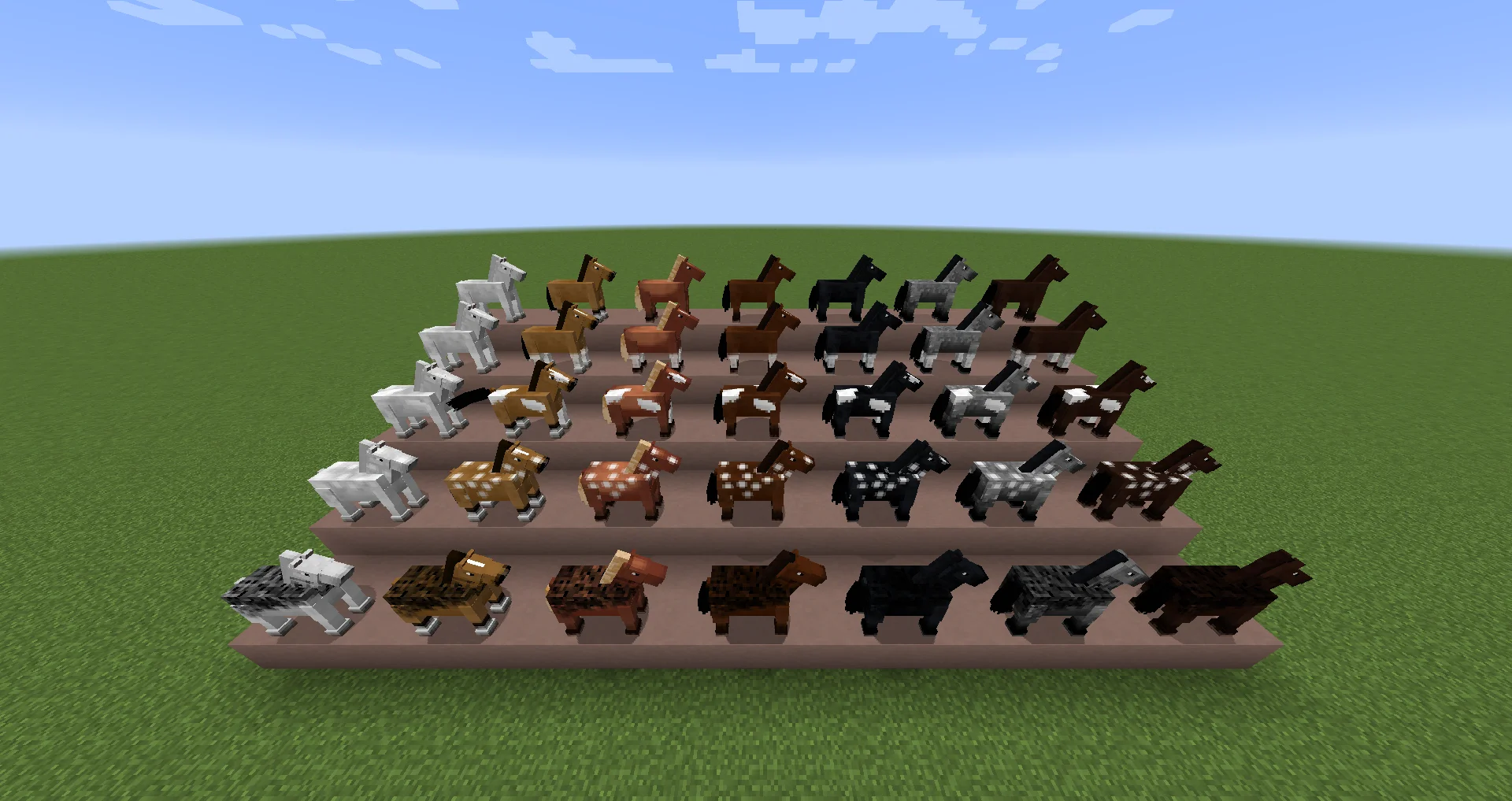
Walking is for the first ten minutes of a world. After that, every serious survival run is a question of what you ride. Minecraft has more rideable mobs than most players ever bother with, and each one is genuinely the best tool for a specific job — horses outrun anything on land and clear fences, llamas haul a wagon train of loot, striders are the only way to cruise a lava ocean, and camels let you ride two-up while shrugging off zombies. The trick is knowing which animal to grab and how to actually tame and equip it.
This guide covers every mount: how taming works, the real stats (checked against the Minecraft Wiki, because there is a lot of made-up "best horse" advice floating around), how to breed a horse worth keeping, and which mob to reach for in which biome.
Why mounts matter
A player walks at about 4.3 blocks per second and sprints at roughly 5.6. The fastest horse moves at around 14.57 blocks per second — nearly three times sprint speed — and can leap walls a player would have to pillar up. That gap is the whole point. A mount turns a ten-minute overland slog into a 90-second ride, lets you escape a bad fight, and in the case of pack animals, doubles as a mobile chest so you do not have to leave loot behind on a long expedition.
Different mounts also unlock terrain. Striders walk on lava. Camels are tall enough that most melee mobs can't hit you. Llamas form caravans so one player can move ten animals' worth of storage at once. Pick the mob to match the trip.
Horses: taming the fast one
Horses spawn in herds of 2–6 in plains and savannas, and generate in village stables. To tame one, you ride it bare — no saddle needed yet.
Here is the mechanic most guides get vague about. Every horse starts with a temper of 0 out of 100. When you mount it (press use with an empty hand), the game rolls a random taming threshold between 0 and 99. If the horse's temper beats that roll, it's tamed and hearts pop up. If not, it bucks you off and its temper rises by 5. So each failed attempt makes the next one more likely. Feeding the horse also raises temper, which is why bringing food speeds taming up dramatically.
Best taming foods, roughly in order of temper gain: sugar, wheat, apples, golden carrots, and golden apples. Golden apples and golden carrots give the biggest temper boost (and are also your breeding food later). Once hearts appear, open the horse's inventory and equip a saddle and you're riding.
You can craft the saddle before you go looking for a horse. Since Java 1.21.6 and Bedrock 1.21.90 (June 2025), a saddle takes 3 leather + 1 iron ingot on a crafting table: leather in the top middle, then leather / iron ingot / leather across the row below. The recipe unlocks the first time you pick up leather. Chests (Nether fortresses, village tanneries and weaponsmiths, End cities), fishing, and master leatherworkers (6 emeralds) still hand them out, but you no longer need to hunt for one.
One quirk worth knowing: horses take fall damage only after 7 blocks (most mobs start at 3), and a rider safely falls 7 blocks too. So you can drop off small cliffs on horseback without splatting.
Horse stats and breeding for speed
This is where horses get interesting. Every horse rolls three hidden "equine stats" at birth or spawn:
- Health: ranges from 15 to 30 health points (avg ~22.5).
- Movement speed: roughly 4.86 to 14.57 blocks/second (avg ~9.71). The single most important stat for travel.
- Jump strength: clears between 1.15 and 5.92 blocks (avg ~3.12). High jump lets you hop fences and small cliffs without a path.
These stats are fixed at spawn and food does not change them — feeding only heals and tames. The only way to improve a horse is breeding.
Feed two tamed horses golden carrots or golden apples (regular apples and carrots do not trigger breeding) to enter love mode and produce a foal, granting 1–7 XP. The foal's stats are not a simple average. For each of the three stats, the game takes the average of the two parents, then adds a random spread of up to about 30% of the stat's full range — meaning the baby can land higher or lower than both parents.
The practical breeding loop: tame a big herd, ride each one to find your fastest and highest-jumping individuals, breed those two together, and keep the best foal. Repeat across a couple of generations and you'll push a horse toward that ~14.5 b/s, ~5-block-jump ceiling. There's no guaranteed perfect horse, but selective breeding gets you close. Foals take 20 minutes to grow up naturally, or feed them to speed it along.
Horse armor and leads
A tamed horse has two equipment slots: a saddle slot and a horse armor slot. Horse armor reduces incoming damage and comes in six tiers — leather, copper, iron, gold, diamond, and netherite. Only leather and netherite horse armor can be crafted or smithed; the rest (copper, iron, gold, diamond) are chest loot from structures like dungeons, desert and jungle temples, Nether fortresses, and End cities. Equip it by pressing use on the horse with the armor in hand, or drop it into the armor slot. Leather horse armor also stops a horse freezing in powder snow.
Leads are essential mount-management gear. Attach a lead to any horse, donkey, mule, or llama and you can tow it behind you on foot or even behind a boat. A mounted horse can be pulled by a lead, and you can hitch a mount to a fence post to park it. Leads are how you relocate a good horse home without riding it the whole way. For the wider picture of getting around, see our Minecraft transportation guide.
Donkeys and mules: the pack animals
Donkeys spawn in plains, meadows, and savannas. They're slower and jump worse than horses, but they have one killer feature: storage. Tame a donkey the same way (ride it bare until hearts), saddle it, then press use with a chest in hand to give it 15 slots of inventory. Now it's a horse you can also pack full of loot. Open the storage by sneaking and using the donkey, or while riding it.
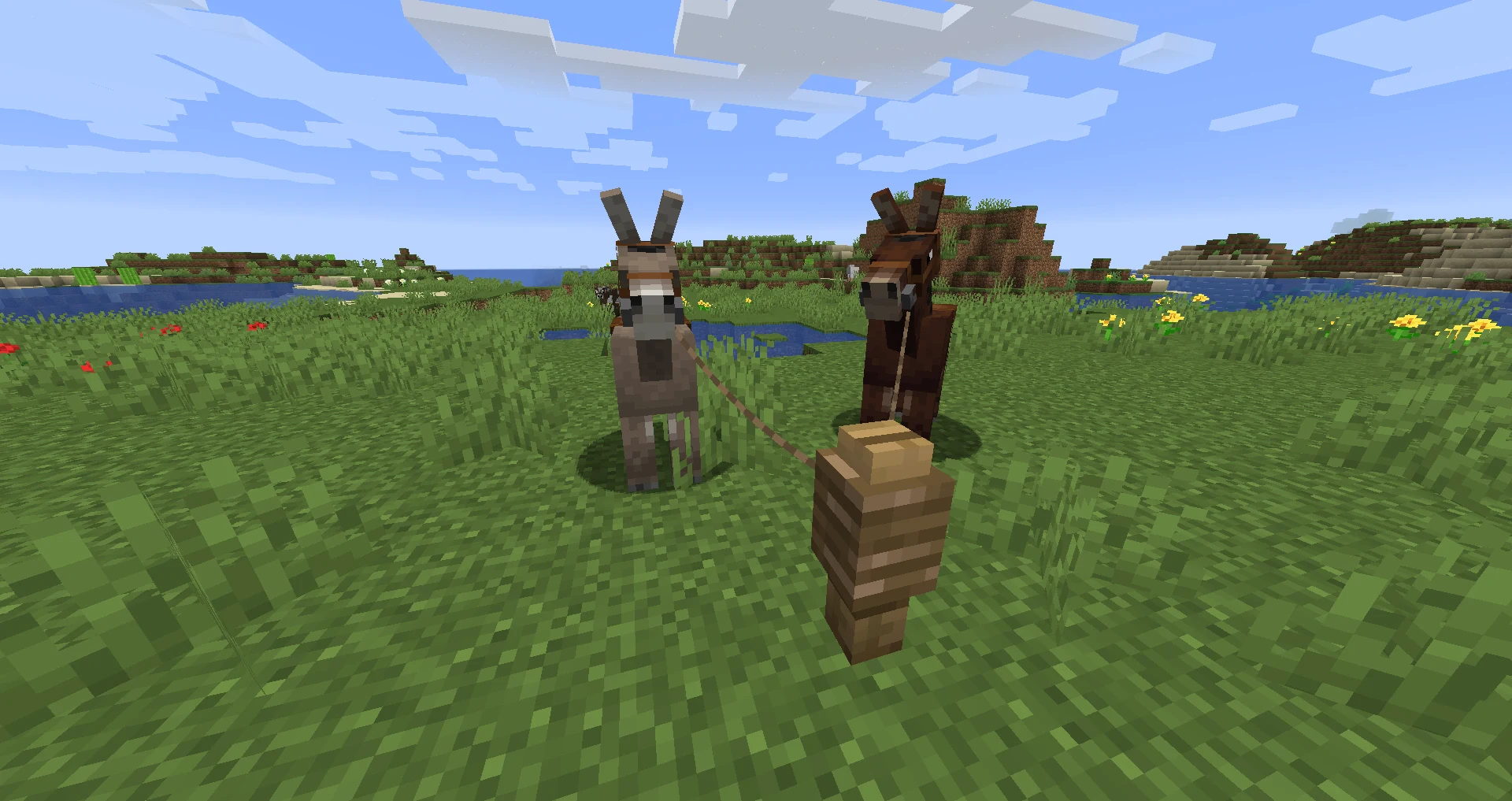
Mules are the cross-breed: feed a tamed horse and a tamed donkey golden carrots/apples and you get a baby mule instead of a foal. Mules also carry a 15-slot chest. The catch — exactly like real life — mules are sterile and cannot breed, so every mule you want has to come from a fresh horse-plus-donkey pairing. Neither donkeys nor mules can wear horse armor; the chest is their whole identity.
Llamas and caravans
Llamas are the bulk-haul specialists. They spawn in savanna plateaus and windswept hills in herds of 4–6. Tame one by riding it (it has a lower max temper than horses, capping at 30, so taming is quick), then equip a chest. A llama's storage scales with its hidden strength stat (1 to 5): weaker llamas get just 3 slots, the strongest get 15. You can't saddle or steer a llama directly — you don't ride them anywhere useful — so their job is hauling, not commuting.
The magic is caravans. Attach a lead to one llama and up to nine nearby unleashed llamas automatically chain behind it, forming a caravan of up to ten. Lead the front llama and the whole train follows. One player can move a small fortune in storage across the map this way — it's the closest thing vanilla Minecraft has to a pack train. Decorate them with carpets (16 colors) if you want, purely cosmetic.

One warning: llamas are neutral, not passive. Provoke one and it spits, dealing damage, and an angry llama in a caravan can be a nuisance. They're also natural wolf-deterrents — wolves flee strength-4 and -5 llamas. For more on raising every animal, including which are worth your time, see the taming and breeding guide.
Camels: two-up desert travel
Camels are arguably the most player-friendly mount. They spawn uncommonly in deserts, and one generates in the center of every desert village that isn't abandoned (that one is persistent and won't despawn — easy free camel). Crucially, camels are naturally tame — no bucking-off ritual. Just slap a saddle on and ride.
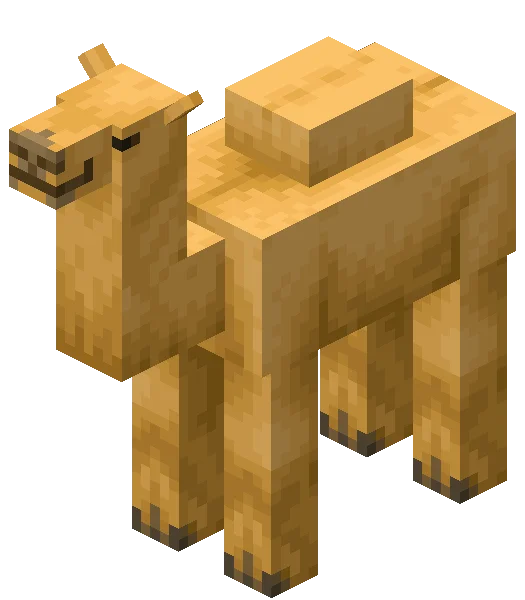
Two things make camels special:
- Two riders. A camel seats two players at once. The back-seat player can't steer or hurt the driver, but it's genuinely useful for traveling with a friend on one animal.
- Dashing. Press the jump control to dash: the camel launches up to 12 blocks forward and one block up, on a 2.75-second cooldown. Hold the control to charge a longer dash. It's a burst of distance that also clears gaps.
Camels are also tall enough that most melee mobs can't reach a mounted rider — zombies, piglins, vindicators, and the like swing and miss. (Spiders, slimes, and wolves jump, so they're still a threat.) Heal a camel by feeding it cactus (2 HP each). They sit down to idle and stand when you ride.
Striders: riding on lava
Striders are your Nether lava taxi, and the only mob that can walk on lava without burning. They spawn in groups of 2–4 on lava in any Nether biome. To ride one, equip a saddle, then steer it with a warped fungus on a stick (the Nether's version of a carrot on a stick — craft it from a fishing rod and a warped fungus). Hold the fungus stick and the strider walks toward where you point.
A strider on a flat lava surface (like the central lava sea) moves at about 4.24 blocks/second in Java — slow, but it's lava travel, so any speed beats burning to death. Each use of the warped fungus on a stick triggers a temporary boost and costs durability. On land, striders crawl (~1.78 b/s) and shiver, turning purple in the cold — keep them on lava.
Breed striders by feeding two of them warped fungus for a baby. They're also a renewable string source. For everything else about surviving the dimension, see the Nether guide.
Pigs: the meme mount
Yes, you can ride a pig. Saddle one (no taming needed — just use a saddle on it) and steer it with a carrot on a stick. It's slow, defaulting to about 2.42 blocks/second, boosting to a peak of around 5.2 b/s while the carrot-on-a-stick boost lasts (each boost burns 7 durability off the stick in Java, 2 in Bedrock). Speed potions push that higher.
The honest take: a pig is worse than walking most of the time and exists mainly for the "When Pigs Fly" achievement (ride a pig off a cliff and take fall damage, or land safely). Nobody commutes on a pig. It's a novelty — but it's a fun one, and the carrot-on-a-stick steering is the same idea as the strider's fungus stick, so it's a decent way to learn the mechanic.
Which mount for which job
Quick decision guide:
- Fastest land travel: a bred-up horse. Nothing else competes on the surface.
- Hauling loot on an expedition: a donkey or mule (15-slot chest, rides like a slow horse).
- Moving a ton of storage at once: a llama caravan (up to ten llamas on one lead).
- Desert travel or riding with a friend: a camel (two riders, dash, mob-proof height).
- Crossing lava in the Nether: a strider (the only option).
- Bragging rights: a pig.
A practical loadout for a big base: keep one fast horse for scouting, a couple of donkeys or a llama caravan for hauling, a camel parked in the desert, and a saddled strider stashed near your Nether lava routes.
Quick Action Checklist
- Tame a horse by riding it bare; feed sugar/apples/golden carrots to raise temper faster
- Equip a saddle once hearts appear (craft it from 3 leather + 1 iron ingot since Java 1.21.6 / Bedrock 1.21.90)
- Breed your two fastest, highest-jumping horses with golden carrots or golden apples
- Keep the best foal; repeat over generations toward ~14.5 b/s and ~5-block jumps
- Slap horse armor (leather/netherite craftable, others are loot) in the armor slot
- Use a lead to tow or park any horse, donkey, mule, or llama
- Give a donkey or mule a chest for 15 slots of mobile storage (mules can't breed)
- Lead one llama to chain a caravan of up to ten; chest = 3–15 slots by strength
- Saddle a desert camel (naturally tame), ride two-up, and dash with the jump key
- Ride striders on Nether lava with a warped fungus on a stick
Frequently Asked Questions
How do you tame a horse in Minecraft?
How do you breed a fast horse in Minecraft?
What is the difference between a donkey and a mule in Minecraft?
How do llama caravans work in Minecraft?
What can a camel do in Minecraft?
Keep Reading
- Minecraft Wiki — horse taming, stats, and breeding
- Minecraft Wiki — llamas, strength, and caravans
- Minecraft Wiki — camel riding and dashing
- Minecraft Wiki — striders and lava travel
- Minecraft Java Edition 1.21.6 changelog — saddles become craftable
- Minecraft Wiki — saddle recipe, chest loot, fishing, and trades
- Minecraft Wiki — horse armor crafting and chest loot
Related Guides
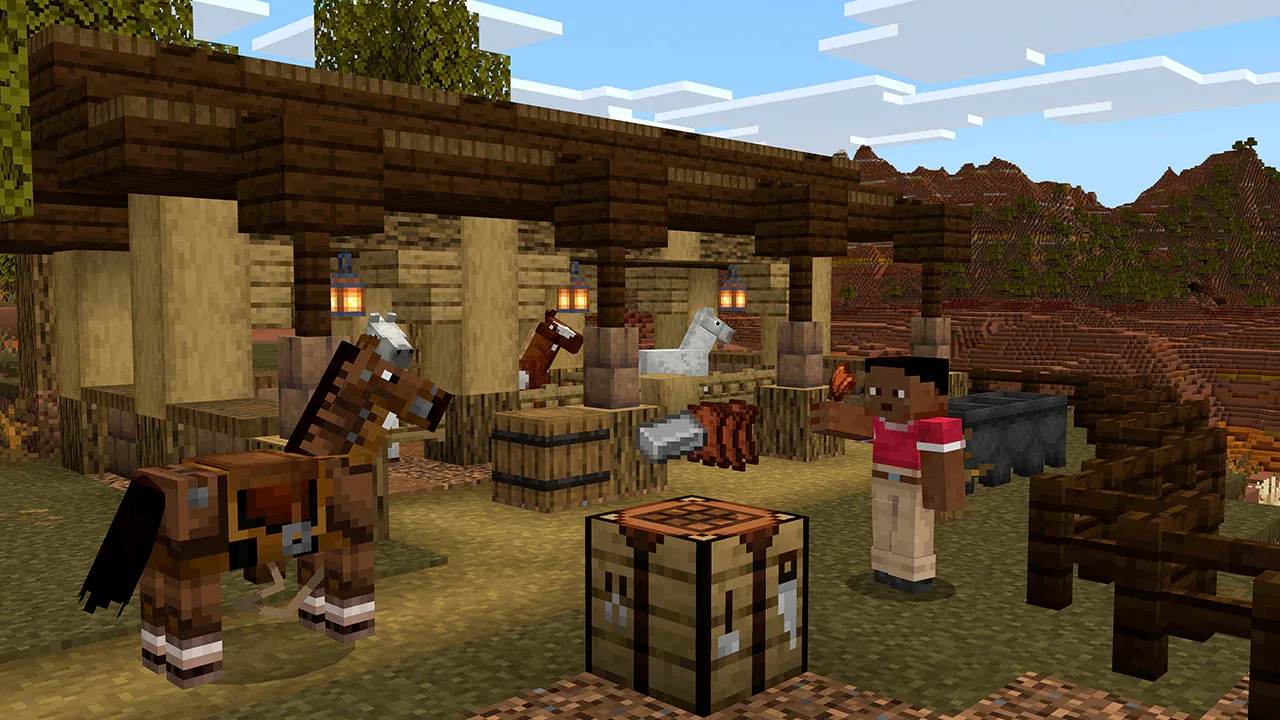
How to Make a Saddle in Minecraft: Recipe and Loot Odds
Saddles have been craftable since June 2025: three leather and one iron ingot. Here is the recipe and what it really costs, every chest, trade and mob drop that still gives one with Java and Bedrock odds, the five chests that stopped, all eleven mobs it fits, and how shears take it back.

Minecraft Transportation Guide: The Fastest Ways to Travel
Walking is for the first three days. After that, the game is a transport optimization problem, and the gap between the fastest and slowest methods is genuinely absurd — we're talking 1.7 m/s on foot versus 72 m/s on a blue ice boat road. Here's every real way to get around, with the actual speeds, so you can stop hoofing it.
Minecraft Bees & Honey Guide: Hives, Farms & Uses
Bees look like a cute side-feature and then quietly become one of the best renewable resources in the game. Here is how they actually work — pollination, hives, the campfire trick that stops the stinging, and what honey and honeycomb are really for.
How to Tame and Breed Every Animal in Minecraft
Taming and breeding are two different systems, and confusing them is why people keep shoving wheat at a wolf. Here is every tameable and breedable mob, the exact food each one wants, and whether the payoff is worth your time.
Minecraft Survival Guide for Beginners: Your First Days
You have about ten minutes of daylight before the sun sets and the world tries to kill you. Here is exactly what to do with them — punch a tree, build a tool chain, and get a roof over your head before the zombies arrive.
Best Minecraft Enchantments, Ranked — The Ones Worth Your XP
Mending is the enchantment that ends the grind — gear that repairs itself forever. Everything else is a fight over your XP and anvil uses. Here is what actually earns a slot, ranked, with the real max levels.