Pokémon TCG Live: Code Cards, Credits, and Free Packs
Pokémon TCG Live is free, runs the paper ruleset, and hands you a collection you then have to grow. The redemption limits are published — 400 booster codes per expansion, 25 Build & Battle codes, four per preconstructed deck. So is the rule that turns your fifth copy of a card into currency. Here is the whole acquisition economy, from The Pokémon Company's own documentation.
Pokémon TCG Live costs nothing and runs the same ruleset as the paper game, which makes it the obvious place to learn. Then you install it, and the interesting part starts: you own a few preconstructed decks, the card your list actually wants is priced in a currency you have not earned yet, and the pile of code cards in your desk drawer may or may not be worth typing in.
The acquisition rules are documented, just scattered: four pages of Pokémon Support, a developer letter on the official forums, and a drop rate page that only one of those support pages points at, in a single line. Everything below comes from those, not from a wiki and not from memory.
There is no cash shop
Start with the thing that shapes every other rule. In the July 2025 developer letter on the official Pokémon forums, the Pokémon TCG Live team addressed rumours that recent economy changes were the run-up to monetisation, and answered directly: "Pokémon TCG Live remains free to play, and there are no plans to add the ability to make real money purchases in the game at this time." The client's own overview page still describes it as learning and playing the Pokémon TCG "at no cost."
That is unusual for a digital card game and it changes what "free-to-play" means here. There is no whale tier to lose to, and no way to convert cash into cards. Past the decks the client hands you on day one, cards reach your collection through three doors: a code card you redeemed, an in-game reward you earned, or in-game currency you spent. The rest of this post is those three doors.
One caveat worth stating rather than burying: the development team has announced "one of our biggest updates yet" for September 15, 2026 and has not described what is in it. The July 2025 position on real-money purchases is the most recent one The Pokémon Company has published, but it was a statement about intent at that time, not a promise.
Two currencies, and what each one does
Pokémon Support's currencies article defines two, and they do not overlap.
Trade Credits buy individual cards. Pokémon Support is not quite consistent about where: the currencies article says you can exchange them in both the Card Dex and the Deck Editor, while its step-by-step exchange article only documents the Deck Editor route. The Deck Editor is the one both pages agree on. Credits are earned by levelling up, and by the duplicate-conversion rule in the next section.
Trainer Points buy sealed items — booster packs, bundles, and deck items. They come from completing quests and levelling up, and they also unlock deck cosmetics and can be spent to unlock a Battle Pass you did not finish.
So the split is: Trainer Points are how you gamble, Trade Credits are how you buy exactly the card you need. If you are building a specific list, credits are the currency that matters, and a pack is worth what it gives you plus what its duplicates convert into.
Note the name. The currency is called Trade Credits and there is no trading in this game — Pokémon Support's answer to whether players can trade cards with each other is one sentence long, and it is no.
How many code cards one product is worth
This is the number that decides whether buying paper for digital value makes sense, and it is published in the Code Card Redemption FAQ. Each product type has a soft redemption limit per account. Hit it, and further codes from that product still work — they just pay out a small amount of in-game currency instead of the item.
| Product type | Soft redemption limit |
|---|---|
| Booster pack | 400 per expansion |
| Build & Battle Box | 25 per expansion |
| Preconstructed deck | 4 per deck |
| Other products, if 1 or more cards would be received | 4 per product |
| Other products, if only deck or avatar cosmetics would be received | 1 per product |
The FAQ notes that some products carry slightly different limits based on their contents, so treat the table as the standard rather than a guarantee for every SKU.
Two practical readings. First, 400 booster codes from a single expansion is a lot of paper — at the 36 packs in a sealed booster box, over eleven boxes — so ordinary collecting does not come close to the ceiling. Second, four per preconstructed deck is a number you can reach buying multiples of one good ex Battle Deck — and the client warns you before you commit, because entering a code displays the item you will receive along with your running redemption count for that product.
Codes redeem two ways — in the app under Shop then Redeem, by typing the code or scanning the QR with a webcam, or on the code redemption site with your Pokémon Trainer Central account. Booster packs and coins land in the Inbox under the Menu rather than straight into your collection. And redemption is account-locked: The Pokémon Company states it cannot move cards or decks between accounts, so a code entered on the wrong login is gone.
What changed about code cards in 2025
If you started playing before the Mega Evolution era and something feels different, it is. The Pokémon Company published an update on July 31, 2025 covering three things.
- Booster pack codes did not change. Same rewards as before.
- Codes in select other products got broader rewards — digital booster packs, digital promo cards, bonus currency, in-game cosmetics or other promotional items, rather than a single fixed item.
- Some products that historically shipped a digital-promo code card no longer include one. The announcement says those promos will be obtainable in Pokémon TCG Live through other means.
The same notice cleans up a genuine printing error: select Mega Evolution packaging describes booster packs as containing an Energy card or a code card. That is wrong. The Pokémon Company's correction is emphatic — every booster pack continues to include both an Energy card and a code card — and it says the packaging will be fixed for future expansions. If you have been checking wrappers and worrying, stop; the box was misprinted, not the pack.
The code card art itself also changed with Mega Evolution, and the new look was released as deck cosmetics for all players.
Trade Credits come from duplicates
You do not buy Trade Credits. Beyond levelling up, they arrive automatically when the game hands you a copy of something you have already maxed out. The thresholds are specific, and they are per card type rather than one blanket rule.
| Card type | You keep up to | Extra copies become Trade Credits |
|---|---|---|
| Standard cards | 4 copies | 5th copy onward |
| ACE SPEC, Prism Star, Pokémon Star | 1 copy | 2nd copy onward |
| Pokémon V-UNION | 1 copy of each part | Any further copy of a part |
| Basic Energy | 59 copies | 60th copy onward |
The support page adds one exclusion to that last row: non-foil Basic Energy cards without a collector number or expansion icon are not counted, so the plain Energy the client hands you does not convert.
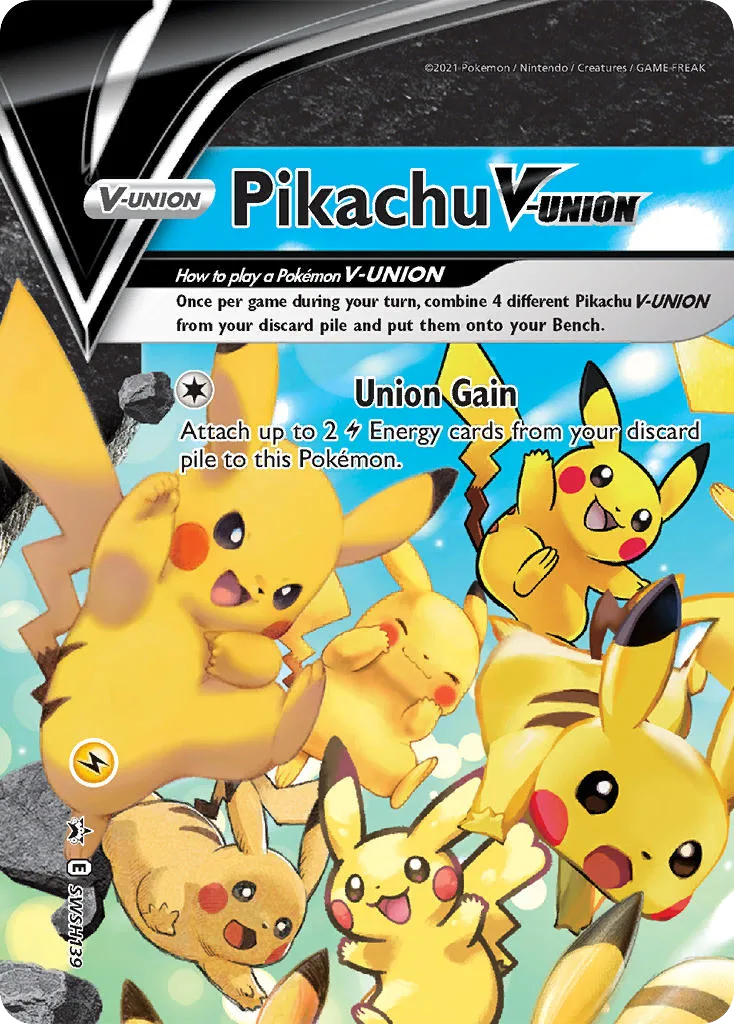
The Pokémon V-UNION row is the one that looks like a typo and is not. A V-UNION is four physically separate cards that combine once per game — Pikachu V-UNION is printed as SWSH139 through SWSH142 in the SWSH Black Star Promos, four different cards that assemble into one 300 HP Pokémon giving up three Prize cards. The client tracks each part separately, so you can be sitting on a spare part three while still missing part one.
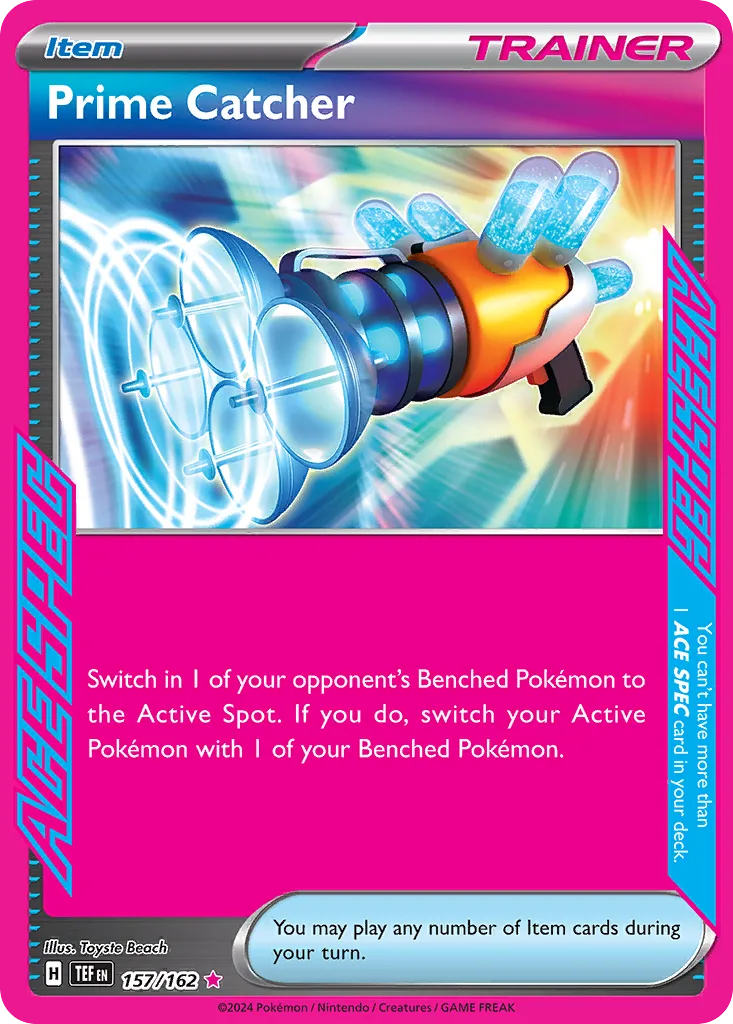
The ACE SPEC row follows the paper rule rather than the collection rule: your deck may contain one ACE SPEC card total, so the client caps you at one copy and converts the rest. Prime Catcher from Temporal Forces prints that restriction on the card itself, and how the subtype works in a 60-card list is covered in our Trainer card guide.
Four rules for spending Trade Credits
Four rules from Pokémon Support's Trade Credit exchange article.
- The documented route is the Deck Editor. The exchange article's steps start there: open Create a Deck or Edit Deck, filter to the card, and exchange from there. If you own zero copies, you may need to change the Show Cards filter before the card appears at all.
- Exchanges are final and non-refundable. The support page states it in bold. Confirm the variant before you press Confirm Exchange.
- You are buying a specific variant, not a card name. Select Available to see the card's available variants and how many copies of each you already own, then pick the one you want. Different variants cost different amounts.
- Play! Pokémon exclusives cannot be crafted at any price. Variants tied to real-world Play! Pokémon activity, such as World Championships and League promos, are obtainable only by redeeming code cards distributed to participants.
Rule three is where the credits go. The Pokémon Company publishes no crafting price list on any of its own pages, and the July 2025 letter confirms values were adjusted in that release to rebalance around the new pack size — so any figure you find is a snapshot, not a rate card. Bulbapedia's community-maintained page records an example of the spread rather than the whole table: a Rare at 400 Credits against 750 for the same card's Illustration Rare. The mechanically useful version of that is simply this — the cheapest legal printing plays identically to the expensive one, exactly as it does on paper, which is the same logic behind buying the base-numbered card instead of the secret rare in a booster box.
A digital pack is collated by slot
The Pokémon Company runs a drop rate page for Pokémon TCG Live covering every expansion in the client. It does not give you odds. What it gives you is the collation — which rarities can appear in which slot — plus a complete card list flagged for the standard set and the parallel (reverse holo) set.
Here is the structure it publishes for Mega Evolution—Pitch Black, an 84-card expansion that reached the client on July 16, 2026 and whose numbering runs to 120 once the secret cards are counted.
| Pack slot | Rarities that can appear |
|---|---|
| 1 | Common, illustration rare, ultra rare, special illustration rare, Mega hyper rare |
| 2-4 | Common |
| 5-7 | Uncommon |
| 8 | Common, uncommon or rare — parallel set |
| 9 | Common, uncommon or rare (parallel set), illustration rare, special illustration rare, Mega hyper rare |
| 10 | Rare, double rare, ultra rare |
Read it against the physical pack and two things stand out. The digital pack is ten cards with no Energy card and no code card, because it does not need either. And slot 1 — a plain Common in paper — can upgrade all the way to a Mega hyper rare in the client. Bulbapedia records that as a deliberate change from the July 2025 update, when digital pack size and composition were brought in line with their real-life counterparts apart from that first-slot upgrade chance.
What the page does not do is quote probabilities anywhere. The same honest limit applies here as it does to paper pull rates: availability is published, odds are not.
The Battle Pass is the actual engine
If you never redeem a code, in-game rewards are the whole of your collection, and the Battle Pass is the structured version of them. The Pokémon TCG Live site says a new Pass arrives with the release of every new expansion, and you climb it by battling and completing quests.
The July 2025 letter is specific about the current design and why it exists. The team lengthened and softened the Pass in a single pass of changes: more XP awarded per quest, more levels, and more reward per level, with the stated aim of "better overall access to cards and Trade Credits over the lifetime of each expansion." The Pass went to 100 levels, and the letter says the team plans to keep the 100-level design "unless player behavior changes in a way that requires further adjustment."
Quest design was tuned in the same direction: the first two Daily Quests are meant to be casual-friendly, with the third pitched harder for players pushing up the Pass, and double XP challenges occasionally dropped into that third slot.
The same letter compressed the Ranked Ladder reset. Players used to fall all the way to Quick League at every turnover; from the July 2025 reset onward the drop is capped at 8 full ranks, which the team framed as honouring where players actually landed. Skipping a ladder entirely still resets you twice, and you still end up back in Quick League.
Why the client says your deck is invalid
The support article on unusable cards and decks lists what a valid deck must satisfy, and one of the six has no paper equivalent.
- Exactly 60 cards
- At least 1 Basic Pokémon
- No banned cards
- No cards illegal in the selected format
- Only cards you own in Pokémon TCG Live
- Any additional rules for the selected format or game mode
That fifth line is the digital tax. A list you netdecked is a shopping list until every card in it is in your collection, which is why the Deck Editor lets you add cards you do not own and then offers the exchange. Version 1.37.0, released April 21, 2026, added deck import options that automatically swap in cards you already own, which takes some of the sting out of it.
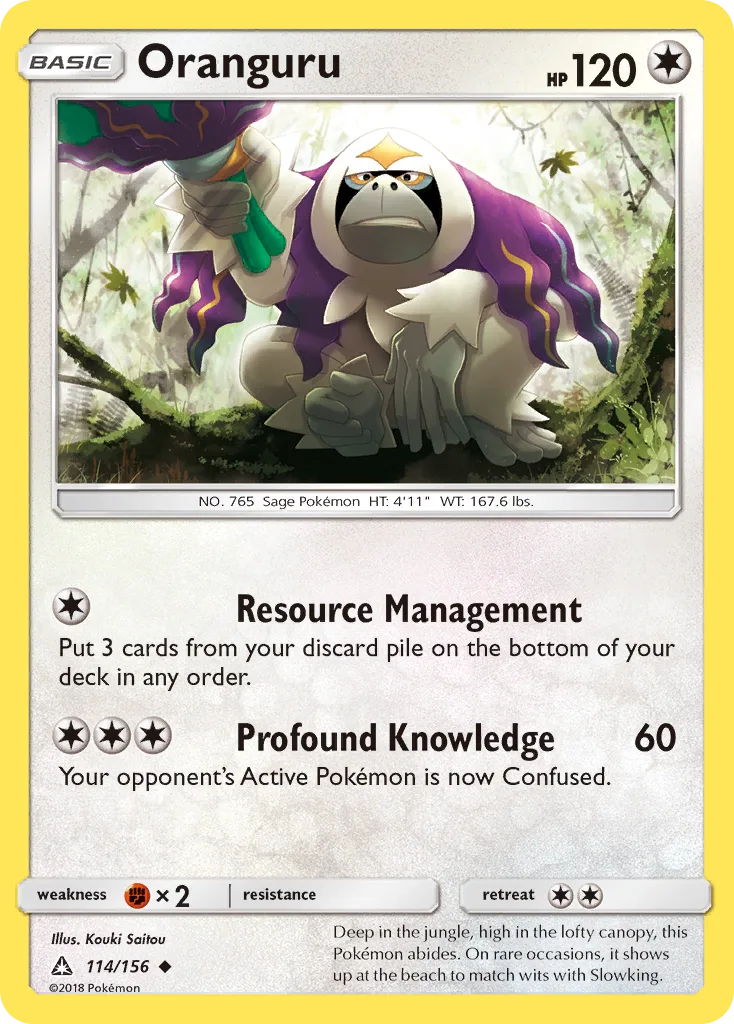
Format legality behaves the way it does on paper, with one gap. A card that rotated out of Standard is still legal in Expanded, and rotation has no effect there — but Pokémon TCG Live does not support the entire Expanded card pool for active play. The support page states that backward compatibility work is ongoing and phased support for additional Expanded cards is expected to begin in 2026. The Expanded ban list applies too, and The Pokémon Company's own worked example is Oranguru from Sun & Moon—Ultra Prism, 114/156, banned in Expanded while other Oranguru cards remain legal. Which format to build for, and what each pool contains, is laid out in our formats guide.
Quick Action Checklist
- Redeem every code card you own, even from products you did not open for the digital reward. Booster codes cap at 400 per expansion, so you are nowhere near the ceiling.
- Check the count before redeeming a fourth preconstructed deck code — that limit is 4 per deck, and past it you get currency instead.
- Never redeem while logged into a second account. Cards and decks cannot be moved between accounts.
- Spend Trade Credits in the Deck Editor, on the cheapest legal printing, and check the variant twice. The exchange is final.
- Do not save credits for Play! Pokémon promo variants. They are code-card-only.
- Finish the Battle Pass — 100 levels of packs, credits and cosmetics, and Trainer Points can buy out levels you did not reach.
- Build for Standard first if you are new. Expanded support in the client is still incomplete.
- Learn the paper rules alongside it. The client uses the same ruleset, so everything transfers to a real table.
Frequently Asked Questions
Can you trade cards with other players in Pokémon TCG Live?
How many Pokémon TCG Live code cards can you redeem from one product?
How do you get Trade Credits in Pokémon TCG Live?
Do Pokémon TCG booster packs still include a TCG Live code card?
Why can I not craft a certain card variant in Pokémon TCG Live?
Keep Reading
- Pokémon Support — In-game currencies in Pokémon TCG Live: what Trade Credits and Trainer Points buy, and the duplicate-conversion thresholds (4 copies, 1 ACE SPEC / Prism Star / Pokémon Star, 1 of each V-UNION part, 59 Basic Energy)
- Pokémon Support — How Do I Exchange Trade Credits to Obtain Cards: Deck Editor-only exchange, variant selection, exchanges final and non-refundable, Play! Pokémon exclusive variants uncraftable
- Pokémon Support — Code Card Redemption FAQ: redemption methods, account lock, and the soft redemption limits (400 booster codes per expansion, 25 Build & Battle, 4 per preconstructed deck)
- Pokémon Support — Why can't I use my card or deck in Pokémon TCG Live: the six deck-validity requirements, the ownership rule, Expanded ban example Oranguru (Ultra Prism 114/156), and phased Expanded support expected in 2026
- Pokémon Support — Can players trade cards in Pokémon TCG Live: no player-to-player trading
- The Pokémon Company (July 31, 2025) — Updates to Pokémon TCG Live Code Cards: booster codes unchanged, expanded rewards on select other products, some products drop their digital-promo code, and the Mega Evolution packaging misprint correction
- Pokémon TCG Live developer letter (July 2025) — Ranked Ladder reset capped at 8 ranks, the 100-level Battle Pass, quest and double-XP design, the Trade Credit revaluation, and the statement that the game remains free to play with no planned real-money purchases
- The Pokémon Company — Pokémon TCG Live Card Drop Rate Information: per-slot rarity availability for the 10-card digital booster and the full standard/parallel card list, shown here for Mega Evolution—Pitch Black
- The Pokémon Company — Pokémon TCG Live overview: free-to-play framing, game modes, Battle Pass per expansion, and the code-redemption entry points
- Pokémon TCG Live Letter to the Community (August 14, 2026) — 2026 Fall Study Season, September 3-15 events, new accessibility settings, and a major update announced for September 15, 2026
- Pokémon TCG Live Version 1.41.0 patch notes (August 18, 2026) — current client release, including a fix for repeated code-card redemption failures on a single product
- Pokémon TCG Live Version 1.37.0 patch notes (April 21, 2026) — deck import that automatically swaps in cards you own, full-screen deck view and clearer deck validation
- Bulbapedia — Pokémon Trading Card Game Live: community-recorded crafting cost example (Rare 400 Credits, Illustration Rare 750) and the July 2025 change aligning digital pack size and composition with physical packs
- Pokémon TCG API — Pikachu V-UNION SWSH139-SWSH142: four separate cards combining into one 300 HP Pokémon V-UNION worth three Prize cards
- Pokémon TCG API — Mega Evolution—Pitch Black set data: 84 printed cards, 120 total, released 17 July 2026
Related Guides
Pokémon TCG Pocket Rules vs the Pokémon TCG, Explained
Pokémon TCG Pocket looks like the Pokémon TCG and uses the same cards, but it is not the same game with a phone screen bolted on. Half the deck is gone, Energy cards do not exist, mulligans cannot happen, and the player who goes first gets the opposite restriction from the paper game. Here are the confirmed core rule differences Pocket made, sourced against Bulbapedia's maintained differences list and The Pokémon Company's own deck-building guide.
Pokémon TCG Prerelease: Build & Battle Box, 40-Card Decks
A Prerelease is the one Pokémon TCG event where the entry fee is the deck. It is also a different game to the one on the Championship Series circuit: 40 cards, no copy limit, four Prize cards. Here is what the Tournament Handbook and the Play! Pokémon organizer guide actually say about Limited play, and what the maths does when you cut two Prizes out of the game.
Pokémon TCG Energy Explained: Basic vs Special, Attack Costs, and the One-Per-Turn Rule
Attacking never spends your Energy. Retreating does. There are exactly nine basic Energy cards in the game's history and two Pokemon types that never got one. Here is how Energy actually works, straight from the rulebook and the card database — attack costs, the one-per-turn attachment rule, every legal way around it, and why Special Energy is a target painted on your attacker.
Pokémon TCG Trainer Cards Explained: Item, Supporter, Stadium, Tool, and ACE SPEC Rules
You can play seven Items in a turn and nobody blinks, but a second Supporter gets you stopped mid-motion. Every Trainer subtype carries its own play rule, printed right on the card, and the differences decide how modern decks are built. Here is what the official rulebook actually says about Items, Supporters, Stadiums, Pokémon Tools, and the one-per-deck ACE SPEC rule.
How to Play the Pokémon TCG — Full Rules and Turn Structure (2026)
Two players, 60 cards each, six face-down Prize cards, and a coin flip. That is the whole skeleton of the Pokémon TCG. Here is every rule that actually matters on turn one, from setup through the three ways to win.
Pokémon TCG Card Rarities Explained: Symbols, Secret Rares, and What Holds Value
You pulled something gold and you have no idea if it matters. Here is the whole Pokémon TCG rarity ladder - the three base symbols, the modern tiers above them, secret rares numbered past the set total, and what actually drives value.