Riftbound Deckbuilding Basics - The Legal Rules, the Curve Math, and Fixing a Precon
A legal Riftbound deck is four separate stacks, and three of them are not the 40 cards you spent all your time on. Here is deck construction straight out of Riot's Core Rules and Tournament Rules, the rune math that decides your curve, the six mistakes new builders make, and how to upgrade a Showdown Deck without making it illegal.

Nobody loses their first Riftbound deckbuild to a bad card choice. They lose it to the moment a judge asks to see their battlefields and they realise they never picked any.
Riftbound asks for four physically separate stacks of cardboard before a game can start, and only one of them is the pile of forty cards everyone means when they say "my deck." The rest - a Legend, twelve runes, three battlefields - are treated as afterthoughts by roughly every new player, and they are the parts that quietly decide whether your curve works.
Everything below comes out of the official Riftbound Core Rules and Tournament Rules, plus Riot Game Director Dave Guskin's own Deckbuilding Primer. It was written against the 16 July 2026 versions of both documents, which stay in force until 15 October. Riot's 9 October update to both, effective 16 October, keeps every deck construction number below the same - 40 cards, 3 copies, 3 Signature cards, 12 runes, 3 battlefields, a sideboard of 10 or fewer - and the wording changes that affect what this guide says are noted where they apply. Where I do arithmetic on a real decklist, it is Riot's published decklist, and I have shown the working. What you will not find here is a tier list. Vendetta went live on 31 July 2026 - two days before this was written - and anybody selling you a settled metagame this week is guessing.
The four stacks you are actually building
The Core Rules define "your deck" as all of this together:
| Stack | What it is | Where it starts |
|---|---|---|
| Champion Legend | Exactly 1 card | Legend Zone, face up, never leaves |
| Main Deck | At least 40 cards, including your Chosen Champion | Main Deck Zone, shuffled |
| Rune Deck | Exactly 12 rune cards | Rune Deck Zone, shuffled, kept physically separate |
| Battlefields | Count set by the mode - three in 1v1 | Set aside before setup |
Your Chosen Champion is pulled out of the Main Deck before the game and placed in its own Champion Zone, where you can play it from at any point. That is a guaranteed card every single game, which is why it is the second decision you make and not the fortieth.
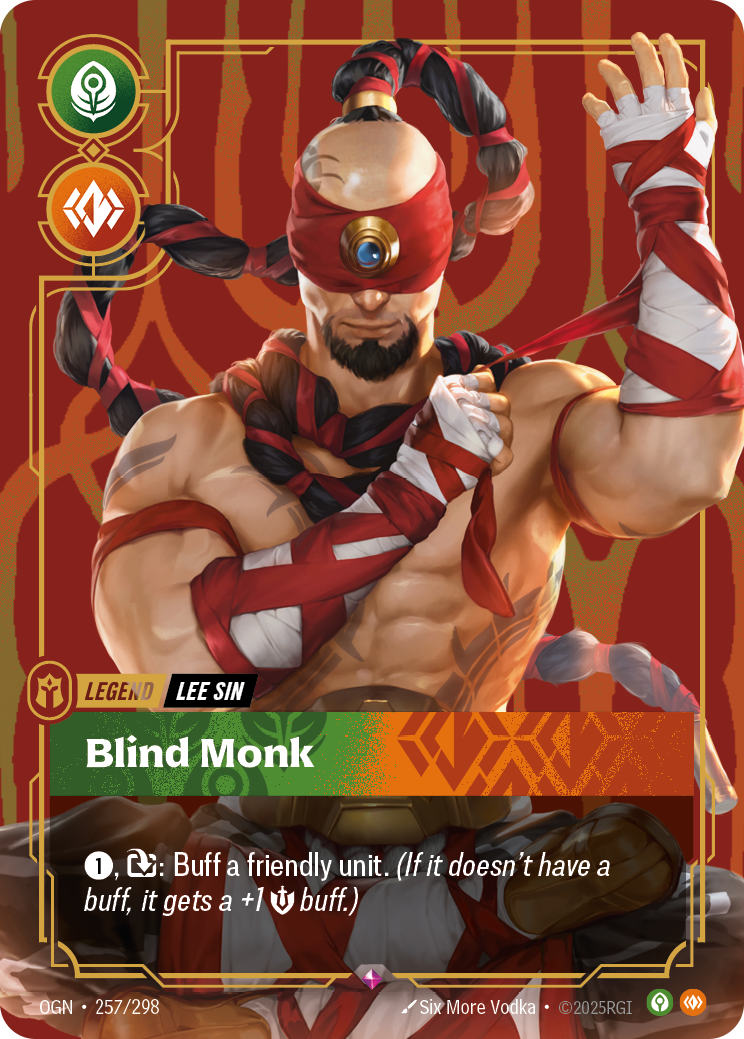
That is Blind Monk, the Lee Sin Legend from Origins. Two symbols in the top-left corner, a champion tag reading LEE SIN, and an always-on ability. Those three elements are your entire deckbuilding brief: the symbols say what you may play, the tag says who your Chosen Champion must be, and the ability says what your deck is for.
The legal minimum, quoted
Straight out of rule 103, Deck Construction:
- Main Deck of at least 40 cards, containing a Chosen Champion plus units, gear and spells.
- Up to 3 copies of the same named card - and "This includes your Chosen Champion." The rules spell out the consequence: a deck could run Volibear, Furious as its Chosen Champion and still hold two more copies in the Main Deck.
- Cards have different names even if they represent the same character. Three Yasuo, Remorseful and three Yasuo, Windrider is legal. Six Yasuos, zero problems.
- Rune Deck of exactly 12 rune cards, all inside your Domain Identity, shuffled and kept separate from the Main Deck.
- Battlefields per your mode, with no two sharing a name when the mode wants more than one.
- Your Chosen Champion must be a champion unit whose champion tag matches the tag on your Champion Legend.
That last one has a trap the rules bother to call out. Tibbers carries the tag Annie, but it is a signature unit, not a champion unit - so it can never sit in the Champion Zone, even in an Annie deck. Check the type line, not the tag.
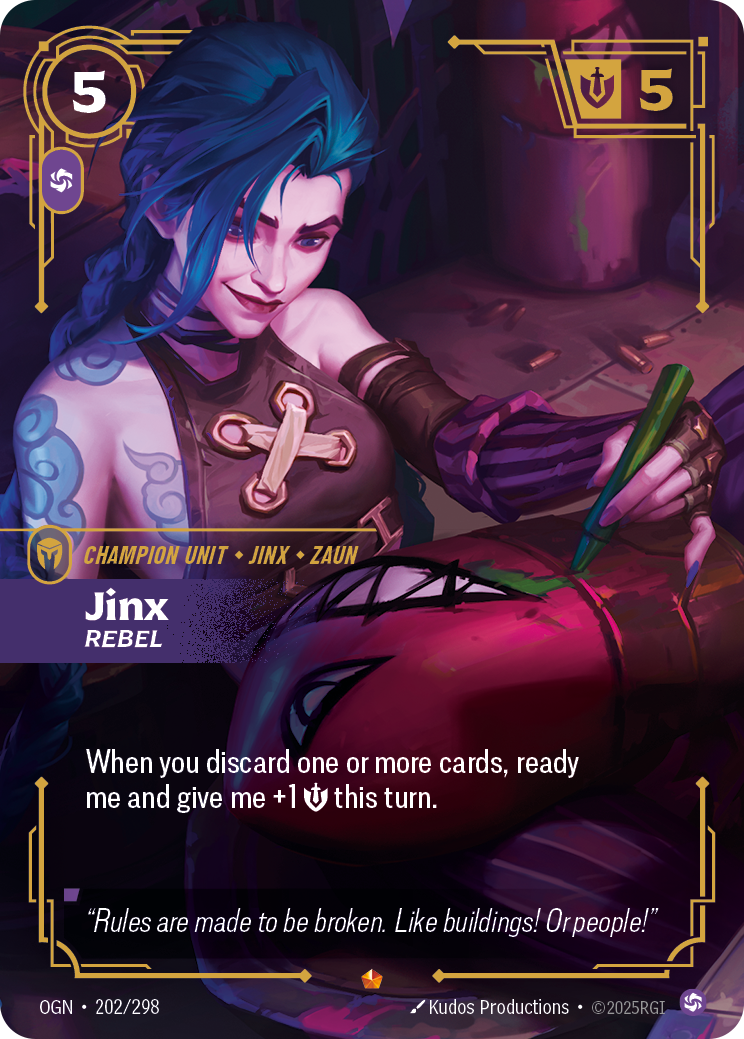
Jinx, Rebel is the rulebook's own worked example: Loose Cannon has the tag Jinx, so a player on that Legend can name either Jinx, Rebel or Jinx, Demolitionist as their Chosen Champion. Note the cost corner while you are here - a numeral for Energy, and a separate symbol underneath for Power. Those are two different resources and they come from two different actions. Hold that thought.
At least 40 versus exactly 40
The Core Rules say at least 40. The Tournament Rules say something narrower. Rule 402.1 in the version in force until 15 October says that in a constructed event, players must register "a Main Deck of exactly 40 cards (including a chosen champion), 1 Legend, 12 runes, and exactly 3 battlefields each with a unique name." Riot's 9 October update, effective 16 October, keeps every one of those numbers and changes "register" to "use" - its changelog says the old wording "implied deck registration was required at low OPL."
So the honest answer to "how big should my deck be" is 40, always, and the only reason the Core Rules leave the ceiling open is kitchen-table play. Guskin puts the case plainly in his own sidebar: going over 40 makes it "less likely you draw into your most powerful cards like your champion and your signature cards."
He is understating it. You open on four cards, with a mulligan that lets you set aside up to two and redraw the same number. Then you draw exactly one per turn. Riftbound gives you less card selection than almost any modern TCG, and diluting a 40-card deck to 45 is not a rounding error - it is a 12 percent haircut on every card you actually built the deck to find. Play 40.
Domain Identity is a wall, not a guideline
Your Legend's domains set your Domain Identity, and every card in your deck has to fit inside it. Two clauses matter:
- A single-domain card is legal in any Domain Identity containing that domain.
- A multi-domain card is legal only in a Domain Identity that contains all of its domains.
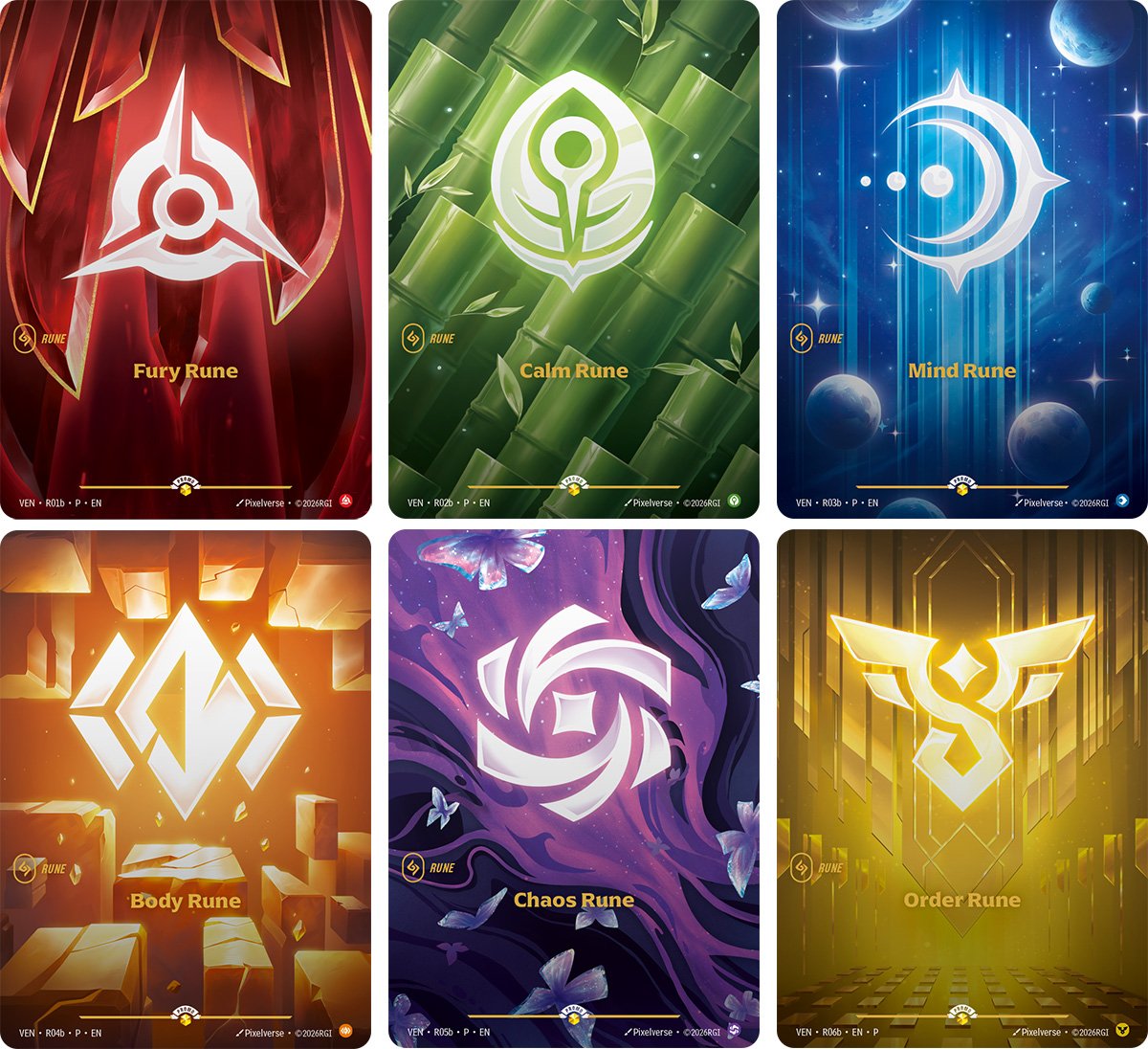
There are six domains - Fury, Calm, Mind, Body, Chaos and Order - and every Legend released so far pairs two of them. Blind Monk is Calm and Body. Eye of Twilight, the Shen Legend from Vendetta, is Calm and Order. Master of Shadows, the Zed Legend, is Fury and Chaos.
The second clause is the one people misread. A Calm-and-Order dual card like Shadow Dash is not playable in a Calm-and-Body deck just because you can pay Calm. You need both halves. If you come from Magic, this is closer to commander colour identity than to a mana base - and unlike Magic, there is no fixing card that bails you out. Our Magic colour pie breakdown is a decent mental model for what each domain wants, but the enforcement here happens when you build the deck, not at the table.
The Signature rule that eats decklists
This is the rule that most often turns a "finished" 40 into an illegal one:
Your deck may only contain 3 total Signature cards that have the same Champion tag as your Champion Legend. Regardless of name, a deck may only contain a sum total of 3 Signature cards.
Read it twice. It is not three copies of each Signature card. It is three Signature cards, full stop, across every Signature card in the deck. If your champion has two Signature cards you like, you are splitting three slots between them - 2/1 or 3/0, never 3/3. And all three must carry your Legend's champion tag, so you cannot borrow somebody else's Signature spell because it happens to be in your domains.
Guskin's advice is to reserve the maximum three, because Signature cards are deliberately pushed - "honestly more powerful than other cards of comparable cost." Take the three unless you have a specific reason not to.
Runes: twelve cards that decide your curve
The Rune Deck is where Riftbound stops resembling anything else. Twelve cards. Not 17 lands, not a variable count - twelve, fixed, for every deck ever built.
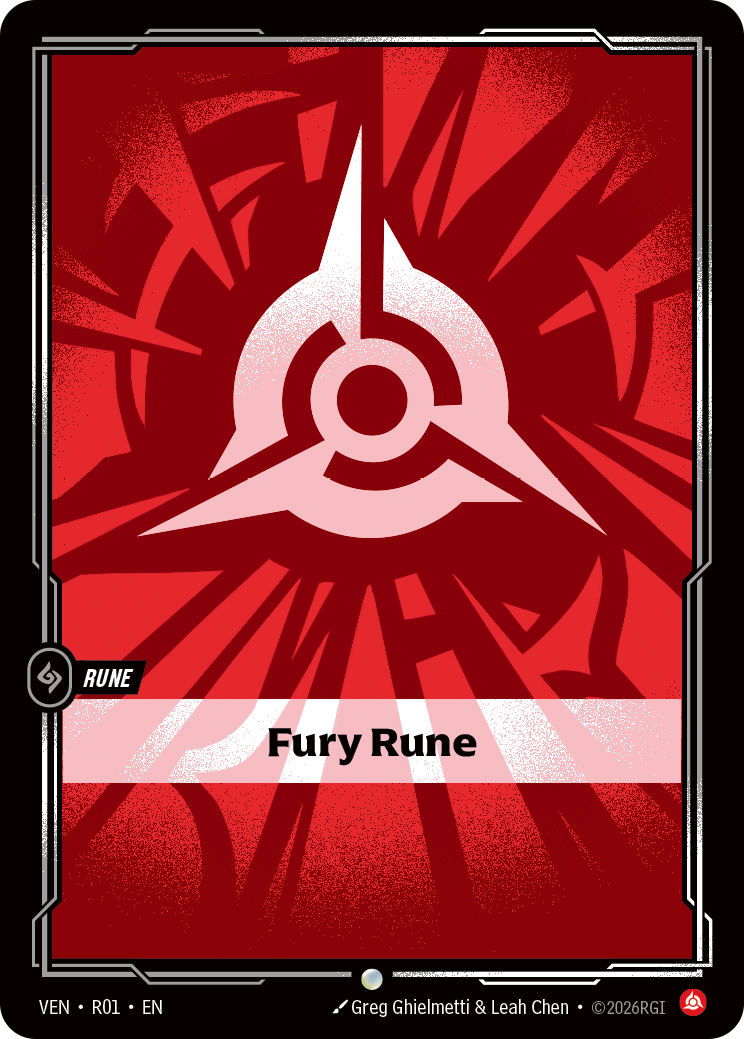
There are six Basic Runes, one per domain, and every one of them has the same two abilities:
- Exhaust it: add 1 Energy. Energy has no domain and no type. It pays the numeral in a card's cost corner.
- Recycle it: add 1 Power of that rune's domain. Power pays the symbols. Recycling sends the rune to the bottom of your Rune Deck.
That is the whole engine, and it produces two consequences that most new builders never connect.
First, each rune does one job per turn. A rune you exhausted for Energy is not available to recycle for Power, and a rune you recycled is off the board entirely until you channel it again.
Second, your Rune Pool empties twice - at the start of each player's Main Phase and at the end of each turn - and any unspent Energy or Power is simply lost. There is no floating, no banking, no ramping into a big turn six by saving up. Whatever you can generate this turn is the entire budget for this turn.
Your turn-by-turn resource ceiling
During your Channel Phase you channel exactly 2 runes off the top of your Rune Deck. Runes stay on the board once channelled. Nothing in a standard turn channels more, and the player going second in 1v1 gets exactly one extra rune during their first Channel Phase.
Do the arithmetic and the curve writes itself. Going first, before you spend a thing:
| Your turn | Runes on board | Max Energy that turn |
|---|---|---|
| 1 | 2 | 2 |
| 2 | 4 | 4 |
| 3 | 6 | 6 |
| 4 | 8 | 8 |
| 5 | 10 | 10 |
| 6 | 12 | 12 |
Turn six is also where the Rune Deck runs dry - all twelve are on the board, and the rules say that when there are fewer than 2 runes left you simply channel as many as possible. Twelve is your hard ceiling unless a card says otherwise. That is why a 6-cost card is a genuinely late-game card in Riftbound and a 7-cost card is a statement of intent.
Now overlay the opening hand. Four cards, one mulligan of up to two, one draw per turn. On turn three you have seen roughly seven cards and can spend six resources. If your deck's cheap end is thin, you are not "durdling" - you are physically unable to contest a battlefield while your opponent walks a 2-drop onto it and starts scoring toward 8.
Power pips are a tax on the same turn
Here is the bit the resource system hides in plain sight. A card costing 4 Energy and 1 Power does not cost "five-ish." It consumes five runes on the turn you cast it: four exhausted, one recycled off the board.
On turn three, with six runes out, that card leaves you exactly one rune of slack. On turn two, with four runes, you cannot cast it at all. Power-heavy cards are a full turn later than their Energy number suggests, and stacking two of them in one turn is usually a fantasy.
Riot's published Shen Showdown decklist shows how a designed-for-beginners deck handles that. Counting the 40 Main Deck cards myself: 26 of them cost pure Energy with no Power symbol at all. Thirteen ask for exactly one Power. Exactly one card - Shen, Leader of the Kinkou Order at 6 Energy and 2 Power - asks for two, and it is the single most expensive card in the deck.
That ratio is the lesson. Roughly two thirds of a functional deck should be castable without spending a rune off the board, so that your Power cards are a decision rather than a bottleneck. Guskin's alternative, if your two domains are lopsided, is to skew the Rune Deck - "play mostly zero-power cards in one domain, and the heavy hitting multiple-power cards in the other," then run something like an 8-4 split toward the demanding side. His default recommendation, and the one both Showdown Decks ship with, is 6-6.
Riot's own rules of thumb, and what they're really saying
From the official primer, with my read on each:
- "Play 9+ small units." Meaning 2-to-4 cost units, enough that you reliably have one by turn one or two. This is not a preference, it is the scoring clock - you cannot take a battlefield with an empty board.
- "Play 6+ interactive spells." Cards that buff yours, shrink theirs, or kill things. Combat decides battlefields, and a deck with no tricks loses every close fight.
- "Don't overload with spells and gear. When in doubt, play more units." Spells support board presence. They do not stand on an objective.
- "Play more of your champion." Extra copies of the card you built around, because opponents will answer the first one.
Check those against the Shen precon and it clears every bar with room to spare: 28 units, 10 spells, 2 gear, and 20 of those units sit in the 2-to-4 Energy band. Its curve, counted card by card, runs 4 one-drops, 16 two-drops, 9 three-drops, 4 four-drops, 6 five-drops and a single six. That is a deliberately front-loaded, teach-you-the-game shape - and it is a perfectly good template to copy before you have opinions of your own.
Battlefields are three slots most people waste
In 1v1 each player brings three battlefields with unique names. Only one from each player is used in a given game, so two are in play total. In best-of-one they are selected at random; in a best-of-three match you choose, and after any game that produced a winner the battlefields used in it are removed for the rest of the match - both players', not just the winner's - forcing you onto your second and third picks. Only a drawn game's battlefields carry forward.
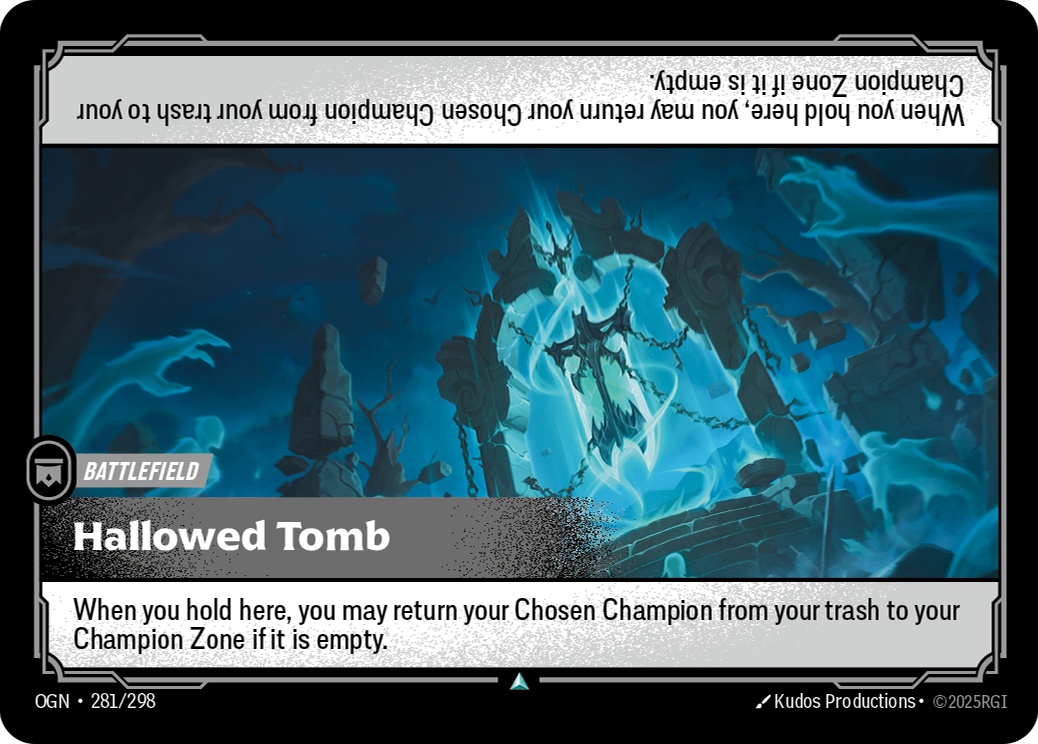
Every battlefield printed so far is colorless, and the Core Rules only make them "subject to Domain Identity if applicable" - so in practice every legal battlefield is available to every deck. That freedom is exactly why people pick lazily. Guskin's three filter questions are better than anything I'd invent:
- Which battlefields do the most to support my strategy?
- Which would be disastrous for my strategy if my opponent controlled them?
- Which are slightly better for me than for my opponent?
Question two is the one nobody asks. Both players' battlefields sit on the same board, and yours is a resource your opponent can take. A battlefield that rewards going wide is a gift to the token deck across the table.
Two more practical notes. Because a best-of-three burns the battlefields from every decided game, all three picks need to be genuinely playable - a "filler" third is a real liability in game three. And five battlefields are banned in Standard Constructed on Riot's list as of 18 September 2026: The Arena's Greatest, Aspirant's Climb, Dreaming Tree, Obelisk of Power and Reaver's Row.
Six mistakes new builders make
- Running 45 cards because you couldn't cut. Illegal in constructed, and bad everywhere else.
- Running three copies of two different Signature cards. Three total. Not three each.
- Treating the Rune Deck as flavour. It is fixed at twelve and it is the only thing standing between you and your costs.
- Ignoring Power pip density. Count them. If half your deck wants a Power symbol, half your deck is a turn later than you think.
- Building a top-end you can never reach. Twelve runes is the ceiling. Two 7-drops is a plan; six is a coin flip on the game lasting long enough.
- Picking battlefields last, in thirty seconds. They are three of the cards in your deck and they are shared terrain.
Upgrading a starter product without breaking it
The cleanest on-ramp is a preconstructed deck, and the newest one is the Vendetta Showdown Decks - two ready-to-play decks, Shen and Zed, built to be played against each other out of the box. Riot published both decklists in full, so you can audit them before you buy.
Each of those decks is 56 physical cards, and the breakdown tells you exactly why: 40 Main Deck (including the champion options), 12 runes, 3 battlefields, 1 Legend. Shen runs Eye of Twilight with 6 Order and 6 Calm runes on Kinkou Temple, Grove of the God-Willow and Threshold of the Gray. Zed runs Master of Shadows with 6 Chaos and 6 Fury on Zaun Warrens, Shadow Temple and Threshold of the Gray. Same skeleton, different everything else.
To upgrade one without wrecking it:
- Swap one-for-one. The deck is exactly 40. Every card in is a card out, or you have broken the only hard number in the format.
- Cut the singletons first. Precons are stuffed with one-ofs for variety, not consistency. In the Shen list, the single copies of Shadow Dash, Steel Paws, Resonating Strike, Ki Barrier, Lacerate, Twilight Shroud and Dragon Form are where the fat is. Turning three of those into a third copy of something already good is the highest-value change you can make.
- Go up on your Chosen Champion before anything else. You are allowed three copies including the one in the Champion Zone. Guskin recommends it, and it is the cheapest way to make a precon more consistent.
- Respect the pip count. If you add three Power-hungry cards, you have moved your whole curve back a turn. Either cut a Power card elsewhere or skew the runes.
- Rethink the battlefields last, but do rethink them. Precon battlefields are chosen to teach, not to win.
- Keep the Legend fixed. Changing your Legend changes your Domain Identity, which can silently invalidate half the deck.
If you would rather start even earlier, the Proving Grounds starter set is Riot's own recommended entry point - four preconstructed decks, a rulebook, playmats and tokens for two to four players. And if you have not sat down with the actual rules yet, start with our full Riftbound rules walkthrough before you build anything.
The precon ban-list loophole
This one is genuinely strange and worth knowing, because it changes the moment you touch a precon.
At low-stakes organised play levels, the Tournament Rules allow a player using the exact deck configuration of a preconstructed Riftbound product to play cards that are on the banned list. Riot's own example is the Jinx Champion Deck, which contains Fight or Flight, Scrapheap and Reaver's Row - all currently banned in Standard Constructed.
The catch is absolute: "If the player makes any changes or adds a sideboard, they can no longer include the banned cards." Change one card, and every banned card in the box becomes illegal. So an out-of-the-box precon at a Nexus Night is fine, and a precon plus your three favourite upgrades is a deck legality problem. Decide which one you are before you sleeve up.
The Standard Constructed banned cards on Riot's list as of 18 September 2026 are Called Shot; Draven, Vanquisher; Ekko, Recurrent; Fight or Flight; Scrapheap; Stacked Deck; and Stealthy Pursuer. Ekko, Recurrent and Stacked Deck were the two added in the September update. Standard is not rotating yet - Riot has said rotation begins in 2028 - so as of August 2026 everything from Origins forward is legal, which the 2026 set schedule covers set by set.
Sideboarding: what you can and cannot change
Sideboards only exist in competitions that allow them, and in constructed the Tournament Rules put them at 10 or fewer cards (rule 601.1.c.1, unchanged between the July 2026 version and Riot's 9 October update) - worth flagging, because the limit was 8 or fewer until Riot's July 2026 update raised it to 10. Sideboard cards must be valid Main Deck cards, and your 3-copy limits apply across Main Deck and sideboard combined.
The mechanics, and they are stricter than most games:
- No sideboard cards in game one.
- Swaps are strictly 1-for-1, and your Main Deck must still be exactly 40 afterwards. (Riot's 9 October update, effective 16 October, rewords rule 403.4 to say the 1-for-1 exchange applies in constructed, not limited.)
- In constructed you may not change your Runes, Legend or Battlefields at any point after deck registration.
- You may change your Chosen Champion, from your sideboard or Main Deck, as long as it still matches your Legend.
That last pair is the real design statement. Your twelve runes and your three battlefields are locked for the entire match, which means they have to answer the whole field, not one matchup. Your Chosen Champion, meanwhile, is a between-games lever - which makes running both versions of your champion a genuinely competitive choice rather than a cute one.
The checklist
- 1 Champion Legend. It sets your Domain Identity and your Chosen Champion's tag.
- Main Deck of exactly 40 in tournaments, at least 40 casually, including the Chosen Champion.
- Max 3 copies of a named card. Different subtitles are different names.
- Max 3 Signature cards in total, all matching your Legend's champion tag.
- Rune Deck of exactly 12, inside your Domain Identity. Start 6-6, skew to 8-4 if one domain is pip-heavy.
- 3 battlefields, unique names, colorless so anything legal is fair game.
- 9+ units at 2-4 Energy. 6+ interactive spells. Units over spells when unsure.
- Aim for roughly two thirds of the deck castable on Energy alone.
- Remember the ceiling: 2 runes channelled per turn, 12 total, pool empties every turn.
- Constructed sideboard 10 or fewer, swapped 1-for-1, and your runes, Legend and battlefields are locked once registered.
Build the rough draft, take it to a Nexus Night, and let losing tell you which three cards are wrong. That is still the fastest deckbuilding tool anyone has invented.
Frequently Asked Questions
How many cards are in a Riftbound deck?
How many copies of a card can you play in Riftbound?
How many Signature cards can a Riftbound deck have?
How does the Riftbound rune deck work?
What is a good rune split in Riftbound?
How big is a Riftbound sideboard?
Can you play banned cards from a Riftbound preconstructed deck?
How many battlefields do you need for a Riftbound deck?
Keep Reading
- Riftbound Rules Hub (Riot Games) - Core Rules, Tournament Rules and ban list
- October 2026 Tournament Rules Changelog (Riot Games) - published 9 October, effective 16 October 2026
- Radiance Patch Notes (Riot Games) - Core Rules update published 9 October, effective 16 October 2026
- September Ban List Updates (Riot Games) - Ekko, Recurrent and Stacked Deck banned, effective 18 September 2026
- July 2026 Tournament Rules Update & Changelog (Riot Games) - constructed sideboard raised from 8 to 10
- Riftbound Deckbuilding Primer - Game Director Dave Guskin (Riot Games)
- The Vendetta Overview (Riot Games) - Showdown Deck decklists and set details
- Riftbound Official Card Gallery (Riot Games)
- Riftbound - Your Journey Starts Here (Riot Games) product overview
Related Guides
Riftbound Sealed and Draft: The Limited Format Rules
Riftbound Limited is not constructed on a budget - it switches off most of the deckbuilding rules you learned. Sealed hands you six packs and a 25-card minimum, Draft hands you three packs and a 20-card minimum, and both let you run ten copies of the same card, ignore Unique, and play cards that are banned in Standard.
Riftbound Domains Explained: All 6 Colors and Their Legends
Riftbound has six domains, and your Legend picks two of them for you. Here is what each color actually plays like - its strengths, its blind spots, its signature mechanics - plus the full grid of all 49 Legend cards by domain pairing, and the three rival pairings that did not exist until Vendetta.

Riftbound Vendetta Rules FAQ: Key Rulings Explained
Riot published the Vendetta Rules FAQ on 14 August 2026 and gave it precedence over the Core Rules Document until a new one was released. That new rulebook arrived on 9 October, effective 16 October. The FAQ also reverses a ruling Riot published in January, explains why Kayle can hold three copies of a status the rules call binary, and admits to a bug the Vendetta rules update introduced.
Riftbound Keywords Explained: All 28 in the Core Rules
The Riftbound Core Rules in force until 15 October 2026 define 25 keywords, and Riot's 9 October update adds Deploy, Disarm and Show Off from 16 October, for 28. The reminder text printed on the card is a summary, not the rule. Here is the whole glossary sorted by what each keyword actually is - passive, triggered, activated, permissive, dependent, cost, or a deck-construction rule that never does anything at the table.

How to Play Riftbound — The League of Legends TCG Rules, Explained (2026)
Riftbound has no life total. You take objectives. Eight points ends it. Here is the whole rules set as Riot actually wrote it - runes, domains, battlefields, showdowns, deck construction, and the final-point rule that decides more games than any card does.
Riftbound Radiance Rules Update: Neeko Rulings and Errata
Riot published three Radiance rules documents on 9 October: Core Rules patch notes with ten official rulings, an errata article for four cards, and a Tournament Rules update. Together they settle how Neeko works, what happens to Equipment that Orianna turns into a unit, and what changes at your table from the 16 October Pre-Rift.