Riftbound Chains and Focus: The HOT FEPR Timing Rules
Riftbound's turn is always in one of four states, and the state - not the card - decides whether you are allowed to play anything. The Core Rules run the whole timing system on two separate permissions called priority and focus, a stack called the chain, and a five-step resolution loop the rulebook actually names in the text: HOT FEPR.
Riftbound has a stack. It is called the chain, it is a zone that blinks in and out of existence, and the Core Rules give its resolution loop a name in the actual rules text: HOT FEPR.
The acronym is Riot's, not a fan mnemonic. Rule 334 reads: "Whenever a Player takes one or more actions that incur Tasks they should refer to the process of HOT FEPR: Handle Outstanding Tasks; then Finalize, Execute, Pass, Resolve." Riot put the acronym in the rulebook.
The rules below are quoted from the official Riftbound Core Rules in force until 15 October 2026, the version last updated 16 July, with the rule numbers attached so you can check me. Riot's 9 October update, effective 16 October, keeps every state, priority, focus, cleanup and chain rule this guide cites (307 to 348) at the same number but renumbers combat, and it changes a few lines this guide quotes; those changes are listed just before the quick reference. The card text comes from Riot's official card gallery, and the three rulings near the end from Riot's Vendetta FAQ. This is the layer underneath how to play Riftbound - that guide tells you what a showdown is and how combat damage gets assigned. This one tells you when you are allowed to do anything at all, which is a different question and the one that decides whether your Reaction spell ever gets cast.
The four states of the turn
Riftbound tracks two independent binary flags, and their combination is the timing filter sitting over everything you play.
The first flag is Neutral versus Showdown (rule 308). If a showdown or combat is in progress, the turn is in a Showdown State; otherwise it is Neutral. The second is Open versus Closed (rule 309). If a chain exists, the turn is in a Closed State; if no chain exists, it is Open.
Rule 310 then combines them, and says the turn is always in exactly one of these four:
| State | What it means | Who may play what |
|---|---|---|
| Neutral Open | No showdown or combat, no chain | The default. Rule 310.1.a: by default, cards may be played and abilities activated only by a player with priority on their own turn |
| Neutral Closed | No showdown or combat, a chain exists | Rule 309.1.a: only cards and abilities with Reaction |
| Showdown Open | Showdown or combat in progress, no chain | Rule 308.1.a: only cards and abilities with Action or Reaction |
| Showdown Closed | Showdown or combat in progress, a chain exists | Reaction only - the Closed restriction is the tighter of the two and still applies |
Read the second column of that table as a filter, not a permission. The state removes options; it never adds them. Rule 806.3 makes the same point about the Action keyword itself - a unit with Action still obeys every normal restriction on playing units. Timing permission is not permission to break a rule.
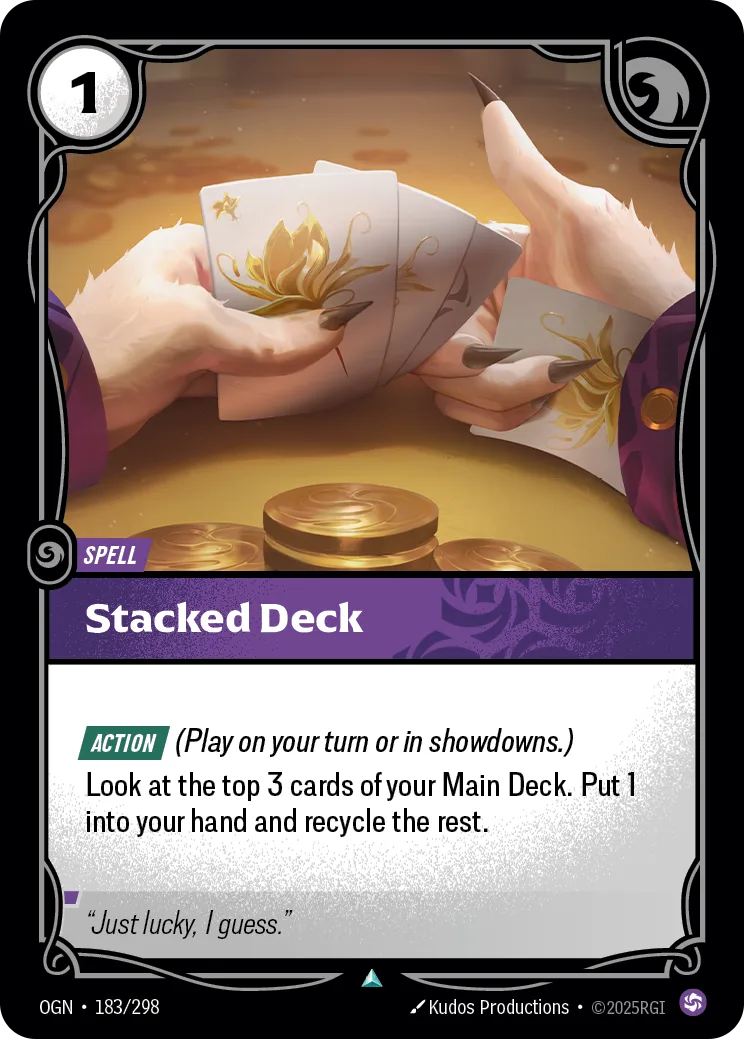
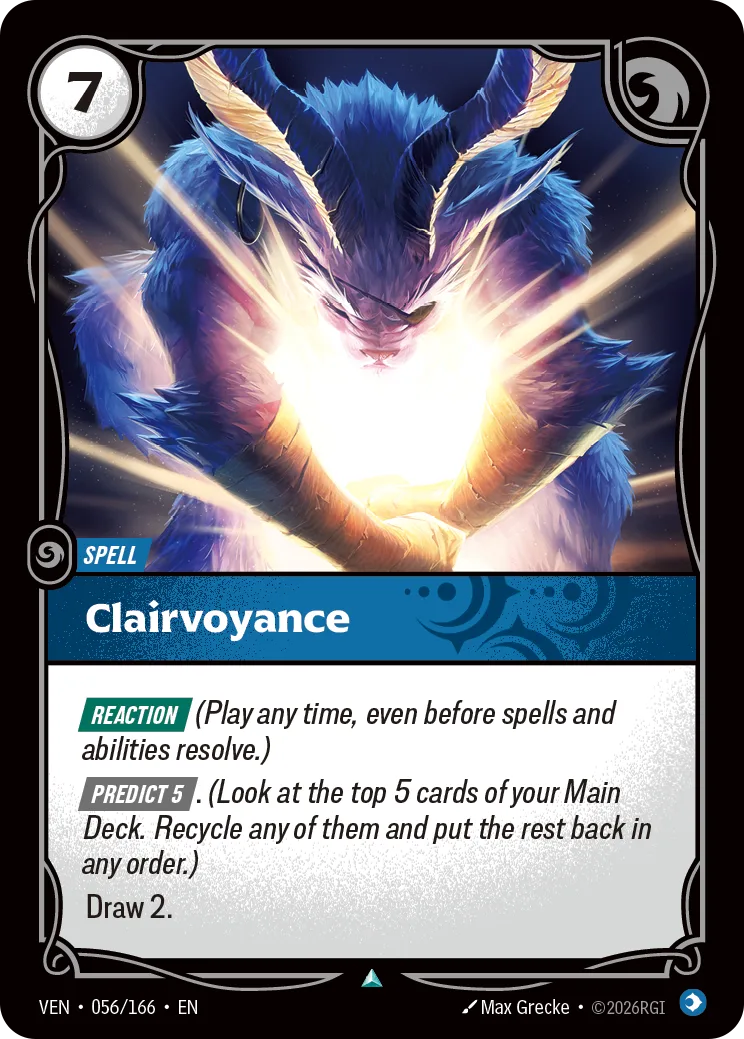
The reminder text on the cards themselves tracks the table exactly. Stacked Deck (OGN 183/298) reads "[Action] (Play on your turn or in showdowns.)" - it gets you into Showdown Open and no further. Clairvoyance (VEN 056/166) reads "[Reaction] (Play any time, even before spells and abilities resolve.)" - "before spells and abilities resolve" is the rulebook's Closed State, described in plain English on the card.
The full keyword breakdown for both, plus Hidden, lives in Riftbound keywords explained. What matters here is the ordering: Reaction contains Action (rule 813.1.b), so a Reaction card can be played in all four states and an Action card in two of them.
Priority is not focus
These are two separate permissions and the rules define them in two separate sections. Conflating them is how you end up thinking you can act when you cannot.
Priority (rule 312) is "the singular exclusive right to take Discretionary Actions." Up to one player has it at a time. If nobody has it, nobody can take a discretionary action - though rule 312.1.b.1 preserves your ability to make choices for limited actions whenever a game effect instructs you to, priority or not. Rule 312.2 lists exactly four moments you receive priority:
- when the turn is in a Neutral Open State during your Main Phase;
- when the turn is in a Showdown State and you gain focus;
- when the turn is Closed, all pending chain items finish being finalized, and you control the next item on the chain;
- when the turn is Closed, you are next in turn order, and the player with priority passes.
Focus (rule 313) is narrower and only exists inside a showdown. It is "the permission to take appropriately timed Discretionary Actions when the turn is in a Showdown Open State," and rule 313.5 is blunt: in a Neutral State, no player has focus at all.
The four clauses that actually matter at the table:
- Gaining focus also gains you priority (313.2).
- Passing priority does not lose you focus (313.3). You keep focus while a chain is being processed even after you pass priority on it - though rule 346 hands focus to the next player once that chain empties, with one exception covered below.
- Focus without priority does nothing (313.4). You may not take discretionary actions with focus unless you also hold priority.
- Focus obeys the same state filter (313.1.a). Riot's own example: a player with focus may not play spells or activate abilities that lack Action or Reaction.
The chain, and why only one exists
Rule 328: "The Chain is a Non-Board Zone that temporarily exists whenever a card is played or an ability is activated." (Riot's 9 October update, effective 16 October, words it "whenever a card or ability is played.") It is not a permanent fixture of the board. It appears when something is played and vanishes when the last item leaves - and rule 330.2 says that while it exists, anything else that begins to be played is placed onto the existing chain rather than starting a new one. Rule 330.1: "Only one Chain can exist at a time."
Items on the chain come in two conditions. A Pending item is one still being played - it sits on the chain while its controller works through targeting, costs and legality. A Finalized item has completed that process and is waiting to resolve (rule 329). The transition happens at the "Check Legality" step (329.2), and the distinction is load-bearing: several cards check whether something has been played, and Riot's Vendetta FAQ confirms that for a card like Crumbling Sands, "played" means finalized.
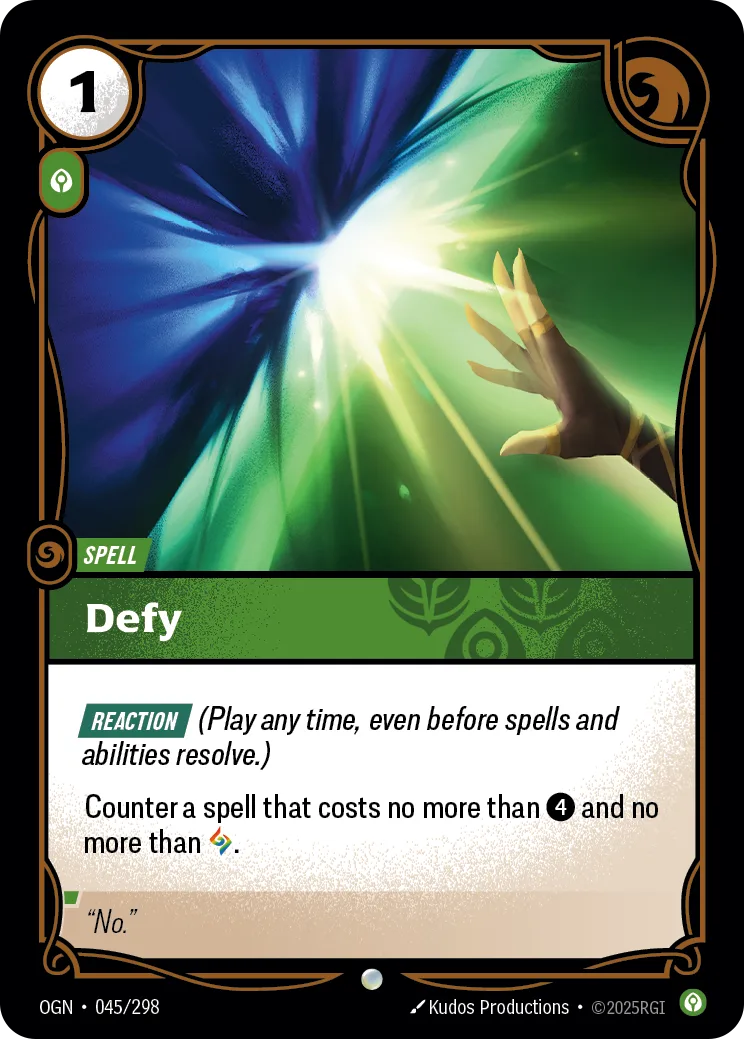
Defy (OGN 045/298) is the card the Core Rules themselves reach for when illustrating this. Rule 419.4.b's example: a player plays a spell, it is countered by Defy, and Legion abilities that player controls are still active - because non-triggered abilities that check whether cards were played reference whether they were finalized, and a countered spell was finalized before it was countered. Riot's 9 October update, effective 16 October, renumbers the rule 420.4.b and extends it to "non-triggered abilities and conditional clauses", keeping the same Defy example. Same example, one step further: if that player then plays Battering Ram and has played no other card that turn, it still costs its reduced price. The countered spell counted.
HOT FEPR: the loop that resolves everything
Rule 333 defines a Task as one or more steps that players must perform before continuing with anything else - cleanups, the start-of-turn process, the steps of combat, the end-of-turn process. Tasks come first. Always. That is the HOT in HOT FEPR.
Once no tasks are outstanding, the four FEPR steps run:
| Step | Rule | What happens |
|---|---|---|
| H - Handle Outstanding Tasks | 334 | Finish every outstanding task first. Chain items added during a task stay put until the task is complete (334.1) |
| F - Finalize | 337 | The controller of the oldest pending item completes playing it. Finalizing does not pass priority (337.1.a). If pending items remain, repeat |
| E - Execute | 338 | The player with priority either plays a legally timed card or ability - in a Closed State that means one with Reaction (338.1.a.2) - or passes |
| P - Pass | 339 | If every player has passed in sequence without adding to the chain, go to Resolve. Otherwise priority moves to the next player in turn order and it is Execute again |
| R - Resolve | 340 | The newest finalized chain item resolves in its entirety |
Note the two opposite directions in one loop. Items finalize oldest-first (337.1.b: "Chain Items are Finalized in the order they were appended to the Chain"). Items resolve newest-first (340.1: "The newest Finalized Chain Item resolves"). Last in, first out on resolution; first in, first out on finalization.
After a resolution, rule 340 branches three ways: if the chain is now empty, play proceeds in an Open State; if items are still pending, back to Finalize; if the chain is not empty and nothing is pending, the controller of the newest item gains priority and it is Execute again.
Units and gear never wait on the chain
This is the shortcut in the middle of FEPR and it changes how the game feels.
Rule 337.2: "If, after finalizing the Chain Item, that item is a Unit, Gear, or an ability that Adds resources, it resolves immediately - Move to Step 4: Resolve."
Skip Execute. Skip Pass. A unit you play does not sit on the chain while the table gets a window to answer it. It finalizes and lands. The same is true of gear, and of resource-adding abilities - which covers the two intrinsic abilities every basic rune carries, "[E]: [Reaction] - Add [1]" and "Recycle this: [Reaction] - Add [C]" at rule 164.2. (Riot's 9 October update, effective 16 October, keeps both abilities at 164.2 but writes them with the keyword first: "[Reaction][>] [E]: Add [1]" and "[Reaction][>] Recycle this: Add [C]".) Tapping a rune for energy hands nobody a window.
Spells and non-resource activated abilities do not get that treatment. They finalize, then priority is offered, then they resolve. So the interaction window in Riftbound is specifically a window on spells and abilities, not on bodies hitting the board. If your plan for an opposing unit is a Reaction card, the Reaction has to answer the unit after it exists, not on the way down.
How focus moves during a showdown
A showdown is described in rule 342 as "a Window of Opportunity in which Players have an Open State in which they may play Spells in an alternating fashion." Alternating is the operative word, and focus is what alternates.
The sequence, start to finish:
- A showdown begins when control of a battlefield is contested during a cleanup and the turn is in a Neutral Open State (rule 344). Contest a battlefield with a unit, and the showdown opens at the next cleanup, not instantly.
- The player who applied the Contested status gains focus (rule 345).
- The player with focus does one of two things (rule 347): play a legally timed card or ability, which starts a chain as normal; or pass.
- When that chain closes, focus passes to the next player in turn order (347.1.b, and rule 346).
- If all players pass focus in sequence without playing anything, the showdown closes (347.2.a and 348).
Step 4 has an exception worth memorising, because it is the difference between getting another turn to act and not. Rules 340.2.a and 346.1: focus does not pass if the chain was opened by a triggered ability, or by an ability that Adds resources. Riot's own example is the combat chain itself - it opens because triggered abilities went on the chain, so when it empties, focus stays where it was rather than moving on.
What happens when a showdown closes depends on which kind it was. A non-combat showdown - one opened by moving onto a battlefield nobody was defending - ends by having the sole remaining player establish control (348.2.a), which is a Conquer if they have not already scored that battlefield this turn. A combat showdown proceeds to the remaining steps of combat.
The three steps of combat, in rules order
Combat and showdown are not synonyms. Rule 316.8.a.1 files a combat showdown as a sub-phase of combat, while a showdown opened by moving onto an empty battlefield is a stand-alone phase that creates no combat at all.
The combat rule numbers below are from the July rules in force until 15 October. From 16 October each one moves up by two (Combat 459 becomes 461, the Resolution Step 466 becomes 468), and one sub-rule also changes letter; the full map is in the section before the quick reference.
A combat begins (rule 460) at a cleanup, when there are no items on the chain, a combat is staged at a battlefield, and no showdown or combat is ongoing anywhere else. Staged means units controlled by two opposing players are at a battlefield but the steps have not started (461). If several battlefields qualify at once, the turn player picks which combat resolves first (461.1). Rule 462 caps it: combat can only ever occur between units controlled by exactly two players, which is why in multiplayer a battlefield with a staged combat or a combat in progress is an invalid destination for units controlled by players not already involved there (462.1) - covered in the 2v2 and multiplayer rules.
Step 1 - The Combat Showdown Step (464; 466 from 16 October). Start-of-combat effects happen. Then attacker and defender are established: the attacker is the player whose units applied the Contested status; the defender is the one who did not. Both players and their units at that battlefield gain the designation now, and any unit that arrives later picks it up at the following cleanup. The attacker then gains focus - unless a showdown was already ongoing when the combat opened, in which case whoever holds focus keeps it (464.2.c.1.b). Finally, if establishing those designations caused triggers, they go on the combat chain in a specified order - the attacking player first, then all non-defender players in turn order, then the defending player (464.2.e.1; 466.2.d.1 from 16 October). If a combat chain was created, the state closes; if not, the combat showdown continues in an Open State.
Step 2 - The Combat Damage Step (465; 467 from 16 October). Only if both attacking and defending units are still there. Sum the might of all attackers, sum the might of all defenders, and starting with the attacker each player assigns damage equal to their total among the other side's units. Rule 465.2.c.1 draws a line that a lot of card text depends on: assigning damage is not dealing damage, and once all of it is assigned it is dealt simultaneously. The lethal-in-full and no-overkill constraints on how that pool is distributed are worked through with examples in how to play Riftbound.
Step 3 - The Resolution Step (466; 468 from 16 October). A Combat Cleanup runs, with two extra steps inserted: "3c. Heal all Units" and "3d. Recall Attackers present at the Battlefield if Defenders are still present." That second insert is the one to internalise - attackers who survive the damage step but did not clear the battlefield go home to base rather than staying. Then the result is determined: a player wins the combat if they are the only one with units left, loses if they are the only one without. There is No Result if units were recalled at step 3d, if both players still have units present, or if neither does - and where both players still have units, a showdown and a combat are staged at that battlefield again (466.3.d.1). Finally, if nothing is staged, the player with units remaining establishes control, which is a Conquer if they have not scored there this turn, and combat ends with all attacker and defender designations removed and all "this combat" effects expiring simultaneously.
Cleanups: the engine you never see
Nothing above works without cleanups, and cleanups are where Riftbound quietly resolves its board state. Rule 319 makes a cleanup an outstanding task after each of these:
- the game transitions to or from an Open or Closed state;
- the game transitions between phases, unless specified otherwise;
- a pending item is added to the chain, or becomes finalized, or is removed from it for any reason;
- any number of game objects enter or leave the board;
- the status of any number of game objects changes for any reason;
- a move is completed.
Rule 320 freezes the chain while a cleanup runs: items cannot be finalized or resolved, finalized items cannot execute, and priority and focus are not passed or awarded. Rule 321 is the mirror - a cleanup cannot occur while a chain item is resolving; if something during resolution qualifies for one, it becomes an outstanding task for afterwards. And rule 322 loops: if an event during a cleanup qualifies for a cleanup, another runs immediately after, repeating until one completes with no change in game state.
Inside a single cleanup, rule 323 of the July rules runs these tasks in this order:
| # | Task |
|---|---|
| 1 | If a player has points at or above the Victory Score and more points than any opponent, that player wins |
| 2 | Assign or remove attacker/defender designations if a combat is in progress |
| 3a | Units with lethal damage that have Deathknell or other death triggers put those triggers on the chain as pending items |
| 3b | Units with lethal damage marked are killed and placed in their owners' trash |
| 4 | Players lose control of battlefields their units no longer occupy, if the state is Open and no showdown or combat is ongoing there |
| 5 | Recall unattached non-unit gear and non-unit runes at battlefields; trash hidden cards at battlefields their controller does not control |
| 6 | Mark a showdown as staged at each battlefield that Contested was applied to |
| 7 | Mark a combat as staged at each such battlefield that has units from opposing players |
| 8 | Remove Contested status where the applying player has no units and no showdown or combat is ongoing |
| 9 | In a Neutral Open State, the turn player picks one staged showdown (without a staged combat) and it begins |
| 10 | In a Neutral Open State, the turn player picks one staged combat and it begins |
Step 1 is the one to sit with. Winning is a cleanup check, not something that fires the instant a point lands. And steps 3a and 3b run in that order for a reason: the Deathknell trigger is created while the unit is still on the board, "making note of their current location, attributes, and other information relevant to add the trigger," and only then is the unit killed.
Riot's 9 October update, effective 16 October, takes the trigger step out of this list, leaving a single step 3a that kills units with lethal damage, and limits steps 6 and 7 to battlefields with no combat already ongoing. The Deathknell order survives: the keyword's own rule, 808.1.d.2, is the same in both versions and adds the trigger to the chain before the card is moved to the trash.
Three rulings that turn on this timing
Riot's Vendetta Rules FAQ, published 14 August 2026, answers three questions that are pure chain mechanics:
- Crumbling Sands (VEN 039/166) reads "Counter a spell if an opponent has played another spell this turn." Riot: yes, you can counter the first of two spells played in succession, because Crumbling Sands "uses the 'finalize' meaning of play" - it checks whether cards have been played and is not a triggered ability. The second spell only needs to have had targets chosen, costs paid, legality checked and finalization completed. Riot adds that it counts "even if that spell was countered." Relevant rule: 419.4.b (420.4.b from 16 October).
- Fallen Feline's play effect names a spell, and Riot's answer separates two moments: you can react to the play effect before a name has been chosen, and once the triggered ability resolves, spells with that name "can not be put onto a chain" - but "any spells already on the chain when Fallen Feline's ability resolves will be unaffected."
- Flow spells and the chain got a definition. Riot spells out that "then banish it" in Flow's text is shorthand for "if it would leave the chain after becoming a finalized chain item, and leaving the chain wasn't instructed by its own execution, banish it instead" - which is why Abandon returning a Flow spell to its owner's hand still results in it being banished.
What changes on 16 October
Riot published a revised Core Rules on 9 October, dated "Last Updated: 2026-10-09", and its patch notes are headed "Radiance Rules Update Effective October 16, 2026". Until 16 October, the July document quoted throughout this guide is the one in force. Every rule this guide cites from 307 to 348 keeps its number in the new version. Combat moves up two, and a few lines change:
| What this guide cites | July rules (until 15 October) | October rules (from 16 October) |
|---|---|---|
| Combat section heading | 459 | 461 |
| When a combat begins | 460 | 462 |
| Staged combat; turn player picks which resolves first | 461, 461.1 | 463, 463.1 |
| Exactly two players; multiplayer invalid destinations | 462, 462.1 | 464, 464.1 |
| The steps of combat | 463-466 | 465-468 |
| Step 1, Combat Showdown Step; focus kept if a showdown was ongoing | 464, 464.2.c.1.b | 466, 466.2.c.1.b |
| Order triggers go on the combat chain | 464.2.e.1 | 466.2.d.1 |
| Step 2, Combat Damage Step; assigning is not dealing | 465, 465.2.c.1 | 467, 467.2.c.1 |
| Step 3, Resolution Step; No Result restages the fight | 466, 466.3.d.1 | 468, 468.3.d.1 |
| A countered spell still counts as played | 419.4.b, "Non-triggered abilities that check cards being played" | 420.4.b, "Non-triggered abilities and conditional clauses that check cards being played" |
| Cleanup handling of lethal damage (323) | Step 3a puts death triggers on the chain, step 3b kills | One step 3a kills; Deathknell's own rule (808.1.d.2) still adds the trigger before the card reaches the trash |
| Cleanup steps 6 and 7 (323) | Stage a showdown at each Contested battlefield, and a combat where opposing units are present | The same, but only where no combat is already ongoing |
| The chain (328) | "whenever a card is played or an ability is activated" | "whenever a card or ability is played" |
| Basic rune abilities (164.2) | "[E]: [Reaction] - Add [1]" and "Recycle this: [Reaction] - Add [C]" | "[Reaction][>] [E]: Add [1]" and "[Reaction][>] Recycle this: Add [C]" |
The one sub-rule that changes letter does so because the July Combat Showdown Step has a separate task, "The Attacker gains Focus" (464.2.d). The October version drops it and leaves the attacker's focus to 466.2.c.1.a: "If a showdown opens as part of combat, this player gains Focus as the showdown begins." The task that puts those triggers on the combat chain moves from e to d as a result, and its ordering rule moves with it.
Riot's patch notes also say the rules documents get a ground-up reformat with Legacy in January, and that it "won't change how Riftbound's mechanics actually work." The new keywords and rulings from the same 9 October drop are covered in the Radiance rules update.
Quick reference
- Four states (rule 310): Neutral Open, Neutral Closed, Showdown Open, Showdown Closed. Neutral Open is the default and only the turn player acts in it.
- Showdown State allows Action or Reaction only (308.1.a). Closed State allows Reaction only (309.1.a). Reaction includes everything Action grants (813.1.b).
- Priority is the exclusive right to take discretionary actions (312.1). Focus only exists inside a showdown (313.5), and gaining focus also gains priority (313.2).
- One chain exists at a time (330.1); anything else played joins it (330.2).
- HOT FEPR (334): Handle Outstanding Tasks, then Finalize, Execute, Pass, Resolve.
- Finalize is oldest-first (337.1.b). Resolve is newest-first (340.1).
- Units, gear and resource-adding abilities resolve immediately on finalization (337.2) - nobody gets a window.
- Focus passes when a chain empties during a showdown (346), except when that chain was opened by a triggered ability or an Add ability (346.1).
- A showdown ends when every player passes focus in sequence without playing anything (347.2.a).
- Combat is three steps (463-466 until 15 October; 465-468 from 16 October): Combat Showdown, Combat Damage, Resolution - and the Resolution Step recalls surviving attackers if defenders are still present.
- Winning is checked at step 1 of a cleanup (323.1).
If you take one thing away, take the pair of directions in FEPR. Oldest finalizes, newest resolves. When two cards go on the same chain, which of those two directions the card in question cares about is the whole ruling.
Frequently Asked Questions
What is HOT FEPR in Riftbound?
What is the difference between priority and focus in Riftbound?
When can you play a Reaction card in Riftbound?
Can you respond to a unit being played in Riftbound?
In what order do Riftbound chain items resolve?
What are the three steps of combat in Riftbound?
Keep Reading
- Riftbound Rules Hub (Riot Games, official) - Core Rules and Tournament Rules, last updated 9 October 2026
- Riftbound Core Rules, last updated 2026-07-16 (Riot Games, PDF) - in force until 15 October 2026; states of the turn 307-310, priority and focus 311-313, cleanups 318-324, chains and showdowns 325-348, combat 459-466
- Riftbound Core Rules, last updated 2026-10-09 (Riot Games, PDF) - effective 16 October 2026; basic runes 164.2, cleanups 323, chains and showdowns 325-348, played-means-finalized 420.4.b, combat 461-468, Deathknell 808.1.d.2
- Radiance Patch Notes (Riot Games, official, 9 October 2026) - Radiance Rules Update Effective October 16, 2026
- Vendetta Rules FAQ and Clarifications (Riot Games, official, 14 August 2026) - Crumbling Sands, Fallen Feline and Flow chain rulings
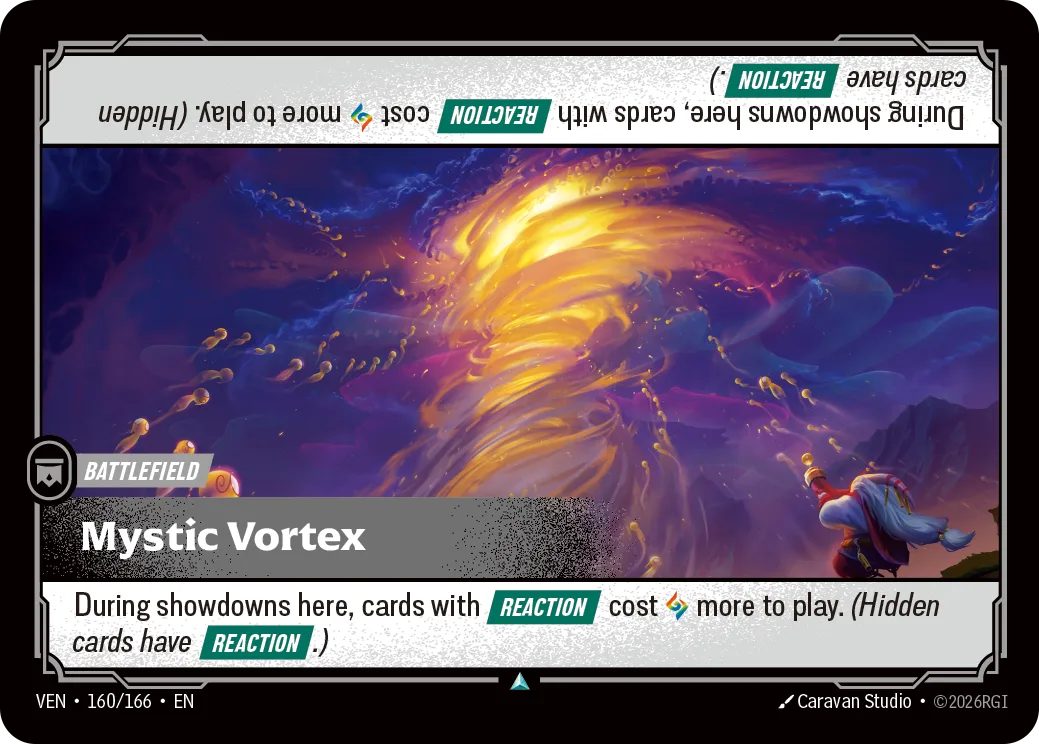
- Riftbound Official Card Gallery (Riot Games) - card text and reminder text for Stacked Deck, Clairvoyance, Defy, Crumbling Sands and Mystic Vortex
- Core Rules: Vendetta Patch Notes (Riot Games, official) - the July 2026 Core Rules revision
Related Guides

Riftbound Keywords Explained: All 28 in the Core Rules
The Riftbound Core Rules in force until 15 October 2026 define 25 keywords, and Riot's 9 October update adds Deploy, Disarm and Show Off from 16 October, for 28. The reminder text printed on the card is a summary, not the rule. Here is the whole glossary sorted by what each keyword actually is - passive, triggered, activated, permissive, dependent, cost, or a deck-construction rule that never does anything at the table.

Riftbound Radiance Rules Update: Neeko Rulings and Errata
Riot published three Radiance rules documents on 9 October: Core Rules patch notes with ten official rulings, an errata article for four cards, and a Tournament Rules update. Together they settle how Neeko works, what happens to Equipment that Orianna turns into a unit, and what changes at your table from the 16 October Pre-Rift.

Riftbound Vendetta Rules FAQ: Key Rulings Explained
Riot published the Vendetta Rules FAQ on 14 August 2026 and gave it precedence over the Core Rules Document until a new one was released. That new rulebook arrived on 9 October, effective 16 October. The FAQ also reverses a ruling Riot published in January, explains why Kayle can hold three copies of a status the rules call binary, and admits to a bug the Vendetta rules update introduced.
Riftbound Multiplayer Rules - How 2v2, Skirmish and War Actually Work
Riftbound has five sanctioned modes and almost everyone plays one of them. The team format is called Magma Chamber, it wants 11 points instead of 8, your partner cannot reinforce your battlefield, and it has a ban list of its own containing exactly one Legend that is legal everywhere else.

How to Play Riftbound — The League of Legends TCG Rules, Explained (2026)
Riftbound has no life total. You take objectives. Eight points ends it. Here is the whole rules set as Riot actually wrote it - runes, domains, battlefields, showdowns, deck construction, and the final-point rule that decides more games than any card does.
Riftbound Domains Explained: All 6 Colors and Their Legends
Riftbound has six domains, and your Legend picks two of them for you. Here is what each color actually plays like - its strengths, its blind spots, its signature mechanics - plus the full grid of all 49 Legend cards by domain pairing, and the three rival pairings that did not exist until Vendetta.