Riftbound Keywords Explained: All 28 in the Core Rules
The Riftbound Core Rules in force until 15 October 2026 define 25 keywords, and Riot's 9 October update adds Deploy, Disarm and Show Off from 16 October, for 28. The reminder text printed on the card is a summary, not the rule. Here is the whole glossary sorted by what each keyword actually is - passive, triggered, activated, permissive, dependent, cost, or a deck-construction rule that never does anything at the table.
Updated 10 October 2026: Riot's 9 October Core Rules update, effective 16 October with the Radiance Pre-Rifts, adds three keywords (Deploy, Disarm and Show Off) and takes the glossary from 25 to 28. They are covered below. Until 16 October, the 25-keyword July rules are still the ones in force.
Fiora, Victorious is a 4-cost, 4-Might champion unit with one sentence of rules text, and that sentence contains four highlighted terms. Three of them are keywords. One of them is not a keyword at all — it is a description the rules define somewhere else entirely, and knowing the difference is why an effect that strips her keywords can take the other three away and leave that one exactly where it was.
The Riftbound Core Rules in force until 15 October 2026, the version last updated 16 July, spend rules 805 through 829 defining 25 keywords. Riot's 9 October update, effective 16 October, keeps all 25 and adds Deploy (830), Disarm (831) and Show Off (832), so the glossary runs 805 through 832, 28 keywords. The reminder text in parentheses on a card is a summary — accurate as far as it goes, and in at least three cases it goes nowhere near far enough. What follows is the whole glossary, grouped by what each keyword structurally is, with the gap between printed reminder and actual rule flagged wherever it matters.
What counts as a keyword, and the eight shapes they come in
Rule 801 defines a keyword as "a specific term that appears on Cards that acts as a shorthand for a specific game effect, or ability of any variety." You spot one visually: keywords carry a coloured highlight, and rule 801.2.a is blunt that "the color of the highlight has no effect on gameplay." A card may carry any number of them, executed in printed order, top to bottom.
The thing the rulebook never puts in one place is that almost every keyword belongs to exactly one structural category — and the category tells you when it can possibly matter:
| Shape | What that means at the table | Keywords |
|---|---|---|
| Passive ability | Always on while the card is where it needs to be. No trigger, no cost. | Ambush, Assault, Backline, Deflect, Flow, Ganking, Shield, Tank; from 16 October also Deploy †, Show Off |
| Triggered ability | Fires on a specific event and goes on the chain. | Deathknell, Hunt, Quick-Draw †, Temporary, Vision, Weaponmaster; from 16 October also Disarm |
| Activated ability | You pay a cost and use it, like any other activated ability. | Empower, Equip |
| Permissive | Changes only when you may play the thing. | Action, Reaction |
| Dependent | The attached text is switched off until a condition is true. | Empowered, Legion, Level |
| Optional additional cost | Pay extra as you play it for an extra effect. | Accelerate, Repeat |
| Deck constraint | A registration rule. Does nothing during play. | Unique |
| Action prerequisite | Unlocks a discretionary action you otherwise cannot take. | Hidden |
Eight plus six plus two plus two plus three plus two plus one plus one — all 25 July keywords accounted for, counting each keyword once. From 16 October, Deploy and Show Off join the passive row and Disarm the triggered row: ten plus seven plus the same eleven makes 28.
† Quick-Draw is the exception to the one-category rule, and the only one among the July 25: rule 819.1 calls it a Triggered Ability keyword and a Permissive keyword, because gear that has it carries Reaction inherently (819.1.b). It is filed above under triggered so the arithmetic stays honest. From 16 October it has company: rule 830.1 calls Deploy "a Passive Ability and a Triggered Ability keyword," and it is filed above under passive for the same reason.
The category is not trivia. Effects that grant keywords ("other friendly units have [Vision]") work in the ability-altering layer and can only hand over things that really are keywords. Effects that grant a state, or that trigger on a game action, are a different animal — which is the whole point of the "not keywords" section below.
The combat four: Assault, Shield, Tank and Backline
Assault and Shield are the same keyword pointed in opposite directions. Assault X is functionally short for "While I am an attacker, I have +X Might." Shield X is "While I am a defender, I have +X Might." If the X is omitted on the card, it is presumed to be 1. Both stack additively from every source: the rules use Petty Officer, which has Assault, being given Assault 3 by the spell Cleave, and the result is Assault 4 — not two separate instances.
Tank and Backline are also mirrors, and this is where the printed reminder text is genuinely misleading. The card reminder for Tank reads "I must be assigned combat damage first." The actual rule, 815.1.b, is:
I must be assigned lethal damage before any other unit with the same controller as me that does not have [Tank] during the Combat Damage step.
Three differences matter: it is lethal damage, not any damage; it only constrains units under the same controller; and it applies during the combat damage step specifically. Backline is the exact inverse — lethal damage must be assigned to it after every other unit its controller has that lacks Backline. If two of your units both have Tank, your opponent may pick either, but every non-Tank unit you control is an illegal assignment until both Tanks have lethal damage on them.
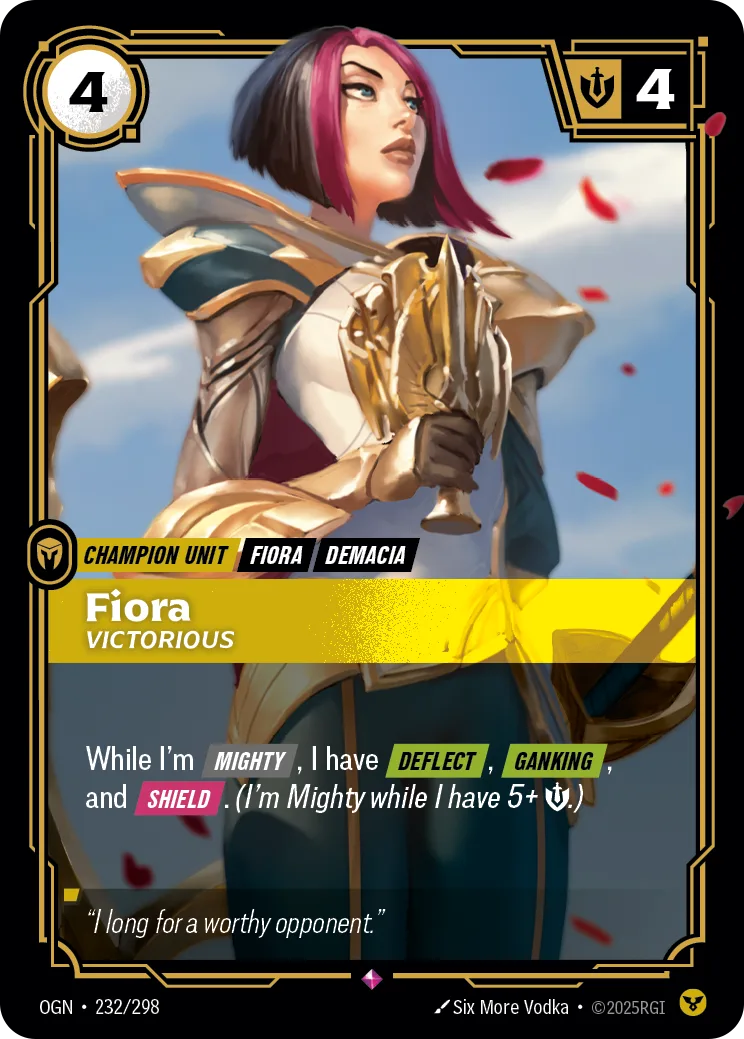
That is the Fiora from the opening. Three of those four highlighted words are keywords. Mighty is not. Rule 708 defines it plainly: a unit is Mighty as long as its Might is 5 or greater. Fiora is printed at 4, so she is a plain body until something buffs her — and the moment a buff drops off mid-combat she loses all three keywords at once, because the layers re-evaluate from scratch.
Deflect, Accelerate, Ganking and Ambush
Deflect X is a tax, not a shield. It reads: spells and abilities an opponent controls that target the card cost an additional amount of Power equal to the Deflect Value, charged once for each time they choose it. The clause people miss is 809.1.c.1 — the Power used to pay a Deflect cost may always be of any domain. It does not have to match the spell or the target. Deflect values stack the same way Assault and Shield do.
Accelerate is an optional additional cost of 1 Energy plus 1 Power, and paying it makes the unit enter ready instead of exhausted. The Power is not free-floating, and this is the sort of detail the reminder text swallows. The Core Rules (805.1.a.1 in the July text, renumbered 805.1.b.1 in the 9 October update) say a unit with one or more domains must pay that Power in one of its own domains, and only a unit with no domain may pay with Power of any domain. Riot's Vendetta Rules FAQ of 14 August, which by its own terms took precedence over the July Core Rules where they differed, loosened the multi-domain case: the [C] in an Accelerate cost "takes on the domain of the Unit, or turns into [A] if the Unit has no domain or multiple domains." Riot's documents now conflict on that multi-domain case. The 9 October Core Rules keep the stricter text, and their example at 135.2.e.6.c has Tibbers, a Fury and Chaos unit, paying its Accelerate Power with Fury or Chaos. The FAQ's own preamble says a newly released Core Rules document takes precedence over points that differ, yet Riot's Radiance patch notes, published the same day, repeat the FAQ's "turns into [A]" shorthand. A single-domain unit demands its own colour under every version; for a multi-domain unit, check with your head judge before paying off-colour. Two more footnotes carry real weight. You cannot pay Accelerate once the unit is on the board — it exists only in the steps of playing the card. And rule 805.6.a says Accelerate is a replacement effect: the unit never enters exhausted and then readies, so nothing that triggers on a unit "becoming ready" will fire. If you have a readying payoff, Accelerate does not feed it.
Ganking is one line: "I may move to a battlefield from another battlefield with a standard move." It adds a destination and nothing else — no cost, no extra movement, no additional activations. Without it, a unit at a battlefield can only walk home to your base.
Ambush lets you play a unit to a battlefield where you already control units, and it grants Reaction while it is being played that way. It is a play-time permission and it is fragile: rule 822.3 says that if there are no units at the chosen location before finalisation completes, the location stops being valid and the card cannot be played there. Riftbound is also happy to use Ambush as a verb, though only the rulebook writes it that way. The Core Rules example at 822.1.d reads "I can [Ambush] to a battlefield where there are enemy units, even if you don't have units there," while the card it is quoting — Rengar, Trophy Hunter, printed in Unleashed as UNL 120/219 and reprinted in Vendetta as VEN 179/166 — spells the same permission out longhand: "I can be played to a battlefield where there are enemy units (even if you don't have units there)." Either wording widens Ambush's normal permission rather than replacing it.
Action, Reaction and Hidden: the permission ladder
These three are the whole of Riftbound's interaction system, and they nest.
Action grants permission to play a card or activate an ability during showdowns, on any player's turn. Reaction grants everything Action grants, plus Closed States. Rule 813.1.b is explicit: Reaction includes Action's permissions. There is no card that has Action but is somehow faster.
Neither changes what the card does. Rule 806.3 spells it out — a unit with Action still obeys every normal restriction on playing units, so it can still only go to your base or a battlefield you control. Permission is not permission to break the rules.
Hidden is the longest entry in the glossary and the one worth reading twice. Functionally: while the card is in your hand or Champion Zone, on your turn, in an Open State, you may pay 1 Power of any domain to hide it facedown at a battlefield you control that does not already have a facedown card there. Beginning on the next turn it gains Reaction and you may play it ignoring its base cost — for 0.
The restrictions are what get people. The card stays hidden only for as long as you control that battlefield. A hidden permanent must be played to that battlefield, which overrides the normal rule that gear can only be played to your base. And targets chosen while playing from hidden must come from options at that battlefield, unless the ability's own targeting makes that impossible.
Triggers on a clock: Deathknell, Vision, Temporary and Hunt
Deathknell is "When I die, [effect]." The trigger is the permanent being killed and sent to the trash. If the death gets replaced — the rules use a Zhonya's Hourglass that heals, recalls and exhausts the unit instead — the triggered ability is removed from the chain and never resolves. Multiple Deathknells on one permanent trigger separately, in an order its controller chooses.
Vision is "When this is played, predict." Predicting means looking at the top card of your Main Deck and choosing whether to recycle it to the bottom. Rule 817.1.c pins the trigger to the permanent entering the Board, which is why handing Vision to something already sitting there is dead weight — the keyword lands (that is ordinary ability-altering-layer work, per 477.2.b, renumbered 479.3.b from 16 October), it just has no event left to fire on. Multiple instances of Vision trigger separately, and if you decline to recycle and nothing happens in between, every instance looks at the same card.
Temporary is "At the start of this permanent's controller's Beginning Phase, before scoring, kill this." Read the clause order. A Temporary unit sitting alone on a battlefield can conquer it on the turn it arrives, but it is dead before the Scoring Step, so it can never hold. Temporary bodies buy you a point and a combat, not an engine.
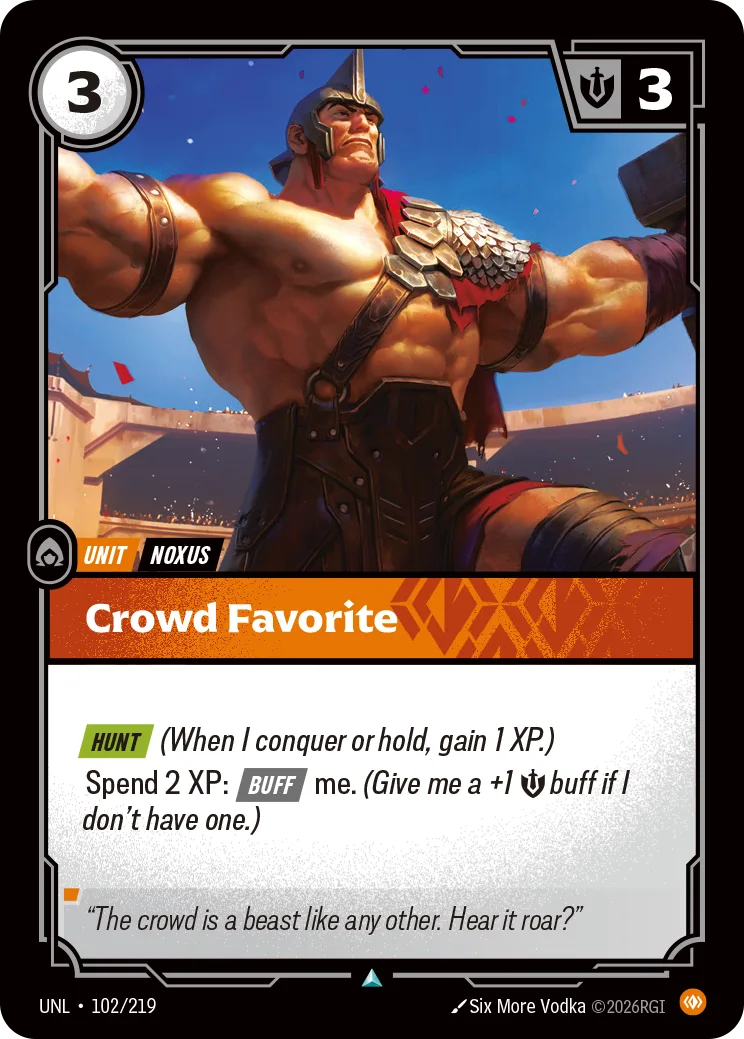
Hunt X is "When I Conquer or Hold, my controller gains X XP," and again the X defaults to 1. Conquer or hold — both routes to a point also pay XP, which is why Hunt units want to sit still rather than roam. XP itself is public information, it cannot be targeted or exhausted because it is not a game object, and rule 732 confirms it is never shared between allies in team modes. If you are running 2v2 or the free-for-all formats, your partner's XP is not yours.
The gear package: Equip, Quick-Draw, Weaponmaster and Unique
Spiritforged brought equipment, and four keywords that only make sense together.
Equip is an activated ability on gear carrying the Equipment tag: "[Cost]: Attach this gear to a unit you control." The chosen unit is a target, so it can be responded to and taxed by Deflect.
Quick-Draw collapses that into playing the card: gear with it has Reaction inherently and attaches to a unit you control the moment you play it. That inherent Reaction is why 819.1 calls it a Triggered Ability keyword and a Permissive keyword in the same breath. Until 16 October it is the glossary's only double-filed keyword; from then, Deploy (830.1) is the second.
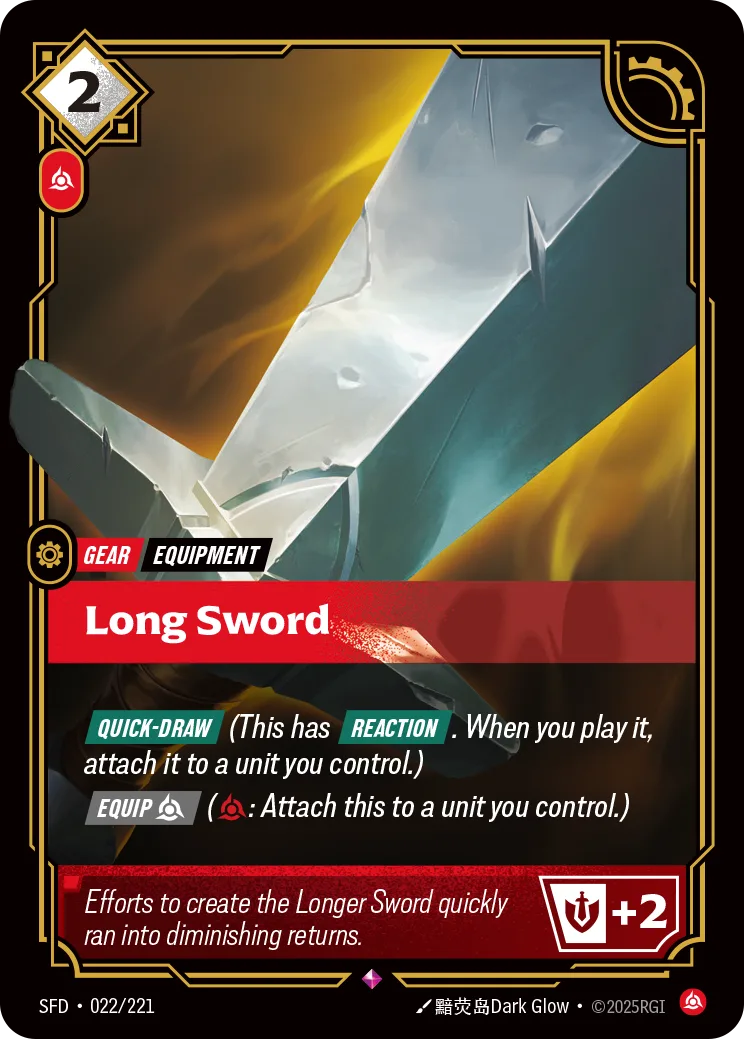
Weaponmaster sits on units and is a play effect: choose an Equipment you control, pay its Equip cost reduced by 1 Power of any domain, and attach it to this unit — ignoring the Equip ability's usual timing, and even if it is already attached elsewhere. Two traps. If the Equip cost contains no Power symbol, there is nothing to reduce and you pay it in full. If the chosen card has no Equip cost at all, it cannot be paid and the gear stays put.
Unique is the odd one out in the entire glossary: it does nothing during a game. Rule 825 calls it a Deck Constraint Permission — a deck may contain only one card of a given name if that card has Unique. The interaction worth memorising is with Signature cards. As covered in the Riftbound deckbuilding rules, you may register a total of three Signature cards; if a card is both Signature and Unique, you can still hit three Signature cards overall, but only one copy of that particular name.
Dependent keywords and paid upgrades
A dependent keyword is written "[Keyword][>] [Text]", and the text after the arrow is Inactive until the keyword's condition is true. Three exist:
| Keyword | Condition it is short for |
|---|---|
| Legion | If you have played another card this turn |
| Level N | While you have N or more XP |
| Empowered | While I have the Empowered status |
Legion has the friendliest wording in the game: rule 812.2 says every instance of Legion a player controls is satisfied by that player playing a single card. Play one thing and all of your Legion text switches on at once. Level re-evaluates if control of the card changes, against the new controller's XP. And when one ability carries two dependent keywords, both conditions must hold — the rules give the example of a unit reading "[Level 11][>>][Legion][>] When you conquer, gain 1 point," which needs 11 XP and another card played that turn.
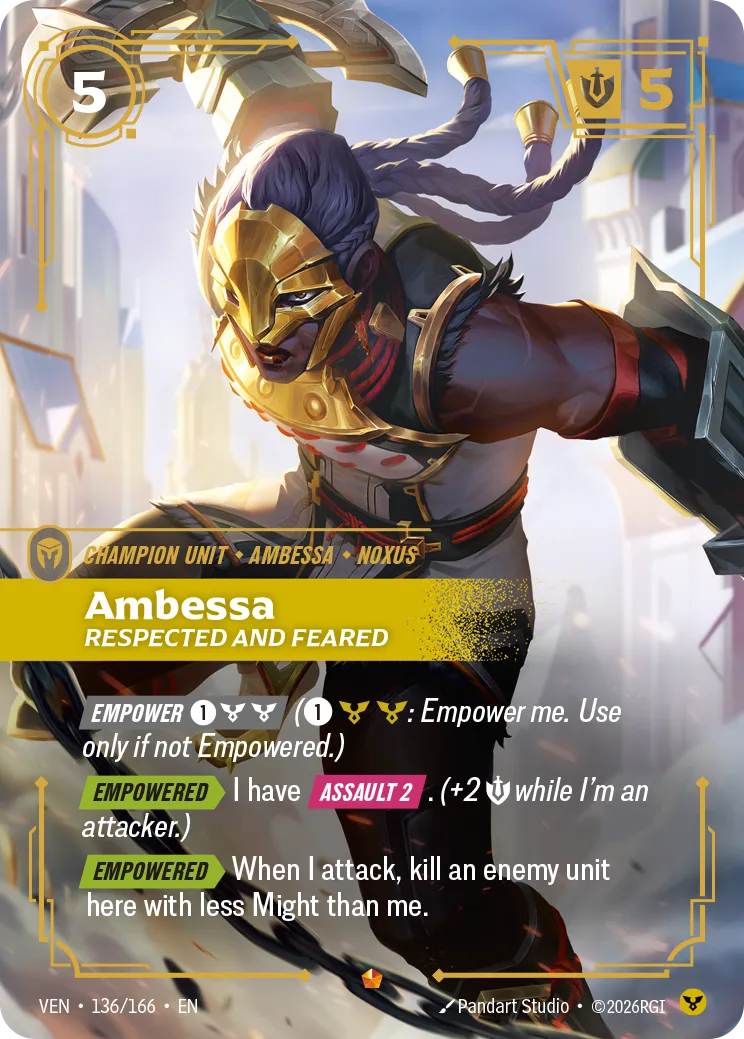
Empower is the activated half: "[Cost]: Empower this. Play only if not Empowered." Empowered is a binary state — a game object either has it or does not, and empowering something already empowered does nothing unless an effect explicitly permits it. Ambessa above is the clean template: pay 1 Energy and 2 Order Power once, and two dormant abilities come online permanently.
Repeat is an optional additional cost that executes the spell or ability's instructions one extra time on resolution. The detail worth money is 820.2.a — choices for the extra execution do not have to match the first. A modal spell can pick a different mode, and a targeted spell can pick a different target. Multiple Repeat costs on one card are paid individually, and no matter how many times the instructions run, the card is still only Played once for anything that counts plays.
Flow is an alternate cost that lets you play a spell from your trash, then banishes it. It changes the zone and nothing else — rule 829.1.b.2 states Flow does not alter the timing at which the spell can be played or any of its other permissions. If a spell prints multiple Flow costs, you choose which one to apply as you play it.
The Radiance three: Deploy, Disarm and Show Off
Riot's 9 October Core Rules update adds rules 830 to 832, effective 16 October with the Radiance Pre-Rifts. Until then they are not in the rules in force, and in Riot's card gallery they appear only on Radiance (RAD) cards.
Deploy (830) sits on gear and is short for four things at once: the gear may be played or created to any battlefield, it may be played or created only to a battlefield, if it is not a unit it is not recalled in cleanups, and "When an opponent holds here, kill this." Rule 830.1.b.1 spells out that any battlefield includes enemy-occupied and open ones. It is the second keyword the rules file in two categories, as noted above, and multiple instances are redundant (830.2).
Disarm X (831) is an attack trigger on units: "When I attack, give an enemy unit here -X [M] this turn," with X defaulting to 1. Disarm values from different sources add up, like Assault and Shield, but rule 831.1.d.1 adds a twist: however many instances a unit has, it triggers once, using the total Disarm Value. The rules' example is Clanging Sentry, which reads "Your Mechs have [Disarm]." Play a second one and both Sentries have Disarm 2.
Show Off (832) is a passive keyword, and Riot's patch notes put it on both units and spells. As you play the card, you may reveal the named object from your hand and/or pick it from among friendly game objects on the board. Other text on the card can then read what you showed off, and 832.1.d.1 locks that information in at the moment it is shown. The rules' example is Primordial Roar, which deals damage equal to a shown-off unit's Might: show off a 4-Might unit, and it still deals 4 even if an opponent responds by giving that unit -2 Might.
Words that look like keywords but are not
These all appear in square brackets with a coloured highlight on cards, which is exactly why players call them keywords. None of them is in the glossary. They are game actions or descriptions defined elsewhere in the Core Rules. The rule numbers are from the July rules in force until 15 October; the 9 October update moves each of these game actions up by one from 16 October:
| Term | What it actually is | The rule |
|---|---|---|
| Buff | Game action (426; 427 from 16 Oct) | Place a Buff counter on a unit — and only if it does not already have one |
| Stun | Game action (423; 424 from 16 Oct) | A binary state, cleared during end-of-turn cleanup; you cannot stun an already-stunned unit |
| Predict | Game action (436; 437 from 16 Oct) | Look at the top card of your Main Deck and choose whether to recycle it |
| Burn | Game action (440; 441 from 16 Oct) | Move X cards from the top of your Main Deck to your trash |
| Recycle | Game action (416; 417 from 16 Oct) | Put cards on the bottom of the matching deck — runes go to the Rune Deck, not the Main Deck |
| Banish | Game action (427; 428 from 16 Oct) | Straight to the Banishment zone; explicitly not a kill and not a discard |
| Disempower | Game action (442; 443 from 16 Oct) | Removes the Empowered status |
| Mighty | Description (706-710) | A unit is Mighty while its Might is 5 or greater |
Why care? Because grant and removal effects work on keywords. An effect that strips a unit's keywords does not stop it being Mighty, and a Buff counter is not a keyword you can remove. Buff also refuses to stack, so a second Buff on an already-buffed unit is wasted.
Which set brought which keyword
Sorted by the earliest set in which a card carrying the keyword appears in Riot's official card gallery. Set codes and dates line up with the 2026 release calendar:
| Set | Keywords introduced |
|---|---|
| Origins (OGN) and the Proving Grounds supplemental (OGS) | Accelerate, Action, Assault, Deathknell, Deflect, Ganking, Hidden, Legion, Reaction, Shield, Tank, Temporary, Vision |
| Spiritforged (SFD) | Equip, Quick-Draw, Repeat, Weaponmaster, Unique |
| Unleashed (UNL) | Ambush, Backline, Hunt, Level |
| Vendetta (VEN) | Empower, Empowered, Flow |
| Radiance (RAD), releasing 23 October 2026 | Deploy, Disarm, Show Off |
Thirteen at launch, then five, four, three and three. That curve is the honest answer to "is Riftbound getting more complicated" — yes, at roughly four new words a set. Vendetta's three lean on states and alternate costs rather than combat math; Radiance's Disarm is combat math again, a Might penalty on attack. Riot's own Vendetta core rules patch notes, published 17 July and effective 24 July 2026, call Empower "the tentpole mechanic of Vendetta" and shipped it alongside Flow, the Burn action and the Skip action in one update. The Radiance patch notes, published 9 October and effective 16 October 2026, add Deploy on gear, Disarm on units and Show Off on both units and spells.
Quick Action Checklist
- Read the rule, not the reminder, for Tank and Backline — both constrain lethal damage assignment, and only among units the same player controls.
- Assault, Shield and Deflect all stack additively and all default to X = 1 when the number is omitted.
- Pay Deflect costs with any domain of Power. It never has to match.
- Accelerate must be paid as you play the unit. A single-domain unit's Power has to match its own domain, and a unit with no domain can pay any domain. For multi-domain units Riot's documents conflict (the 14 August 2026 Vendetta FAQ says any domain, the 9 October Core Rules say one of the unit's own), so check with your head judge. Accelerate does not trigger anything that watches for units becoming ready.
- From 16 October, a unit with several Disarm instances triggers once, for the summed Disarm Value.
- A Temporary unit can conquer but can never hold — it dies before the Scoring Step.
- One card played switches on every Legion ability you control, not one of them.
- Unique is a deck-registration rule only. Check it before you sleeve up, because it never comes up again.
If you are still getting the basics down, the full Riftbound rules walkthrough covers the turn structure, scoring and final-point rules this glossary assumes you already know. If you are coming from elsewhere, the way Magic sorts its evergreen mechanics by colour is the closest mental model — except Riftbound sorts by structure, and once you know whether a word is passive, triggered or permissive, you can usually work the ruling out yourself.
Frequently Asked Questions
How many keywords does Riftbound have?
What is the difference between Tank and Backline in Riftbound?
How does Deflect work in Riftbound?
What does Hidden do in Riftbound?
Is Mighty a keyword in Riftbound?
What is a dependent keyword in Riftbound?
Does Accelerate trigger abilities that care about units readying?
Keep Reading
- Riftbound Rules Hub (Riot Games) - Core Rules and Tournament Rules, last updated 9 October 2026
- Riftbound Core Rules, last updated 2026-07-16 (Riot Games, PDF) - in force until 15 October 2026; Keyword Glossary at rules 804-829
- Riftbound Core Rules, last updated 2026-10-09 (Riot Games, PDF) - effective 16 October 2026; Keyword Glossary at rules 804-832
- Radiance Patch Notes (Riot Games, 9 October 2026) - Deploy, Disarm and Show Off, effective 16 October 2026
- Core Rules: Vendetta Patch Notes (Riot Games) - Empower, Flow, Burn and Skip
- Vendetta Rules FAQ and Clarifications (Riot Games, 14 August 2026) - Accelerate [C] cost for multi-domain units
- Riftbound Official Card Gallery (Riot Games)
- Riftbound Core Rules Gameplay Guide (Riot Games)
Related Guides
Riftbound Chains and Focus: The HOT FEPR Timing Rules
Riftbound's turn is always in one of four states, and the state - not the card - decides whether you are allowed to play anything. The Core Rules run the whole timing system on two separate permissions called priority and focus, a stack called the chain, and a five-step resolution loop the rulebook actually names in the text: HOT FEPR.
Riftbound Domains Explained: All 6 Colors and Their Legends
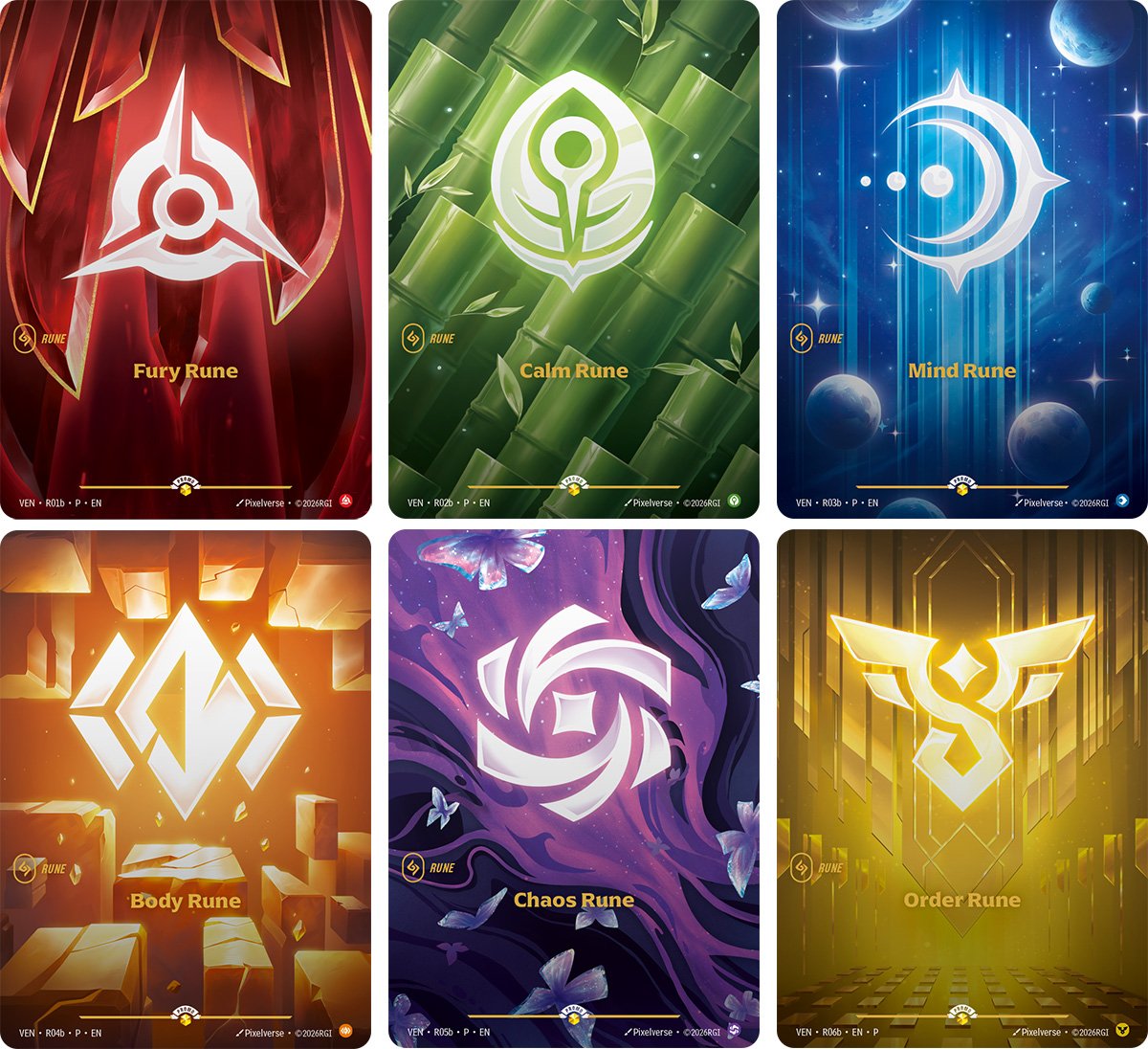
Riftbound has six domains, and your Legend picks two of them for you. Here is what each color actually plays like - its strengths, its blind spots, its signature mechanics - plus the full grid of all 49 Legend cards by domain pairing, and the three rival pairings that did not exist until Vendetta.
Riftbound Going Second: Riot's Start-of-Game Rules Test
Riot says going first wins too often, and on 15 October it published three possible fixes it wants to test at events: the second player starts on 1 point, draws an extra card, or Predicts before their first draw. Turn order would also be settled before battlefields are picked. None of it is a rules change yet. Here is what moves, where the test tables are, and when Riot decides.
Riftbound Radiance Rules Update: Neeko Rulings and Errata
Riot published three Radiance rules documents on 9 October: Core Rules patch notes with ten official rulings, an errata article for four cards, and a Tournament Rules update. Together they settle how Neeko works, what happens to Equipment that Orianna turns into a unit, and what changes at your table from the 16 October Pre-Rift.

How to Play Riftbound — The League of Legends TCG Rules, Explained (2026)
Riftbound has no life total. You take objectives. Eight points ends it. Here is the whole rules set as Riot actually wrote it - runes, domains, battlefields, showdowns, deck construction, and the final-point rule that decides more games than any card does.

Riftbound Vendetta Rules FAQ: Key Rulings Explained
Riot published the Vendetta Rules FAQ on 14 August 2026 and gave it precedence over the Core Rules Document until a new one was released. That new rulebook arrived on 9 October, effective 16 October. The FAQ also reverses a ruling Riot published in January, explains why Kayle can hold three copies of a status the rules call binary, and admits to a bug the Vendetta rules update introduced.